Using transformative GIS pedagogies to translate STEM to STEAM: Integrating the arts in African higher education
Abstract
In the study reported on here we investigated how transformative pedagogical approaches involving geographical information systems (GIS) could support the transition from traditional STEM (science, technology, engineering, and mathematics) to a more integrative STEAM model in which the A refers to the arts, used here as an umbrella term that also encompasses humanistic perspectives. While the STEM framework has received extensive attention over the past decade -particularly in relation to teaching practices, learning outcomes, and assessment methods - ongoing debates about its disciplinary boundaries and its capacity to address complex socio-environmental challenges have stimulated a shift toward STEAM, which recognises the value of artistic and humanistic ways of knowing alongside scientific inquiry. Using a systematic literature review of peer-reviewed publications on GIS, STEM and STEAM education published between 2014 and 2024 and indexed in major education and geography databases (such as Scopus, Web of Science, Education Resources Information Center [ERIC] and Google Scholar), we map international trends and identify the countries and regions represented, including work emerging from Sub-Saharan Africa. The analysis highlights the potential of geography, and specifically GIS, to act as a conduit for designing integrative learning experiences that connect spatial analysis with creative and critical engagement. The findings suggest that GIS-supported teaching designs can enhance students' spatial reasoning, critical thinking and creative expression, thereby deepening cognitive engagement in STEM subjects while foregrounding contextual, ethical and cultural dimensions more typically associated with the arts. In turn, this GIS-mediated integration of arts and STEM aligns with global imperatives such as the Sustainable Development Goals (SDGs) and responds to context-specific educational priorities in South Africa, offering concrete pathways for operationalising STEAM in school and higher-education settings.
GIS integration; STEAM education; STEM education; transformative pedagogy
Introduction
Following a growing international call to move from science, technology, engineering, and mathematics (STEM) to science, technology, engineering, arts, and mathematics (STEAM), in this study we explored how transformative pedagogical approaches using geographical information systems (GIS) could mediate that shift in higher education. In this research, the A in STEAM represents the arts, used as an umbrella term that also encompasses humanistic perspectives. Rather than simply adding arts to existing STEM curricula, we used the notion of translation to signal a more profound reconfiguration of teaching and learning - one that reshapes epistemic priorities, classroom practices, and the kinds of problems that students are invited to engage with.
STEM, understood as an interdisciplinary framework connecting science, technology, engineering, and mathematics, has attracted extensive scholarly attention, particularly in relation to teaching, learning, and assessment (Yakman & Lee, 2012). However, debates persist about the disciplinary boundaries of STEM and its capacity to address complex socio-environmental, cultural, and ethical challenges. These debates have contributed to the evolution of STEAM, where the arts broaden the frame to include creativity, imagination, critical reflection, and aesthetic or humanistic ways of knowing (Rodrigues-Silva & Alsina, 2023). STEAM is, therefore, best understood not as a pedagogy in itself but as a curricular and conceptual framework within which specific pedagogical approaches can be designed.
In this context, transformative pedagogies are taken to mean teaching approaches that aim to bring about substantial shifts in students' perspectives, knowledge, and skills by emphasising critical thinking, problem-solving, and the application of knowledge in real-world settings. Within STEAM, such pedagogies seek to integrate arts-based and humanistic dimensions with STEM content in ways that promote creativity, innovation, and holistic learning (Aguilera & Ortiz-Revilla, 2021; Clements & Sarama, 2021). Existing work highlights a range of such approaches. Levkoe, Brail and Daniere (2014), for example, discuss engaged and transformative pedagogies in community-based postgraduate contexts, while Leavy, Dick, Meletiou-Mavrotheris, Paparistodemou and Stylianou (2023) examine how technological innovation can deepen STEAM learning environments. Hasti, Amo-Filva, Fonseca, Verdugo-Castro, García-Holgado and García-Peñalvo (2022) emphasise inclusive practices that address persistent diversity gaps in STEAM education. Together, these contributions underline the need for context-sensitive, equity-oriented pedagogical models rather than generic one-size-fits-all solutions.
Geography offers a compelling disciplinary space for such work. Its core concerns - spatial reasoning, regional analysis, and humanenvironment interaction - align closely with STEM domains while simultaneously opening social, cultural, and political questions (Baerwald, 2010; Baker, 2012). Within the South African school system, geography is specifically structured around inquiry-driven learning through geographical questioning (Wilmot & Dube, 2016), which positions it well to support integrative teaching that blends analytical, creative, and critical dimensions. GIS, as a key tool used in geography, has been shown to create interactive, learner-centred environments that engage students in spatial problem-solving and data-rich inquiry (Ercan, Bozkurt Altan, Taştan & Dağ, 2016; Holmlund, Lesseig & Slavit, 2018; Liu & Zhu, 2008). Such GIS-mediated designs can serve as concrete pedagogical mechanisms through which a STEAM framework is enacted in practice.
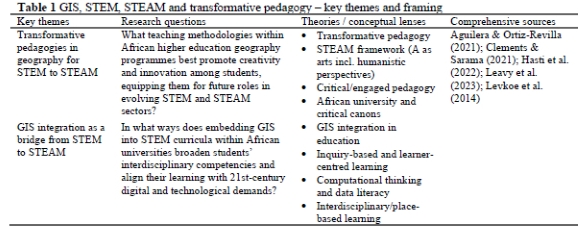
At the same time, expanded models such as STREAM - which adds reading to science, technology, engineering, arts, and mathematics -further foreground literacy as central to holistic education. Scholars have argued that students must be equipped with innovative and adaptive skills to navigate dynamic, technology-rich societies (Leavy et al., 2023; Yakman & Lee, 2012; Yu, 2021). Within this broader landscape (see Table 1), GIS has been proposed as a powerful tool for strengthening computational thinking, data literacy, and digital problem-solving (Dolgopolovas & Dagienè, 2021), with particular relevance to geography and other spatially oriented disciplines.
With this research we connect these debates to the realities in African higher education contexts. We recognise that STEM and STEAM are not neutral constructs but are historically and ideologically situated. Critically engaging with how STEM emerged, and how it has been re-articulated as STEAM, requires attention to the socio-political and educational forces shaping curriculum and knowledge production on the African continent. Drawing on African scholarship and the idea of the African university and critical canons, we investigate the relevance of STEM and STEAM formulations for South African education and for universities more in the Global South.
The central aim with this study was to illustrate the potential of geography - particularly through the application of GIS - to act as a bridge between STEM and a more expansive STEAM framework. The study is informed by global educational imperatives such as the Sustainable Development Goals (SDGs), especially Goal 4 on inclusive and equitable quality education, as well as South Africa's National Development priorities, which call for graduates who are both technically competent and critically engaged. Methodologically, the study draws on a systematic review of international and African literature on GIS, STEM, STEAM, and transformative pedagogy in geography, with a focus on higher education.
Within this overarching frame, we address two guiding research questions:
1) What teaching methodologies within African higher education geography programmes best promote creativity and innovation among students, equipping them for future roles in evolving STEM and STEAM sectors?
2) In what ways does embedding GIS into STEM curricula within African universities broaden students' interdisciplinary competencies and align their learning with 21st-century digital and technological demands?
By foregrounding GIS-mediated teaching designs within a STEAM framework, we aim to contribute both conceptually and practically to ongoing efforts to reimagine STEM education in African higher education.
Theoretical Framing: Transformative Pedagogy, GIS and STEAM
Transformative pedagogy is understood as a set of teaching approaches that not only transmits content, but shifts students' frames of reference through critical reflection, problem-posing and engagement with real-world issues. Transformative pedagogies emphasise students' active participation in questioning, analysing and reimagining their social and environmental contexts, rather than treating knowledge as fixed and decontextualised. Within a STEAM framework, such pedagogies create conditions for students to draw on both scientific and artistic/humanistic ways of knowing - combining data analysis with narrative, ethical, aesthetic and cultural perspectives.
GIS functions as a mediating tool within this transformative pedagogy. On the one hand, GIS supports core STEM goals by enabling spatial analysis, pattern recognition and evidence-based reasoning. On the other hand, its representational and multimodal affordances open space for the A in STEAM. Through story maps, participatory mapping and visual design tasks, students can transform abstract data into situated visual narratives that incorporate images, symbols, colours and text. These activities foreground interpretation, design choices and communication with an audience, drawing on artistic and humanistic skills such as storytelling, critical reading of space, and attention to lived experience.
In addition, GIS-supported tasks can foreground humanistic questions about power, inequality and representation. When students map issues such as service provision, environmental risk or historical land dispossession, they are invited to ask whose perspectives are represented, whose are missing, and how spatial data can both reveal and obscure social realities. In this sense, GIS supports the development of critical spatial literacy that is central to both contemporary geography and to the humanities-oriented strands of STEAM.
Bringing these strands together, we conceptualise GIS-enabled geography as a transformative, STEAM-aligned pedagogy: GIS provides the technical and analytical backbone associated with STEM, while its visual, narrative and critical capacities make room for artistic and humanistic engagement. With this review we, therefore, focus on studies where GIS is used not merely as a technical mapping tool, but as part of inquiry- and project-based designs that integrate analysis, creativity and critical reflection.
Literature Review
The inception of STEM education was motivated by the urgent need to cultivate a skilled workforce in areas dominated by science and mathematics (Van Staden & Combrinck, 2023). The aim with this initiative was to integrate these essential subjects into school syllabi to meet national development and industrial demands (Brown, Brown, Reardon & Merrill, 2011). At its core, STEM was envisioned to equip students for careers in these vital fields by merging scientific inquiry with technological innovation and engineering design within mathematics curricula. Despite its prominence, the nature and definition of STEM remain contested (Brown et al., 2011). Concerns continue to emerge regarding the true intent of STEM education, the extent to which it affects student performance, and the inconsistency with which educators implement its principles. As this conversation continues, the progression to STEAM - adding the humanities and arts to the STEM framework - opens new vistas for creative pedagogy and holistic skills development. STEAM advocates argue that blending creativity, critical thinking, and cultural insights into scientific discourse enriches student learning and fosters holistic development. Geography, specifically through geographic information systems (GIS), represents a key vehicle for this integration. We aim to illustrate how geography can meaningfully contribute to STEAM by acting as a transformative pedagogical tool that enriches both theoretical and practical aspects of education. The integration of GIS not only supports data analysis and spatial visualisation but also encourages students to interpret and critically engage with real-world issues. This approach resonates strongly with SDG 4, of which the aim is to ensure inclusive and equitable quality education. In South Africa, similar objectives are outlined under National Development Goal 1, which advocates for enhanced education quality and equity. Informed by these global and national imperatives, we assess how geography, as a discipline embedded in human-environment interactions, can act as a conduit for translating STEM into STEAM by foregrounding dimensions such as climate change, land use, resource distribution and spatial justice.
Spatial reasoning and visualisation offered by GIS enable students to synthesise numeric data into visual knowledge, providing an interpretive lens for real-world analysis.
The interdisciplinary nature of STEAM encourages a re-examination of pedagogical frameworks. For example, geography provides opportunities for inquiry-based learning, where questions of location, interaction, and change underpin the curriculum. It fosters the development of problem-solving, analytical reasoning, and reflective judgment - skills necessary for an evolving workforce. Moreover, project-based learning (PjBL) and problem-based learning (PBL) are teaching strategies that facilitate real-world learning, making them naturally compatible with STEM and STEAM approaches. These strategies are widely supported for promoting innovation and creativity among students. The relevance of STEM and STEAM is especially significant in the South African context, where disparities in education are stark. Xie, Fang and Shauman (2015) note that students' performance in STEM fields is often determined by socio-economic conditions. This is compounded in South Africa by overcrowded classrooms, a lack of resources, and infrastructural deficits, particularly in underprivileged communities. These challenges restrict cognitive development, reduce academic motivation, and lead to poor learning outcomes (Pitsoe & Machaisa, 2012). As highlighted in the 2021 Progress in International Reading Literacy Study (PIRLS), more than 80% of Grade 4 learners in South Africa cannot read for meaning in any language (Van Staden & Combrinck, 2023). In a context where such a large proportion of learners struggle with text-based comprehension, visual and spatial approaches such as GIS become crucial for turning abstract information into accessible, interpretable knowledge.
These deficits underscore the importance of incorporating alternative learning methods such as spatial learning and visualisation - strengths inherent in geography and GIS - to aid knowledge acquisition and student engagement. A critical research question emerges from these discussions: What pedagogical strategies within geography can stimulate innovation and creativity while closing future skills gaps among STEM and STEAM graduates? The answer lies partly in recognising geography as a transdisciplinary subject. With its foundation in spatial and place-based analysis, it blends well with scientific reasoning and humanistic inquiry. GIS technology exemplifies this convergence, allowing students to visualise spatial data, test hypotheses, interpret trends, and engage with community-based problems. The application of GIS in classrooms aligns with the goals of STEAM by promoting critical and analytical skills. Students gain insights into urban planning, environmental management, and disaster preparedness while acquiring technological competencies. However, the potential of GIS is often underutilised due to software complexity, a lack of training for educators, and limited infrastructure (Liu & Zhu, 2008). Thus, reimagining GIS as an intuitive, interdisciplinary learning environment is essential for its integration into STEAM pedagogy.
LaForce, Noble, King, Holt and Century (2014) propose a model that blends multiple disciplines into a coherent instructional strategy. This model supports the holistic nature of STEAM and redefines what effective learning entails by emphasising collaboration, real-world problem-solving and inquiry-based engagement.
By integrating geography, students move beyond textbook learning and engage with data-rich, spatially grounded challenges. Educators play a pivotal role here, not only in designing curriculum but also in providing inclusive learning environments that reflect the varied cultural, cognitive, and socio-economic backgrounds of student. In terms of technological adaptation, geography's utility in STEAM education can be further enhanced by embedding it in project-based initiatives. For instance, students could use GIS to map local environmental issues, conduct socio-demographic surveys, or simulate climate change scenarios. Such projects would enhance student motivation, deepen content understanding, and promote collaborative learning. In turn, this aligns with global education agendas focused on sustainable and inclusive development.
Another central research question to consider is: How does embedding geography - particularly GIS - into STEM contribute to developing a versatile skillset aligned with digital age demands? The fusion of arts and STEM as STEAM enables students to appreciate the aesthetic, ethical, and cultural dimensions of scientific knowledge. In this light, GIS facilitates a multi-layered understanding of phenomena, combining spatial data analysis with narrative and interpretive skills. It also fosters digital literacy, data governance, and visual communication - competencies increasingly valued in the 21st-century workplace. Moreover, STEAM pedagogy grounded in geography addresses concerns of equity, diversity, and inclusion. Students from different learning backgrounds can benefit from visual learning models and field-based education. For instance, students with low literacy levels may find visual maps more accessible than textual content, enabling them to participate in complex problem-solving processes. By aligning such practices with national and global agendas, STEAM becomes more than an educational framework - it becomes a tool for social transformation. The inclusion of humanities in STEM further cultivates empathy, civic responsibility, and contextual awareness among students. As they engage with issues like climate change, migration, and urbanisation through GIS, they are invited to think critically about global challenges and local implications.
STEAM, therefore, provides a platform for developing not only cognitive abilities but also ethical reasoning and reflective practice, aligning with transformative pedagogy that positions students as critical agents who investigate and reshape their social realities (LaForce et al., 2014).
Despite these promising intersections, institutional barriers remain. These include rigid curricular structures, teacher resistance to change, and assessment practices that undervalue creativity and interdisciplinary thinking. Therefore, systemic reforms are necessary to promote a culture of experimentation and innovation within educational institutions. Policymakers, curriculum designers, and education departments must work collaboratively to embed GIS and spatial learning into core syllabi and assessment regimes.
In conclusion, the integration of geography and GIS into the STEM curriculum to form a STEAM-oriented educational experience holds immense promise. This interdisciplinary framework bridges gaps between technical know-how and humanistic insight, preparing students to meet contemporary societal challenges. It promotes spatial reasoning, visual analysis, and ethical inquiry while also enhancing digital literacy and technological competence.
By reframing geography as a central component of STEAM, education systems can cultivate a new generation of students equipped to thrive in a complex, interconnected world, in line with global frameworks such as the United Nations Educational, Scientific and Cultural Organization's (UNESCO's) Education for Sustainable Development and Global Citizenship Education. Thus, through transformative pedagogy, inclusive practice, and interdisciplinary synergy, we assert the need to reposition geography and GIS at the heart of modern education.
Methodology
Research Design
We adopted a systematic literature review design to synthesise scholarship on the use of GIS in STEM, STEAM and related educational contexts, with a particular focus on transformative pedagogies in geography and African higher education. The review process and reporting were aligned with the Preferred Reporting Items for Systematic Reviews and Meta-Analyses 2020 (PRISMA 2020) guidelines for transparent and rigorous systematic reviews (Page, McKenzie, Bossuyt, Boutron, Hoffmann, Mulrow, Shamseer, Tetzlaff, Akl, Brennan, Chou, Glanville, Grimshaw, Hróbjartsson, Lalu, Li, Loder, Mayo-Wilson, McDonald, McGuinness, Stewart, Thomas, Tricco, Welch, Whiting & Moher, 2021; Page, Moher, Bossuyt, Boutron, Hoffmann, Mulrow, Shamseer, Tetzlaff, Akl, Brennan, Chou, Glanville, Grimshaw, Hróbjartsson, Lalu, Li, Loder, Mayo-Wilson, McDonald, McGuinness, Stewart, Thomas, Tricco, Welch, Whiting & McKenzie, 2021).
The review was guided by two research questions:
1) What teaching methodologies within African higher education geography programmes best promote creativity and innovation among students, equipping them for future roles in evolving STEM and STEAM sectors?
2) In what ways does embedding GIS into STEM curricula within African universities broaden students' interdisciplinary competencies and align their learning with 21st-century digital and technological demands?
Timeframe and Scope
To capture contemporary developments in STEAM and GIS in education, we focused on literature published between 2014 and 2024. This 10-year period reflects the intensifying global interest in STEAM and the increasing accessibility of GIS tools in educational settings. Only sources published within this timeframe were eligible for inclusion, and the years of publication are reflected in both the literature review and the reference list.
The search was international in scope, but particular attention was paid to studies conducted in Sub-Saharan Africa, including South Africa, to ensure that the synthesis relates directly to African higher education contexts.
Data Sources and Search Strategy
A structured search was conducted across the following databases and indexing services:
• Scopus
• Web of Science Core Collection
• ERIC (Education Resources Information Center)
• Google Scholar
• African Journals Online (AJOL)
Additional targeted searches were undertaken in selected publisher platforms and institutional repositories to locate African and South African scholarship that may not have been fully indexed in the above databases.
Search strings combined keywords related to GIS, STEM/STEAM, education and pedagogy.
Typical search combinations included:
• "geographic information systems" OR "GIS"
• AND "STEM" OR "STEAM'' OR "STREAM"
• AND "education" OR "teaching" OR "learning" OR "pedagogy"
• AND "Geography" OR "geography education"
• AND "higher education" OR "university" OR "tertiary" OR "school."
Boolean operators, truncation and phrase searching were adapted to the conventions of each database. Reference lists of key articles were also scanned (snowballing) to identify additional relevant sources.
Inclusion and exclusion criteria
Studies were included if they:
• Focused on STEM, STEAM or STREAM education and explicitly engaged with geography and/or GIS in teaching, learning or curriculum design;
• Addressed pedagogical, curricular or learning dimensions (e.g. teaching strategies, student engagement, creativity, critical thinking, interdisciplinary learning);
• Reported empirical findings (qualitative, quantitative or mixed-methods) or provided substantial conceptual/theoretical analyses of GIS-mediated pedagogy;
• Were published between 2014 and 2024 in peer-reviewed journals, scholarly books, edited volumes or reputable research reports;
• Were written in English.
Studies were excluded if they:
• Focused primarily on technical GIS algorithms, remote sensing or software development without an educational component;
• Addressed STEM/STEAM in general with no substantive engagement with geography or GIS;
• Were conference abstracts, editorials or opinion pieces lacking methodological detail;
• Fell outside the specified timeframe.
Study selection and PRISMA procedure
All records retrieved from the databases were exported to a reference-management programme and duplicates were removed. The remaining records were screened in two stages:
1) Title and abstract screening against the inclusion and exclusion criteria;
2) Full-text screening of potentially eligible studies to confirm relevance and methodological adequacy.
The selection process is documented in a PRISMA 2020 procedure, which records the number of records identified, screened, excluded (with reasons) and finally included (Page, McKenzie, et al., 2021; Page, Moher, et al., 2021). This procedure strengthens the transparency and rigour of the review. The procedure included:
Data extraction and analytic approach A structured data-extraction template was used for all included sources. For each study, the following information was captured:
• Bibliographic details (author, year, title, outlet);
• Country and region of the study, with a specific flag for Sub-Saharan African contexts;
• Educational level (primary, secondary, higher education, teacher education, et cetera.);
• Disciplinary focus (geography, broader STEM fields, interdisciplinary programmes);
• Role of GIS (e.g. core instructional tool, supplementary visualisation, project-based work);
• Pedagogical framing (e.g. transformative pedagogy, inquiry-based learning, PBL, community-engaged learning);
• Reported outcomes (e.g. creativity, innovation, critical thinking, spatial reasoning, engagement, equity and inclusion).
These variables enabled the identification of trending indicators, including:
• Temporal patterns (distribution of studies by year of publication);
• Geographic patterns (countries and regions represented, with emphasis on Sub-Saharan Africa);
• Predominant pedagogical approaches;
• Ways in which GIS is integrated into STEM/STEAM learning designs.
Descriptive statistics (frequencies and percentages) were used to summarise these trends, and a thematic analysis was conducted to synthesise recurring conceptual and pedagogical themes across the studies.
Document types
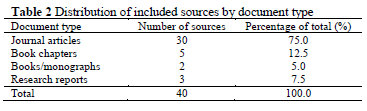
In response to the reviewer's recommendation, the type of each source was also recorded (journal article, book chapter, book/monograph, research report). In total, 40 sources met the inclusion criteria. Journal articles constituted the majority of the dataset, followed by book chapters, research reports and a small number of books/monographs. This distribution is summarised in Table 2.
With this structured approach to identification, selection, extraction and reporting we addressed the concerns about methodological rigour and aligned the study with contemporary standards for systematic reviews in education.
Coding and theme development
To analyse the selected studies, we followed a two-stage coding process. Firstly, a set of deductive codes was developed from the research questions and theoretical framing (e.g., transformative pedagogy, GIS integration, STEAM/arts, African context). Secondly, inductive codes were added to capture recurring ideas that emerged from the literature (e.g., community engagement, story mapping, critical spatial literacy, data and computational literacies). Codes were then grouped into broader categories and refined into themes corresponding to each research question. For Research Question 1 (RQ1), this resulted in themes such as inquiry-/project-based learning, community-engaged and place-based pedagogy, and arts-infused/multimodal practice. For RQ2, themes included GIS as a catalyst for spatial problem-solving, as a vehicle for digital and data literacies, and as a tool for contextualised, equity-oriented learning. These themes structured the presentation of the findings and discussion.
Ethical Approval
This study is a systematic review of previously published literature and did not involve human participants, animals, or primary data collection. Formal institutional ethical approval was, therefore, not required. The study did not involve recruitment or direct participation of human subjects.
Findings and Discussion
The analysis of the reviewed literature was organised around the two RQs and the themes that emerged in relation to each question.
RQ1: Teaching Methodologies in Geography that Promote Creativity and Innovation RQ1: What teaching methodologies within African higher education geography programmes best promote creativity and innovation among students, equipping them for future roles in evolving STEM and STEAM sectors?
From the synthesis, three main themes emerged.
Inquiry- and project-based learning as transformative pedagogy
Across the literature, inquiry- and project-based approaches are consistently highlighted as central to transformative geography pedagogy. Studies emphasise open-ended questions, investigation of real-world problems, and student-led projects as means of fostering creativity, critical thinking and innovation (Garner, 2007; Wilmot & Dube, 2016). When situated within a STEAM framework, these approaches invite students to combine scientific analysis with narrative, visual and ethical dimensions, enabling them to translate disciplinary content into socially meaningful questions and responses (Aguilera & Ortiz-Revilla, 2021; Clements & Sarama, 2021).
Community-engaged and place-based pedagogies
A second theme concerns community-engaged and place-based models of teaching. Service-learning and community-based projects position students as co-researchers working with local partners, thereby linking geography content to lived experiences and socio-environmental challenges (Baerwald, 2010; Levkoe et al., 2014). These approaches deepen students' sense of agency and relevance, and they foreground ethical, cultural and political dimensions that resonate strongly with the A in STEAM.
Arts-infused and multimodal practices
A third theme relates to the integration of arts-based and multimodal practices within geography teaching. Studies report the use of visualisation, storytelling, drama, design tasks and other creative media to support student expression and interpretation alongside technical analysis (Aguilera & Ortiz-Revilla, 2021; Leavy et al., 2023). When combined with spatial tools, these practices encourage students to move between maps, images, text and performance, thereby cultivating imaginative reasoning and layered understandings of place. Within African higher education contexts, such multimodal practices also open space for local knowledge, languages and aesthetics to enter STEM-oriented curricula.
Together, these three themes indicate that transformative methodologies in geography are those that engage students in inquiry, community-connected problem-solving and arts-infused, multimodal expression, rather than relying solely on traditional content delivery.
RQ2: GIS as a Bridge from STEM to STEAM RQ2: In what ways does embedding GIS into STEM curricula within African universities broaden students' interdisciplinary competencies and align their learning with 21st-century digital and technological demands?
Three interrelated themes emerged.
GIS as a catalyst for spatial thinking and problem-solving
The first theme highlights GIS as a powerful tool for developing spatial reasoning and complex problem-solving. Research shows that structured, interactive GIS tasks help students visualise patterns, model scenarios and interrogate relationships between human and physical processes (Bednarz, Heffron & Huynh, 2013; Holmlund et al., 2018; Liu & Zhu, 2008). In STEM-oriented modules, GIS tasks require students to integrate mathematical, scientific and technological thinking, while in a STEAM frame they also invite interpretive and critical perspectives on what the mapped data represent.
Developing digital, data and computational literacies
A second theme concerns the role of GIS in developing 21st-century digital competencies. Studies point to gains in data literacy, coding-related skills and computational thinking when students work with GIS platforms, open data and tools such as OpenStreetMap (Baker, 2012; Dolgopolovas & Dagienè, 2021; Shiau, Huang, Yang & Juang, 2018). These literacies are central to contemporary STEM careers, but the literature also shows that when GIS tasks include interpretation, communication and design elements, they support STEAM-aligned capacities such as critical data reading and creative representation.
Contextualisation, equity and African perspectives
The third theme points to the importance of context and equity. African and Global South studies underscore how GIS can be used to foreground local places, inequalities and development challenges, aligning with the SDGs and with decolonial debates in higher education (Griffey, 2023; Hasti et al., 2022; Wilmot & Dube, 2016). When students work with local datasets - on issues such as land use, service delivery, or environmental risk - GIS becomes a medium for integrating scientific analysis with ethical reflection, narrative and visual communication. This positioning of GIS supports the translation from STEM to STEAM by situating technical competencies within socially and culturally meaningful projects.
Taken together, these themes suggest that embedding GIS in STEM curricula broadens students' competencies when it is used not only as a technical mapping tool, but as an integrative platform for spatial reasoning, digital and data literacies, and contextually grounded, justice-oriented inquiry. In such designs, GIS operationalises the STEAM framework by connecting scientific, technological and mathematical skills with artistic and humanistic ways of knowing.
In the body of literature reviewed for RQ2, studies consistently report that GIS-based activities are associated with higher levels of student participation, more sustained task engagement and deeper spatial and analytical reasoning in STEM-related contexts. For example, classroom and project-based interventions using GIS describe improvements in students' spatial thinking, data interpretation, problem-solving and willingness to explore alternative solutions, compared to more traditional, non-GIS approaches. At the same time, several studies highlight how GIS tasks that include interpretation, design and communication components (e.g., story maps, community projects, visual narratives) open space for creative and critical expression that aligns with the A in STEAM. Taken together, these converging findings support a cautious, evidence-informed claim that embedding GIS in inquiry- and project-based designs can enhance cognitive engagement in STEM subjects and contribute to more holistic, STEAM-oriented learning experiences.
Transformative Pedagogy as an Integrative Lens
Interpreting the themes for RQ1 and RQ2 through the lens of transformative pedagogy shows that GIS-enabled geography can do more than enhance technical skills. Firstly, the prominence of inquiry-and project-based learning and community-engaged, place-based pedagogy reflects a shift from transmission-oriented teaching toward learner-centred, problem-posing approaches in which students critically interrogate real socio-environmental issues. Secondly, the integration of arts-infused and multimodal practices and critical spatial literacy illustrates how GIS-based tasks can open space for artistic and humanistic dimensions of STEAM, as students design story maps, visual narratives and other expressive products that require interpretation, aesthetic judgement and ethical reflection. Thirdly, the emphasis on digital, data and computational literacies shows that transformative pedagogy in this context also involves equipping students to navigate complex, data-rich environments in ways that are both analytically rigorous and socially responsive. Taken together, these patterns suggest that GIS-supported geography teaching can operationalise transformative pedagogy by simultaneously fostering critical inquiry, creative expression and technically robust engagement with STEM/STEAM content.
Conclusion and Recommendations
With this study we set out to explore how transformative pedagogical approaches in geography, particularly those involving GIS, could support the translation from STEM to STEAM in African higher education. Guided by two RQs, we used the systematic review to examine (1) teaching methodologies in geography that promote creativity and innovation in STEM/STEAM contexts, and (2) the ways in which embedding GIS into STEM curricula can broaden students' interdisciplinary competencies and align learning with 21st-century digital demands.
In relation to RQ1, three themes emerged from the reviewed literature:
• Inquiry- and project-based learning, which positions students as active investigators of real-world problems;
• Community-engaged and place-based pedagogies, which connect classroom learning to local socio-environmental issues and lived experience; and
• Arts-infused and multimodal practices, which incorporate visual, narrative and performative forms of expression alongside analytical tasks.
Taken together, these methodologies move geography teaching beyond content transmission toward transformative pedagogy that fosters creativity, critical thinking and innovation - key capabilities for evolving STEM and STEAM sectors.
In relation to RQ2, the literature points to three complementary roles for GIS. Firstly, GIS functions as a catalyst for spatial thinking and problem-solving, with multiple studies reporting improvements in students' spatial reasoning, data interpretation and scenario modelling when GIS is used in structured tasks. Secondly, GIS supports the development of digital, data and computational literacies, as students work with spatial datasets, digital platforms and, in some cases, coding-related skills. Thirdly, when GIS projects are designed around contextual and justice-oriented issues, particularly in Sub-Saharan African settings, they create opportunities for students to integrate scientific analysis with ethical reflection, local knowledge and creative representation (for example, through story maps and community-based projects). In these studies, GIS-mediated activities are repeatedly associated with higher student participation, more sustained engagement and richer problem-solving than traditional, non-GIS approaches. On this basis, we make a cautious, evidence-informed claim that embedding GIS within inquiry- and project-based designs may enhance cognitive engagement in STEM subjects and support the design of more holistic STEAM-oriented learning experiences, rather than asserting this as an unqualified effect.
Practical Recommendations
Drawing on these themes and RQs, the following practical recommendations are proposed for African higher education institutions, curriculum designers and geography lecturers.
1) Design GIS-infused, inquiry-driven modules Structure geography and related STEM modules around open-ended, GIS-supported investigations of real problems (e.g., land use change, service provision, environmental risk) that require students to ask questions, collect or source data, analyse patterns and propose evidence-based responses.
2) Embed arts and humanistic elements in GIS tasks Intentionally integrate arts-related and humanistic activities - such as visual storytelling, reflective narratives, community mapping exhibitions or digital story maps - into GIS projects so that students practise both technical analysis and creative, critical communication aligned with the A in STEAM.
3) Use local and African contexts
Prioritise locally relevant datasets and themes that relate to African socio-economic and environmental realities. This supports contextual relevance, advances equity and allows students to see the value of STEM and STEAM competencies in addressing issues that matter in their own communities.
4) Invest in staff development and cross-disciplinary collaboration
Provide professional development for geography and STEM lecturers on GIS tools, STEAM-oriented curriculum design and transformative pedagogy, and encourage collaboration with colleagues in the arts and humanities to co-design integrative learning experiences.
5) Align assessment with STEAM-oriented outcomes Ensure that assessment strategies recognise not only technical GIS competence and content knowledge, but also creativity, critical reasoning, collaboration and ethical awareness developed through GIS-based projects.
Limitations and Future Directions
As a literature-based study, we synthesised reported findings but did not generate new empirical data. The strength and generalisability of the conclusions are, therefore, shaped by the quality and geographical distribution of the available studies, with Sub-Saharan African contexts still under-represented relative to the Global North. Future research should include empirical investigations of GIS-mediated, STEAM-oriented pedagogy in African universities, including longitudinal and comparative studies that can more robustly evaluate the impact on student engagement, achievement and graduate trajectories.
Data Availability
No new datasets were generated or analysed for this study. All sources used are publicly available and fully cited in the reference list.
Authors' Contributions
The initial idea for this study originated from the second author. The first author led the development of the study design, conducted the systematic review, performed the analysis and interpretation of the literature, and prepared the first full draft of the manuscript. The second author provided conceptual guidance while the first author provided critical feedback on the framing and argument, and the revision of the manuscript. Both authors reviewed and approved the final version and agree to be accountable for all aspects of the work.
Conflict of Interest
The authors declare that they have no known competing financial interests or personal relationships that could have influenced the work reported on in this manuscript.
Notesi. Published under a Creative Commons Attribution Licence.
Acknowledgements
Use of generative artificial intelligence (AI) and AI-assisted tools - In developing this manuscript, the authors made limited use of AI-assisted language tools (QuillBot) to improve clarity and readability. All content was subsequently reviewed, verified and revised by the authors, who take full responsibility for the final version of the manuscript.
References
-
Aguilera D & Ortiz-Revilla J 2021. STEM vs. STEAM education and student creativity: A systematic literature review [Special issue]. Education Sciences, 11(7):331. https://doi.org/10.3390/educsci11070331
» https://doi.org/10.3390/educsci11070331 -
Baerwald TJ 2010. Prospects for geography as an interdisciplinary discipline. Annals of the Association of American Geographers, 100(3):493-501. https://doi.org/10.1080/00045608.2010.485443
» https://doi.org/10.1080/00045608.2010.485443 - Baker T 2012. Advancing STEM education with GIS. Redlands, CA: Esri.
-
Bednarz SW, Heffron S & Huynh NT 2013. A road map for 21st century geography education: Geography education research (A report from the Geography Education Research Committee of the Road Map for 21st Century Geography Education Project). Washington, DC: Association of American Geographers. Available at https://www.researchgate.net/profile/Sarah-Bednarz/publication/264275198_A_Road_Map_for_21st_Century_Geography_Education_Geography_Education_Research/links/53d6bf260cf228d363ea81f3/A-Road-Map-for-21st-Century-Geography-Education-Geography-Education-Research.pdf. Accessed 19 January 2026.
» https://www.researchgate.net/profile/Sarah-Bednarz/publication/264275198_A_Road_Map_for_21st_Century_Geography_Education_Geography_Education_Research/links/53d6bf260cf228d363ea81f3/A-Road-Map-for-21st-Century-Geography-Education-Geography-Education-Research.pdf -
Brown R, Brown J, Reardon K & Merrill C 2011. Understanding STEM: Current perceptions. Technology and Engineering Teacher, 70(6):5-9. Available at https://www.researchgate.net/proffile/Chris-Merrill/publication/234659554_Understanding_STEM_Current_perceptions/links/618c0dce61f09877207bc812/Understanding-STEM-Current-perceptions.pdf. Accessed 19 January 2026.
» https://www.researchgate.net/proffile/Chris-Merrill/publication/234659554_Understanding_STEM_Current_perceptions/links/618c0dce61f09877207bc812/Understanding-STEM-Current-perceptions.pdf -
Clements DH & Sarama J 2021. STEM or STEAM or STREAM? Integrated or interdisciplinary? In C Cohrssen & S Garvis (eds). Embedding STEAM in early childhood education and care. Cham, Switzerland: Palgrave Macmillan. https://doi.org/10.1007/978-3-030-65624-9_13
» https://doi.org/10.1007/978-3-030-65624-9_13 -
Dolgopolovas V & Dagienè V 2021. Computational thinking: Enhancing STEAM and engineering education, from theory to practice [Special issue]. Computer Applications in Engineering Education, 29(1):5-11. https://doi.org/10.1002/cae.22382
» https://doi.org/10.1002/cae.22382 -
Ercan S, Bozkurt Altan E, Taştan B & Dağ Ý 2016. Integrating GIS into science classes to handle STEM education [Special issue]. Journal of Turkish Science Education, 13:30-43. https://doi.org/0.12973/tused.10169a
» https://doi.org/0.12973/tused.10169a -
Garner WP 2007. Enquiry as a pedagogical approach within the context of primary geography. MEd dissertation. Chester, England: University of Chester. Available at https://chesterrep.openrepository.com/bitstream/handle/10034/97297/wendy%20patricia%20garner.pdf?sequence=33&isAllowed=y. Accessed 19 January 2026.
» https://chesterrep.openrepository.com/bitstream/handle/10034/97297/wendy%20patricia%20garner.pdf?sequence=33&isAllowed=y -
Griffey DC 2023. Strategies to increase engagement in K-12 STEM programs among BIPOC students' grades 3rd - 8th. PhD dissertation. Kalamazoo, MI: Western Michigan University. Available at https://www.proquest.com/docview/2861537230?pq-origsite=gscholar&fromopenview=true&sourcetype=Dissertations%20&%20Theses. Accessed 19 January 2026.
» https://www.proquest.com/docview/2861537230?pq-origsite=gscholar&fromopenview=true&sourcetype=Dissertations%20&%20Theses -
Hasti H, Amo-Filva D, Fonseca D, Verdugo-Castro S, García-Holgado A & García-Peñalvo FJ 2022. Towards closing STEAM diversity gaps: A grey review of existing initiatives [Special issue]. Applied Sciences, 12(24):12666. https://doi.org/10.3390/app122412666
» https://doi.org/10.3390/app122412666 -
Holmlund TD, Lesseig K & Slavit D 2018. Making sense of "STEM education" in K-12 contexts. International Journal of STEM Education, 5:32. https://doi.org/10.1186/s40594-018-0127-2
» https://doi.org/10.1186/s40594-018-0127-2 -
LaForce M, Noble E, King H, Holt S & Century J 2014. The 8 elements of inclusive STEM high schools: Findings from the STEM school study. Chicago, IL: Outlier Research & Evaluation, CEMSE, The University of Chicago. Available at https://d30clwvkkpiyjx.cloudfront.net/S3/Elements_Findings.pdf. Accessed 19 January 2026.
» https://d30clwvkkpiyjx.cloudfront.net/S3/Elements_Findings.pdf -
Leavy A, Dick L, Meletiou-Mavrotheris M, Paparistodemou E & Stylianou E 2023. The prevalence and use of emerging technologies in STEAM education: A systematic review of the literature. Journal of Computer Assisted Learning, 39(4):1061-1082. https://doi.org/10.1111/jcal.12806
» https://doi.org/10.1111/jcal.12806 -
Levkoe CZ, Brail S & Daniere A 2014. Engaged pedagogy and transformative learning in graduate education: A service-learning case study. Canadian Journal of Higher Education, 44(3):68-85. Available at https://files.eric.ed.gov/fulltext/EJ1049392.pdf. Accessed 19 January 2026.
» https://files.eric.ed.gov/fulltext/EJ1049392.pdf -
Liu S & Zhu X 2008. Designing a structured and interactive learning environment based on GIS for secondary geography education. Journal of Geography, 107(1):12-19. https://doi.org/10.1080/00221340801944425
» https://doi.org/10.1080/00221340801944425 -
Page MJ, McKenzie JE, Bossuyt PM, Boutron I, Hoffmann TC, Mulrow CD, Shamseer L, Tetzlaff JM, Akl EA, Brennan SE, Chou R, Glanville J, Grimshaw JM, Hróbjartsson A, Lalu MM, Li T, Loder EW, Mayo-Wilson E, McDonald S, McGuinness LA, Stewart LA, Thomas J, Tricco AC, Welch VA, Whiting P & Moher D 2021. The PRISMA 2020 statement: An updated guideline for reporting systematic reviews. BMJ, 372:n71. https://doi.org/10.1136/bmj.n71
» https://doi.org/10.1136/bmj.n71 -
Page MJ, Moher D, Bossuyt PM, Boutron I, Hoffmann TC, Mulrow CD, Shamseer L, Tetzlaff JM, Akl EA, Brennan SE, Chou R, Glanville J, Grimshaw JM, Hróbjartsson A, Lalu MM, Li T, Loder EW, Mayo-Wilson E, McDonald S, McGuinness LA, Stewart LA, Thomas J, Tricco AC, Welch VA, Whiting P & McKenzie JE 2021. PRISMA 2020 explanation and elaboration: Updated guidance and exemplars for reporting systematic reviews. BMJ, 372:n160. https://doi.org/10.1136/bmj.n160
» https://doi.org/10.1136/bmj.n160 -
Pitsoe VJ & Machaisa PR 2012. Teacher attrition catastrophe in Sub-Saharan Africa: A hurdle in the achievement of UPE, EFA policy goals and MDGs. Science Journal of Sociology & Anthropology, 2012:1-7. https://doi.org/10.7237/sjsa/215
» https://doi.org/10.7237/sjsa/215 -
Rodrigues-Silva J & Alsina Á 2023. Conceitualização e modelo da educação STEAM: O que é (e o que não é) essa abordagem educacional? [Conceptualising and framing STEAM education: What is (and what is not) this educational approach?]. Texto Livre, 16:e44946. https://doi.org/10.1590/1983-3652.2023.44946
» https://doi.org/10.1590/1983-3652.2023.44946 -
Shiau SJH, Huang CY, Yang CL & Juang JN 2018. A derivation of factors influencing the innovation diffusion of the OpenStreetMap in STEM education. Sustainability, 10(10):3447. https://doi.org/10.3390/su10103447
» https://doi.org/10.3390/su10103447 -
Van Staden S & Combrinck C 2023. Looking back, looking forward: The future of reading for South African children. In S van Staden & C Combrinck (eds). Tracking changes in South African reading literacy achievement. Leiden, The Netherlands: Brill. https://doi.org/10.1163/9789004687011_008
» https://doi.org/10.1163/9789004687011_008 -
Wilmot PD & Dube C 2016. Opening a window onto school geography in selected public secondary schools in the Eastern Cape Province. South African Geographical Journal, 98(2):337-350. https://doi.org/10.1080/03736245.2015.1028989
» https://doi.org/10.1080/03736245.2015.1028989 -
Xie Y, Fang M & Shauman K 2015. STEM education. Annual Review of Sociology, 41:331-357. https://doi.org/10.1146/annurev-soc-071312-145659
» https://doi.org/10.1146/annurev-soc-071312-145659 - Yakman G & Lee H 2012. Exploring the exemplary STEAM education in the U.S. as a practical educational framework for Korea. Journal of the Korean Association for Science Education, 32(6):1072-1086.
-
Yu P 2021. Development, characteristic and enlightenment of STEAM education in the United States. Frontiers in Educational Research, 4(10):96-99. https://doi.org/10.25236/FER.2021.041019
» https://doi.org/10.25236/FER.2021.041019
Revised: 4 December 2025
Accepted: 15 January 2026
Published: 23 January 2026