Educators on the scene: Challenges in the education of refugees in Türkiye
Abstract
Education in a country hosting many refugees has its own unique dynamics and challenges. A long settlement process for multinational refugees has continued in Türkiye for many years and several concerns related to their education have emerged. With the study reported on here we aimed to highlight the perspectives of academics and teachers regarding the general and educational challenges faced by refugees, the policies in Türkiye related to refugees' education and their own suggestions for addressing these issues. The study was designed as phenomenological research with the study group consisting of 4 academics (from a faculty of education) and 4 primary teachers who work with refugee students. A semi-structured interview form was used to collect the data and the participants were interviewed for approximately 15 to 25 minutes. The interviews were transcribed and analysed using content analysis. The results show that adaptation, uncertainty, and unplanned settlement are the most crucial problems stated by the participants. Another important point emphasised was that strong policies concerning the education of refugees in Türkiye should be well structured. Furthermore, we found that these students should be supported and treated with care, empathy and understanding. Discrimination or isolation should be eliminated. In addition, the teachers should be supported in many ways (e.g. language support, psychological support, et cetera.)
adaptation; refugee policies; refugee problems; refugee students; teachers
Introduction
A secure, dignified and comfortable place to live is one of the main requirements for a satisfactory life. Communities made up of refugees seeking asylum or safety can often form their own cultures, with distinct living conditions and varying lifestyles wherever they settle. The reasons that people leave their previous countries to travel to another varies depending on their places of origin, their personal lives and many other important factors. These reasons could be pleasant, such as a new job offer or the opportunity to live in a more preferential place. However, some unpleasant reasons, such as wars, religious conflicts and persecution could result in this desire for people to seek out a better life in a new country. A refugee is defined, according to the United Nations Refugee Convention, as someone who is unable or unwilling to return to their country of origin owing to a well-founded fear of being persecuted for reasons of race, religion, nationality, membership in a particular social group, or political opinion (United Nations High Commissioner for Refugees [UNHCR], 2010). Refugees experience many problems associated with their relocation to a new place. They worry about their past lives including culture, language, family, and friends in addition to the loss of effectiveness and social identity (Vaynshtok, 2001).
In most communities, movements of migration that create ethnic and cultural differences form demographic, economic and social dynamics (Giddens, 2013). Refugees bring their own cultural features and living habits to their new countries of residence. The most obvious problems that refugees and people who are forced to immigrate experience include security concerns, housing issues, financial and employment difficulties, educational challenges, health complications, cultural adaptation problems, and other conflicts (Tamer & Birvural, 2018). In particular, people who experience war feel insecure. War is considered a public health problem that may cause biological, psychological and social damage in people affected by it. It is generally easier for adults to adapt to a new location when there are people from the same country of origin or members of their same cultural groups nearby. However, refugee children need to put much more effort into adapting to new school systems and their new environments as they need to navigate successfully through a rapid immigration process, different cultural characteristics, practices and backgrounds, and language differences from their local peers (Sarman, Günay & Sarman, 2018). It is crucial to develop clear strategies that assist these children in adapting and becoming successful, integrated, and constructive members of their new societies.
To facilitate social justice and ensure the adherence to basic human rights laws for refugees, it is important to understand international organisations' various assistance models. Upon examination, it is clear that their focus is on short-term relief instead of longer-term policies (Goetz, 2006). Yet, it is crucial to continue focusing on a long-term perspective to work with refugees and to have realistic expectations for their development in an open-minded and non-judgemental way (Vaynshtok, 2001). Refugees are usually people that need to be taken care of in many ways. Their most basic needs include housing, health care, education, and employment. As one of the most important of these needs, education was chosen as the focus of this study. In particular, the actions by authorities, refugee education policies, problems, and solutions were followed.
Theoretical Framework
Migration is an extremely complex topic and therefore, the reasons why people choose to relocate, and the results of those choices should be handled in detail. Ravenstein's laws of migration is one theory used in an attempt to explain the migration process. In this study, Ravenstein states that immigrants mostly migrate short distances, which effects the local citizens as well, leading to bigger and more massive migration movements. In addition, he indicates that this migration flows towards commercial and industrial centres. Although people could have different reasons for migration, Ravenstein regards economic reasons as the basic motivation for migration. Parallel to the development of industry and commerce in urban areas, people migrate to these cities while others take their places in their former residences. This results in a chain migration that spreads all over the world. Industrialised cities typically fulfil their labour needs by absorbing immigrants from nearby areas. However, migration may also occur directly over long distances. People living in rural areas were found to be more likely to migrate than those living in urban areas. Ravenstein states that women tend to migrate more than men in internal and short-distance migrations, while the opposite is true for long-distance migrations (1885, 1889, as cited in ince, 2019). It is observed that distance is an especially important factor for compulsory immigrants, as is the case with most of the refugees in Türkiye. Syrian refugees also typically migrate due to conflicts in their country. They do not usually have the economic and social capital to migrate over longer distances, so they often choose to relocate to nearby Türkiye, with whom they share a border. Ravenstein's theory works here to explain both the short-distance migration and the follow-up migration to commercial and industrial centres such as Istanbul, Izmir and other developed cities in Türkiye. It is vital to understand the underlying reasons behind the replacement to be able to comment on current policies or analyse the problems about refugees' needs.
Another significant theory used to explain migration is Lee's push and pull theory. This approach asserts that certain factors attract or repel people from their place of origin or their destination through migration. Lee indicates that different factors may attract people to a specific destination while these factors could be neutral or not enticing to others - at least not up to the demographic and sociological standards of the immigrants (Lee, 1966). In the Syrian context, factors pushing individuals to leave include low levels of belonging among some residents, the destruction of substructures, unemployment, poverty, and military enlistment. In Ankara Prime Ministry Disaster and Emergency Management Presidency's (2014) report, the most significant contributing factors that help determine whether a person wants to immigrate or not are related to security and political considerations. The most appealing reason is regarded as reaching a safe area. However, different studies reveal that employment conditions, the current refugee policy, accessibility, as well as language and cultural similarities, are some of the other pull factors of destinations (Çaglayan, 2015; Sahin, 2015). Other theories of migration, such as the migration systems theory and the network theory associate the migration act with social bonds. In the migration systems theory it is suggested that shared historical, cultural, political, and social factors, along with similarities in ethnicity, create a strong connection between the origin and destination of migration. This bond makes it easy for immigrants to migrate and settle down, especially around the border of Türkiye, which has more commonalities than other parts of the country (ince, 2019). Similarly, the network theory emphasises the importance of social networks in explaining the direction of migration. Because some people established networks at their destination, those left behind reduce costs and risks by using the networks that they created (Massey, Arango, Hugo, Kouaouci, Pellegrino & Taylor, 1993).
These theories reveal the way in which migration flow to Türkiye could be explained in different perspectives. Syrian refugees could have many reasons for choosing Türkiye as a destination - from economic reasons, such as the cost of the journey, employment opportunities and the policies related to the attainment of official refugee status in a country, to the social and cultural links between the two countries. All these reasons put the background of the high number of refugees in Türkiye into perspective. On the other hand, it is significant to state that some of the problems that the refugees face at their destinations are also associated with these reasons. Refugees often bond and build social links and networks with other settled refugees, but not with local people. As explained in the network theory, their networks are mostly built among the refugees who have settled down there before, which result in the problem of adapting the local culture, as contact would be low. Previously, local people welcomed newcomers warmly thanks to their shared cultural values but as the number of immigrants has increased, the cultural capital they piled up was much more rooted in their own culture, including their language, traditions and so on. This causes obstacles in building any networks with the local people and two separate communities are founded, destroying the necessary harmony within society.
It is crucial to understand to what extent the adaptation of refugee/immigrant groups with local residents would be assured. The International Organization for Migration defines cultural adaptation as a series of changes in cultural traditions that stem from the direct or constant contact between groups from different cultures (Dedeoglu & Ekiz Goçmen, 2020). The adaptation of refugees or immigrants could only be ensured by creating some social, political, and economic conditions. The nature of the contact that occurs between them and their relationships are of the utmost importance. Allport (1954) puts forward the conditions for ideal intergroup contact as equal status, common goals, intergroup cooperation, and support of authorities, law or customs (Pettigrew, 1998). He explains an individual's sense of belonging coming from the psychological idea of taking for granted to be a member of any religion, race, social tradition, et cetera. This sense of belonging fosters a feeling of existence and offers a framework for understanding the self. However, in some cases people could wish to be accepted by reference groups other than the in-group of the individual himself/herself. Each group has its own way of living and forms some preferences that have an impact on individuals as well, which cause prejudices for the ones who are different as a result (Allport, 1954). Drawing on Allport's theory of optimal intergroup contact, it can be argued that effective cultural adaptation and the development of healthy social relations within multicultural contexts are contingent upon the fulfilment of the four conditions outlined above.
The realistic group conflict theory (RGCT), originally developed by Sherif in 1966, was a result of many experiments, including The Robbers Cave Experiment, that were based on forming friendships and grouping people with similar characteristics (such as sex, age, religion, etc.) to start competitive actions and observe the relationships (Terhune & Matusitz, 2016). The last stage of the experiment was about integration. This theory shows that the tension raised within the competitive goals decreased with subordinate goals that served everyone, such as searching for food or other basic needs. When aims are common, the relationships are friendly while prejudice and conflicts are the focus within the friction (competitive groups) phase. The idea behind this theory also helps us to understand the related situations within immigration - people who do not have the same status or limited resources could feel hostility or prejudices brought on by competitive actions. On the other hand, common goals, such as a need for unity and cooperation, could lessen this. Related to the conditions in Türkiye, it could be said that when people have common goals, they may cooperate and develop positive intergroup interaction - yet their unequal statuses, or having limited resources (both groups) turn these interactions into prejudices and negative attitudes.
These conditions could also explain the root of the problems experienced in the new multicultural society in Türkiye after the influx of refugees. To understand these, it is necessary to observe the refugee population and their conditions in Türkiye.
Refugees in Türkiye
Türkiye plays a significant role in international refugee policies - especially in terms of housing these refugees. Wars are still a reality of life in many parts of the world. In 2011, when the civil war in Syria started, Türkiye became the country that hosted one of the largest populations of refugees. The United Nations High Commissioner for Refugees ([UNHCR], 2022) stated that Türkiye hosted 3.7 million Syrians under temporary protection and over 320,000 other international refugees and asylum seekers under Türkiye's protection. For example, Afghans have been the highest number of applicants to Türkiye since 2019. Due to all the refugees and asylum seekers, Türkiye is now a new home for nearly 4 million people. These numbers show that Türkiye has many factors and variables to consider if it hopes to ensure peace and harmony within its borders.
The new war between Russia and Ukraine has also affected Türkiye's position as a refugee-hosting country. According to a statement by an official of the UNHCR (Anadolu Agency, 2022), Türkiye is now home to more than 68,000 refugees from Ukraine. This crisis, much like the Syrian situation, needs to be managed delicately and with care by Turkish officials as many people wait in line to have their basic living needs met by the government.
In the Asylum Report of 2021, it is shown that the Syrian refugee population in Türkiye was very high (6.6 million by 2020). In the same report, Türkiye is stated to be the country hosting the largest number of refugees worldwide (European Asylum Support Office, 2021). Türkiye, therefore, requires constantly evolving strategies and policies for the incoming flow of refugees. Having so many people from different cultures results in difficult problems for the governments to focus on - especially providing these people with basic social services such as health, education, finance, et cetera. Within the educational service contexts, many problems have been revealed and with this study we aimed to put forward some of these problems.
Refugee education and inclusiveness
Just as other basic needs, education is a crucial component for the settlement and adaptation of refugees. Education is a vital tool for adapting to new environments and living styles, besides mitigating immigrants'/refugees' dramatic past experiences (Eren, 2019). Research has shown that the psychological adaptation of refugee children is supported mostly through education (Mogli, Kalbeni & Stergiou, 2020:44). Sinclair (2001) indicates that education in emergencies contributes to the successful assimilation of immigrants in many ways, such as ensuring a sense of normality, reproducing hope, providing psychological support, assistance with gaining critical life skills, preventing conflicts, violence, and inequality based on gender. Furthermore, education for refugees also helps to protect minority groups and support children's access to education. Therefore, education is one of the emergent requirements for refugees or immigrants. Even if it is not easy to give children access to all educational levels, this issue cannot be ignored. People in emergency conditions, such as those displaced by war or calamity, regard education as a must and very significant for the future of their children (Sinclair, 2001). Schools have a role as a stabilising factor in young refugees' lives and provide them with new interactions or opportunities in a safe environment (Matthews, 2008).
Even though inclusive education refers to including students with different disabilities into regular classes, the term has been expanded to also address diversity regarding culture, language, and other considerations (Taylor & Sidhu, 2012). In this regard, inclusive education should also cover individuals from different societies and cultures, such as refugees or asylum seekers. Blum (2014) mentions three important values for education in a multicultural society with diversity: difference recognition, national cohesion, and equality. The education of refugees should be considered taking inclusive educational practices and multicultural factors into account. In any society that includes different cultures, it is crucial to provide equality of opportunities and strive for cohesion within the new mixed society. The adaptation and desire to learn about these differences regarding cultures could bring about some difficulties in education. Refugee students face many obstacles during schooling as well, especially regarding factors such as social psychology, language learning, systemic barriers, et cetera (Celik, Kardas Isler & Saka, 2023).
In order to understand and solve them, it is vital to raise awareness concerning the problems of refugee students and the people who are responsible for their education. The adaptation or integration process requires a detailed understanding of these problems and finding ways to create links among diverse communities within a society could help. This study could also be a step towards reaching this aim by assisting with a general understanding of these problems and their roots, along with possible solutions offered by professional educators themselves.
The dynamics of Syrian refugees' education in Türkiye
The Syrian civil war has been one of the most tragic incidents of recent years, bringing about many humanitarian crises that lead to high immigration numbers. Syrian refugees have been coming to Türkiye and other countries in Europe to have a better life since March 2011; the beginning of the civil war in Syria. According to data from the Turkish Immigration Authority, 25 temporary refugee centres in 10 cities hosted 267,243 Syrian people over a period of 4 years. However, the total number of Syrian refugees under temporary protection was 2,503,549 in and out of the temporary refugee centres. Even though 78,707 were registered children and young refugees being educated, a total of 913,827 people aged 5 to 18 years old were under temporary protection in Türkiye in 2015 (General Directorate of Migration Management, 2016). These figures show that not all children and young persons had access to educational support. The Human Rights Watch group and the United Nations Children's Fund (UNICEF) announced that nearly 400,000 to 450,000 children were not being educated (Gee, 2015). Some projects are carried out by many partners, such as UNICEF and the Turkish National Ministry of Education, to provide better educational conditions for refugees in Türkiye. These projects include initiatives to support 103 schools and temporary education centres, promote Syrian teachers, teach Turkish in temporary refugee centres, and much more.
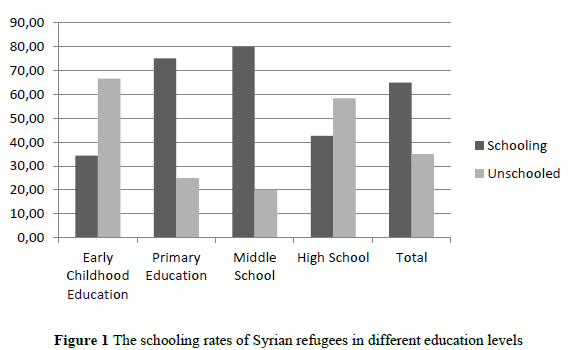
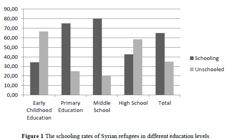
The current number of Syrian refugees in Türkiye is 3.7 million under temporary protection and 322,000 refugees under international protection (UNHCR, 2022). By 2021, 730,806 Syrian students under temporary protection had access to the Turkish education system. The current schooling rates according to educational levels are shown below (Turkish Ministry of National Education, General Directorate for Lifelong Learning, Directorate of Training in Migration and Emergencies, 2022):
Figure 1 shows that the schooling rates of Syrian students had increased compared to 2015, but 35% of the whole population of school-aged children still did not have access to formal education institutions. Also, the rates for primary and middle school students are better than those for higher levels of education.
Even though it is obvious that schooling rates are improving and the conditions regarding education are being enhanced for refugees, they still face many problems in the education system. Taylor and Sidhu (2012) put forward that refugee students' needs are mostly ignored - not only by policymakers, but also by researchers studying migration and multicultural education. Related policies and the scientific data revealing the problems and disadvantages that refugees faced regarding their education were also neglected. In a study by Seydi (2013), Syrian academics and teachers indicated major problems in terms of educating Syrian people, especially for those outside the temporary centres.
With the first influx of refugees, the Turkish Ministry of National Education started to provide education in the camps in Arabic, but the lessons were still in line with the Turkish curriculum. Even though refugee students obtained education as soon as possible, they could not acquire Turkish proficiencies as readily. Many international schools also support refugees' education, even functioning in contravention of Turkish law (McCarthy, 2018). In those days, the policies regarding social life and education were mostly based on the assumption that refugees would leave shortly. However, the educational attempts and practices were standardised and regulated through a circular in 2014. Moreover, the initiatives concerning the education of Syrian refugees are presented in the strategic plans covering the years 2015 to 2019 (Aksoy, 2020).
Irrespective of what has been done in terms of laws or regulations, positive developments related to the educational problems faced by refugees have been minimal. As policies and the direction of future considerations were not fully solidified, their integration and equal education were not determined or implemented. In their study, Mercan Uzun and Bütün (2016) point out that Syrian children experience problems in their education due to language differences, feelings of exclusion, and other families' attitudes towards them. Similarly, Tamer and Birvural (2018) state that educating Syrian students together with others in the earlier grades of primary school caused language and understanding problems both for students and teachers. Whether Syrian refugees are educated with Turkish students or not, young refugees still face problems regarding their adaptation to daily life and life in Turkish schools.
Problem Statement
Countries employ various strategies to educate refugee students. In Türkiye, for instance, many Syrian teachers instruct refugee students at state schools after regular school hours; after Turkish students had completed their classes. This approach allows the same school facilities to be used interchangeably. Some refugee students are even integrated into the same classes as Turkish children. As such, the policies implemented in Türkiye regarding the education of refugee children are vital in shaping how educators perceive and implement these strategies. These policies may have positive or negative effects, and ultimately the teachers determine the most effective practices. Even though the reasons for migration are not the focus of the study, the general results of the migration and problems of refugees were studied. In the theories mentioned above, migration is linked to many causes including security, unemployment, and destruction. The direction of migration is explained through short distances, economic opportunities, accessibility, similarities in language and culture. These may help to understand the motivation of refugees for settling in Türkiye, however, the problems should still be investigated. Especially, whether the educational needs, one of the basic needs and opportunities to construct equal status and common goals to enable the interaction between groups of refugees and native residents of the country, have been met or not. This results in a search for answers regarding the problems and possible solutions through education.
With this study we aimed to present the perspectives of educators in faculties of education and teachers working with refugees regarding the educational challenges faced by these refugees, along with their proposed solutions. The goal was to enhance the understanding of refugee education from the educators' point of view. It would clarify how refugee students received education and what emerged in both theoretical and practical contexts. By examining the situation in light of migration theories, we aimed to support the recommendations offered. These findings would complement results from other Turkish and international studies. The research questions were the following:
1) What are the views of academics in the faculty of education and teachers in schools who work with refugees regarding the general problems of refugees?
2) What are the views of academics in the faculty of education and teachers in schools who are working with refugees in Türkiye regarding refugees' educational problems?
3) What are the suggestions of academics in the faculty of education and teachers in schools for enhancing the educational process of refugees?
It is necessary to mention that we aimed to address the status, educational problems and possible solutions for refugee education resulting from displacement caused by war. Even though some of the theories mentioned above do not focus on forced migration, they could help researchers to understand the potential results through a new settlement or how people could have bonds and prolong them. Therefore, these theories formed a basis for this study to determine the problems and ways to solve them through educators' perspectives.
Methodology
In this phenomenological study the data analysis was aimed at revealing experiences and meanings (Yildirim & Simsek, 2013). Phenomenological research focuses on the way that people describe their experiences and how they perceive these experiences (Patton, 2014). In this study the emphasis was on teachers' experiences with Syrian refugee students and the academics' predictions and opinions regarding refugees' education based on their educational expertise and observations related to refugee problems. Therefore, phenomenology was the best way to gain insight through others' experiences and feelings on a specific matter.
The study participants were eight volunteer educators (four academics and four teachers) selected using the criterion sampling method. The criteria included participants having refugee students in their classrooms and working at a primary school for teachers. The criteria for academics were having studied or worked in refugee education or inclusiveness. Two female and two male academics from different departments of a faculty of education with experience ranging between 17 and 30 years participated in the study. Three female and one male primary school teacher with Syrian refugees in their classes and who had experience of between 13 and 17 years participated in the study. Once saturation was reached, the number remained at eight. The participants were from a university in southern Türkiye and a primary school located in the city centre of Adana, which has a low socioeconomic status. A1, A2, A3 and A4 were the pseudonyms used for the academics and T1, T2, T3 and T4 were used as pseudonyms for the teachers.
Data collection involved conducting semi-structured interviews with the participants. The sessions lasted approximately 15 to 25 minutes and were conducted in empty classrooms or offices. Through the interviews, both the main questions and the sub-questions were put to the participants. The interviews were recorded using a voice recorder and we also took notes during the interviews. Afterwards, the recorded data were transcribed. To ensure validity and reliability, the participants were asked to confirm the transcriptions by doing member checking.
The content analysis method was used to analyse the data. The data were coded by two different researchers and differing codes and themes were negotiated. The codes on which the researchers agreed were retained unchanged. Coder reliability, using Miles and Hubermann's (1994) formula, was found to be 0.88. The data for academics and teachers were analysed separately, but they were presented together for the same questions asked in the interviews.
Results
Through this study, the participants indicated the general problems regarding refugees and the policies implemented in the hosting process. They also mentioned educational problems and their suggestions for better solutions. The themes identified include the challenges faced by refugees, perspectives on refugee policies, recommendations for improving these policies and concerns regarding the roles of schools, teachers, and administrators. Additionally, the findings address teachers' opinions on having refugee students in their classes, as well as their suggestions for enhancing the educational experience of refugees. These findings are presented in the sections below.
Refugee Problems and Policies
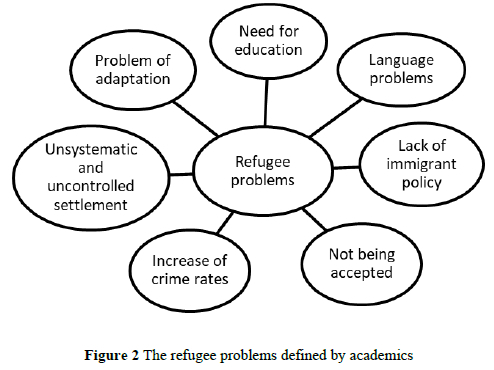
Within the study, academics and teachers were asked about the different dimensions of problems experienced by refugees. The problems mentioned by academics and teachers are presented in Figures 2 and 3 respectively.
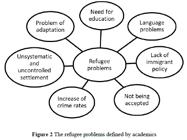
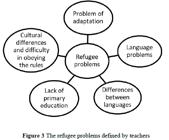
The problems mentioned by the academics and teachers were similar (Figures 2 and 3). Both groups mentioned the language, adaptation problems, as well as a lack of and a need for education in general. The academics also emphasised the lack of an immigrant policy, the increase in crime rates and the rejection of refugees while teachers indicated the differences between languages and cultures. As examples of these explanations, the quotes below show the academics' concerns regarding systematicity and basic needs while teachers' expressions were more about differences between languages and the difficulties in learning a new language.
This immigration issue has not been systematic for Türkiye and so people have serious problems in education, health or economy, etc. I guess, we see in schools frequently (A3).
But especially the students from Syria had a very different literacy education as Turkish and Arabic are very different languages. I have a student writing from right to left. I could only change this after several weeks (T2).
Some children don't know the language, they come here and learn a new language and this creates a problem (T1).
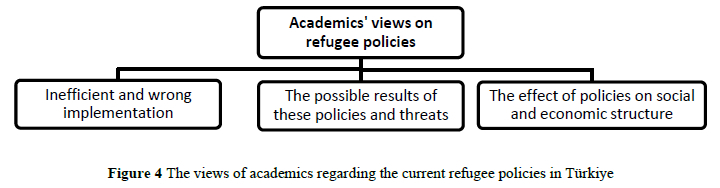
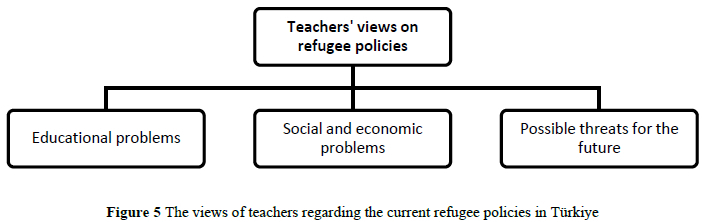
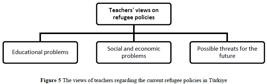
The participants were also asked about the refugee policies in Türkiye. Their views are shown in Figures 4 and 5.
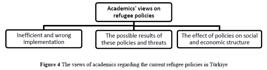
Regarding the refugee policies in Türkiye, the academics mentioned "inefficient and wrong implementation", "the possible results of these policies and threats" and "the effect of policies on social and economic structure." Within the first category, they talked about the inefficiency of planning being unscientific, uncertainty, teachers' intolerance, and professional incompetence. The threat they mentioned involved refugees participating in illegal groups and having a tendency for crime. Lastly, the academics put forward the adverse effects of these policies on social structure, employment problems, and economic burden.
If integration is not achieved, these people will become targets for every kind of terror group, I believe this. No matter legal or illegal, various social institutions can undertake this education responsibility; I feel there is such a danger... (A4).
The refugee population is increasing day by day, which means that certain precautions should be taken. This growth also poses a significant economic burden for Türkiye. The numbers are quite high, and we need to provide adequate facilities for healthy nutrition, shelter, and education. (A2)
Teachers reflected on "educational problems, social and economic problems and possible threats for the future." Issues related to education included the negative effects of separate education on the adaptation process, difficulties among students in adapting to each other, and the impact of age differences. The social and economic problems included preserving cultures, resisting new cultural influences, and harming social justice. With these possible threats, teachers stated being in a race of power and a tendency towards crime, which was also mentioned by the academics. Two teachers discussed the need for adaptation and the challenges that refugees faced in learning and adjusting to a new culture.
It is not about teaching Arabic etc. I expect that they will adapt to us. So, I don't like those second schools (separate schools) because the children will not speak Arabic when they go outside or get on a bus or when they sit in a patisserie. I want everyone to live in harmony, regardless of their culture. (T3)
They live as if it is their own country. For example, they wear long dresses and speak Arabic. Seeing Arabic writing in markets and shops makes us feel as if we are second-class citizens and this is their own country. I cannot think of the future in political matters. This could go in many different directions. (T2)
The academics and teachers made suggestions for the current policies regarding refugees. The academics' suggestions were recorded under three headings: "planning for settlement", "adaptation process implementations" and "education planning. " The suggestions for planning the settlement processes included making systematic settlements, planning for the eventual return of the refugees to their country of origin, creating living spaces and determining mutual expectations. As for adaptation and educational planning, adaptation education, language education, social integration and citizenship education, registering and recognising refugees' needs, integrated education with Turkish and forming an immigrant policy were suggested.
One of the academics indicated how adaptation was missing: "It is necessary to know where and how these people live systematically because they should not be on the streets" (A2).
The other participant explained why adaptation was required: "These children, for example, should have an adaptation education and a beginning for courses with a teacher who knows their language regarding where this place is, what they will do and what their life will be like hereafter" (A1).
Teachers also put forward similar suggestions, which included integrated education and creating an adaptation process. Some teachers also suggested separate education, creating living spaces, and supporting education related to their own culture.
Of course, when we say education, it is not about books, notebooks or pencils but practical education. I do not talk about literacy but if Turkish living, habits, and things could be taught practically they do not know Turkish but at least they can have some visual materials. (T3)
Educational Matters
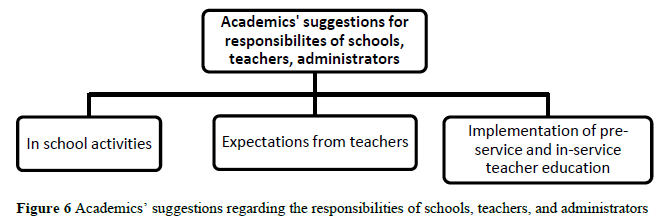
The academics and teachers were also asked about the education of refugees and the responsibilities of schools, teachers, and administrators. Teachers also reported challenges that they faced in their classrooms with refugee students. Figure 6 shows the suggestions made by academics regarding the responsibilities of schools, teachers and administrators.
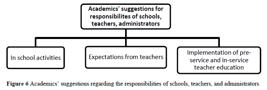
As seen in Figure 6, the academics' suggestions were presented under the categories "in-school activities", "expectations from teachers" and "implementation of pre-service and in-service teacher education." Schools were expected to integrate with society, adopt a multicultural approach, and provide educational support. As for teachers, being tolerant and just, being role models and making refugee students feel valuable were expected. Regarding pre-service and in-service teacher education, academics indicated that inclusion of matters regarding refugees in teacher education and giving seminars would be important. Some quotations from their views are presented below. The first academics explained how a teacher in a multicultural classroom should be and the other one mentioned courses for integration in teacher education programmes.
The teacher should be the teacher of everyone in the classroom. Not only the teacher of Turkish students or people living in Türkiye, but also for refugees (A3).
This should also be done, if there is a refugee reality or a Syrian reality then I think there should be courses regarding refugees-refugee integration in education faculties (A4).
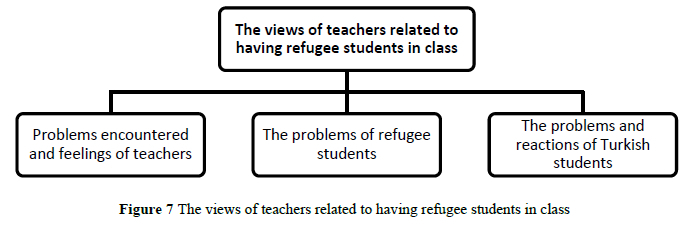
The next question was about the issues that teachers experienced in their classes with refugee students, presented in Figure 7.
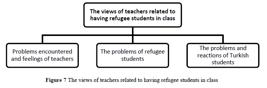
Figure 7 shows the problems faced by teachers, their feelings, the challenges encountered by refugee students, and the responses of Turkish students. Teachers mentioned interaction problems, empathising, feeling bad, and having to put in more effort in classes with refugee students. Students reported feelings of exclusion and loneliness, silence, insecurity, timidity, being offended, rebellion, and difficulty interacting. The problems and reactions of Turkish students were indicated as exclusion or showing support in some ways. Some of the teachers' statements are presented below.
The mother came, and talked but could not explain. I always tried to find someone who knows both Arabic and Turkish, but we could not. We could understand each other with a translator (T2). They feel excluded (T4).
Lastly, teachers were asked about their suggestions concerning the educational process of refugee students and the responsibilities of the stakeholders. Teachers' suggestions were about the arrangements regarding the school and parents' responsibilities. While they recommended private classes and teachers, giving seminars and education, they talked about using games and child language, providing a good environment, being empathetic, treating them with love and not discriminating against them. They also came up with some suggestions regarding parents, such as educating families, being in touch with the parents and getting support from Turkish parents. One of the teachers said: "Parents should also have Turkish education. It should not only be for their children, but for all the people who came from Syria ..." (T1).
These findings show that the problems regarding refugees were mostly related to language, adaptation, lack of systematisation within actions for refugees and the lack of an immigration policy. Both academics and teachers regarded current policies as creating threats for the future. Integration, gaining a multicultural perspective, getting more support for teachers, and not discriminating were some of the suggestions concerning the education of refugees. Lastly, teachers mentioned exclusion, loneliness, feelings of insecurity and the inability to interact as some observations for the refugee students in their classes.
Discussion
In Türkiye, many problems regarding refugees exist and the most problems mentioned in this study were related to a lack of systematisation within actions for refugees and uncontrolled settlement, adaptation and language problems. Both teachers and academics regarded the adaptation process as a requirement for every Syrian refugee. Similar studies also mention the importance of adaptation through refugees' satisfaction with their lives and the educational process (Dolapcioglu & Bolat, 2021; Kagnici, 2017; Safak-Ayvazoglu, Kunuroglu & Yagmur, 2021). Education is an important factor in helping refugees overcome integration problems and provide them with greater confidence and certainty (Dündar, 2019). Education and training can play a crucial role in supporting the socio-economic and political integration of refugees (Dolapcioglu & Bolat, 2021). Although many studies have been conducted on these issues, with this study we aimed to reveal understanding in two dimensions: theory (with academics) and practice. It is crucial to identify and integrate academics' suggestions with the issues in practice mentioned by the teachers. According to McBrien (2005), there is a significant gap between theory and practice in refugee education, which contributes to the dropout rates and cultural adaptation challenges faced by refugee students. This study could also contribute to refugee education being more scientific, thanks to the data obtained from the academics and the theories taken into consideration.
The teachers and academics also shared their thoughts regarding the refugee policies in Türkiye. While academics found the implementations wrong and inefficient, indicating the possible threats and the adverse effects on social and economic structure, teachers emphasised the same problems, together with other educational matters. Türkiye used an open door policy since the beginning of the war in Syria, which has increased the number of refugees (Koca, 2016). This was the beginning of the problems regarding the settlement and adaptation processes. As the number of refugees increased, so too did their needs. The World Bank has identified three key questions for Türkiye to consider in relation to its refugee policies. These questions focus on the potential negative socio-economic impact of the refugee presence on host communities, strategies to maximise the social and economic benefits of refugees for Türkiye, and ways to support refugees under temporary protection in becoming self-reliant until they are able to return to their home countries (World Bank, 2015). It is important to see that it brings about perceptions of threat among local people when the refugees start to stay longer. These threats were explained as realistic and symbolic threats and were expressed as economic burdens, violence, crime, and factors related to perceptions of threat, et cetera (Hynie, 2018). These issues should be considered while dealing with refugee policies. Otherwise, as explained in the RGCT, people lean on these perceptions resulting in prejudice or conflict among local people and refugee communities.
As the academics and teachers also stated, social and economic problems, such as employment, the economic burden on the hosting country, intolerance within the society against refugees, and the tendency for crime among the young refugees, could increase due to the lack of reasonable refugee policies. Similar perceptions were found within the analyses regarding some news in national newspapers in Türkiye that showed that Syrian refugees were regarded as victims or guests, or burdens and threats (Göktuna Yaylaci & Karakus, 2015). Even when not in a refugee context, some adaptation difficulties could arise in multicultural environments, such as education for international students. Yilmaz and Temizkan (2022) state that language deficiency, cultural differences, social interaction, academic work and religious beliefs are important dimensions of satisfaction for students. These are also important dimensions for refugees and should be considered within refugee policies. Many actors within the society or authority could be involved in creating sound policies for refugee problems. However, the lack of dialogue and inadequate cooperation between national and international organisations (such as non-governmental organisations [NGOs]), administrative units, the Turkish state, et cetera) cause many challenges on the path towards the protection and well-being of refugees (Memisoglu & Ilgit, 2017). Allport (1954) stresses support by authorities through creating ideal intergroup contact as well. Therefore, legislation, egalitarian laws, and common customs could support the development of policies on refugees.
Through the study we observed that the academics and teachers made some suggestions to enhance the current refugee policies, such as more planned settlements, practices for adaptation, integrated or separate education for refugees, supporting their culture and living spaces, et cetera. Adaptation or cohesion in society is a complicated process. The open-door policy regarding Syrian refugees was in the context of temporary protection. Even in those days, the uncertainty regarding the settlement (e.g. some were in the camps, some were in urban areas) and not having any adaptation plans were the obvious problems. Syrians staying longer in their host countries inflated problems with cultural adaptation and education even more; it became an obligation to ensure the integrity of the hosting culture (Magaziner, 2015). Erdogan (2019) notes that states may hesitate to promote cohesion if this may imply permanent settlement, but avoidance can have significant long-term consequences. According to the Global Commission on International Migration, a sustainable immigration policy should have a long-term perspective that takes the causes and consequences of irregular migration into account. This balanced approach harmonises individual rights with state sovereignty. Additionally, a holistic strategy is needed to enhance dialogue between various government departments, non-governmental organisations, civil society, and the governments of different countries (Koser, 2005).
Along the problems in social life, the lack of cohesion or adaptation between Turkish and Syrian students challenges the teaching experience at schools. Teachers with refugee students in their classes experience many problems, such as language and communication, older, illiterate refugee students, undisciplined behaviour, ineffective teaching materials, inappropriate curricula, psychological effects (Karakus, 2019; Toker Gökçe & Acar, 2018), and a lack of support mechanisms (Soylu, Kaysili & Sever, 2020). In our study, teachers reported experiencing similar challenges in communicating and empathising with refugee students. They stated that refugee students felt excluded, lonely, insecure and timid and they were silent, offended and rebellious in some ways. Seker and Sirkeci (2015) also found that refugee children experienced a language barrier that made life at school even more difficult and badly affected their academic success altogether, with other conflicts regarding cultural differences also causing the isolation of these students. These issues may lead to inefficiencies in the educational process for these students and their exclusion from society. Therefore, it is crucial to find solutions for these problems.
Schools are vital in enhancing refugee students' well-being, self-esteem, learning process and social inclusion (Seker & Sirkeci, 2015). Teachers and academics suggested that teachers present private classes and seminars, use child language or games, show empathy and treat them with love, be tolerant, and make them feel valuable. Pre-service teachers should also be trained accordingly. Supporting refugees is essential to address their emotional, physical, and social needs. Implementing consistent practices, expressing love and affection, and fostering a positive learning environment can help refugee students feel more comfortable and enhance their learning (Gürel & Büyüksahin, 2020). Empathy and love could heal the negative effects of war and migration. Also, the resolution of the adverse attitudes regarding the differences could bring relief for refugees in general and for refugee students. We found that assurance, empathy, cultural differences and religious beliefs positively affected the students' satisfaction (Yilmaz & Temizkan, 2022). As schools are considered an important factor in refugee settlement, being more welcoming and developing positive attitudes at school would be more significant and educational authorities should support this process (Taylor & Sidhu, 2012). Teachers should also use group activities and intercultural dialogue to allow students learn from each other and to share their traditional way of life or culture (songs, food, dances, etc.). These experiences may enhance the students' mutual respect (Özel & Altunay-Yilmaz, 2021). Pettigrew (1998) indicates that intergroup contact could decrease prejudice. Based on this and Allport's (1954) points on cooperation and common goals, it is evident that when groups get to know each other, they develop common goals and cooperate, which leads to positive outcomes. So, it could be the right solution for schools to create common goals that students will strive to achieve together, regardless of their background, to have students from different ethnic or cultural groups work together on projects.
Teachers are also in need of help in this process. They should be supported through support groups that would help them share their experiences and feelings and develop their knowledge and expertise (Özel & Altunay-Yilmaz, 2021). A study on the Greek system of training teachers for the education of refugees indicates that teachers who do not have the necessary skills to provide psychological support to students or who have communication problems due to language may also cause problems in the education process (Mogli et al., 2020). Multicultural schools require a respectful environment for differences and the situation in Türkiye is challenging due to the lack of structured, multicultural education practices which makes the process even more difficult for teachers with many responsibilities (Soylu et al., 2020). Teachers could achieve much through this process, but they carry a heavy burden as well. Therefore, they must always receive the necessary support to continue effectively. Additionally, the Organisation for Economic Co-Operation and Development (OECD) report (2018) emphasises the need for increased support and training for teachers. This would enhance their ability to manage diverse classrooms and effectively engage with immigrant students and their families. Viewing the multicultural world as a significant reality requires being open to differences, tolerating traditions and cultures, and fostering cohesion - education should lead the way in this regard. The roles of teachers, being in a very sensitive position, would be to lead the desired changes in schools and in society.
Many other problems regarding the educational process of refugees exist all over the world. Bullying, racial discrimination, low expectations, traumatic experiences caused by migration, and teacher stereotyping are mentioned as major risks. However, high ambition in academic and social life, parental involvement, and teachers' understanding of cultural and linguistic background are some of the ways offered for success in refugee education (Graham, Minhas & Paxton, 2016). Schools are seen as places helping refugees to stabilise. They are sources of settlement, safety and security (Matthews, 2008). The school environment should provide a feeling of freedom and caring. It is vital to support refugee youths to overcome prejudice and teachers need to confront their own attitudes and beliefs towards refugee students. They are also responsible for multicultural and respectful classes (McBrien, 2005). Similar problems and solutions are indicated in our study.
Our study had a number of limitations, such as its focus on the challenges faced by refugee students only in a specific, local area of Türkiye. However, as the highest number of refugees reside in Türkiye, it needs to find better ways to deal with the growing number of refugees. This study was also based solely on data gained from interviews conducted in a southern city. While we refer to global literature and experiences to some extent, we primarily relied on local studies and addressed issues specific to the refugee community in Türkiye.
Conclusion
Academics and teachers regard the adaptation process for refugees as essential. Many express concerns about current refugee policies, deeming them ineffective and inadequate, particularly regarding issues such as employment and crime. To tackle these challenges, the participants recommended supporting refugees' cultural needs and living conditions, organising more effective settlements, and providing collaborative or separate education.
Teachers with refugee students in their classes reported facing significant difficulties, especially related to language and communication barriers. Consequently, the students may feel excluded, voiceless, and insecure. It has been suggested that teachers help refugees by demonstrating empathy, compassion, and patience. There is also a pressing need for training programmes for pre-service teachers to better prepare them for these situations. Moreover, teachers themselves require support to effectively navigate the challenges of working with refugee students.
In light of these observations, several actionable implications are proposed:
• In Türkiye, the most prominent problems regarding refugees are a lack of systematic organisation, uncontrolled settlement, and challenges related to adaptation and language.
• Both teachers and academics viewed the adaptation process as essential for every Syrian refugee.
• Although we primarily focused on education in this study, most of the identified problems and suggestions also addressed social and economic aspects.
• This indicates that the refugee issue cannot be analysed without considering the various dimensions that impact the entire process.
• The key points to keep in mind are:
o Multiculturalism is increasing.
o Adaptation is essential.
o Balancing privileges while ensuring social justice.
o Educating children to prevent criminal futures.
Data Availability
The data that support the findings in this study are available from the corresponding author upon reasonable request.
Authors' Contributions
EY: conceptualisation, methodology, writing and preparation of the original draft, reviewing and editing, data curation, visualisation, investigation, proofreading. MS: conceptualisation, supervision, validation, writing, reviewing and editing.
Notesi. This paper was presented at the 6th International Conference on Critical Education (ICCE), London, 1013 August 2016.
ii. Published under a Creative Commons Attribution Licence.
Acknowledgement
The authors thank the teachers and academics interviewed for sharing their thoughts and experiences and contributing to this scientific paper.
References
-
Aksoy E 2020. Türkiye'deki Suriyeli göcmen çocuklarin okullasma durumlari [Syrian immigrant children's schooling status in Turkey]. Akademik Hassasiyetler, 7(14):37-51. Available at https://dergipark.org.tr/en/pub/akademik-hassasiyetler/issue/58511/801065. Accessed 25 March 2022.
» https://dergipark.org.tr/en/pub/akademik-hassasiyetler/issue/58511/801065 - Allport GW 1954. The nature of prejudice. Cambridge, MA: Perseus Books.
-
Anadolu Agency 2022. Over 68,000 Ukrainians take refuge in Turkey: UN agency. Daily Sabah, 6 April. Available at https://www.dailysabah.com/politics/diplomacy/over-68000-ukrainians-take-refuge-in-turkey-un-agency. Accessed 15 April 2022.
» https://www.dailysabah.com/politics/diplomacy/over-68000-ukrainians-take-refuge-in-turkey-un-agency - Ankara Basbakanlik Afet ve Acil Durum Yönetimi Baskanligi [Prime Ministry Disaster and Emergency Management Presidency] 2014. Suriye 'den Türkiye 'ye nüfus hareketleri: Kardes topraklarindaki misafirlik [Population movements from Syria to Türkiye: Hospitality in sibling lands]. Ankara, Türkiye: Author.
-
Blum L 2014. Three educational values for a multicultural society: Difference recognition, national cohesion and equality. Journal of Moral Education, 43(3):332-344. https://doi.org/10.1080/03057240.2014.922057
» https://doi.org/10.1080/03057240.2014.922057 - Çaglayan S 2015. Suriye savasi ve Suriyeli goçmenler: Teorik ve kavramsal anlama çabasi [Syrian war and Syrian refugees: Theoretical and conceptual understanding endeavour]. Sosyoloji Divani, 6:193-208.
-
Celik S, Kardas Ísler N & Saka D 2023. Refugee education in Turkey: Barriers and suggested solutions. Pedagogy, Culture & Society, 31(4):687-705. https://doi.org/10.1080/14681366.2021.1947878
» https://doi.org/10.1080/14681366.2021.1947878 - Dedeoglu S & Ekiz Göcmen Ç 2020. Göç, sosyal dislama ve entegrasyon [Migration, social exclusion and integration]. In F Güllüpinar (ed). Göç sosyolojisi içinde. Eskisehir, Türkiye: Anadolu Üniversitesi Yayini.
-
Dolapcioglu S & Bolat Y 2021. The education issues of Syrian students under temporary protection status. Research in Education, 109(1):3-19. https://doi.org/10.1177/0034523719892019
» https://doi.org/10.1177/0034523719892019 -
Dündar A 2019. Impact of physical education lesson on adaptation of Syrian refugee school age children in Turkey. World Journal of Education, 9(1):266-273. https://doi.org/10.5430/wje.v9n1p266
» https://doi.org/10.5430/wje.v9n1p266 - Erdogan M 2019. Syrian refugees in Turkey (Konrad-Adenauer-Stiftung Report). Istanbul, Türkiye: TAGU- Turkish-German University, Migration and Integration Research Center.
-
Eren Z 2019. Yönetici ve ögretmen görüclerine göre göcmen çocuklarin egitim sorunlari ve cözüm önerileri [According to principals and teachers educational problems of immigrant children and solutions]. Bolu Abant Izzet Baysal Üniversitesi Egitim Fakültesi Dergisi, 19(1):213-234. https://doi.org/10.17240/aibuefd.2019.19.43815-476805
» https://doi.org/10.17240/aibuefd.2019.19.43815-476805 -
European Asylum Support Office 2021. EASO asylum report 2021 - Annual report on the situation of asylum in the European Union. Luxembourg: Publications Office. https://doi.org/10.2847/6007
» https://doi.org/10.2847/6007 -
Gee S 2015. "When I picture my future, I see nothing": Barriers to education for Syrian refugee children in Turkey. New York, NY: Human Rights Watch. Available at https://www.hrw.org/sites/default/files/report_pdf/turkey1115_reportcover_web.pdf. Accessed 15 January 2023.
» https://www.hrw.org/sites/default/files/report_pdf/turkey1115_reportcover_web.pdf -
General Directorate of Migration Management 2016. 2015 Türkiye göç raporu [2015 Turkish migration report]. Available at https://www.goc.gov.tr/kurumlar/goc.gov.tr/files/2015_yillik_goc_raporu.pdf. Accessed 15 December 2021.
» https://www.goc.gov.tr/kurumlar/goc.gov.tr/files/2015_yillik_goc_raporu.pdf - Giddens A 2013. Sosyoloji [Sociology]. Istanbul, Türkiye: Kirmizi Yayinlari.
- Goetz NH 2006. A pragmatic solution, revisited: Evaluating the successes and failures of a self-sufficiency and integration programme for Rwandese refugees in Burundi, 1962-1976. In F Crépeau, D Nakache, M Collyer, NH Goetz, A Hansen, R Modi, A Nadig, S Spoljar-Vrzina & LHM van Willigen (eds). Forced migration and global processes: A view from forced migration studies. Lanham, MD: Lexington Books.
- Göktuna Yaylaci FG & Karakus M 2015. Perceptions and newspaper coverage of Syrian refugees in Turkey. Migration Letters, 12(3):238-250.
-
Graham HR, Minhas RS & Paxton G 2016. Learning problems in children of refugee background: A systematic review. Pediatrics, 137(6):e20153994. https://doi.org/10.1542/peds.2015-3994
» https://doi.org/10.1542/peds.2015-3994 -
Gürel D & Büyüksahin Y 2020. Education of Syrian refugee children in Turkey: Reflections from the application. International Journal of Progressive Education, 16(5):426-442. https://doi.org/10.29329/ijpe.2020.277.26
» https://doi.org/10.29329/ijpe.2020.277.26 -
Hynie M 2018. Refugee integration: Research and policy [Special issue]. Peace and Conflict: Journal of Peace Psychology, 24(3):265-276. https://doi.org/10.1037/pac0000326
» https://doi.org/10.1037/pac0000326 -
Ince C 2019. Göç kuramlari ve Suriye göçü üzerine bir degerlendirme [An evaluation on migration theories and Syrian migration]. OPUS International Journal of Society Researches, 11(18):2579-2615. https://doi.org/10.26466/opus.546737
» https://doi.org/10.26466/opus.546737 -
Kagnici DY 2017. Suriyeli mülteci çocuklarin kültürel uyum sürecinde okul psikolojik daniçmanlarina düçen rol ve sorumluluklar [School counselors' roles and responsibilities in cultural adaptation process of Syrian refugee children]. Elementary Education Online, 16(4):1768-1776. https://doi.org/10.17051/ilkonline.2017.342990
» https://doi.org/10.17051/ilkonline.2017.342990 -
Karakus M 2019. Views of teachers and students on the problems of Syrian children in a refugee school in Turkey. International Journal of Education & Literacy Studies, 7(2):211-219. https://doi.org/10.7575/aiac.ijels.v.7n.2p.211
» https://doi.org/10.7575/aiac.ijels.v.7n.2p.211 -
Koca BT 2016. Syrian refugees in Turkey: From "guests" to "enemies" [Special issue]? New Perspectives on Turkey, 54:55-75. https://doi.org/10.1017/npt.2016.4
» https://doi.org/10.1017/npt.2016.4 -
Koser K 2005. Irregular migration, state security and human security. Geneva, Switzerland: Global Commission on International Migration (GCIM). Available at https://www.iom.int/sites/g/files/tmzbdl486/files/jahia/webdav/site/myjahiasite/shared/shared/mainsite/policy_and_research/gcim/tp/TP5.pdf. Accessed 22 April 2022.
» https://www.iom.int/sites/g/files/tmzbdl486/files/jahia/webdav/site/myjahiasite/shared/shared/mainsite/policy_and_research/gcim/tp/TP5.pdf -
Lee ES 1966. A theory of migration. Demography, 3(1):47-57. https://doi.org/10.2307/2060063
» https://doi.org/10.2307/2060063 -
Magaziner J 2015. The importance of higher education for Syrian refugees. World Education News + Reviews, 7 December. Available at http://wenr.wes.org/2015/12/the-importance-of-higher-education-for-syrian-refugees. Accessed 15 March 2022.
» http://wenr.wes.org/2015/12/the-importance-of-higher-education-for-syrian-refugees -
Massey DS, Arango J, Hugo G, Kouaouci A, Pellegrino A & Taylor JE 1993. Theories of international migration: A review and appraisal. Population and Development Review, 19(3):431-466. https://doi.org/10.2307/2938462
» https://doi.org/10.2307/2938462 -
Matthews J 2008. Schooling and settlement: Refugee education in Australia. International Studies in Sociology of Education, 18(1):31-45. https://doi.org/10.1080/09620210802195947
» https://doi.org/10.1080/09620210802195947 -
McBrien JL 2005. Educational needs and barriers for refugee students in the United States: A review of the literature. Review of Educational Research, 75(3):329-364. https://doi.org/10.3102/00346543075003329
» https://doi.org/10.3102/00346543075003329 -
McCarthy AT 2018. Politics of refugee education: Educational administration of the Syrian refugee crisis in Turkey. Journal of Educational Administration and History, 50(3):223-238. https://doi.org/10.1080/00220620.2018.1440541
» https://doi.org/10.1080/00220620.2018.1440541 -
Memisoglu F & Ilgit A 2017. Syrian refugees in Turkey: Multifaceted challenges, diverse players and ambiguous policies. Mediterranean Politics, 22(3):317-338. https://doi.org/10.1080/13629395.2016.1189479
» https://doi.org/10.1080/13629395.2016.1189479 -
Mercan Uzun E & Bütün E 2016. Okul öncesi egitim kurumlarindaki Suriyeli siginmaci çocuklarin karsilastiklan sorunlar hakkinda ögretmen görüsleri [Teachers' views on the problems faced by Syrian refugee children in preschool education institutions]. Uluslararasi Erken Çocukluk Egitimi Çalismalari Dergisi, 1(1):72-83. Available at http://ijeces.hku.edu.tr/tr/pub/issue/22947/175325#article_cite. Accessed 10 November 2021.
» http://ijeces.hku.edu.tr/tr/pub/issue/22947/175325#article_cite - Miles MB & Huberman AM 1994. Qualitative data analysis: An expanded sourcebook (2nd ed). Thousand Oaks, CA: Sage.
-
Mogli M, Kalbeni S & Stergiou L 2020. "The teacher is not a magician": Teacher training in Greek reception facilities for refugee education. International e-Journal of Educational Studies, 4(7):42-55. https://doi.org/10.31458/iejes.605255
» https://doi.org/10.31458/iejes.605255 -
Organisation for Economic Co-operation and Development 2018. The resilience of students with an immigrant background: Factors that shape well-being. Paris, France: OECD Publishing. https://doi.org/10.1787/9789264292093-en
» https://doi.org/10.1787/9789264292093-en -
Özel D & Altunay-Yilmaz H 2021. Educational journey of refugee students: Suggestions for practitioners. Turkish Online Journal of Qualitative Inquiry, 12(2):405-437. https://doi.org/10.17569/tojqi.852044
» https://doi.org/10.17569/tojqi.852044 - Patton QM 2014. Nitel arastirma ve degerlendirme yöntemleri [Qualitative research and evaluation methods]. Translated by M Bütün & SB Demir. Ankara, Türkiye: Akademi.
-
Pettigrew TF 1998. Intergroup contact theory. Annual Review of Psychology, 49:65-85. https://doi.org/10.1146/annurev.psych.49.1.65
» https://doi.org/10.1146/annurev.psych.49.1.65 -
Çafak-Ayvazoglu A, Kunuroglu F & Yagmur K 2021. Psychological and socio-cultural adaptation of Syrian refugees in Turkey. International Journal of Intercultural Relations, 80:99-111. https://doi.org/10.1016/j.ijintrel.2020.11.003
» https://doi.org/10.1016/j.ijintrel.2020.11.003 - Çahin A 2015. Suriyeli siginmacilarin Kahramanmaras çadir kent'te yaçam koçullan ve adaptasyon sorunlari [Living conditions and adaptation problems of Syrian asylum seekers in Kahramanmaras Tent City]. Master's thesis. Kahramanmaras, Türkiye: Kahramanmaras Sütçü Imam University.
-
Sarman A, Günay U & Sarman E 2018. Savas ve göçün çocuklar üzerindeki travmatik etkileri [Traumatic effects of the war and migration on children]. In V Özpolat (ed). Zorunlu göcler ve dogurdugu sosyal travmalar. Ankara, Türkiye: Hegem Yayinlari. Available at https://oka.gov.tr/assets/upload/dosyalar/zorunlu-gocler-ve-dogurdugu-sosyal-travmalar-yayini.pdf. Accessed 27 November 2025.
» https://oka.gov.tr/assets/upload/dosyalar/zorunlu-gocler-ve-dogurdugu-sosyal-travmalar-yayini.pdf -
Seker BD & Sirkeci I 2015. Challenges for refugee children at school in Eastern Turkey. Economics & Sociology, 8(4):122-133. https://doi.org/10.14254/2071-789X.2015/8-4/9
» https://doi.org/10.14254/2071-789X.2015/8-4/9 -
Seydi AR 2013. Türkiye'deki Suriyeli akademisyen ve egitimcilerin görüslerine göre Suriye'deki çatismalarm Suriyelilerin egitim sürecine yansimalari [Reflections of conflicts in Syria on the education process of Syrians from the perspectives of Syrian academicians and educators in Turkey]. SDÜ Fen Edebiyat Fakültesi Sosyal Bilimler Dergisi, 30:217-241. Available at https://dergipark.org.tr/tr/pub/sufesosbil/issue/11407/136200. Accessed 15 April 2021.
» https://dergipark.org.tr/tr/pub/sufesosbil/issue/11407/136200 -
Sinclair M 2001. Education in emergencies. In J Crisp, C Talbot & DB Cipollone (eds). Learning for a future: Refugee education in developing countries. Geneva, Switzerland: United Nations High Commissioner for Refugees. Available at https://www.unhcr.org/sites/default/files/legacy-pdf/4a1d5ba36.pdf. Accessed 30 November 2025.
» https://www.unhcr.org/sites/default/files/legacy-pdf/4a1d5ba36.pdf -
Soylu A, Kaysili A & Sever M 2020. Mülteci çocuklar ve okula uyum: Ogretmenlerin kültüre duyarliliklan üzerinden bir çozümleme [Refugee children and adaptation to school: An analysis through cultural responsivities of the teachers]. Egitim ve Bilim, 45(201):313-334. https://doi.org/10.15390/EB.2020.8274
» https://doi.org/10.15390/EB.2020.8274 -
Tamer M & Birvural A 2018. Zorunlu goçün toplumlarda olusturdugu problemler [Problems caused by forced migration in societies]. In V Özpolat (ed). Zorunlu göcler ve dogurdugu sosyal travmalar. Ankara, Türkiye: Hegem Yayinlari. Available at https://oka.gov.tr/assets/upload/dosyalar/zorunlu-gocler-ve-dogurdugu-sosyal-travmalar-yayini.pdf. Accessed 27 November 2025.
» https://oka.gov.tr/assets/upload/dosyalar/zorunlu-gocler-ve-dogurdugu-sosyal-travmalar-yayini.pdf -
Taylor S & Sidhu RK 2012. Supporting refugee students in schools: What constitutes inclusive education? International Journal of Inclusive Education, 16(1):39-56. https://doi.org/10.1080/13603110903560085
» https://doi.org/10.1080/13603110903560085 -
Terhune V & Matusitz J 2016. The Uighurs versus the Chinese government: An application of Realistic Conflict Theory. Journal of Applied Security Research, 11(2):139-148. https://doi.org/10.1080/19361610.2016.1137174
» https://doi.org/10.1080/19361610.2016.1137174 -
Toker Gökce AT & Acar E 2018. School principals' and teachers' problems related to the education of refugee students in Turkey. European Journal of Educational Research, 7(3):473-484. https://doi.org/10.12973/eu-jer.7.3.473
» https://doi.org/10.12973/eu-jer.7.3.473 -
Turkish Ministry of National Education, General Directorate for Lifelong Learning, Directorate of Training in Migration and Emergencies 2022. 2021-2022 egitim-ögretim yili verileri [2021-2022 school year data] [PowerPoint presentation]. Available at http://hbogm.meb.gov.tr/meb_iys_dosyalar/2022_01/26165737_goc2022sunu.pdf. Accessed 15 November 2025.
» http://hbogm.meb.gov.tr/meb_iys_dosyalar/2022_01/26165737_goc2022sunu.pdf -
United Nations High Commissioner for Refugees 2010. Convention and protocol relating to the status of refugees. Geneva, Switzerland: Author. Available at https://www.unhcr.org/media/convention-and-protocol-relating-status-refugees. Accessed 15 March 2020.
» https://www.unhcr.org/media/convention-and-protocol-relating-status-refugees -
United Nations High Commissioner for Refugees 2022. Turkey fact sheet. Available at https://reliefweb.int/report/turkey/unhcr-turkey-fact-sheet-february-2022-entr. Accessed 29 November 2025.
» https://reliefweb.int/report/turkey/unhcr-turkey-fact-sheet-february-2022-entr -
Vaynshtok O 2001. Facilitating learning and transition among the refugee population. Adult Learning, 13(1):26-28. https://doi.org/10.1177/104515950101200407
» https://doi.org/10.1177/104515950101200407 -
World Bank 2015. Turkey's response to the Syrian refugee crisis and the road ahead. Available at https://www.worldbank.org/en/country/turkey/publication/turkeys-response-to-the-syrian-refugee-crisis-and-the-road-ahead. Accessed 25 March 2022.
» https://www.worldbank.org/en/country/turkey/publication/turkeys-response-to-the-syrian-refugee-crisis-and-the-road-ahead - Yildirim A & Çimçek H 2013. Sosyal bilimlerde nitel arastirma yöntemleri [Qualitative research methods in social sciences] (9th ed). Ankara, Türkiye: Seçkin Yayincilik.
-
Yilmaz K & Temizkan V 2022. The effects of educational service quality and socio-cultural adaptation difficulties on international students' higher education satisfaction. Sage Open, 12(1 ):1-18. https://doi.org/10.1177/21582440221078316
» https://doi.org/10.1177/21582440221078316
Revised: 10 May 2025
Accepted: 16 July 2025
Published: 31 December 2025