Challenges and opportunities regarding usage of computers in the teaching and learning of Mathematics
Abstract
Many studies have identified the fact that most mathematics teachers experience challenges in using technology in their teaching, and learners also find it difficult to use it in their learning. Teachers often fail to address opportunities regarding this usage to address the situation. This paper explores factors contributing to teachers' and learners' challenges and opportunities for using Information and Communication Technology (ICT), such as computers, in the teaching and learning of mathematics in the OR Tambo Education District. A case-study design was used. The sample comprised 5 teachers and 5 learners selected from 5 performing schools in the District. Individual interviews and open-ended questionnaires were used for data collection. Content analysis was used to analyse the data. The study revealed that a lack of computer tuition opportunities, school managers' attitudes and limited material resources contributed to challenges and opportunities regarding the use of computers in mathematics instruction in schools. The study concluded that a lack of teachers' access to the use of computers in schools made it difficult for them to assist learners in the use of computers for teaching and for school tasks. Recommendations have been made to help enforce and monitor the use of available computers in schools.
challenges; computer use; poor implementation; teachers and learners
Introduction and Background
The movement towards the use of technology in mathematics instruction in the mainstream education system continues to dominate academic discourse throughout the world today. This rapid global development in technology in the 21st century in general, and recognition of Information and Communication Technology (ICT) as a subject, in schools in particular, have opened new avenues for the learning and teaching fraternity in the current generation (Angeli & Valanides, 2005; United Nations Educational, Scientific and Cultural Organization [UNESCO] & International Centre for Technical and Vocational Education and Training [UNEVOC], 2014). Research has demonstrated that knowledge in ICT has become an important part of most organisations and businesses in today's technological world and people must be supported in acquiring these skills (Zhang & Aikman, 2007). Dawes (2001) is of the view that computers have the potential to support education across the curriculum and provide opportunities for effective communication between teachers and learners in ways that have not been possible before. This has, consequently, called for the use of computers in the teaching and learning of mathematics. The use of ICTs, such as computers, is therefore becoming an essential tool in mathematics in the modern world and the use of computer technology is now important in the teaching and learning of mathematics in schools (Association of Mathematics Teacher Educators, 2006). The benefits of using computers in the teaching and learning of mathematics outweighs the disadvantages. However, many teachers cannot use these mechanisms effectively in the teaching of mathematics in schools in the Eastern Cape province of South Africa. The problem is that many teachers do not have the skills as they have limited access to computers in their schools. Related literature also shows that many teachers in sub-Saharan Africa use computers poorly in the teaching and learning of mathematics (Hennessey, 2010) as many of them find it difficult to develop mathematical models that support the teaching and learning of mathematics in schools. This is because most of the teachers do not have access to computers in their schools. Furthermore, a lack of educational facilities such as classrooms and buildings to safeguard computers contributes to this problem. To address all the above problems, the following research question was posed: What are the factors that contribute to teachers' and learners' challenges and opportunities regarding the use of computers for the teaching and learning of mathematics in schools?
This is a pertinent question given the fact that the use of ICTs, such as computers, is becoming an essential tool in mathematics in the modern world and the use of computer technology is now important in the teaching and learning of mathematics in schools (Association of Mathematics Teacher Educators, 2006). Further to this, related literature also shows that many teachers in sub-Saharan Africa use computers ineffectively because they have not had any formal computer training that could enable them to use alternative teaching skills and strategies when integrating technology in the teaching and learning of mathematics (Hennessey, 2010; Tajudin & Kadir, 2014). Moreover, hardly anything has been done regarding the methods or approach of using computers as viable teaching aids for teaching mathematics, hence the current study.
Literature Review
As stated before, the use of ICTs is important for teaching and learning. Good mathematics instruction in schools is essential since mathematics deals with real-life situations in our daily activities (Ojose, 2011). The teaching and learning of mathematics has been found to be complex and abstract in nature and, as a result, learners find it difficult to comprehend most cases (Webb & Austin, 2009). Research has demonstrated that the incorporation of computer technology into mathematics teaching and learning in schools motivates and engages students; it further provides the best opportunities for them in problem-solving activities (Attard & Northcote, 2011; Pierce & Ball, 2009). However, research into the use of technology in mathematics classrooms has revealed concerns that negatively affect both teachers' and learners' engagement as a result of the inaccessibility of computers and how teachers and learners engage in existing practices in their environment (Van Staden, 2015).
The use of technology has created an innovative learning environment for teachers and learners in order to stimulate and enhance the learning and teaching processes worldwide (Tarhini, Hone, Liu & Tarhini, 2017; Yadav, 2016). The use of computers as ICT tools has made things easier for many people in many organisations in the world. Research has shown that computers were introduced into schools in the early 1980s to support teaching and learning. Several researchers believe that computers are an important part of education for the teaching and learning of mathematics and will be for generations to come (Bransford, Brown & Cocking, 2000; Yelland, 2001). It is believed that teachers' professional technology development in the teaching of mathematics should be approached in line with the constructivism process that requires teachers to learn how to use ICT tools and apply them in their routine classroom activities.
South African learners' performance in mathematics has been very poor compared to that in other countries (Webb & Austin, 2009). Currently, however, school learners are surrounded by, and are in contact with, modern technologies through the use of cell phones. This has raised the question of how mathematics can be taught in schools using multimedia, such as Google Apps, to raise the standard of learners' performance in the subject, hence the need for teachers to take advantage of ICTs in the school context.
Given the popularity of the internet in the modern world, ICT has recently become one of the most promising educational tools; computers can therefore help teachers in designing and promoting their educational programmes. These programmes can be beneficial to both teachers and learners in the teaching and learning of mathematics. It is further believed that diffusing the use of computer technology in the teaching and learning of mathematics can transform classroom activities and education in general, for the better (Samuelsson, 2007). Further research indicates that for teachers teaching in rural and township areas, the use of computers can also positively influence many aspects of their social lives as well as their leisure activities. These in turn influences their teaching of mathematics (Laudon & Traver, 2013).
In South Africa, for example, the government has recently supplied computers to many schools to support the smooth running of the schools in the country. However, there have been reports from the teachers that these computers are not accessible to either teachers or learners for fear of damage and theft, hence unused computers are kept in computer labs serving no purpose, despite education being considered as a means for moving countries into the information age and thus transforming education to a level where it can cope with the new challenges facing so many people in the current technologically-oriented world (Dawes, 2001). Moreover, a substantial number of teachers often face problems in using computers for teaching, especially in mathematics, due to certain factors related to schools in the rural areas. Without the use of computers learners seem less motivated and their curiosity to acquire skills for solving mathematics problems is left unattended. Beukes-Amiss and Chiware (2006) state that the use of computers can provide teaching and learning resources as well as opportunities for new tools, approaches, and strategies in teaching and learning. Beukes-Amiss and Chiware (2006) further state that while there is a great deal of knowledge about how ICTs are being used in developed countries, less is understood about how ICT is being introduced into schools in developing countries.
Internationally, the use of ICT tools, as a multimedia way of teaching mathematics is not underestimated. Attard and Northcote (2011), Nivala (2009) and Ottestad (2010) maintain that the use of digital technology equipment such as Show Me, iPads, and overhead projectors in the teaching and learning of mathematics in schools can be driving forces behind the change of a country's education for the better. ICT thus continues to contribute to the extent of transforming the lives of people for the better. Over the past three decades there has been an ongoing discussion in countries such as Sweden regarding the intention of integrating ICT and computers in school curricula to enhance effective teaching and learning (Buabeng-Andoh, 2012; Jedeskog, 2005).
Related literature (Australian Association of Mathematics Teachers [AAMT], 2006:Sec. 3; Galligan, Loch, McDonald & Taylor, 2010) has shown that the teaching and learning of mathematics could be made interesting and easily understandable when dedicated mathematics teachers create "an environment that maximises students' learning opportunities" through the use of computer technologies in mathematics classes. The use of these technologies encourages self-directed learning which leads to "model mathematical thinking and reasoning" and provides "purposeful and timely feedback" to learners (Galligan et al., 2010:38). This means that teachers should always embark on the use of tangible and reliable technologies that support learners' understanding of mathematics in all spheres. For instance, the use of an iPad for learning helps to increase fluency in number operations and to some degree, mathematical reasoning. Show Me allows learners to record their voices while they draw (Galligan et al., 2010). In a situation where teachers disregard the use of computer technology as well as local materials in the mathematics classroom, teaching and learning, in most cases, becomes abstract and meaningless to learners, hence the learners develop negative attitudes towards the subject. It is my wish that mathematics teachers throughout the world, especially those in rural areas, make applicable use of technology and local materials in the teaching and learning of mathematics at all times. It is my belief that the use of relevant materials in the teaching and learning of mathematics fosters a deep understanding of the material used to illustrate a concept being taught in class by mentally connecting the new information to be learned with relevant prior knowledge (Swanson, Moran, Bocian, Lussier & Zheng, 2013; Wittrock, 1989).
In using ICTs to teach mathematics, teachers should use it in such a way that it (ICTs) not only drives pedagogy, but supports learning and teaching in class and provides the best opportunities for allowing the "pedagogy to drive the technology" in the teaching of mathematics (Attard & Northcote, 2011).
Based on Koehler, Mishra, Akcaoglu and Rosenberg's (2013) typology of the technological pedagogical content knowledge (TPCK) model of the teaching and learning of mathematics, this paper therefore has a process-oriented focus (Stoffels, 2007). Some previous studies on the level of technological pedagogical content knowledge of mathematics teachers mostly focused on the amount of TPCK in the teaching and learning of mathematics using technology (Tajudin & Kadir, 2014). The current study goes deeper into how mathematics teachers need to be afforded the opportunity to use information and communication technology for training in their schools to enable them to develop and acquire alternative teaching strategies when integrating technology into the teaching and learning of mathematics.
Contribution of this paper to literature
The TPCK model used in this study includes a conceptual system of knowledge construction and acquisition as indicated by researchers like Koehler et al. (2013); it is the type of pedagogical content knowledge that guides and assists teachers to develop a relevant tool(s) for mathematics teaching through the integration of technological knowledge. This helps them to assess their learners in the mathematics class. It is believed that when scholars, especially mathematics teachers, read this information, it will help them to acquire technological pedagogical content knowledge that can be applied to mathematics teaching to construct and explain real-life situations of similar or another systems through generic or relevant procedures with the purpose of generating useful information for problem-solving through the use of software to perform mathematics operations successfully and accurately. Furthermore, the moment the learner attempts to solve a mathematical problem formulated within a real-life situation, the learner may embark on an integration of technological knowledge introduced by the teacher in the mathematics class. By using computer technology in this situation, learners embark on a mathematisation process that may involve abilities to explore different ideas and thus easily apply strategies through mathematical modelling in solving specific problems in life. This must be encouraged in all mathematics classrooms in the country.
Theoretical Framework
Studies in the field of challenges and opportunities for using computer technology in classroom teaching have identified a complex pattern of interconnected factors that are presumed to be hindrances to a successful implementation of ICT in education in South Africa. These factors arise from teachers' external and internal environment such as a lack of resources, restrictions on the use of computers by the managers and/or the personal characteristics of the teachers such as beliefs, values, attitude, and interests, which are likely to influence their use of computers for the teaching and learning of mathematics in schools (Zehra & Bilwani, 2016).
Further studies have demonstrated that traditional classroom learning typically involves face-to-face interaction between a teacher and learners, which is a more teacher-directed instructional approach in a synchronous environment (Wu, Tennyson & Hsia, 2010). Learners should not be regarded as passive recipients of knowledge, but they should be involved in the process of knowledge acquisition through hands-on activities. This paves the way for learners to create a model that includes a conceptual system which helps to construct and explain real-life or similar situations through mathematical modelling in solving specific life problems.
The theoretical framework that underpins this study is the technological pedagogical content knowledge (TPACK) model (Mishra & Koehler, 2006). The above-mentioned theory is used in this paper to show the framework through which teachers and learners can deal with complications of the use of ICT in mathematics classes. The use of ICTs as an instructional mechanism in mathematics classes in schools has become an emerging trend in global higher education in the current generation (Wu et al., 2010). Many higher education institutions in the country expect that the implementation of an ICT policy will somehow enhance the overall quality of the educational programme that will support and propagate the use of computers in the teaching and learning of mathematics in schools. This will help ease teachers' problems regarding the use of computers in the teaching of mathematics.
Teaching, they say, is complicated because it is conventionally based on various types of knowledge, and its application in life includes understanding the educational programme and the learners' ways of thinking and learning to solve specific problems (Chai, Chin, Koh & Tan, 2013; Mishra & Koehler, 2006). By the same token, researchers such as Resnick (1987) and Shulman (1987) assert that teaching any subject in school involving learners' understanding is a highly complex cognitive activity, which requires knowledge application for multiple domains that must be carefully handled. Teachers need to adopt and apply cognitive knowledge of computer use in teaching and learning. This should result in learners' application of complex cognitive activity that helps in executing the problem at hand. Furthermore, knowledge is highly contextualised because it is affected by people's culture, their socio-economic status, their ability to plan, and other factors that help to solve specific problems (Harris & Hofer, 2011). Shulman proposes pedagogical content knowledge (PCK) that facilitates the development of ideas as well as ways to solve problems that can be supported by technological knowledge (TK). The use of computers in mathematics classes necessitates the addition of technological knowledge (TK) (Mishra & Koehler, 2006) to Shulman's (1987) original idea of pedagogical content knowledge (PCK). Teachers' use of computers in mathematics classrooms should therefore be such that it influences the lives of the learners in the learning of mathematics. It therefore makes teaching and learning more practical and enjoyable for learners when they see and practice rather than deal with abstract presentations.
Research conducted by Messina and Tabone (2012), as well as Shu (2016), revealed that the application of the TPACK model in the teaching and learning environment could help in explaining the complexity of ICT integration into the teaching and learning of mathematics in schools. They indicate that the application of the model in the teaching profession usually paves the way for classroom teachers to reflect on their own teaching practices for professional development.
Studies related to ICT integration in teaching and learning revealed that, since its inception, the TPACK model has been widely used for various purposes in the teaching profession and researchers recommend this model to ICT users to explore different factors in the classroom situation (Maher, 2013) - hence the use of this model in this study. Figure 1 depicts the cyclical nature of all necessary contexts that influence the types of knowledge to be acquired through the use of ICTs in the teaching and learning environment.
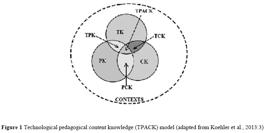
This study adopts a theoretical framework that helps to explore and use teachers' knowledge in identifying challenges and opportunities that support and enforce teachers' implementation of computer programs in schools. According to Shulman (1987), the three main circles (see Figure 1) represent the main categories of knowledge needed by teachers in the teaching and learning environment. These are technological knowledge (TK), pedagogical knowledge (PK) and content knowledge (CK).
The main categories of knowledge intersect in pairs to form three sub-types of knowledge, namely technological pedagogical knowledge (TPK), technological content knowledge (TCK) and pedagogical content knowledge (PCK) (see Figure 1), which are essential for skills acquisition. The three main categories, as adapted from Shulman (1987), interconnect to form the technological pedagogical content knowledge (TPACK), which is very useful in the teaching and learning of mathematics.
Aim of the Study
The study explored specific factors that contribute to challenges and opportunities regarding teachers' use of computers for the teaching and learning of mathematics in schools.
Methodology
This paper used a qualitative research approach and aimed at examining the factors contributing to teachers' and learners' challenges and opportunities for using computer technology in the teaching and learning of mathematics in schools. A case-study design was used to facilitate an in-depth understanding of teachers' and learners' problems. Data was collected through open-ended questionnaires and face-to-face interviews. The aim of the interviews was to gather in-depth information from the teachers in the sampled schools about how they taught certain mathematics topics without the use of computers, as well as the challenges faced by learners in the learning of mathematics with or without the use of ICTs. The study further focused on determining whether or not they (teachers) were being deprived of using available computers in their schools for teaching and learning.
The population for the study consisted of mathematics teachers (N = 50) in secondary schools in the OR Tambo Education District of the Eastern Cape province of South Africa. The sample comprised five mathematics teachers - three males and two females. The five learners included two boys and three girls selected from the five performing schools in the OR Tambo Education District. The teachers were between 25 and 55 years of old. Some of them had no computer knowledge. In this report, only factors contributing to teachers' and learners' challenges and opportunities regarding the use of computers for mathematics instruction and learning in the selected performing schools were established. I also investigated reasons why the schools happened to be performing schools although the teachers and learners did not use computers for the teaching and learning of mathematics. Convenience sampling, based on the participants' accessibility and willingness to take part, was used in the selection of the participants. This sampling technique was used to ensure that every possible characteristic of the participants was accounted for. Consent was sought from the participating learners and teachers and the parents of under-aged learners.
Questionnaires and interviews were used to collect data from the participants. I distributed the open-ended questionnaires to the participants who indicated their views on the topic under study. I also interviewed the participants individually after collecting the questionnaires in order to check correlation between the responses to the questionnaires and the interviews. Interviews were also used to check how teachers recorded/documented/captured official information regarding the learners without the use of computers. Content analysis was used to analyse data. Interviews were coded into categories and themes. To ensure the trustworthiness of this study, I adopted renowned approaches for selecting reliable methodology, design, instruments and relevant literature that embraced the procedures of data collection and analysis (Creswell, Klassen, Plano Clark & Clegg Smith, 2011; Yin, 2016).
Results
The results of the research are presented according to the themes that emerged from the coding and analysis of the data. The themes that emerged are challenges and opportunities for using computers for related school activities, improving computer technology confidence among teachers and learners, support measures for computer programs, and controlled use of computer technology in schools. The various responses relating to the themes are presented below.
Challenges of Using Computers for Related Work Activities in Schools
The responses given by teachers and learners indicated that they faced many challenges in using computers for their daily school activities and projects. These included creating and drawing of graphs for learners' assessment, capturing of raw marks for the South African Schools Administration and Management Systems (SA-SAMS) document, retrieving information from computers for teachers' and learners' benefit, and guiding learners in retrieving information from the internet for their homework and projects. The following extracts from participants' responses, which are presented verbatim, confirm these challenges.
Teacher A:
As for me I have not been able to and I cannot use computer for teaching and learning of mathematics in my school. This is due to the fact that the computers are locked up in a computer lab and nobody is allowed to use the computer(s) for any purposes in the school. Nobody is allowed to go to the computer lab for anything. The principal is the one who is keeping the keys to the lab. He always says that you guys don't know how to use computers so if you go there you would spoil the computers so use any local materials available at your disposal to teach your subject. The principal always says that after all, you have been producing good results but you are not using computers.
Teacher B:
In most of our teaching we needed to put in more effort in order for us to produce good results. We had to call some of our friends from other schools to presents some topic with their computers for us. This means that we could have done better if we had our own computers in schools.
Learner C:
Since our teachers are not allowed to use computers in teaching us in schools, sometimes we find it very difficult to complete some of our assignments on time as some of the assignments and projects need to be researched.
Learner A:
As for me I have to rely on my father's computer at home to search for information for my assignments and projects through his guidance when he is not busy using the computer at home. This has made me to acquire some computer skills that had helped me to solve a lot of mathematics activities especially those with graphs and charts. This means that if the principals are giving us chances to use these computers in school, I promise you I will be better than what I am today in mathematics.
Improving Computer Technology Confidence Among Teachers and Learners
Teachers and learners indicated that they wished to improve their computer technology skills and ideas. This would benefit and add value to the teaching and learning of mathematics. This is what two teachers and one learner had to say about the lack of opportunities:
Teacher E:
Because I was not used to being using computers for personal purposes, I find it difficult to use it for teaching and learning of mathematics. This is because we have never been encouraged by our managers to practice the use of computers in our schools. We have no confidence of using it for teaching of mathematics even though we feel guilty of not using it in our teaching.
Teacher D said:
The management should try to improve our computers skills by giving us chance to use school's computers daily. We would have long been perfect of using it for teaching of mathematics if we had not been deprived of it use and been encouraged by our managers.
One learner had this to say:
If the principals will not give chances to teachers to use the computers in schools, as for us we should be given opportunities to use them daily by employing somebody who can teach us how to use them in learning of mathematics. After all the government brought these computers to the schools because of learners and there are so many maths software programs which are easy to learn by yourself and also easy to understand if you are able to practice them every day. Even through this small help that I am getting from my father at home, I am able to learn a lot of computer programs, and through that, I able to use the computer to make or develop some models by yourself which are very good to understand so many mathematics concepts which are difficult to understand if you are not using a computer.
Support Measures on Computer Programs
The participants indicated that support measures should be instituted by the Department to encourage and enforce teachers' use of computers, not only for mathematics, but for all subjects (Curriculum Assessment Policy Statements [CAPS]) to enhance classroom teaching and learning. Some indicated that even though they had not been familiar with the use of computers, they believed that the use of computers in the teaching and learning of mathematics would have a positive influence on learners' performance. If support measures were strictly implemented, teachers and learners would have access to computers and would use them more effectively. Some of their views are presented below.
Teacher A:
In fact, this is my first time to use computer for teaching but I hope it would make difference in my teaching of mathematics.
Teacher C:
I am not sure whether I would be able to apply it in my teaching since I am not familiar with the skills but what I am doing with my learners, for the example, I sometimes ask learners with hands-on information to share with their friend and I hope once I introduce it in the class, they would love it. TB: Even though the use of computers in teaching and learning of mathematics is not a panacea to the mathematics problem in the country, because you can even teach whatever you want to teach if you don't have computers, however, I have seen that those who are using them in teaching are making difference in the teaching and learning of mathematics. So we need to learn it use in teaching and learning of mathematics.
Learner D:
If we get access to school computers, we learners will be able to practice ourselves even if the teachers are not around because practice makes a man perfect. The more we practice the more we can become perfect in using computers and other ICT equipment to solve mathematics problems.
Controlled Use of Computer Technology in Schools
Teachers indicated that the only way to solve the problem of poor computer use was to make computers available to teachers at all times so that they (teachers) would be conversant with the use of computers and acquire computer skills for the teaching and learning of mathematics in schools. Learners also indicated that if teachers had frequent access to computers, they would be able to assist learners to acquire skills in using mathematics software programs that would enhance their understanding of mathematics problem-solving. The following quotes from TC, TK and Learner B support the above statement:
Teacher C:
Since we are not allowed to use it in our schools, I have now beginning to develop negative attitude towards its use for teaching and learning of mathematics. But if we get complete control of its use, all these negative attitudes will go away as we are yelling to use it for our teaching and learning.
Teacher K:
As for me, I will always use it for teaching if we get control of its use since I already have the skills of using computers for teaching and plan my lesson well before teaching. Even when I am teaching my extra class learners, that is what I use a lot in some of the topics in maths. This helps me not to deviate from my teaching and also guide me when I am grouping my learners in group discussion. So this problem of not allowing us to use in schools be stopped as a matter of fact.
Learner B:
This time there are a lot of computer software programs available on the internet so if we get the chance to use computers available in our schools, we can do a lot of things with computer which will help us to understand mathematics much better than relying on teachers only in learning of mathematics.
Findings and Discussion
The participants elaborated on a number of factors relating to challenges and opportunities regarding the use of computers in schools. These pertained to why they (teachers) were not able to use computers for the teaching and learning of mathematics in their schools and to enable them to acquire additional skills in the teaching and learning of mathematics. The teachers indicated that hands-on activities regarding computer technology was important in achieving their objective of teaching mathematics successfully. This supports international research which demonstrates that knowledge and use of ICT has become an important part of most organisations and businesses in today's technological world, and people must be supported in acquiring these skills (Zhang & Aikman, 2007) to help them in teaching and learning. The Association of Mathematics Teacher Educators (2006) further supports this when saying that technology is becoming an important tool for doing mathematics in today's world and that technology is important for better understanding in the teaching and learning of mathematics in schools. The use of ICTs also improves teachers' pedagogical knowledge of teaching mathematics. Moreover, teacher can use ICTs for non-teaching activities, and this further improves their pedagogical content knowledge of teaching mathematics (Haddad, Ferreira & Faria, 2014). In addition, learners indicated in their responses that the use of the TPCK model in the learning of mathematics helped them to develop a similar model that included a conceptual system of ideologies that in turn helped them to construct and explain real-life situations and apply them in similar or different situations when problem-solving. Thus, the more they practiced, the more they would improve in using computers to create different models that help them understand the many mathematical concepts that can be applied in life. Messina and Tabone (2012) and Shu (2016) are of the view that the application of the TPCK model in the teaching and learning environment can help in explaining the complexity of ICT integration into the teaching and learning of mathematics. It is therefore paramount that mathematics teachers should be encouraged to use computers for teaching and learning. The use of ICT, especially in schools, for improving the learning and teaching of mathematics is therefore essential since mathematics deals with real-life situations in our daily activities (Ojose, 2011). For one to understand a concept and use it or apply it correctly in real-life situations, one needs to actively perform certain activities regularly in order to understand and appreciate its value.
For teachers to be able to use computers wisely for the teaching and learning of mathematics, they need to be exposed to its use frequently. The principals' refusal of allowing teachers to use school computers should be dealt with immediately by the Department of Education. This will ensure that teachers can use computers more efficiently. Moreover, teachers should know where and under what circumstances computers should be used in the teaching of mathematics.
During the interviews the participants were asked whether or not the use of computer programs would influence their ways of teaching and learning mathematics in schools. Four of the participating teachers indicated that they would like to use ICT to teach some of the topics such as graphs, however, they were not able to use computers to teach these topics and as a result, they had to call somebody to teach certain topics for them in their respective schools. This demoralised them. This is what one teacher had to say:
I remember when the teacher was teaching graphs using computer programs (Haymaths). I was so happy as the teacher could do everything easily and self-explanatory, but I felt guilty as a teacher and wondered what my learners would take me for. This actually disturbs me as a mathematics teacher. So I must do my best to develop myself in ICT to acquire some skills that can help my learners in learning of mathematics using computers.
Clearly, from these comments, teachers were desperate to use computers in the teaching and learning of mathematics and therefore they must be allowed to do so. Tarhini et al. (2017) and Yadav (2016) contend that the development of ICT has provided an innovative learning environment for teachers and learners to stimulate and enhance learning and teaching processes worldwide. A study conducted in Malaysia showed that teachers' use of computers in teaching and learning had a moderate impact on their professional development through technology (Khambari, Luan & Ayub, 2012).
Another teacher commented on the program that had been used by teachers from other schools who used computers for the teaching of graphs. Her inadequacy is clear:
As for me, I don't have any problem with any mathematics content but what actually disturbs me is that I'm not able to use computers like some of my friends do in teaching. So I could see that I lack something relevant in terms of skill(s) acquisition in teaching mathematics. All this has happened because of so-called school managers. Instead of giving teachers an opportunity to use the computers in the schools they always deprive teachers from using them. I'll be very happy to know more about usage of computers to teach mathematics but here I'm not even able to press the keyboard.
Three learners indicated that the use of computers at home had helped them to use Google Apps for many mathematical activities both at school and at home. This included searching for information for assignments and projects.
Some teachers described their inability to use computer technology for teaching mathematics and their attempts to have the computers released:
Teacher A:
... how do I use computers to teach mathematics when our managers do not allow us to use the available computers in our schools? Maybe I may have to fight with them before they allow us use for the benefit of the learners.
Teacher C:
It looks as if I have to teach. I say the use of computers for teaching and learning of mathematics is important. I always kept on reminding my principal why he not giving us chances to use learners to reflect and predict on their thought processes in order to attain my specific outcome in teaching.
Teacher C:
The department should make it compulsory for every teacher to use it in class in order to equip learners in the teaching and learning of re-teach the lesson again and sometimes invite learners who have the idea to explain to them.
Recommendations
The following recommendations are made to help enforce and monitor the use of available computers in schools. Teachers should embark on the use of tangible and reliable technologies that support learners' understanding of mathematics in all spheres. For example, the use of an iPad for learning helps to increase fluency in number operations and to some degree, mathematical reasoning. The district authorities should ensure that school computers are made available for the relevant staff and learners in all schools in the country. Computer literacy should be a compulsory subject for prospective teachers at tertiary institutions in the country.
Conclusion
From the findings of the study, it can be concluded that mathematics teachers have a professional responsibility to be reflective and evaluative about how they can overcome the problem of not being allowed to use computers in teaching. Furthermore, they need to develop strategies for using computers in their daily teaching of mathematics in schools. This study differs from the previous mathematics-related research projects, hence this exploration can serve as a base-line observation that can be used to encourage the development of the skills of many rural teachers on how to use computers for the teaching and learning of mathematics. It is my wish that teachers are allowed to use available computers in the respective schools and are assisted in acquiring skills that will enable them to use computers for the teaching of mathematics in class and for administrative functions.
Notesi. Published under a Creative Commons Attribution Licence.
References
-
Angeli C & Valanides N 2005. Preservice elementary teachers as information and communication technology designers: An instructional systems design model based on an expanded view of pedagogical content knowledge. Journal of Computer Assisted Learning, 21(4):292-302. https://doi.org/10.1111/j.1365-2729.2005.00135.x
» https://doi.org/10.1111/j.1365-2729.2005.00135.x -
Association of Mathematics Teacher Educators 2006. Preparing teachers to use technology to enhance the learning of Mathematics. San Diego, CA: Author. Available at https://amte.net/sites/default/files/amtetechnologypositionstatement.pdf. Accessed 10 October 2017.
» https://amte.net/sites/default/files/amtetechnologypositionstatement.pdf -
Attard C & Northcote M 2011. Mathematics on the move: Using mobile technologies to support student learning (Part 1). Australian Primary Mathematics Classroom, 16(4):29-31. Available at https://files.eric.ed.gov/fulltext/EJ961656.pdf. Accessed 27 September 2019.
» https://files.eric.ed.gov/fulltext/EJ961656.pdf -
Beukes-Amiss CM & Chiware ERT 2006. The impact of diffusion of ICTs into educational practices: A review of the Namibian situation. NERA Journal:29-45. Available at http://repository.unam.edu.na/bitstream/handle/11070/685/neraocr.pdf?sequence=1&isAllowed=y. Accessed 16 June 2016.
» http://repository.unam.edu.na/bitstream/handle/11070/685/neraocr.pdf?sequence=1&isAllowed=y - Bransford JD, Brown AL & Cocking RR 2000. How people learn: Brain, mind, experience and school. Washington, DC: National Academy Press.
-
Buabeng-Andoh C 2012. Factors influencing teachers' adoption and integration of information and communication technology into teaching: A review of the literature. International Journal of Education and Development using Information and Communication Technology, 8(1):136-155. Available at https://files.eric.ed.gov/fulltext/EJ1084227.pdf. Accessed 28 September 2019.
» https://files.eric.ed.gov/fulltext/EJ1084227.pdf -
Chai CS, Chin CK, Koh JHL & Tan CL 2013. Exploring Singaporean Chinese language teachers' technological pedagogical content knowledge and its relationship to teachers' pedagogical beliefs. The Asia-Pacific Education Researcher, 22(4):657-666. https://doi.org/10.1007/s40299-013-0071-3
» https://doi.org/10.1007/s40299-013-0071-3 -
Creswell JW, Klassen AC, Plano Clark VL & Clegg Smith K 2011. Best practices for mixed methods research in the health sciences. Available at http://www2.jabsom.hawaii.edu/native/docs/tsudocs/Best_Practices_for_Mixed_Methods_Research_Aug2011.pdf. Accessed 27 September 2019.
» http://www2.jabsom.hawaii.edu/native/docs/tsudocs/Best_Practices_for_Mixed_Methods_Research_Aug2011.pdf - Dawes L 2001. What stops teachers using new technology? In M Leask (ed). Issues in teaching using ICT. London, England: Routledge Falmer.
-
Galligan L, Loch B, McDonald C & Taylor JA 2010. The use of tablet and related technologies in mathematics teaching. Australian Senior Mathematics Journal, 24(1):38-51. Available at https://files.eric.ed.gov/fulltext/EJ891808.pdf. Accessed 24 September 2019.
» https://files.eric.ed.gov/fulltext/EJ891808.pdf -
Haddad MEO, Ferreira NSC & Faria AA 2014. The use of educational technologies in distance education- enabling the appropriation of teaching and learning process. Open Journal of Social Sciences, 2:54-58. https://doi.org/10.4236/jss.2014.21006
» https://doi.org/10.4236/jss.2014.21006 -
Harris JB & Hofer MJ 2011. Technological pedagogical content knowledge (TPACK) in action: A descriptive study of secondary teachers' curriculum-based, technology-related instructional planning. Journal of Research in Technology Education, 43(3):211-229. https://doi.org/10.1080/15391523.2011.10782570
» https://doi.org/10.1080/15391523.2011.10782570 - Hennessey BA 2010. Intrinsic motivation and creativity in the classroom: Have we come full circle? In RA Beghetto & JC Kaufman (eds). Nurturing creativity in the classroom. New York, NY: Cambridge University Press.
- Jedeskog G 2005. Ch@nging school: Implementation of ICT in Swedish school, campaigns and experiences 1984-2004. Uppsala, Sweden: Pedagogiska Institutionen, Uppsala Universitet.
- Khambari MN, Luan WS & Ayub AFM 2012. Promoting teachers' technological development through laptops. Pertanika Journal of Social Sciences & Humanities, 20(1):137-145.
-
Koehler MJ, Mishra P, Akcaoglu M & Rosenberg JM 2013. The technological pedagogical content knowledge framework for teachers and teacher educators. New Delhi, India: CEMCA. Available at https://pdfs.semanticscholar.org/8d80/98360cd542c98ac33c47e7b4232919c0a40a.pdf. Accessed 28 September 2019.
» https://pdfs.semanticscholar.org/8d80/98360cd542c98ac33c47e7b4232919c0a40a.pdf - Laudon KC & Traver CG 2013. E-commerce: Business, technology, society (9th ed). Boston, MA: Pearson.
-
Maher D 2013. Pre-service primary teachers' use of iPads to support teaching: Implications for teacher education. Educational Research for Social Change, 2(1):48-63. Available at https://opus.lib.uts.edu.au/bitstream/10453/27340/1/2013001701OK.pdf. Accessed 23 September 2019.
» https://opus.lib.uts.edu.au/bitstream/10453/27340/1/2013001701OK.pdf -
Messina L & Tabone S 2012. Integrating technology into instructional practices focusing on teacher knowledge. Procedia - Social and Behavioral Sciences, 46:1015-1027. https://doi.org/10.1016/j.sbspro.2012.05.241
» https://doi.org/10.1016/j.sbspro.2012.05.241 - Mishra P & Koehler MJ 2006. Technological pedagogical content knowledge: A framework for teacher knowledge. Teachers College Record, 108(6):1017-1054.
-
Nivala M 2009. Simple answers for complex problems: Education and ICT in Finnish information society strategies. Media, Culture & Society, 31(3):433-448. https://doi.org/10.1177%2F0163443709102715
» https://doi.org/10.1177%2F0163443709102715 -
Ojose B 2011. Mathematics literacy: Are we able to put the mathematics we learn into everyday use? Journal of Mathematics Education, 4(1):89-100. Available at http://educationforatoz.com/images/8.Bobby_Ojose_--_Mathematics_Literacy_Are_We_Able_To_Put_The_Mathematics_We_Learn_Into_Everyday_Use.pdf. Accessed 23 September 2019.
» http://educationforatoz.com/images/8.Bobby_Ojose_--_Mathematics_Literacy_Are_We_Able_To_Put_The_Mathematics_We_Learn_Into_Everyday_Use.pdf -
Ottestad G 2010. Innovative pedagogical practice with ICT in three Nordic countries - differences and similarities. Journal of Computer Assisted Learning, 26(6):478-491. https://doi.org/10.1111/j.1365-2729.2010.00376.x
» https://doi.org/10.1111/j.1365-2729.2010.00376.x -
Pierce R & Ball L 2009. Perceptions that may affect teachers' intention to use technology in secondary mathematics classes. Educational Studies in Mathematics, 71(3):299-317. https://doi.org/10.1007/s10649-008-9177-6
» https://doi.org/10.1007/s10649-008-9177-6 -
Resnick LB 1987. The 1987 Presidential Address: Learning in school and out. Educational Researcher, 16(9):13-20+54. Available at https://pdfs.semanticscholar.org/f418/08bdf11d61eeaa6c1fea06634bdb9137109d.pdf. Accessed 21 September 2019.
» https://pdfs.semanticscholar.org/f418/08bdf11d61eeaa6c1fea06634bdb9137109d.pdf -
Samuelsson J 2007. How students interact when working with mathematics in an ICT context. Seminar.net -International Journal of Media, Technology & Lifelong Learning, 3(2):1-13. Available at https://journals.hioa.no/index.php/seminar/article/view/2506/2405. Accessed 21 September 2019.
» https://journals.hioa.no/index.php/seminar/article/view/2506/2405 -
Shu X 2016. An action research on TPACK's influence on teachers of National Open University: Exemplified with an English teacher of Zhejiang Radio and TV University. Open Access Library Journal, 3:e2336. https://doi.org/10.4236/oalib.1102336
» https://doi.org/10.4236/oalib.1102336 -
Shulman L 1987. Knowledge and teaching: Foundations of the new reform. Harvard Educational Review, 57(1):1-23. https://doi.org/10.17763/haer.57.Lj463w79r56455411
» https://doi.org/10.17763/haer.57.Lj463w79r56455411 -
Stoffels NT 2007. A process-oriented study of the development of science textbooks in South Africa. African Journal of Research in Mathematics, Science and Technology Education, 11(2):1-13. https://doi.org/10.1080/10288457.2007.10740617
» https://doi.org/10.1080/10288457.2007.10740617 -
Swanson HL, Moran AS, Bocian K, Lussier C & Zheng X 2013. Generative strategies, working memory, and word problem solving accuracy in children at risk for math disabilities. Learning Disability Quarterly, 36(4):203-214. https://doi.org/10.1177%2F0731948712464034
» https://doi.org/10.1177%2F0731948712464034 -
Tajudin NM & Kadir NZA 2014. Technological pedagogical content knowledge and teaching practice of Mathematics trainee teachers. In MT Ismail, S Ahmad, RA Rahman (eds). Proceedings of the 21st National Symposium on Mathematical Sciences (SKSM21). Melville, NY: AIP Publishing LLC. https://doi.org/10.1063/L4887681
» https://doi.org/10.1063/L4887681 -
Tarhini A, Hone K, Liu X & Tarhini T 2017. Examining the moderating effect of individual-level cultural values on users' acceptance of E-learning in developing countries: A structural equation modelling of an extended technology acceptance model. Interactive Learning Environments, 25(3):306-328. https://doi.org/10.1080/10494820.2015.1122635
» https://doi.org/10.1080/10494820.2015.1122635 -
The Australian Association of Mathematics Teachers Inc. 2006. AAMT standards for excellence in teaching mathematics in Australian schools. Adelaide, Australia: Author. Available at http://www.aamt.edu.au/Standards. Accessed 16 February 2009.
» http://www.aamt.edu.au/Standards -
United Nations Educational, Scientific and Cultural Organization (UNESCO) & International Centre for Technical and Vocational Education and Training (UNEVOC) 2014. Vocational pedagogy: What it is, why it matters and how to put it into practice (Report of the UNESCO-UNEVOC virtual conference 16-26 May 2014). Bonn, Germany: Author. Available at https://unevoc.unesco.org/fileadmin/up/e-forum_synthesis_report_on_vocational_pedagogy.pdf. Accessed 28 September 2019.
» https://unevoc.unesco.org/fileadmin/up/e-forum_synthesis_report_on_vocational_pedagogy.pdf -
Van Staden EL 2015. A work-place-based learning (WPBL) policy: The national perspective [PowerPoint presentation]. Available at http://www.saair-web.co.za/wp-content/uploads/2015/08/06-EvS-WBL-for-PSET.pdf. Accessed 27 September 2019.
» http://www.saair-web.co.za/wp-content/uploads/2015/08/06-EvS-WBL-for-PSET.pdf -
Webb P & Austin P 2009. The family maths programme: Parents' perceptions of what influences their engagement, enjoyment and confidence within a complex learning community. Education as Change, 13(1):27-14. https://doi.org/10.1080/16823200902933438
» https://doi.org/10.1080/16823200902933438 -
Wittrock MC 1989. Generative processes of comprehension. Educational Psychologist, 24(4):345-376. https://doi.org/10.1207/s15326985ep2404_2
» https://doi.org/10.1207/s15326985ep2404_2 -
Wu JH, Tennyson RD & Hsia TL 2010. A study of student satisfaction in a blended e-learning system environment. Computers & Education, 55(1):155-164. https://doi.org/10.1016/j.compedu.2009.12.012
» https://doi.org/10.1016/j.compedu.2009.12.012 - Yadav A 2016. Significance of ICT in teacher education. Asian Journal of Educational Research & Technology, 6(2):184-189.
- Yelland N 2001. Teaching and learning with information and communication technologies (ICT) for numeracy in the early childhood and primary years of schooling. Canberra, Australia: Department of Education, Training and Youth Affairs.
- Yin RK 2016. Qualitative research from start to finish (2nd ed). New York, NY: The Guilford Press.
-
Zehra R & Bilwani A 2016. Perceptions of teachers regarding technology integration in classrooms: A comparative analysis of elite and mediocre schools. Journal of Education and Educational Development, 3(1):1-29. Available at https://journals.iobmresearch.com/index.php/JoEED/article/viewFile/709/156. Accessed 3 September 2019.
» https://journals.iobmresearch.com/index.php/JoEED/article/viewFile/709/156 -
Zhang P & Aikman S 2007. Attitudes in ICT acceptance and use. In JA Jacko (ed). Human-computer interaction: Interaction design and usability. HCI 2007. Lecture notes in computer science (Vol. 4550). Heidelberg, Germany: Springer. https://doi.org/10.1007/978-3-540-73105-4_112
» https://doi.org/10.1007/978-3-540-73105-4_112
Revised: 19 February 2019
Accepted: 22 April 2019
Published: 31 December 2019