Exploring learning support among parents and teachers of Grade 1 learners in a low-income school in South Africa
Abstract
Learning support plays an integral part in children's learning and cognitive development. In the study reported on here we explored the various types of learning support provided at home and school for Grade 1 learners in a low-resource school in the Msunduzi municipality of the KwaZulu-Natal province, South Africa. A descriptive case study design and semi-structured interviews with a purposefully selected sample of 12 participants, which included 2 teachers of Grade 1 learners and 10 parents of Grade 1 learners, was adopted. The results revealed that while parents described learning support as being physically present and available when needed, the teachers defined learning support as the provision of stimulating educational experiences aimed at promoting greater learning. It was further revealed that many of the parents assisted with homework, supported learning through singing and reciting poems, and engaging in fun play activities. The teachers adopted aural and visual support techniques. In the classroom, further support came from peers and teaching assistants. We recommend that the benefits of peer, sibling and teacher assistant support be recognised and promoted within the schooling environment.
learning support; low-income schools; parents; South Africa; teachers; zone of proximal development
Introduction
Learning support is a significant part of a functioning learning environment and it centres on how an educator or tutor can aid learners outside of the official provision of content or skills development (Bates, 2014). Such support can include accompanying or extra class instruction, support-group work, and promoting learning and note-taking skills (De Boer & Kuijper, 2021; Mashua, Steyn, Van der Walt & Wolhuter, 2008). A fundamental part of learning from others is emphasised in Vygotsky's zone of proximal development, which outlines how much more a child can achieve academically when learning with the support of a teacher, parent, caregiver, or peer (Goswami & Bryant, 2007). However, learning from others through supportive channels is not always available, and this is especially the case in low-support schools in rural communities in South Africa. Low-resource schools usually lack qualified teachers, multi-grade teaching takes place, the teacher-learner ratios are unreasonably high, and teaching staff have poor morale and lack inspiration (Hlalele, 2014).
Linked to the need for learning support, the policy in White Paper 6 advocates that an inclusive education system requires that all learners, irrespective of race, gender, language, class, religion, disability, HIV/AIDS status (human immunodeficiency virus/acquired immune deficiency syndrome) and culture have the right to access education as well as the necessary support (Department of Education [DoE], 2001). Prior to the introduction of this policy, support for learners was the concern of specialised professionals who were proficient and could provide such support (Mahlo, 2011). Teachers did not consider it as their duty to aid these learners as they were not trained to do so. However, currently, teachers are required to adjust the surroundings, their approaches, the curriculum, and instruction methods in a manner that lessens learners' external and internal barriers to learning (Mahlo, 2011; Walton & Engelbrecht, 2024).
The current challenge faced by teachers in rural areas is that the provision of individual attention and support to a learner is not possible in a classroom with many learners (Mahlo, 2017). Further challenges include a lack of support from caregivers. Mahlo (2017) outlines that if parents and caregivers assume responsibility for their children, teachers, in turn, will feel motivated to help the learners as they will know that they have the parents' and caregivers' support. One of the reasons for this lack of support is that many parents and caregivers in South Africa face socio-economic challenges; many are forced to leave their children with siblings or grandparents. In rural homes, many parents often have lower levels of education and are normally ill-equipped to meet the educational needs of their children (Skosana, 2018). Following this challenge to learning support, we explored the extent to which parents and teachers of Grade 1 learners are still able to provide learning support despite the constraints of their physical and social contexts.
Literature Review
Learning support: Home
According to Anthony, Brazier and Moccia (2009), the process of learning does not start when a child walks through the doors at school, nor does it end when the child leaves school; learning takes place all the time, throughout life. Learning starts at a very young age and one's childhood is a period in which rapid brain development takes place. There is an increase in synapses and connections between regions of the brain, with the brain reaching 90% of its total weight when the child reaches the age of 5 (Dubois, Dehaene-Lambertz, Kulikova, Poupon, Hüppi & Hertz-Pannier, 2014). Research by Ebrahim, Seleti and Dawes (2013) indicates that when children are born, they are ready to learn through experiencing their surroundings. Moreover, depending on the motivation they receive, brain activity linked to language, memory and higher cognitive functions develops swiftly (Ebrahim et al., 2013). However, for a learner living in a poor, rural community, parental involvement is lacking as parents are mainly concerned with living day to day and not much about their child's educational goals and schooling (Msila, 2012; Myende & Nhlumayo, 2022). Matshe (2014) reports that many barriers such as time, a lack of skills, and poor communication channels hinder parental involvement. Moreover, it is also difficult to escape a low-resourced, under-financed public school system - especially in low-income communities (Msila, 2012). Several factors like parents with a low level/lack of schooling, exposure to bad educational experiences, homelessness, lack of time and resources, abuse and neglect, and dangerous neighbourhoods cause impoverished children to be more vulnerable to educational failure (Du Plessis, 2014; Du Plessis & Mestry, 2019). In spite of the numerous socio-economic challenges many African countries acknowledge the value of involving parents in their children's education (Ndebele, 2018). In South Africa, the Department of Basic Education (DBE) strives to get parents involved in their children's schooling through the introduction of the school governing body (SGB) (Republic of South Africa, 1996). The main stakeholders in the SGB are the parents and their responsibility is governance of the school (Tsebe & Scherman, 2020). Partially or uneducated parents find it challenging to work with the school and teachers and to support their children with homework and extra undertakings (Skosana, 2018).
Various simple ways are available for parents to be more supportive with their children's homework, including providing space and learning materials, interacting with teachers about instructions regarding homework, and monitoring the completion of homework (Hoover-Dempsey, Battiato, Walker, Reed, DeJong & Jones, 2001; Ndebele, 2018). Homework teaches learners to work independently and allows them to develop a sense of responsibility (Januseva, Pejcinovska, Talevski Dimitrija & Merkovska, 2018). Homework also assists in developing higher cognitive processes, allowing learners to solve problems, and think creatively and critically (januSeva et al., 2018). Skandera and Sousa (2003) find that homework is the groundwork for learners' future success. It helps them to develop good behaviour and academic discipline, and prepares them for studies later in life, which in turn will prepare them to function as adults. In this study we uncovered the different forms of learning support that parents provide amid a lack of resources and in many cases, a low level of education.
Learning support: Teachers
In the classroom, the teacher is the first and most significant link in the chain of support in ensuring quality learning for learners (Oswald, 2019). The support that a teacher offers is within the margins of their understanding, skills, and resources (Nel, Tlale, Engelbrecht & Nel, 2016). Findings from a research study in South Africa show that learner accomplishment in rural schools is quite poor (Du Plessis & Mestry, 2019). The authors further outline the various challenges encountered in rural schools. These include the employment and retention of qualified teachers, the reluctance of teachers to work or reside in rural areas due to the shortage of access to professional opportunities and teachers doing several tasks without appropriate reimbursement (Du Plessis & Mestry, 2019). The South African Department of Education outlines the State's obligation to provide basic learning support (DoE, 2001). These services include the training of learning support teachers, a focus on multi-level classroom teaching, collaborative learning and teaching and the development of learner's strengths and proficiencies, rather than concentrating on their deficiencies (DoE, 2001). Learning support at school can be in the form of classroom engagement, allowing children to be more interactive, thus creating learning opportunities (Langeloo, Mascareño Lara, Deunk, Klitzing & Strijbos, 2019). It also includes extra class instruction, advice on how to meet their social, emotional and academic needs, and nutritional support (Bojuwoye, Moletsane, Stofile, Moolla & Sylvester, 2014).
While literature focuses on the teacher' s role in learning support, these studies highlight the support provided to learners in full-service schools, or to intermediate learners. However, it does not adequately reflect how Grade 1 teachers in low-income schools provide support (Conway, 2017; Joorst, 2010). Therefore, we intended to explore the unique and creative forms of learning support provided by teachers to Grade 1 learners, as this is considered an important grade in the basic education pathway.
Conceptual Framework
The Vygotskian sociocultural approach
Vygotsky developed the concept of scaffolding referring to the brief support that individuals receive from more educated others (such as caregivers, teachers, and peers) during their development (1978:86-87). Related to this is the zone of proximal development (ZPD), which refers to the difference between what people can accomplish by themselves and what they can accomplish with the support of others (Margolis, 2020; Samana, 2013; Vygotsky, 1978). In a perfect environment, a child's caregivers, teachers, and more mature peers can nurture healthy cognitive development and foster learning by providing support. We explored the types of learning support provided by parents and teachers that aided Grade 1 learners in their learning.
Bronfenbrenner's Bioecological Model
Learners' environmental contexts should be taken into consideration when examining developmental outcomes. Bronfenbrenner's bioecological model contributes to the understanding of learning support in the cognitive development of Grade 1 learners in a low-resource school (Bronfenbrenner, 1995; Lloyd & Fernyhough, 1999). Bronfenbrenner's ecological approach reveals how the microsystem, like the home environment, is linked with the mesosystem (e.g. the school, teachers, and other schooling workforce), as well as broader society in deciding, directing and aiding learners' growth and learning (1995).
Research Questions
Our study was guided by the following research questions:
• How do the parents and teachers of Grade 1 learners conceptualise learning support?
• How do parents in low-income contexts provide learning support for their children in Grade 1?
• How do teachers of Grade 1 learners in low-income contexts provide learning support for the learners?
Methodology
Sampling and Participants
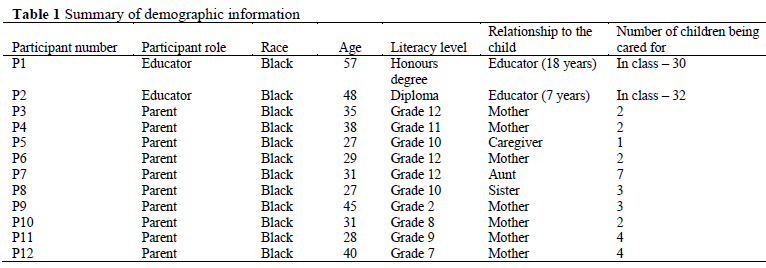
As the aim was to explore how parents and teachers perceived learning support, a qualitative research approach (Cropley, 2022) was used in this study. Furthermore, a descriptive case study design was adopted to explore learning support within the school and home context. Purposeful sampling was used as information-rich cases were required (Palinkas, Horwitz, Green, Wisdom, Duan & Hoagwood, 2015). A sample of 12 participants was selected, including two Grade 1 teachers, and 10 parents of Grade 1 learners. The sample consisted of Black women of different ages and literacy levels. Table 1 provides a summary of the participants' demographic information.
Data Collection and Ethical Considerations
In this study, data were collected through semi-structured interviews. Before starting the data collection process, we presented all participants with a letter confirming that the study was approved by the Ethics Committee of the University of Pretoria's Faculty of Education (Ethics Clearance Number: EDU081/21). We also confirmed that permission to conduct the research in the Msunduzi municipality was requested from the KwaZulu-Natal Department of Basic Education and from the school's principal. Participants were reminded that their involvement was voluntarily and that they were permitted to withdraw their participation at any time without any negative consequence. Additionally, the participants' anonymity and confidentiality were protected through the use of pseudonyms. Interviews with teachers were in English and with parents in IsiZulu. The interviews were conducted in a low-income school in KwaZulu-Natal. The participants were informed that the interview sessions would be recorded and that the researchers would make notes. The interviews lasted between 10 minutes and an hour.
Data Analysis
The data were thematically analysed (Braun & Clarke, 2012) to find common themes. We maintained a reflexivity journal in which detail of the process involved in extracting patterns from the data was recorded. We used manual coding; the coding framework was inductive as we started with no codes and developed codes once the data were analysed. Further analysis of the coded and organised data excerpts was done to look for possible themes of greater importance (Braun & Clarke, 2012). Finally, the themes were examined with the aim of providing clear answers to the research questions, whereafter the report was written. To establish the rigour and trustworthiness of the findings, the analysis and interpretations of the data were based on the data and we attempted to eliminate possible bias due to our own assumptions. To ensure internal credibility we employed triangulation as we used interviews and observation to collect data for this study (Carter, Bryant-Lukosius, DiCenso, Blythe & Neville, 2014). We documented the research process in great detail in an attempt to improve dependability (Anney, 2014). The first author and the research supervisor discussed the outcomes of the study and suggestions for further examination were made.
Results and Discussion
The objective with our study was to explore the various types of learning support provided at home and school for Grade 1 learners in a low-resource school. The themes and accompanying verbatim responses are presented next. The following themes emerged from the findings:
Theme 1: Physical presence and availability
Theme 2: Creative support with home and schoolwork
Theme 3: Singing and reciting poems
Theme 4: Play
Theme 5: Auditory and visual learning support techniques
Theme 6: Support from siblings, peers, and teaching assistants
Physical Presence and Availability
The first theme identified describes how the participants interpreted the concept of learning support. While most of the participants regarded learning support as a way of helping their children, some of the parents felt that their physical presence and availability may well be considered as a form of learning support. Many of the participating parents worked long hours with limited time for additional activities, however, they were available for their children when needed, usually when they returned from work late at night. All of the parents acknowledged providing this support on a regular basis, ranging from 15 minutes to 2 hours per day.
I support them ... also being at home (Participant 3).
Learning support is something to do to make my child learn better, learn more (Participant 12).
The two Grade 1 teachers expressed similar views, stating that learning support encompasses helping learners acquire new information and skills by making the various learning activities interesting. The support provided also brought about an improved understanding of the schoolwork so that learners were better equipped to cope with schoolwork.
Mm ... my understanding of what learning support is that ... is the things that are helping learners to learn more and to find learning interesting for them so that they could easily understand what we are teaching (Participant 2).
Yeah ... The the support help them a lot to to cope better (Participant 1).
Kutty and Joy (2018) found that interesting activities enhanced learning with many learners wanting a chance to explore, imagine and go on field trips. These reports are comparable with the outcomes of a research study by Manurung (2012) who describes how inspired teachers were able to plan joyful lessons in which complex concepts could be explained in simple ways and acceptable examples given so that uninterested learners could be more involved in the lesson. The findings in our study also reflect proximal processes in terms of how the Grade 1 teachers arranged fun, shared activities to engage all learners, thus promoting interaction between learners, peers and teachers (Bronfenbrenner, 1995; Griffore & Phenice, 2016).
Creative Support with Home and Schoolwork
The second theme highlights the forms of learning support provided by parents and teachers. In this theme we focused on the creative methods that both the parents and teachers applied to encourage learning, and to provide much-needed learning support. Many of the parents lacked resources and the necessary educational skills, and used innovative and fun approaches to promote learning within the home environment. While all the parents confirmed that the main form of learning support they provided involved helping their children with their homework, some parents found this task difficult.
I usually help them with homework, and ... the reading, spelling of words, not more than 15 minutes, maybe three times a week. Like giving them ... blank paper to draw what she can draw and ask them to sing songs ... cause sometimes I only help when asked. (Participant 6)
Some of the parents established that their involvement was merely reminding their children to do their homework, and they only assisted when requested to do so. The participating Grade 1 teachers adapted their teaching methods to accommodate the learners' interests and cognitive abilities. They used various practical methods to make learning interesting, such as listening to stories on the radio and using physical objects to explain concepts.
We need to have real objects ... when they are counting, they ... they need something to count ... it can be adding or subtracting. They need to see you take it away, you see, so that they will understand . the term subtraction. (Participant 1)
The findings revealed that teachers sometimes used a variety of manipulatives, including beads, number lines, and flash cards (Mntunjani, Adendorff & Siyepu, 2018). This supports the development of knowledge on a particular number or concept, or techniques related to number processes such as addition (Mntunjani et al., 2018). We found that the Grade 1 teachers used physical objects when explaining mathematical concepts.
They learn uh ... they must understand. They must have this support to really ... in order for them to understand, so most of the time when we are teaching, we must use this support material (Participant 2).
Vygotsky's socio-cultural theory suggests that a child's development and learning are located in a cultural setting (Bredekamp, 2014; Louw & Louw, 2014). In socio-cultural settings, learning is as a result of reciprocal social exchanges that emphasise support between those more knowledgeable and those who know less (Scrimsher & Tudge, 2003; Zaretsky, 2021).
Singing and reciting poems
In the sub-theme to the main theme of creative support with home and schoolwork, the parents described various ways in which songs and poems were used as a form of learning support.
Yes ... we sing together, whatever they sing in school. She teaches me and then we sing (Participant 3).
The songs and poems learnt are either studied at school or are religious verses learnt at the local church. The participating parents described singing out aloud together as one of the methods that they used to make the learning process more fun. The children enjoyed it, and it also assisted them to remember information.
She helps uh ... they sing together, but church songs (Participant 7).
Participants 3 and 5 described the techniques that they used to provide this form of support, stating that when their children struggled to understand a new poem, they encouraged them to sing out one line, thereafter the children taught the poem to the parents. In many ways, this boosted the children's confidence and improved their memory of the poem.
When the child doesn't understand, she makes us sing the thing, so she can understand them like they sing the line to understand (Participant 5).
Although IsiZulu is the language of learning in the Foundation Phase, English is also taught as a subject. Many of the learners struggle to understand English, therefore the teachers use songs and sometimes drama to improve their understanding. This is similar to findings by Džanić and Pejić (2016) who indicate that teachers used songs to teach learners new concepts and language as songs contain language patterns and develop listening skills, articulation and rhythm and most importantly, is regarded as a fun activity while establishing learning.
Our findings indicate that the learning support given by parents promotes family bonding, allowing the children to have fun and learn at the same time, improving language skills, listening skills, and pronunciation. In an experimental study it was found that where music activities, singing, and movement were used in an English language lesson, learners in an experimental group demonstrated considerably better academic scores in comparison to those in a control group (Králová, 2014). The above findings are an indication that music, and even singing and movement, can be considered different forms of learning support that may aid learners academically in the classroom. In the context of low-resource schools, music and songs may be considered a form of learning support as the parents and teachers from the rural community where the study was conducted, were able to constructively interact with learners for learning to take place.
Play
Many of the parents emphasised the importance of play, stating that their children needed more play time at school. The parents expressed the need for more free time as their children became tired when academic lessons continued for lengthy periods of time. Some of the parents suggested taking the learners on excursions to different places where they could play games and be free. Other suggestions included having a sports ground and introducing more play activities like soccer. Most of the parents encouraged play during the weekends as this gave their children the opportunity to interact with their siblings, and also promoted learning.
Maybe you can get something ... a car ... or somewhere where you can take them uh ... where you can take them and make them play or ... they need the time (Participant 3).
Irvin (2017) explains that play creates a ZPD in a child, given that, while playing, children are inclined to behave above their average age and above their daily behaviour. Findings from our study support those of Ogunyemi and Ragpot (2015) that highlight the importance of play, describing it as more than just physical movements but as educational with the necessary elements for motivation that fosters children's overall development.
Auditory and Visual Learning Support Techniques
The participating teachers adapted their lessons to meet the needs of their learners. Kayalar and Kayalar (2017) state that nearly all learners have diverse learning strengths that enable them to concentrate, to remain focused, and to understand and remember significant information and concepts. Syofyan and Siwi (2018) agree that auditory learners learn by listening and moving their lips while reading.
Most of the time because as they are ... the Grade 1s. Most of the time they learn by saying things (Participant 2).
Participant 1 indicated that when the learners struggled to write but still understood the work, she would call the learners to her table and give them the opportunity to give the answers verbally.
They can't write. But ... but I think if the child can't write, I call them here in [sic] my table and stand there. I ask them to give the answers verbally. They get it verbally, they are not able to write it down, I ask them verbally. (Participant 1)
The teachers also described how the radio was used on a regular basis to promote the learners' listening skills. Every day, at a specific time, a story was narrated on an IsiZulu radio station. The learners were encouraged to remain quiet and listen to the story, unfortunately, the radio was stolen in a burglary.
The learners need to listen to the story because at 9 o 'clock all the ... all ... every day at 9 o 'clock, you have the story telling. So, if we had that radios, it would help (Participant 1).
Budyana, Basuki, Nurlaela, Umboh and Nagari (2018) found that the radio promotes listeners' imaginative faculties through words and sounds. The authors further indicate that listening to electronic media required a variety of capabilities, including the ability to concentrate, the ability to understand, and the ability to precipitate information (Budyana et al., 2018).
Visual learning support techniques were also adopted by teachers as they used charts, pictures, physical objects, and books to explain new concepts. Raiyn (2016) clarifies that a large amount of all information processed by the brain is derived from visual formats. As Grade 1 learners are very young, many are unable to read, therefore, pictures and colourful charts are used to assist them with phonics and counting. Raiyn (2016) further explicates that learners understand information better in a classroom when they see it as they are able to remember facts better by connecting ideas, words, and concepts with pictures. Participant 1 described a lesson involving a brown paper bag, stating that many of the learners had never seen a brown paper bag because plastic packets were mainly used in their community, therefore pictures and charts assisted in the learning process.
Maybe we are talking uh ... long time ago we were using paper bag. ... One one time I was teaching them about ... paper bag, but I don't have paper bag. So, they don't understand this paper bag because they know plastic bag. If I am talking about the paper now, they don't understand. So that's why we need these ... these real objects. It helps us a lot because they see it. If they can't see it, they don't understand. (Participant 1)
And try to get the pictures and put it, as you see, pictures next to it so that when the child forgot the phonic, they look at the picture and then after looking at the picture, they remember the phonic. (Participant 1)
Support from Siblings, Peers, and Teaching Assistants
In the classroom, learning experiences and assessment activities create opportunities for learner engagement, and the development of connectedness with peers and teaching staff (Smith, 2011). In this study, these patterns were undoubtably evident when parents, siblings, and peers interacted with the children in the home and school environments, providing learning support in various ways. Support received from siblings, peers, and teaching assistants is discussed in the following paragraphs.
The participating parents described the way in which they encouraged their older children to support their younger siblings with schoolwork and play activities. These parents highlighted that they sometimes found the homework difficult to understand and therefore arranged the assistance of their older children.
She's got an older daughter ... so her older daughter also helps, they sing together (Participant 4).
Not all but some ... she ... she does understand some ... the brother ... when they doing homework (Participant 5).
Parents also used the support provided by siblings due to their own lack of time. The participating parents worked long hours and could not always be available to support their children with their learning, so this responsibility was shared by their older children.
The kids help each other ... they are always helping each other, and I find that when they are ... its him who is explaining to them. They understand more, when he explains to them, they understand more than I've explained. (Participant 2)
High-achieving learners are more inclined to grasp new information quicker, and subsequently assist the teacher in clarifying new concepts to their peers. Bojuwoye et al. (2014:12) confirm this, relating how the teachers in their study encouraged learners to work together in groups, introducing a "buddy system", which inspired and improved the learners' confidence. Participant 1 emphasised that the help received from the teaching assistant was much appreciated as it allowed her the opportunity to work one-on-one with learners who required further learning support. The support by the teaching assistants allowed the teachers more time to focus on smaller groups of learners, thereby allowing for effective teaching.
The teacher's assistant came last week, it's only 5 months, started November until March next year. There are these readers for groups, the small books for groups. When I'm busy with the other group, she'll take the other group. When we are doing writing, when I'm in the uh ... the other rows, she's in the other one. (Participant 1)
Participant 1 described the various ways in which the teaching assistant helped her, which included helping with marking, writing, and reading, however, not teaching. This is consistent with Navarro's (2015) findings, which state that learning support staff contribute to the learners' learning and well-being by providing an improved classroom climate, personalised attention, and better overall teaching.
The study was conducted at only one low-income school in Pietermaritzburg, KwaZulu-Natal, and therefore cannot be generalised to all low-income schools in South Africa. Although a small sample was used, the aim of qualitative studies is to gain a rich, in-depth understanding and this was achieved, albeit with a small sample.
One implication of this study is that the stimulating, creative approaches to learning support adopted by parents and teachers could be encouraged and promoted by the school authorities. This should especially be the case during inter-school meetings and workshops so that other schools and parents in rural communities can benefit, as these methods are not dependent on an abundance of resources. Another implication is a suggested amendment to White Paper 6, outlining the need and benefit of additional teaching assistants in low-income schools. This is necessary as the current policy clearly states that both the youth and adults have the capability to learn if given the required support. Large classes inhibit the teachers' ability to provide individual support, however, the presence of a teaching assistant allows the teacher to provide the needed support. A further recommendation would be that the South African government invest more in rural, low-income schools through the provision of better infrastructure and additional resources, such as libraries and playgrounds.
A positive, real approach to learning support would be for the South African DBE to set up workshops in schools to encourage those individuals closest to the learner, namely, parents, teachers, siblings, and peers. This training would enable them to assist young learners in whatever way is suitable and familiar to them, whether it be telling stories, playing, or merely engaging in conversation. Young learners benefit from reciprocal interaction with siblings and peers, engaging in conversation, and play; in the process, learning occurs naturally. Furthermore, it is suggested that the South African DBE provide educational workshops that equip teachers with the understanding and capabilities to identify learners that need additional aid, and to ensure that the necessary support is in place.
Conclusion and Recommendations
The findings of this study show that the parents and teachers defined learning support as being physically present and available for their children when needed. The teachers outlined their perceptions and experiences of learning support, which encompassed the provision of stimulating learning activities to encourage greater learning.
The teachers established that the support provided helped the learners to acquiring a better understanding of the schoolwork; learners were also better equipped to cope with the volume of work. The results further reveal that parents who lacked time, knowledge, and experience requested that their older children assist the younger siblings. This form of support from siblings allowed learners to engage positively with their older brothers and sisters. The participating parents revealed that they incorporated activities familiar to them such as singing songs, reciting poems, and engaging in stimulating play activities to provide needed support. Furthermore, the Grade 1 teachers found innovative ways of making learning interesting and providing the support needed. The teachers embraced creative approaches to learning, including available resources and aids, whether these involved making charts, using physical objects, or getting additional support from teaching assistants and learners in the classroom.
Our first recommendation is that a comparative study is done on the various forms of learning support provided at different schools (e.g., government, former Model-C, and private schools). The second recommendation is a longitudinal study that monitors the effectiveness of learning support through the various school grades. This would allow one to record the support provided alongside the age of the learner. A longitudinal study would take changes over a period of time into account, thereby providing insight into the cause-and-effect relationship between learning support and learner development as well as academic progress.
Authors' Contributions
AS wrote the manuscript and provided data, conducted the interviews, and thematic analyses. AWF reviewed and worked on subsequent drafts of the manuscript up to the point of submission.
Notesi. Published under a Creative Commons Attribution Licence.
Acknowledgement
This article is dedicated in loving memory to Ms Ashika Singh.
References
- Anney VN 2014. Ensuring the quality of the findings of qualitative research: Looking at trustworthiness criteria. Journal of Emerging Trends in Educational Research and Policy Studies (JETERAPS), 5(2):272-281.
- Anthony D, Brazier C & Moccia P 2009. The state of the world's children: Celebrating 20 years of the Convention on the Rights of the Child (special ed). New York, NY: United Nations Children's Fund.
-
Bates T 2014. Why learner support is an important component in the design of teaching and learning. Blog post, 26 August. Available at https://www.tonybates.ca/2014/08/26/why-leamer-support-is-an-important-component-in-the-design-of-teaching-and-leaming/#:~:text=Leamer%20support%20is%20another%20critical%20component%20of%20an,the%20formal%20delivery%20of%20content%2C%20or%20skills%20development. Accessed 20 August 2025.
» https://www.tonybates.ca/2014/08/26/why-leamer-support-is-an-important-component-in-the-design-of-teaching-and-leaming/#:~:text=Leamer%20support%20is%20another%20critical%20component%20of%20an,the%20formal%20delivery%20of%20content%2C%20or%20skills%20development -
Bojuwoye O, Moletsane M, Stofile S, Moolla N & Sylvester F 2014. Learners' experiences of learning support in selected Western Cape schools. South African Journal of Education, 34(1):Art. # 750, 15 pages. https://doi.org/10.15700/201412121002
» https://doi.org/10.15700/201412121002 - Braun V & Clarke V 2012. Thematic analysis. In H Cooper, PM Camic, DL Long, AT Panter, D Rindskopf & KJ Sher (eds). In APA handbook of research methods in psychology (Vol. 2). Washington, DC: American Psychological Association.
- Bredekamp S 2014. Effective practices in early childhood education: Building a foundation. Upper Saddle River, NJ: Pearson.
-
Bronfenbrenner U 1995. Developmental ecology through space and time: A future perspective. In P Moen, GH Elder, Jr. & K Lüscher (eds). Examining lives in context: Perspectives on the ecology of human development. Washington, DC: American Psychological Association. https://doi.org/10.1037/10176-018
» https://doi.org/10.1037/10176-018 -
Budyana L, Basuki I, Nurlaela L, Umboh MA & Nagari K 2018. The effect of listening to radio news in developing students' listening comprehension skills. In KA Persichitte, A Suparman & M Spector (eds). Educational technology to improve quality and access on a global scale: Papers from the Educational Technology World Conference (ETWC 2016). Cham, Switzerland: Springer. https://doi.org/10.1007/978-3-319-66227-5_12
» https://doi.org/10.1007/978-3-319-66227-5_12 -
Carter N, Bryant-Lukosius D, DiCenso A, Blythe J & Neville AJ 2014. The use of triangulation in qualitative research. Oncology Nursing Forum, 41(5):545-547. https://doi.org/10.1188/14.ONF.545-547
» https://doi.org/10.1188/14.ONF.545-547 -
Conway C 2017. Teachers' perspectives of learner support in a full-service school - A case study. MEd thesis. Stellenbosch, South Africa: Stellenbosch University. Available at https://core.ac.uk/download/pdf/188225251.pdf. Accessed 20 August 2025.
» https://core.ac.uk/download/pdf/188225251.pdf -
Cropley A 2022. Introduction to qualitative research methods: A practice-oriented introduction. Bucuresti, Romania: Editura Intaglio. Available at https://www.researchgate.net/publication/285471178_Qualitative_Research_Methods_A_Practice-Oriented_Introduction. Accessed 31 August 2025.
» https://www.researchgate.net/publication/285471178_Qualitative_Research_Methods_A_Practice-Oriented_Introduction -
De Boer A & Kuijper S 2021. Students' voices about the extra educational support they receive in regular education. European Journal of Special Needs Education, 36(4):625-641. https://doi.org/10.1080/08856257.2020.1790884
» https://doi.org/10.1080/08856257.2020.1790884 -
Department of Education 2001. Education White Paper 6: Special needs education. Building an inclusive education and training system. Pretoria, South Africa: Author. Available at http://www.education.gov.za/LinkClick.aspx?fileticket=gVFccZLi/tI=&tabid=191&mid=484. Accessed 18 August 2025.
» http://www.education.gov.za/LinkClick.aspx?fileticket=gVFccZLi/tI=&tabid=191&mid=484 -
Dubois J, Dehaene-Lambertz G, Kulikova S, Poupon C, Hüppi PS & Hertz-Pannier L 2014. The early development of brain white matter: A review of imaging studies in fetuses, newborns and infants. Neuroscience, 276:48-71. https://doi.org/10.1016/j.neuroscience.2013.12.044
» https://doi.org/10.1016/j.neuroscience.2013.12.044 -
Du Plessis P 2014. Problems and complexities in rural schools: Challenges of education and social development. Mediterranean Journal of Social Sciences, 5(20):1109-1117. https://doi.org/10.5901/mjss.2014.v5n20p1109
» https://doi.org/10.5901/mjss.2014.v5n20p1109 -
Du Plessis P & Mestry R 2019. Teachers for rural schools - a challenge for South Africa [Special issue]. South African Journal of Education, 39(Suppl. 1):Art. #1774, 9 pages. https://doi.org/10.15700/saje.v39ns1a1774
» https://doi.org/10.15700/saje.v39ns1a1774 -
Džanić ND & Pejić A 2016. The effect of using songs on young learners and their motivation for learning English. NETSOL: New Trends in Social and Liberal Sciences, 1(2):40-54. https://doi.org/10.24819/netsol2016.8
» https://doi.org/10.24819/netsol2016.8 - Ebrahim H, Seleti J & Dawes A 2013. Learning begins at birth: Improving access to early learning. In L Berry, L Biersteker, A Dawes, L Lake & C Smith (eds). South African Child Gauge 2013. Cape Town, South Africa: Children's Institute, University of Cape Town. Available at https://ci.uct.ac.za/sites/default/files/content_migration/health_uct_ac_za/533/files/Gauge2013EarlyLearning.pdf. Accessed 30 January 2021.
-
Goswami U & Bryant P 2007. Children's cognitive development and learning (Primary Review Research Survey 2/1a). Cambridge, England: University of Cambridge Faculty of Education. Available at http://www.complexneeds.org.uk/modules/Module-1.1-Understanding-the-child-development-and-difficulties/All/downloads/m01p030c/primary_review_2-1a_report_cognitive_development_learning_071214.pdf. Accessed 21 August 2025.
» http://www.complexneeds.org.uk/modules/Module-1.1-Understanding-the-child-development-and-difficulties/All/downloads/m01p030c/primary_review_2-1a_report_cognitive_development_learning_071214.pdf -
Griffore R & Phenice LA 2016. Proximal processes and causality in human development. European Journal of Educational and Development Psychology, 4(1):10-16. Available at https://eajournals.org/wp-content/uploads/Proximal-Processes-and-Causality-in-Human-Development.pdf. Accessed 20 May 2022.
» https://eajournals.org/wp-content/uploads/Proximal-Processes-and-Causality-in-Human-Development.pdf -
Hlalele D 2014. Rural education in South Africa: Concepts and practices. Mediterranean Journal of Social Sciences, 5(4):462-469. https://doi.org/10.5901/mjss.2014.v5n4p462
» https://doi.org/10.5901/mjss.2014.v5n4p462 -
Hoover-Dempsey KV, Battiato AC, Walker JMT, Reed RP, DeJong JM & Jones KP 2001. Parental involvement in homework. Educational Psychologist, 36(3):195-209. https://doi.org/10.1207/S15326985EP3603_5
» https://doi.org/10.1207/S15326985EP3603_5 -
Irvin M 2017. The importance of play in early childhood education. Master's thesis. Orange City, IA: Northwestern College. Available at https://nwcommons.nwciowa.edu/cgi/viewcontent.cgi?article=1067&context=education_masters. Accessed 15 August 2025.
» https://nwcommons.nwciowa.edu/cgi/viewcontent.cgi?article=1067&context=education_masters -
Januseva V, Pejcinovska M, Talevski Dimitrija J & Merkovska M 2018. Homework in function of formative assessment of students' achievements in teaching the Macedonian language in the Republic of Macedonia. International Journal of Research Studies in Education, 7(1):29-39. https://doi.org/10.5861/ijrse.2017.1712
» https://doi.org/10.5861/ijrse.2017.1712 -
Joorst RH 2010. Investigating the implementation of learning support strategies by teachers in the intermediate phase of a school in the Western Cape. MEd thesis. Bellville, South Africa: University of the Western Cape. Available at https://uwcscholar.uwc.ac.za:8443/server/api/core/bitstreams/c67510cb-c3e7-489a-825a-0ebd3e9b1c5a/content. Accessed 15 August 2025.
» https://uwcscholar.uwc.ac.za:8443/server/api/core/bitstreams/c67510cb-c3e7-489a-825a-0ebd3e9b1c5a/content -
Kayalar F & Kayalar F 2017. The effects of auditory learning strategy on learning skills of language learners (students' views). lOSR Journal of Humanities and Social Science (IOSR-JHSS), 22(10):04-10. https://doi.org/10.9790/0837-2210070410
» https://doi.org/10.9790/0837-2210070410 -
Králová E 2014. Music as means to support academic performance and behaviour of preadolescents. Ars inter Culturas, 3:117-136. Available at https://www.researchgate.net/publication/289532976_MUSIC_AS_MEANS_TO_SUPPORT_ACADEMIC_PERFORMANCE_AND_BEHAVIOUR_OF_PREADOLESCENTS. Accessed 14 August 2025.
» https://www.researchgate.net/publication/289532976_MUSIC_AS_MEANS_TO_SUPPORT_ACADEMIC_PERFORMANCE_AND_BEHAVIOUR_OF_PREADOLESCENTS -
Kutty AS & Joy MM 2018. Can learning be fun? Available at https://www.researchgate.net/publication/330185223_CAN_LEARNING_BE_FUN. Accessed 15 August 2025.
» https://www.researchgate.net/publication/330185223_CAN_LEARNING_BE_FUN -
Langeloo A, Mascareño Lara M, Deunk MI, Klitzing NF & Strijbos JW 2019. A systematic review of teacher-child interactions with multilingual young children. Review of Educational Research, 89(4):536-568. https://doi.org/10.3102/0034654319855619
» https://doi.org/10.3102/0034654319855619 - Lloyd P & Fernyhough C (eds.) 1999. Lev Vygotsky: Critical assessments (Vol. 4). London, England: Routledge.
- Louw D & Louw A 2014. Child and adolescent development. Johannesburg, South Africa: UJ Press.
-
Mahlo D 2017. Teaching learners with diverse needs in the Foundation Phase in Gauteng Province, South Africa. SAGE Open, 7(1):1-9. https://doi.org/10.1177/2158244017697162
» https://doi.org/10.1177/2158244017697162 -
Mahlo FD 2011. Experiences of learning support teachers in the Foundation Phase with reference to the implementation of inclusive education in Gauteng. PhD dissertation. Pretoria, South Africa: University of South Africa. Available at https://www.proquest.com/docview/32246079207pq-origsite=gscholar&fromopenview=true&sourcetype=Dissertations%20&%20Theses. Accessed 14 August 2025.
» https://www.proquest.com/docview/32246079207pq-origsite=gscholar&fromopenview=true&sourcetype=Dissertations%20&%20Theses - Manurung K 2012. Creative teachers and effective teaching strategies that motivates learners to learn. Indonesian Journal of Science Education, 2(1): 18.
-
Margolis AA 2020. Zone of proximal development, scaffolding and teaching practice. Cultural-Historical Psychology, 16(3):15-26. https://doi.org/10.17759/chp.2020160303
» https://doi.org/10.17759/chp.2020160303 -
Mashua S, Steyn E, Van der Walt J & Wolhuter C 2008. Support services perceived necessary for learner relationships by Limpopo educators. South African Journal of Education, 28(3):415-430. https://doi.org/10.15700/saje.v28n3a183
» https://doi.org/10.15700/saje.v28n3a183 - Matshe PFA 2014. Challenges of parental involvement in rural public schools in Ngaka Modiri Moleme District of North West province (South Africa). International Journal of Humanities Social Sciences and Education, 1(6):93-103.
-
Mntunjani LM, Adendorff SA & Siyepu SW 2018. Foundation phase teachers' use of manipulatives to teach number concepts: A critical analysis. South African Journal of Childhood Education, 8(1):a495. https://doi.org/10.4102/sajce.v8i1.495
» https://doi.org/10.4102/sajce.v8i1.495 -
Msila V 2012. Black parental involvement in South African rural schools: Will parents ever help in enhancing effective school management7 Journal of Educational and Social Research, 2(2):303-313. https://doi.org/10.5901/jesr.2012.v2n2.303
» https://doi.org/10.5901/jesr.2012.v2n2.303 -
Myende PE & Nhlumayo BS 2022. Enhancing parent-teacher collaboration in rural schools: Parents' voices and implications for schools. International Journal of Leadership in Education, 25(3):490-514. https://doi.org/10.1080/13603124.2020.1731764
» https://doi.org/10.1080/13603124.2020.1731764 -
Navarro FM 2015. Learning support staff: A literature review (OECD Education Working Papers No. 125). https://doi.org/10.1787/5jmzm39w45l-en
» https://doi.org/10.1787/5jmzm39w45l-en -
Ndebele M 2018. Homework in the Foundation Phase: Perceptions of principals of eight public primary schools in Johannesburg. South African Journal of Education, 38(2):Art. # 1461, 12 pages. https://doi.org/10.15700/saje.v38n2a1461
» https://doi.org/10.15700/saje.v38n2a1461 -
Nel NM, Tlale LDN, Engelbrecht P & Nel M 2016. Teachers' perceptions of education support structures in the implementation of inclusive education in South Africa. Koers - Bulletin for Christian Scholarship, 81(3):1-14. https://doi.org/10.19108/KOERS.81.3.2249
» https://doi.org/10.19108/KOERS.81.3.2249 - O'Conner T 2012. Infant brain development: Supporting infants' social & emotional growth. Wildwood Resources.
-
Ogunyemi FT & Ragpot L 2015. Work and play in early childhood education: Views from Nigeria and South Africa. South African Journal of Childhood Education, 5(3):Art. #344, 7 pages. https://doi.org/10.4102/sajce.v5i3.344
» https://doi.org/10.4102/sajce.v5i3.344 -
Oswald MM 2019. Teachers need scientific and experiential knowledge on learning support: Recommendations for a teacher educator. South African Journal of Higher Education, 33(4):237-252. https://doi.org/10.20853/33-4-2864
» https://doi.org/10.20853/33-4-2864 -
Palinkas LA, Horwitz SM, Green CA, Wisdom JP, Duan N & Hoagwood K 2015. Purposeful sampling for qualitative data collection and analysis in mixed method implementation research [Special section]. Administration and Policy in Mental Health and Mental Health Services Research, 42(5):533-544. https://doi.org/10.1007/s10488-013-0528-y
» https://doi.org/10.1007/s10488-013-0528-y -
Raiyn J 2016. The role of visual learning in improving students' high-order thinking skills. Journal of Education and Practice, 7(24):115-121. Available at https://files.eric.ed.gov/fulltext/EJ1112894.pdf. Accessed 12 August 2025.
» https://files.eric.ed.gov/fulltext/EJ1112894.pdf - Republic of South Africa 1996. South African School Act, 1996 (Act No. 84, 1996). Government Gazette, 377(17579):1-50, November 15.
-
Samana W 2013. Teacher's and students' scaffolding in an EFL classroom. Academic Journal of Interdisciplinary Studies, 2(8):338-343. https://doi.org/10.5901/ajis.2013.v2n8p338
» https://doi.org/10.5901/ajis.2013.v2n8p338 -
Scrimsher S & Tudge J 2003. The teaching/learning relationship in the first years of school: Some revolutionary implications of Vygotskya's theory. Early Education and Development, 14(3):293-312. https://doi.org/10.1207/s15566935eed1403_3
» https://doi.org/10.1207/s15566935eed1403_3 - Skandera H & Sousa R 2003. School figures: The data behind the debate (No. 494). Stanford, CA: Hoover Institution Press, Stanford University.
-
Skosana N 2018. Learner support services in full-service schools: Voices of parents in Uthukela district Kwazulu-Natal. MEd dissertation. Durban, South Africa: University of Kwa-Zulu Natal. Available at https://researchspace.ukzn.ac.za/handle/10413/17028. Accessed 20 May 2022.
» https://researchspace.ukzn.ac.za/handle/10413/17028 -
Smith L 2011. Applying the bioecological theory of human development to learning. Enhancing student engagement in online learning. In J Skalicky, A Adam, D Abbott & G Kregor (eds). Proceedings of the 10th Teaching Matters Annual Conference. Sharing practice (Vol. 5). Launceston, Australia: University of Tasmania. Available at https://figshare.utas.edu.au/articles/conference_contribution/Applying_the_bioecological_theory_of_human_development_to_learning_Enhancing_student_engagement_in_online_leaming/23089643/1?file=40815386. Accessed 22 August 2025.
» https://figshare.utas.edu.au/articles/conference_contribution/Applying_the_bioecological_theory_of_human_development_to_learning_Enhancing_student_engagement_in_online_leaming/23089643/1?file=40815386 - Syofyan R & Siwi MK 2018. The impact of visual, auditory, and kinesthetic learning styles on economics education teaching. In N Erinos & Y Yurniwata (eds). First Padang International Conference on Economics Education, Economics, Business and Management, Accounting and Entrepreneurship (PICEEBA 2018). Padang, Indonesia: Atlantis Press.
-
Tsebe AT & Scherman V 2020. Towards a theory of parental support: Development of English First Additional Language for grade 4 learners. Literator, 41(1):a1642. https://doi.org/10.4102/lit.v41i1.1642
» https://doi.org/10.4102/lit.v41i1.1642 - Vygotsky LS 1978. Mind in society: The development of higher psychological processes. Cambridge, MA: Harvard University Press.
-
Walton E & Engelbrecht P 2024. Inclusive education in South Africa: Path dependencies and emergences. International Journal of Inclusive Education, 28(10):2138-2156. https://doi.org/10.1080/13603116.2022.2061608
» https://doi.org/10.1080/13603116.2022.2061608 -
Zaretsky VK 2021. One more time on the zone of proximal development. Cultural-Historical Psychology, 17(2):37-49. https://doi.org/10.17759/chp.2021170204
» https://doi.org/10.17759/chp.2021170204
Revised: 8 October 2024
Accepted: 3 July 2025
Published: 31 August 2025