Diverse teaching styles in Grade 6 English First Additional Language: Impact on engagement, comprehension, and assessment in South African schools
Abstract
A variety of approaches to teaching English First Additional Language (EFAL) to Grade 6 learners affects how learners are involved, understand, and perform academically during assessment. In the study reported on here, we looked deeper into how teaching styles affect Grade 6 EFAL learners, referring to involvement, comprehension, and assessment. A qualitative approach, classroom observations, open-ended questionnaires and focus group interviews were applied. Participants (teachers and Grade 6 learners) shared their insight on the 3 major focus points: involvement, comprehension, and assessment. Classroom observations gave clear insight into how these focus points were affected by different teaching styles. Various teaching styles provide learners with different ways to grasp EFAL concepts. The findings indicate that learner involvement was clearly enhanced by discussions in class, while visual aids and exercises improved comprehension and interest. Diverse teaching styles accommodate learners with different learning preferences. To maintain the various teaching styles in keeping with learners' different ways of learning, teachers need to attend training sessions to find optimal performance and improve outcomes, which include the design of a formal assessment (FA) aligned with the different teaching styles. Embracing different ways to instruct EFAL in Grade 6 may lead to deeper involvement, comprehension, and assessment.
assessment performance; comprehension; English First Additional Language (EFAL); formal assessment (FA); language of learning and teaching (LoLT); learner engagement; learning preferences; teaching styles
Introduction and Background
Ignacio Estrada, Director for grants administration at the Gordon and Betty Moore Foundation said the following: "If a child can't learn the way we teach, maybe we should teach the way they learn" (Schwab, 2016:para. 1). Unlocking the learners' potential is not only about teaching but also about discovering what uncovers the impact on learner engagement, comprehension, and academic success in Grade 6 English First Additional Language (EFAL). More so because Grade 6 EFAL learners learn through the medium of their second language, English, and are often reluctant to participate in class (Department of Basic Education, Republic of South Africa, 2011). However, the South African policy document anticipates continuous improvement of learners' listening, speaking, reading, and writing skills at the intermediate and senior EFAL phases. A teacher's selection of teaching approaches for EFAL instruction may stall or expedite the acquisition of the language communication skills. We considered a primary school in South Africa situated in a well-resourced, socio-economically stable environment, where learners typically have access to supportive home backgrounds, adequate learning materials, and enriched educational opportunities - factors that may influence the effectiveness of different teaching styles.
In the digital era, education is undergoing a paradigm shift, driven by technological advancements (Ruiz-Rojas, Acosta-Vargas, De-Moreta-Llovet & Gonzalez-Rodriguez, 2023). Notably, learners have diverse learning styles and preferences. Exploring diverse teaching styles accommodates these differences, potentially reaching and benefiting a broader spectrum of learners. To accommodate various learners, teachers may gain insight into effective teaching methodologies, guiding them to adapt and innovate their teaching approaches for better results. As Han, Han and Shin (2019) acknowledge, rapid development in technology and the widespread use of social media have changed the educational landscape. Schools may make informed decisions by focusing on those methods that yield the most significant benefits in terms of engagement, comprehension, and assessment performance.
This article has international significance because education systems in different countries often face similar challenges in engaging learners, improving comprehension, and ensuring better assessment results. Teachers must be trained to use available tools to teach. Teachers should also help create resources that fit their specific situation and the curriculum. This involvement of teachers will make learning more relevant, leading to meaningful changes in society (Sanusi, Oyelere & Omidiora, 2022). Sharing findings globally can lead to the adoption of best practices and innovative teaching methodologies across borders.
The issue lies in aligning teaching methodologies with the specific needs of a country's education system. Habib (2023) comments that it is important to collaborate with international partners that may help ensure that educational content is up to date, relevant, and aligned with global best practices. Our research contributes towards enhancing the quality of education. Additionally, at the national level, this study may inform teacher training, restructuring of the curriculum and revised assessment methods to improve educational outcomes throughout the country.
Teachers must diversify teaching strategies to accommodate various learning preferences and optimise learner engagement and comprehension. Ummi, Chenshuai, Vijayaratnam, Rajanthran, Girija and Ravindran (2024) highlight the important role of adaptable teaching methods in overcoming challenges and offering valuable insight for enhancing instructional practices to cater for diverse learning styles. Providing training and support for teachers to implement different teaching styles effectively can positively affect learning outcomes. Granero-Gallegos, Escaravajal, López-García and Baños (2022) suggest that to feel motivated and good in educational settings, learners need the freedom to make their own choices and decisions -the feeling that they are good at what they do and may handle challenges and a sense of connection and belonging with others.
Framed within a three-tier conceptual framework, this research provides insight into the relationship between instructional strategies, motivates active participation, engaging with the material through discussions, problem-solving, and other interactive methods, such as quick checks for understanding to captivate learners' interest, which may lead to better comprehension, followed by assessment. Curricular adjustments that integrate multiple teaching methods can enhance learners' experiences and assessment performance in EFAL classes.
With this research, we set out to determine participants' perspectives and experiences on how different teaching styles affect learner engagement, comprehension, and assessment performance in Grade 6 EFAL in South African primary schools. In that way, we hope to identify which teaching methods contribute most effectively to the three aspects of learning. Leong and Ahmadi (2017) argue that effective communication is the most important skill. They further note that verbal expression done by language learners remains a struggle due to the limited vocabulary. The application of a qualitative approach, combining classroom observations, open-ended questionnaires, and focus group interviews to explore the influence of various teaching styles, affects these three interconnected aspects of learning (involvement, comprehension, and assessment).
The specific objectives were to determine how various teaching styles affected Grade 6 EFAL for educational practices. Teachers must diversify teaching styles to accommodate various learning preferences for different learners to optimise learner engagement and comprehension. Ummi et al. (2024) highlight the important role of adaptable teaching methods. This adaptation may overcome challenges and provide insight regarding the enhancement of instructional practices for different types of learners with different types of learning. Granero-Gallegos et al. (2022) suggest that learners need to feel motivated in educational settings, therefore, the freedom to make their own decisions, feeling that they are good at what they do, and handling challenges and a sense of connection and belonging with others are important.
Framed within a three-tier conceptual framework, we aimed to provide insight into the relationship between instructional strategies: involvement through discussions and problem-solving, quick checks on captivating learners' interest that may lead to better comprehension, followed by assessment. Adjustments that integrate various teaching methods can enhance learners' experiences and assessment performance in Grade 6 EFAL.
Investigating the influence of different teaching styles in Grade 6 EFAL requires understanding the importance of the context and how different teaching methods influence the learning of Grade 6 EFAL learners. We argue that using different teaching methods can greatly affect learner involvement, comprehension, and performance in assessment. We suggest that activities like actively being part of the learning process, using pictures, and performing hands-on tasks can make a positive difference in how well learners do in Grade 6 EFAL. Morado, Melo and Jarman (2021) defend the urgency of creating an educational setting where learners participate and construct their ideas by being exposed to a variety of teaching styles, materials, and tools.
Literature Review
Harnessing the power of hybrid teaching: A blend of tradition and technology for enhanced learner engagement
Effective teaching aligns with how children learn, making it essential to explore how diverse teaching styles impact engagement, comprehension, and assessment in Grade 6 EFAL. Grounded in established theoretical frameworks, we examine how blended contemporary classroom practices accommodate different learning styles to enhance the academic performance of teaching methodologies in the South African context.
Zargaran, Turki, Bhaskar, Spiers and Zargaran (2020) emphasise that incorporating technology into classes enhances interactivity, making lessons more dynamic and immersive. Interactive learning platforms, educational applications (apps), and multimedia resources captivate learners' attention, fostering deeper engagement and understanding of the subject matter. Dewi, Waloyo and Ria (2023) state that videos, simulations, and interactive activities captivate learners' attention, evoke curiosity, and create memorable learning experiences. Furthermore, combining traditional teaching methods, such as discussions, group activities, and hands-on experiences with technology-based tools like computer-generated experiences simplifies the learning experience and creates a holistic learning environment. Gutierrez, Escusa, Lyon, Magaña, Cabrera, Pehovaz, Link, Rivillas-Ospina, Acuña, Kuroiwa, Guzman and Latosinski (2022) still believe that improvements in teaching depend on the participation of educational actors, such as teachers or teaching assistants, to some extent.
This multifaceted approach caters for various learning styles, accommodating visual, auditory, kinaesthetic, and tactile learners, thereby boosting overall engagement and comprehension among learners. According to Rogowsky, Calhoun and Tallal (2020), learners scored higher in visual than in auditory learning, which implies that this generation of learners is more focused on what they see, rather than on what they hear.
Ultimately, the key lies in striking a balance between traditional teacher-centred and learner-centred teaching methods. Al Mamun, Lawrie and Wright (2020) refer to scaffolding as the support provided by teachers to help learners learn new concepts or skills. Diyessa and Woldearegawie (2025) found that, as a result, learners prefer grammar explanations from their teachers because they were used to the lecture method. By combining traditional teaching with watching and discussing content and incorporating structured learner debate, a dynamic learning environment is created. Thus, the learners learn from both the teacher and from themselves. Therefore, regarding the use of this multifaceted approach of engagement (i.e., group engagement) and its impact on collaborative learning, the findings show that group behavioural engagement has a significantly positive effect on group problem-solving performance (Xing, Zhu, Arslan, Shim & Popov, 2023). Teachers can create a stimulating and engaging classroom environment that maximises learner participation, comprehension, and creativity. Senthamarai (2018) has explored the impact of interactive discussions, visual aids, and hands-on exercises on learners' learning outcomes and found that comprehension is not solely dependent on teachers as providers of information.
Research indicates that learners often prefer interactive and engaging teaching methods to traditional lecture-based approaches. For instance, Geng, Law and Niu (2019) found that interactive teaching methods not only improved learners' academic performance but also enhanced their communication skills, teamwork, and self-directed learning abilities.
Similarly, a study by Tlhoaele, Hofman, Winnips and Beetsma (2014) revealed that interactive engagement methods positively affected learners' academic achievement and are more effective than traditional methods for enhancing learners' understanding and academic performance.
However, some studies have identified gaps in aligning teaching methods with learners' preferred learning styles. For example, research by Hilyatun Nafis (2017) highlights that while learners are aware of their preferred learning styles, their educational experiences often do not align with these preferences, suggesting a need for more personalised teaching approaches.
Uzun and Kilis (2019) found that the intensive use of media and technology has explicitly affected and changed our study habits. The learners that we teach are raised with the social web and are digital-centric (Singh & Dangmei, 2016). Some learners from the study indicated that they preferred teaching with a visualiser, because it allowed them to see the work while the teacher was explaining; one learner even described herself as a "visual creature." Research on teaching styles in language education highlights the importance of using different teaching methods to make learners more interested in learning, comprehension, and academic performance. Marsick and Watkins (2015) believe that learners must feel involved in their continuous learning process. Furthermore, Baines, Blatchford, and Kutnick (2016) note that group work allows for more active participation from learners; these learners want to be part of the learning process.
According to Cohen and Henry (2019), the driving force behind some learners' exceptional performance lies in their motivation and their active, creative participation in the learning process, spurred on by the application of personalised learner strategies. When teachers prioritise interaction, they create an environment where learners actively engage with the material and with each other. Ultimately, as a result, teachers should regard interaction, lesson preparation and classroom management as key (Momanyi, 2016).
Effective teaching aligns with how children learn, making it essential to explore how diverse teaching styles impact engagement, comprehension, and assessment in Grade 6 EFAL. Grounded in established theoretical frameworks, we examine how blended contemporary classroom practices accommodate different learning styles to enhance academic performance. Literature emphasises the importance of catering to different learning preferences through a mix of teaching methodologies to optimise learner understanding and achievement (Ruiz-Rojas et al., 2023). This aligns with the view of Shirani Bidabadi, Nasr Isfahani, Rouhollahi and Khalili (2016), who argue that the most effective teaching approach is a mixed method that integrates both learner-centred and teacher-centred strategies.
In New South Wales, Australia, overall assessment indicates a need for learner-centred teaching (Strnadová & Cumming, 2014), although Hamida (2013) found that 72.1% of learners preferred multiple ways of learning. Embracing various modes of learning, such as visual aids, interactive discussions, hands-on activities, digital resources, and group collaboration, caters for the different ways in which learners absorb information. Tursunoy and Nazira (2020) identify that learners learn in different ways. Some like facts and data, while others prefer theories. Some learners learn best by seeing things such as pictures or slides, while others prefer listening and talking about the topic. Then there are those who understand things better when they do something related to what they are learning.
Most importantly, content that triggers learners' interests enhances learning, thus learner-centred teaching is required (Strnadová & Cumming, 2014).
According to open-ended interviews with Grade 6 learners in various groups, the majority preferred interactive and engaging teaching methods with less learner-centred teaching (although they felt that it was necessary as well). Most of the learners (72%) said that they liked to be heard and not only seen.
Using multiple ways of teaching is more popular and effective than teaching only in one way. As a participant from the study explained, teachers must make their learning space and teaching methods interesting. One group from a study by Stoimcheva-Kolarska (2020) was taught through games, and one group was taught using books and worksheets. A comparison was then made between the input and output results. According to the findings, the game-playing environment was the basic component to maintain a fun and relaxed learning atmosphere. Playing games leads to higher and more fruitful educational and learning outcomes.
Learners struggle to learn English due to their poor proficiency in the language (Belhiah & Elhami, 2015). Curriculum change, language of learning and teaching (LoLT), overcrowded classrooms, poor discipline, and a lack of resources are common challenges that teachers face regularly, if not daily (Du Plessis & Letshwene, 2020). The design of formal assessment (FA) requires clear instructions on how it should be implemented so that learners know exactly what is expected of them (Jian & Luo, 2014). Participating teachers agreed that they sometimes had little time for crafting assessment.
Irons and Elkington (2021) agree that summative assessment is more holistic than measurement and grades. Summative assessment, as defined by Kibble (2017), is usually applied at the end of a period of instruction to measure the outcome of learners' learning. Learners are being judged, while measurements or grades might focus on specific aspects or singular achievements. Summative assessment, typically used for final evaluation or grading, considers a broader range of skills, knowledge, and understanding compared to simple measurements or grades in order to capture a more comprehensive view of a learner's overall performance. The ultimate goal, in line with Ranta (2010), is to use English effectively inside and outside the classroom.
Summative assessment is holistic and considers multiple facets of learning in which skills such as critical thinking, problem-solving, application of knowledge, and conceptual understanding provide a more complete and well-rounded evaluation of a learner' s capabilities. It implies that assessment focusing solely on measurement or grades might overlook these broader aspects of learning, potentially offering a more limited perspective on a learner's abilities and knowledge. Learners' satisfaction levels are related to constructive feedback (Lee, 2014).
The effectiveness of teaching methods might change depending on factors such as where and who the learners are, and what they are studying. Dede (2014) explains that as schools shift from traditional education models to providing deeper learning environments, they are required to replace their outdated technology practices and implement new infrastructure to support learning. According to Prosheva, Kjosevska and Velik Stefanovska (2020), the physical environment (as assessed in the Republic of North Macedonia), is crucial for learning to take place. Aixia, Ying and Wijaya (2020) believe that the quality of learners' learning is an important part of teaching evaluation; thus, the environment should be encouraging. Schools face challenges such as regular curriculum change, a lack of resources and poorly trained teachers (Maharajh, Nkosi & Mkize, 2016).
Additionally, while certain approaches might enhance engagement, their direct influence on assessment performance remains a topic of ongoing debate. According to Balakrishnan and Lay (2016), teachers should keep diverse individuals in the classroom in mind. Varying teaching styles to meet most learners' learning preferences and improved assessment outcomes, a balance between traditional methods and the use of technology is required to maximise effectiveness (Languita, Ligtas, Baron & Diquito, 2023).
Overall, literature acknowledges the importance of employing different teaching strategies to accommodate diverse learning needs. Hence, more detailed research on how diverse teaching styles in South African schools affect learners' involvement, understanding, and performance in their assessment, especially in Grade 6 EFAL, is a necessity.
Theoretical Framework
This study is grounded in the educational effectiveness theory, which emphasises the relationship between teaching practices and academic outcomes. Edward Thorndike (1917), recognised as the first modern educational psychologist, sought to apply intellectual theory to teaching. Thorndike's contributions remain relevant today, particularly his introduction of reinforcement to enhance learning. His perspective underscores the importance of boosting learners' confidence and motivation to achieve optimal educational results (Mayer, 2003).
Educational effectiveness is an integrative process that considers both the school and its teaching methods (Scheerens, 2015). When teaching is conducted effectively, it positively influences a school's overall academic performance. One of the most crucial indicators of a school' s educational effectiveness is students' assessment outcomes. Assessment serves multiple purposes: it determines a learner's current academic standing, monitors progress, assigns grades, and evaluates the efficacy of teaching practices.
According to Creemers and Kyriakides (2008), a teacher's behaviour in the classroom plays a pivotal role in determining educational effectiveness. Teaching styles can significantly impact engagement, comprehension, and overall learner performance. Effective teaching requires not only the dissemination of knowledge but also teachers' and learners' active involvement. Social learning, which includes peer interaction and learning through play, is essential for an effective educational experience (Barnett, Jung, Yarosz, Thomas, Hornbeck, Stechuk & Burns, 2008).
Assessment is a key factor in identifying challenges related to poor academic performance. In striving for a successful education system, it is imperative to maintain a strong academic foundation supported by effective teaching. When educators employ diverse and effective teaching styles, they contribute to improved learner engagement, comprehension, and assessment outcomes, ensuring the continued effectiveness of the educational institution.
Methodology
With the study we set out to obtain answers to the main research question: What are the perspectives and experiences of Grade 6 teachers and learners on how different teaching styles affect learner engagement, comprehension, and assessment performance in Grade 6 EFAL classes in South African primary schools? To explore this question, the study was rooted in an interpretivist paradigm, which emphasises understanding participants' experiences from their own perspectives. We employed a qualitative research approach to gain rich, descriptive insight into learners' interaction with different teaching styles. In the qualitative study, we obtained rich data and achieved an understanding of experiences (Kim, Sefcik & Bradway, 2017) in EFAL classrooms, focusing on participants' engagement, comprehension, and academic performance in assessment. Within this approach, we adopted an educational case study research design to capture the lived experiences of participants regarding engagement, comprehension, and academic performance in EFAL. An educational case study is a data collection procedure in which education issues "inform educational judgements and decisions to improve educational actions" (Bassey, 2012).
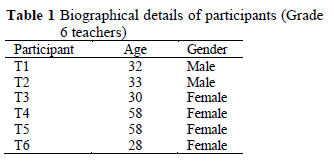
The population for this study comprised Grade 6 EFAL learners and teachers from selected South African schools. Following Stratton's guidelines (2021), we employed purposive sampling by personally selecting 30 Grade 6 learners and six teachers to ensure diversity in learning experiences. With the selection process, we aimed to ensure a diverse representation of learners and teachers to capture various perspectives on teaching styles and their impact. Engaging six teachers ensured a broad spectrum of teaching approaches. Table 1 indicates the biographical details of the Grade 6 teachers (T) who completed an open-ended questionnaire.
We purposefully selected 30 Grade 6 learners enrolled in EFAL and investigated the influence of diverse teaching styles on the learners' academic performance. We based the selection of the learners on their marks (two low marks, two average and two good marks per focus group). Of the 30 Grade 6 learners, 13 were boys and 17 girls; all the boys were being 11 years old, nine girls were 11 years old, and eight girls were 12 years old at the time of the study.
Three data collection methods, open-ended questionnaires, focus group interviews, and classroom observations were used, allowing for an in-depth exploration of Grade 6 EFAL learners' and teachers' perspectives. Focus group interviews were conducted to gather qualitative data on perceptions, experiences, and preferences of Grade 6 learners (with varied academic performance) regarding the different teaching styles employed in their classes. We held five focus group interviews with six Grade 6 learners. In focus group interviews, the primary objective was to encourage Grade 6 learners to express their thoughts and experiences while we actively listened.
The focus group interviews of Grade 6 learners provided rich qualitative data, offering insights into teachers' and learners' perceptions of different teaching styles, their preferences, experiences, and how these factors related to the Grade 6 EFAL learners' and teachers' perspectives on engagement, comprehension, and assessment performance.
Classroom observations were used to capture the implementation of different teaching styles. These observations involved noting the methods used by Grade 6 teachers in EFAL assessment. The teacher's guidance plays a crucial role in facilitating teamwork. Including a teacher for classroom observations was significant to answer the research question because it provided direct insight into how diverse teaching styles impacted learner engagement, comprehension, and assessment performance in Grade 6 EFAL. Touchette, Oates, Menec and Sibley (2021) suggest that for an ongoing process, a descriptive design in assessment should be regularly monitored, acknowledging assessment as a fundamental aspect of education. Observing teachers in action allows for the identification of specific instructional strategies, classroom interactions, and learner responses that may not be fully captured through interviews alone. This method ensures a deeper understanding of how different teaching approaches influence learners' experiences, helping to validate findings through real-time observations of teaching and learning dynamics. Additionally, classroom observations enhanced the credibility of the study by allowing us to compare what learners expressed in interviews with actual classroom practices. Well-structured and organised lesson plans enhance classroom management, minimises disruptions, and promotes a positive learning environment in which learners feel safe, engaged, motivated to learn, and know what is expected of them. A well-structured lesson plan provides a clear framework for both teachers and learners, fostering a sense of security and direction in the classroom. When learners know what to expect, they experience reduced anxiety and are more likely to engage actively in the lesson (Marzano, 2007). The classroom observations and focus group interviews were documented, maintaining an impartial and objective stance throughout. The collection of dependable and trustworthy data was the goal.
Six Grade 6 teachers completed open-ended questionnaires on their experiences, perceptions, and observations of various teaching styles in Grade 6 classes. This was an appropriate method for gathering qualitative data, allowing participants to share their experiences and perceptions freely. The provision of detailed and descriptive responses that offered rich information on their perspectives and practices in the classroom context was clear from their responses to the open-ended questionnaires, because these participants freely conveyed their perspectives (Korstjens & Moser, 2018). Further, open-ended questionnaires encouraged detailed responses, avoiding the limitations of closed-ended formats which are more limiting regarding the freedom of opinions (Adler, Salantera & Zumstein-Shaha, 2019).
A thematic approach was used for data analysis, identifying key patterns and themes that emerged (Choongwa, 2018) from the learners' responses.
We obtained ethical clearance from the relevant authorities to ensure the trustworthiness and credibility of our research, with strict adherence to participant confidentiality and anonymity. Credibility in qualitative research refers to the accuracy of the findings (Korstjens & Moser, 2018). Grade 6 learners were minors, therefore, we obtained ethical clearance for our study. Informed consent forms from parents or guardians and secured assent from the learners were collected to ensure voluntary participation.
However, the study had some limitations. Teaching styles and Grade 6 EFAL performance were the only focus for this study, in which factors such as learners' study habits and home settings may have been overlooked. The fact that only a limited number of participants were involved may restrict the generalisability of the findings.
Research Findings
The main purpose of the study was to investigate the impact of diverse teaching styles on engagement, comprehension, and assessment in Grade 6 EFAL. Open-ended questionnaire, focus group interviews and classroom observation were used to collect data. The findings provide an overall understanding of how different teaching styles affected Grade 6 EFAL learners' experiences and academic outcomes. We used themes formulated from the research sub-questions or objectives, ensuring alignment with the study's focus to ensure trustworthy findings. These themes focus on learner involvement, comprehension, and assessment.
The open-ended questionnaires completed by Grade 6 teachers revealed that learners found teaching styles with a focus on participation, such as group discussions and storytelling, more engaging, while traditional teaching felt boring and made it difficult to concentrate. The observations showed that learners engaged in lessons by incorporating visual aids and peer collaboration, whereas passive engagement (teacher-centred) was noted as dull and limited learner participation. The focus group interviews further confirmed that learners felt more motivated when teachers used real-life and relevant examples, encouraged discussions, and varied their teaching styles to maintain interest.
The findings from the open-ended questionnaires reveal that learners preferred visual aids like pictures, diagrams, and videos, which enhanced their comprehension, while verbal explanations alone were challenging. The observations showed that active engagement led to better comprehension of concepts, whereas teacher-centred learning made it difficult for learners to grasp the content. Focus group interviews revealed that learners perceived conceptual understanding to be enhanced when teaching approaches encouraged active learner expression and participation.
The findings from the open-ended questionnaires show that revision activities, practice exercises, and feedback prepared learners more for the assessment, while rushed lessons (to get through the syllabus) led to poor performance. Observations revealed that learners engaged in interactive teaching and performed better when teachers played the dominant role. The focus group interviews indicated that learners found assessment easier when questions were related to what was practised in class; learners feared the unknown in unfamiliar assessment.
Discussions and problem-solving where participatory techniques were applied showed a stronger positive impact. Rogowsky et al. (2020) highlight the importance of visual learning over auditory learning. Visual aids and exercises were much more beneficial in enhancing comprehension, while traditional methods had a weaker positive influence.
The findings support those of previous studies indicating that interactive discussions and the use of visual aids effectively enhanced learner engagement, comprehension, and assessment. According to Rogowsky et al. (2020), visual learning was more beneficial than auditory learning. Furthermore, modern-day learners are raised with the social web and are digital-centric (Singh & Dangmei, 2016). Hamida (2013) found that 72.1% of learners preferred multiple ways of learning. Embracing various modes of learning, such as visual aids, interactive discussions, hands-on activities, digital resources, and group collaboration, caters for the different ways in which learners absorb information. Moreover, the positive association between exposure to various teaching styles and improved assessment outcomes confirms the importance of using different teaching methods. Teacher 2, an ardent advocate, believes that teachers must be informed about the preferences of modern-day learners, including variations in teaching styles. In the fifth focus group interview Learner 1 indicated that it was reassuring to see that their input was valued. Learner 6 expressed enthusiasm for interactive technology exercises, describing them as enjoyable learning experiences that made the English FAL class their favourite. In contrast, Learner 1 from the first focus group interview stated that she preferred teachers using a visualiser to teach as it enabled her to visualise the content being taught.
Discussion of the Findings
The value of a variety of teaching styles, which highlights improvement in learners' involvement, comprehension, and assessment, was consistent with previous research on the teaching and learning of Grade 6 EFAL.
Dewi et al. (2023) and Zargaran et al. (2020) believe that using technology and interactive aspects in teaching promotes curiosity and deeper engagement, thus keeping learners interested in EFAL, by using different teaching styles and mixing traditional and technological ways to convey content.
Although Rogowsky et al. (2020) highlight that visual learning is much more beneficial than auditory learning, different teaching philosophies still have different perspectives on learners' comprehension. Shirani Bidabadi et al. (2016) and Tursunoy and Nazira (2020) emphasise that learners' preferences regarding teaching approaches are a serious concern; therefore, teachers need to adapt and refine their instructional strategies to maximise learners' comprehension abilities.
Higher test scores show that teacher- and learner-centred teaching styles should be alternated (Shirani Bidabadi et al., 2016; Strnadová & Cumming, 2014). Cohen and Henry (2019) agree because they are of the opinion that deeper understanding of content in EFAL is associated with more than one teaching style. Interactive conversations and group projects encouraging learners to participate actively in the learning process are important and need to be applied (Baines et al., 2016; Marsick & Watkins, 2015). As literature shows, academic performance depends on the variety of teaching styles. Singh and Dangmei (2016) and Uzun and Kilis (2019) further boost these findings by noticing the desire for enjoyable, fun, and interactive ways to instruct. Different ways of teaching enhance teaching by addressing learner involvement, comprehension, and assessment.
The findings in our study also show that blended teaching is beneficial, using the learner- and teacher-centred teaching styles.
Conclusion
The findings show that mixed teaching styles that include teacher- and learner-centred teaching, which focus on the learner's preference for learning, lead to the improvement of learning outcomes, as well as learner engagement and comprehension in Grade 6 EFAL and the grasping of EFAL concepts.
Boosting learner engagement, comprehension, and assessment performance are crucial in teaching.
This research is relevant internationally, offering insight into effective, adaptable teaching styles and is, therefore, noteworthy regarding educational practices. To accommodate various learning preferences and optimise learner involvement and comprehension, the way that teachers teach should be varied. Providing training and support for teachers in order to implement different teaching styles may positively affect learning outcomes. Future research should expand the study to include a larger participant pool for broader insight. Investigating the long-term effects of certain teaching styles on learners' understanding and support of the LoLT is also important.
Moreover, the positive association between exposure to various teaching styles and improved assessment outcomes confirms the importance of using different teaching methods.
Authors' Contributions
RC collected and analysed the data and wrote 70% of the manuscript, including the theoretical framework. ECDP wrote the abstract, sections from the introduction and literature and reviewed the final manuscript.
Notesi. This article is based on a master's dissertation.
ii. Published under a Creative Commons Attribution Licence.
References
-
Adler K, Salantera S & Zumstein-Shaha M 2019. Focus group interviews in child, youth, and parent research: An integrative literature review. International Journal of Qualitative Methods, 18:1-15. https://doi.org/10.1177/1609406919887274
» https://doi.org/10.1177/1609406919887274 -
Aixia W, Ying Z & Wijaya TT 2020. The current situation and prospect of study quality evaluation research in china in the last 10 years. Edukatif: Journal Ilmu Pendidikan, 2(1):101-112. Available at https://www.researchgate.net/publication/342496499_The_Current_Situation_and_Prospect_Of_Study_Quality_Evaluation_Research_in_China_in_The_Last_10_Years. Accessed 18 December 2025.
» https://www.researchgate.net/publication/342496499_The_Current_Situation_and_Prospect_Of_Study_Quality_Evaluation_Research_in_China_in_The_Last_10_Years -
Al Mamun MA, Lawrie G & Wright T 2020. Instructional design of scaffolded online learning modules for self-directed and inquiry-based learning environments. Computers & Education, 144:103695. https://doi.org/10.1016/j.compedu.2019.103695
» https://doi.org/10.1016/j.compedu.2019.103695 -
Baines E, Blatchford P & Kutnick P 2016. Promoting effective group work in the primary classroom: A handbook for teachers and practitioners (2nd ed). London, England: Routledge. https://doi.org/10.4324/9781315730363
» https://doi.org/10.4324/9781315730363 -
Balakrishnan V & Lay GC 2016. Students' learning styles and their effects on the use of social media technology for learning. Telematics and Informatics, 33(3):808-821. https://doi.org/10.1016/j.tele.2015.12.004
» https://doi.org/10.1016/j.tele.2015.12.004 -
Barnett WS, Jung K, Yarosz DJ, Thomas J, Hornbeck A, Stechuk R & Burns S 2008. Educational effects of the Tools of the Mind curriculum: A randomized trial. Early Childhood Research Quarterly, 23(3):299-313. https://doi.org/10.1016/j.ecresq.2008.03.001
» https://doi.org/10.1016/j.ecresq.2008.03.001 - Bassey M 2012. Case study research. Educational Research, 54(4):1-14.
-
Belhiah H & Elhami M 2015. English as a medium of instruction in the Gulf: When students and teachers speak. Language Policy, 14:3-23. https://doi.org/10.1007/s10993-014-9336-9
» https://doi.org/10.1007/s10993-014-9336-9 - Choongwa GH 2018. Fundamentals of applied research methodology: A complete guide for scholars & researchers in social sciences. Mbabane, Eswatini: Southern African Research Foundation for Economic Development.
-
Cohen AD & Henry A 2019. Focus on the language learner: Styles, strategies and motivation. In D Coulson, N Schmitt & J Clenton (eds). An introduction to applied linguistics (3rd ed). London, England: Routledge. https://doi.org/10.4324/9780429424465
» https://doi.org/10.4324/9780429424465 - Creemers BPM & Kyriakides L 2008. The dynamics of educational effectiveness: A contribution to policy, practice and theory in contemporary schools. London, England: Routledge.
-
Dede C 2014. The role of digital technologies in deeper learning. Students at the Center: Deeper Learning Research Series. Boston, MA: Jobs for the Future. Available at https://files.eric.ed.gov/fulltext/ED561254.pdf. Accessed 18 December 2025.
» https://files.eric.ed.gov/fulltext/ED561254.pdf -
Department of Basic Education, Republic of South Africa 2011. Curriculum and Assessment Policy Statement Grades 4- 6 English First Additional Language. Pretoria: Author. Available at https://www.education.gov.za/Portals/0/CD/National%20Curriculum%20Statements%20and%20Vocational/CAPS%20IP%20%20FAL%20%20ENGLISH%20GR%204-6%20%20WEB.pdf7ver=2015-01-27-161045-913. Accessed 31 December 2025.
» https://www.education.gov.za/Portals/0/CD/National%20Curriculum%20Statements%20and%20Vocational/CAPS%20IP%20%20FAL%20%20ENGLISH%20GR%204-6%20%20WEB.pdf7ver=2015-01-27-161045-913 -
Dewi DS, Waloyo E & Ria TN 2023. The impact of technology-based learning on students' affective, behavioral, and cognitive engagement in EFL higher education. In Proceedings of UNNES-TEFLINNational Conference (Vol. 5). Available at https://proceeding.unnes.ac.id/index.php/utnc/article/view/2607. Accessed 16 November 2023.
» https://proceeding.unnes.ac.id/index.php/utnc/article/view/2607 -
Diyessa TT & Woldearegawie AG 2025. Students' perceptions on the advantages of learner-centred approaches and grammar teaching methods in selected secondary schools. JOLLT Journal of Languages and Language Teaching, 13(1):18-31. https://doi.org/10.33394/jollt.v13i1.9184
» https://doi.org/10.33394/jollt.v13i1.9184 -
Du Plessis EC & Letshwene MJ 2020. A reflection on identified challenges facing South African teachers. The Independent Journal of Teaching and Learning, 15(2):69-91. Available at https://joumals.co.za/doi/pdf/10.10520/ejc-jitl1-v15-n2-a7. Accessed 18 December 2025.
» https://joumals.co.za/doi/pdf/10.10520/ejc-jitl1-v15-n2-a7 -
Geng S, Law KMY & Niu B 2019. Investigating self-directed learning and technology readiness in blending learning environment. International Journal of Educational Technology in Higher Education, 16:17. https://doi.org/10.1186/s41239-019-0147-0
» https://doi.org/10.1186/s41239-019-0147-0 -
Granero-Gallegos A, Escaravajal JC, López-García GD & Baños R 2022. Influence of teaching styles on the learning academic confidence of teachers in training. Journal of Intelligence, 10(3):71. https://doi.org/10.3390/jintelligence10030071
» https://doi.org/10.3390/jintelligence10030071 -
Gutierrez RR, Escusa F, Lyon JA, Magana AJ, Cabrera JH, Pehovaz R, Link O, Rivillas-Ospina G, Acuña GJ, Kuroiwa JM, Guzman MX & Latosinski FG 2022. Combining hands-on and virtual experiments for enhancing fluid mechanics teaching: A design-based research study. Computer Applications in Engineering Education, 30(6):1701-1724. https://doi.org/10.1002/cae.22551
» https://doi.org/10.1002/cae.22551 -
Habib M 2023. Digital transformation strategy for developing higher education in conflict-affected societies. Social Sciences & Humanities Open, 8(1):100627. https://doi.org/10.1016/j.ssaho.2023.100627
» https://doi.org/10.1016/j.ssaho.2023.100627 -
Hamida N 2013. The learning style preference of Semarang State Polytechnic students in second language learning. Ragam, 13(2):111-117. Available at https://jumal.polines.ac.id/index.php/ragam/article/view/473. Accessed 18 December 2025.
» https://jumal.polines.ac.id/index.php/ragam/article/view/473 -
Han I, Han S & Shin WS 2019. Teachers' and students' perspectives on good teaching using technology in elementary classrooms. International Journal of Information and Communication Technology Education (IJICTE), 15(3):103-116. https://doi.org/10.4018/UICTE.2019070108
» https://doi.org/10.4018/UICTE.2019070108 -
Hilyatun Nafis STG 2017. Students' preference of language learning style in English classroom (A survey at Senior High School No 1 Seulimeum). S.Pd. thesis. Banda Aceh, Indonesia: Ar-Raniry State Islamic University. Available at https://repository.ar-raniry.ac.id/id/eprint/2600/1/Hilyatun%20Nafis.pdf . Accessed 18 December 2025.
» https://repository.ar-raniry.ac.id/id/eprint/2600/1/Hilyatun%20Nafis.pdf -
Irons A & Elkington S 2021. Enhancing learning through formal assessment and feedback (2nd ed). London, England: Routledge. https://doi.org/10.4324/9781138610514
» https://doi.org/10.4324/9781138610514 -
Jian H & Luo S 2014. Formative assessment in L2 classroom in China: The current situation, predicament and future. Indonesian Journal of Applied Linguistics, 3(2):18-34. Available at https://pdfs.semanticscholar.org/b642/8a03703311527d118223e079b6e369a88c22.pdf. Accessed 18 December 2025.
» https://pdfs.semanticscholar.org/b642/8a03703311527d118223e079b6e369a88c22.pdf -
Kibble JD 2017. Best practices in summative assessment. Advances in Physiology Education, 41(1):110-119. https://doi.org/10.1152/advan.00116.2016
» https://doi.org/10.1152/advan.00116.2016 -
Kim H, Sefcik JS & Bradway C 2017. Characteristics of qualitative descriptive studies: A systematic review. Research in Nursing & Health, 40(1):23-42. https://doi.org/10.1002/nur.21768
» https://doi.org/10.1002/nur.21768 -
Korstjens I & Moser A 2018. Series: Practical guidance to qualitative research. Part 4: Trustworthiness and publishing. European Journal of General Practice, 24(1):120-124. https://doi.org/10.1080/13814788.2017.1375092
» https://doi.org/10.1080/13814788.2017.1375092 -
Languita JMS, Ligtas JB, Baron DC & Diquito TJA 2023. Preferred style of teaching and learning by college students in the new normal. American Journal of Multidisciplinary Research and Innovation, 2(1):74-82. https://doi.org/10.54536/ajmri.v2i1.1209
» https://doi.org/10.54536/ajmri.v2i1.1209 -
Lee J 2014. An exploratory study of effective online learning. Assessing satisfaction levels of students of mathematics education associated with human and design factors of an online course. International Review of Research in Open and Distributed Learning, 15(1):111-132. https://doi.org/10.19173/irrodl.v15i1.1638
» https://doi.org/10.19173/irrodl.v15i1.1638 -
Leong LM & Ahmadi SM 2017. An analysis of factors influencing learners' English-speaking skill. International Journal of Research in English Education, 2(1):34-41. Available at https://sid.ir/paper/349619/. Accessed 23 February 2024.
» https://sid.ir/paper/349619/ -
Maharajh LR, Nkosi T & Mkhize MC 2016. Teachers' experiences of the implementation of the Curriculum and Assessment Policy Statement (CAPS) in three primary schools in Kwa-Zulu Natal. Africa's Public Service Delivery & Performance Review, 4(3):371-388. https://doi.org/10.4102/apsdpr.v4i3.120
» https://doi.org/10.4102/apsdpr.v4i3.120 -
Marsick VJ & Watkins K 2015. Informal and incidental learning in the workplace. London, England: Routledge. https://doi.org/10.4324/9781315715926
» https://doi.org/10.4324/9781315715926 - Marzano RJ 2007. The art and science of teaching: A comprehensive framework for effective instruction. Alexandria, VA: Association for Supervision and Curriculum Development (ASCD).
-
Mayer RE 2003. The promise of multimedia learning: Using the same instructional design methods across different media. Learning and Instruction, 13(2):125-139. https://doi.org/10.1016/S0959-4752(02)00016-6
» https://doi.org/10.1016/S0959-4752(02)00016-6 - Momanyi M 2016. Enhancing quality teacher education programs in developing countries. In J Keengwe, JG Mbae & G Onchwari (eds). Handbook of research on global issues in next-generation teacher education. Hershey, PA: Information Science Reference.
-
Morado MF, Melo AE & Jarman A 2021. Learning by making: A framework to revisit practices in a constructionist learning environment. British Journal of Educational Technology, 52(3):1093-1115. https://doi.org/10.1111/bjet.13083
» https://doi.org/10.1111/bjet.13083 -
Prosheva S, Kjosevska E & Velik Stefanovska V 2020. ПРОЦЕНКА НА СОСТОЈБАТА СО ФИЗИЧКАТА СРЕДИНА ВО ОСНОВНИТЕ УЧИЛИШТА ВО РЕПУБЛИКА СЕВЕРНА МАКЕДОНИЈА [Assessment of the physical environment situation in primary schools in the Republic of North Macedonia]. Archives of Public Health, 12(3):5-15. https://doi.org/10.3889/aph.2020.5418
» https://doi.org/10.3889/aph.2020.5418 -
Ranta E 2010. English in the real world vs. English at school: Finnish English teachers' and students' views. International Journal of Applied Linguistics, 20(2):156-177. https://doi.org/10.1111/j.1473-4192.2009.00235.x
» https://doi.org/10.1111/j.1473-4192.2009.00235.x -
Rogowsky BA, Calhoun BM & Tallal P 2020. Providing instruction based on students' learning style preferences does not improve learning. Frontiers in Psychology, 11:164. https://doi.org/10.3389/fpsyg.2020.00164
» https://doi.org/10.3389/fpsyg.2020.00164 -
Ruiz-Rojas LI, Acosta-Vargas P, De-Moreta-Llovet J & Gonzalez-Rodriguez M 2023. Empowering education with generative artificial intelligence tools: Approach with an instructional design matrix [Special issue]. Sustainability, 15(15):11524. https://doi.org/10.3390/su151511524
» https://doi.org/10.3390/su151511524 -
Sanusi IT, Oyelere SS & Omidiora JO 2022. Exploring teachers' preconceptions of teaching machine learning in high school: A preliminary insight from Africa. Computers and Education Open, 3:100072. https://doi.org/10.1016/j.caeo.2021.100072
» https://doi.org/10.1016/j.caeo.2021.100072 - Scheerens J 2015. School effectiveness and improvement: An international review (2nd ed). Cham, Switzerland: Springer.
-
Schwab K 2016. Teach the students you have, not the ones you want. Available at https://karleyschwab.wordpress.com/2016/01/29/teach-the-students-you-have-not-the-ones-you-want/. Accessed 19 December 2023.
» https://karleyschwab.wordpress.com/2016/01/29/teach-the-students-you-have-not-the-ones-you-want/ -
Senthamarai S 2018. Interactive teaching strategies. Journal of Applied and Advanced Research, 3(Suppl. 1):S36-S38. https://doi.org/10.21839/jaar.2018.v3S1.166
» https://doi.org/10.21839/jaar.2018.v3S1.166 -
Shirani Bidabadi N, Nasr Isfahani A, Rouhollahi A & Khalili R 2016. Effective teaching methods in higher education: Requirements and barriers. Journal of Advances in Medical Education & Professionalism, 4(4):170-178. Available at https://pmc.ncbi.nlm.nih.gov/articles/PMC5065908/. Accessed 18 December 2025.
» https://pmc.ncbi.nlm.nih.gov/articles/PMC5065908/ -
Singh AP & Dangmei J 2016. Understanding the Generation Z: The future workforce. South-Asian Journal of Multidisciplinary Studies, 3(3):1-5. Available at https://bk.unipasby.ac.id/morevej/2018/05/UNDERSTANDING-THE-GENERATION-Z-THE-FUTURE-WORKFORCE.pdf. Accessed 18 December 2025.
» https://bk.unipasby.ac.id/morevej/2018/05/UNDERSTANDING-THE-GENERATION-Z-THE-FUTURE-WORKFORCE.pdf -
Stoimcheva- Kolarska DL 2020. The impact of a relaxed and fun learning environment on the second language learning. Turquoise International Journal of Educational Research and Social Studies, 2(1):9-17. Available at https://files.eric.ed.gov/fulltext/ED606062.pdf. Accessed 18 December 2025.
» https://files.eric.ed.gov/fulltext/ED606062.pdf -
Stratton SJ 2021. Population research: Convenience sampling strategies. Prehospital and Disaster Medicine, 36(4):373-374. https://doi.org/10.1017/S1049023X21000649
» https://doi.org/10.1017/S1049023X21000649 -
Strnadová I & Cumming TM 2014. The importance of quality transition processes for students with disabilities across settings: Learning from the current situation in New South Wales. Australian Journal of Education, 58(3):318-336. https://doi.org/10.1177/0004944114543603
» https://doi.org/10.1177/0004944114543603 - Thorndike EL 1917. Educational psychology (Vol. 1). New York, NY: Teachers College, Columbia University.
-
Tlhoaele M, Hofman A, Winnips K & Beetsma, Y 2014. The impact of interactive engagement methods on students' academic achievement. Higher Education Research & Development, 33(5):1020-1034. https://doi.org/10.1080/07294360.2014.890571
» https://doi.org/10.1080/07294360.2014.890571 -
Touchette AJ, Oates AR, Menec VH & Sibley KM 2021. Design characteristics and inclusion of evidence-based exercise recommended in fall prevention community exercise programmes for older adults in Canada: A national descriptive self-report study. BMC Geriatrics, 21(1):33. https://doi.org/10.1186/s12877-020-01949-2
» https://doi.org/10.1186/s12877-020-01949-2 -
Tursunoy R & Nazira I 2020. Factors of successful group activities and application of multimedia technologies in teaching foreign language. Mental Enlightenment Scientific-Methodological Journal, 1(01):110-119. Available at https://mentaljoumal-jspu.uz/index.php/mesmj/article/view/36/34. Accessed 2 February 2024.
» https://mentaljoumal-jspu.uz/index.php/mesmj/article/view/36/34 -
Ummi A, Chenshuai W, Vijayaratnam P, Rajanthran SK, Girija V & Ravindran T 2024. Exploring teaching strategies used by university instructors to enhance student engagement in academic subjects. International Journal of Learning, Teaching and Educational Research, 23(9):543-559. https://doi.org/10.26803/ijlter.23.9.27
» https://doi.org/10.26803/ijlter.23.9.27 -
Uzun AM & Kilis S 2019. Does persistent involvement in media and technology lead to lower academic performance? Evaluating media and technology use in relation to multitasking, self-regulation and academic performance. Computers in Human Behavior, 90:196-203. https://doi.org/10.1016/j.chb.2018.08.045
» https://doi.org/10.1016/j.chb.2018.08.045 -
Xing W, Zhu G, Arslan O, Shim J & Popov V 2023. Using learning analytics to explore the multifaceted engagement in collaborative learning. Journal of Computing in Higher Education, 35(3):633-662. https://doi.org/10.1007/s12528-022-09343-0
» https://doi.org/10.1007/s12528-022-09343-0 -
Zargaran A, Turki MA, Bhaskar J, Spiers HVM & Zargaran D 2020. The role of technology in anatomy teaching: Striking the right balance. Advances in Medical Education and Practice, 11:259-266. https://doi.org/10.2147/AMEP.S240150
» https://doi.org/10.2147/AMEP.S240150
Revised: 3 July 2025
Accepted: 10 September 2025
Published: 31 December 2025