Curriculum implementation in Lesotho secondary schools: Insight from a distributed instructional leadership perspective
Abstract
The academic world has become increasingly complex over the years, thus necessitating distributed instructional leadership (DIL) among more people to improve the efficacy of curriculum implementation. However, DIL at departmental level in secondary schools in Lesotho is ambiguous and not fully acknowledged. With this mixed-methods research of a convergent parallel design we explored how heads of science departments (HoDs) conducted DIL in their respective departments for the implementation of the new science and technology (ST) curriculum in Lesotho secondary schools. Quantitative data from a concurrent nested sample of 67 HoDs were collected through a questionnaire and analysed through descriptive and inferential statistics. A stratified purposive subset consisting of 4 HoDs and their 4 ST teachers was interviewed, and the data were thematically analysed. The HoDs in this study performed DIL functions related to out-of-class activities more effectively than the functions related to in-class activities. Only 2 of 4 interviewees implemented curriculum integration as proposed in the syllabus. We recommend constant communication among the HoDs, teachers and curriculum developers through regular feedback during the implementation process.
curriculum implementation; distributed instructional leadership; heads of department; integrated curriculum; science and technology learning area
Introduction
Successful leadership is a key factor in enhancing learning outcomes and overall institutional achievement by enhancing staff morale and student engagement (Akomodi, 2025; Wolfe, Knudsen & Mahaffey, 2023). Leadership success depends on the efficacy of first-order innovations such as changes in curricular and instructional design (Demirdag, 2021). However, Thornell (2022) posits that instructional leadership (IL), which focuses on teaching and learning, remains undervalued despite its potential to influence school performance.
The academic world has become complex over the years. This necessitates DIL to extend beyond one leader because, individually, leaders are more likely to focus their attention on administrative duties than on instructional advancement (Li, Chan & Hu, 2023; Sahlin, 2023). This paradigm shift has resulted in the incorporation of more people into leadership practice for instructional improvement, including the HoDs (Malinga & Jita, 2020).
HoDs are central to DIL, particularly during curriculum reform, owing to their influence on instruction, which is more consistent and significant compared to other leaders (Sengai, 2021). HoDs are change agents and expert leaders who model and coordinate good curriculum implementation practices and support their teachers in terms of expertise and resources, thus creating a positive environment for instructional activities (Doherty, 2021). In cases where they were unable to offer direct support to their teachers, they solicited external assistance by encouraging and organising collaboration among teachers within and beyond their department and/or school (Sahlin, 2023; Sengai, 2021; Thornell, 2022).
Literature Review
None of the components of the education system requires more effective leadership strategies than secondary schools, owing to IL of poor quality that often leads to resistance to curriculum reforms (United Nations Educational Scientific and Cultural Organisation [UNESCO], 2021). According to Akuma and Gaigher (2021), the senior secondary and natural science sectors present most of the challenges. For instance, secondary schools achieve poor results in national examinations, experience a high dropout rate resulting from their large size, wide curriculum, and a lack of relevant research (Examinations Council of Lesotho [ECoL], 2020; Leithwood, 2016). These challenges are exacerbated by, among other factors linked to curriculum implementation, a lack of leadership expertise and resources, inefficient teaching methods, and inadequate support from stakeholders (Aslam, Mushtaq, Noor, Maqbool, Khan & Sarfraz, 2024; Jita, 2021).
Curriculum implementation is one of the key factors affecting the success of education systems, hence the need for appropriate approaches to resolve the challenges (Aslam et al., 2024). The world is consistently adapting to changes through curriculum reforms, and Lesotho is no exception. The Lesotho government opted for curriculum integration as its latest strategy for enhancing knowledge construction and self-reliance among students (Ministry of Education and Training [MoET], 2021). This innovation manifested as the Integrated Basic Education Curriculum (IBEC), which is the most recent reform since the end of British colonial rule of Lesotho in 1966 (Raselimo & Mahao, 2015). This was an extension of the Curriculum and Assessment Policy (CAP) of 2009, and it was introduced in stages, starting from 2012 (MoET, 2021). The IBEC arranges traditional subjects into learning areas such as science and technology (ST), creativity and entrepreneurship, and linguistics and literacy, for Grade 8 (MoET, 2009, 2018). The ST learning area, which is the focus of this study, includes natural science, agriculture, home economics, technological and technical subjects, geography, life skills, and health and physical education (MoET, 2009). An ST teacher, therefore, is expected to teach all these subjects in a holistic, integrated manner. Concepts are taught once rather than many times in different subjects through student-centred pedagogy and democratic learning to develop 21st-century skills (MoET, 2021).
Problem Statement
It appears that the governments of Lesotho, Zimbabwe, and South Africa are not adequately committed towards innovations. Jita (2021) is of the opinion that these countries seem to introduce new curricula mostly for compliance with international educational standards. The CAP 2009 was not effectively implemented owing to a lack of planning, supervision, and evaluation, among other reasons (MoET, 2021). As a result, it was reviewed even before the IBEC rollout was completed in secondary schools, resulting in the development of the new policy, namely, the Lesotho Basic Education Curriculum Policy (LBECP) of 2021. While Niemelä (2022) highlights that effective curriculum integration requires high competence levels, the policy review (MoET, 2021) reveals that Lesotho teachers lacked content knowledge and appropriate qualifications for implementing the IBEC, thus proposing that the integration of subjects in secondary schools be aborted. Nonetheless, the IBEC is currently being implemented in Lesotho secondary schools pending the development of the new curriculum.
The impact that HoDs have is yet to be fully acknowledged by educational systems and researchers on secondary schools, in particular (Leithwood, 2016). This means that although the subject departments are valuable, the principles of departmental leadership as part of DIL are not clearly stated (Forde & Kerrigan, 2022). For instance, the new career structure for Lesotho teachers summarises the role of HoDs in one paragraph of general statements rather than indicating specific functions, for example, "the position holder coordinates the processes of learning and teaching in the group of subjects for whom he or she is responsible" (MoET, 2019:14). We recognised this gap and acknowledged the urgency of research that explores the contribution of HoDs towards school leadership. Research on the HoDs' DIL function is even more significant in underdeveloped countries such as Lesotho, which require drastic educational reforms for socio-economic growth. In this study we explored DIL practice based on the question: What are the Lesotho science HoDs' DIL practices and perspectives related to the implementation of the ST curriculum in their departments?
Theoretical Framework
Instruction is a multi-faceted phenomenon that requires the distribution of leadership among people and instruments that drive the education system (Doherty, 2021; Sahlin, 2023). The importance of DIL is two-fold: leaders' attention is focused on improving instruction (Shaked, 2022), and leadership is effectively distributed for instructional advancement (Malinga, Jita & Bada, 2022). The origins of DIL can be traced back to the effective school movement era in the United States of America (USA) between 1960 and 1980, during which the meaningful dynamics of educational performance was explored through research (Australian Department of Education, 2022). Since then, DIL and accountability demands required of leaders to shift from haphazard management to purposeful leadership (Munna, 2023). DIL has emerged as a crucial strategy for leaders to improve their schools (Dania & Andriani, 2021).
DIL emphasises that leaders such as HoDs should collaborate and make decisions with their teachers, instead of isolating their leadership behaviour or traits (Malinga et al., 2022; Sachar, 2025). HoDs' functions include stating their expectations of the teachers in their departments, identifying professional learning activities for their teachers and employing data-driven improvement plans (Akomodi, 2025; Sachar, 2025). Each function can be achieved through a specific set of strategies and resources, such as the educational policies and regulations that constitute the school's context (Diamond & Spillane, 2016). Consequently, the positive impact of DIL manifests in conducive learning environments, empowered teachers, and improved student achievement (Demirdag, 2021; Sachar, 2025). This impact places DIL second after classroom instruction among the most significant factors influencing learning achievement (Leithwood, Harris & Hopkins, 2020).
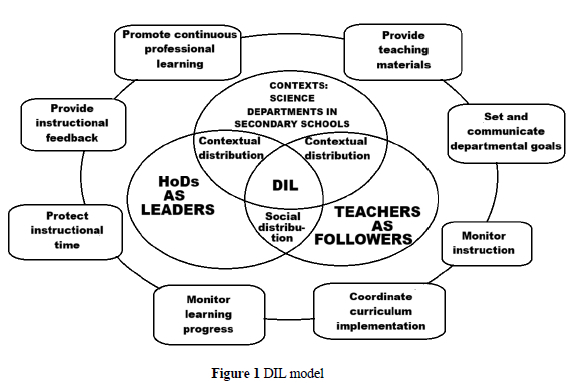
Based on literature (e.g. Akram, Kiran & İlğan, 2017; Day & Sammons, 2016; Hallinger & Murphy, 1985; Spillane, Halverson & Diamond, 2004) we developed Figure 1 to illustrate the principles used in this study and the DIL functions that HoDs distribute to their teachers.
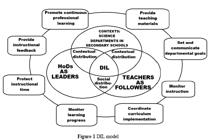
The interaction among HoDs, teachers, and their school contexts is illustrated in Figure 1: social distribution among HoDs and their teachers and contextual distribution between HoDs/teachers and their environment (Halverson & Clifford, 2013). The outermost layer of the diagram illustrates the eight functions that were explored in this study (Demirdag, 2021).
Methods
The mixed methods research approach supported by pragmatism was employed in this study because it provides for research diversity through quantitative and qualitative methods (Cohen, Manion & Morrison, 2018). A convergent parallel design was employed because it is more time- and cost-effective than sequential designs.
The names of schools from all 10 districts in Lesotho were fed into a number generator (Random.org, 2021) to select an accurate quantitative sample of 67 schools to enhance the generalisability of the conclusions. We assumed one HoD per high school (HS). Schools are more accessible than individual HoDs, hence their engagement as units of sampling in this study (Creswell & Creswell, 2018). A stratified purposive sample of four HoDs was also selected from the original sample to promote the comparison of responses from various contexts in the qualitative phase.
All the HoDs rated their practice on a 5-point Likert scale of 40 DIL statements. Four HoDs were individually interviewed using semi-structured open-ended questions to allow them to express their opinions freely and honestly. These HoDs were then asked to choose one Grade 8 teacher to participate in the interviews. Half of the interviewees were from urban schools, and half were from schools piloting the new curriculum. All interviews were audio-recorded to have a detailed account of the findings with minimal interference. The questionnaire responses were analysed using statistical analysis software ([SAS] SAS Institute Inc., 2013) to enumerate and organise the quantitative results for meaningful reporting. The interview data were transcribed and coded to identify meaning for thematic analysis. The original study design included document analysis, but this data collection method was ultimately eliminated as research instrument because the documents lacked significant information about the HoDs' DIL. For instance, the interviewed teachers' preparation books had only the HoDs' signature as evidence of checking instead of providing meaningful feedback on instructional activities. The policy documents and the syllabus also did not provide any guidance regarding the specific functions of the HoDs and how the curriculum should be integrated.
Even though the questionnaire employed in this study was adapted from valid instruments, namely Hallinger and Murphy's (1985) principals' instructional management rating scale (PIMRS) and Akram et al.'s (2017) instructional leadership questionnaire (ILQ), it was re-validated through inferential statistics and piloting. The results reveal reasonably high internal consistency because the Cronbach alpha coefficients ranged between 0.63 and 0.80 for the eight constructs. Most (71%) of their Pearson inter-item correlation coefficients were between 0.5 and 0.77, which Cohen et al. (2018) consider acceptable for social research. All DIL constructs were significantly and linearly related to each other (α < 0.05), meaning that the questionnaire had acceptable content validity. The questionnaire and the interview protocol were piloted in two secondary schools to improve the reliability and validity of the items. The data collection instruments were self-administered to augment the credibility of the procedures.
Ethical Considerations
The relevant authorities granted permission for this study to be conducted within a specific code of ethics. Participation in this study was voluntary and anonymous, and the information was handled confidentially. Anonymity was achieved using pseudonyms. Information regarding this research was communicated to the participants and authorities in writing. This research was declared independent and free from any conflicts of interest.
Results
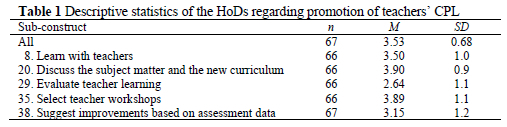
Teachers' Continuous Professional Learning Table 1 displays the descriptive data for the five DIL sub-constructs addressing how the HoDs promoted continuous professional learning (CPL) among their teachers.
Table 1 illustrates that the HoDs were moderately engaged in promoting their teachers' learning in four of five sub-constructs of DIL. Their activity was highest when engaging with teachers in discussions regarding the content and the curriculum, and when selecting teacher workshops. However, their engagement level in the evaluation of CPL was below average. The interviews revealed that the HoDs addressed some of the implementation challenges by facilitating collaboration. For instance, the teachers shared ideas regarding the solutions to some of the instructional challenges that they had experienced.
The teachers believed that some of the challenges were student-related. For instance, they considered that the quality of students who were exposed to the new integrated curriculum was lower than that of their counterparts who were taught using the old curriculum. Ms Ntha indicated: "They are difficult to teach. The present ones cannot even write ... They do not even come close to writing the right thing because they seem to be writing in Afrikaans'" This challenge necessitated teachers to share pedagogical content knowledge (PCK) strategies suitable for teaching such students. For instance, Ms. Ntha solicited assistance related to PCK from other teachers:
When we have problems we bring them to other teachers so that they can advise accordingly ... so that they can teach it for you ... However, if it is something that is easy to understand, then they give you the material that you can read. (Ms Ntha, Pelo HS)
Ms Skop also encouraged collaboration beyond her department by allowing her teachers to request help from elsewhere: "Some were consulting from other schools, and that seems to have helped them ... Our leader is supporting us. As a science teacher herself, she even helps us with the teaching of our subjects whenever we experience problems."
Some of the implementation challenges originated from the teachers themselves because of a lack of PCK for some of the subjects in the ST learning area. Mr Santos said: "It is taught by one person. Someone will not be well equipped with the content of certain subjects." Mr Maru was the only participant who felt comfortable teaching ST even though he expressed concern for student teachers: "It is so difficult, why because on behalf of the interns they did home economics at the college but here they are teaching physics, biology, chemistry, and agric[ulture]." Therefore, some HoDs, in collaboration with their teachers, decided to separate ST into its components to enable different teachers to teach the subjects in which they majored, although this was contrary to the curriculum expectation of integration. For instance, Mr Santos said: "We discussed as the department that we should at least split it. It is true that the ministry does not encourage this issue of splitting because it does not have integration."
The HoDs facilitated the attendance of workshops organised by the MoET to mitigate the teachers' challenges linked to PCK. All teachers expressed positive feelings about the workshops, even though they were concerned that the workshops had either stopped or occurred less frequently. The participants reported this lack of support in terms of in-service training as one of the barriers to the successful implementation of the new curriculum, as was the case in a study by Tafai and Tsakeni (2022) on primary teachers in Lesotho. Mr Thabi emphasised: "We used to have them in the past. Honestly, we no longer have them. I think for the past 2 years, there was nothing except for the dissemination..." Ms Lebo explained how they mitigated the lack of government workshops:
We stopped the activities of the association because of corona. ... We ended up creating a page for maths and science teachers, whereby we could easily communicate urgent matters. ... We also shared ways of dealing with the learning challenges of our students. (Ms Lebo, Monti HS)
Ms Ntha expressed positive feelings about her HOD's DIL role regarding the strategic selection of teachers who needed additional assistance: "When you teach a class that experiences many learning problems, the HoD normally chooses you to represent the school in relevant workshops so that you can gain the necessary skills..." However, Ms Maki represented her school as HOD in the dissemination workshop, thus demonstrating a lack of distribution of IL in this regard. When Ms Maki was asked to comment on the professional development of the teachers she said: "... Last time I checked was when they were disseminating this new syllabus to be given the syllabus copy and getting an explanation about how we should work." However, Ms Lebo, indicated the lack of information sharing after the HoD attended such a workshop: "We never had a chance to attend Grade 8 workshops."
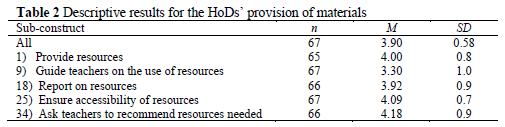
Procurement of Instructional Resources Table 2 presents the mean and standard deviation scores of the participating HoDs in the five sub-constructs of the category related to the DIL function of providing instructional materials.
The participants' activity in this construct was high because three of the five sub-constructs were scored above 4/frequently. The interviews confirmed that the HoDs collaborated with their teachers and principals in terms of securing the necessary resources for teaching and learning. Ms Ntha commented: "Yes, there are times when we need some things, especially in ST because it requires a lot of things. She helps us...." Ms Skop shared Ms Ntha's sentiments: "The school bought the necessary textbooks for different subjects. The school also photocopied the materials for the teachers in situations where the textbooks were not available. ... Our department is greatly supported by the administration..." Mr Thabi also expressed that he actively provided the resources for his department: "Uhm, oh, the school management gives me the support because everything we need .... There has never been a time when they give us trouble with our needs as the department."
Nonetheless, Mr Maru contradicted his HoD (Mr Thabi) to indicate the opposite: "... why, because we regularly talk about the science lab equipment, then write down, but even today nothing. So, I can't say they are supporting us."
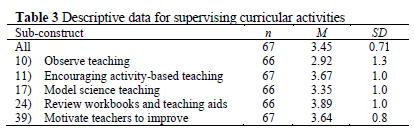
Coordination of the Curriculum Table 3 provides a summary of the scores in the DIL functions related to the supervision of the implementation of the curriculum.
Table 3 indicates that the HoDs' activity in this DIL category was above average, except in observing classroom activity. From the interviews it was clear that the HoDs periodically reviewed their teachers' lesson plans, scheme books, and records of work done. For instance, Ms Skop expressed her practice as follows: "If it is the day designated for checking lesson plans, then I check them together with the scheme books." Ms Skop also highlighted that she modelled good practice by stating: "I always ensure that I am the first one to have lesson plans for my classes. That motivates me to check other people's work."
Some participants acknowledged the importance of classroom observations. Ms Maki said: "Because I believe through observations even the subject that you do not know well, you may end up having a slight idea.." Nonetheless, comments made during the interviews disclosed that the HoDs did not necessarily visit the classrooms, but when they did, it was not to observe but to learn and teach. Ms Skop declared: "I have not gone to class for supervision in a long time." Ms Ntha agreed: "Both the HoD and the principal do not go to classes. They monitor us in the staff room when we are sitting in here instead of being in class." Mr Thabi admitted that he visited classrooms strictly on demand: "No, not necessarily, most of the time we do it when a person has asked you." Ms Maki also admitted that she visited only some teachers instead of all the teachers: "I do it, but not to all teachers. Some of them refuse and say no..." Nevertheless, the teachers disagreed with them. Mr Maru disputed that Mr Thabi visited their classrooms: "He has never come." Ms Lebo also indicated that Ms Maki did not observe classroom activity: "I do not remember her coming to my class or seeing her going with another teacher to class."
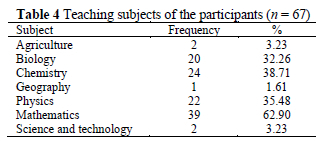
Table 4 illustrates the teaching subjects from the questionnaire while Table 5 displays the subjects that were taught by the interviewees.
Tables 4 reveals that only two HoDs taught ST. Most (62.9%) of the HoDs could not teach ST because they were teaching mathematics. The interview responses show that the participants referred to the experiences of other teachers in their departments, instead of their own. For instance, Ms Skop said: "The teachers did not know how to handle them", even though she was one of only two HoDs who indicated ST as their teaching subject. Mr Santos also used the pronoun "they" in his responses: "One of the challenges that they raised is the issue of teaching ST."
Discussion
The Challenges of the Implementation Process With this study we explored the DIL functions of science HoDs related to the coordination of the integrated curriculum implementation in Grade 8 in Lesotho. Successful curriculum integration requires high levels of PCK of all the subjects involved (Niemelä, 2022). However, the participants in this study were concerned that the expectation of one teacher teaching eight natural and applied science subjects in ST was ambitious. This situation was exacerbated by the low quality of the Grade 8 students, who were reported to lack the expected prior knowledge. The participants believed that the integrated curriculum had reduced the quality of education in Lesotho instead of enhancing knowledge construction and creativity. The new policy (LBECP) states that the Lesotho government confirms that this grouping of subjects has negatively impacted the quality of the content. The reason given by the policy reviewers was related to the way in which the subjects were presented in the syllabus and in the classrooms (MoET, 2021). These results suggest that HoDs, teachers, and students in selected schools lacked the competence levels necessary for the implementation of the ST curriculum. The schools navigated the implementation process without the necessary content knowledge, pedagogical skills related to curriculum integration and support from the educational leaders (MoET, 2021).
The ST syllabus document does not provide support in terms of guidance on curriculum integration because it does not prescribe how it should be delivered. Instead, it presents each learning outcome independently, thus allowing teachers to deliver the content in a fragmented manner. The participating HoDs could not provide the necessary support in terms of the DIL functions directly linked to in-class activities, even though teachers required more support on instructional activities that take place in rather than out of the classroom (Alsaleh, 2022). This is because they lacked relevant, first-hand experience, as most (62.9%) of the HoDs and three of the four interviewees did not teach the ST curriculum. As a result, they could not effectively perform DIL functions such as observing teaching (M = 2.92) and evaluating their teachers' CPL (M = 2.64), among others. The Lesotho government, in their review of the CAP, emphasise that the HoDs could not properly supervise the implementation of the IBEC owing to a lack of experience (MoET, 2021). This problem is not particular to Lesotho as a South African study also revealed that more than 50% of its sample of science HoDs did not teach natural science, yet they were expected to supervise the instruction thereof (Malinga, Jita & Bada, 2021).
Strategies for Effective Curriculum Implementation
Collaboration contributes significantly to the creation of a conducive climate for instruction (Sengai, 2021), which is one of the key principles of DIL (Akomodi, 2025; Sachar, 2025). Even though social distribution of DIL acknowledges collaboration, it does not necessarily imply delegating other people into leadership positions but suggests empowering them in their current roles (Solly, 2018). Mxenge and Bertram (2023) emphasise that subject clusters, such as departments and teachers' associations, can be an effective strategy for teachers of the same subject to learn together to improve academic outcomes. The HoDs not only cooperated with their teachers for knowledge sharing, but they also facilitated teacher collaboration within and beyond their departments and schools through subject associations. The results have also shown that having a science specialist as a principal had a positive impact on the HoDs' enactment of DIL within the science departments.
As Jita (2021) asserts, instructional practices in schools are sometimes not a reflection of the expectations of the curriculum. The contextual distribution of the DIL practice demands that the leaders, such as the HoDs, make sense of and implement existing contexts to avoid being passive recipients of the circumstances (Leithwood et al., 2020). The ST curriculum has been designed based on learning areas meant to be taught by one teacher, but some participants implemented the curriculum in a fragmented manner to mitigate their lack of knowledge of some of the traditional components. This implies that the participants' schools assimilated and adapted the curriculum to make it suitable for their contexts instead of adopting it passively.
The results also reveal that teaching ST requires a substantial number of resources, which some participants successfully provided. This is the DIL construct in which the HoDs were most active (M = 3.90), hence their biggest contribution towards curriculum implementation. However, it was difficult for the HoDs to supply materials in an environment in which collaboration and cooperation were not supported.
Conclusion
The heads of departments have the potential to promote curriculum implementation (Sengai, 2021). The participating HoDs in this study employed a certain degree of DIL to uphold the implementation of the Grade 8 ST curriculum. The main DIL function that they practised was collaboration. The HoDs collaborated with their teachers in decision-making on the purchasing of instructional materials. Their collaboration continued into assimilating school contexts to address the challenges in the implementation process. However, most of the selected HoDs could not effectively perform DIL functions directly linked to in-class activities, owing to their focus on mathematics over science, among other reasons. We argue that the HoDs must experience the actual teaching of the subjects under their purview because subject expertise is the distinguishing factor between HoDs and other instructional leaders. We, therefore, recommend restructuring departments into sections of different disciplines with either formal or informal teacher leaders to enhance subject-related distribution of IL.
The integration of concepts across a wide range of subjects is one of the major challenges found in this study (Day & Sammons, 2016; Leithwood, 2016). We argue that the mode of integration adopted in Lesotho may be inappropriate because secondary school teachers have been trained to teach only a few subjects. The issue should not be the number of teachers involved, but rather how the concepts are brought together in a meaningful, integrated manner. Consequently, we recommend that the decision of how change is implemented should be a result of multi-level collaboration and that the HoDs enrol in massive open online courses (MOOCs) for leadership training related to curriculum implementation. These collaborations for curriculum implementation could also be enhanced through the inclusion of the responsibilities of the HoDs in influential legal documents, such as the education acts and policies, to enhance the HoDs' participation and accountability in DIL.
The findings of this study should be cautiously considered owing to their lack of corroboration from observations and follow-up interviews. However, this study contributes DIL evidence from a developing country's perspective towards research and practice that could form the basis of a new model. The new DIL model could be extended through research that includes more departments and deeper data analyses for further understanding of the leadership required for curriculum implementation.
Authors' Contributions
LNL wrote the manuscript. LCJ supervised the study and reviewed the final manuscript.
Notesi. This article is based on the doctoral thesis of Lucia Nthooa Lisene.
ii. Published under a Creative Commons Attribution Licence.
Acknowledgement
Robert Schall for generating the descriptive data.
References
-
Akomodi JO 2025. The impact of organizational leadership on educational outcomes and school effectiveness. Open Access Library Journal, 12:e13674. https://doi.org/10.4236/oalib.1113674
» https://doi.org/10.4236/oalib.1113674 -
Akram M, Kira S & îlğan A 2017. Development and validation of instructional leadership questionnaire. International Journal of Organizational Leadership, 6(2017):73-88. https://doi.org/10.33844/ijol.2017.60435
» https://doi.org/10.33844/ijol.2017.60435 -
Akuma FV & Gaigher E 2021. A systemic review describing contextual teaching challenges associated with inquiry-based practical work in natural sciences education. EURASIA Journal of Mathematics, Science and Technology Education, 17(12):em2044. https://doi.org/10.29333/ejmste/11352
» https://doi.org/10.29333/ejmste/11352 -
Alsaleh AA 2022. The influence of heads of departments' instructional leadership, cooperation, and administrative support on school-based professional learning in Kuwait. Educational Management Administration and Leadership, 50(5):832-850. https://doi.org/10.1177/1741143220953597
» https://doi.org/10.1177/1741143220953597 -
Aslam P, Mushtaq Q, Noor F, Maqbool S, Khan NY & Sarfraz J 2024. The literature review on curriculum implementation problems. Journal of Health and Rehabilitation Research, 4(2):497-501. https://doi.org/10.61919/jhrr.v4i2.844
» https://doi.org/10.61919/jhrr.v4i2.844 -
Australian Department of Education 2022. Instructional leadership - leading the teaching and learning. Education Improvement Research Centre. Available at https://schoolreviews.education.qld.gov.au/res/Documents/spotlight-paper-instructional-leadership.pdf. Accessed 22 April 2026.
» https://schoolreviews.education.qld.gov.au/res/Documents/spotlight-paper-instructional-leadership.pdf - Cohen L, Manion L & Morrison K 2018. Research methods in education (8th ed). New York, NY: Routledge.
- Creswell JW & Creswell JD 2018. Research design: Qualitative, quantitative, and mixed methods approaches (5th ed). Los Angeles, CA: Sage.
-
Dania R & Andriani DE 2021. Instructional leadership practices of principals at public elementary schools in Indonesia. KnE Social Sciences, 6(2):364-380. https://doi.org/10.18502/KSS.vbi2.10001
» https://doi.org/10.18502/KSS.vbi2.10001 -
Day C & Sammons P 2016. Successful school leadership. Berkshire, England: Education Development Trust. Available at https://files.eric.ed.gov/fulltext/ED565740.pdf. Accessed 17 August 2018.
» https://files.eric.ed.gov/fulltext/ED565740.pdf -
Demirdag S 2021. School principals' instructional leadership as a predictor of teacher motivation. Inquiry in Education, 13(2):1-19. Available at https://digitalcommons.nl.edu/ie/vol13/iss2/6. Accessed 4 August 2022.
» https://digitalcommons.nl.edu/ie/vol13/iss2/6 -
Diamond JB & Spillane JP 2016. School leadership and management from a distributed perspective: A 2016 retrospective and prospective. Management in Education, 30(4):147-154. https://doi.org/10.1177/0892020616665938
» https://doi.org/10.1177/0892020616665938 -
Doherty J 2021. Teacher leadership as model of school leadership and professional development. Impact, 11. Available at https://my.chartered.college/impact_article/teacher-leadership-as-a-model-of-school-leadership-and-professional-development/. Accessed 17 April 2026.
» https://my.chartered.college/impact_article/teacher-leadership-as-a-model-of-school-leadership-and-professional-development/ - Examinations Council of Lesotho 2020. Examiner's report to teachers: Physical science-0181/03. Maseru, Lesotho: Ministry of Education and Training.
-
Forde C & Kerrigan K 2022. Middle leaders in the schools. In I Menter (ed). The Palgrave handbook of teacher education research. Cham, Switzerland: Palgrave Macmillan. https://doi.org/10.1007/978-3-030-59533-3_26-1
» https://doi.org/10.1007/978-3-030-59533-3_26-1 - Hallinger P & Murphy J 1985. Assessing the instructional leadership behaviour of principals. Elementary School Journal, 86(2):217-248.
-
Halverson R & Clifford M 2013. Distributed instructional leadership in high schools. Journal of School Leadership, 23(2):389-419. https://doi.org/10.1177/105268461302300207
» https://doi.org/10.1177/105268461302300207 - Jita LC 2021. Curriculum reforms and classroom practice in South Africa, Lesotho, and Zimbabwe: The common and the diverse. Paper presented at the World Education Research Association Virtual Focal Meeting (WERA), Galicia, Spain, 7-9 July.
-
Leithwood K 2016. Department-head leadership for school improvement. Leadership and Policy in Schools, 15(2):117-140. https://doi.org/10.1080/15700763.2015.1044538
» https://doi.org/10.1080/15700763.2015.1044538 -
Leithwood K, Harris A & Hopkins D 2020. Seven strong claims about successful school leadership revisited. School Leadership & Management, 40(1):5-22. https://doi.org/10.1080/13632434.2019.1596077
» https://doi.org/10.1080/13632434.2019.1596077 -
Li J, Chan PWK & Hu Y 2023. The effects of principals' instructional leadership on primary school students' academic achievement in China: Evidence from serial multiple mediating analysis. Sustainability, 15(3):2844. https://doi.org/10.3390/su15032844
» https://doi.org/10.3390/su15032844 -
Malinga CB & Jita LC 2020. Step children of the science department? The neglect of Grade 8 and 9 natural sciences teachers in South African secondary schools. Educational Management Administration & Leadership, 48(2):231-247. https://doi.org/10.1177/1741143218788576
» https://doi.org/10.1177/1741143218788576 -
Malinga CB, Jita LC & Bada AA 2021. Middle management and instructional leadership: The case of natural sciences heads of departments in South Africa. Journal of Education, Teaching, and Learning, 6(2):119-137. Available at https://www.learntechlib.org/p/219956/. Accessed 17 April 2026.
» https://www.learntechlib.org/p/219956/ -
Malinga CB, Jita LC & Bada AA 2022. Natural sciences teachers' views on the quality of instructional leadership in Gauteng schools. Journal of Education, Teaching, and Learning, 7(1):1-9. Available at https://www.learntechlib.org/p/223089/. Accessed 17 April 2026.
» https://www.learntechlib.org/p/223089/ - Ministry of Education and Training 2009. Curriculum and assessment policy: Education for individual and society development. Maseru, Lesotho: Government Printer.
-
Ministry of Education and Training 2018. Grade 8 science and technology syllabus. Maseru, Lesotho: Author. Available at http://www.education.gov.ls/img/FINAL%20GRADE%208%20SCIENCE%20AND%20TECHNOLOGY%20SYLLABUS%20(1).pdf. Accessed 24 April 2026.
» http://www.education.gov.ls/img/FINAL%20GRADE%208%20SCIENCE%20AND%20TECHNOLOGY%20SYLLABUS%20(1).pdf - Ministry of Education and Training 2019. ECCD, primary and secondary schools teachers' career structure. Maseru, Lesotho: Government Printer.
-
Ministry of Education and Training 2021. Lesotho Basic Education Curriculum Policy (LBECP). Maseru, Lesotho: Author. Available at http://www.education.gov.ls/img/lesotho%20basic%20education%20curriculum%20policy.pdf. Accessed 24 April 2026.
» http://www.education.gov.ls/img/lesotho%20basic%20education%20curriculum%20policy.pdf -
Munna AS 2023. Instructional leadership and role of module leaders. International Journal of Educational Reform, 32(1):38-54. https://doi.org/10.0A153/10567879211042321
» https://doi.org/10.0A153/10567879211042321 -
Mxenge N & Bertram C 2023. Teacher learning and collaboration in a life sciences cluster in South Africa. South African Journal of Education, 43(4):Art. #2251, 9 pages. https://doi.org/10.15700/saje.v43n4a2251
» https://doi.org/10.15700/saje.v43n4a2251 -
Niemelä M 2022. Subject matter-specific curriculum integration: A quantitative study of Finnish student teachers' integrative content knowledge. Journal of Education for Teaching, 48(2):228-240. https://doi.org/10.1080/02607476.2021.1989288
» https://doi.org/10.1080/02607476.2021.1989288 -
Random.org 2021. List randomizer. Available at https://www.random.org/lists/. Accessed 10 December 2021.
» https://www.random.org/lists/ -
Raselimo M & Mahao M 2015. The Lesotho curriculum and assessment policy: Opportunities and threats. South African Journal of Education, 35(1):Art. # 1041, 12 pages. https://doi.org/10.15700/201503070025
» https://doi.org/10.15700/201503070025 -
Sachar S 2025. Exploring distributed leadership models in education. Research Invention Journal of Current Issues in Arts and Management, 4(1):23-26. https://doi.org/10.59298/RIJCIAM/2025/412326
» https://doi.org/10.59298/RIJCIAM/2025/412326 -
Sahlin S 2023. Teachers making sense of the principals' leadership in collaboration within and beyond school. Scandinavian Journal of Educational Research, 67(5):754-774. https://doi.org/10.1080/00313831.2022.2043429
» https://doi.org/10.1080/00313831.2022.2043429 -
SAS Institute Inc. 2013. SAS/STAT® 13.1 user's guide. Cary, NC: Author. Available at https://support.sas.com/documentation/cdl/en/statug/66859/HTML/default/viewer.htm. Accessed 14 June 2015.
» https://support.sas.com/documentation/cdl/en/statug/66859/HTML/default/viewer.htm -
Sengai W 2021. Heads of Departments' role in implementation of History syllabi at selected Zimbabwean secondary schools: An instructional leadership perspective. Yesterday, and Today Journal of History Education in South Africa and Abroad, 2:1-30. https://doi.org/10.17159/2223-0386/2021/n25a6
» https://doi.org/10.17159/2223-0386/2021/n25a6 -
Shaked H 2022. Role identity of instructional leaders. Leadership and Policy in Schools, 21(2):398-111. https://doi.org/10.1080/15700763.2020.1770805
» https://doi.org/10.1080/15700763.2020.1770805 -
Solly B 2018. Distributed leadership explained. Available at https://www.sec-ed.co.uk/content/best-practice/distributed-leadership-explained. Accessed 24 April 2026.
» https://www.sec-ed.co.uk/content/best-practice/distributed-leadership-explained -
Spillane JP, Halverson R & Diamond JB 2004. Towards a theory of leadership practice: A distributed perspective. Journal of Curriculum Studies, 36(1):3-34. https://doi.org/10.1080/0022027032000106726
» https://doi.org/10.1080/0022027032000106726 -
Tafai MG & Tsakeni M 2022. Professional development activities that shape teachers' perspectives on the curriculum project in Lesotho. Universal Journal of Educational Research, 10(3):246-259. https://doi.org/10.13189/ujer.2022.100307
» https://doi.org/10.13189/ujer.2022.100307 -
Thornell R 2022. What does it mean to be an instructional leader? Available at https://schoolrubric.org/what-does-it-mean-to-be-an-instructional-leader/. Accessed 24 April 2026.
» https://schoolrubric.org/what-does-it-mean-to-be-an-instructional-leader/ - United Nations Educational Scientific and Cultural Organisation 2021. Reimagining our futures together: A new social contract for education. Paris, France: Author.
-
Wolfe Z, Knudsen KK & Mahaffey A 2023. Distribution of instructional leadership roles within a school organization. Excelsior: Leadership in Teaching and Learning, 15(1):21-30. https://doi.org/10.14305/jn.19440413.2023.15.1.02
» https://doi.org/10.14305/jn.19440413.2023.15.1.02
Revised: 2 February 2026
Accepted: 1 April 2026
Published: 31 May 2026