Changing pedagogy in rural secondary schools through the Technology, Pedagogy, Content, and Spaces (TPeCS) knowledge framework
Abstract
The coronavirus disease (COVID-19) pandemic exposed insecurities and inequalities in schools. As such, there has been changing pedagogy in rural secondary schools in the uMkhanyakude district. Teachers adopted the technology, pedagogy, content, and spaces (TPeCS) knowledge framework, integrating planned behaviour. Teachers and learners engaged in discussion as a means of teaching and learning mathematics after school hours. This implicated cultural and sociological dimensions that were common among rural teachers and learners. Although the findings of this study could not be generalised, an all-encompassing framework for rural secondary school teachers and learners through online discussions is recommended. Novel technology-enhanced out-of-school teaching and learning activities were developed through progressive, participatory action-research. Furthermore, the findings support collaboration and a new contextualised theory called the technology, pedagogy, content, interaction, and spaces (TPeCIS) knowledge framework.
out-of-school; sociotechnical practices; teaching and learning spaces; technology-enhanced interaction; TPeCIS; TPeCS
Introduction
Teachers are still facing challenges in maintaining professionalism in the 21st century (Galeshi & Taimoory, 2019). Teachers are driven by beliefs that determine their level of engagement (Chapman & Heater, 2010; Mthethwa, 2021). However, some teachers are revived by their pervasiveness in learners' microsystems and in their everyday lives (Theron & Engelbrecht, 2012). During the pandemic, normal daily meetings between teachers and learners were restricted. Hence, the possibility for the development of resilience-orientated (Lotz-Sisitka, Mandikonza, Misser & Thomas, 2021) and networked learning (Kali, Baram-Tsabari & Scheijter, 2019) was the solution. In this regard, there was a paradigm shift in South Africa about the concept of resilience as a result of individual qualities that predicted coping with stress (Msiza, Malatji & Mphahlele, 2020). Demonstration of teaching expertise (Kali, Sagy, Benichou, Atias & Levin-Peled, 2019) in rural schools relative to their rural settings and shared features of rurality (Hardré, 2011) was a challenge. Dube (2020) emphasises unprecedented challenges faced by rural learners to adapt to new ways of learning while deepening their low-tech applications. In a study by Ungar (2012), findings indicate the gap in how understanding social environments can affect flexibility. An individual-oriented understanding of flexibility conception overlooks numerous conditions that inform effective growth in the face of adversity. It became imperative to identify ecologies that sustain a continual learning process (Mthethwa, 2021).
COVID-19 and pandemic restriction orders called for drastic changes that demanded a prospective study to investigate the consequences of altering teaching and learning through the use of new technologies (Mthethwa, 2021). In a study of secondary schools in rural areas of uMkhanyakude, schools struggled to adapt to the challenges posed by poverty and move toward efficient use of technology infrastructure (Mthethwa, 2021). Consequently, the call to extensive attainment of Sustainable Development Goal (SDG) 4, ensuring inclusive and equitable quality education while promoting lifelong learning was imperative. Education systems ushered in inclusive quality education and created opportunities for lifelong learning for all (United Nations Educational, Scientific and Cultural Organization [UNESCO], 2017). Hence, three schools in the uMkhanyakude district of Richards Bay in the KwaZulu-Natal province of South Africa agreed to "explore the integration of social networks in the teaching and learning of mathematics in rural secondary schools" (Mthethwa, 2021:i).
The SDG 4 calls for the provision of education that meets the needs of learners in the 21st century. Unfortunately, rural secondary schools still face particular challenges in developing new ways of teaching and learning (Dube, 2020). Learning through the use of social networks is becoming pervasive (Kali, Baram-Tsabari, et al., 2019). WhatsApp has opened new opportunities for extended communication in out-of-school contexts (Mefolere, 2016). Brain Acton and Jan Koum created WhatsApp in 2009 and the app currently has over 500 million users (Acton & Koum, 2014). No wonder that Galeshi and Taimoory (2019) suggest that positive interpersonal relationships can enhance a teacher' s daily experience and create a positive learning environment for learners. In science, learners have been observed finding solutions to their daily life challenges in out-of-school settings wherein they can construct their own meaning (Mupezeni & Kriek, 2018). The out-of-school involvement was identified as having the potential of changing pedagogy. Literature confirms that when mathematics teachers integrate technology in their classrooms, the use of WhatsApp tends to become routine rather than transformational (Graham, Stols & Kapp, 2021). Moreover, WhatsApp has become an effective platform for data collaboration, interaction, and activity (Mutodi & Ngirande, 2014). It is interesting to note that literature does not undervalue the impact of the globalisation and the growing effect of technology on the classroom, which is increasingly about interpersonal relationships and cutting edge learning (Galeshi & Taimoory, 2019). Professional development opportunities are crafted among teachers using instrumental change, conceptual change, and foundational change (Chapman & Heater, 2010). In the same vein, learners' encounters with mathematics could be improved by a teacher-learner relationship that occurs outside of the classroom and in which digital learning environments are used (Durgungoz & Durgungoz, 2022).
Mthethwa' s (2021) findings indicate the importance of out-of-school communication. In this article we track the framework that rural secondary schools use for the extension of communication outside of school hours. Hence, we explored the framework that was used by teachers and learners via WhatsApp. WhatsApp was the chosen social network and teaching and learning environment as teachers initiated new socio-ecological spaces to apply new pedagogies in new dimensions. Teachers' communicative acts opened a sustained learning environment between teachers and learners via WhatsApp. The WhatsApp platform has been transformed to a triadic humanistic social space.
Background
The school system in South Africa is composed of highly unequal societies, characterised by a large disparity in infrastructure with 7% private schools and 93% public schools (Reddy, Visser, Winnaar, Arends, Juan, Prinsloo & Isdale, 2016). The 2015 Trends in International Mathematics and Science Study (TIMSS) indicates that the pass rate for mathematics in quintile 1 schools (schools in poor communities) in the uMkhanyakude district was 23% (Reddy et al., 2016). With the electronic learning (e-learning) project in the Gauteng province of South Africa, an attempt was made to improve the quality of education by recommending extensive training for both learners and teachers in the use of e-learning (Msiza et al., 2020). In spite thereof, the problem of poor infrastructure and qualified human capital in affording technological pedagogy still persist (Dube, 2020) - especially in rural areas. In the data collected by teachers on the introduction of technology, the gap was on how to use data to inform the type of framework that participants can use to successfully implement e-learning (Mthethwa, 2021). The problem in our study was to identify a suitable framework for teaching extensively using social networks and means of ensuring that both teachers and learners can communicate out of the school context.
There were limitations on how data could be aggregated through the use of WhatsApp in rural secondary schools, either as a disruptive force or a resource for educational advancement (Kearney, Burden & Schuck, 2019). A didactical configuration occurred which is "an arrangement of artefacts in the environment, or, a configuration of the teaching setting and the artefacts involved in it" (Drijvers, 2012:268). It is, therefore, imperative for teachers to present strategies that are designed to mimic traditional classroom interactions between the teacher and learners (Galeshi & Taimoory, 2019). This was adopted from what has been proposed in American schools as the spaces of possibilities, reinvigorated teachers to be skilled and augment learners' daily sustainability (Lee & Delaney, 2021). New directions of educational research that are unlocked are pursued (Umugiraneza, Bansilal & North, 2018).
Studies where teachers use a particular framework to identify a suitable teaching and e-learning platform are still lacking. Jere, Jona and Lukose (2019) indicate that mathematics teachers and 10 learners were engaged in a study to examine the efficiency of using WhatsApp. The researchers in this study enlisted the assistance of mathematics teachers to explore the efficacy of using WhatsApp among Grade 12 learners at Phakamani High School in South Africa' s Eastern Cape province. Finding the social media platform that works best for their situation was not the teachers' idea. Dube (2020) reveals the need to emancipate deprived rural learners as a means of promoting social and learning conditions. This could alleviate their poverty which prevented them from benefiting from online learning during the pandemic and beyond. Dube' s (2020) findings indicate that while the South African government has pushed online learning as the only option during COVID-19, many rural learners were unable to learn because they lacked the means to access to the internet. However, learning management systems are still in high demand. In spite of South Africa's enthusiasm to bring information and communication technology (ICT) into mathematics teaching and learning, the majority of schools are still in the early stages of integrating ICT (Lotz-Sisitka et al., 2021). Therefore, there has been an urgent call for the implementation of the mathematics teaching and learning framework for South Africa (Department of Basic Education, Republic of South Africa, 2018).
In my study data wrangling was applied, which is "a process of preparing potentially large and complex data sets for further analysis or manual examination" (Koehler, Bogatu, Civili, Konstantinou, Abel, Fernandes, Keane, Libkin & Paton, 2017:956). The data from Mthethwa's (2021) doctoral study, with all the relevant ethical approval, were used. Collected data were reviewed to analyse the suitable framework for this article (Erickson, Wilkerson, Finzer & Reichsman, 2019).
Poverty, inequality, and mathematical achievement (Dube, 2020) can directly impact content, space and pedagogy (Ajzen, 1991). In a Turkish study, Durgungoz and Durgungoz (2022) explored out-of-school WhatsApp interactions between secondary school learners and a teacher over 2 years. The analysis of the teacher' s communication behaviour was the motivation for the group to continue interacting. Different relationships among learners added co-construction of new learning design and theories (Lee & Dubovi, 2020). Personal learning could be prompted by instructional design. The co-construction was family geo-biographies that spanned datasets, the family's intergenerational migrations, and learners' engagements (Kahn, 2020). A pedagogical three-part Venn diagram depicted data science teachers with 21st-century skills, such as ICT data and data skills, mathematics, and statistics. These skills can be communicated easily using WhatsApp for instructional design (Finzer, 2013). These suggestions were proposed in a specific mathematical domain (Lee & Delaney, 2021).
Using the TPeCS framework as a yardstick in crafting this article, learners were free to ask questions and discuss important mathematics topics and problems. The aforementioned background sparked interest in learning more about the deficiencies that were contextually recognised in the uMkhanyakude district.
My study was guided by the following two research questions (RQs):
RQ 1. What is the framework that rural secondary schools used in initiating the use of WhatsApp in teaching and learning?
RQ 2. What is the extent of communication between teachers and learners via WhatsApp?
Literature Review
The SDG 4 and SDG 11 respectively aim at advancing quality education and reducing inequalities, which both favour the outcomes of 21st century learning in which both teachers and learners need to use technology, information, and communication facilities during learning hours (United Nations, 2019). Accessible systems like WhatsApp have the potential to be widely used outside of spaces where they are usually used (Kahn, 2020), hence that impacted on the teacher's beliefs as they used technology out of school hours. Teachers' changing beliefs would benefit learners' effective participation in online discussions. In this article, "out of school" refers to learning outside of the school through sharing knowledge and cognitive facilities (Durgungoz & Durgungoz, 2022; Kearney et al., 2019). Schools are criticised for sharpening individual skills which might limit learners' out-of-school performance (Aluko, 2017). Teaching materials used should also be based on technology, information, and communication
The above-mentioned dimensions have the potential of technological advancement which is introduced through human activities. These are interactions related to human dynamics ranging from theoretical discussions, development of method, empirical research, data and social issues using the internet, computers and smartphones (Shaw, Tsou & Ye, 2016). Thus, the space where the teacher lacks a specific skill in the four domains is "the danger zone" (Lee & Delaney, 2021:82). To complement this, rural learners and teachers should have access to data that enable them to participate in the online learning process (Dube, 2020). In this regard, personal meaning mapping (PMM) could be adopted to understand personal experiences in which teachers and learners can craft their adventures in education, as in museum visits (Falk & Dierking, 2000; Mupezeni & Kriek, 2018).
COVID-19 experiences could be used to inform policies since numerous disasters that evolve around climate change are a measurable reality in South Africa (Lotz-Sisitka et al., 2021). Human activities shared through oral communication improves collaboration and co-operative learning (Lazić, Marićić, Marić & Mrda, 2022). The gap identified in the literature was with regard to the approach of advancing TPeCS in rural schools. Hence the novelty issue in this article is the rural context with substantial communication after school hours, as well as the use of qualitative methodology, not quantitative measures.
The Theoretical Framework for this Study
The mapping of participants was done using the technological, pedagogical, content knowledge model (TPACK) (Shulman, 1986; Voogt, Fisser, Pajera Roblin, Tondeur & Van Braak 2013). Unfortunately, this framework has been criticised as only suitable for monitoring, compared to the TPeCS framework with more intervention capabilities using data science (Kali, Sagy, et al., 2019). Falk and Dierking (2000) used the contextual model of learning (CML) in describing how learning in museums could involve three overlapping contexts: personal, physical, and sociocultural. Teachers struggled with enhancing their teaching using informal, museum, and out-of-school teaching and learning (Lelliott, 2009). However, it was good in that it framed all learning as a process/product of the interactions between the physical context (environment) being expressed, the social context in which the experience took place, and the personal context into which experiences were being integrated (Falk & Dierking, 2000). Falk and Dierking's (2000) framework is the assimilation of experiences happening out of school as real-world experiences of content, process, and pedagogy. The spaces (Kali, Sagy, et al., 2019) were practically constructed as future socio-ecological spaces for resilient teaching and learning (Gergen, 2015).
Teachers who are willing to use technology to enhance their practice are expected to be versatile in their understanding of the subject, how to teach, and the potential of technology (Voogt et al., 2013). TPACK is an information base for teachers' thoughtfulness of educational practices based on technology, content, pedagogical knowledge, and the interaction of participants (Shulman, 1986; Voogt et al., 2013). Hence, with the inclusion of learners, the TPeCS was developed (Kali, Sagy, et al., 2019; Maher, 2021). The formation of intentions is influenced by a combination of motivational factors that impact an individual' s behaviour using three distinct constructs - attitude, subjective norm, and perceived norm (Ajzen, 1991). These intentions determine the level of effort and determination to plan and execute a specific action. Assessment of intentions is based on the concept of learning beyond the traditional, which, in this article, refers to the out-of-the-school context. To appreciate the new anthropological changing aspects of space-place understanding, the spatial framework was identified, which consists of humans' dynamic objects, namely, location, relative space, place, identity and dynamics, together with a sense of place, which is a mental space (Shaw & Sui, 2020). This endorsed the anticipated provision of personal wireless and mobile devices to provide continuous, location-independent access to information services (Beetham & Sharpe, 2013).
Methodology
As an interpretivist, I acknowledge that a research problem exists in a social context, where reality is harvested from humans and constructions using language, awareness and shared meanings. In this qualitative study I employed a framework used by rural secondary schools to introduce the use of WhatsApp as a medium for teaching and learning. The issue was whether teachers managed to change their beliefs and share their social networks with learners. Three mathematics teachers and Grade 9 learners from rural schools who had access to WhatsApp were conveniently sampled to investigate their "living experiences" (Marshall & Rossman, 2016:54) of a rural social phenomenon. Semi-structured interviews were conducted with three mathematics school teachers before and after the research process. Online WhatsApp group discussions and focus groups were used. For this article, no data from other sources were used.
Participants and Context
Because of their poor performance in mathematics for 3 consecutive years (2013, 2014 and 2015), three schools were purposely selected from one circuit in the uMkhanyakude district of KwaZulu-Natal. The letter T was used to refer to mathematics teachers and FG was used to refer to each focus group from the three participating schools.
Method of Data Analysis
TPACK posits that effective instruction in the present era necessitates not only comprehension of the correlation between technology and pedagogy and content, but also a comprehension and proficiency in modifying pre-existing physical environments, capitalising on alternative spaces, or creating novel ones (Kali, Baram-Tsabari, et al., 2019). Analysing this data has been a process (Clarke, Hayfield, Moller, Tischner & The Story Completion Research Group, 2017) of reviewing limited research by doing reflective thematical analysis (Braun & Clarke, 2021) that existed in the pedagogical practices of teachers. The template analysis (Brooks, McCluskey, Turley & King, 2015) with the four theoretical pillars of technology, pedagogy, content, and spaces was used, matching the extent of the use of components of the Theory of Planned Behaviour (TPB), namely, attitude, subjective norm, and perceived norm (Ajzen, 1991).
Findings
The following two research questions (RQ) were used:
RQ 1. What is the framework that rural secondary schools used in initiating the use of WhatsApp in teaching and learning?
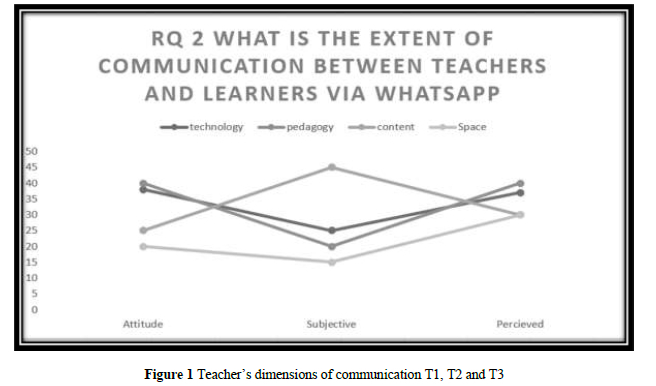
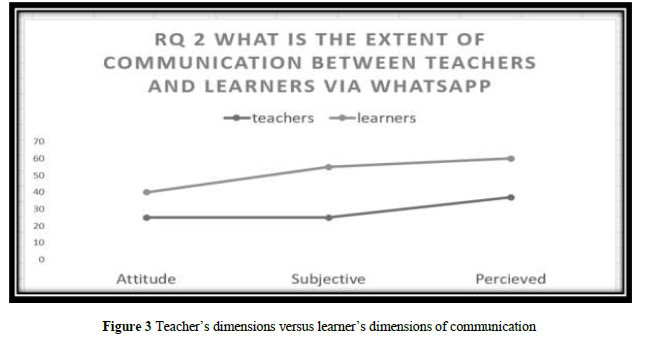
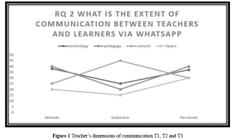
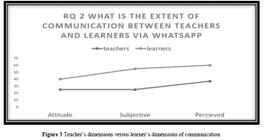
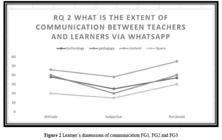
RQ 2. What is the extent of communication between teachers and learners via WhatsApp? Dimensions in this article refer to how much teachers/learners have used WhatsApp for communication based on the four theoretical pillars. In determining the dimensions of communication, a visual presentation was prepared to graphically portray the dimensions of communication (cf. Figure 1). From the analysis it was clear that matters related to content dominated (cf. Figures 1 and 2). In Figure 3 learners' interaction promoted out-of-school communications. This meant that the teachers' perceived extent of communication was heightened too.
Technology-related Data
Using semi-structured pre-research interviews, the aim was to determine the underlying structure that rural secondary schools employed to start using WhatsApp as a tool for education and the scope of interaction between teachers and learners through WhatsApp. T1 commented that "[t]here isn't any computer. They were stolen, it was a very sad thing, also they were useless because there was no internet." T2 also said: "There are no computers they were stolen." T3 said in reaction: "We had the resource room with computers since we are the full-service school, I think they were 20 ... instead, they are vandalised." This indicates that there were no technological resources in schools to use for the teaching of mathematics since the computers were damaged. Teachers were disheartened by the malicious acts of vandalism, which in turn hindered their pursuit of cutting-edge teaching and implementation of innovative methodologies.
Teachers were to determine from their learners which social networks they could afford to continue with their extensive communication after school hours. In support of this, T3 commented that "[h]ere there are no resources except the books. We have a resource room with computers; the problem is there is no internet. Cell C is available here for communication only but to use it for data the signal coverage is very poor. The government promised a long time ago to install internet for us, but up to this far nothing has happened." This indicates a lack of technological tools for instruction and learning. Teachers have been waiting for government to fulfil its promises (T1, T2), but there was no innovation by the schools either. As a result we suggest investigating how digital platforms could improve teaching and learning in rural schools. Despite the shortage of ICT resources in schools, teachers can use WhatsApp to match the socio economic needs of education. One of the participants (T3) clarified things in this regard: "I use my cell phone to access the internet because here at school we are not yet connected. I download information for the class. I use my internet to get more practice for my learners. I use it more for the Grade 11 classes where I take also the projector to the classroom." Some participants in the study were able to use the internet for teaching and learning, but others did not have the necessary knowledge and skills to effectively use it as a resource. T1 declared that "[w]e need training in accessing the relevant site where we can download work, photocopy handouts and have them distributed among the learners." This suggests that professional development programmes for teachers are minimal or are not available to capacitate the teachers with enhancing technology in their teaching. In this article we indicate how teachers progressed on their own.
Pedagogy-related Matters
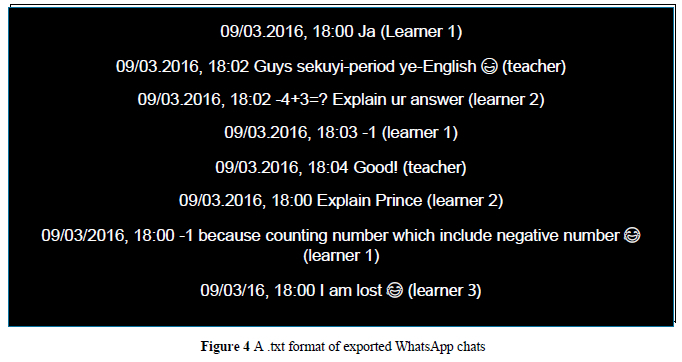
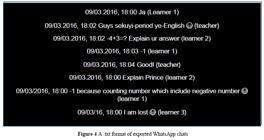
School teachers are increasingly expected to lead the crafting of extensive teaching and learning support services in their schools to create contextually relevant pedagogical structures that support learning. For instance, T3 indicated attempting to use other resources besides computers which were not bound by the availability of the internet. Teachers' beliefs together with professional growth and progress are engines of teaching and learning. These interactions increased knowledge and were expressed in the form of beliefs, conceptions of learning, and enhanced understanding of the pedagogical approach. Teachers gathered data from their learners through WhatsApp messages that were exported from chats through a .txt format. When opening this file, I accessed messages in the format shown in Figure 4.
Information gathered from three WhatsApp groups was retrieved and processed to prepare combined datasets for data processing. It was intriguing to see the learners' determination to orchestrate mathematics content. The results incorporated the directed positive pedagogical moves among teachers. Daily interactions led to teachers' gaining insight into the WhatsApp engagement and equipped them with skills to disseminate new topics. Online communications show that learners and teachers were very polite in their communication with one another. A learner from School A politely contacted group members: "I am so sorry let us get another problem.... I feel bad for disturbing you, can you post for me. " What was observed contradicted teachers' scepticism on rude learner behaviour. Learners' characters and social skills were not intentionally developed. The TPeCS framework suggests that in a modern society learning is regarded as a collaborative process in which knowledge is created together in learning communities that are supported by technology. Additionally, the physical environment also plays a significant role in both learning and teaching. Some teachers indicated the absence of policies which could be directly linked to a lack of incorporating technology in teaching and learning. By engaging in research on smart technologies using WhatsApp, teachers could easily indicate the lack thereof. For instance, T2 mentioned: "I haven't seen it [policy], perhaps you can help us to design it because cases related to cell phones at school are reported daily but we haven't done anything."
Content-related Data
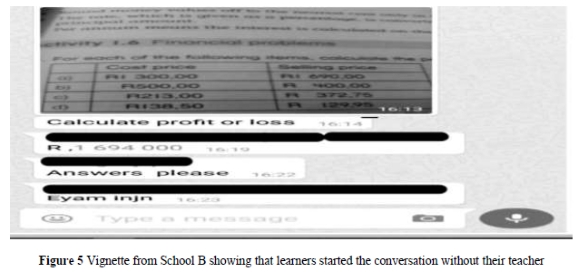
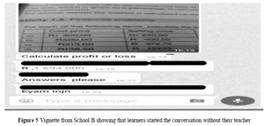
The main content that was supposed to be discussed was mainly based on mathematics as a subject. The areas and the scope of the content were discussed properly on the consent forms since participants were informed that the formation of the group was mainly for discussing mathematics content. The general agreement among the participants was noted. However, abiding by the general agreement was not an easy task. For instance, T3 explained that "[t]his is because I have noticed that these communications also demand the educator [teacher] to have questions, solutions, and practices at hand. With me, I could also have to struggle thinking where to get the exercises which will be clearer but in a very brief structure.' The above indicates that participants were aware of the content and their discussions were guided towards reaching critical questions regarding the curriculum. Furthermore, the teachers' demographics indicated that they were not properly qualified to teach mathematics. It was interesting to learn that online discussions revealed that learners were not waiting to have their lessons initiated by their teachers. Interestingly, interaction promoted out-of-school communication after school hours. In numerous WhatsApp vignettes, learners were observed initiating the discussion before the joining of their teacher. For example, the following vignette demonstrated such in School B (cf. Figure 5).
Space-related Data
The vignette in Figure 5 demonstrates the proximity of learners - their conversations were not limited by space. In confirming this, FG2 from school B mentioned that "things have changed. Our teacher used to remind us about the submission of the assignment or writing of the classwork when we meet him after school. So, I used to run away when I saw a teacher at first." This indicates a shift in education towards the use of online platforms and connectivity, and that participants could remind one another about their school tasks and duties. Participants' interactions progressed which extended their out-of-school engagement after school hours.
Discussion
TPeCS offered important insights from the project's first stage, which illuminated the selection of pertinent a priori themes. Interaction was identified as the new drive for both teachers and learners.
The Progression of Teacher's Roles
This was demonstrated by the evolution of the teachers' roles and learners initiating the new role of pedagogical practice. A paradigm shift is characterised by interactionism and pedagogical resilience which has been overlooked among rural secondary schools. Teachers as initiators of the WhatsApp groups intended and maintained the epistemic and pragmatic value of out-of-school interaction. Teacher' s attitudes were matched with a particular change in behaviour. This finding negates scholars who identified that teachers' data skills and teaching informed by data-driven findings were non-existent (Finzer, 2013). Erickson et al. (2019:para.5.) suggest "data moves" which incorporate data literacy by elaboration on how data can be manipulated and used to inform suitable teaching and learning. This was a progressive action-reaction development. Findings confirm that this could be possible through data wrangling (Koehler et al., 2017). Given all the difficulties faced by the participants, the intervention resulted in certain adjustments that provided improved chances. Teachers and learners could trade contact information and information on a social network site. It was intriguing to hear that contact eliminated scepticism and erased learners' apprehension. The findings revealed that teachers were having challenges with the use of WhatsApp, while learners were not struggling with posting mathematics practices. Teacher' /learners' out-of-school mathematics communication had improved. The manner in which teachers and learners thought, questioned things and solved problems could be grouped as "data habits." In a nutshell "the learning environment plays a critical role in developing data habits of the mind" (Finzer, 2013:6). Conclusions drawn from this study indicate that the situation in rural secondary schools needed immediate intervention of conceptualising and synthesising space and place (Shaw & Sui, 2020). This would entail using suitable social networks depending on the location or contextual factors.
Data revealed that the participating rural secondary schools had the responsibility of adopting their developmental trajectory, unlike other schools with well-balanced ICT infrastructure. Interaction among stakeholders (teachers and learners from three schools) played a fundamental role in educational improvement in teacher' s/learner' s new spaces (Kali, Baram-Tsabari, et al., 2019). Inadequate ICT policies and regulations promote mismanagement and risks to ICT equipment. It was found that new resilient teachers were emerging with the purpose of using deliberate, planned behaviour to open up new paths in their personal spaces (Gergen, 2015; Ungar, 2012). To advance teaching and learning, the TPeCS frameworks assumes that effective teaching requires more than just knowledge of the relationship between technology, pedagogy, and content (Kali, Sagy, et al., 2019). These pedagogical commitments are vital but frequently fail to address the obstacles and opportunities that contextually embedded data provide learners (Wilkerson & Polman, 2020). Extensive collaboration demands knowledge and a familiarity with technological spaces by considering them as alternative spaces for teaching and learning (Kali, Sagy, et al., 2019). This is included in the idea that the future is now, with technological, societal, and economic developments occurring rapidly (UNESCO, 2017). The new normal has impacted education on becoming more resilient and flexible in the face of challenges by advancing and thriving in this ever-changing world. In short, the new normal brought dynamic skills of teaching and learning, including an adoption of data science pedagogy. Data science pedagogy can be understood as the new science or purview of science education or an integration of existing sciences (Lee & Delaney, 2021). Data science could also be "described in emerging policy and consensus documents as a highly novel set of tools and practices or as an eclectic combination of fields with which learners are likely to have had little experience outside of formal, collegiate instruction" (Wilkerson & Polman, 2020:5). This issue is relevant to rural secondary schools for the identification of opportunities that could enhance technology for teaching and learning. Data science pedagogy could be well explained with the triadic interaction between teacher, learner and WhatsApp. The triadic interaction consisted of three components: an action plan in which the content of the available data was important (Lee & Delaney, 2021); the learners' role in guiding their learning outside of the formal setting (Lee & Dubovi, 2020); and teachers' expertise (Lee & Delaney, 2021; Wilkerson & Polman, 2020). In this study, both teachers and learners were resilience agents (Ungar, 2012). Knowledge of the role of both teachers and learners in advancing communication in rural contexts was added.
Interaction which Promoted Out-of-school Communication after School Hours
The roles, knowledge, and beliefs of teachers as well as the nature of mathematical tasks influenced the types of content that emerged in mathematics. Learners could also initiate conversations as they engaged in socially responsive discussions. Subjective norms could be matched with beliefs and positive confessions. Discussions from teachers and learners intended to improve engagement via WhatsApp. Ultimately, this was the verification of WhatsApp's ability to construct a solid triadic relationship using content-related topics. Learners collegiate instruction by initiating learning discussions (Wilkerson & Polman, 2020) and schools become spaces of transformational possibilities (Lee & Delaney, 2021). In this case, new cultural and sociological structures emerged, with WhatsApp being a humanistic, participatory approach. Data show that using WhatsApp improved user communication and collaboration. Perceived norms could be matched with what participants were willing to, but unable to do. Participants from various schools favoured WhatsApp as a social networking medium. Both teachers and learners confirmed that they were interested in using WhatsApp as a social network platform. The use of WhatsApp in teaching and learning has enhanced communication and discipline in schools to some extent. Learners may collaborate and share knowledge on the WhatsApp application. This suggests that learners' interaction on social platforms boosted their mathematics learning while also building confidence in expressing their ideas for solving mathematical problems.
Communication and learner discipline at schools have to some extent been involved in the engagement of social platforms. Teacher-learner and learner-learner communication had improved. This means that learners' engagement on social platforms has improved the learning of mathematics, while at the same time they built confidence of sharing their ideas of solving mathematical problems. Participating in groups develops a relaxed environment, builds self-esteem, enhances openness and makes it easier to monitor learners' progress. WhatsApp caters for personal experiences, cultural influences and widens humanistic elements. Interactions between teachers and learners as agents of resilience during COVID-19 raised the possibility of continuity in teaching and learning. Social ecologies of resilience provided an ecological source of hope and optimism.
The progressive expansions guided the study towards the emancipation of novel technology-enhanced out-of-school teaching and learning activities. This would imply the theory that would include the technology, pedagogy, content, interaction, and spaces (TPeCIS) knowledge framework - a new contextualised theory. The findings agree with those of Galeshi and Taimoory (2019) on how mathematics teachers view and perceive their relationships with their learners on a personal level and are the main priority of ensuring professionalism among them as teachers. When reviewing literature on professional development, the urgency for technological teaching (Drijvers, 2012), provision of teacher training (Aluko, 2017), and the lack of sufficient teacher training is currently all too clear (Dube, 2020). The construction of the TPeCIS framework seems to resolve issues by orchestrating what teachers and learners already use on a daily basis.
WhatsApp makes it possible to change the character of mathematics in a way that makes sense at the most basic setting for teaching and learning. Interaction brought about the fifth dimension through intricate pedagogical actions that entailed the creation of inquiries, the scrutiny of data, and the discernment of conclusions (Clarke, Braun, Frith & Moller, 2019). Teachers and learners used WhatsApp not restricted by time nor space. It was evident that the possibilities crafted by the triadic communication using WhatsApp could apply to other subjects as well. Effective future learning spaces (FLSs) were formed (Kali, Baram-Tsabari, et al., 2019). WhatsApp promoted hidden resilience (Ungar, 2012) and effective collaboration (Lazić et al., 2022).
Recommendations
It is recommended that schools without resources start with what they can afford and what is suitable in their context using TPeCIS. Communication widens critical skills of both teachers and learners while expanding avenues for extensive developments, intentional behaviour and resilience. With this study we elucidated the significance of shifting from emphasising individual talents to enhancing learners' ability to become effective and interact both within and outside of the classroom.
Conclusion
The results show that when teachers embraced the TPeCS knowledge framework, the pedagogical model in rural secondary schools in the uMkhanyakude district changed. According to this study, the triadic connection between teachers, learners, and WhatsApp has taken on a "pedagogical turn" in a humanistic participative manner. The interaction and interdependence between learners and teachers in the environments and situations where individuals actively participated and cooperated were acknowledged. Every teacher's epistemic professionalism would be the key to an autonomous development trajectory. The interaction, which was the fourth dimension suggested, demonstrated personal relevance to teachers and learners and the movement toward "spaces of possibilities" where appropriate 21st-century abilities were developed. The awareness of the adoption of this framework by teachers and learners could widen opportunities for teaching and learning. Data "moves" were recognised as crucial to maintain consistency with the evolving curriculum, inter-curriculum teaching and learning. Engagements in this regard will inform agents about various mitigation and adaptation strategies timeously and can easily be infused into any subject. What informed the adoption of this framework was the intention to improve the teaching and learning of mathematics. The teaching and learning opportunities in data-rich learning environments have drastically changed in rural secondary schools. The progression of teachers' roles enabled progressive action-reaction developments. These developments were identified in teachers' new roles as they planned new behaviour. Data wrangling gave rise to novel technology-enhanced out-of-school teaching and learning activities. Changes in pedagogy in rural secondary schools gave birth to the new contextualised theory called the TPeCIS knowledge framework. This paved the way to learn, unlearn, relearn, advance curriculum materials, and develop interaction strategies at rural secondary schools.
Notesi. Published under a Creative Commons Attribution Licence.
Acknowledgements
I acknowledge the constructive support in the construction of this manuscript that I had received from the reviewers. The contents of this article is based on my doctoral study. I acknowledge the contributions of the participants from the uMkhanyakude district and the KwaZulu-Natal Department of Education.
References
-
Acton B & Koum J 2014. WhatsApp blog. Available at http://blog.whatsapp.com/. Accessed 31 October 2023.
» http://blog.whatsapp.com/ -
Ajzen I 1991. The theory of planned behavior. Organizational Behavior and Human Decision Processes, 50(2):179-211. https://doi.org/10.1016/0749-5978(91)90020-T
» https://doi.org/10.1016/0749-5978(91)90020-T -
Aluko R 2017. Applying UNESCO guidelines on mobile learning in the South African context: Creating an enabling environment through policy. International Review of Research in Open and Distance Learning, 18(7):24-44. https://doi.org/10.19173/irrodl.v18i7.2702
» https://doi.org/10.19173/irrodl.v18i7.2702 -
Beetham H & Sharpe R (eds.) 2013. Rethinking pedagogy for a digital age: Designing for 21st century learning (2nd ed). New York, NY: Routledge. https://doi.org/10.4324/9780203078952
» https://doi.org/10.4324/9780203078952 -
Braun V & Clarke V 2021. One size fits all? What counts as quality practice in (reflexive) thematic analysis? Qualitative Research in Psychology, 18(3):328-352. https://doi.org/10.1080/14780887.2020.1769238
» https://doi.org/10.1080/14780887.2020.1769238 -
Brooks J, McCluskey S, Turley E & King N 2015. The utility of template analysis in qualitative psychology research. Qualitative Research in Psychology, 12(2):202-222. https://doi.org/10.1080/14780887.2014.955224
» https://doi.org/10.1080/14780887.2014.955224 -
Chapman O & Heater B 2010. Understanding change through a high school mathematics teacher's journey to inquiry-based teaching. Journal of Mathematics Teacher Education, 13(6):445-158. https://doi.org/10.1007/s10857-010-9164-6
» https://doi.org/10.1007/s10857-010-9164-6 -
Clarke V, Braun V, Frith H & Moller N 2019. Editorial introduction to the special issue: Using story completion methods in qualitative research. Qualitative Research in Psychology, 16(1 ): 1-20. https://doi.org/10.1080/14780887.2018.1536378
» https://doi.org/10.1080/14780887.2018.1536378 -
Clarke V, Hayfield N, Moller N, Tischner I & The Story Completion Research Group 2017. Once upon a time ... Qualitative story completion methods. In V Braun, V Clarke & D Gray (eds). Collecting qualitative data: A practical guide to textual media and virtual techniques. Cambridge, England: Cambridge University Press. https://doi.org/10.1017/9781107295094
» https://doi.org/10.1017/9781107295094 -
Department of Basic Education, Republic of South Africa 2018. Mathematics teaching and learning framework for South Africa: Teaching mathematics for understanding. Pretoria: Author. Available at https://www.jet.org.za/clearinghouse/projects/primted/curriculum-frameworks/mathematics-curriculum-frameworks/12-august-2018-mathematics-framework-draft.pdf/view. Accessed 31 October 2023.
» https://www.jet.org.za/clearinghouse/projects/primted/curriculum-frameworks/mathematics-curriculum-frameworks/12-august-2018-mathematics-framework-draft.pdf/view - Drijvers P 2012. Teachers transforming resources into orchestrations. In G Gueudet, B Pepin & L Trouche (eds). From text to 'lived' resources: Mathematics curriculum materials and teacher development. New York, NY: Springer.
-
Dube B 2020. Rural online learning in the context of COVID 19 in South Africa: Evoking an inclusive education approach. Multidisciplinary Journal of Educational Research, 10(2):135-157. https://doi.org/10.4471/remie.2020.5607
» https://doi.org/10.4471/remie.2020.5607 -
Durgungoz A & Durgungoz FC 2022. "We are much closer here": Exploring the use of WhatsApp as a learning environment in a secondary school mathematics class. Learning Environments Research, 25:423-444. https://doi.org/10.1007/s10984-021-09371-0
» https://doi.org/10.1007/s10984-021-09371-0 -
Erickson T, Wilkerson M, Finzer W & Reichsman F 2019. Data moves. Technology Innovations in Statistics Education, 12(1). https://doi.org/10.5070/t5121038001
» https://doi.org/10.5070/t5121038001 - Falk JH & Dierking LD 2000. Learning from museums: Visitor experiences and the making of meaning. Walnut Creek, CA: AltaMira Press.
-
Finzer W 2013. The data science education dilemma. Technology Innovations in Statistics Education, 7(2):1-9. https://doi.org/10.5070/t572013891
» https://doi.org/10.5070/t572013891 -
Galeshi R & Taimoory HR 2019. Online education: Influencing teachers' perception of professionalism. International Journal of Online Pedagogy and Course Design (IJOPCD), 9(4):1 - 17. https://doi.org/10.4018/IJOPCD.2019100101
» https://doi.org/10.4018/IJOPCD.2019100101 -
Gergen KJ 2015. From mirroring to world-making: Research as future forming. Journal for the Theory of Social Behaviour, 45(3):287-310. https://doi.org/10.1111/jtsb.12075
» https://doi.org/10.1111/jtsb.12075 -
Graham MA, Stols GH & Kapp R 2021. Integrating classroom technology: South African mathematics teachers. Computers in the Schools, 38(3): 189-213. https://doi.org/10.1080/07380569.2021.1953951
» https://doi.org/10.1080/07380569.2021.1953951 -
Hardré PL 2011. Motivation for math in rural schools: Student and teacher perspectives. Mathematics Education Research Journal, 23(2):213-233. https://doi.org/10.1007/s13394-011-0012-5
» https://doi.org/10.1007/s13394-011-0012-5 -
Jere NR, Jona W & Lukose JM 2019. Effectiveness of using WhatsApp for Grade 12 learners in teaching Mathematics in South Africa. In 2019 IST-Africa Week Conference (IST-Africa). Piscataway, NJ: IEEE. https://doi.org/10.23919/ISTAFRICA.2019.8764822
» https://doi.org/10.23919/ISTAFRICA.2019.8764822 -
Kahn J 2020. Learning at the intersection of self and society: The family geobiography as a context for data science education. Journal of the Learning Sciences, 29(1):57-80. https://doi.org/10.1080/10508406.2019.1693377
» https://doi.org/10.1080/10508406.2019.1693377 -
Kali Y, Baram-Tsabari A & Scheijter A (eds.) 2019. Learning in a networked society: Spontaneous and designed technology enhanced learning communities. Cham, Switzerland: Springer. https://doi.org/10.1007/978-3-030-14610-8
» https://doi.org/10.1007/978-3-030-14610-8 -
Kali Y, Sagy O, Benichou M, Atias O & Levin-Peled R 2019. Teaching expertise reconsidered: The Technology, Pedagogy, Content and Space (TPeCS) knowledge framework. British Journal of Educational Technology, 50(5):2162-2177. https://doi.org/10.1111/bjet.12847
» https://doi.org/10.1111/bjet.12847 -
Kearney M, Burden K & Schuck S 2019. Disrupting education using smart mobile pedagogies. In L Daniela (ed). Didactics of smart pedagogy: Smart pedagogy for technology enhanced learning. Cham, Switzerland: Springer. https://doi.org/10.1007/978-3-030-01551-0_7
» https://doi.org/10.1007/978-3-030-01551-0_7 -
Koehler M, Bogatu A, Civili C, Konstantinou N, Abel E, Fernandes AAA, Keane J, Libkin L & Paton NW 2017. Data context informed data wrangling. In JY Nie, Z Obradovic, T Suzumura, R Ghosh, R Nambiar, C Wang, H Zang, R Baeza-Yates, X Hu, J Kepner, A Cuzzocrea, J Tang & M Toyoda (eds). 2017 IEEE International Conference on Big Data Proceedings. Los Alamitos, CA: IEEE. https://doi.org/10.1109/BigData.2017.8258015
» https://doi.org/10.1109/BigData.2017.8258015 -
Lazic B, Maricic S, Marié M & Mrda M 2022. Cooperative learning in online class teaching of mathematics. Slavonic Pedagogical Studies Journal, 11(2):212-226. https://doi.org/10.18355/PG.2022.11.2.3
» https://doi.org/10.18355/PG.2022.11.2.3 -
Lee VR & Delaney V 2021. Identifying the content, lesson structure, and data use within pre-collegiate data science curricula. Journal of Science Education and Technology, 31:81-98. https://doi.org/10.1007/S10956-021-09932-1
» https://doi.org/10.1007/S10956-021-09932-1 -
Lee VR & Dubovi I 2020. At home with data: Family engagements with data involved in Type 1 diabetes management. Journal of the Learning Sciences, 29(1):11-31. https://doi.org/10.1080/10508406.2019.1666011
» https://doi.org/10.1080/10508406.2019.1666011 - Lelliott A 2009. Teacher practices during science school visits in Gauteng. In M Schäfer & C McNamara (eds). Proceedings of the Seventeenth Annual Meeting of the Southern African Association for Research in Mathematics, Science and Technology Education. Grahamstown, South Africa: Rhodes University.
-
Lotz-Sisitka H, Mandikonza C, Misser S & Thomas K 2021. Making sense of climate change in a national curriculum. In I Schudel, Z Songqwaru, S Tshiningayamwe & H Lotz-Sisitka (eds). Teaching and learning for change: Education and sustainability in South Africa. Cape Town, South Africa: African Minds. Available at https://library.oapen.org/bitstream/handle/20.500.12657/64082/1/9781928502241.pdf. Accessed 31 October 2023.
» https://library.oapen.org/bitstream/handle/20.500.12657/64082/1/9781928502241.pdf -
Maher D 2021. Innovative practices in primary and secondary school learning environments. In J Keengwe (ed). Handbook of research on innovations in non-traditional educational practices. Hershey, PA: IGI Global. https://doi.org/10.4018/978-1-7998-4360-3.ch004
» https://doi.org/10.4018/978-1-7998-4360-3.ch004 - Marshall C & Rossman GB 2016. Designing qualitative research (6th ed). Los Angeles, CA: Sage.
- Mefolere KF 2016. WhatsApp and information sharing: Prospect and challenges. International Journal of Social Science and Humanities Research, 4(1):615-625.
-
Msiza GM, Malatji KS & Mphahlele LK 2020. Implementation of an e Learning project in Tshwane South district: Towards a paperless classroom in South African secondary schools. The Electronic Journal of e-Learning, 18(4):300-310. https://doi.org/10.34190/EJEL.20.18A003
» https://doi.org/10.34190/EJEL.20.18A003 -
Mthethwa LC 2021. Integrating social networks in the teaching and learning of mathematics in rural secondary schools. PhD thesis. Pretoria, South Africa: University of South Africa. Available at https://uir.unisa.ac.za/bitstream/handle/10500/29536/thesis_mthethwa_lc.pdf?sequence=1&isAllowed=y. Accessed 31 October 2023.
» https://uir.unisa.ac.za/bitstream/handle/10500/29536/thesis_mthethwa_lc.pdf?sequence=1&isAllowed=y -
Mupezeni S & Kriek J 2018. Out-of-school activity: A comparison of the experiences of rural and urban participants in science fairs in the Limpopo Province, South Africa. EURASIA Journal of Mathematics, Science and Technology Education, 14(8):em1577. https://doi.org/10.29333/ejmste/92041
» https://doi.org/10.29333/ejmste/92041 -
Mutodi P & Ngirande H 2014. Perception of secondary school teachers towards the use of concrete materials in constructing mathematical meaning. International Journal of Educational Sciences, 7(3):449-461. https://doi.org/10.1080/09751122.2014.11890206
» https://doi.org/10.1080/09751122.2014.11890206 -
Prabowo A, Rahmawati U & Anggoro RP 2019. Android-based teaching material for statistics integrated with social media WhatsApp. International Journal on Emerging Mathematics Education, 3(1):93-104. https://doi.org/10.12928/ijeme.v3i1.11961
» https://doi.org/10.12928/ijeme.v3i1.11961 -
Reddy V, Visser M, Winnaar L, Arends F, Juan A, Prinsloo C & Isdale K 2016. TMSS 2015: Highlights of mathematics and science achievement of Grade 9 South African learners. Pretoria, South Africa: Human Sciences Research Council. Available at https://repository.hsrc.ac.za/bitstream/handle/20.500.11910/10673/9591.pdf?sequence=1&isAllowed=y. Accessed 31 October 2023.
» https://repository.hsrc.ac.za/bitstream/handle/20.500.11910/10673/9591.pdf?sequence=1&isAllowed=y -
Shaw SL & Sui D 2020. Understanding the new human dynamics in smart spaces and places: Toward a splatial framework. Annals of the American Association of Geographers, 110(2):339-348. https://doi.org/10.1080/24694452.2019.1631145
» https://doi.org/10.1080/24694452.2019.1631145 -
Shaw SL, Tsou MH & Ye X 2016. Editorial: Human dynamics in the mobile and big data era. International Journal of Geographical Information Science, 30(9):1687-1693. https://doi.org/10.1080/13658816.2016.1164317
» https://doi.org/10.1080/13658816.2016.1164317 - Shulman LS 1986. Paradigms and research programs in the study of teaching: A contemporary perspective. In MC Wittrock (ed). Handbook of research on teaching (3rd ed). New York, NY: Macmillan.
-
Theron LC & Engelbrecht P 2012. Caring teachers: Teacher-youth transactions to promote resilience. In M Ungar (ed). The social ecology of resilience: A handbook of theory and practice. New York, NY: Springer. https://doi.org/10.1007/978-1-4614-0586-3
» https://doi.org/10.1007/978-1-4614-0586-3 -
Umugiraneza O, Bansilal S & North D 2018. Exploring teachers' use of technology in teaching and learning mathematics in KwaZulu-Natal schools. Pythagoras, 39(1):a342. https://doi.org/10.4102/pythagoras.v39i1.342
» https://doi.org/10.4102/pythagoras.v39i1.342 -
Ungar M 2012. Social ecologies and their contribution to resilience. In M Ungar (ed). The social ecology of resilience: A handbook of theory and practice. New York, NY: Springer. https://doi.org/10.1007/978-1-4614-0586-3
» https://doi.org/10.1007/978-1-4614-0586-3 -
United Nations 2019. Sustainable development goal in South Africa [PowerPoint presentation]. Available at https://sustainabledevelopment.un.org/content/documents/24474SA_VNR_Presentation__HLPF_17_July_2019._copy.pdf. Accessed 31 October 2023.
» https://sustainabledevelopment.un.org/content/documents/24474SA_VNR_Presentation__HLPF_17_July_2019._copy.pdf -
United Nations Educational, Scientific and Cultural Organization 2017. UNESCO moving forward the 2030 Agenda for Sustainable Development. Paris, France: Author. Available at https://unesdoc.unesco.org/ark:/48223/pf0000247785. Accessed 31 October 2023.
» https://unesdoc.unesco.org/ark:/48223/pf0000247785 -
Voogt JP, Fisser N, Pajera Roblin N, Tondeur J & Van Braak J 2013. Technological pedagogical content knowledge - a review of the literature. Journal of Computer Assisted Learning, 29(2):109-121. https://doi.org/10.1111/j.1365-2729.2012.00487.x
» https://doi.org/10.1111/j.1365-2729.2012.00487.x -
Wilkerson MH & Polman JL 2020. Situating data science: Exploring how relationships to data shape learning. Journal of the Learning Sciences, 29(1):1-10. https://doi.org/10.1080/10508406.2019.1705664
» https://doi.org/10.1080/10508406.2019.1705664
Revised: 4 November 2023
Accepted: 13 December 2023
Published: 31 December 2023