School principals' leadership development: Lessons from the ACE school leadership programme on leading during the COVID-19 pandemic
Abstract
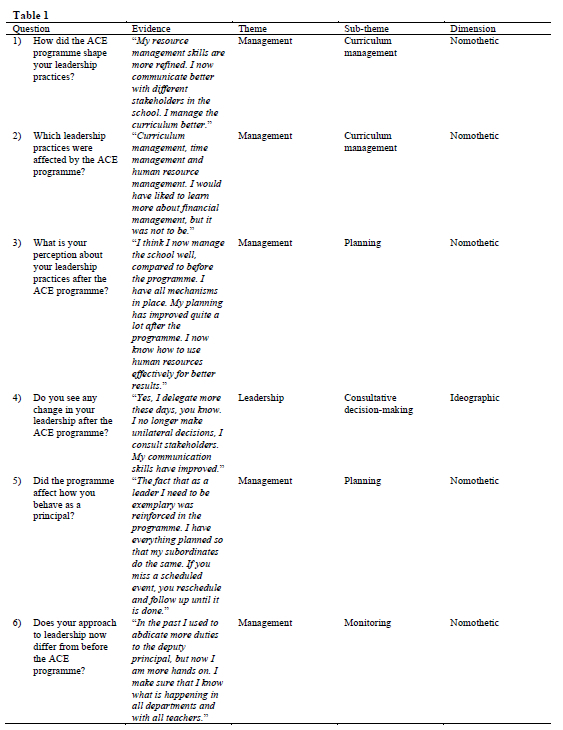
The COVID-19 pandemic presented the world with many challenges - some of which were unprecedented challenge for school leaders. The South African Department of Education (DoE) introduced a new threshold qualification, an Advanced Certificate in Education (School Leadership) (ACE), which was the first concrete step towards implementing a compulsory professional qualification for principalship. In this study I employed qualitative case study research methods and procedures to investigate the influence of the ACE programme on leadership practices. Six township secondary school principals from the Mpumalanga province, South Africa, who had completed the ACE programme were purposively selected. Semi-structured interviews were used to collect data. A thematic approach was used to analyse the data. The findings display ample evidence of the nomothetic dimensions of the social systems theory, outweighing the ideographic dimensions in the preparation programme for principals. The study revealed that the programme mostly developed principals' management practices and needed to develop principals' leadership skills as well. Furthermore, the study revealed that principals were able to apply the management skills gained from the ACE programme during the COVID-19 pandemic.
idiographic dimension; leadership; leadership practice; nomothetic dimension; principals' leadership roles; principals' preparation programmes; social system