School principals' leadership development: Lessons from the ACE school leadership programme on leading during the COVID-19 pandemic
Abstract
The COVID-19 pandemic presented the world with many challenges - some of which were unprecedented challenge for school leaders. The South African Department of Education (DoE) introduced a new threshold qualification, an Advanced Certificate in Education (School Leadership) (ACE), which was the first concrete step towards implementing a compulsory professional qualification for principalship. In this study I employed qualitative case study research methods and procedures to investigate the influence of the ACE programme on leadership practices. Six township secondary school principals from the Mpumalanga province, South Africa, who had completed the ACE programme were purposively selected. Semi-structured interviews were used to collect data. A thematic approach was used to analyse the data. The findings display ample evidence of the nomothetic dimensions of the social systems theory, outweighing the ideographic dimensions in the preparation programme for principals. The study revealed that the programme mostly developed principals' management practices and needed to develop principals' leadership skills as well. Furthermore, the study revealed that principals were able to apply the management skills gained from the ACE programme during the COVID-19 pandemic.
idiographic dimension; leadership; leadership practice; nomothetic dimension; principals' leadership roles; principals' preparation programmes; social system
Introduction and Background
Schools were the most critical societal institutions to be affected by the coronavirus disease (COVID-19) pandemic. Unfortunately, most school leaders have little or no training in crisis leadership (McLeod & Dulsky, 2021). According to Suto (2013), success in the workplace, especially education, requires new skills in the 21st century. Harris (2020) asserts that school leadership has been shifted towards network practices through communication and collaboration during the COVID-19 pandemic. With this study I investigated how the ACE programme prepared principals to exercise their leadership practices during a crisis. There have been concerns about poor school leadership in South Africa even before the COVID-19 pandemic. In light of the perceived poor school leadership, the former Minister of Basic Education, Dr Naledi Pandor, expressed her dissatisfaction with the state of school leadership, and stated that "...we have a (school) leadership that cannot analyse, cannot problem-solve, cannot devise strategic interventions and plans, and cannot formulate perspectives that are directed at achieving success" (Business Day, 2004:6). According to Mahlangu (2018), poor school leadership and management are the major contributors to the dysfunctionality of a school. Therefore, the South African DoE introduced a school leadership qualification called the ACE School Leadership programme, which was piloted in six provinces from 2007 to 2009 (Bush, Kiggundu & Moorosi, 2011).
The importance of specialised training and development for school principals became the focus (Bush 2008, in Naidoo, 2019:2). This linked to concerns about the disappointing learner outcomes, especially in national tests, and the belief that raising leadership quality would lead to enhanced learner performance (Bush et al., 2011).
According to Ngidi and Qwabe (2006:529), "some of the challenges in school leadership and management in South Africa are linked to generally poor management of schools by school leaders." The identified management challenges include time management, timetabling, poor administration, and poor human resources skills. According to Bush and Oduro (2006), many practicing principals lack basic leadership and management training before, and after, their entry into the principalship.
Kamper (2008), who investigated effective leadership in some high-poverty schools in South Africa discovered that poverty-related challenges could be overcome through energetic, compassionate, innovative, and empowering leadership. The intention with the ACE programme was for it to be practice-based. My study was aimed at investigating the influence of the ACE programme on leadership practices with a purpose to determine how much of the course was internalised, made meaning of, and applied in practice in schools (Bush et al., 2011). The study was motivated by the fact that some university-based programmes have been criticised for being disconnected from the demands of school leadership needed for leading schools (Wilson, 2011). In addition to the criticism levelled against professional development, a paradigm shift for professional development refutes the previous drive-by workshop model in favour of the innovative and opportunity-driven one (Stein, MK, Smith & Silver, 1999).
The structure of the ACE programme is such that it accommodates the participants' contexts and covers leadership and management aspects required for effective school leadership. The challenges mentioned above sparked curiosity to question the current mechanisms for preparing principals in South Africa. Bush (2009:12) writes that "... global interest to develop school principals for leadership and management are based on the assumptions that it will lead to school improvements and enhanced learning outcomes."
Statement of Problem
Poor school leadership is a serious concern in most schools in South Africa. In recent years there has been an emphasis on enhancing the leadership and managerial competencies of school principals (Cruz, Villena, Navarro, Balecina & Garvido, 2016) as there were concerns about the quality of school leadership in some South African schools. As a result of identifying gaps in the quality of school leadership, a course, the Advanced Certificate in Education: School Leadership, was introduced. This programme was aimed at empowering school leaders on leadership practices. The programme was piloted in six provinces from 2007 to 2009. Globally, school leaders were not prepared to deal with what the COVID-19 pandemic presented. South Africa never had a programme specifically meant to train school leaders for leadership. It is highly likely that the pandemic added to the existing woes faced by school leaders. I found that even when people were exposed to some kind of training, they failed to lead and manage during crises. I sought to investigate how the ACE programme affected how school leaders who had completed the programme led and managed during the COVID-19 pandemic.
Research Question
With this study I aimed to answer the following research question:
• How did the ACE programme influence principals' leadership practices during the COVID-19 pandemic?
Aim and Objective of the Study
I aimed to investigate the synchrony between theory and practice by exploring the perceptions of school principals who had attended the ACE programme on their leadership practices during the COVID-19 pandemic. The objective of the study was to understand how principals who had completed the ACE programme applied the skills and knowledge gained from the programme during the COVID-19 pandemic.
Method
I adopted a qualitative research approach. McMillan and Schumacher (2001:41) state that a qualitative approach is designed to collect data primarily in the form of words rather than numbers. The data for this study were gathered through semi-structured interviews with six purposively selected township school principals in the Mpumalanga Province who had completed the ACE programme. Guided by the research question, we used semi-structured interviews to collect data.
Interviews were audio-recorded and later transcribed. An interpretivist paradigm was adopted in this study. Thematic data analysis was employed. A case study design was adopted for this study.
Theoretical Framework
The theoretical framework underpinning this research is the social systems theory. Coladarci and Getzels (1955) view administration as a hierarchy of subordinate-superordinate relationships within an institution. According to Constantinidou (1995:135), the school is a system of social interaction; it is an organised whole comprised of interacting personalities bound together in an organic relationship. Therefore, this implies that administration is carried out within a formal structure, consisting of operations and interactions that call for coordination for the achievement of institutional goals. According to Jensen (1954), a school situation is the interaction of small social groups. The groups embody different roles, indicating rights and obligations held in common by all members of the institution. Therefore, administration plays an integrative role aimed at making organisational and individual aims constant.
Programmes preparing principals for leadership
There is a concern that many school principals graduate from university programmes without the requisite skills to lead schools, and positively turn around their schools for the better (Duncan, Range & Scherz, 2011). Therefore, programmes for the preparation of principals must be linked to the skills that a principal will need in the role of school leader (Stein, SJ & Gewirtzman, 2003). In the next section I explain why leadership development programmes for principals are important.
Dichotomy of the impact of preparation programmes
Little empirical evidence exists that demonstrates whether, and how, the learning offered in preparation programmes assist principals to become more effective in their practice (Scott, 2008). This sentiment is amplified by Davies, Darling-Hammond, LaPointe and Meyerson (2005:7) who state that programmes are experimenting with different combinations of curricula, methods, and structures, with the aim to develop principals' practice. An argument by Dimmock and Walker (2000:21) demonstrates that "corroborative evidence about the impact of leadership training and development aimed at influencing principals' skills, knowledge and behaviour is emerging." This holds true for leadership development in South Africa. The pace of professional development of principals in South Africa has been slow compared to that in developed countries around the world. South Africa only got a wake-up call on leadership developmentin 2003 (DoE, RSA, 2008).
An entry-level qualification called the Advanced Certificate in Education (ACE) for principals was introduced in 2007 (DoE, RSA, 2008). The curriculum of the South African ACE programme is like the curricula of programmes elsewhere in the world but is contextualised for South African (Scott, 2008). Despite the programme having the necessary ingredients, criticism was levelled against it throughout the world. My study highlights some of the strengths and weaknesses of the ACE programme. One of the weaknesses was that the programme did not prepare school principals for leading and managing a school as discussed below.
Leadership competencies
Zhao (2020) states that education and school leadership roles have been redesigned and recrafted during the COVID-19 pandemic. During the pandemic, in most instances, education was presented through online teaching and learning (Zhao, 2020). Bitterová, Hasková and Pisoñová (2014) conclude that the quality of principals influences the quality of teaching and learning at a school. Bitterová et al. (2014) further emphasise that school leadership training programmes are expected to include aspects on personnel, economy, legislation, leadership, and management in the curriculum. Therefore, the main leadership competencies that a school leader should have, include, among others, to lead and control colleagues, to create and develop a learning environment effective for learning and teaching, to create motivational strategies, to define power scopes and tasks clearly, and to distribute and delegate responsibilities (Bitterová et al., 2014).
Shaping the direction and development of the school
The DoE, RSA (2008:16) claims that "the ACE School Leadership programme was designed to provide principals with knowledge to manage and lead schools." The school principal is responsible to provide leadership through the vision and development of the school. The principal, working in collaboration with the school governing body (SGB), the school management team (SMT), and other stakeholders, is responsible to create a shared vision, mission, and strategic plan that inspire and motivate all who work in and with school, and to provide direction for the school's on-going development. The vision and mission encapsulate the core educational values and the moral purpose of the school community. The strategic planning process is fundamental for shaping and sustaining school improvement and for empowering the school to be active in its ongoing development (DoE, RSA, 2008). School principals, as leaders and managers, are expected to develop and empower others. Principals can only empower others if they are empowered.
Managing the school as an organisation
The principal is expected to provide effective leadership and management of the school, and based on on-going review and evaluation, continuously strive to find ways to develop and improve organisational structures and functions. According to the DoE, RSA (2008:16), "the principal is responsible for ensuring that the school and its people, assets and all other resources are organised and managed to provide an effective, efficient, safe and nurturing learning environment."
The ability to manage a school effectively as an organisation was even more critical during the COVID-19 pandemic. During this and other periods of crisis, principals were especially expected to provide leadership and management. The management function dictates that the principal should 1) build and strengthen the capacity of those working in the school, and ensure that all valuable assets and resources are equitably deployed to maximum effect in supporting effective teaching and learning, and 2) seek to build the school as a successful organisation through genuine and effective collaboration with others (DoE, RSA, 2008:18).
School principals should be able to establish a link between the school and the community. There should be amicable partnerships between the school and other stakeholders. The principal needs to have skills to promote amicable partnerships so that the school benefits from the support from the community.
Data Analysis
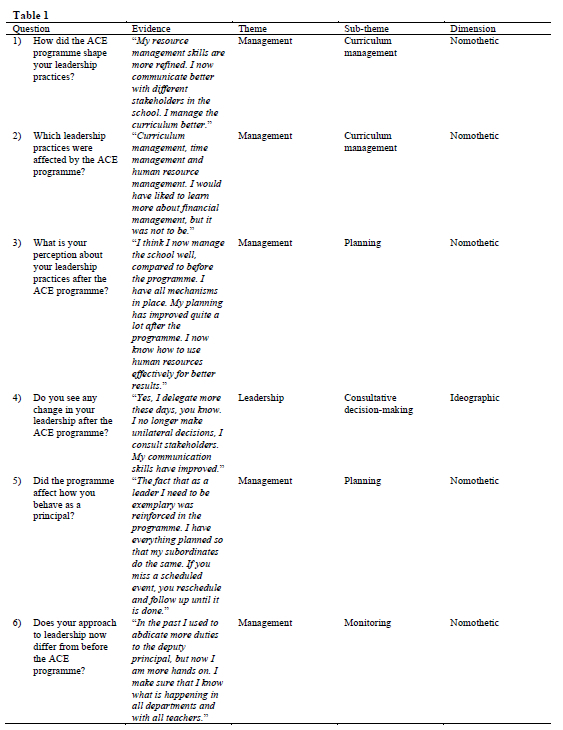
Table 1 below indicates how I analysed the interviews with principals. Principals' responses (evidence), questions, themes and sub-themes are presented in Table 1.
Discussion and Findings
Two main interrelated themes emerging from the data addressed principals' experiences of the ACE School Leadership programme. The themes are management and leadership. The two themes are supported by sub-themes like curricular management, planning, organising, coordinating, monitoring and communication. These themes are categorised into two dimensions, namely, the nomothetic dimension and the idiographic dimension. The nomothetic dimension focuses on the institutions' roles and expectations, and the idiographic dimension focuses on the individual, personality and need-disposition. Abbot (1965:5) states that "the institutional dimension of an organisation refers primarily to bureaucratic expectations of the position within the organisation." In this context, principals are expected to perform certain functions in line with their position. The ACE programme was expected to empower principals to perform those functions competently. Individual behaviour is a function of the interaction between expectations of the bureaucratic role and the relevant individual's personality traits (Constantinidou, 1995).
The themes and sub-themes that emerged during the interviews with school principals on their experiences in the ACE School Leadership programme are discussed below.
Human Capital
The principal needs to promote quality teaching, secure commitment, and enhance the performance of the school (DoE, RSA, 2008:17). Kimball, Milanowski and McKinney (2009) assert that principals must develop their staff, as well as provide an atmosphere that will allow the staff to fully commit to the principals' vision. My investigation revealed that the ACE programme helped principals manage human capital well. Most principals in the study indicated that they learnt how to create a conducive environment for all the stakeholders at the school. One principal revealed that he made the best of the limited resources available during the pandemic. The principal indicated that teachers were frustrated due to the lack of resources, which led to the departure of valuable staff members. The programme helped them identify priority areas and do more with less. Simple things such as the ability to communicate shortcomings, and indicate commitment to remedy the situation, means a lot to staff members. As a result, there was a change of attitude from staff members, which translated into happy staff instead of the usual grumpy and reluctant staff members. A happy workforce produces desirable outcomes which make everybody happy. Overall, the ACE programme helped principals to manage in the right way at the school.
Management
Scholars define management in different ways. Kinicki and Williams (2018:5) define management as "the pursuit of organizational goals efficiently and effectively by integrating the work of people through, planning, organizing, leading, and controlling the organization's resources." Jones and George (2018:5) define management as "planning, organizing, leading, and controlling of human and other resources to achieve organizational goals efficiently and effectively." John Kotter, a guru in change management and leadership, defines management as "coping with complexity, while leadership is coping with change" (Kotter, 2001:85). Research indicates that school principals can have a positive effect on a school's level of productivity (Hallinger & Murphy 1985). My investigation indicates that the ACE programme was instrumental in producing nomothetic leaders. According to Satimburwa (1998), a nomothetic leader emphasises the needs of the institution. Much as the programme was to develop principals' leadership competencies, the programme mostly developed principals' management competencies.
Principals positively rated the ACE programme as having sharpened their managerial skills. Development of management skills included human resource management, financial management, and curriculum management. Most educators confessed to inadequate financial management skills until they enrolled in the ACE programme. Principals espoused the benefits of the programme regarding management functions. They are now good at planning, organising, leading, and coordinating (POLC). Overall, the ACE programme mostly developed them in the nomothetic dimension.
My study revealed that the theme of management dominated in the analysis of the data. Principals indicated that they put the skills that they had learnt from the ACE programme to good use during COVID-19. High volumes of information needed to be managed carefully during COVID-19. Therefore, principals needed to be able to plan, organise, lead and coordinate things well during the pandemic. According to Davies et al. (2005:4), "principals are expected to be educational visionaries, instructional and curriculum leaders, assessment experts, disciplinarians, community builders, public relations experts, budget analysts, and facility managers." My study revealed that management skills were positively affected after the completion of the programme. Compelling evidence exists that the POLC management functions were enhanced through the programme. This indicates that the nomothetic dimension was developed through the programme. The only distinctive leadership skill developed by the ACE programme was communication. The study revealed that curriculum management improved because of the programme. This is supported by data from interviews and document analysis.
Leadership
Robbins and DeCenzo (2007:247) define leadership as the ability that an individual demonstrates to influence others to act in a particular way through direction, encouragement, sensitivity, consideration, and support. My study demonstrates that the ACE programme, to some extent, played a role in developing ideographic leaders. According to Satimburwa (1998), an ideographic leader is a leader who emphasises the well-being of individual and group needs. Principals indicated that they were able to communicate more effectively with the stakeholders during the COVID-19 pandemic. Through proper communication, potential challenges were dealt with even before they occurred, which is the opposite of what used to happen prior to them having attended the ACE programme. The principals were glad that they were able to have one-on-one encounters with staff members regarding non-job-related matters. These interactions helped staff members to open, which translated into members becoming free to express concerns and gratitude for what happened in schools. Principals indicated that they were able to view leadership and management from a holistic world view, as opposed to a mechanistic world view. The ACE programme enabled principals to be more organised, plan well, and coordinate activities much better, which allowed them to interact better with subordinates.
Instructional leadership
Hallinger (2005) and Hoy and Hoy (2009) assert that most school principals face challenges balancing their varied management duties with their curriculum leadership functions. Cotton (2003) asserts that effective instructional leaders are intensely involved in curricular and instructional issues that directly affect learner achievement. Furthermore, Murphy, Hallinger, Weil and Mitman (1983) outline the leadership process which includes decision-making, communication, conflict management, the change process, group process, and environmental interaction. Most participating principals indicated that the programme assisted them to learn more about instructional management. Although they had learnt more about instructional management, there were spinoffs from other leadership skills like communication, which made them become good instructional leaders. Principals were able to perform their instructional leadership roles with ease during the COVID-19 pandemic. Principals indicated that they communicated school instructional programmes better. What is critical is that they started POLC instructional activities after the ACE programme.
My study revealed that principals learned more on leadership functions than they did on leadership skills. Some principals even went as far as stating that the programme helped reinforce what they had already known regarding management. However, some principals emphasised that their communication skills were sharpened. One of the roles of the principal is that of communicator - someone who can communicate the vision and the mission of the school effectively. The study revealed that the ACE programme was focussing more on the nomothetic dimensions than the idiographic dimensions.
Executive leadership
Turner (2007, in Tingle, Corrales & Peters, 2019), indicates that effective leaders are those that enable institutions to respond to change, address challenges, and create a culture that engages employees. My study revealed that principals benefited more from the ACE programme regarding management skills. Principals indicated that after the ACE programme they were more organised in terms of planning, leading, and coordinating activities in their schools. The principals were instrumental in managing the transition from face-to-face teaching to online teaching during the COVID-19 pandemic. The nomothetic dimension took centre stage in the ACE programme. Communication was the aspect of the idiographic dimension highlighted by principals. To execute management and leadership activities in schools, principals are expected to have effective communication skills. Principals pointed out that they had learnt a lot about effective written and verbal communication.
Principals highlighted how they were now able to empower stakeholders much better than before embarking on the programme. Principals indicated that they were now able to do things that they previously could not, such as approaching companies for sponsorships. Other principals indicated that the way they used to address staff-parent meetings had been revolutionised after the programme. Principals were now free and ready to face departmental officials when they visited the school, because things were now in order. Structures in the school were now functioning well; in the past these were just done to tick the box. All stakeholders in the school were operating as expected.
School Culture
According to Fullan (2007), school culture can be defined as the guiding beliefs and values evident in the way the school operates, including attitudes, expected behaviour, and values. COVID-19 shifted how things were done in schools. When schools were closed because of the pandemic, principals ensured that they maintained the culture of communication among the staff, learners and parents. This study revealed that the programme only assisted in the improvement on communication with stakeholders in the school. Principals indicated that the programme assisted them in identifying the body language, from subordinates down to learners, which required them to act in a particular way after interpreting what it could mean. One principal mentioned that apart from subordinates showing complete respect towards them as leaders while communicating, small things such as sudden silences when they were around, somehow made them noticed issues of concern. The programme helped the principals in reading the school culture appropriately, which enabled them to turn things around in the school. Principals indicated that they were able to reinforce good school culture and discourage non-progressive school culture for the betterment of the school.
Strategic Operations
The investigation revealed that the ACE programme influenced principals' strategic operations in their schools. Principals indicated that they were able to apply strategic operations as directed by the government during the COVID-19 pandemic. Principals believed that the ACE programme helped them to manage activities in their schools much better than before. Principals emphasised that they were able to ensure that teaching and learning infrastructure, especially online infrastructure, was organised well. Highest on the list was the principals' ability to plan for curriculum activities more effectively and well in advance. Not only were they planning better, but were also following through, evaluating progress, and making relevant amendments along the way. Principals now used data to assess and plan on how best to manage the curriculum and to monitor educators' progress. Innovative strategies of managing the curriculum were implemented, which resulted in learner achievement. The year plan, school management plan, and school development plan were well coordinated to monitor progress. Under the ideographic dimension, communication resurfaced as the skill that was sharpened through the ACE programme.
Communication
Webb and Norton (2003) state that effective communication is essential in developing trust, mutual respect, and clarity of function. The programme included a module dedicated to communication. This study revealed that there was a higher level of improvement on communication at different levels. Principals indicated that what they had learnt from the programme assisted them to communicate and disseminate information effectively during the COVID-19 pandemic. Principals communicated better and involved teachers, SMTs, SGBs, administration staff and the representative council for learners (RCL) in decision-making better than before. Edwards and Smit (2008) argue that mature, productive, and interdependent relations serve as a bond that sustains a school. In this study I discovered the existence of constant communication between the stakeholders. The study revealed that the communication was mostly initiated by the principal. There seems to be a common thread among the participants regarding how principals put their vision across to the stakeholders. Bell (2013:85) emphasises the significance of vision in leadership by stating that "establishment of vision is an essential trait for an effective leader." This indicates that principals improved in communicating their vision to the stakeholders.
The communication theme falls under the ideographic dimension which is essential for good leadership. Communication is one of the pillars of leadership. Bennis and Nanus (2003:145) stress that "leadership is all about communicating, and effective principals regularly utilize communication skills in soliciting beliefs and ideas, advocating positions, and persuading others." This study revealed that communication was by far the only prominent idiographic dimension that the ACE programme developed in principals. Principals insisted that their communication skills were much better developed than before they had enrolled for the programme. Principals indicated that due to better communication, relations in their schools had improved. They indicated that effective communication abolished role ambiguity in their schools. Stakeholders knew what was expected from them and how it should be done. Most principals indicated that collective decision-making was developed by the ACE programme.
Mentorship
The ACE programme developed principals to work closely with their subordinates. Due to sharpened communication skills, principals assumed their role as mentors more and more. By virtue of their position, principals were expected to be experts in different aspects of teaching. This investigation revealed that principals became more involved in monitoring curriculum matters. Principals served as immediate mentors to their deputy principals. Principals served as training officers to their subordinates after having received training from government officials on how things should be done. Principals made sure that deputy principals interacted with heads of department to monitor the status. One principal confessed that he was guilty of appending his signature on curriculum documents without sufficient knowledge of the content. Principals could now identify challenges before they escalated, as they knew what was happening and were able to mentor appropriately. Because they knew what was going on, principals could reward good work, which motivates staff members.
Collegiality
This investigation revealed that principals now worked closely with other principals. The aspect of communication involved principals working with their peers. Principals now shared good practices with other principals to turn their schools around. During the COVID-19 pandemic they worked more closely with each other. Virtual meetings were held and ideas shared on how best to monitor and implement online teaching. One principal even went as far as sharing resources such as teachers. A good mathematics teacher, for example, may teach at more than one school. This kind of collegiality was not common before principals had enrolled for the ACE programme.
Recommendations
I recommend that future school leadership preparation programmes should place more emphasis on developing the individual's (idiographic) leadership competencies. Principals' leadership development should strike a balance between the nomothetic (organisation) and idiographic (individual) competencies.
Conclusion
The influence of programmes for school leadership preparation has been well researched. The challenge seems to be that most university-based preparation programmes do not effectively prepare school leaders. With this study I concluded that the ACE programme influenced the principals' management (nomothetic) practices more positively than it did their leadership (idiographic) practices. Principals seemed to become more aware of management tools to effectively achieve the vision of the school. It seems that the ideographic dimension emerged as a by-product of increased confidence in management. Principals often use decision-making and strategic leadership unconsciously. This was clear from the communication strategies used by principals in this study. The principals need to ensure that the required documents (files) are always available in case departmental officials pay them a visit.
The ACE programme has influenced how principals executed their management activities. It seems that principals became more aware of bureaucratic requirements of running an organisation (school), which made a difference to learners' education. Furthermore, the analysis revealed that principals were aware of checklists and other documents that were required for efficient functioning of the school. However, I sensed that in most cases, principals were following the prescribed policies slavishly, which left little room for creativity and innovation. This indicates that more is still required to develop principals in South Africa. In conclusion, the ACE programme positively influenced principals' management practices more than it did leadership practices.
Notesi. This article is based on the doctoral thesis of Ephraim Matala Kgwete.
ii. Published under a Creative Commons Attribution Licence.
Acknowledgement
I would like to express my gratitude to the school principals who participated in this study by sharing their experiences and time for this study.
References
-
Abbot MG 1965. Intervening variables in organizational behavior. Education Administration Quarterly, 1(1):1-14. https://doi.org/10.1177/0013161X6500100102
» https://doi.org/10.1177/0013161X6500100102 -
Bell RM 2013. Charismatic leadership case study with Ronald Reagan as an exemplar. Emerging Leadership Journeys, 65(1):83-91. Available at https://www.regent.edu/acad/global/publications/elj/vol6iss1/elj-vol6iss1.pdf#page=73. Accessed 14 February 2025.
» https://www.regent.edu/acad/global/publications/elj/vol6iss1/elj-vol6iss1.pdf#page=73 - Bennis W & Nanus B 2003. Leaders: The strategies for taking charge. New York, NY: Harper & Row.
-
Bitterová M, Hasková A & Pisoñová M 2014. School leader's competencies in management area. Procedia - Social and Behavioural Sciences, 149:114-118. https://doi.org/10.1016/j.sbspro.2014.08.170
» https://doi.org/10.1016/j.sbspro.2014.08.170 - Bush T 2009. Managing teaching and learning in South African schools. International Journal of Educational Development, 10:10-16.
-
Bush T, Kiggundu E & Moorosi P 2011. Preparing new principals in South Africa: The ACE: School Leadership Programme. South African Journal of Education, 31(1):31-43. https://doi.org/10.15700/saje.v31n1a356
» https://doi.org/10.15700/saje.v31n1a356 -
Bush T & Oduro GKT 2006. New principals in Africa: Preparation, induction and practice. Journal of Educational Administration, 44(4):359-375. https://doi.org/10.1108/09578230610676587.
» https://doi.org/10.1108/09578230610676587 - Business Day 2004. New programmes for principals, 30 December.
- Coladarci AP & Getzels JW 1955. The use of theory in educational administration. Educational Administration Monographs, 5.
-
Constantinidou EA 1995. Administration: An examination of theory and its application to secondary public schools in Cyprus with particular reference to the role of principals. MA thesis. Durham, England: Durham University. Available at https://core.ac.uk/download/pdf/9640311.pdf. Accessed 14 February 2025.
» https://core.ac.uk/download/pdf/9640311.pdf - Cotton K 2003. Principals and student achievement: What the research says. Alexandria, VA: Association for Supervision and Curriculum Development.
-
Cruz CDP, Villena DK, Navarro EV, Belecina RR & Garvida MD 2016. Towards enhancing the managerial performance of school heads. International Review of Management and Business Research, 5(2):705-714. Available at https://www.researchgate.net/profile/Marc-Garvida/publication/304348451_Towards_Enhancing_the_Managerial_Performance_of_School_Heads/links/576c642108aedb18f3eb28cf/Towards-Enhancing-the-Managerial-Performance-of-School-Heads.pdf. Accessed 14 February 2025.
» https://www.researchgate.net/profile/Marc-Garvida/publication/304348451_Towards_Enhancing_the_Managerial_Performance_of_School_Heads/links/576c642108aedb18f3eb28cf/Towards-Enhancing-the-Managerial-Performance-of-School-Heads.pdf -
Davies S, Darling-Hammond L, LaPointe M & Meyerson D 2005. School leadership study: Developing successful principals. Stanford, CA: Stanford Educational Leadership Institute. Available at https://www.casciac.org/pdfs/sls_research_review.pdf. Accessed 14 February 2025.
» https://www.casciac.org/pdfs/sls_research_review.pdf -
Department of Education, Republic of South Africa 2008. Advanced Certificate: Education (School Management and Leadership). Pretoria: Author. Available at https://oerdev.nbatesting.co.za/system/files/2024-01/courseoutlinever6_0.pdf. Accessed 17 February 2025.
» https://oerdev.nbatesting.co.za/system/files/2024-01/courseoutlinever6_0.pdf -
Dimmock C & Walker A 2000. Cross-cultural values and leadership. Management in Education, 14(3):21-24. https://doi.org/10.1177/089202060001400308
» https://doi.org/10.1177/089202060001400308 -
Duncan H, Range B & Scherz 2011. From professional preparation to on-the-job development: What do beginning principals need? International Journal of Educational Leadership Preparation, 6(3):1-20. Available at https://files.eric.ed.gov/fulltext/EJ974249.pdf. Accessed 14 February 2025.
» https://files.eric.ed.gov/fulltext/EJ974249.pdf - Edwards G & Smit B 2008. Collaborative leadership as a necessary condition for successful curriculum implementation. Journal of Education, 44:109-122.
- Fullan M 2007. The new meaning of educational change (4th ed). New York, NY: Teachers College Press.
-
Hallinger P 2005. Instructional leadership and the school principal: A passing fancy that refuses to fade away. Leadership and Policy in Schools, 4(3):221-239. https://doi.org/10.1080/15700760500244793
» https://doi.org/10.1080/15700760500244793 -
Hallinger P & Murphy J 1985. Assessing the instructional management behaviour of principals. The Elementary School Journal, 86(2):217-247. https://doi.org/10.1086/461445
» https://doi.org/10.1086/461445 -
Harris A 2020. COVID-19 - school leadership in crisis? Journal of Professional Capital and Community, 5(3/4):321-326. https://doi.org/10.1108/JPCC-06-2020-0045
» https://doi.org/10.1108/JPCC-06-2020-0045 - Hoy AW & Hoy W 2009. Instructional leadership: A research-based guide to learning in schools. Boston, MA: Pearson.
- Jensen GE 1954. The school as a social system. Educational Research Bulletin, 33(2):38-46.
- Jones GR & George JM 2018. Contemporary management (10th ed). New York, NY: McGraw-Hill Education.
-
Kamper G 2008. A profile of effective leadership in some South African high-poverty schools. South African Journal of Education, 28(1):1-18. Available at https://sajournalofeducation.co.za/index.php/saje/article/view/145. Accessed 28 February 2025.
» https://sajournalofeducation.co.za/index.php/saje/article/view/145 -
Kimball SM, Milanowski A & McKinney SA 2009. Assessing the promise of standards-based performance evaluation for principals: Results from a randomized trial. Leadership and Policy in Schools, 8(3):233-263. https://doi.org/10.1080/15700760802416099
» https://doi.org/10.1080/15700760802416099 - Kinicki A & Williams BK 2018. Management: A practical introduction (8th ed). New York, NY: McGraw-Hill.
- Kotter JP 2001. What leaders really do? Havard Business Review, 79(11):85-96.
-
Mahlangu VP 2018. Pertinent leadership and governance challenges facing schools in South Africa. In N Popov, C Wolhuter, JM Smith, G Hilton, J Ogunleye, E Achinewhu-Nworgu & E Niemczyk (eds). BCES conference books (Vol. 16, Pt. 3). Sofia, Bulgaria: Bulgarian Comparative Education Society. Available at https://files.eric.ed.gov/fulltext/ED586178.pdf. Accessed 17 February 2025.
» https://files.eric.ed.gov/fulltext/ED586178.pdf -
McLeod S & Dulsky S 2021. Resilience, reorientation, and reinvention: School leadership during the early months of the COVID-19 pandemic. Frontiers in Education, 6:637075. https://doi.org/10.3389/feduc.2021.637075
» https://doi.org/10.3389/feduc.2021.637075 - McMillan JH & Schumacher S 2001. Research in education: A conceptual introduction (5th ed). New York, NY: Longman.
-
Murphy J, Hallinger P, Weil M & Mitman A 1983. Instructional leadership: A conceptual framework. Planning & Changing, 14(3):137-149. Available at https://www.researchgate.net/publication/234676251_Instructional_Leadership_A_Conceptual_Framework. Accessed 13 February 2025.
» https://www.researchgate.net/publication/234676251_Instructional_Leadership_A_Conceptual_Framework -
Naidoo P 2019. Perceptions of teachers and school management teams of the leadership roles of public-school principals. South African Journal of Education, 39(2):Art. #1534, 14 pages. https://doi.org/10.15700/saje.v39n2a1534
» https://doi.org/10.15700/saje.v39n2a1534 -
Ngidi D & Qwabe J 2006. The partnership of parents, educators, and principals in creating a culture of teaching and learning in schools. South African Journal of Education, 26(4):529-539. Available at https://sajournalofeducation.co.za/index.php/saje/article/view/24/10. Accessed 12 February 2025.
» https://sajournalofeducation.co.za/index.php/saje/article/view/24/10 - Robbins SP & DeCenzo DA 2007. Supervision today! (5th ed). Englewood Cliffs, NJ: Prentice Hall.
-
Satimburwa GW 1998. Student leadership in Black schools. MEd dissertation. Durban, South Africa: University of Zululand. Available at https://uzspace.unizulu.ac.za/server/api/core/bitstreams/39aa1d99-9b00-4a69-a93e-bda54110d3b8/content. Accessed 12 February 2025.
» https://uzspace.unizulu.ac.za/server/api/core/bitstreams/39aa1d99-9b00-4a69-a93e-bda54110d3b8/content - Scott RW 2008. Organizations and organizing: Regional, natural, and open systems perspectives. Upper Saddle River, NJ: Prentice Hall.
-
Stein MK, Smith MS & Silver EA 1999. The development of professional developers: Learning to assist teachers in new ways. Harvard Educational Review, 69(3):237-269. https://doi.org/10.17763/haer.69.3.h2267130727v6878
» https://doi.org/10.17763/haer.69.3.h2267130727v6878 - Stein SJ & Gewirtzman L 2003. Principal training on the ground: Ensuring highly qualified leadership. New York, NY: Argosy Publishing.
-
Suto I 2013. 21st century skills: Ancient, ubiquitous, enigmatic. Research Matters, 15:2-8. https://doi.org/10.17863/CAM.100282
» https://doi.org/10.17863/CAM.100282 -
Tingle E, Corrales A & Peters ML 2019. Leadership development programmes: Investing in school principals. Educational Studies, 45(1):1-16. https://doi.org/10.1080/03055698.2017.1382332.
» https://doi.org/10.1080/03055698.2017.1382332 - Webb LD & Norton MS 2003. Human resources administration: Personnel issues and needs in education (4th ed). Upper Saddle River, NJ: Merrill/Prentice Hall.
-
Wilson DL 2011. Successful educational leadership at high performing schools. US-China Education Review, 8(3):393-398. Available at https://files.eric.ed.gov/fulltext/ED520457.pdf. Accessed 28 February 2025.
» https://files.eric.ed.gov/fulltext/ED520457.pdf -
Zhao Y 2020. COVID-19 as a catalyst for education change. Prospects, 49:29-33. https://doi.org/10.1007/s11125-020-09477-y
» https://doi.org/10.1007/s11125-020-09477-y
Revised: 2 July 2022
Accepted: 1 November 2024
Published: 28 February 2025