Reading on paper or reading digitally? Reflections and implications of ePIRLS 2016 in South Africa
Abstract
South Africa participated in the electronic version of the Progress in International Reading Literacy Study (ePIRLS) in 2016 but faced many challenges during implementation. Accurate databases on information and communication technologies (ICT) capacity of schools were not available for sampling in Gauteng, many schools had old and/or non-functional hardware and half of the schools had not used their computer laboratories in the last 3 years. Consequently, South Africa was excluded from the international report as the study requirements could not be met. In this paper we examine the implications of the problems experienced in the ePIRLS multiple case study, conducted in 9 schools (n = 277) in Gauteng. Multilevel models were built using data from the nationally representative Grade 4 Progress in International Reading Literacy Study (PIRLS) data from 2011 (n = 15,744) and 2016 (n = 12,810). In the 2016 national study, principals and teachers reported fewer computers and libraries being available for learners than were reported in 2011. Computers and paper-based libraries being available were not significant predictors of reading literacy. Instead, the medium of instruction in the Foundation Phase, school location, gender, and socioeconomic composition of the school predicted reading literacy achievement. The ePIRLS results show no significant difference between paper-based and online reading. While issues of poverty, gender inequality, and historical disadvantage persist, Grade 4 learners may lack adequate opportunities to acquire paper and digital reading skills. We conclude that the most disadvantaged learners have increasingly insufficient opportunities and resources available to attain basic reading skills and this will have negative long-term consequences for South Africa's educational sector and economy.
digital and online reading literacy; ePIRLS; ICT; multilevel modelling; PIRLS; reading comprehension; South African primary schools
Introduction
The role of online reading in primary school education is increasingly viewed as essential to the nature of living in the information age (Gerick, Eickelmann & Bos, 2017; Hennessy, Onguko, Harrison, Ang'ondi, Namalefe, Naseem & Wamakote, 2010; Mullis, Martin, Foy & Hooper, 2017a; Plowman, McPake & Stephen, 2012). Some scholars argue that the effectiveness of ICT and digital media in primary education is yet to be established and should be limited with young learners (Burnett, 2010; Hesterman, 2011; Organisation for Economic Cooperation and Development [OECD], 2015a). Other scholars argue in favour of ICT to enhance reasoning skills as well as computer and information literacy (Beetham & Sharpe, 2013; Fisher, R 2014; Toki & Pange, 2014; Vasquez & Felderman, 2013).
ICT can contribute positively to online and paper-based reading literacy, but the context and purpose of instruction should guide its use and it should be integrated with the aims of the curriculum (Lindberg, Olofsson & Fransson, 2017; Mills, 2010; Sharpe & Oliver, 2013). The educational debate is shifting from ICT advantages and disadvantages, to methods of using ICT to maximise the benefit to both teachers and learners (Cicconi, 2014; Meyer & Gent, 2016; Mills, 2010; Toki & Pange, 2014; Whittingham, Huffman, Rickman & Wiedmaier, 2013). A balanced approach to the utilisation of technology in the classroom could strengthen digital literacy and enhance the teaching and learning of reading literacy (Lim & Hang, 2003; McLean, 2017). Reading paper-based materials and online reading are two constructs that overlap but also differ in some aspects, which is why there is a strong argument for developing both constructs in a digitally-rich world (Coiro, 2011; Gilleece & Eivers, 2018).
In this paper we investigate which ICT resources are available for teaching and learning reading literacy in Grade 4 and whether regular use predicts paper-based reading literacy. The challenges of assessing online reading is discussed in the context of ICT availability and utilisation in South African primary schools as well as the findings from the ePIRLS.
Literature Review
The ePIRLS 2016 international results report significant differences between online reading and paper-based reading for all but two of the 14 participating countries (Mullis, Martin, Foy & Hooper, 2017b). The main conclusion of the ePIRLS international study is that when learners are well-prepared to read paper texts and are exposed to digital reading in school, they are proficient in online reading, including skills such as navigating simulated internet pages, integrating interactive content and searching for information (Mullis et al., 2017a). The complexities of online reading, when compared to paper, are being expanded on by researchers, and include issues such as the type of information read online, its context, and use. For example, there may be no significant differences in comprehension of fiction or nonfiction texts when readers are exposed to paper, tablets, or computer reading (Margolin, Driscoll, Toland & Kegler, 2013). There may be a difference between online reading and paper-based reading for those who do not have access to digital reading devices (Leu, Forzani, Rhoads, Maykel, Kennedy & Timbrell, 2015). Factors that affect reading literacy achievement in online reading versus paper-based include socioeconomic factors. Those living in impoverished areas may have significantly lower online reading literacy achievement than children in more affluent neighbourhoods (Gilleece & Eivers, 2018; Leu et al., 2015). When learners do not have access to ICT resources, their overall reading achievement in both paper and online reading could be lower (Leu et al., 2015).
ICT policies, plans and reality in South Africa
Incorporating ICT into pedagogy has been part of education reform since 1994. A Technology Enhanced Learning Initiative (TELI) was introduced in 1995 (De Jager & Nassimbeni, 2002). The initiative was followed by a draft policy paper in 1997, which aligned itself with the TELI strategic plan (Boekhorst & Britz, 2004). As part of incorporating ICT into pedagogy, SchoolNET was launched in 1997 (Blignaut & Howie, 2009). Seven years after the ICT initiative, a draft policy, the White Paper on e-education, was published in 2004 (Department of Education [DoE], 2004; Vandeyar, 2015). The strategic message of the White Paper on e-education was that management, teachers, and learners should have computer literacy skills and access to ICT resources by 2013 (DoE, 2004). The slow and uncoordinated implementation of the policy can be attributed to a lack of resources and departmental capacity (Gauteng Department of Education [GDE], 2010; Meyer & Gent, 2016). Other challenges include a lack of integrative strategies and a one-size-fits-all approach that does not work in South Africa's diverse educational landscape (Meyer & Gent, 2016). Poor strategy and implementation on a national level has resulted in provinces taking initiative and developing their own approaches. Of the nine provinces, only two are proactive on this topic - the Gauteng Departments of Education and the Western Cape Education Department (GDE and WCED). WCED rolled out the Khanya Project, which envisaged providing every school with computers for administration, teaching, and learning (Chigona, Chigona & Davids, 2014). Gauteng Online was a project that provided computer labs with internet connections to primary schools that did not have these resources.
The South African administration of ePIRLS reported a lack of ICT resources, even in the more urbanised province of Gauteng (Howie, Combrinck, Roux, Tshele, Mtsatse, McLeod Palane & Mokoena, 2017). South Africa was not included in the international ePIRLS report due to insufficient information for random sampling and was treated as a multiple case study. The fact that the GDE did not have a complete list of schools with ICT capacity indicates gaps in monitoring the availability and use of computer laboratories or tablets, as well as its implementation. Schools in impoverished environments, which do not fall within the former model C classification, face a persisting disadvantage (Christie & McKinney, 2017), a fact that is supported by findings from this paper. The ePIRLS 2016 Gauteng study reported that, even when schools had some ICT capacity, many had outdated hardware and software or nonfunctional resources such as computers which no longer worked or were missing essential components such as keyboards (Howie, Combrinck, Roux, Tshele, Mtsatse, et al., 2017).
Research Objective and Questions
The main aim of this paper was to examine the current status, challenges, and implications of ICT availability in South Africa for Grade 4 and Grade 5 reading literacy teaching and achievement.
Research questions related to the main objective:
1) What is the current status of ICT availability for learning and teaching reading literacy in Grade 4?
2) What is the association between ICT resources and reading literacy achievement when controlling for other variables?
3) Does regular use of computers in the classroom predict increased reading scores?
4) What are the implications of the ePIRLS challenges and results?
Conceptual Framework
This study is grounded in conceptual models which demonstrate that, in a developing context, socioeconomic factors, language background, and the school's reading literacy environment are significant predictors of both paper and online reading literacy (Finch & Arrow, 2017; Hartas, 2011; Hat-levik, Ottestad & Throndsen, 2015; Netten, Luyten, Droop & Verhoeven, 2016; Van Staden & Howie, 2014).
Methodology
The main study for the Progress in International Reading Literacy Study (PIRLS) was implemented in South Africa at the end of 2015 (Howie, Combrinck, Roux, Tshele, Mokoena & McLeod Palane, 2017; Howie, Combrinck, Tshele, Roux, McLeod Palane & Mokoena, 2017). PIRLS is a once-off test in the fourth year of schooling and primarily uses paper-based reading passages. More than 50 countries participate world-wide once every five years. The 2016 round of PIRLS had the addition of ePIRLS which features a simulated, interactive, online reading assessment component. The simulated online version (ePIRLS) was administered in the first school term of 2016. For the sub-study of ePIRLS, learners wrote the paper version and completed the electronic assessment (on separate days). ePIRLS provided the opportunity to compare online reading with paper-based reading in a convenience sample of Gauteng primary schools.
Sample
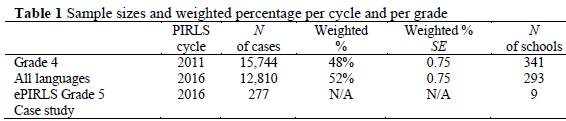
The sample sizes of the main studies and the ePIRLS case study, as well as the weighted percentage and the standard error (SE) of the weighted percentage, when cycles were combined in data sets are shown in Table 1 (Howie, Van Staden, Tshele, Dowse & Zimmerman, 2012; Howie, Venter, Van Staden, Zimmerman, Long, Du Toit, Scherman & Archer, 2008).
The national PIRLS samples are stratified clusters randomly drawn to represent populations chosen by the participating countries (LaRoche, Joncas & Foy, 2017). Schools are randomly selected, thereafter classes are randomly drawn. The South African samples were stratified by language and province, with the exception of the 2011 cycle, in which the sample was not stratified by province. Analysis for the current paper was conducted with data combined per grade, as shown in Table 1. In the case of Grade 4, data for all languages is available for 2011 and 2016, hence the large sample sizes. Due to difficulties discussed later in this paper, only nine schools and 277 learners participated in the ePIRLS 2016 study.
Instruments
The paper-based PIRLS booklets each contained a fictional passage as well as a non-fictional passage. Each passage was accompanied by 12 to 15 questions which contained a balance of multiple-choice and constructed-response items ranging in difficulty and cognitive demand. The paper-based version included a combination of passages aimed at international standards of fourth-year reading, and easier passages targeted at developing readers. The rotated-test design resulted in each learner completing one booklet from the 16 possible booklets, and achievement scores were estimated for all learners and all passages, producing imputed plausible values (PVs). The tasks and items of ePIRLS were developed by the International Association for the Evaluation of Educational Achievement (IEA) and the Australian Council for Educational Research (ACER) (Mullis et al., 2017a). The electronic version of the test required the ability to search for information in a simulated online environment, directly report facts in lower-order tasks and evaluate the information and synthesise material in higher-order tasks. The electronic version of the assessment only contained informational tasks and there was no overlap between paper and electronic tasks or passages; the tests were equated on the same learners being tested in both instruments. An interactive example of ePIRLS can be found on the Boston College websitei (Mullis et al., 2017b).
Four different questionnaires were also included in the study and they were answered by learners, teachers, principals, and parents. The contextual variables used in the analysis, for example whether the classroom had computers, were derived from the questionnaire data.
Administration and Ethical Considerations
The standard IEA protocols were followed during test administration, with one day used for the paper-based test and a separate day for the digital, online reading test. Both tests comprised 45 minutes of reading and answering questions for each task or passage. Learners were given a break between the sessions and testing was conducted in the morning to avoid fatigue. All administrators underwent training and quality assurance monitoring was done by the international body as well as the national team. Ethical clearance for the project was obtained from the University of Pretoria, Faculty of Education. Principals gave permission for testing to take place in their schools, and signed consent was obtained from the learners' parents.
Challenges in Sampling and Administration of ePIRLS
Some of the challenges of implementing ePIRLS were discussed in the highlights report (see Howie, Combrinck, Roux, Tshele, Mtsatse, et al., 2017). This paper reports the challenges in more detail, investigates whether findings and experiences from ePIRLS can be substantiated with findings from the main study, and examines the implications. A requirement of ePIRLS was that schools should have functional computer rooms. The South African sample was originally intended to be representative of schools in Gauteng with computer facilities, where English was the language of learning and teaching (LoLT) from Grade 1. Initially, a database was obtained from the GDE. The list contained 2,161 schools; after eliminating high schools and adult centres, 236 schools remained.
Verification with schools revealed that many of the schools had been assigned the incorrect medium of instruction (language) and even though all the schools on the list should have had ICT capacity, many did not. Liaising with the GDE eventually revealed that accurate databases of ICT capacity were not available. After telephone conversations with the schools the list was reduced to 36 schools. According to the protocol for the international study, Statistics Canada drew a random sample of 25 schools in Gauteng. However, after school visits it emerged that the LoLT and availability of ICT equipment had been reported incorrectly at even more schools. Eventually, 15 schools were invited to participate and nine agreed. The fact that a representative sample could not be tested had the unfortunate consequence that South Africa was excluded from the international report. Despite schools having computer laboratories, functionality was limited or non-existent in many schools. Therefore, the ePIRLS team had to rent laptops to take to schools, which escalated the cost of the study. During the study it was also discovered that four of the nine schools had not used their computer rooms in the last three years. The result of inactive ICT usage was observed during fieldwork; learners sometimes struggled to use the mouse and respond to the interactive content. Learners in schools where computers rooms were not used, did not read better on paper than online, which is attributed to the fact that both online and paper-based reading are closely linked and that neither of the skills had been adequately developed.
Data Analysis
The initial descriptive analysis was conducted using the IEA's International Database (IDB) Analyzer software, which functions in conjunction with the Statistical Package for the Social Sciences (IBM Corp., 2017; IEA, 2018). The mean achievement derived from the PIRLS comprehension are the PVs on a scale of 0 to 1,000 with a standard deviation of 100. IDB Analyzer runs statistical tests, while accounting for standard errors, weighting the sample appropriately and combining the plausible values (Foy, 2018; IEA, 2018). IDB Analyzer was used to generate descriptive statistics of ICT availability for the larger samples as well as the ePIRLS multiple case study.
Multilevel modelling (MLM) was conducted using the Hierarchical Linear and Nonlinear Modeling Program (HLM 7) to control for between-school variance (Raudenbush, Bryk & Congdon, 2013). In South Africa, between-school variance tends to be large due to the heterogeneous population, socioeconomic factors and complex schooling system (Van Staden, 2010; Van Staden & Howie, 2014). Consequently, models that consider the nested nature of the sample are necessary when the intraclass correlation coefficient (ICC) exceeds 5% (Arends, Winnaar & Mosimege, 2017; Huta, 2014).
Multilevel models were built for the Grade 4 data, with two separate models, one for 2011 and another for 2016 (see Table 1 for sample sizes). The models included the socioeconomic composition of the school, computer availability for learners to use in the school (from the principal questionnaire) as well as computers for class use (from the teacher questionnaire). The availability of a school library and a classroom library was included in the model as an additional control for paper-based reading resources. Weighting was calculated to represent the probability of the within-cluster units by multiplying all design weights and non-response adjustment, as recommended by As-parouhov (2006) and Stancel-Piatak and Desa (2014). To draw conclusions about the overall population, grand mean centring was used for all the variables at level 2 (Hoffman & Gavin, 1998; Raudenbush & Bryk, 2002; Snijders & Bosker, 1999; Stancel-Piatak, Mirazchiyski & Desa, 2013).
Economic variables included in the model were school location and school socioeconomic composition to account for learner background. Being exposed to an African language in the Foundation Phase, versus attending an English or Afrikaans school, was included as a variable that indicates both language background and socioeconomic status (SES). Attending a school where the LoLT is an African language or attending an English or Afrikaans LoLT school was specifically included as a predictor, because during the sampling of ePIRLS it was found that African LoLT schools were the most unlikely to have ICT resources. Afrikaans and English LoLT schools were grouped together due to their linguistic similarities and shared historical advantages. The African LoLT schools were grouped together as local languages due to their history and the fact that they differ linguistically from the European languages. It is acknowledged that Afrikaans can be classified as an African language due to its development in South Africa, but in this study it has been grouped with English.
The school reading literacy environment was measured by whether the school had a library and classrooms had reading corners or libraries (paper-based resources). The availability of computers or tablets for learners to use in the school and the classroom was included as digitally-based resources. Considering the large gender disparity in reading literacy, the gender of the child was included as a control variable in the model. The presence of computers or tablets does not necessarily imply that they are being used. For this reason, another model was built for schools where classroom computers or tablets were present to estimate the effect of regularly using these ICT resources.
Missing data can be problematic in multilevel modelling (Raudenbush et al., 2013). The variables derived from the school (principal questionnaire) had relatively large percentages of missing data; a total of 21% of the responses were missing for 2011 Grade 4 data, and 32% were missing for 2016. The combined cycles had as much as 26% of data missing regarding the variable of computers being available for learners' use in the school. The teachers' responses on computer availability for the classroom had an average of 7% missing data for each of the cycles. Full information maximum likelihood (FIML) estimation, using IBM Amos, was used to estimate missing values (Arbuckle, 2014, 2017; Enders & Bandalos, 2001; Schminkey, Von Oertzen & Bullock, 2016). FIML provides unbiased estimates that are equivalent to multiple imputation (MI) in large samples (Ferro, 2014). The missing data models included predictors which had correlations above .40 with the outcome variables (Enders, 2010). Effect sizes in multilevel models are estimated with the proportion of explained variance (PEV), equivalent to the traditional r2. The PEV of the null model represents the magnitude of variance that can be explained by school differences, whereas the unstandardized regression coefficients, shown in Table 4 and Table 5, represent the magnitude of the fixed effects, using the pertinent predictors (Lorah, 2018). It should be noted that the student weight of the ePIRLS data was set to 1 in the analysis, as the sample is not representative of any population. Therefore, means may differ slightly from the highlights report, where weights had not been changed.
Results
Results are shown for the MLM models of the Grade 4 national sample in terms of the availability of general ICT and paper-based resources (Table 4), as well as a model built only for classrooms where teachers reported having computers or tablets (Table 5). A multiple linear regression model was built for the results of the ePIRLS multiple case study in Table 7.
Attending an African Language School Versus an Afrikaans or English School
Among the challenges described earlier in this paper, the researchers found that, when a school's LoLT was an African language, the school tended to report no computer facilities or access to tablets. This led the researchers to suspect that there is a divide in ICT availability between African language schools and non-African language schools. To investigate whether the experiences during the multiple case study are supported by the main study, a variable was created to dichotomise writing the assessment in an African language school, as compared to writing in an Afrikaans or English school. While language in this dichotomisation is closely related to socioeconomic status, there are also potentially broader reasons for the divide, such as cultural elements (reading culture), historical disadvantage, and managerial issues within the school system. The divide between African LoLT schools (historically black schools) and English and Afrikaans LoLT schools (historically white schools) remains controversial and incendiary, but the research in this paper finds that issues of inequality persist between the two types of schools. Therefore, the variable was included for scientific reasons but also for the social implications.
The current status of ICT availability for Grade 4s as reported by principals and teachers of African and non-African LoLT schools, is shown in Table 2.
With each subsequent cycle of PIRLS participation, both principals and teachers reported less ICT availability. A large and significant difference between ICT availability as reported by African LoLT language schools and English or Afrikaans LoLT schools also existed.
Table 3 shows how many principals reported the presence of a school library and how many teachers reported classroom libraries or reading corners. As is the case with the ICT resources, a decline in paper reading materials was reported between the cycles.
ICT Availability and Use as Predictor of Reading Literacy Achievement
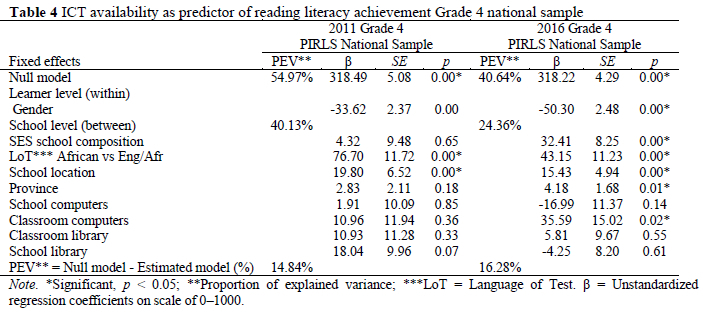
In Table 4 the multilevel models of the Grade 4 national samples are shown, with the model of the 2011 cycle on the left and the 2016 cycle on the right. The null model is shown first to account for between-school variance, which predicted 55% of the variance in the 2011 cycle and 41% of variance in the 2016 cycle. The models in Table 4 are based on the full Grade 4 national sample; in 2011 the representative sample included 15,744 learners and in 2016 a total of 12,810 learners participated.
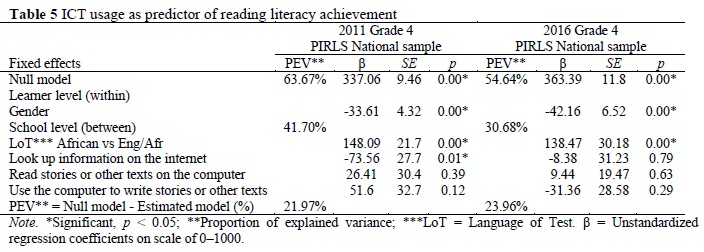
In 2011 the teachers of 22% of learners (n = 3,088), and in 2016 the teachers of 8% of learners (n = 861) reported that classroom computers or tablets were available for reading lessons. Teachers were also asked how often the classroom computers were used to look up information on the internet, read stories or other texts on the computer or use the computer to write stories or other texts. Based on category functioning, the responses were coded as Less than once a month and Weekly or daily. In 2011, 66% of the learners whose classrooms had computers were in African language schools and this percentage was 71% in 2016. Considering that African langvuage LoLT schools were the least likely to have access to ICT resources, the variable of being in an African LoLT language school, or not, was once again included in the model. In Table 5 the results of the model for schools where teachers reported the availability of computers are shown for the 2011 sample and 2016 samples respectively.
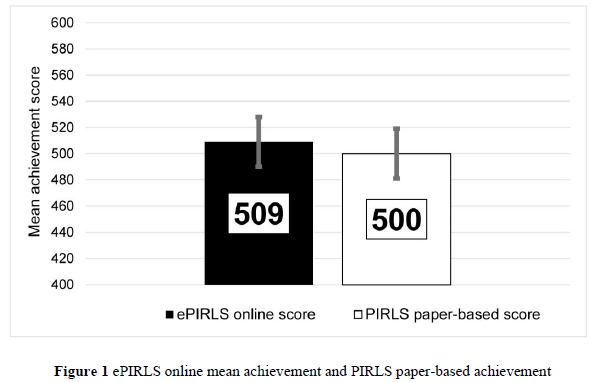
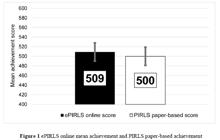
No statistically significant difference was found between the mean achievements of paper-based reading compared to online reading (shown in Figure 1). This is not surprising as the two types of reading were highly correlated in the South African multiple case study, r = .87 (p = .000). Therefore, predictors were expected to be similar for the two types of reading.
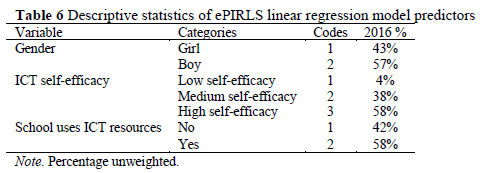
Schools who had not used their ICT resources in the last three years were classified as not using ICT; the descriptive statistics for the variables included in the multiple linear regression model are shown in Table 6.
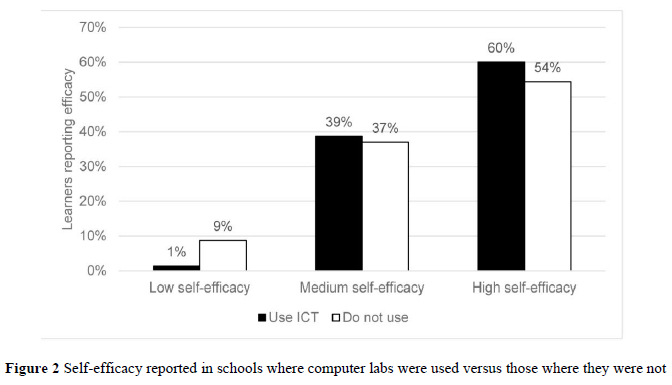
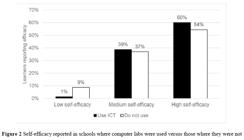
Learners reporting self-efficacy in using computers could be related to whether or not the school had used the computer room in the last three years. When self-reported efficacy of learners in schools that use their ICT resources was compared to the four schools that did not use it, only small differences were found (see Figure 2). Only 1% of learners in schools that used computer laboratories reported low self-efficacy, whereas 9% of learners in schools that did not use their computer rooms had low self-efficacy. The self-efficacy scale was generated by the IEA and based on items which included: asking learners to rate whether they were good at using computers, good at typing and whether it was easy for them to find information on the internet (Mullis et al., 2017a). Multicollinearity was not problematic as the correlation between computer self-efficacy and being in a school using the computer room was small (r = .11; p = .20).
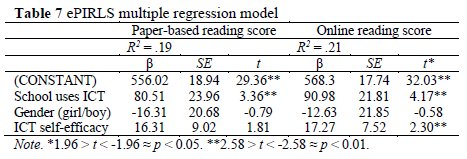
To gain insight into factors that predict paper-based reading and online reading, a multiple regression model was built for the 277 learners who participated in ePIRLS (shown in Table 7).
The results of ePIRLS (n = 277) cannot be generalised to any population because a representative sample was not drawn. The results of the 2016 ePIRLS multiple case study are intended to provide some insight into the predictors that are related to paper-based and online reading.
Discussion
When the influence of ICT availability, using the national Grade 4 samples, was examined, the availability of computers for learners' use in schools was not a significant predictor of paper-based reading literacy achievement in either of the two cycles. In the 2016 sample, classroom computers were significant (β = 35.59; SE = 15.02) but the 2011 model did not show the same significance. It should be acknowledged here that having access to resources, such as school libraries and computers or tablets, does not necessarily mean the resources will be used or that teachers have the required pedagogical knowledge to integrate these resources into teaching and learning (Mathevula & Uwizeyimana, 2014; Paton-Ash & Wilmot, 2015). The strongest significant predictor was attending an African language school or attending a non-African language school, predicting 76.70 (SE = 11.72) score points in the 2011 cycle and 43.15 (SE = 11.23) score points in the 2016 cycle. Attending an Afrikaans or English LoLT school could increase reading literacy achievement by more than a year of schooling (half a standard deviation) when other factors are fixed.
Gender was the second strongest predictor, with girls achieving as much as 33.62 (SE = 2.37) score points more than boys in 2011, and in 2016 the difference increased to 50.30 (SE = 2.48) score points (half a standard deviation). Globally, the reading literacy disparity between boys and girls in early grades has been documented for decades (Brozo, Sulkunen, Shiel, Garbe, Pandian & Valtin, 2014; Marinak & Gambrell, 2010; Zuze & Reddy, 2014). The increasing gender gap was also noted in the international report for two countries, South Africa and Saudi Arabia, which have the largest disparities between boys and girls in PIRLS (Mullis et al., 2017b). School location was also a significant predictor and living in a deep rural area or township could mean that learners achieved as much as 19.80 (SE = 6.52) score points less than those in urban areas in the 2011 study and 15.43 (SE = 4.94) score points less in the 2016 cycle. Having a school library and having a classroom library did not significantly predict paper-based reading achievement in either cycle when other predictors were fixed. Access to ICT for teaching and learning in South Africa is still associated with the SES of both schools and learners (Howie, 2010; Meyer & Gent, 2016; Sithole, Moses, Davids, Parker, Rumbelow, Molotja & Labadarios, 2013), and ICT uptake in schools remains lower than targets set by educational departments (Padayachee, 2017).
The 2011 and 2016 models explained 15-16% of variance in reading achievement once school variances were deducted (PEV). For the small percentage of schools where computers or tablets were available in classrooms (22% in 2011 and 8% in 2016), regular use of these resources was not a significant predictor of reading literacy achievement (paper-based). The exception was using computers to regularly look up information on the internet in the 2011 results. However, the regular use of computers to look up information in the 2011 cycle predicted a large, significant decrease in score points (β = -73.56; SE = 27.02). This result may be due to the fact that the majority (71%) of teachers said that they used the computers less than once a month, or it may be a spurious finding. Using the computers to read stories or other text and write stories or texts weekly did not significantly predict increased reading literacy achievement. Teacher responses to PIRLS questionnaire items can be excessively positive, and an over-reporting of activities has been found in secondary analysis of data when followed up with case studies (Van Staden & Zimmerman, 2017; Zimmerman, 2010). Therefore, no conclusions can be drawn from the fact that the reported regular use of ICT did not predict increased scores. The ICT usage models explained 23-24% of reading literacy achievement when controlling for between-school variance. Both of the multilevel models (Table 4 and Table 5) show that demographic predictors, such as gender, socioeconomic composition of the school, school location, and language of instruction are large, significant predictors of reading achievement. Issues of language as well as a lack of economic empowerment continue to be major in-luences on learning (Van der Berg, Spaull, Wills, Gustafsson & Kotzé, 2016).
In the ePIRLS linear regression model, the notion of schools using their ICT resources was the largest significant predictor of both paper-based and online reading achievement. Due to the small sample size and large amount of missing data for the questionnaire (more than 50%), contextual variables such as school SES composition could not be included in the model. Consequently, schools that use their computer laboratories may be the schools that are more functional, have learners from more advantaged backgrounds, implying general economic and social advantages, which are not accounted for in the model. Only English language schools in urban areas were used in the multiple case study, further limiting conclusions and comparisons, which is why models were built for the national sample. The ePIRLS multiple case study regression models explained 19% of the variance in paper-based reading and 21% of the variance in online reading. If a more complex and representative sample could have been drawn, more demographic variables and questionnaire items could have been used to strengthen the models.
Conclusion and Implications
In each subsequent cycle of PIRLS, South African principals and teachers reported less access to ICT resources in schools and classrooms than had been reported in the previous cycle. In 2011 principals of 55% of Grade 4 learners said that school computers were available for learning. By 2016 the principals of 44% of the Grade 4 learners reported ICT availability - a significant reduction. In 2011, teachers of 22% of the learners said that classroom computers were present; by 2016 the number of teachers reporting classroom computers (or tablets) had been reduced to 8%. When taking into consideration that many South African schools in rural areas still lack basic infrastructure, such as flushing toilets or electricity, the obstacles in providing ICT capacity to schools are understandable (Fisher, J, Bushko & White, 2017). Overcrowded classrooms, curriculum overload, and teachers not being equipped to use ICT are further reasons cited for the slow implementation of ICT in schools (Fisher, J et al., 2017; Mathevula & Uwizeyimana, 2014; Padayachee, 2017).
The PIRLS main study was designed to be representative of the Grade 4 population in South Africa, and conclusions can be drawn that ICT availability in primary schools may be declining nationally. The world is becoming increasingly digitised, but South African schools, especially those in disadvantaged communities, are experiencing a decrease in access to ICT resources. There may be a large portion of South African learners who complete their schooling with limited exposure to computers and limited opportunity to gain online reading literacy skills.
The same decline in resources was observed regarding paper-based reading material despite the importance of school and classroom libraries in promoting reading literacy skills (Howie & Chamberlain, 2017). There was a slight reduction in school libraries and a large reduction in classroom libraries/reading corners being reported. Classroom libraries were reported for 70% of Grade 4 learners in 2011 and this dropped to 54% in 2016. When dichotomising the sample according to African language schools and non-African language schools, the digital divide is larger. African language schools are significantly (p < 0.01) less likely to have school computers (51% in 2011 and 33% in 2016) when compared to Afrikaans and English schools (76% in 2011 and 61% in 2016). The same pattern holds for paper-based resources; a third of African language schools reported school libraries in both cycles, whereas two-thirds of English and Afrikaans schools reported having a school library. The gap in digital access in the country is evident, not only by learners' SES, but also by school language. We found that the school's LoLT from Grade 1 to 3 predicts the reading performance of Grade 4 learners. After more than twenty-four years of democracy and promotion of a multilingual education system, the language of learning still predicts limited access to libraries, reading material, and ICT facilities in African language schools.
Despite a reported decline in electronic and paper resources for learning and teaching, neither ICT availability nor books are significant predictors in the models, once other contextual factors are considered. Significant predictors of Grade 4 reading literacy included LoLT of the school, school location (rurality), learners' socioeconomic background, and gender. Even when classrooms did have computers or tablets, regular use did not predict increased scores. This paper is based on the argument that 21st century online literacy reading skills are crucial for modern day readers and the demands learners will face in higher education and the world of work (Breytenbach, 2013; Maneschijn, Botha & Van Biljon, 2013; OECD, 2015b). South African ePIRLS scores show that paper-based reading highly correlates to online reading and strengthening the former could develop the latter. But results from this paper show that South Africa still faces significant challenges in terms of developing both paper-based and online reading skills due to issues of poverty, historical disadvantage, and the gender gap. A reading literacy culture is unlikely to develop when vulnerable populations continue to face issues of basic survival. Further qualitative research is required to understand how reading literacy, both on paper and digitally, can be supported and developed in a decolonised context.
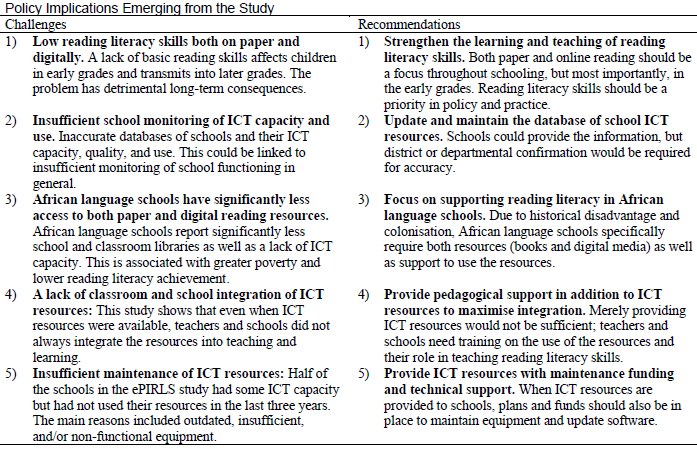
The problems experienced with implementing ePIRLS allude to the inadequate monitoring by departments in the South African education system, despite the published ICT policies and set goals. ePIRLS highlights the fact that both ICT and paper-based reading skills are not being taught to the most vulnerable populations and that resource shortages and a lack of usage continue to plague the system. The reading crisis is one of social injustice that persists. PIRLS 2021 will be the last cycle with a paper-based option. There is an increased focus on digital literacy internationally and South Africa lags behind; to our detriment and the disadvantage of learners and their future. Serious changes are required if South Africa wants to compete in the global market and give learners opportunities to contribute to the economy in the future. Policy implications that emerged from the current study are provided below as general guidelines for stakeholders to consider.
Authors' Contributions
Celeste Combrinck conducted the data analysis, wrote the methodology, results, and discussion sections. Nangamso Mtsatse contributed the introduction and literature review. The conclusions and implications were written in a joint effort.
Notesi. http://timssandpirls.bc.edu/pirls2016/international-results/epirls/take-the-epirls-assessment/
ii. Published under a Creative Commons Attribution Licence.
Acknowledgements
We gratefully acknowledge Pierre Foy, the Director of Sampling, Psychometrics, and Data Analysis at the TIMSS & PIRLS International Study Center (Boston College) for providing invaluable statistical advice and insights. We acknowledge the Department of Basic Education (DBE) for funding PIRLS 2016 and their steadfast support.
References
-
Arbuckle JL 2014. IBM® SPSS® Amos™ 23 user's guide. Chicago, IL: IBM SPSS. Available at http://amosdevelopment.com/download/User_Guide_23.pdf. Accessed 27 November 2019.
» http://amosdevelopment.com/download/User_Guide_23.pdf -
Arbuckle JL 2017. IBM®SPSS® Amos™ 25 user's guide. Chicago, IL: IBM SPSS. Available at http://amosdevelopment.com/download/CurrentUserGuide_EN.pdf. Accessed 27 November 2019.
» http://amosdevelopment.com/download/CurrentUserGuide_EN.pdf -
Arends F, Winnaar L & Mosimege M 2017. Teacher classroom practices and Mathematics performance in South African schools: A reflection on TIMSS 2011. South African Journal of Education, 37(3):Art. # 1362, 11 pages. https://doi.org/10.15700/saje.v37n3a1362
» https://doi.org/10.15700/saje.v37n3a1362 -
Asparouhov T 2006. General multilevel modeling with sampling weights. Los Angeles, CA: Muthen & Muthen. Available at www.statmodel.com/download/asparouhovgmms.pdf. Accessed 17 May 2018.
» www.statmodel.com/download/asparouhovgmms.pdf - Beetham H & Sharpe R (eds.) 2013. Rethinking pedagogy for a digital age: Designing for 21st century learning (2nd ed). New York, NY: Routledge.
- Blignaut S & Howie SJ 2009. National policies and practices on ICT in education: South Africa. In T Plomp, RE Anderson, N Law & A Quale (eds). Cross-national information and communication technology: Policies and practices in education. Charlotte, NC: Information Age Publishing.
- Boekhorst AK & Britz JJ 2004. Information literacy at school level: A comparative study between the Netherlands and South Africa. South African Journal of Libraries and Information Science, 70(2):63-71.
-
Breytenbach J 2013. A critical review of ICT-enabled development influencing the quality and quantity of South African tertiary education students. PhD thesis. Pretoria, South Africa: University of Pretoria. Available at https://repository.up.ac.za/handle/2263/32046. Accessed 27 November 2019.
» https://repository.up.ac.za/handle/2263/32046 -
Brozo WG, Sulkunen S, Shiel G, Garbe C, Pandian A & Valtin R 2014. Reading, gender, and engagement. Journal of Adolescent & Adult Literacy, 57(7):584-593. https://doi.org/10.1002/jaal.291
» https://doi.org/10.1002/jaal.291 -
Burnett C 2010. Technology and literacy in early childhood educational settings: A review of research. Journal of Early Childhood Literacy, 10(3):247-270. https://doi.org/10.1177%2F1468798410372154
» https://doi.org/10.1177%2F1468798410372154 -
Chigona A, Chigona W & Davids Z 2014. Educators' motivation on integration of ICTs into pedagogy: Case of disadvantaged areas. South African Journal of Education, 34(3):Art. # 859, 8 pages. https://doi.org/10.15700/201409161051
» https://doi.org/10.15700/201409161051 -
Christie P & McKinney C 2017. Decoloniality and "MODEL C" schools: Ethos, language and the protests of 2016. Education as Change, 21(3):160-180. https://doi.org/10.17159/1947-9417/2017/2332
» https://doi.org/10.17159/1947-9417/2017/2332 -
Cicconi M 2014. Vygotsky meets technology: A reinvention of collaboration in the early childhood mathematics classroom. Early Childhood Education Journal, 42(1):57-65. https://doi.org/10.1007/s10643-013-0582-9
» https://doi.org/10.1007/s10643-013-0582-9 -
Coiro J 2011. Predicting reading comprehension on the Internet: Contributions of offline reading skills, online reading skills, and prior knowledge. Journal of Literacy Research, 43(4):352-392. https://doi.org/10.1177%2F1086296X11421979
» https://doi.org/10.1177%2F1086296X11421979 -
De Jager K & Nassimbeni M 2002. Institutionalizing information literacy in tertiary education: Lessons learned from South African programs. Library Trends, 51(2):167-184. Available at https://www.ideals.illinois.edu/bitstream/handle/2142/8461/librarytrendsv51i2d_opt.pdf. Accessed 23 November 2019.
» https://www.ideals.illinois.edu/bitstream/handle/2142/8461/librarytrendsv51i2d_opt.pdf -
Department of Education 2004. White Paper on e-Education: Correction notice. Government Gazette, 470(26734): 1-13, August 26. Available at https://www.westerncape.gov.za/text/2004/11/ch1_introduction_26734.pdf. Accessed 20 July 2015.
» https://www.westerncape.gov.za/text/2004/11/ch1_introduction_26734.pdf - Enders CK 2010. Applied missing data analysis. New York, NY: The Guilford Press.
- Enders CK & Bandalos DL 2001. The relative performance of full information maximum likelihood estimation for missing data in structural equation models. Structural Equation Modeling, 8(3):430-457.
-
Ferro MA 2014. Missing data in longitudinal studies: Cross-sectional multiple imputation provides similar estimates to full-information maximum likelihood. Annals of Epidemiology, 24(1):75-77. https://doi.org/10.1016/j.annepidem.2013.10.007
» https://doi.org/10.1016/j.annepidem.2013.10.007 -
Finch B & Arrow AW 2017. Digital technologies in the literate lives of young children. In CJ McLachlan & AW Arrow (eds). Literacy in the early years: Reflections on international research and practice. Singapore: Springer. https://doi.org/10.1007/978-981-10-2075-9
» https://doi.org/10.1007/978-981-10-2075-9 -
Fisher J, Bushko K & White J 2017. Blended beyond borders: A scan of blended learning obstacles and opportunities in Brazil, Malaysia, & South Africa. Doha, Qatar: World Innovation Summit for Education/Lexington, MA: Clayton Christensen Institute. Available at https://files.eric.ed.gov/fulltext/ED586369.pdf. Accessed 30 November 2019.
» https://files.eric.ed.gov/fulltext/ED586369.pdf - Fisher R 2014. Thinking skills. In T Cremin & J Arthur (eds). Learning to teach in the primary school (3rd ed). Abingdon, England: Routledge.
-
Foy P 2018. PIRLS 2016 user guide for the international database. Chestnut Hill, MA: TIMSS & PIRLS International Study Center, Lynch School of Education, Boston College/Amsterdam, The Netherlands: International Association for the Evaluation of Educational Achievement (IEA). Available at https://timssandpirls.bc.edu/pirls2016/international-database/downloads/P16_UserGuide.pdf. Accessed 30 November 2019.
» https://timssandpirls.bc.edu/pirls2016/international-database/downloads/P16_UserGuide.pdf - Gauteng Department of Education (GDE) 2010. GDE study on e-maturity and e-readiness. Johannesburg, South Africa: DBE.
-
Gerick J, Eickelmann B & Bos W 2017. School-level predictors for the use of ICT in schools and students' CIL in international comparison. Large-Scale Assessments in Education: An IEA-ETS Research Institute Journal, 5:5. https://doi.org/10.1186/s40536-017-0037-7
» https://doi.org/10.1186/s40536-017-0037-7 -
Gilleece L & Eivers E 2018. Characteristics associated with paper-based and online reading in Ireland: Findings from PIRLS and ePIRLS 2016. International Journal of Educational Research, 91:16-27. https://doi.org/10.1016/j.ijer.2018.07.004
» https://doi.org/10.1016/j.ijer.2018.07.004 -
Hartas D 2011. Families' social backgrounds matter: Socio-economic factors, home learning and young children's language, literacy and social outcomes. British Educational Research Journal, 37(6):893-914. https://doi.org/10.1080/01411926.2010.506945
» https://doi.org/10.1080/01411926.2010.506945 -
Hatlevik OE, Ottestad G & Throndsen I 2015. Predictors of digital competence in 7th Grade: A multilevel analysis. Journal of Computer Assisted Learning, 31(3):220-231. https://doi.org/10.1111/jcal.12065
» https://doi.org/10.1111/jcal.12065 -
Hennessy S, Onguko B, Harrison D, Ang'ondi EK, Namalefe S, Naseem A & Wamakote L 2010. Developing the use of information and communication technology to enhance teaching and learning in East African schools: Review of the literature (Centre for Commonwealth Education & Aga Khan University Institute for Educational Development - Eastern Africa Research Report No. 1). Cambridge, England: University of Cambridge, Faculty of Education/London, England: Department for International Development. Available at https://www.educ.cam.ac.uk/centres/archive/cce/publications/CCE_Report1_LitRevJune0210.pdf. Accessed 18 April 2018.
» https://www.educ.cam.ac.uk/centres/archive/cce/publications/CCE_Report1_LitRevJune0210.pdf -
Hesterman S 2011. A contested space: The dialogic intersection of ICT, multiliteracies, and early childhood. Contemporary Issues in Early Childhood, 12(4):349-361. https://doi.org/10.2304%2Fciec.2011.12.4.349
» https://doi.org/10.2304%2Fciec.2011.12.4.349 -
Hoffmann DA & Gavin MB 1998. Centering decisions in hierarchical linear models: Implications for research in organizations. Journal of Management, 24(5):623-641. https://doi.org/10.1177%2F014920639802400504
» https://doi.org/10.1177%2F014920639802400504 -
Howie S & Chamberlain M 2017. Reading performance in post-colonial contexts and the effect of instruction in a second language. IEA Policy Brief, 14:1-11. Available at https://files.eric.ed.gov/fulltext/ED574333.pdf. Accessed 12 November 2019.
» https://files.eric.ed.gov/fulltext/ED574333.pdf - Howie S, Van Staden S, Tshele M, Dowse C & Zimmerman L 2012. PIRLS 2011: South African children's reading literacy achievement (Summary Report). Pretoria, South Africa: Centre for Evaluation and Assessment, University of Pretoria.
-
Howie S, Venter E, Van Staden S, Zimmerman L, Long C, Du Toit C, Scherman V & Archer E 2008. PIRLS 2006 Summary Report: South African children's reading literacy achievement. Pretoria, South Africa: Centre for Evaluation and Assessment, University of Pretoria. Available at https://repository.up.ac.za/bitstream/handle/2263/65994/Howie_PIRLS_2006.pdf?sequence=1&isAllowed=y. Accessed 1 December 2019.
» https://repository.up.ac.za/bitstream/handle/2263/65994/Howie_PIRLS_2006.pdf?sequence=1&isAllowed=y -
Howie SJ 2010. ICT-supported pedagogical policies and practices in South Africa and Chile: Emerging economies and realities. Journal of Computer Assisted Learning, 26(6):507-522. https://doi.org/10.1111/j.1365-2729.2010.00377.x
» https://doi.org/10.1111/j.1365-2729.2010.00377.x -
Howie SJ, Combrinck C, Roux K, Tshele M, Mokoena GM & McLeod Palane N 2017. PIRLS Literacy 2016 Progress in International Reading Literacy Study 2016: South African children's reading literacy achievement. Pretoria, South Africa: Centre for Evaluation and Assessment. Available at https://repository.up.ac.za/handle/2263/65780. Accessed 5 December 2019.
» https://repository.up.ac.za/handle/2263/65780 -
Howie SJ, Combrinck C, Roux K, Tshele M, Mtsatse N, McLeod Palane N & Mokoena GM 2017. ePIRLS 2016: South African Highlights Report. Pretoria, South Africa: Centre for Evaluation and Assessment. Available at https://repository.up.ac.za/bitstream/handle/2263/66172/Howie_ePIRLS_2017.pdf?sequence=1&isAllowed=y. Accessed 5 December 2019.
» https://repository.up.ac.za/bitstream/handle/2263/66172/Howie_ePIRLS_2017.pdf?sequence=1&isAllowed=y -
Howie SJ, Combrinck C, Tshele M, Roux K, McLeod Palane N & Mokoena GM 2017. PIRLS 2016 Progress in International Reading Literacy Study 2016 Grade 5 benchmark participation: South African children's reading literacy achievement. Pretoria, South Africa: Centre for Evaluation and Assessment. Available at https://repository.up.ac.za/handle/2263/65221. Accessed 5 December 2019.
» https://repository.up.ac.za/handle/2263/65221 -
Huta V 2014. When to use hierarchical linear modeling. The Quantitative Methods for Psychology, 10(1):13-28. https://doi.org/10.20982/tqmp.10.1.p013
» https://doi.org/10.20982/tqmp.10.1.p013 - International Association for the Evaluation of Educational Achievement (IEA) 2018. International Database Analyzer, version 4.0. Hamburg, Germany: Author.
- IBM Corp. Released 2017. IBM SPSS Statistics for Windows, Version 25.0. Armonk, NY: Author.
-
LaRoche S, Joncas M & Foy P 2017. Sample design in PIRLS 2016. In MO Martin, IVS Mullis & M Hooper (eds). Methods and procedures in PIRLS 2016. Chestnut Hill, MA: TIMSS & PIRLS International Study Center, Lynch School of Education, Boston College/Amsterdam, The Netherlands: International Association for the Evaluation of Educational Achievement (IEA). Available at https://timssandpirls.bc.edu/publications/pirls/2016-methods.html. Accessed 2 December 2019.
» https://timssandpirls.bc.edu/publications/pirls/2016-methods.html -
Leu DJ, Forzani E, Rhoads C, Maykel C, Kennedy C & Timbrell N 2015. The new literacies of online research and comprehension: Rethinking the reading achievement gap. Reading Research Quarterly, 50(1):37-59. https://doi.org/10.1002/rrq.85
» https://doi.org/10.1002/rrq.85 -
Lim CP & Hang D 2003. An activity theory approach to research of ICT integration in Singapore schools. Computers & Education, 41(1):49-63. https://doi.org/10.1016/S0360-1315(03)00015-0
» https://doi.org/10.1016/S0360-1315(03)00015-0 -
Lindberg OJ, Olofsson AD & Fransson G 2017. Same but different? An examination of Swedish upper secondary school teachers' and students' views and use of ICT in education. The International Journal of Information and Learning Technology, 34(2):122-132. https://doi.org/10.1108/IJILT-09-2016-0043
» https://doi.org/10.1108/IJILT-09-2016-0043 -
Lorah J 2018. Effect size measures for multilevel models: Definition, interpretation, and TIMSS example. Large-scale Assessments in Education, 6:8. https://doi.org/10.1186/s40536-018-0061-2
» https://doi.org/10.1186/s40536-018-0061-2 -
Maneschijn MM, Botha A & Van Biljon JA 2013. A critical review of ICT skills for higher education learners. In 2013 International Conference on Adaptive Science and Technology. Piscataway, NJ: IEEE. https://doi.org/10.1109/ICASTech.2013.6707503
» https://doi.org/10.1109/ICASTech.2013.6707503 -
Margolin SJ, Driscoll C, Toland MJ & Kegler JL 2013. E-readers, computer screens, or paper: Does reading comprehension change across media platforms? Applied Cognitive Psychology, 27(4):512-519. https://doi.org/10.1002/acp.2930
» https://doi.org/10.1002/acp.2930 -
Marinak BA & Gambrell LB 2010. Reading motivation: Exploring the elementary gender gap. Literacy Research and Instruction, 49(2):129-141. https://doi.org/10.1080/19388070902803795
» https://doi.org/10.1080/19388070902803795 -
Mathevula MD & Uwizeyimana DE 2014. The challenges facing the integration of ICT in teaching and learning activities in South African rural secondary schools. Mediterranean Journal of Social Sciences, 5(20):1087-1097. https://doi.org/10.5901/mjss.2014.v5n20p1087
» https://doi.org/10.5901/mjss.2014.v5n20p1087 -
McLean K 2017. Literacy, technology and early years education: Building sustainable practice. In CJ McLachlan & AW Arrow (eds). Literacy in the early years: Reflections on international research and practice. Singapore: Springer. https://doi.org/10.1007/978-981-10-2075-9
» https://doi.org/10.1007/978-981-10-2075-9 -
Meyer IA & Gent PR 2016. The status of ICT in education in South Africa and the way forward. Centurion, South Africa: National Education Collaboration Trust (NECT). Available at http://nect.org.za/publications/technical-reports/the-state-of-ict-in-education-in-south-africa/view. Accessed 20 March 2018.
» http://nect.org.za/publications/technical-reports/the-state-of-ict-in-education-in-south-africa/view -
Mills KA 2010. A review of the "digital turn" in the new literacy studies. Review of Educational Research, 80(2):246-271. https://doi.org/10.3102%2F0034654310364401
» https://doi.org/10.3102%2F0034654310364401 -
Mullis IVS, Martin MO, Foy P & Hooper M 2017a. ePIRLS 2016 international results in online informational reading. Chestnut Hill, MA: TIMSS & PIRLS International Study Center, Lynch School of Education, Boston College/Amsterdam, The Netherlands: International Association for the Evaluation of Educational Achievement (IEA). Available at https://files.eric.ed.gov/fulltext/ED580351.pdf. Accessed 5 December 2017.
» https://files.eric.ed.gov/fulltext/ED580351.pdf -
Mullis IVS, Martin MO, Foy P & Hooper M 2017b. PIRLS 2016 international results in reading. Chestnut Hill, MA: TIMSS & PIRLS International Study Center, Lynch School of Education, Boston College and International Association for the Evaluation of Educational Achievement (IEA). Available at https://files.eric.ed.gov/fulltext/ED580353.pdf. Accessed 5 December 2017.
» https://files.eric.ed.gov/fulltext/ED580353.pdf -
Netten A, Luyten H, Droop M & Verhoeven L 2016. Role of linguistic and sociocultural diversity in reading literacy achievement: A multilevel approach. Journal of Research in Reading, 39(2):189-208. https://doi.org/10.1111/1467-9817.12032
» https://doi.org/10.1111/1467-9817.12032 -
OECD 2015a. Skills for social progress: The power of social and emotional skills (OECD skills studies). Paris, France: OECD Publishing. https://doi.org/10.1787/9789264226159-en
» https://doi.org/10.1787/9789264226159-en -
OECD 2015b. Students, computers and learning: Making the connection. Paris, France: OECD Publishing. https://doi.org/10.1787/9789264239555-en
» https://doi.org/10.1787/9789264239555-en -
Padayachee K 2017. A snapshot survey of ICT integration in South African schools. South African Computer Journal, 29(2):36-65. https://doi.org/10.18489/sacj.v29i2.463
» https://doi.org/10.18489/sacj.v29i2.463 -
Paton-Ash M & Wilmot D 2015. Issues and challenges facing school libraries in selected primary schools in Gauteng Province, South Africa. South African Journal of Education, 35(1):Art. # 1042, 10 pages. https://doi.org/10.15700/201503062342
» https://doi.org/10.15700/201503062342 - Plowman L, McPake J & Stephen C 2012. Extending opportunities for learning: The role of digital media in early education. In S Suggate & E Reese (eds). Contemporary debates in childhood education and development. New York, NY: Routledge.
- Raudenbush SW & Bryk AS 2002. Hierarchical linear models: Applications and data analysis methods (2nd ed., Advanced Quantitative Techniques in the Social Sciences Series, Vol. 1). Thousand Oaks, CA: Sage.
- Raudenbush SW, Bryk AS & Congdon R 2013. HLM 7.01 for Windows [Computer software]. Skokie, IL: Scientific Software International.
-
Schminkey DL, Von Oertzen T & Bullock L 2016. Handling missing data with multilevel structural equation modeling and full information maximum likelihood techniques. Research in Nursing & Health, 39(4):286-297. https://doi.org/10.1002/nur.21724
» https://doi.org/10.1002/nur.21724 - Sharpe R & Oliver M 2013. Designing for learning in course teams. In H Beetham & R Sharpe (eds). Rethinking pedagogy for a digital age: Designing for 21st century learning (2nd ed). New York, NY: Routledge.
-
Sithole MM, Moses C, Davids YD, Parker S, Rumbelow J, Molotja N & Labadarios D 2013. Extent of access to information and communications technology by the rural population of South Africa. African Journal of Science, Technology, Innovation and Development, 5(1):71-84. https://doi.org/10.1080/20421338.2013.782144
» https://doi.org/10.1080/20421338.2013.782144 - Snijders TAB & Bosker RJ 1999. Multilevel analysis: An introduction to basic and advanced multilevel modeling. London, England: Sage.
- Stancel-Piqtak A & Desa D 2014. Methodological implementation of multi group multilevel SEM with PIRLS 2011: Improving reading achievement. In R Strietholt, W Bos, JE Gustafsson & M Rosén (eds). Educational policy evaluation through international comparative assessments. Münster, Germany: Waxmann.
-
Stancel-Piqtak A, Mirazchiyski P & Desa D 2013. Promotion of reading and early literacy skills in schools: A comparison of three European countries [Special issue]. European Journal of Education, 48(4):498-510. https://doi.org/10.1111/ejed.12050
» https://doi.org/10.1111/ejed.12050 -
Toki EI & Pange J 2014. ICT use in early childhood education: Storytelling. Tiltai, 66(1):183-192. https://doi.org/10.15181/tbb.v66i1.786
» https://doi.org/10.15181/tbb.v66i1.786 -
Van der Berg S, Spaull N, Wills G, Gustafsson M & Kotzé J 2016. Identifying binding constraints in education: Synthesis Report for the Programme to Support Pro-poor Policy Development (PSPPD). Stellenbosch, South Africa: Research on SocioEconomic Policy (ReSEP), Department of Economics, University of Stellenbosch. Available at http://resep.sun.ac.za/wp-content/uploads/2016/05/PSPPD_BICiE-email.pdf. Accessed 1 December 2019.
» http://resep.sun.ac.za/wp-content/uploads/2016/05/PSPPD_BICiE-email.pdf -
Van Staden S 2010. Reading between the lines: Contributing factors that affect Grade 5 learner reading performance. PhD thesis. Pretoria, South Africa: University of Pretoria. Available at https://repository.up.ac.za/bitstream/handle/2263/24944/Complete.pdf?sequence=8. Accessed 26 October 2019.
» https://repository.up.ac.za/bitstream/handle/2263/24944/Complete.pdf?sequence=8 - Van Staden S & Howie S 2014. Reflections on Creemers' comprehensive model of educational effectiveness for reading literacy: South African evidence from PIRLS 2006. Perspectives in Education, 32(3):172-192.
- Van Staden S & Zimmerman L 2017. Evidence from the Progress in International Reading Literacy Study (PIRLS) and how teachers and their practice can benefit. In V Scherman, RJ Bosker & SJ Howie (eds). Monitoring the quality of education in schools: Examples of feedback into systems from developed and emerging economies. Rotterdam, The Netherlands: Sense.
-
Vandeyar T 2015. Policy intermediaries and the reform of e-Education in South Africa [Special issue]. British Journal of Educational Technology, 46(2):344-359. https://doi.org/10.1111/bjet.12130
» https://doi.org/10.1111/bjet.12130 - Vasquez VM & Felderman CB 2013. Technology and critical literacy in early childhood. New York, NY: Routledge.
- Whittingham J, Huffman S, Rickman W & Wiedmaier C 2013. Technological tools for the literacy classroom. Hershey, PA: IGI Global.
-
Zimmerman L 2010. The influence of schooling conditions and teaching practices on curriculum implementation for Grade 4 reading literacy development. PhD thesis. Pretoria, South Africa: University of Pretoria. Available at https://repository.up.ac.za/handle/2263/24982?show=full. Accessed 25 October 2019.
» https://repository.up.ac.za/handle/2263/24982?show=full -
Zuze TL & Reddy V 2014. School resources and the gender reading literacy gap in South African schools. International Journal of Educational Development, 36:100-107. https://doi.org/10.1016/j.ijedudev.2013.10.002
» https://doi.org/10.1016/j.ijedudev.2013.10.002
Revised: 22 March 2019
Accepted: 27 April 2019
Published: 31 December 2019