Addressing a theory-practice gap in teacher education by using a participatory action learning and action research (PALAR) approach
Abstract
In this article we combine Boyer's 4 domains of scholarship with Hutchings' 4 types of questions and Ghaye, Melander-Wikman, Kisare, Chambers, Bergmark, Kostenius and Lillyman's (2008) reflective learning framework using a Participatory Action Learning and Action Research (PALAR) method to explore the perceived gap in in-service teachers' experience in classroom contexts. Qualitative data were collected in an action learning set (ALS) consisting of distance learning in-service teachers enrolled in a learning support programme through purposeful discussions, reflective diaries, observations, and open-ended reflective learning questionnaires. In the research reported on here we found that collaborative partnerships initiated scholarly thoughts and actions when sharing and evaluating insights during the research process, which resulted in building on learning that has been gained together. The findings point to the need for collaboration between lecturers and students to develop an awareness to not only take knowledge from one another to create theories about how they should deal with problems but rather to jointly become reflective collaborative scholars to address the theory-practice gap.
Boyer's four domains of scholarship; Hutchings' four types of questions; PALAR; reflective-learning; scholarship; theory-practice gap
Introduction
Using action research, and in this case, PALAR, is currently regarded as an appropriate research method to realistically improve practices (Wood & Zuber-Skerrit, 2013). Consequently, as the focus of this research was on the theory-practice gap in in-service teachers' experiences in classroom contexts identified in research (Edwards & Burns; 2016; McGarr, O'Grady & Guilfoyle, 2017; Nel, 2013; Schoeman, 2012), it was deemed as the most suitable method to address these challenges. The research reported on in this article focused primarily on the effectiveness of using PALAR as a method to address the theory-practice gap.
Background to the Research
In global education research, the theory-practice gap is repeatedly identified as challenging (Darling-Hammond, 2014; Sagor & Williams, 2016). Even as early as the 1900s, Dewey (1904) expressed concern about this and the scenario still seems to remain the same. Meijer, De Graaf and Meirink (2011) describe this phenomenon as the discrepancy that students experience between academic learning at higher education institutes (HEI) and the reality that they experience in the classroom. It is vital to address this gap since a student only starts to understand theory when they participate in the application of knowledge (Darling-Hammond, 2006, 2014). The following quotes by in-service teacher participants capture the theory-practice gap that they experienced in reality:
...you teach us theory and not reality. What you teach us is not how it is out there [in the classroom]... (P4).
...but we sit with heaps of theory and definitions but we need practice ... In theory, you only learn about the nice and the ideal (P2).
In the South African context, this is currently even more evident as education policies and classroom scenarios, as well as practices, had changed radically and at a fast pace following the political transformation in 1994. These changes were required to address the discriminatory practices of the previous dispensation. Since then South African classrooms have become very diverse with regard to different languages, cultures, races, religions, and abilities represented by the learners in the class. In 2001, South Africa accepted an inclusive education approach by introducing Education White Paper 6, which requires that every teacher should be enabled to teach and provide learning support within these diverse classrooms (Department of Education [DoE], 2001). This implied that learners who experienced barriers to learning should first be supported by the classroom teacher and not simply referred for additional support in special or remedial classes. Teacher education policies, as well as HEI curriculum reformations, are attempting to address the changing needs, but it seems to still not adequately respond to the demands of classroom practice (Henning & Gravett, 2011). Also, most in-service teachers (the focus of this study) were trained before the introduction of inclusive education and, therefore, had no formal exposure to what inclusive education entailed in theory and practice. They were either trained as mainstream or special-education teachers. Consequently, a large percentage of mainstream teachers did not obtain the necessary knowledge and skills to teach learners who experienced barriers to learning (Magare, Kitching & Roos, 2010). As a result, research has shown that most teachers did not feel confident and competent in modifying the curriculum and learning material to address diverse learning needs or to assist learners who struggle academically. Furthermore, they were uncertain about how to provide individual learning support and they tended to overlook learners who experienced barriers to learning (Andrews, 2020; Bomman & Rose, 2017; Donohue & Bornman, 2014). This contributed to a negative attitude towards inclusive education as teachers did not experience success in the implementation thereof (Andrews, Walton & Osman, 2021).
This is confirmed by the following comments by in-service teacher participants: "[T]eachers are expected to do curriculum differentiation, which entails multilevel teaching, differentiating teaching methods and catering for different learning styles but are not trained to do it" (P2). The participants revealed feelings of "incompetence'", "hopelessness" and "frustration", as well as "[I] feel overwhelmed and do not know where to start" (P8) because of a lack of, as they call it, "in-service professional development programmes."
In an attempt to provide more formal training to in-service teachers, the university where the authors were employed developed a programme in learning support. This specific qualification was presented within the Unit for Open Distance Learning. During the teaching and assessment of students' assignments it became evident that the students were able to report on the knowledge learned, but struggled to answer questions/instructions in which the knowledge had to be applied (e.g. in case studies). When attempting to deal with application questions, they only answered the theoretical part of the question and ignored the application part or only answered the application part with examples derived from a prescribed textbook or an article. This seems to confirm the findings of Childs, Edwards and McNicholl (2014), Darling-Hammond (2006, 2014), Gravett, Petersen and Petker (2014), as well as Rouse and Florian (2012) who found that globally HEI students were struggling to apply academic knowledge to a practical and work context. The reason for this was that transferring theory still seemed to be the dominant focus of the study material and, therefore, did not adequately address the gap of applying theory into practice. However, this can also point to the lecturers who developed and taught the material: "Students need to visit schools, be exposed to real case studies and day trips in the inclusive classroom. People [teachers] that actually applied the knowledge should talk to students or students should observe them in their classrooms" (P8).
Consequently, we asked the following questions in this study: i) What role do we, as lecturers, play in advancing the theory-practice gap? ii) Do we have sufficient insight into the practice outside of our classrooms to understand the theory-practice gap reflected in students' course assessments? and iii) How can we address this gap in this course to ensure that in-service teachers are fully prepared to teach and provide learning support in an inclusive classroom? This research was underpinned by the arguments of Kemmis and Mutton (2012) as well as Mertler (2012), who reason that lecturers and students need to develop an awareness to not only take knowledge from one another to create theories about how they should deal with problems but that together they should become reflective scholars to address the theory-practice gap. To achieve an optimal solution for this gap, we believe that it requires of students to develop a scholarship of teaching throughout their training and to maintain this in their practice. This is affirmed by Zuber-Skerritt (2011:4) who asserts that lecturers must encourage students to experience the ability to "think for themselves" so that the discovery of new insights can be enjoyed. According to Mezirow (2000, 2011) and stressed by researchers like Biasin, (2018) and Garneau (2016), engaging in critical reflection, questioning beliefs, values, and assumptions to discover new perspectives in this process of developing a scholarship in teaching is essential. For this purpose, Boyer's (1990) four domains of scholarship originally identified in higher education, namely: discovery, integration, application, and teaching, as well as Hutchings' four types of questions (Hutchings, Huber & Ciccone, 2011) and the reflective learning framework of Ghaye et al. (2008), were deemed as most appropriate to integrate as conceptual framework in this research.
Conceptual Framework
Bayer's four domains of scholarship
Although Boyer's domains of scholarship are mostly used to categorise different kinds of scholarly activity, we show in this article that the scholarship has characteristics of each category. We investigated the scholarship of teaching and learning (Boyer, 1990) at two levels (Kern, Mettetal, Dixson & Morgan, 2015) - our teaching and that of the in-service teachers in the ALS, which resonate with Boyer (1990) as well as Lazerson, Wagener and Shumanis' (2000) valuing of teaching as scholarship.
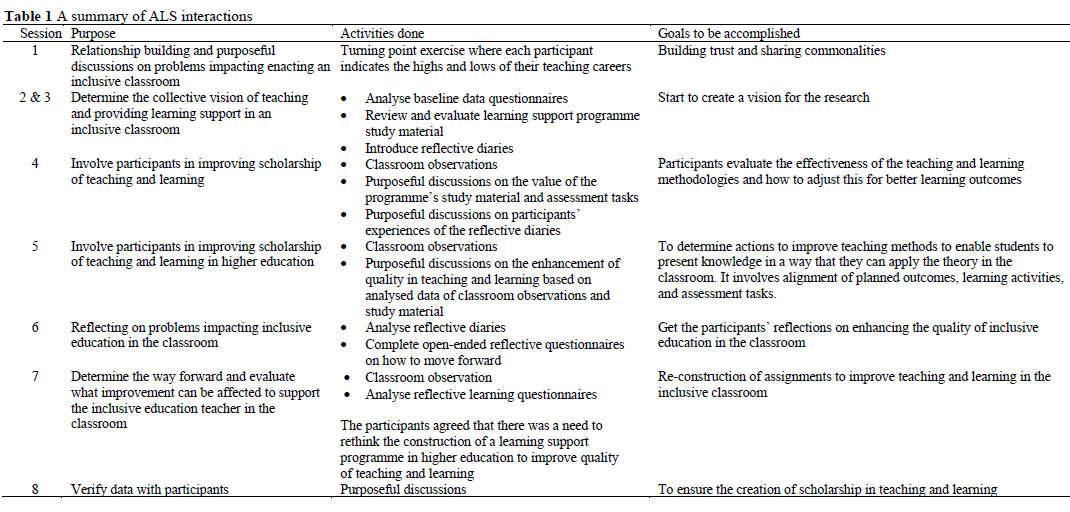
The scholarship of discovery and integration formed part of the research to create knowledge in the learning environment when the ALS members as participants, including the authors and the in-service teachers, acted as co-researchers in phase two of this research. Collaboratively we analysed 34 open-ended questionnaires which served as baseline data for the study completed on in-service teachers' prior knowledge and skills on inclusive education. The questions posed were: "What is inclusive education, what do you understand under the concept, and can one apply theoretical knowledge to support a learner experiencing barriers to learning?" Through this action, isolated facts were placed in perspective and contributed to generating new knowledge to achieve an outcome (Boyer, 1990; Starr-Glass, 2013). By involving the ALS, we developed ownership of the research project and together established a relationship of trust in the set (cf. Table 1). This aligns with Trigwell and Shale (2004) and Zuber-Skerritt (2011) who encourage developing an inquisitive mind and ability to solve problems creatively. The participants started to apply knowledge by integrating it into a larger intellectual pattern by filling the gap between the environment and the needs of the world beyond their environment by connecting different disciplines within a larger body of knowledge. This urged all members to become "reflective practitioners" moving between theory and practice making theory more authentic (Starr-Glass, 2013:69) and initiating lifelong learning skills, scholarship, which was an outcome of this research (Boyer, 1990). It is, therefore, important that in the training process, lecturers and students alike must engage with the world outside and not only be bound to theoretical knowledge (cf. Table 1).
The practical part of the training must provide opportunities for reflection where new knowledge and theory can be derived from and about practice (Kemmis & Mutton, 2012; Mertler, 2012). However, within such a process one needs to remember that personalities and context will influence the reflection because the participants critically examine and reflect on policies, practice, and difficult elements from their authentic classroom perspectives and experiences. This activity could deter teacher education from becoming either "inherently conservative or becoming a dangerous doctrinaire" (Carr & Kemmis 1986:6) because reflection is not only a purely academic or theoretical action.
Since engaging in critical reflection, questioning is a central feature of Boyer's four domains of developing scholarship (Boyer, 1990; Mezirow, 2000). We decided on using Hutchings' four types of questions as strategic elements in this research to further explore what works, what is, visions of the possible, and theory development.
Hutchings' four types of questions (Hutchings, 2000)
The "What works?" question characterises scholarship of teaching and learning and generates a search for evidence of the relative effectiveness of different teaching approaches. The "What?" questions can be regarded as a "cousin" of assessment, since something needs to be "proven." By asking "What?", a better understanding can be offered of learning or understanding of the problem. In this research, the question was: "What do we want the students to know and be able to do by the end of this course?" There were thus two parts to this "What works?" question. The "know" part of the question included content and pedagogical knowledge about teaching learners with diverse learning needs, as well as providing learning support to learners who experienced barriers to learning. With these questions in mind, the participants were allowed to critique the study material and measure their hands-on classroom experience against the study material (cf. Table 1). The significance for us lecturers was to experience the reality of an inclusive context through the eyes of in-service teachers. The critical reflections helped us to identify possible shortfalls and adjust the material to be suitable for authentic classrooms. The "be able to do" part (Hutchings, 2000:16) dealt with more practical aspects, such as differentiating the curriculum, modifying assessment strategies and classroom methodologies (DoE, 2001) which the ALS felt negative towards since they lacked support from the department: Participants 2 and 5 in the ALS stated that the department required of them to proceed with teaching, although they did not always have training or skills..."Mem [sic], teaching must go on'' (P5) and "We only see new admin, then we know it's [again] a new policy, but nothing change in the class, we must teach" (P2). In the ALS, we decided that we needed to work around the challenge through strategies of collaboration between educators and other role players (e.g. the community, parents, etc.). The participants suggested that colleagues from the same grade or phase should visit one another's classrooms to give support by providing creative ideas to address the challenges in class. They even recommended that schools in the same town should liaise and build networks to learn from one another by rotating resources or exchange samples of lesson plans or ideas to address barriers in class. This resonates with Hutchings' (2000:4) "What is?" question when evaluating traditional and innovative methods of teaching to determine the effectiveness thereof and searching answers for the "What works?" question. Schulman (2011) states that learning flourishes when we take what we think we know and offer it as unrestricted knowledge to be tested, examined, challenged, and improved before it is adopted.
The interaction in the ALS refers to the "vision question" (Salvatori, 2008, as cited in Hutchings, 2000), as possible "window" to uncover the essential understanding of issues in either a particular text or in the larger context of the discipline. The purpose of the vision questions (cf. Table 1) was to explore how the course could be adapted for future students to bridge the gap between theory and practice. The ALS felt strongly that the study material should focus more on effective lesson planning and creative ideas to implement and improve teaching in a diverse classroom. They argued that if teachers knew how to plan a lesson, they would feel in control of the class, have confidence in what they were doing which would affect teaching positively. The participants consequently suggested an assignment where a lesson plan is designed and practiced for an inclusive classroom environment. The fourth question that focuses on "theory building" (Hutchings, 2000:5) aligns with Zuber-Skerritt (1992) who mentions that theoretical principles can inform but not positively justify practical actions. Therefore, practice is informed by theories and can develop new theories, but practice cannot be regarded as non-theoretical and theory cannot be considered non-practical. The interaction between theory and practice (praxis) is thus significant. The interaction between theory and practice appeared to be a significant factor for the participants. The following summarises the participants' overwhelming response: "Make it [course material] PRACTICAL ... Incorporate practice in the theory. Let the student teach. Cut back on theoretical assignments. They [students] need to see, feel, smell, and experience everything about teaching" (P2). The next quotes capture the need for students to be exposed to the reality of a school context: "Because I am teaching [in-service teachers]. That exposed me to what it feels to be inside. You do not learn it in books. But when I started to teach -1 was shocked!!' (PI).
It was, therefore, important that the participants understood the importance of theory, but were also enabled to bridge the gap to integrate and apply the theory in practice (cf. Table 1).
The element of critical reflection was addressed by using the reflective-learning framework developed by Ghaye et al. (2008).
Reflective-learning framework
In this framework, participants need to engage positively in a process of critically reflecting on their work and themselves. This should result in realising the influence that they have on their learning, as well as on the learning that occurs where they live and work. A typical self-reflection question could be: "How can I improve what I am doing?" (Whitehead, 2014:83, 88). Collecting data through critical self-reflection can be very valuable to plot a constructive way forward and maybe alter direction. The following components are an integral part when applying this framework successfully to ensure sustainability (Ghaye et al., 2008:371). Rather than focusing on the negative in an attempt to solve problems, an appreciative "gaze" or insight should be developed to understand the root sources of success and build a better future from a positive present. One participant responded with the following: "When I start to reflect about my teaching, my life, why I am teaching in this rural area school full of poverty, abuse and alcohol, I started to think everything in life has a purpose. I am here because of something. I decided I want to make a difference and I am going to start in my class with that child that the world and me judged as a lost case [cause]" (P4). This response summarises the development of an appreciative "gaze" by reframing experiences to build practical wisdom of achieving to "alter direction" and move towards the goal.
The second component emphasises collective learning and knowledge sharing, rather than self-learning where the focus is on the individual in isolation. Participant 2 commented as follows: "In my reflective journey, I learned so much about myself and I could see how I developed professionally. A lot is because of the interaction with the other teachers in the ALS. I really met some mentors, and the strange thing is, they were always only a few classes away but I was not aware!" This statement emphasises moving away from only one way of knowing and only one perspective on what the truth is to an acceptance of a pluralistic view of ways of knowing and understanding of the human experience and putting the knowing to good use.
PALAR as the Research Methodology
Research Methodology
The research was epistemologically embedded in a critical, transformative research paradigm because the critique and transformation occurred when the ALS, consisting of eight in-service teachers and two lecturers from an HEI, acting as participants, were empowered to reflect and transform meaning schemes in terms of beliefs, attitudes, opinions and emotional reactions (Mertens & Wilson, 2012; Turesky & Gallagher, 2011). As participants, we reflected on the current social reality (the effective application of learning support in the classroom), identified factors that needed to change, and provided both clear norms for criticism, as well as achievable practical goals for transformation (Saric & Steh, 2017). The PALAR research method was regarded as applicable since it promotes the forming of the ALS in which we share and transform knowledge, find common ground of intellectual commitment, change practices where needed, and create new thinking directions to close the theory-practice gap (Khan, Bawani & Aziz, 2013).
PALAR represents an extensive network of approaches to the inquiry on different research traditions that are all participative and grounded in experience and actions. Zuber-Skerritt (2011:6) refers to it as a "way of thinking, feeling, living, and being that influences our values, worldviews and paradigms of learning, teaching, and research. It influences our behaviour, strategies, methods, and therefore the capacity for improving practice." PALAR is not only action learning and action research combined; it is rather a synthesis of concepts and traditions that together form a participatory paradigm of theory and practice (praxis). The participatory part in PALAR is where participants collaborate and learn from each other, whereas the research part is cyclical and provides a framework for gathering, analysing, reflecting, and improving the understanding of practice in each stage. In the context of this study, action learning, as well as the research aspect were focused on enabling participants to reflect on mutual teaching and learning experiences. These reported lived experiences were the product of self-reflective action research which influenced the participants' teaching and learning behaviour, strategies, and methods, and consequently capacity for improving practice. Concerning improving practice, the 3Rs of PALAR - relationships, reflection, and recognition (Wood & Zuber-Skerrit, 2013) - were key elements of this research. The purpose was to promote a truly participatory approach to knowledge creation and practical educational improvements. The 3Rs were applied in the following way. The development of a democratic, authentic, trusting, and supportive relationship between the participants in the ALS. In all cycles, and between all participants, the process of continual critical reflection took place in a collaborative learning context, as well as through the recognition of achievement.
Zuber-Skerritt's (2011) PALAR model consists of three main components in a cycle: vision, context, and practice, which should continuously be revisited, revised, reconsidered, and reflected on. In the context component, the ALS focused on teambuilding, where participants identified assets in themselves as well as in their teaching which proved to be critical in the success of this research. It helped everyone to maximise and strengthen opportunities and to minimise the focus on weaknesses and barriers. The context component helped the participants to form a vision for what they aimed to achieve before they moved to the practice part. Thus, in each component, the participants reflected on practice, took action, reflected again, and then took further action on their current classroom situations (Zuber-Skerritt & Wood, 2019). This made the research flexible so that each component in the cycle could build on the understanding and experiences gained from the previous cycle. This means that data were generated, analysed and interpreted simultaneously, moving back and forth in the research cycles - thus not following fixed steps. Since the ALS participants were in-service teachers, we were exposed to typical challenges and frustrations experienced in authentic inclusive classrooms. We reflected on the situation and critiqued ourselves to consider alternative viewpoints and creative ideas that potentiate a deeper understanding of the application of inclusive education theory in the classroom. We created and shared knowledge, challenges, values, and fears, and sought conflicting arguments rather than handed out ready-made truths that assumed solutions for our challenges. For this reason, the enquiries were conducted with the participants rather than about them and resulted in developing a scholarship of teaching and learning (Hutchings et al., 2011:xix).
Participants
The participants in this research were two learning support (LS) lecturers from an HEI and eight in-service female cultural divers Afrikaans and English-speaking Foundation Phase teachers from a rural school close by. The teachers were enrolled in an LS programme, which made this convenient. The teachers' ages ranged between 23 and 65 years old. Four teachers had between 1 and 10 years of teaching experience, one teacher between 10 and 20 years, and three teachers between 20 and 30 years. They were all from one school, formed the ALS and acted as co-researchers. The in-service teachers were purposefully selected (Creswell & Creswell, 2018) for the reason that it was the most teachers at one school enrolled in the learning support programme, making it a convenient sample.
Data Collection Methods
In the reflecting, planning, observing, and acting cycles, four different data collection methods were employed, namely purposeful discussions, reflective diaries, observations, and open-ended reflective learning questionnaires (Ghaye et al., 2008; Zuber-Skerritt, 2011). These cycles were not rigid and the purposeful discussions, reflective diaries, and observations were ongoing and continuous processes that took place throughout all the cycles of data generation. Hutchings' four types of questions formed the underlying discourse in that these provided structure during the purposeful discussions and in the analysis of the reflective diaries.
Purposeful discussions
The purposeful group discussions were regarded as data generation opportunities. These discussions were informal face-to-face, unstructured conversations between all the participants about their classroom teaching, learning, assessment, support knowledge, and experiences. Once they shared this information, the participants would decisively link it to typical theory-practice gaps in the study material and further regard it as valuable self-reflection opportunities (Wood, 2019). Consequently, these discussions allowed for a deeper insight into the lived classroom experiences as well as the shortcomings of the programme.
Reflective diaries
All the participants were requested to keep reflective diaries during session 3 of the data generation sessions (cf. Table 1). This had value for both the professional and self-development of the participants, as well as for in-depth generation of qualitative data. Through the reflective diaries, the participants were confronted with their actions, attitudes, knowledge, realities, and values that took place in their inclusive classrooms. The participants did not read about barriers occurring in a general inclusive classroom in a textbook, but rather learned about their challenges from their own experiences, which underlined the complexity of inclusive education, which Stake (2003:140) refers to as happenings "within its own world." Through their reflections, the participants discovered themselves through their voices and eyes. "My reflected journey makes me ashamed. I was struggling with the idea if I must write it and expose myself but then realised we are a team and I owe it to the rest of the group'' (P1). Hammersley and Gomm (2000:3) affirm that participants need to be "given a voice, rather than use them as respondents or even as informants." Without a conscious decision, the participants reflected not only on their teaching actions in the class but also on their emotions. This benefited deep understanding and meaningful context-bound data generation. "Through this reflection journey, I again remind myself that I will make the most of every day. I will take every lesson and use every teaching skill I acquired in the last 20 years of teaching and do the best I can. It is my reality" (P5). Since the diaries became the participants' life journey, only the applicable parts that aimed to answer the research question were addressed in the discussions and the research findings. "I will get there and then make a copy for each to read. I will also include a box tissue'" (P4). A disadvantage of reflective diaries is that participants can reveal an overwhelming mass of data along with inner feelings and thoughts which need to be dealt with sensitively and ethically. A critical contribution to the validity of the research was that the diaries enabled us to get a sense of the whole before we started to systemise the data (Creswell & Creswell, 2018). A challenge of the reflective diaries was that the participants were not always consistent in keeping them (Ndamba & Van Wyk, 2016). To encourage them to do so, the principal researcher randomly sent text messages of inspiration thanking the participants for their collaboration in the research.
Participant observation
Permission to do classroom observations was obtained from the school principal and the participants. The observations took place during sessions 4, 5, and 7 before the ALS meetings (cf. Table 1). The observations went beyond only focusing on teaching techniques and strategies, the achievement of lesson objectives, and assessment strategies. The opportunity was used to rather develop a holistic understanding of all the activities and interactions occurring in the real-life context of an inclusive classroom. This allowed us to experience the classroom through the eyes of the in-service teachers as students and compare the LS programme with their day-to-day experiences. As we developed a closer relationship with the participants, as well as empathy with their frustrations in the classrooms, it was essential to remind ourselves to remain objective. This was necessary to ascertain valid objective data (Zuber-Skerritt & Wood, 2019).
During the data analysis, these observations were triangulated with the ALS discussions as well as the reflections in the diaries.
Open-ended reflective-learning questionnaire
The aim of the open-ended reflective-learning questionnaire was for the participants to reflect on the significance of the theory in the study material as it related to their classroom experiences. The questions were based on the framework of Ghaye et al. (2008) comprising of developing an appreciative gaze, reframing lived experiences, and moving forward into the goal. In the first question, the participants viewed their study material and current practice in the classrooms and then focused only on the positive results gained.
While working through the study material, I came to realise that he [a learner in her classroom] has ADHD [Attention-deficit/hyperactivity disorder] and I need to help him (P1).
Another participant expressed that "... I was [also] not aware that we have autistic learners in Foundation Phase until I read in the study material about characteristics and accommodation of the disability" (P6 and P7).
With the second and third questions, the participants identified gaps in the programme's study material and assessment that they believed did not address the authentic classroom practice.
"...What about group-work assignment [?]. Look how nice we learned from each other in the ALS. Students can work together on a case study as if they are an [n] ILST [institutional level support team] committee and look at from Bronfenbrenner up to a support programme"" (P6). Thereafter, the participants were challenged to provide creative alternatives to address these gaps. "... I think we take all the negative things we talked about [purposeful discussions] that is not happening in the classroom and put together an assignment on that? Things like learner-centred approach; different learning styles; pace of learning; flexible teaching methods; multilevel" (P2). The adjustments were inspired by ethical actions and moral courage based on things that we all felt were worth valuing, celebrating, and sustaining. The questionnaires provided insight into how the participants, including the researchers, could learn from one another (Creswell & Creswell, 2018).
Data Analysis
The data analysis was influenced by our epistemological and ontological paradigm towards reality in the inclusive classroom. Since data in action research can be vast and thus overwhelming (Lacey & Smith, 2010), we started with data reduction when we identified and categorised the data before coding it. The coding proceeded from open to selective to theoretical integration of concepts. The emerging themes and their connections were integrated with existing theoretical literature to find how it all fit together in categories (Saldaña, 2013).
Trustworthiness
To confirm trustworthiness, we aligned with Kemmis and McTaggart's (2005) view on the creeds of action research and combined respect, reciprocity, relevance, and reflection (Butin, 2010). This is relevant because the data were developed from the participants' "own voices" (Hammersley & Gomm, 2000:3).
Respect for the participants' viewpoints of their real-life events (Yin, 2008:4) made it impossible for us to ignore what they thought and desired. Together we needed to address reciprocated needs between the participants through mutual respect and agreement on actions regarding their views. We had to encourage relevant learning, which included professional development and positive critical reflection on actions happening in the classrooms and the ALS. This underlined the importance that research must happen in a context so that local knowledge can help with the interpretation of results and the design of actions to understand the real-life processes. Within this research, the participants tested the knowledge by focusing on relevance, social change, and validity.
Herr and Anderson (2005) feel strongly about quality in action research and suggest five indicators: outcome validity, process validity, democratic engagement, catalytic validity, and dialogic validity.
Outcome validity is about the level to which actions resolve through the primary question posed. This research evolved into lifelong learning, professional development, relationship building, and sustainability of all the participants to have a vision, a plan, and a way to apply the plan. If the process was shallow or weak, it would be reflected in the outcomes.
Process validity is the level to which problems are framed and solved in a way that enables lifelong learning. This implies that we needed to be confident that the findings were true by verifying them through triangulation.
Democratic engagement involves the participants working equally and collaboratively together. We all engaged in the interactions throughout the different cycles of data collection to solve problems and overcome obstacles. We reflected on happenings, which ensured the quality of the process. As researchers, we ensured that the data sources were shared, as we wanted to accurately represent the participants' ideas, perspectives, and experiences (Mertler, 2012:132). We had to be cautious about how we presented and interpreted the data from the participants to reflect their values and not ours. Denzin and Lincoln (2005:91) argue that "[r]epresentation is self-presentation", meaning that the other's presence is directly connected to the researcher's self-presence in the text. The "their" presented in the text should be a version of the researcher's self. Josselson (2007:548) refers to this as "changed ownership", implying that what was once the story of the participant, has become the interpretation of the researcher.
Catalytic validity is the level to which the research process re-orients, focuses, and energises participants towards knowing reality to transform it. The participants were all part of a transformation process of self-understanding where their day-to-day views of reality and experiences underwent transformation and re-orientation. This could contribute to a deeper understanding of the social reality in their lives (Herr & Anderson, 2005).
Ethics Clearance
Ethical clearance was gained from the appropriate Ethics Committee of the relevant University, the relevant provincial DoE, and the school principal. All participants signed informed consent and they were informed that group discussions could not assure confidentiality but that their names and details would not be reported in any instance. It was made clear in both written and oral communication that no participant was forced to take part in the research. The participants were allowed to withdraw at any stage. In analysing the reflective diaries, the participants' confidentiality was strongly protected. The participants only gave us access to the parts in their diaries that were applicable to the research. Findings of the research were reported completely and honestly without misleading others about the nature of the findings and data were not fabricated to support a particular conclusion.
Discussion
From the results of this research, we could answer the following question: "What role do we, as lecturers, play in advancing the theory-practice gap?" By using PALAR as a research method and acting as participants in the ALS, we gained "sufficient insight into the authentic classroom to understand the theory-practice gap [that] the students reflect[ed] in their course assessments." We experienced the classroom reality through the eyes of in-service teachers. PALAR enabled us to evaluate the theory from a real-life context, the classroom, as well as external factors that impact on the learning of learners. This led to the transformation of both the participants and the context in which the action took place (Wood, 2019). Through PALAR we could answer the question of what we wanted the students to know and be able to do by the end of the course. The participants constructed knowledge, applied, tested, and reviewed the theoretical knowledge against their daily experiences in the inclusive classroom. Through transformative learning, the participants perceived themselves as scholars and not only as teachers (Kreber, 2013). They could contribute to filling the gap between theory and practice in the scholarly community of inclusive education, which adhered to the question of how we could address this gap to ensure that in-service teachers were fully prepared to teach and provide learning support in inclusive classrooms.
The reflective diaries seemed to have taken the participants through a process of revelations about themselves as teachers. It was as if they viewed themselves from a distance and reflected and commented objectively about themselves. This made the diaries a rich data-generating tool. Another key positive result derived from PALAR was the participants' realisation of the value of collaboration achieved in the ALS meetings. Each participant was regarded as equally important and honest to the self and others (Zuber-Skerritt, 2011). Therefore, during the ALS meetings, the participants got to know one another, experienced that they had similar daily needs and challenges; they realised that they could rely on one another, and started to regard the others as mentors.
As lecturers and participants in the ALS, we started to understand the reality of the in-service teacher's contexts, and why they felt that the theory of textbooks did not always prepare them for what happened in their classrooms. We could place ourselves in their shoes and develop an understanding of their struggles. It further enabled us to explore, in theory, and practice, what learner support in inclusive education entailed. The collaboration changed our meaning schemes (Mezirow, 2000). Our moral rights, values, and prejudgements were challenged when we started to reflect on our teaching and learning (Mezirow, 1991; Zuber-Skerritt, 2011), which resonates in the words of Participant 5:
By altering yourself and focusing on a positive attitude. Even more; By making a mind shift to become positive.
The moment we took the self out of the picture and started thinking about the learner in front of us, our attitudes changed. It was then that we came up with solutions to fill the theory-practice gap. The in-service teachers stopped regarding us as their lecturers, but rather as persons who came to learn from teachers with experience and how we, together, could make a difference in the inclusive classroom.
Conclusion
The research reported on here focused on addressing the theory-practice gap by using the PALAR research design where participants in the ALS collaboratively generated data that led to the transformation of both the participants and the context in which the action took place (Wood, 2019). By combining Boyer's four domains of scholarship with Hutchings' four types of questions and Ghaye et al.'s reflective learning framework, we could reflect on our practice and come up with suggestions on how we could improve teaching and learning in an inclusive education classroom. Since PALAR is based on democratic principles, there were no power struggles between participants but rather stimulated intellectual curiosity to activate us all to become scholars of our teaching and learning, which in the process, linked action and learning. We build trust to respect others, to reflect on viewpoints, to value opinions, and to take responsibility for our actions (Wood, 2019; Zuber-Skerritt, 2012). The PALAR process was a journey of personal and professional growth, which I can recommend for further research of this kind.
Authors' Contributions
Marinda Neethling - researcher and main author. Mirna Nel was the co-author and edited the text.
Notesi. This article is based on the doctoral thesis of Marinda Neethling.
ii. Published under a Creative Commons Attribution Licence.
References
- Andrews D 2020. The affordances and constraints to inclusive teaching in four South African schools: A cultural historical activity theory perspective. PhD thesis. Johannesburg, South Africa: University of the Witwatersrand.
-
Andrews D, Walton E & Osman R 2021. Constraints to the implementation of inclusive teaching: A cultural-historical activity theory approach. International Journal of Inclusive Education, 25(13):1508-1523. https://doi.org/10.1080/13603116.2019.1620880
» https://doi.org/10.1080/13603116.2019.1620880 -
Biasin C 2018. Transformative learning: Evolutions of the adult learning theory. Phronesis, 7(3):5-17. https://doi.org/10.7202/1054404ar
» https://doi.org/10.7202/1054404ar - Bornman J & Rose J 2017. Believe that all can achieve: Increasing classroom participation in learners with special support needs (2nd ed). Pretoria, South Africa: Van Schaik.
- Boyer EL 1990. Scholarship reconsidered: Priorities of the professoriate. Washington, DC: The Carnegie Foundation.
- Butin DW (ed.) 2010. Service-learning in theory and practice: The future of community engagement in higher education. New York, NY: Palgrave Macmillan.
- Carr W & Kemmis S 1986. Becoming critical: Education, knowledge and action research. London, England: Palmer Press.
- Childs A, Edwards A & McNicholl J 2014. Developing a multi-layered system of distributed expertise: What does cultural-historical theory bring to understandings of workplace learning in school-university partnerships? In O McNamara, J Murray & M Jones (eds). Workplace learning in teacher education: International practice and policy. New York, NY: Springer.
- Creswell JW & Creswell JD 2018. Research design: Qualitative, quantitative, and mixed methods approaches (5th ed). Thousand Oaks, CA: Sage.
-
Darling-Hammond L 2006. Constructing 21st-century teacher education. Journal of Teacher Education, 57(3):300-314. https://doi.org/10.1177/0022487105285962
» https://doi.org/10.1177/0022487105285962 -
Darling-Hammond L 2014. Strengthening clinical preparation: The holy grail of teacher education. Peabody Journal ofEducation, 89(4):547-561. https://doi.org/10.1080/0161956X.2014.939009
» https://doi.org/10.1080/0161956X.2014.939009 - Denzin NK & Lincoln YS (eds.) 2005. The Sage handbook of qualitative research (3rd ed). Thousand Oaks, CA: Sage.
-
Department of Education 2001. Education White Paper 6. Special needs education: Building an inclusive education and training system. Pretoria, South Africa: Author. Available at https://www.gov.za/sites/default/files/gcis_document/201409/educ61.pdf. Accessed 4 June 2019.
» https://www.gov.za/sites/default/files/gcis_document/201409/educ61.pdf -
Dewey J 1904. The relation of theory to practice in education. In CA McMurry (ed). The Third Yearbook of the National Society for the Scientific Study of Education (Part I). Chicago, IL: The University of Chicago Press. Available at https://archive.org/details/r00elationoftheorynatirich. Accessed 30 November 2021.
» https://archive.org/details/r00elationoftheorynatirich -
Donohue D & Bornman J 2014. The challenges of realising inclusive education in South Africa. South African Journal of Education, 34(2):Art. # 806, 14 pages. https://doi.org/10.15700/201412071114
» https://doi.org/10.15700/201412071114 -
Edwards E & Burns A 2016. Language teacher action research: Achieving sustainability. ELT Journal, 70(1):6-15. https://doi.org/10.1093/elt/ccv060
» https://doi.org/10.1093/elt/ccv060 -
Garneau AB 2016. Critical reflection in cultural competence development: A framework for undergraduate nursing education. Journal of Nursing Education, 55(3):125-132. https://doi.org/10.3928/01484834-20160216-02
» https://doi.org/10.3928/01484834-20160216-02 - Ghaye T, Melander-Wikman A, Kisare M, Chambers P, Bergmark U, Kostenius C & Lillyman S 2008. Participatory and appreciative action and reflection (PAAR) - democratizing reflective practices. Reflective Practice, 9(4):361-397.
-
Gravett S, Petersen N & Petker G 2014. Integrating foundation phase teacher education with a 'teaching school' at the University of Johannesburg. Education as Change, 18(Suppl. 1):S107-S119. https://doi.org/10.1080/16823206.2013.877357
» https://doi.org/10.1080/16823206.2013.877357 - Hammersley M & Gomm R (eds.) 2000. Introduction. In R Gomm, M Hammersley & P Foster (eds). Case study method: Key issues, key texts. London, England: Sage.
-
Henning E & Gravett S 2011. Pedagogical craft and its science: Janus-faced in pre-service teacher education. Education as Change, 15(Suppl. 1):S21 -S33. https://doi.org/10.1080/16823206.2011.643617
» https://doi.org/10.1080/16823206.2011.643617 - Herr K & Anderson GL 2005. The action research dissertation: A guide for students and faculty. Thousand Oaks, CA: Sage.
-
Hutchings P (ed.) 2000. Opening lines: Approaches to the scholarship of teaching and learning. Princeton, NJ: The Carnegie Foundation for the Advancement of Teaching. Available at http://files.eric.ed.gov/fulltext/ED449157.pdf. Accessed 4 November 2012.
» http://files.eric.ed.gov/fulltext/ED449157.pdf - Hutchings P, Huber MT & Ciccone A 2011. The scholarship of teaching and learning reconsidered: Institutional integration and impact. San Francisco, CA: Jossey-Bass.
- Josselson R 2007. The ethical attitude in narrative research: Principles and practicalities. In DJ Clandinin (ed). Handbook of narrative inquiry: Mapping a methodology. London, England: Sage.
- Kemmis S & McTaggart R 2005. Participatory action research: Communicative action and the public sphere. In NK Denzin & YS Lincoln (eds). The Sage handbook of qualitative research (3rd ed). Thousand Oaks, CA: Sage.
-
Kemmis S & Mutton R 2012. Education for sustainability (EfS): Practice and practice architectures. Environmental Education Research, 18(2):187-207. https://doi.org/10.1080/13504622.2011.596929
» https://doi.org/10.1080/13504622.2011.596929 -
Kern B, Mettetal G, Dixson MD & Morgan RK 2015. The role of SoTL in the academy: Upon the 25th anniversary of Boyer's scholarship reconsidered. Journal of Scholarship of Teaching and Learning, 15(3):1 -14. https://doi.org/10.14434/josotl.v15i3.13623
» https://doi.org/10.14434/josotl.v15i3.13623 -
Khan KS, Bawani SAA & Aziz A 2013. Bridging the gap of knowledge and action: A case of participatory action research (PAR). Action Research, 11(2):157-175. https://doi.org/10.1177/1476750313477158
» https://doi.org/10.1177/1476750313477158 - Kreber C 2013. The transformative potential of the scholarship of teaching. Teaching & Learning Inquiry, 1(1):5-18.
-
Lacey P & Smith P 2010. Inclusive libraries. Journal of Assistive Technologies, 4(2):44-48. https://doi.org/10.5042/jat.2010.0282
» https://doi.org/10.5042/jat.2010.0282 -
Lazerson M, Wagener U & Shumanis N 2000. What makes a revolution? Teaching and learning in higher educations, 1980-2000. Change: The Magazine of Higher Learning, 32(3):12-19. https://doi.org/10.1080/00091380009601731
» https://doi.org/10.1080/00091380009601731 - Magare I, Kitching AE & Roos V 2010. Educators' experiences of inclusive learning contexts: An exploration of competencies. Perspectives in Education, 28(1):52-63.
-
McGarr O, O'Grady E & Guilfoyle L 2017. Exploring the theory-practice gap in initial teacher education: Moving beyond questions of relevance to issues of power and authority. Journal of Education for Teaching, 43(1):48-60. https://doi.org/10.1080/02607476.2017.1256040
» https://doi.org/10.1080/02607476.2017.1256040 -
Meijer PC, De Graaf G & Meirink J 2011. Key experiences in student teachers' development. Teachers and Teaching: Theory and Practice, 17(1):115-129. https://doi.org/10.1080/13540602.2011.538502
» https://doi.org/10.1080/13540602.2011.538502 - Mertens DM & Wilson AT (eds.) 2012. Program evaluation theory and practice: A comprehensive guide. New York, NY: The Guilford Press.
- Mertler CA (ed.) 2012. Action research: Improving schools and empowering educators (3rd ed). Thousand Oaks, CA: Sage.
- Mezirow J 1991. Transformative dimensions of adult learning. San Francisco, CA: Jossey-Bass.
-
Mezirow J 2000. Learning to think like an adult: Core concepts of transformation theory. In J Meizrow & Associates (eds). Learning as transformation: Critical perspectives on a theory in progress. San Francisco, CA: Jossey-Bass. Available at http://citeseerx.ist.psu.edu/viewdoc/download?doi=10.1.1.463.1039&rep=rep1&type=pdf. Accessed 30 November 2021.
» http://citeseerx.ist.psu.edu/viewdoc/download?doi=10.1.1.463.1039&rep=rep1&type=pdf - Mezirow J 2011. An overview on transformative learning. In K Illeris (ed). Contemporary theories of learning. New York, NY: Routledge.
- Ndamba M & Van Wyk A 2016. Portfolios in teaching practice - paper-based versus e-based portfolios. In C Okeke (ed). Learn to teach: A handbook for teaching practice. Cape Town, South Africa: Oxford University Press Southern Africa.
- Nel M 2013. Understanding inclusion. In A Engelbrecht, H Swanepoel, M Nel & A Hugo (eds). Embracing diversity through multi-level teaching: For foundation, intermediate and senior phase. Cape Town, South Africa: Juta.
-
Rouse M & Florian L 2012. Inclusive practice project: Final report. Aberdeen, Scotland: University of Aberdeen. Available at https://www.academia.edu/4432038/The_Inclusive_Practice_Project_Final_Report. Accessed 21 July 2019.
» https://www.academia.edu/4432038/The_Inclusive_Practice_Project_Final_Report - Sagor RD & Williams C 2016. The action research guidebook: A process for pursuing equity and excellence in education (3rd ed). Thousand Oaks, CA: Corwin.
- Saldaña J (ed.) 2013. The coding manual for qualitative researchers (2nd ed). London, England: Sage.
-
Saric M & Steh B 2017. Critical reflection in the professional development of teachers: Challenges and possibilities. CEPS Journal, 7(3):67-85. https://doi.org/10.25656/01:14908
» https://doi.org/10.25656/01:14908 - Schoeman M 2012. Developing an inclusive education system: Changing teachers' attitudes and practices through critical professional development. Paper presented at the National Teacher Development Conference, Pretoria, South Africa, 15-17 September.
-
Schulman LS 2011. The scholarship of teaching and learning: A personal account and reflection. International Journal for the Scholarship of Teaching and Learning, 5(1):1-7. https://doi.org/10.20429/ijsotl.2011.050130
» https://doi.org/10.20429/ijsotl.2011.050130 - Stake R 2003. Case studies. In NK Denzin & YS Lincoln (eds). Strategies of qualitative inquiry (2nd ed). Thousand Oaks, CA: Sage.
-
Starr-Glass D 2013. Learning through learning: Experiential resonance in an online management course. International Journal of Management, Knowledge and Learning, 2(1):65-82. Available at http://issbs.si/press/ISSN/2232-5697/2_65-82.pdf. Accessed 8 August 2016.
» http://issbs.si/press/ISSN/2232-5697/2_65-82.pdf -
Trigwell K & Shale S 2004. Student learning and the scholarship of university teaching. Studies in Higher Education, 29(4):523-536. https://doi.org/10.1080/0307507042000236407
» https://doi.org/10.1080/0307507042000236407 -
Turesky EF & Galligher D 2011. Know thyself: Coaching for leadership using Kolb's Experimental Learning Theory. The Coaching Psychologist, 7(1):5-14. Available at https://www.researchgate.net/profile/Elizabeth-Turesky-2/publication/285307039_Know_thyself_Coaching_for_leadership_using_Kolb's_Experiential_Leaming_Theory/links/58993a36a6fdcc32dbdd12f0/Know-thyself-Coaching-for-leadership-using-Kolbs-Experiential-Learning-Theory.pdf. Accessed 30 November 2021.
» https://www.researchgate.net/profile/Elizabeth-Turesky-2/publication/285307039_Know_thyself_Coaching_for_leadership_using_Kolb's_Experiential_Leaming_Theory/links/58993a36a6fdcc32dbdd12f0/Know-thyself-Coaching-for-leadership-using-Kolbs-Experiential-Learning-Theory.pdf -
Whitehead J 2014. Enacting educational reflexivity in supervising research into creating living-educational-theories. Educational Research for Social Change, 3(2):81-93. Available at https://insight.cumbria.ac.uk/id/eprint/3779/1/Whitehead_EnactingEducational.pdf. Accessed 30 November 2021.
» https://insight.cumbria.ac.uk/id/eprint/3779/1/Whitehead_EnactingEducational.pdf - Wood L 2019. PALAR: Participatory Action Learning and Action Research for community engagement. In O Zuber-Skerritt & L Wood (eds). Action learning and action research: Genres and approaches. Bingley, England: Emerald Publishing.
-
Wood L & Zuber-Skerrit O 2013. PALAR as a methodology for community engagement by faculties of education [Special issue]. South African Journal of Education, 33(4):Art. #812, 15 pages. https://doi.org/10.15700/201412171322
» https://doi.org/10.15700/201412171322 - Yin RK 2008. Case study research: Design and methods (4th ed). London, England: Sage.
- Zuber-Skerritt O 1992. Action research in higher education: Examples and reflections (2nd ed). London, England: Kogan Page.
-
Zuber-Skerritt O 2011. Action leadership: Towards a participatory paradigm. New York, NY: Springer. https://doi.org/10.1007/978-90-481-3935-4
» https://doi.org/10.1007/978-90-481-3935-4 - Zuber-Skerritt O (ed.) 2012. Action research for sustainable development in a turbulent world. Wagon Lane, England: Emerald Group Publishing Limited.
- Zuber-Skerritt O & Wood L 2019. Introduction to action learning and action research: Genres and approaches. In O Zuber-Skerritt & L Wood (eds). Action learning and action research: Genres and approaches. Bingley, England: Emerald Publishing.
Revised: 3 August 2020
Accepted: 1 October 2020
Published: 30 November 2021