The effects of mental games on third graders' reading comprehension skills in Turkish classes
Abstract
With the study reported on here we set about to reveal the effects of mental games on third graders' reading comprehension skills in Turkish classes. The study group comprised 71 students, 35 of whom were included in the experimental group, and 36 in the control group. The experimental group played simple to difficult mental games selected by the researcher for 2 hours per week for 10 weeks. In the control group, the students continued with the traditional teaching process which excluded the playing of mental games until the end of the semester. Mental games like Whatzizz, detective, Q-bitz, Target 5, six, 3 stone, 9 stone, Skippity, Reversi, Kulami, that correspond to skills such as attention-concentration, reasoning, logical inference, and strategic thinking, were used. The study was conducted as a quasi-experimental pre-test/post-test control group design. The quantitative data were collected through the reading comprehension skill test. The pre-test data and the post-test-data collected through the test constituted the research data. The research data were analysed by using the 2-factor ANOVA test for mixed designs. The post-test scores of the students in the experimental group were higher than those of the students in the control group. The findings obtained from the quantitative analysis indicate that mental games had a positive effect on the Turkish reading comprehension of students in the experimental group as well as positive effects on students' skills such as strategic thinking, logical inference and reasoning.
mental games; reading comprehension skills; Turkish class; Turkish teaching
Introduction
Games are activities that enable children to learn about and perceive things happening, thus discovering their immediate surroundings and the world. According to Saracho (1999), a game is a way of social behaviour in which children make attempts, cooperate and develop solutions to problems. It is important to watch them in this process, which is reflective of their most natural states, in order to learn about their world, and take note of their creativity (Davasligil, 1989). Article 31 of the United Nations Declaration of the Rights of the Child (United Nations General Assembly, 1959) also mentions children's right of resting, recreation, playing and taking part in amusement activities suitable to their age. With the changing mentality in education, the concept also began to appear in the learning-teaching environments as a requirement of the constructivist approach. In this context, educational games and mental games were included in certain learning environments in order to support teaching through games. The effects of mental games in particular on an individuals' mental abilities were noted and their importance became increasingly apparent, as they were found useful for having fun, acquiring a number of skills, and improving on these skills.
The constructivist approach was adopted in Türkiye in 2015 with gradual changes in the curricula. An activity-based approach, along with the teaching-learning process in which students played active roles was considered essential, and a game-based learning method was also introduced. In this way, games, that are important at any time in life, began to manifest in many activities, both in and out of school. Child games were introduced in teaching environments in a more structured way once their mental, physical, social, and psychological benefits were realised. Games are frequently used as teaching method, especially in and out of class in pre- and primary schools.
Educational games, which are mostly considered to be individual and technological games, are interactive games in which students are the most active, harbour self-confidence, learn by having fun, and in which they control the learning-teaching processes. As students' reading skills develop, their span of focus increases, their comprehension and problem-solving skills develop, their self-respect increases, their social skills develop, their motivation increases, and their empathy develops with the use of educational games in learning environments (Lupu, 2018).
In addition to educational games, mental games, which have attracted recent interest, are considered to be an effective method in the formation of the human profile required in modern life. Mental games in the form of statements requiring one to find solutions to a problem have certain rules and are played by touching, individually or collectively, supporting social as well as cognitive development. They enable individuals to experience real-life problems in the form of games (MEB, 2013). Despite these benefits, no compulsory course is offered on mental games in primary schools.
Within the scope of this research, the effects of mental games on reading comprehension skills are discussed, since mental games point to high-level thinking skills (especially strategic thinking, inference, and reasoning).
Literature Review and Theoretical Framework
Mental games
Individuals need 21st-century skills to adapt to modern times. Some 21st-century skills include problem-solving, reasoning, and inference. Games are important in inculcating and developing these skills in students, and schools play an important part in the process. Mental games play a role in developing thinking skills, such as strategic thinking and reasoning (Alkas. Ulusoy, Saygi & Umay, 2017).
Bottino, Ott and Tavella (2013) emphasise mental games as out-of-class activities that require in-depth thinking and develop reasoning skills. Mental games are influential in a child's discovery of solutions to problems that they are likely to face in daily life, in making rapid and effective decisions, and in implementing these decisions.
According to Bottino and Ott (2006), mental games played on computers also help to improve cognitive skills. In their study, the role of digital mental games such as Mastermind, TreeTent, Hexip, Brickshooter, Tetravex in the development of cognitive skills such as logical reasoning and strategic thinking was revealed. Emphasis was placed on the features, use and skills of digital mental games in primary schools.
In Turkey, mental games have been offered in secondary schools as an elective course since the 2012-2013 academic year. The purpose of the curricula for the fifth, sixth, seventh and eighth grade mental game courses was described to recognise and develop a students' intelligence potential. Mental games, as a method in education, can be used effectively by planning them according to the students' interests and needs. They support students' mental development, raise their motivation and learning speed, help them to grasp problems with all their dimensions, and predict the results of the problem (MEB, 2013).
Mental games were introduced in primary schools in 2006, with a course in chess, whereafter secondary school and religious secondary school mental games were included in the programme as an elective course in the 2013-2014 academic year. The course aims to recognise students' intelligence potential and to develop it. Accordingly, the goal was to ensure that students develop different and specific strategies to a problem, that they make right decisions, that they develop a structure of systematic thought, that they develop skills of working individually or in teams in competitive environments, and that they display positive attitudes towards problem-solving. The curriculum for the course emphasises the development of students' capacity to perceive and evaluate the problems they encounter and their skills of making rapid and right decisions in relation to the problems. Students are also expected to develop their reasoning skills, and to use their logic in addition to focusing on solving problems, and adopting alternative solutions and different perspectives through those games. Learners can become aware of their own abilities and potential, and they can learn not to be discouraged by failure, they can gain habits of disciplined working, and they can express themselves more easily. All these skills help students to increase their self-confidence (MEB, 2013). The skills that mental games aim to engender as described in the curriculum involve such basic skills as reasoning, problem-solving and communicating, becoming aware of problems, understanding and questioning, making rapid and effective decisions and implementing them, developing prediction skills, and developing strategies.
Demirkaya and Masal (2017) investigated whether or not the activities based on geometric-mechanical games used in the elective mental games course had any effects on secondary school students' spatial thinking skills. In the study - which included students in the sixth, seventh and eighth grade - a pre-test post-test experimental design was used. Two separate scales were used to measure spatial skills as a tool for data collection. It was found that spatial skills scores differed significantly in the posttest at every grade level and thus had a significant impact on students' spatial skills.
Marangoz and Demirtas (2017) analysed the effects of mechanical mental games on second graders' levels of mental skills. Twenty-four students, of whom 12 were included in the experimental group and 12 in the control group - all of whom were students in a private elementary school - were made to play mental games for 14 weeks. The students were given a test developed by the researcher to identify their levels of mental skills in a study in which a pre-test and post-test were used. The findings show that mechanical mental games had positive effects on the second graders' levels of mental skills (focusing their attention, strategic thinking, analysing, setting up part-whole relations, visual perception and using clues), and also further developed these.
In a study by Esentas (2021), intelligence games were described as a leisure activity in which the participants in the research participated. It was concluded that the use of these games in learning environments supported the development of students' social-cognitive skills. Research results emphasise that games contribute to the development of skills such as problem-solving, self-awareness, and self-confidence.
In a Turkish study, Kula (2021) aimed to examine teachers' opinions of mental games. In this research, which was designed with a phenomenological design (one of the qualitative research methods) the opinions of 31 teachers, selected through the purposeful sampling, were examined. The results of the research show that after having played mental games for 2 hours each week, strategy games were most preferred and memory games were least preferred by the participants. In addition, it was concluded that mental games have a positive influence on communication, creativity, logical thinking, problem-solving and academic skills. In this sense, it was emphasised that mental games support students' multi-faceted development.
Literature demonstrates that mental games contribute to developing higher-order thinking skills and influence students' academic achievement in positive ways (Demirkaya & Masal, 2017; Esentas, 2021; Kula, 2021; Kurbal, 2015; Marangoz & Demirtas, 2017). Mental games, which activate higher-order thinking skills at the level of creative thinking, problem-solving, inferencing, setting up cause-effect relationships, analysing, synthesising, and evaluating can be considered instruments used in acquiring interdisciplinary skills. They can also be influential in developing reading comprehension skills - which are expected to be developed at primary school level - are also associated with higher-order thinking skills.
Reading comprehension
Reading is an activity through which readers make meaning of a text. Reading, which is the interaction between a reader and a text, is a cognitive activity through which a person makes individual sense of a text. According to Yildiz and Akyol (2011), reading is a complex structure of thought, which represents establishing the meaning after actualising it in the brain. Özdemir (2017) defines this as perceiving the printed or written words through our senses, making sense of the words and interpreting them. Changes in individuals' expectations over time has caused definitions to change, and meanings attached to reading skills to deepened. Children enter the process of making sense of a text by putting their reading skills, vocabulary, prior knowledge, and reading comprehension skills into action while learning to read.
The expectation with reading comprehension is to read effectively, to fully understand what one has read and to associate one's understanding with life. What is expected of a good reader is to continue making sense of a text before, during, and after reading it, instead of making sense of a text at the specific time of reading it (Duke & Pearson, 2002). The process of reading comprehension, which is thought to be a rich mental process, is considered to be a process that enables readers to use their knowledge and experiences and to integrate these into the knowledge in the text, which helps them to go beyond the text without remaining in the context of the text (Bastug, Higde, Çam, Örs & Efe, 2019).
Thorndike (1917) regards reading as reasoning and focuses on complex thought processes. The author stresses that reading requires one to take on the responsibility to create meaning. The author argues that revealing ideas, as well as organising and analysing them, develop on the basis of reading activity. Davis (1944) states that reading and comprehension consist of nine skills and considers the nine skills together by reviewing the literature in relation to reading comprehension and by thinking of the programmes used currently. The skills are listed as word meanings, word meanings in context, following the organisation between sentences in a text, finding the main idea, answering the textual questions, answering the textual questions by interpreting them with individual thoughts, making inferences about the content, literary elements and the purpose of the author. These are the skills at the centre of the current curriculum and which are still considered important in the 21st century. In particular, skills such as finding the main idea, paying attention to important details, ordering of events, finding cause-and-effect relationships, and making inferences, are considered important in reading comprehension.
Comprehension involves sequential and hierarchically related skills. Reading aims to accept to a certain extent the meaning that writers want to convey, and to go beyond it, in addition to being an active process by means of which readers use textual clues. In developing reading comprehension skills, readers employ the strategies suggested to comprehend the texts that become increasingly complicated. Teachers play important roles from the earliest stages of the educational-instructional process in learning and implementing the strategies (Dole, Duffy, Roehler & Pearson, 1991). Using reading comprehension strategies makes it possible to use several skills together. Combined use of these skills positively affect reading and students' academic achievement (Tsuei, Huang & Cheng, 2020).
The quality of questions about texts are important in attaining high levels of comprehension, and questions that test in-depth understanding play a greater role in the comprehension process (Akyol, Yildirim, Ates & Çetinkaya, 2013). The questions that students are required to answer are thought to help students gain a number of skills which are considered important for students to understand a text. Those questions raise students' motivation towards the text, secure their attention and concentration, make them active in reading, ensure that they state their own thoughts, and make it possible for them to monitor and evaluate themselves.
Teachers' questions are said to touch on students' mental processes, and are influential in their comprehension levels. The in-text, out-of- text and intertextual questions asked in the context of texts are important, and they should be frequently included in learning environments. Relevant references in this regard include Ates, Güray, Dögmeci and Gürsoy (2016), and Kocaarslan and Yamag (2018).
Taxonomies that enable the process of measurement and evaluation along with comprehension can describe students' level of comprehension. Of the taxonomies that reflect different levels, Bloom and Barrett in particular are considered important, and are used to determine information about a reader's comprehension level (Bas.tug et al., 2019). The use of electronic books (e-books) is frequently referred to in studies on reading and comprehension. In a particular study, it was notable that the use of e-books positively affected students' reading speed and comprehension (Sackstein, Spark & Jenkins, 2015). In this sense, it is important to review teachers' questions on the e-books read.
While the reading comprehension process is shaped according to the teacher's questions, Barrett's taxonomy - which also supports the affective dimension in classification - is a taxonomy that may guide teachers. The taxonomy aims to eliminate teachers' fossilised misconceptions about reading comprehension. Barrett's taxonomy, which considers the reading comprehension process at five levels sequenced from simple to complex (simple comprehension, inferential comprehension, reorganising, evaluating, and satisfaction) reflects the elements of reading comprehension corresponding to cognitive and affective domains in detail. Questions at all levels can be ranked from simple to complex within each level. Depending on how the questions are set, the most difficult questions in each level can be more difficult than the easier questions in the next level (Akyol et al., 2013).
Primary school, where the first steps in reading are taken, is an important period in the development of children's thinking and reading comprehension skills. The situation is important in the sense that mental games occupy an important place in the development of thinking skills and that mental games can be indirectly influential in the actualisation of reading comprehension at higher levels.
The Purpose and Significance of the Study
Reading comprehension skills involve higher-order thinking skills. The development of mental processes (problem-solving, strategic thinking, associating, making comparisons, et cetera) and supporting those mental processes help individuals gain competence in reading comprehension. Due to the fact that mental games also focus on thinking skills, and that they also aim to develop those skills, the question of whether reading comprehension will occur or not, and of what effects they have on reading comprehension, emerges. This study is pertinent in this regard.
A review of studies in which mental games first gained importance, demonstrates that the studies focussed on the effects of mental games on the development of primary school students' thinking skills. The fact that mental games support thinking skills, and that reading comprehension skills also require higher-order thinking skills, has led to the idea that the two skills can influence one another. Considering the studies conducted in the context of primary school, it was observed that there were deficiencies in the area. We believe that mental games as an alternative instrument to develop reading comprehension skills at primary school can be beneficial in acquiring higher-order thinking skills (reasoning, making inferences, et cetera) required for reading comprehension. Hence, with this study we analysed the effects of mental games on reading comprehension to fill the gap in literature. The reading comprehension test prepared for this study is believed to contribute to research in the area as it was designed to examine the effects of mental games on third graders' reading comprehension skills in Turkish classes. For this purpose, an answer to the following question was sought: Do mental games have any effects on third graders' reading comprehension in Turkish classes?
Method
Design
This study was designed as an experimental study. We used a pre-test post-test control group design as a quasi-experimental design. The quasi-experimental design is appropriate for use in cases where participants cannot be randomly assigned to groups. The quasi-experimental design was preferred due to the fact that random assigning was difficult to do in educational institutions, due to probable negative effects (Fraenkel, Wallen & Hyun, 2012). Existing groups at the school were retained as artificial groups could not be formed in the environment in which the research was conducted (Creswell, 2012). The design of the study is shown in Table 1.
A pre-test in a research model can be used to attain equivalence (Fraenkel et al., 2012). Thus, care was taken with uncontrollable independent variables (such as students' experiences, their end-of-term marks in Turkish, classroom size, et cetera), which are regarded as undesirable variables in attaining group equivalence, and without having significant differences in pre-test score averages, which measure groups' reading comprehension skills. In addition to those factors taken into consideration, information on whether the third graders had previous experience with mental games, whether their teachers were knowledgeable about mental games, and other information on students' levels of reading was obtained through interviews with the teachers of the students in the experimental and the control groups.
The Study Group
The study group consisted of third grade students attending a public primary school in Ankara, Turkey. The reason for choosing the above-mentioned school was the availability of mental games and of a mental games workshop at the school. The fact that the location was rural, that the income level of families was low, and that families were similar in this respect, were considered important for this research. For this reason, a school located in the city centre was not chosen. The fact that the third graders had not played mental games before, that the teachers were not knowledgeable about mental games, that there were no students on two extreme ends of the continuum (those who read many books and those with low levels of reading), that the students were similar in terms of their academic levels, and that both groups' teachers told them to read an equal number of 10 books during the summer holiday, were the criteria that we found important in choosing the participants for the study. On the other hand, the fact that the groups had different teachers, which could be regarded as a limitation, was not ignored, and special care was taken to include teachers who had similar teaching experience, and teachers who had used similar activities in Turkish classes. We evaluated the students and the teachers according to the above-mentioned criteria and equivalence between groups was considered important. Finally, the decision was made to work with a total of 71 third graders (39 girls and 32 boys), 35 in the experimental group (21 girls and 14 boys) and 36 in the control group (18 girls and 18 boys) and with their teachers who met the criteria for inclusion in the study. The parents of the students in the control group were informed of the research and that the students would not be engaged in mental games at school or at home.
Independent group t-tests were undertaken to determine whether or not the groups' average scores for reading comprehension skills prior to the test were equal. Having found that the scores were equal, the classes were randomly assigned as experimental group and control group. The results of the analysis are shown in Table 2.
As seen in Table 2, the average reading comprehension skills pre-test scores of the students in the experimental group and the control group did not differ significantly (t(69)= 1.20, p > 0.05). Accordingly, the score averages can be said to be equal.
A review of relevant literature demonstrated that mental games were considered across various themes, along with the focal skills that were influenced by them. Care was taken to ensure that the mental games played during the application included focal skills supportive of higher-order thinking skills as the reading comprehension test was directed at higher-order thinking skills. The mental games that we chose were planned and played every week - from simpler to more difficult. The games chosen for use in the research included such skills as attention-concentration, reasoning, logical inference, and strategic thinking.
Data Collection Tools
Test scores obtained through the reading comprehension skills test given before and after the application constituted the qualitative data of the research. Primarily, the types of questions in reading comprehension tests available in the literature were examined for our purposes. Thus, the types of texts were decided on and a pool of texts was created. Two texts, one narrative and another informative, were selected after expert opinion was consulted. The views of five experts on the two texts to be included in the reading comprehension test were obtained - three experts in the teaching of Turkish, and two experts in primary school teaching. The items on which expert opinion was received were based on the standard of textuality suggested by De Beaugrande and Dressler (1981) of which the criteria were the following: cohesion of meaning between sentences, attracting readers' attention, written in a clear and understandable language, a consistent relationship between subject and theme, linking words and sentences in the text, spelling and punctuation features, whether errors were included or not, whether the texts activated higher-order thinking skills, and finally, whether the texts could be used to measure reading comprehension skills.
The draft for the open-ended test questions containing the stages of simple comprehension, in-depth/inferential comprehension, re-organising, evaluation, and satisfaction was prepared using Barrett's taxonomy where the types of questions enabled a maximum level of comprehension (Yildirim, 2012). For this reason, questions meeting Barrett's taxonomy were included in the test for the two texts. The final two questions were out-of-text questions added based on expert opinion.
The views of nine experts (experts in the subject and experts in measurement and evaluation) and of three primary school teachers were consulted on the adequacy of the open-ended questions in the reading comprehension test. As a result, eight open-ended questions for the text, "The young bear who wants to be a bird" and six open-ended questions for the text, "Young sea birds" were included in the test. Based on expert opinion, a question on intertextual meaning was added for each text. The test contained 16 questions in its final form.
Having stable and consistent results in the reading comprehension test of open-ended questions supports the reliability of the test. A rubric was created to contribute to reliability of the scores achieved in the reading comprehension test. Each item in the test was prepared in a way that met the criteria in Barrett's taxonomy. For this reason, the stages of simple comprehension, inferential comprehension, re-organising, evaluating and satisfaction were also included as criteria in the rubric. The views of two experts in their areas and of an expert in measurement and evaluation were consulted for the rubric.
Data Collection
Turkish classes in the control group were taught by the teachers in accordance with the course book prepared by the Ministry of National Education and included activities from the course book. The teachers lead the activities in question and answer form and the students wrote the answers to the questions. Throughout the semester the focus in the classes in both groups was on the course book. Even though the teaching methods and techniques were the same in both groups, mental games were used with the experimental group only. Mental games including Whatzizz, detective, Q-bitz, Target 5, six, 3 stone, 9 stone, Skippity, Reversi, Kulami, which corresponds to skills such as attention-concentration, reasoning, logical inference, and strategic thinking were included.
The students thought that the teachers being present and monitoring them during the playing of the mental games created a more positive environment. The students were reminded of mental games a day before the application each week, and student attendance was thus ensured throughout the application. We reminded the students that their participation was important for the research and that their opinions were valuable. The students' safety and health were considered important throughout the application. On the students' entry into the classroom, the researcher first introduced the games. The name of the game and the rules for the game were written on the board before the students entered the room. The students began to play the games in groups after an example was given and after the rules had been learnt. Meanwhile, the researcher visited each group, reminded the students of the rules to ensure that the games were played correctly. The fact that the teacher visited groups and checked how the students played the games increased the students' motivation regarding the games.
External validity of research is related to generalising the results obtained (Fraenkel et al., 2012). The results of this research can be generalised into a larger population if similar conditions to those in which the research was done, are met.
The threats to the internal validity of research are the characteristics of the participants, lost participants, the place of application, the process of data collection, the effects of the pre-test, undesirable situations which arise over time, maturation, and the attitudes of the participants (Fraenkel et al., 2012). We took these elements into consideration and made efforts to minimise the effects thereof.
All applications in this research were carried out after the required legal permissions were obtained from the parents and the school, together with the permission by the ethics commission to carry out the research.
The pilot scheme for the reading comprehension skill test
The criterion that a sample of approximately 10 times greater than the number of items should be used was taken into consideration. One hundred and fifty-four students were reached in the pilot of the reading comprehension skills test, which contained 16 questions.
Cronbach's alpha coefficient was calculated for the reliability of the test with the data obtained from the implementation of the test. Thus, Cronbach's alpha coefficient (α) was found to be 0.80. The items were analysed after the pilot and item difficulty and item discrimination indices were calculated. Item difficulty indices were found to be between 0.08 and 0.80, while item discrimination indices were found to be between 0.26 and 0.59. Accordingly, it was found that the difficulty indices for items 3 (0.16), 9 (0.12) and 14 (0.08) were smaller than 0.20, which was regarded as reference. Item 9 in the test was the final item for text one, but considering the fact that it aimed to set up intertextual meaning and considering the level of item 14 among the items which were ranked from easier to more difficult, these two items could be said to be difficult. The difficulty of those questions was linked to our purpose. The other two items with discrimination indexes between 0.20 and 0.30 (items 4 and 8) were modified in terms of expression, and were made clearer and more comprehensible, and then included in the test. Prior to administering the test, the comprehensibility of the two modified items was checked with five students after the reading comprehension test was finalised. Cronbach's alpha coefficient was calculated again after the main application for the reliability of the results obtained from the experimental and the control groups in the post-test of the reading comprehension skills test. The value (α) was found to be 0.78.
The pilot application was carried out before the actual research. The situation in which the pilot was conducted assisted us to ensure a suitable environment for the actual research. Even during the pilot application, a positive impact of mental games on the post-test reading comprehension results of the experimental group was observed.
Data Analysis
The research was conducted with an experimental group and a control group. The homogeneity of variances was tested with the normal distribution of the data - which was regarded as parametric test assumptions. The homogeneity of variances was analysed using Levene's test of equality of error variances after ensuring that the groups' pre-test and post-test scores showed normal distribution. The p-values were found to be bigger than 0.05 in Levene's test for the pre-test and post-test results of the experimental and control groups. Thus, it was found that the groups had normal distribution, that their variances were homogeneous, and that group covariances were equal in binary combinations of sets of measurement (as a result of Box's test of equality of covariance matrices, p = 0.163 and p > 0.05). The two-factor ANOVA test for mixed measurements was used since it met the conditions for parametric tests on evaluating all the results together. The significance level was regarded as 0.05 in interpreting the statistical analysis results. In addition, Eta square (η2) values showing the effect size were also calculated in order to test the effects of the dependent variable (reading comprehension test) on the independent variable (mental games application).
Findings and Interpretations
In this section we discuss the research findings about the effects of mental games on third graders' reading comprehension skills in Turkish classes.
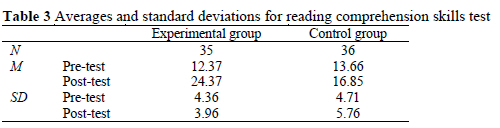
The averages and standard deviations for the experimental and the control groups' reading comprehension skills pre-test and post-test are shown in Table 3.
The data in Table 3 shows that the average score of the students in the experimental group in the reading comprehension test prior to the mental game application was 12.37, reaching 24.37 after the mental game application. On the other hand, the average pre-test score of the students in the control group was 13.66, and their post-test score average was 16.85. It is thus clear that the post-test average reading comprehension skills scores of the students in the experimental group with whom mental game activities were undertaken were higher than those of the post-test scores of the students in the control group.
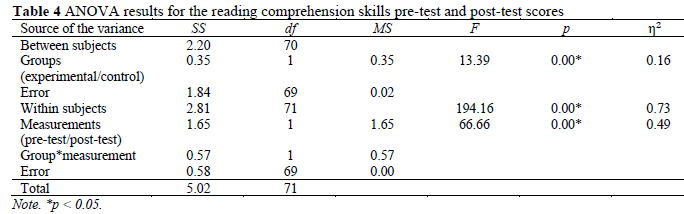
The results of the two-factor ANOVA test for mixed designs, which was done to determine whether or not the pre-test and post-test scores of the students in the experimental and the control groups differed significantly, are shown in Table 4.
It was thus found that using mental games in the experimental group and maintaining traditional teaching in the control group resulted in a significant difference in the results of the students in the experimental group from those in the control group. The joint effects of the different groups and the repeated measurements of reading comprehension skills were found to be significant (F[1.69] = 66.66, p < 0.05). The findings indicate that using mental games had different effects on students' reading comprehension skills. While the average score of the students in the experimental group was 12.37 prior to the application, the figure rose to 24.37 after the application. In the control group, where no mental games were employed, the students' pre-test and post-test scores were 13.66 and 16.85 respectively. The average post-test scores of the students in the experimental group increased much more than those of the students in the control group. It was thus concluded that mental games had a positive effect on students' scores in the reading comprehension skills test.
The effect size was 0.16 for measurements between groups, 0.73 between measurements, and 0.49 for joint effect group measurement. Based on these values, it can be said that the effect sizes obtained in this study had large effects, in other words, the effects tested in the research were sufficiently large.
The reading comprehension test, which consists of open-ended questions, was used as a data collection tool. The questions were ordered from simple to difficult according to Barrett' s taxonomy, and intra-textual, non-textual and intertextual meaning-making questions were used respectively according to their levels. While the first two questions are basic and inferential comprehension questions, the following questions correspond to the skills of evaluation, reorganisation, and satisfaction. In this context, the questions in the reading comprehension test correspond to analysis, synthesis and creative thinking skills, which are at the highest level in Bloom's revised taxonomy, and measure these skills. As a result, the findings indicate that the students in the experimental group were more successful in the reading comprehension test than the students in the control group.
Conclusion, Discussion and Recommendations
The research question was: Are there any significant differences between the pre-test and post-test scores of students in the experimental group and the control group on reading comprehension? The results of the research show a significant difference between the average pre-test and post-test scores of students in the experimental group and in the control group, and also between the average pre-test and post-test scores between the two groups. Examination of the differences between the average scores of the experimental and the control groups favoured the experimental group. Based on the results it was found that mental games were influential in improved reading comprehension skills.
With this article we tried to support the results obtained in studies on the effects of mental games on higher-order thinking skills, as, to our knowledge, no studies on the effects of mental games on reading comprehension skills were available in the literature. The questions that we prepared for the reading comprehension test met higher-order thinking skills - from the easiest to the most difficult.
Based on the results of this study it is clear that students' thinking skills had developed, and that they attained more success in the reading comprehension post-test than in the pre-test. This result agrees with that obtained by Alkas Ulusoy et al. (2017). Bottino et al. (2013) also conclude that mental games developed students' reasoning skills, and therefore, the result from our study were similar.
The results obtained in this study are also similar to those results obtained by Marangoz and Demirtas (2017) in which the effects of mental games on second graders' mental skills were revealed. Thus, the finding that mental games increased attention and secured concentration, were beneficial in making inferences, evaluating and analysing, were consistent with the finding that mental games had effects on reading comprehension, because reading comprehension skills involve such skills as making inferences, evaluating, and analysing.
Demirkaya and Masal (2017) found that mental games were influential in developing thinking skills. This result is supportive of the effects of mental games on reading comprehension skills, since reading comprehension skills are connected with thinking skills. The reading comprehension skills test used in this study also contained thinking skills. For this reason, it was found that reading comprehension skills also developed as a result of the direct effects of mental games on thinking skills.
The results obtained in the study also agree with those found by Esentas (2021) and Kurbal (2015). The conclusion that reasoning skills, which form the basis of sixth graders' problem-solving strategies is similar to the conclusion of our study. Accordingly, it can be said that the development of students' reasoning skills, making inferences, and evaluating caused an increase in their reading comprehension and thus the development of their reading comprehension skills.
Recommendations
• This study was conducted with third grade students to reveal the effects on their reading comprehension skills in Turkish classes. Similar studies could be performed with different grade levels, for different courses and for different skills.
• A reading comprehension skills tests of open-ended questions was prepared to use as the pre-test and post-test in this study. We recommend that similar tests may be developed and used in similar studies.
• It was found that mental games were beneficial to the students in question, which supported higher-order thinking skills, and not only in simple 5W1H (5W is an acronym for What, Where, When, Why, and Who, while the letter H stands for How) questions, since they focused on developing students' different thinking skills. As it was found that mental games positively influenced higher-order thinking skills, teachers ought to use more inferential questions instead of simple 5W1H questions.
• Reading comprehension questions should encourage students to think. Owing to the fact that mental games were supportive of skills like making inferences and logical thinking, primary school teachers in particular ought to pose thought-provoking questions to student in Turkish classes.
• Considering the results of this study and of other studies on the effects of mental games on affective and cognitive skills, we recommend that mental games be taught in primary schools as a compulsory course at all grade levels.
• The importance of mental games ought to be increased and primary school teachers should be offered in-service training and educational seminars by experts.
• Prospective teachers ought to be informed about the advantages of integrating mental games in teaching and they ought to be offered opportunities to experience those games in practice.
Authors' Contributions
All statistical analyses in the study were conducted by both researchers.
Notesi. This article emanated from the master's thesis entitled, "The effects of mind games on third graders' reading comprehension skills in Turkish classes" completed by Yasemin Erdem under the supervision of Bilge Gök.
ii. Published under a Creative Commons Attribution Licence.
References
-
Akyol H, Yildirim K, Ate? S & Qetinkaya Q 2013. Anlamaya yönelik nasil sorular soruyoruz [What kinds of questions do we ask for making meaning?]. Mersin ÜniversitesiEgitim Fakiiltesi Dergisi, 9(1):41-56. Available at https://dergipark.org.tr/en/download/article-file/160845. Accessed 31 December 2022.
» https://dergipark.org.tr/en/download/article-file/160845 -
Alka? Ulusoy Q, Saygi E & Umay A 2017. ilkögretim matematik ögretmenlerinin zeka oyunlari dersi ile ilgili görüsleri [Views of elementary mathematics teachers about mental games course]. Hacettepe Üniversitesi Egitim Fakiiltesi Dergisi, 32(2):280-294. https://doi.org/10.16986/HUJE.2016018494
» https://doi.org/10.16986/HUJE.2016018494 -
Ates S, Güray E, Dögmeci Y & Gürsoy FF 2016. Ögretmen ve ögrenci sorularinin gerektirdikleri zihinsel sürejler ajisindan karsilastirilmasi [Comparison of questions of teachers and students in terms of level]. Okuma Yazma Egitimi Arasttrmalari, 4(1):1-13. Available at https://dergipark.org.tr/en/download/article-file/270310. Accessed 31 December 2022.
» https://dergipark.org.tr/en/download/article-file/270310 - Bastug M, Higde A, Çam E, Örs E & Efe P 2019. Okudugunu anlama becerilerini gelistirme: Stratejiler, teknikler, uygulamalar [Developing reading comprehension skills: Strategies, techniques, practices]. Ankara, Turkey: Pegem Akademi.
-
Bottino RM & Ott M 2006. Mind games, reasoning skills, and the primary school curriculum. Learning, Media and Technology, 31(4):359-375. https://doi.org/10.1080/17439880601022981
» https://doi.org/10.1080/17439880601022981 - Bottino RM, Ott M & Tavella M 2013. Investigating the relationship between school performance and the abilities to play mind games. In Proceedings of the European conference on games based learning.
- Creswell JW 2012. Educational research: Planning, conducting, and evaluating quantitative and qualitative research (4th ed). Boston, MA: Pearson.
- Davasligil Ü 1989. Yaraticilik ve oyun [Creativity and play]. Egitim ve Bilim, 13(71):24-32.
-
Davis FB 1944. Fundamental factors of comprehension in reading. Psychometrika, 9(3):185-187. https://doi.org/10.1007/BF02288722
» https://doi.org/10.1007/BF02288722 - De Beaugrande R & Dressler W 1981. Introduction to text linguistics. London, England: Longman Group Limited.
-
Demirkaya C & Masal M 2017. Geometrik-mekanik oyunlar temelli etkinliklerin ortaokul ögrencilerinin uzamsal dü§ünebilme becerilerine etkisi [The effect of geometric-mechanic games based activities on the spatial skills of secondary school students]. Sakarya University Journal of Education, 7(3):600-610. https://doi.org/10.19126/suje.340730
» https://doi.org/10.19126/suje.340730 -
Dole JA, Duffy GG, Roehler LR & Pearson PD 1991. Moving from the old to the new: Research on reading comprehension instruction. Review of Educational Research, 61(2):239-264. https://doi.org/10.3102/00346543061002239
» https://doi.org/10.3102/00346543061002239 - Duke NK & Pearson PD 2002. Effective practices for developing reading comprehension. In AE Farstrup & SJ Samuels (eds). What research has to say about reading instruction (3rd ed). Newark, DE: International Reading Association.
-
Esentas M 2021. A leisure time educational tool: Mind and intelligence games. International Journal of Curriculum and Instruction, 13(2):1355-1373. Available at https://ijci.globets.org/index.php/IJCI/article/view/591/320. Accessed 31 December 2022.
» https://ijci.globets.org/index.php/IJCI/article/view/591/320 - Fraenkel JR, Wallen NE & Hyun HH 2012. How to design and evaluate research in education (8th ed). New York, NY: McGraw-Hill.
-
Kocaarslan M & Yamaç A 2018. Sinif ögretmenlerinin Türkje dersi sinavlarinda sorduklari metne dayali anlama sorularinin incelenmesi [Investigating text-based comprehension questions primary school teachers ask in exams of Turkish course]. Trakya Üniversitesi Egitim Fakiiltesi Dergisi, 8(2):431-448. https://doi.org/10.24315/trkefd.356769
» https://doi.org/10.24315/trkefd.356769 -
Kula SS 2021. Mind games with the views of classroom teachers. International Journal of Research in Education and Science, 7(3):747-766. https://doi.org/10.46328/ijres.1471
» https://doi.org/10.46328/ijres.1471 -
Kurbal MS 2015. An investigation of sixth grade students' problem solving strategies and underlying reasoning in the context of a course on general puzzles and games. MSc dissertation. Ankara, Turkey: Middle East Technical University. Available at https://etd.lib.metu.edu.tr/upload/12618983/index.pdf. Accessed 31 December 2022.
» https://etd.lib.metu.edu.tr/upload/12618983/index.pdf - Lupu N 2018. Educational game. A best practice for improving academic achievement to students with special educational needs. Paper presented at The 20th International Scientific Research & Education in the Air Force Conference, Bra§ov, Romania, 2227 May.
-
Marangoz D & Demirta§ Z 2017. Mekanik zekâ oyunlarinin ilkokul 2. Sinif ögrencilerinin zihinsel beceri düzeylerine etkisi [The effect of mechanical intelligence games on the mental skill levels of primary school second grade students]. Uluslararasi Sosyal Arasttrmalar Dergisi, 10(53):612-621. https://doi.org/10.17719/jisr.20175334149
» https://doi.org/10.17719/jisr.20175334149 - MEB 2013. Zekâ oyunlart dersi (5-8. stntflar) ögretim programt [Intelligence games lesson (5th-8th grades) curriculum]. Ankara, Turkey: Talim ve Terbiye Kurulu Baskanligi.
- Özdemir Y 2017. Okumadan önce, okuma esnasinda, okumadan sonra düsün stratejisinin okudugunu anlama becerisine etkisi [The effect of think before, during reading, after reading strategy on reading comprehension skills]. MEd dissertation. Samsun, Turkey: Ondokuz Mayis University.
-
Sackstein S, Spark L & Jenkins A 2015. Are e-books effective tools for learning? Reading speed and comprehension: iPad®i vs. paper [Special issue]. South African Journal of Education, 35(4):Art. # 1202, 14 pages. https://doi.org/10.15700/saje.v35n4a1202
» https://doi.org/10.15700/saje.v35n4a1202 -
Saracho ON 1999. A factor analysis of preschool children's play strategies and cognitive style. Educational Psychology, 19(2): 165-180. https://doi.org/10.1080/0144341990190204
» https://doi.org/10.1080/0144341990190204 -
Thorndike EL 1917. Reading as reasoning: A study of mistakes in paragraph reading. Journal of Educational Psychology, 8(6):323-332. https://doi.org/10.1037/h0075325
» https://doi.org/10.1037/h0075325 -
Tsuei M, Huang HW & Cheng SF 2020. The effects of a peer-tutoring strategy on children's e-book reading comprehension. South African Journal of Education, 40(2):Art. #1734, 12 pages. https://doi.org/10.15700/saje.v40n2a1734
» https://doi.org/10.15700/saje.v40n2a1734 - United Nations General Assembly 1959. Publicity to be given to the Declaration of the Rights of the Child: Resolution.
-
Yildirim K 2012. Ögretmenlerin ögrencilerin okudugunu anlama becerilerini degerlendirmede kullanabilecekleri bir sistem: Barrett Taksonomisi [A system to be used by teachers to evaluate students' reading comprehension skills: Barrett Taxonomy]. Mustafa Kemal Üniversitesi Sosyal Bilimler Enstitüsü Dergisi [Mustafa Kemal University Journal of Social Sciences Institute], 9(18):45-58. Available at https://dergipark.org.tr/en/download/article-file/183001. Accessed 31 December 2022.
» https://dergipark.org.tr/en/download/article-file/183001 -
Yildiz M & Akyol H 2011. Ilkögretim 5. sinif ögrencilerinin okudugunu anlama, okuma motivasyonu ve okuma aliskanliklari arasindaki ili§ki [The relationship between 5th graders' comprehension, reading motivation and reading habits]. Gazi Üniversitesi Gazi Egitim Fakültesi Dergisi, 31(3):793-815. Available at https://dergipark.org.tr/en/download/article-file/76969. Accessed 31 December 2022.
» https://dergipark.org.tr/en/download/article-file/76969
Revised: 10 March 2022
Accepted: 19 December 2022
Published: 31 December 2022