Evaluating implementation: A fidelity assessment of Child, Adolescent and Family Care Days from a health facility perspective
BACKGROUND. The South African (SA) Department of Health (DoH) Child, Adolescent and Family Care Day (Care Day) model aims to strengthen service delivery for children with chronic illnesses, particularly HIV. However, implementing partner experience indicates gaps in service delivery. OBJECTIVES. To assess the fidelity and sustainability of Care Days to inform implementation improvement. METHODS. We conducted a cross-sectional implementation fidelity assessment at 25 facilities in SA between May and November 2023 using a structured Care Day component questionnaire. Fidelity scores were calculated for each of the five components and categorised as low (0 - 1.9/4), medium (2 - 3.9/4) or high (4/4), and summed to calculate total facility scores. Sustainability was assessed through efforts to upskill DoH healthcare workers, DoH delivery of psychosocial services, engagement with community-based organisations and implementation challenges. RESULTS. Primary care facilities in the Johannesburg, Sedibeng, Capricorn and Mopani districts were included (N=21). District median (interquartile range (IQR)) fidelity scores ranged from 10.5 (8.5 - 12.5) to 17 (16 - 19) and 17 (16.5 - 17.5) out of a possible score of 20. Psychosocial support was implemented with the highest fidelity (medium or high scores at all facilities), followed by implementation support (n=19 with medium or high scores). Medication collection (n=3) and facility-community-based organisation collaboration (n=7) had low fidelity scores. Clinical mentoring and collaborative links with community organisations were established at most facilities (n=19 and n=17, respectively), supporting potential sustainability. However, fewer facilities had psychosocial mentoring (n=14) and more advanced engagement with community organisations (n=10 - 12). CONCLUSION. Some facilities demonstrated high fidelity to Care Day components, but fidelity varied across facilities and districts. The pragmatic assessment approach enabled identification of components requiring strengthening and highlighted risks to sustainability, especially for psychosocial support. Integrating Care Days into routine government primary healthcare services may improve their effectiveness.
paediatric HIV; retention in care; viral suppression; implementation science; holistic care; community collaboration; sustainability
Evaluating implementation: A fidelity assessment of Child, Adolescent and Family Care Days from a health facility perspective
C L TaitI, II; C NjugunaIII; R NdouIV; J L DunlopV, VI; B MugisaVII, VIII; K ReesIX, X
IMB ChB, MSc (Translat Health Sci) ; Anova Health Institute, Johannesburg, South Africa
IIMB ChB, MSc (Translat Health Sci) ; Division of Community Paediatrics, Department of Paediatrics and Child Health, School of Clinical Medicine, Faculty of Health Sciences, University of the Witwatersrand, Johannesburg, South Africa
IIIBPharm, MPH (Epidemiology) ; Anova Health Institute, Johannesburg, South Africa
IVDipNSc ; Anova Health Institute, Johannesburg, South Africa
VMB BCh, MSc (Med) Anova Health Institute, Johannesburg, South Africa
VIMB BCh, MSc (Med) Division of Community Paediatrics, Department of Paediatrics and Child Health, School of Clinical Medicine, Faculty of Health Sciences, University of the Witwatersrand, Johannesburg, South Africa
VIIMD, MPH ; Bilateral Health Office, United States Agency for International Development, Pretoria, South Africa
VIIIMD, MPH ; Prism Global Advisory Group, Kampala, Uganda
IXMB BCh, FCPHM (SA) Anova Health Institute, Johannesburg, South Africa
XMB BCh, FCPHM (SA) Department of Community Health, School of Public Health, Faculty of Health Sciences, University of the Witwatersrand, Johannesburg, South Africa
BACKGROUND. The South African (SA) Department of Health (DoH) Child, Adolescent and Family Care Day (Care Day) model aims to strengthen service delivery for children with chronic illnesses, particularly HIV. However, implementing partner experience indicates gaps in service delivery.
OBJECTIVES. To assess the fidelity and sustainability of Care Days to inform implementation improvement.
METHODS. We conducted a cross-sectional implementation fidelity assessment at 25 facilities in SA between May and November 2023 using a structured Care Day component questionnaire. Fidelity scores were calculated for each of the five components and categorised as low (0 - 1.9/4), medium (2 - 3.9/4) or high (4/4), and summed to calculate total facility scores. Sustainability was assessed through efforts to upskill DoH healthcare workers, DoH delivery of psychosocial services, engagement with community-based organisations and implementation challenges.
RESULTS. Primary care facilities in the Johannesburg, Sedibeng, Capricorn and Mopani districts were included (N=21). District median (interquartile range (IQR)) fidelity scores ranged from 10.5 (8.5 - 12.5) to 17 (16 - 19) and 17 (16.5 - 17.5) out of a possible score of 20. Psychosocial support was implemented with the highest fidelity (medium or high scores at all facilities), followed by implementation support (n=19 with medium or high scores). Medication collection (n=3) and facility-community-based organisation collaboration (n=7) had low fidelity scores. Clinical mentoring and collaborative links with community organisations were established at most facilities (n=19 and n=17, respectively), supporting potential sustainability. However, fewer facilities had psychosocial mentoring (n=14) and more advanced engagement with community organisations (n=10 - 12).
CONCLUSION. Some facilities demonstrated high fidelity to Care Day components, but fidelity varied across facilities and districts. The pragmatic assessment approach enabled identification of components requiring strengthening and highlighted risks to sustainability, especially for psychosocial support. Integrating Care Days into routine government primary healthcare services may improve their effectiveness.
Keywords: paediatric HIV, retention in care, viral suppression, implementation science, holistic care, community collaboration, sustainability
Children living with HIV (CLHIV) continue to experience poorer health outcomes than adults,[1] highlighting the need for a model of comprehensive clinical and psychosocial support (PSS). The South African (SA) Department of Health (DoH) developed the Child, Adolescent and Family Care Day (Care Day) model in collaboration with implementing partners to strengthen holistic, family-centred care services for children with chronic diseases, particularly CLHIV, and improve treatment adherence and retention.[2,3] Finalised in 2020, the Care Day model is embedded within the Matrix of Interventions, a standardised package that outlines minimum care standards to support achievement of the 95-95-95 targets for children.[4]
The model comprises several components, outlined in a standard operating procedure (SOP),[2] informed by best practices from implementing partners. These include:
1. Choosing specific days at health facilities on which Care Day components are delivered and scheduling appointments in advance for children and adolescents with chronic diseases, as well as their caregivers.[2,3]
2. Pre-retrieving patient files and pre-packing medication prior to the Care Day.[2,3] Pre-packing can be done at facilities for children aged <5 years. For those aged >5 years, SA's differentiated service delivery repeat prescription collection strategy (RPCS) enables centralised dispensing and facility- or out-of-facility collection.[5]
3. Clinical and psychosocial healthcare worker (HCW) mentoring to sustain quality paediatric care.[2,3]
4. Providing individual and group PSS, including adherence counselling and support for HIV disclosure.[2,3,6]
5. Linking to Orphans and Vulnerable Children and Youth (OVCY) community-based organisations (CBOs) for community-based support,[2,3] including multidisciplinary case conferencing to support families requiring more intensive support.[7]
Anova Health Institute (Anova), an SA non-governmental implementation partner, played a pivotal role in developing the Care Day model and SOP.[2] Through funding from the US President's Emergency Plan for AIDS Relief (PEPFAR) and the United States Agency for International Development (USAID), it has provided technical and direct service support to facilities to adopt and implement the recommended Care Day components.
Implementation fidelity is a key determinant of programme effectiveness. Defined as the degree to which an intervention is delivered as intended,[8] fidelity can be used to describe adherence to a programme as intended, as well as the dose and quality of implementation, usually at the implementer level.[8] It is considered an implementation outcome necessary for achieving programme outcomes, such as paediatric retention or viral suppression.[8]
While the Matrix of Interventions has helped standardise recommendations for paediatric care, its effectiveness has been limited by resource constraints, inconsistent support and gaps in monitoring and evaluation.[4] Although implementing partners have played a critical role in service delivery and support, sustained DoH leadership is essential to ensure long-term fidelity and sustainability. The goal is for all Care Days to be fully DoH led, with oversight, preparation and service delivery carried out by DoH staff rather than by implementing partners. Programme experience indicates that Care Day components are not consistently implemented as intended, and sustainability remains a concern at some facilities. In addition, despite the model's positive effect in supported districts, gaps in paediatric adherence and retention persist.[3] There is also limited evidence on the implementation fidelity of the model's components.
To strengthen Care Day functioning, sustainability and effectiveness, this evaluation assessed model fidelity at selected primary healthcare facilities by measuring implementation alignment with the core Care Day components. The aim was to describe fidelity levels at implementing facilities and explore sustainability potential to inform targeted support and improvement efforts.
Methods
Study design
We conducted a cross-sectional descriptive fidelity assessment at selected primary healthcare facilities.
Setting
Primary healthcare facilities in four Anova-supported districts were evaluated: Johannesburg and Sedibeng districts (Gauteng Province), and Capricorn and Mopani districts (Limpopo Province).
Johannesburg has seven urban and peri-urban subdistricts, and had Care Day implementation in 52 of 129 facilities. It has more children receiving antiretroviral therapy (ART) per facility than the other districts included in the study.
Capricorn and Sedibeng, both mixed rural and urban districts, had fewer facilities implementing Care Days (14/112 facilities in Capricorn and 10/51 in Sedibeng). Mopani, a predominantly rural district, had 44 out of 113 facilities implementing Care Days. Many of these facilities are geographically remote, making them more difficult for the evaluation team to access.
Selection of facilities
A list of 120 potential facilities was compiled using programme reports on Care Days. Of these, 25 facilities were assessed across the four districts (4 - 7 facilities per district).
In Johannesburg, where there were many accessible facilities implementing Care Days, we purposively selected facilities across different subdistricts, including both smaller and larger sites based on the number of CLHIV receiving care.
In the other districts, fidelity assessment visits had to be co-ordinated with the Anova facility support teams, so facilities were therefore selected using a convenience sampling approach.
As this was a process evaluation, the results were not analysed for statistical significance but rather used to provide insights into implementation successes and challenges.
Data collection
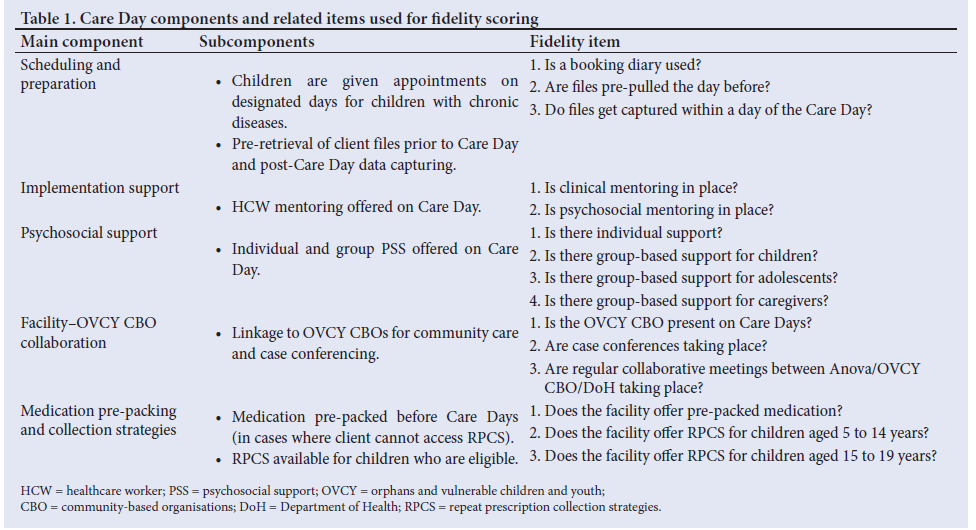
We developed a structured questionnaire for data collection based on the Care Day components. To develop the questionnaire, we first grouped related Care Day interventions into five main components: (i) scheduling and preparation; (ii) implementation support; (iii) PSS; (iv) facility-OVCY CBO collaboration; and (v) medication pre-packing and collection strategies. We then developed fidelity assessment questions for each component (Table 1).
In addition, we included a limited number of free-text fields in the questionnaire to record brief comments raised during the assessment and capture the research nurse's overall impression of Care Day implementation. The research nurse also made field notes during each assessment.
Data were collected between May and November 2023 and managed using REDCap electronic data capture tools hosted at the study institution. REDCap (Research Electronic Data Capture) is a secure, web-based software platform designed to support data capture for research studies.'9,101 A structured questionnaire on REDCap was completed by a research nurse familiar with primary healthcare facility contexts.
The research nurse conducted site visits to each selected facility. She completed the questionnaire using information provided by two or three HCWs involved in implementing Care Days. This included at least one DoH and/or implementing partner clinician and one PSS staff member (such as a counsellor, youth ambassador or social auxiliary worker) at each facility. One questionnaire was completed for each facility. The questionnaire was designed for facility staff to self-assess implementation of Care Days, and no validation of responses was sought.
Data analysis
The outcome of interest was the facility-level fidelity scores,'8,111 calculated using dichotomous outcomes, with 'yes' coded as a one and 'no' coded as a zero for each fidelity item (Table 1). Data were analysed using Excel (Microsoft Corp., USA).
Each main component represents a key feature of Care Days. Fidelity items were designed to measure implementation of each component. However, some components were more amenable to measurement than others or required disaggregation by age group, resulting in a varying number of fidelity items per component. We therefore weighted all components equally to ensure that the overall facility fidelity score reflected implementation across all Care Day components.
Fidelity scores were calculated for each Care Day component and each facility. Each component comprised between two and four fidelity items. For components with fewer than four items, the component score was converted so that all components could be compared on a four-point scale. For example, total scores for the 'scheduling and preparation' component (three items), were multiplied by 1.33 to convert the total to a score out of 4. Each component was then categorised as (i) low implementation fidelity (score 0 - 1.9); (ii) medium implementation fidelity (score 2 - 3.9); or (iii) high implementation fidelity (score 4).
Cut-offs were defined by the authors based on the distribution of the data, allowing differentiation between facilities. To calculate the overall facility fidelity score, the component scores were summed to obtain a total out of a possible score of 20.
We also assessed Care Day sustainability at the facilities using (i) DoH involvement in components, (ii) collaboration with CBOs and (iii) free-text comments, as follows:
• Implementation support: mentoring of DoH HCWs in clinical care and PSS.
• PSS: implementation by DoH HCWs.
• Facility-OVCY CBO collaboration: presence of the fidelity items.
Free-text responses: These were analysed to provide additional insight into Care Day sustainability and complement the quantitative fidelity findings. Responses relating to implementation challenges (including Care Day implementation and file flow challenges) and DoH involvement in Care Days were reviewed. One of the authors familiarised themself with these data and identified and reported recurring themes that contributed to understanding implementation of Care Day components. Illustrative free-text comments were included to provide additional context.
Ethical considerations
This study forms part of Anova Health Institute's programme evaluation activities, approved by the South African Human Sciences Research Council and the Johannesburg District and Limpopo Province Research Committees. Facility-level permission was obtained from facility managers. As the evaluation questionnaire was completed by a research nurse at the facility level and no personal information was collected, informed consent was not required. Data confidentiality was maintained by restricting access to the REDCap database to authorised study personnel.
Results
A total of 25 facilities were assessed across four districts. Of these, 21 (84.0%) were implementing Care Days and were included in the analysis: Johannesburg (n=7; 33.3%), Sedibeng (n=4; 19.0%), Mopani (n=6; 28.6%) and Capricorn (n=4; 19.3%). Four of the 25 facilities were excluded because they were not implementing Care Days.
Overall, Care Day implementation strengths included frequent delivery of PSS during Care Days, engagement with CBOs and the availability of RPCS. Implementation support and clinical mentoring were also available to guide facilities and strengthen service delivery. Additional strengths included facility support and leadership, trained HCWs and adequate file storage.
Implementation weaknesses included infrequent psychosocial mentoring, limited delivery of psychosocial services by facility HCWs and few out-of-facility medication collection options. Additional weaknesses included challenges with filing systems and partner-led implementation of Care Days.
Fidelity of implementation of Care Day components
Facilities in the Mopani and Capricorn districts implemented Care Days with the highest fidelity (median score (interquartile range (IQR)) 17 (16.0 - 19.0) for Mopani and 17 (16.5 - 17.5) for Capricorn), with less variation in scores in Capricorn. Johannesburg District had a median (IQR) fidelity score of 14 (14 - 18) and a wider range of facility fidelity scores (13 - 19). Sedibeng District had the widest range of fidelity scores (6 - 14) and the lowest median (IQR) fidelity score of 10.5 (8.5 - 12.5).
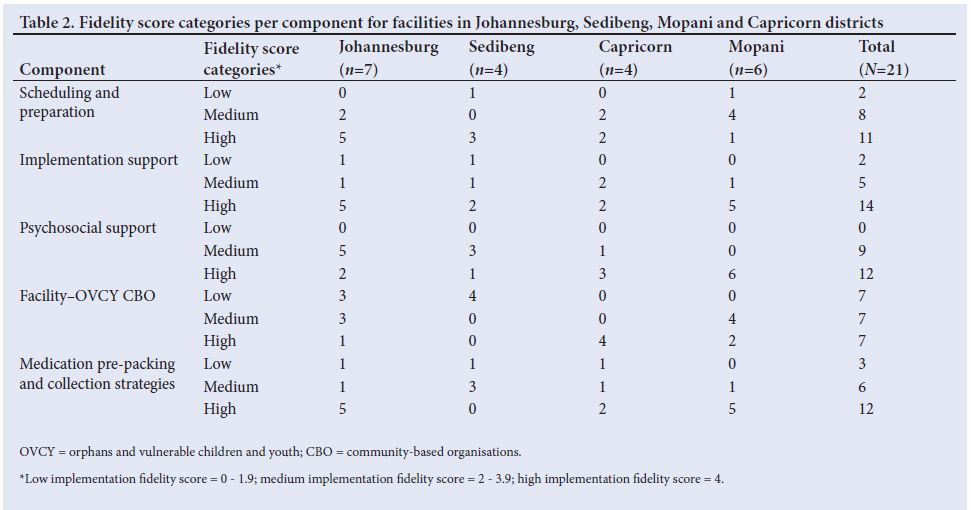
When disaggregated by component (Table 2), PSS was implemented with the highest fidelity across facilities and districts, with all 21 facilities scoring in the medium- or high-fidelity category. Implementation support achieved high fidelity in the greatest number of facilities (n=14; 66.7%). Across all districts, facility-OVCY CBO collaboration showed the lowest overall fidelity, with one-third of facilities (n=7; 33.3%) falling into the low-fidelity category. By contrast, far fewer facilities recorded low fidelity scores for the other components: scheduling (two facilities), implementation support (two facilities) and medication pre-packing/collection strategies (three facilities) (Table 2).
In Johannesburg District, the components implemented with the highest fidelity were scheduling, implementation support and medication pre-packing/collection strategies (Table 2). In Sedibeng District, only the scheduling component achieved high implementation fidelity, in three of the four facilities. The PSS component was implemented with high fidelity in three of the four facilities in Capricorn District and in all facilities in Mopani District. Capricorn was the only district in which the facility-OVCY CBO collaboration component was implemented with high fidelity at all facilities.
Most facilities (n=19) had RPCS available for children aged >5 years. There were 15 facilities pre-packing medication for children who were not eligible for RPCS. More facilities had in-facility medication collection options (n=18) than out-of-facility options (n=12), with Johannesburg having the highest proportion of facilities offering out-of-facility collection (6/7).
Potential for sustainability
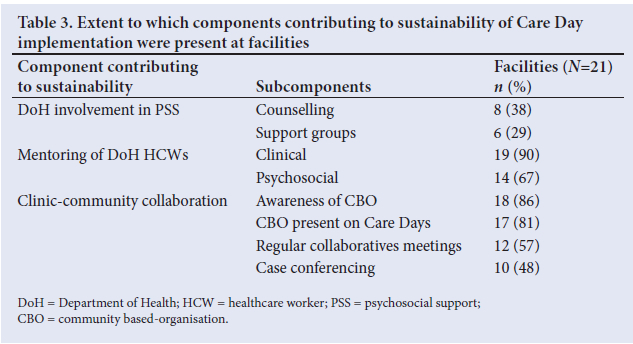
With regard to Care Day sustainability, DoH involvement in counselling and support groups was reported at fewer than half of the facilities (Table 3). Although most facilities had clinical mentoring, only two-thirds (n=14) offered PSS mentoring. Collaborative links with OVCY CBOs were in place at more than 80% (n=17) of the facilities. However, more advanced forms of engagement, such as collaborative meetings and case conferencing, were reported less frequently (Table 3).
Although the majority of facilities received DoH support for Care Day implementation, implementing partners often drove implementation. Staffing shortages were reported to contribute to this imbalance, making Care Day implementation challenging. In addition, a need for further capacity building was identified, as expressed by one facility in Limpopo:
'Only one DoH clinician is involved in implementing Care Days ... the operation[al] manager is keen to get other staff trained so that more people are involved.'
Newly appointed staff and routine staff rotation were reported to affect training and pose challenges to ongoing implementation:
'The new facility manager, who was not sensitised about Care Days in full . has asked to be mentored so that they will be able to train their DoH staff .'
Conversely, two facilities in Gauteng reported no implementation challenges:
'The facility manager and clinician are keen to implement Care Days [reasoning] that it helps with retaining kids and adolescents in care.'
Another facility in Gauteng commented that they had already been seeing children before Care Days and that:
'[Care Days were] just a continuation of what they have been doing.'
Regarding client file flow, although some facilities reported no problems, others reported inadequate filing space, lost files, duplicate files or clients keeping their own files. Reasons given for missing files included files being lost after data capture, being refiled incorrectly, inadequate file storage infrastructure and delays resulting from a shortage of filing clerks.
Discussion
We assessed the implementation fidelity of Care Days at primary healthcare facilities in four SA districts. While some facilities demonstrated high fidelity to the Care Day components, implementation varied across facilities and districts. PSS and implementation support were the most consistently delivered components, whereas scheduling, medication pre-packing and collection strategies and facility-OVCY CBO collaboration showed lower fidelity. Although clinical mentoring was available at most facilities, PSS mentoring and model delivery by DoH HCWs were less common, raising concerns about the sustainability of Care Days. This fidelity assessment identified aspects of the model requiring ongoing support or strengthening to maximise its effectiveness.
Variations across districts highlight the influence of context on implementation. Capricorn and Mopani are predominantly rural districts, whereas Johannesburg and Sedibeng are urban and peri-urban. Scheduling, particularly pre-retrieval of patient folders, was more common in Johannesburg and Sedibeng. This likely reflects the greater availability of facility support staff in urban areas. By contrast, PSS and facility-OVCY CBO collaboration were implemented more consistently in rural districts. The landscape for co-ordination among partners is also less complex in rural areas, with fewer partners operating within each geographic area. In addition, the Limpopo Provincial Department of Health has identified PSS for children as a priority area, supporting implementation of more holistic care.
PSS is vital for CLHIV, whose health outcomes are shaped by complex socioeconomic factors and whose access to care is mediated by caregivers.[6] Key challenges include food insecurity,[12] poverty,[13] stigma and HIV disclosure.[14] It is therefore encouraging that PSS was implemented with moderate or high fidelity across the facilities. However, it was provided predominantly by implementing partners (i.e. partner-led), particularly support groups and PSS mentoring, which may threaten programme continuity because of short-term or unstable funding.
This reliance was further reinforced by implementing partner-supported PSS cadres in three of the four districts, who were appointed to compensate for the lack of available DoH personnel to deliver PSS. While this addressed a critical gap, it highlights the urgent need to integrate sustainable PSS for CLHIV into the basic primary healthcare package to mitigate service disruption risks. This will require structural changes, including dedicated psychosocial roles within the government health staffing framework and investment in appropriately trained personnel, such as social workers, enrolled nurses and counsellors.
In addition, mobilising an intersectoral, community-based approach may enhance resource utilisation,[15] improve outcomes for CLHIV[16] and promote more resilient, locally anchored PSS. Effective facility-community collaboration requires engagement between organisations and established referral and communication processes[15] to enable CBO linkages and case conferencing. In this group of facilities, HCW awareness of CBOs and their presence during Care Days indicate that facility-community collaboration was underway. However, the lower overall fidelity of this component shows that further effort is required for full implementation. Capricorn was the only district with high-fidelity implementation of the facility-OVCY CBO collaboration component, likely because Care Days were established alongside existing OVCY CBO support. In the other districts, Care Day implementation preceded facility-OVCY CBO collaboration. Introducing the intervention within an existing collaboration structure appears to have enabled smoother integration and more consistent implementation than in districts where OVCY CBOs were incorporated later. The Clinic-Community toolkit recommends using a Partnership Relationship Checklist to assess progress and identify areas requiring improvement.[15,17] This could help scale successful partnerships, such as through joint meetings and case conferences, across more facilities while guiding those in the early stages of relationship building.
Intervention compatibility with existing policies and systems may influence implementation.[18] In SA, the government-led quality assurance policy known as the 'Ideal Clinic' programme[19] is embedded within facility systems. The programme recommends appointment systems for stable clients with chronic conditions and pre-retrieval of their clinic files prior to appointments.[19] This likely contributed to the moderate or high implementation of this component observed during the evaluation. Facilities with low implementation of this component should review their booking systems and file pre-retrieval processes for all clients, not only those attending Care Days. In a study by Ngxongo and Zulu,[20] several Ideal Clinic processes were reported to be difficult to implement because of staff shortages, limited knowledge of the required procedures and the absence of essential equipment. Applied to booking systems, these challenges may include insufficient staff to manage appointment scheduling for all clients, inadequate training on designing or maintaining an effective booking system, and a lack of appropriate registers or tools, all of which may explain the inconsistent implementation observed in our study.
Medication pre-packing and in-facility RPCS were moderately available, whereas out-of-facility collection strategies were less common. Johannesburg's urban setting likely contributed to their greater availability in that district. In the context of high uptake of RPCS among adults,[21] limited access for children may hinder retention in care. Enabling caregivers to collect their own medication together with that of their children may reduce the burden of clinical attendance and support treatment adherence. Further investigation into barriers to children's access to the RPCS is warranted.
Several implementation factors affect the potential sustainability of Care Days. Clinical mentoring was present at most facilities, potentially enhancing DoH clinicians' capacity to manage CLHIV and supporting sustainability. Collaborative links with CBOs had also been established at some facilities, promoting continuity of care. However, partner-led implementation may threaten long-term sustainability.
In addition, 25 facilities were selected, and all were expected to be implementing Care Days. However, at the time of the fidelity assessment site visits, four facilities were not implementing Care Days. Consequently, they were excluded from the analysis because they could not contribute data on implementation fidelity. This finding suggests challenges in both Care Day reporting, which is not yet fully integrated into routine reporting systems, and the sustainability of Care Day implementation.
To embed Care Days as a standard of care, further engagement with HCWs, facility managers and subdistrict leadership is required. Efforts should focus on integration planning and capacity building rather than direct service support from technical or implementing partners, as well as aligning Care Days with broader DoH priorities and programmes.[22
Strengths and limitations
This evaluation used a pragmatic and systematic data collection approach to assess key aspects of Care Day implementation at healthcare facilities.
Owing to the scope of the assessment, only a once-off assessment was possible, limiting the number of available HCWs who could participate. This likely affected the completeness of the data.[8] In addition, potential fluctuations over time were not captured. Repeated data collection would contribute to a more comprehensive understanding of implementation. Expanding the assessment to include other implementation outcomes, such as acceptability or feasibility, would provide additional insight into how implementation has unfolded and help explain the fidelity levels observed.[8] Our assessment focused primarily on implementation fidelity and therefore included limited qualitative data collection. Employing additional qualitative methods to explore fidelity and other implementation outcomes would deepen the analysis and strengthen the recommendations. Similarly, we did not assess the quality of implementation of each component. The quality of services, particularly mentoring and PSS, inevitably affects programme outcomes.
The structured fidelity questionnaire was administered by the same research nurse at all facilities, ensuring consistency in the assessment approach. However, the reliance on self-reported information may have introduced bias and affected the reliability of the findings. Although the research nurse's overall impression of implementation was incorporated to a limited extent into the sustainability analysis through the free-text component, we did not conduct direct observational assessments. Future studies could strengthen methodological triangulation by incorporating facility record reviews and/or direct observation to validate self-reported data.
Finally, the number of facilities included and the sampling approach provided insight into variation in fidelity to Care Day components but limit generalisability of the findings regarding Care Day implementation overall.
Implications
This study assessed implementation of the Care Day model, which was designed to facilitate multidisciplinary integration of services for children and their caregivers. Although integration of care is widely supported in SA policy documents, its implementation in practice remains challenging. A better understanding of how integrated models are implemented can support future implementation efforts. For example, we found that PSS requires dedicated staff embedded within the DoH, while collaboration with external organisations requires additional attention and systematic strengthening. In the current climate of declining HIV-specific funding, it is critical that DoH managers and supporting partners understand the strengths and weaknesses of Care Day implementation. These findings provide the DoH with evidence on implementation of the different Care Day components, enabling more effective planning and targeted support for components that are more challenging to implement or remain largely partner-led.
Conclusion
The Child, Adolescent and Family Care Day model is endorsed by the SA DoH to improve retention in care and viral suppression among CLHIV Adequate implementation fidelity at health facility level is crucial to maximise its effectiveness. This study highlights that, although components such as PSS and implementation support were implemented with high fidelity at many facilities, additional support is required to strengthen implementation of all Care Day components, particularly collaboration with CBOs and RPCS. The findings further suggest that sustainability has not yet been optimised at these sites, particularly for essential PSS interventions that need to be embedded within DoH primary healthcare staffing frameworks. Further research is needed to better understand the factors contributing to the fidelity findings to prioritise components requiring improvement and develop strategies to enhance the effectiveness of Care Days for children, adolescents and their families.
Data availability statement. All relevant data in the article are available from the corresponding author on request.
Declaration. None.
Acknowledgements. The authors would like to acknowledge the HCWs who supported completion of the questionnaire, and the implementing HCWs who offer care to children, adolescents and families as part of Care Days.
Author contributions. JLD led project conceptualisation and design, supported by CLT and KR. RN conducted data collection; CN and CLT conducted data analysis, supported by JLD and KR. CLT and CN wrote the manuscript, with contributions from RN, JLD, KR and BM.
Funding. This study was made possible by support from the US President's Emergency Plan for AIDS Relief (PEPFAR) through the US Agency for International Development (USAID) under co-operative agreement number 674-A-12-00015 to the Anova Health Institute. The contents remain the responsibility of the Anova Health Institute and do not necessarily reflect the views of USAID or the US Government.
Conflicts of interest. None.
References
-
1. Joint United Nations Programme on HIV/AIDS. AIDSinfo: Epidemic and response. Geneva: UNAIDS, 2022. https://aidsinfo.unaids.org/ (accessed 8 April 2024).
» https://aidsinfo.unaids.org/ - 2. National Department of Health. Consolidated standard operating procedures for achieving 90-90-90. Based on the Paediatric and Adolescent HIV Matrix of Interventions. NDoH, 2020.
-
3. Dunlop J. Child, Adolescent and Family Care Days provide a mix of interventions that support retention and virological suppression in children living with HIV. In: Baby on board: Pediatric & PMTCT interventions to improve HIV outcomes for infants, children, and adolescents. 4th Annual USAID Global Health Local Partner Meeting. PEPFAR USAID, 2022. https://www.intrahealth.org/sites/ihweb/file/baby_on_board_11.15.2022.pdf (accessed 22 April 2024).
» https://www.intrahealth.org/sites/ihweb/file/baby_on_board_11.15.2022.pdf -
4. Bamford L, Silere-Maqetseba T, Maharaj Y, Fritz R, Pillay Y. Accelerating achievement of the 95-95-95 targets in South Africa using a paediatric and adolescent Matrix of Interventions. In: The 12th IAS Conference on HIV Science. Brisbane: IAS, 2023. https://clientfacingsa.blob.core.windows.net/programme/pagmaterials/IAS2023/PPT/19168_967/IAS_eposter_2864_Bamford.pdf (accessed 22 April 2024).
» https://clientfacingsa.blob.core.windows.net/programme/pagmaterials/IAS2023/PPT/19168_967/IAS_eposter_2864_Bamford.pdf -
5. National Department of Health. National Strategic Plan for HIV, TB and NCDs. NdoH, 2023. https://anovahealthl-my.sharepoint.com/:b:/g/personal/tait_anovahealth_co_za/IQBk0FXB1M-WQrCfIQj_OhkaAeNPvJLbDs6cM4F0qYxgIiU?e=R26HsK (accessed 20 July 2026).
» https://anovahealthl-my.sharepoint.com/:b:/g/personal/tait_anovahealth_co_za/IQBk0FXB1M-WQrCfIQj_OhkaAeNPvJLbDs6cM4F0qYxgIiU?e=R26HsK -
6. Busza J, Simms V, Dziva Chikwari C, et al. 'It is not possible to go inside and have a discussion': How fear of stigma affects delivery of community-based support for children's HIV care. AIDS Care 2018;30(7):903-909. https://doi.org/10.1080/09540121.2018.1445826
» https://doi.org/10.1080/09540121.2018.1445826 -
7. Joint United Nations Programme on HIV/AIDS. Transforming vision into reality: The Global Alliance progress report on ending AIDS in children by 2030. Geneva: UNAIDS, 2024. https://www.unaids.org/sites/default/files/media_asset/transforming-vision-into-reality_en.pdf (accessed 16 September 2025).
» https://www.unaids.org/sites/default/files/media_asset/transforming-vision-into-reality_en.pdf -
8. Proctor E, Silmere H, Raghavan R, et al. Outcomes for implementation research: Conceptual distinctions, measurement challenges, and research agenda. Adm Policy Ment Health 2011;38(2):65-76. https://doi.org/10.1007/s10488-010-0319-7
» https://doi.org/10.1007/s10488-010-0319-7 -
9. Harris PA, Taylor R, Minor BL, et al. The REDCap Consortium: Building an international community of software platform partners. J Biomed Inform 2019;42(2):377-381. https://doi.org/10.1016/j.jbi.2019.103208
» https://doi.org/10.1016/j.jbi.2019.103208 -
10. Harris PA, Taylor R, Thielke R, Payne J, Gonzalez N, Conde JG. Research electronic data capture (REDCap) - A metadata-driven methodology and workflow process for providing translational research informatics support. J Biomed Inform 2009;42(2):377-381. https://doi.org/10.1016/j.jbi.2008.08.010
» https://doi.org/10.1016/j.jbi.2008.08.010 -
11. MST Institute. The Multisystemic Therapy (MST) QA/QI program. MST Institute, 2024. https://msti.org/cam (accessed 14 November 2024).
» https://msti.org/cam -
12. Young S, Wheeler AC, McCoy SI, Weiser SD. A review of the role of food insecurity in adherence to care and treatment among adult and pediatric populations living with HIV and AIDS. AIDS Behav 2014;18(Suppl 5):S505-S515. https://doi.org/10.1007/s10461-013-0547-4
» https://doi.org/10.1007/s10461-013-0547-4 -
13. Bosma CB, Toromo JJ, Ayers MJ, Foster ED, McHenry MS, Enane LA. Effects of economic interventions on pediatric and adolescent HIV care outcomes: A systematic review. AIDS Care 2024;36(1):1-16. https://doi.org/10.1080/09540121.2023.2240071
» https://doi.org/10.1080/09540121.2023.2240071 -
14. Robinson A, Cooney A, Fassbender C, McGovern DP. Examining the relationship between HIV-related stigma and the health and wellbeing of children and adolescents living with HIV: A systematic review. AIDS Behav 2023;27(9):3133-3149. https://doi.org/10.1007/s10461-023-04034-y
» https://doi.org/10.1007/s10461-023-04034-y -
15. Paediatric-Adolescent Treatment Africa, Positive Action for Children Fund. Clinic-community collaboration toolkit: Working together to improve PMTCT and paediatric HIV treatment, care and support. Cape Town, SA: PATA; Brentford, UK: PACF. https://www.childrenandaids.org/media/4621/file/C3-Tookit_PATA.pdf (accessed 4 July 2023).
» https://www.childrenandaids.org/media/4621/file/C3-Tookit_PATA.pdf -
16. Mushamiri I, Belai W, Sacks E, Genberg B, Gupta S, Perry HB. Evidence on the effectiveness of community-based primary health care in improving HIV/ AIDS outcomes for mothers and children in low-and middle-income countries: Findings from a systematic review. J Glob Health 2021;11:11001. http://doi.org/10.7189/jogh.11.11001
» http://doi.org/10.7189/jogh.11.11001 -
17. Barnidge EK, Brownson CA, Baker EA, Shetty G. Tools for building clinic-community partnerships to support chronic disease control and prevention. Sci Diabetes Self Manag Care 2010;36(2):190-201. https://doi.org/10.1177/0145721709359089
» https://doi.org/10.1177/0145721709359089 -
18. Damschroder LJ, Reardon CM, Widerquist MAO, Lowery J. The updated consolidated framework for implementation research based on user feedback. Implement Sci 2022;17(1):75. https://doi.org/10.1186/s13012-022-01245-0
» https://doi.org/10.1186/s13012-022-01245-0 -
19. National Department of Health. Ideal Clinic and Community Health Centre: Definitions, components and checklists. Version 20. NdoH, April 2025. https://www.idealhealthfacility.org.za/App/Document/Download/414 (accessed 20 July 2026).
» https://www.idealhealthfacility.org.za/App/Document/Download/414 -
20. Ngxongo TSP, Zulu M. Nurses experiences regarding ideal clinic project implementation in eThekwini district. Heal SA Gesondheid 2024;29:a2407. https://doi.org/10.4102/hsag.v29i0.2407
» https://doi.org/10.4102/hsag.v29i0.2407 -
21. Liu L, Christie S, Munsamy M, et al. Expansion of a national differentiated service delivery model to support people living with HIV and other chronic conditions in South Africa: A descriptive analysis. BMC Health Serv Res 2021;21(1):549. https://doi.org/10.1186/s12913-021-06561-7
» https://doi.org/10.1186/s12913-021-06561-7 -
22. Spicer N, Hamza YA, Berhanu D, et al. 'The development sector is a graveyard of pilot projects!' Six critical actions for externally funded implementers to foster scale-up of maternal and newborn health innovations in low- and middle- income countries. Global Health 2018;14(1):74. https://doi.org/10.1186/s12992-018-0389-y
» https://doi.org/10.1186/s12992-018-0389-y

Accepted 5 May 2026