Prevalence, outcomes and management of haemodynamically significant patent ductus arteriosus in very-low-birthweight neonates: A retrospective cohort study in a resource-limited setting
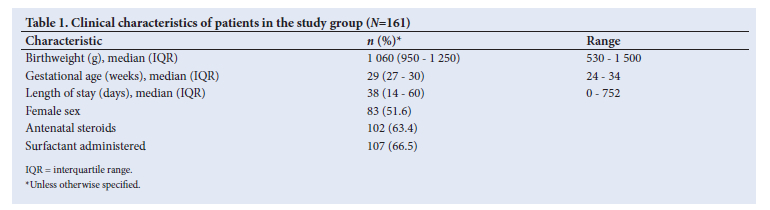
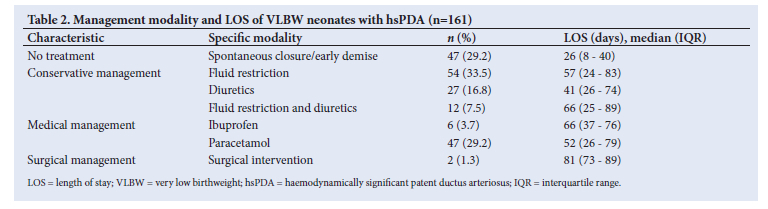
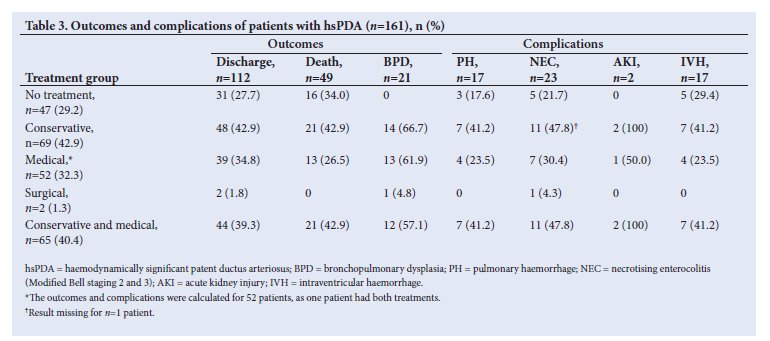
BACKGROUND. Haemodynamically significant patent ductus arteriosus (hsPDA) remains a significant challenge in neonatal care, particularly in very-low-birthweight (VLBW) infants. Data on its prevalence, outcomes, and management in resource-limited settings, such as the Free State Province of South Africa, remain limited. OBJECTIVE. To determine the prevalence, outcome and management approach of hsPDA in VLBW infants at two tertiary hospitals. METHODS. This retrospective cohort study reviewed records from 2020 to 2022 at Universitas Academic Hospital and Pelonomi Tertiary Hospital. The study included all VLBW (< 1 500 g) neonates diagnosed with hsPDA by echocardiogram. Data collected included management (no treatment, conservative, medical or surgical) and short-term outcomes (death, length of stay, and complications). RESULTS. Of 1 523 VLBW neonates, 161 (10.6%) received an hsPDA diagnosis. The median interquartile range (IQR) gestational age was 29 (27 - 30) weeks (range 23 - 34 weeks). Conservative management was most common (50.3%), followed by medical management (32.9%) and no treatment (29.2%). Definite necrotising enterocolitis (14.4%) and moderate-to-severe bronchopulmonary dysplasia (13.0%) were the most observed complications. Overall mortality was 30.4% (n=49). The median (IQR) length of stay was 38 days (14 - 60 days). The 'no treatment' group showed a statistically significant shorter length of stay (p<0.001). CONCLUSION. HsPDA prevalence at our centres was 10.6%. The high mortality rate, particularly in the extremely low-birthweight (ELBW) subgroup, requires attention. Conservative management was the preferred approach. Treatment modalities may not significantly reduce the length of stay in VLBW infants with hsPDA.
haemodynamically significant patent ductus arteriosus; very low birthweight; neonatal morbidity and mortality; conservative management; resource-limited setting; Free State