Long-term mental health and wellness of South African children treated for multisystem inflammatory syndrome in children: An observational study
BACKGROUND. Data on mental health and wellness of children with multisystem inflammatory syndrome in children (MIS-C) from Africa are limited. OBJECTIVE. To investigate the long-term mental health and wellness outcomes in a South African cohort of children with MIS-C. METHODS. This study reports on the long-term mental health of 27 such patients using age-appropriate developmental, clinical and neuropsychiatric validated scales, 6 - 24 months after the initial diagnosis. RESULTS. Nineteen (70%) children did not meet any criteria for psychiatric disorders. Eight participants met the criteria for a pre-MIS-C-dated psychiatric diagnosis, based on the fifth edition of the Diagnostic and Statistical Manual of Mental disorders Three (11%) met the criteria for an anxiety disorder, three (11%) for adjustment disorder, one (4%) for attention deficit hyperactive disorder (ADHD) only, and one (4%) for both anxiety and ADHD. CONCLUSION. None of the participants met the diagnostic criteria for psychotic illnesses, sleep issues, mood disturbances or posttraumatic stress disorder related to MIS-C. The study enabled recognition and management of pre-dated MIS-C mental health risk and psychiatric diagnosis.
COVID-19; MIS-C; paediatric mental health
Long-term mental health and wellness of South African children treated for multisystem inflammatory syndrome in children: An observational study
D R AbrahamI; N A YunisI; R H GlashoffII; H RabieIII; M M van der ZalmIII; A LachmanIV
IFC Paed, Cert Paed Rheum; Department of Paediatrics and Child Health, Faculty of Medicine and Health Sciences, Stellenbosch University and Tygerberg Academic Hospital, Cape Town, South Africa
IIPhD; Department of Pathology, National Health Laboratory Service and Faculty of Medicine and Health Sciences, Stellenbosch University, Cape Town, South Africa
IIIPhD; Department of Paediatrics and Child Health, Faculty of Medicine and Health Sciences, Stellenbosch University and Tygerberg Academic Hospital, Cape Town, South Africa
IVPhD; Desmond Tutu TB Centre, Faculty of Medicine and Health Sciences, Stellenbosch University, Cape Town, South Africa
VPhD; Child and Adolescent Psychiatric Inpatient Unit, Faculty of Medicine and Health Sciences and Tygerberg Academic Hospital, Stellenbosch University, Cape Town, South Africa
BACKGROUND. Data on mental health and wellness of children with multisystem inflammatory syndrome in children (MIS-C) from Africa are limited.
OBJECTIVE. To investigate the long-term mental health and wellness outcomes in a South African cohort of children with MIS-C.
METHODS. This study reports on the long-term mental health of 27 such patients using age-appropriate developmental, clinical and neuropsychiatric validated scales, 6 - 24 months after the initial diagnosis.
RESULTS. Nineteen (70%) children did not meet any criteria for psychiatric disorders. Eight participants met the criteria for a pre-MIS-C-dated psychiatric diagnosis, based on the fifth edition of the Diagnostic and Statistical Manual of Mental disorders Three (11%) met the criteria for an anxiety disorder, three (11%) for adjustment disorder, one (4%) for attention deficit hyperactive disorder (ADHD) only, and one (4%) for both anxiety and ADHD.
CONCLUSION. None of the participants met the diagnostic criteria for psychotic illnesses, sleep issues, mood disturbances or posttraumatic stress disorder related to MIS-C. The study enabled recognition and management of pre-dated MIS-C mental health risk and psychiatric diagnosis.
Keywords: COVID-19, MIS-C, paediatric mental health
Multisystem inflammatory syndrome in children (MIS-C) is a postinfectious syndrome caused by severe acute respiratory syndrome Coronavirus 2 (SARS-CoV-2).[1] It can present with neurological symptoms such as headaches, altered levels of consciousness and behavioural changes.[1] The neurotrophic effects of SARS-CoV-2 in MIS-C arise from both direct viral interactions with neurons and widespread exaggerated inflammatory response that leads to neuroinflammation and neurological symptoms.[2] It affects neuronal integrity, synaptic plasticity, glutamatergic signalling and serotonergic transmission, alters the tryptophan-degrading enzymes and decreases levels of both tryptophan and serotonin.[1] This may increase the vulnerability of children to posttraumatic stress disorder, anxiety, depression, cognitive impairments and psychosomatic symptoms.[1-3] Pandemic-related stressors, such as poor sleep, mood changes, behavioural challenges and psychosocial disruptions, may alter coping mechanisms related to medically stressful situations, prolonged hospitalisation and social isolation during lockdowns.[1]
Approximately one in seven children and adolescents in sub-Saharan Africa experience significant psychological distress associated with violence, poverty and illness (including tuberculosis and HIV), which is worsened by inadequate access to essential preventive and therapeutic mental health services.[4] Early-life adversity, and in particular what the mother experiences early on in life, is a potent risk factor poor mental health outcomes.[5]
There are few reports on the mental health outcomes of children and adolescents in Africa who have recovered from MIS-C. This study aims to investigate the long-term mental health and wellness outcomes in a South African cohort of children with MIS-C.
Methods
This prospective, longitudinal observational study recruited children from birth to 13 years of age presenting with MIS-C at Tygerberg Hospital, Cape Town, between 1 June 2020 and 31 March 2023.
Patients diagnosed with MIS-C at Tygerberg Hospital and who met the World Health Organization (WHO) diagnostic criteria[6] were enrolled. A child psychiatrist (AL) assessed participants with age-appropriate developmental and neuropsychiatric tools 6 - 24 months after the initial MIS-C diagnosis. The screening tools included: Activities of Daily Living Scores for children from infancy to 13 years, measuring a child's ability to perform daily living activities; the Swanson, Nolan and Pelham (SNAP) rating scale designed for children aged 6 - 18 years to assess symptoms of attention deficit and hyperactivity disorder (ADHD) and related behaviours; the Screen for Child Anxiety Related Disorders (SCARED) scale, used for children aged 8 - 18 years; and a modified version of the Beck's Depression Inventory (BDI) to measure the severity of depression in children younger than 13 years.[7-10] All tools were adapted in this study to be used in younger children, as appropriate. All concerns identified in the screening tools were meticulously reviewed and verified by AL to determine whether a diagnosis could be made according to the fifth edition of the Diagnostic and Statistical Manual of Mental Disorders (DSM-5).[11] Where necessary, management strategies were offered to caregivers.
Children were classified as presenting with severe MIS-C if they required inotropic support, non-invasive or invasive ventilatory support, received renal replacement therapy or if an ejection fraction of <40% was recorded.
Data were captured on standard case report forms. A statistical software package (StataCorp release 17, 2021) was used for statistical analysis. Medians and interquartile ranges (IQRs) were used to describe continuous data, whereas numbers and proportions were used to describe dichotomous data.
Ethical considerations
The Health Research Ethics Committee of Stellenbosch University approved the study (ref. no. S22/11/240). All caregivers provided formal written consent and children >7 years gave verbal assent. Ethics approval for incorporating the mental health assessment substudy was granted subsequent to the initial approval of the main study. Some children were lost to follow-up.
Results
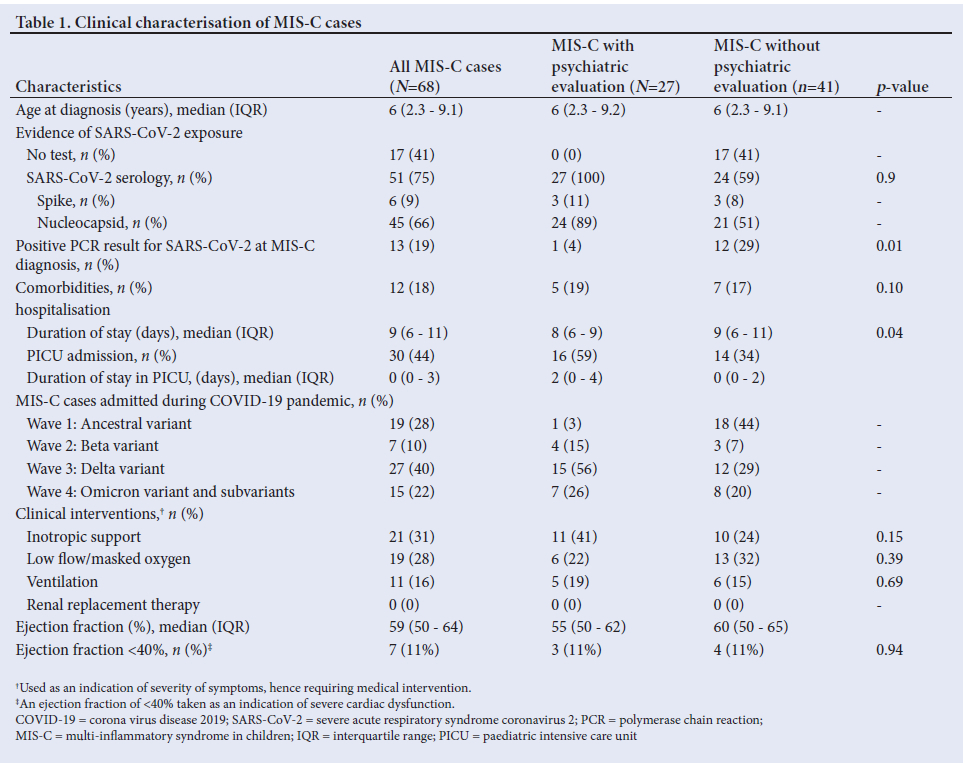
Because the mental health substudy approval was obtained after the main study had already commenced, mental health assessments were performed in only 27 (40%) of the 68 cases initially recruited. Enrolment for the study commenced during the Delta and Omicron waves of the COVID-19 pandemic.'12,131 The median (IQR) age of participants in the neuropsychiatric substudy was 8 (3.5 - 10) years (Table 1). Of these 27 participants, eight (30%) were under 5 years old, 13 (48%) were between 6 and 10 years old, and six (22%) were between 11 and 14 years old. Fifteen participants (56%) were male.
Fifteen (56%) participants were recruited during the Delta wave and seven (26%) during the Omicron wave (five other cases were identified during earlier waves). The median (IQR) duration of hospitalisation was 8 (6 - 9) days. Admission to the paediatric intensive care unit (PICU) was required for 16 participants (59%), with a median duration of 2 days. Central nervous system symptoms such as irritability, headache and delirium at diagnosis were present in six participants (22%), including three who presented with severe MIS-C.
Perinatal, early childhood stressors and premorbid clinical and mental health diagnosis prior to MIS-C diagnosis
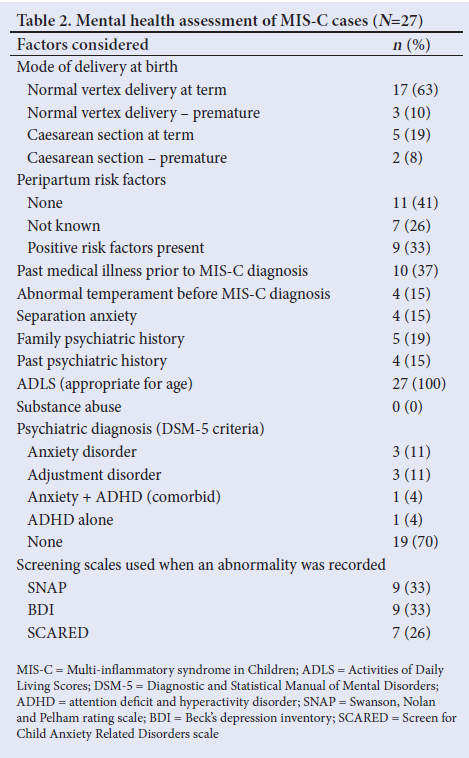
Factors considered for this analysis are shown in Table 2. The following perinatal and family risk factors were identified in mothers: HIV, n=2 (7%); maternal alcohol abuse, n=1 (4%); gestational hypertension, n=1 (4%); gestational diabetes, n=1 (4%); obstetric risk factors (e.g. threatened miscarriage or prolonged labour), n=1 (4%); teenage pregnancy, n=1 (4%); and maternal depression, n=2 (7%).
All HIV-exposed babies received preventive antiretroviral therapy and tested HIV negative. Four children (15%) had a strong family history of psychiatric illness and one was an orphan in foster care.
Three participants were diagnosed with a chronic illness, including obesity, hypertension, congenital heart disease or a genetic syndrome. Of note, four participants (15%) had previously been diagnosed with mental disorders, including ADHD (n=1, 4%), anxiety disorder (n=1, 4%), temper tantrums (n=1, 4%), and autistic spectrum disorder (n=1, 4%). Two children had previously been hospitalised for an acute condition.
Screening tool risk characterisation and formal mental health assessments
Nineteen of the 27 children (70%) were of school-going age; academic progress was appropriate for age in 18 (95%) of these participants. There were no reports of substance misuse. Nineteen (70%) participants did not meet any criteria for a psychiatric disorder (Table 2). Of the four participants with a prior mental disorder diagnosis, only one - a six-year-old girl - was professionally confirmed to have anxiety disorder (Supplementary Table 2). Upon formal screening, nine participants(33%) met the criteria for ADHD on the SNAP rating scale, nine (33%) were identified as having a high risk of developing a depressive mood disorder according to BDI criteria, and seven (26%) were considered as having a high risk of developing anxiety disorders as determined by the SCARED scale.[7-10] Another four participants (15%) were noted to display signs of separation anxiety. After full clinical assessment, review of past medical history and the age-appropriate screening tools having been administered, eight participants met a DSM-5 classification for a psychiatric diagnosis (Supplementary Table 2). Three participants (11%) met the criteria for an anxiety disorder, three (11%) for adjustment disorder, one (4%) for ADHD, and one (4%) for both anxiety disorder and ADHD (Table 2). In all eight participants, the onset of symptoms is reported to have preceded the MIS-C diagnosis.
None of the participants experienced sleep concerns, mood disturbances, emotional tantrums, behavioural disruptions or symptoms of posttraumatic stress disorder that were related directly to, or followed after, the diagnosis of MIS-C. Of the six participants (22%) who presented with central nervous system symptoms, none had a concerning mental assessment. Of the eight children with psychiatric disorders prior to their MIS-C diagnosis, six were admitted to the PICU, with five noted to have severe MIS-C on admission. None were found to have deteriorating or new psychiatric symptoms linked to MIS-C.
Discussion
We found no significant impairments in adaptive functioning or neuropsychiatric comorbidity in the home or academic environments 6 - 24 months after children were diagnosed with MIS-C. However, eight participants (30%) were found to have premorbid mental health conditions.
In South Africa (SA), children face many early-life developmental challenges, including food insecurity, financial pressures and poverty, housing insecurity, exposure to violence, emotional and physical trauma, substance misuse, crime and caregiver illness, and mental illness.'11 The SARS-CoV-2 pandemic and the associated social restrictions introduced an additional challenge in an already vulnerable population.
Despite this burden, our study did not find any significant adverse neuropsychiatric or developmental outcomes due to MIS-C. This is unlike reports from the Global North. For example, in their narrative review of MIS-C, Pan et al.[2] highlighted deleterious psychosocial experiences with pandemic-related stressors, including that prolonged hospitalisations may confer deleterious psychiatric outcomes in the recovery phase of MIS-C, with risk of low mood.'21 Data from the United States and Canada further suggest that although hospitalisation-related variables were not linked with neurobehavioural outcomes, lower left ventricular ejection fraction and PICU admissions were each significantly associated with worse executive functioning within 6 - 12 months after discharge.[14] Francoeur et al.[15] noted that children with severe neurological manifestations at the time of MIS-C presentation had higher odds of having new neurocognitive or neurofunctional morbidity at hospital discharge than those who did not have a diagnosis of MIS-C. It is not clear whether earlier recognition and aggressive therapy will ameliorate the early or delayed neurological manifestations of MIS-C.
It should be noted that our sample was small, patients did not present with very severe neurological manifestations on admission, and we did not analyse our cohort at the time of discharge for neurocognitive or neurodysfunctional conditions. Given SA's geopolitical and -historical background, its health disparities and socio-environmental factors, it is surprising that the psychosocial and psychiatric impact of COVID-19 on children presenting with severe MIS-C appeared muted in this group. We speculate that this was possibly due to caregiver scaffolding, resilience or collective community psychosocial support, which adapted HIV and tuberculosis care models in limited-resource settings to include support during the COVID-19 pandemic. The period of hospitalisation may also have met the children's essential needs, which may otherwise have been lacking in their challenging environments. This may reflect a lower overall psychosocial impact of COVID-19 in SA, and especially so in the later waves of the pandemic, than in high-income settings.[16]
Study limitations
Limitations included the small sample and unintended bias in MIS-C case selection oflater waves given that approval for the neuropsychiatric follow-up study was granted only at a later stage. Care should be taken to generalise these findings to children presenting with MIS-C from higher social strata as this study was conducted among children managed in the public health sector. The wide age range, as well as a possible distortion in caregivers' cognitive recollection about the children's general functioning after recovering from a life-threatening illness, must be considered in interpreting the findings from this study.
Conclusion
This is the first study from Africa reporting on the impact of MIS-C on mental health and wellness. Although many children in environments like ours encounter significant psychological and social stressors, this study highlights the role of community psychosocial support in fostering resilience among SA children and adolescents facing life-threatening conditions. Future research should assess how individual caregiver characteristics and social and economic factors in community-based psychosocial support contribute to resilience in SA youth presenting with MIS-C or other critical illnesses. Strategies are needed to strengthen support networks for vulnerable children, especially those at higher risk or with critical illnesses, to reduce the negative impacts of social distress, illness and hospitalisation.
Declaration. None.
Acknowledgements. Our gratitude to Ms Refilwe More for her expertise in statistical analysis and interpretation. She granted permission to be named and acknowledged in the manuscript.
Author contributions. DA, HR, AL, MvdZ and RG substantially contributed to conceptualisation of the study. NY, HR, AL and DA enrolled MIS-C cohorts, and DA and AL tabulated all the preliminary MIS-C and mental health and wellness data. AL, HR, MvdZ, RG and DA contributed to interpretation of data. All authors critically revised and approved the final manuscript, and agreed to be accountable for all aspects of the work in ensuring that questions related to the accuracy or integrity of any part of the work were appropriately investigated and resolved.
Funding. Research reported in this publication was partially funded by the South African Medical Research Council and the Poliomyelitis Research Foundation. The content and findings reported are the sole deduction, view and responsibility of the researchers and do not reflect the official position and sentiments of the funders. MvdZ is supported by a career-development grant from the EDCTP2 programme supported by the European Union (TMA2019SFP-2836 TB lung-FACT2), the Fogarty International Center of the National Institutes of Health (award number K43TW011028), and a self-initiated research (SIR) grant from the South African Medical Research Council.
Conflicts of interest. None.
References
-
1. Da Silva Chagas L, Sandre PC, De Velasco PC, et al. Neuroinflammation and brain development: Possible risk factors in COVID-19-infected children. Neuroimmunomodulation 2021;28(1):22-28. https://doi.org/10.1159/000512815
» https://doi.org/10.1159/000512815 -
2. Pan T, Gallo ME, Donald KA, et al. Elevated risk for psychiatric outcomes in pediatric patients with multisystem inflammatory syndrome (MIS-C): A review of neuroinflammatory and psychosocial stressors. Brain Behav Immun Health 2024;38:100760. https://doi.org/10.1016/j.bbih.2024.100760
» https://doi.org/10.1016/j.bbih.2024.100760 -
3. Racine N, McArthur BA, Cooke JE, et al. Global prevalence of depressive and anxiety symptoms in children and adolescents during COVID-19: A meta- analysis. JAMA Pediatr 2021;175(11):1142-1150. https://doi.org/10.1001/jamapediatrics.2021.2482
» https://doi.org/10.1001/jamapediatrics.2021.2482 -
4. Sorsdahl K, Petersen I, Myers B, et al. A reflection of the current status of the mental healthcare system in South Africa, SSM - Mental Health 2023;4:100247.https://doi.org/10.1016
» https://doi.org/10.1016 -
5. Barclay ME, Rinne GR, Somers JA, et al. Maternal early life adversity and infant stress regulation: Intergenerational associations and mediation by maternal prenatal mental health. Res Child Adolesc Psychopathol 2023;51(12):1839-1855. https://doi.org/10.1007/s10802-022-01006-z
» https://doi.org/10.1007/s10802-022-01006-z -
6. World Health Organization. Multisystem inflammatory syndrome in children and adolescents with COVID-19: Scientific Brief. Geneva: World Health Organization; 2021. https://www.who.int/publications-detail/multisystem-inflammatory-syndrome-in-children-and-adolescents-with-COVID-19.
» https://www.who.int/publications-detail/multisystem-inflammatory-syndrome-in-children-and-adolescents-with-COVID-19 -
7. Chen M, Dutt AS, Nair R. Systematic review of reviews on Activities of Daily Living measures for children with developmental disabilities. Helivon 2022;13:8(6):e09698. https://doi.org/10.1016/j.helivon.2022.e09698
» https://doi.org/10.1016/j.helivon.2022.e09698 -
8. Zieff MR, Hoogenhout M, Eastman E, et al. Validity of the SNAP-IV For ADHD assessment in South African children with neurodevelopmental disorders. J Autism Dev Disord 2023;53(7):2851-2862. https://doi.org/10.1007/s10803-022-05530-1
» https://doi.org/10.1007/s10803-022-05530-1 -
9. Hassem T, Laher S. A systematic review of online depression screening tools for use in the South African context. S Afr J Psychiatr 2019;12:25:1373. https://doi.org/10.4102/sajpsychiatry.v25i0.1373
» https://doi.org/10.4102/sajpsychiatry.v25i0.1373 -
10 Runyon K, Chesnut SR, Burley H. Screening for childhood anxiety: A meta- analysis of the screen for child anxiety related emotional disorders. J Affect Disord 2018;240:220-229. http://doi.org/10.1016/j.jad.2018.07.049
» http://doi.org/10.1016/j.jad.2018.07.049 -
11. First MB, Clarke DE, Yousif L, et al. DSM-5-TR: Rationale, process, and overview of changes. Psychiatr Serv 2023;74(8):869-875. https://doi.org/10.1176/appi.ps.20220334
» https://doi.org/10.1176/appi.ps.20220334 -
12. National Institute of Communicable Disease. COVID-19 genomic surveillance update. https://www.nicd.ac.za/diseases-a-z-index/disease-index-COVID-19/sars-cov-2-genomic-surveillance-update (accessed 11 December 2024).
» https://www.nicd.ac.za/diseases-a-z-index/disease-index-COVID-19/sars-cov-2-genomic-surveillance-update -
13. Abraham DR, Butters C, Yunis NA, et al. The impact of SARS-CoV-2 variants on the clinical phenotype and severity of multisystem inflammatory syndrome in children in South Africa. Pediatr Infect Dis J 2022;41(12):e510-e512. https://doi.org/10.1097/INF.0000000000003441
» https://doi.org/10.1097/INF.0000000000003441 -
14. Rollins CK, Calderon J, Wypij D, et al. Neurological and psychological sequelae associated with multisystem inflammatory syndrome in children. JAMA Netw Open 2023;3:6(7):e2324369. https://doi.org/10.1001/jamanetworkopen.2023.24369
» https://doi.org/10.1001/jamanetworkopen.2023.24369 -
15. Francoeur C, Alcamo AM, Robertson CL, et al. Severe pediatric neurological manifestations with SARS-CoV-2 or MIS-C hospitalisation and new morbidity. JAMA Netw Open 2024;7(6):e2414122. https://doi.org/10.1001/jamanetworkopen.2024.14122
» https://doi.org/10.1001/jamanetworkopen.2024.14122 -
16. Yates J, Mantler T. The resilience of caregivers and children in the context of COVID-19: A systematic review. J Child Adolesc Trauma 2023;16:819-838.https://doi.org/10.1007/s40653-022-00514-w
» https://doi.org/10.1007/s40653-022-00514-w

Accepted 7 May 2025