Stunting factors in children aged 0 - 59 months in the Manzini Region of Eswatini: A cross-sectional analysis
BACKGROUND. Stunting early in life can result in severe, irreversible physical and cognitive damage. Although stunting rates have declined in Eswatini, an upward trend was noted in the Manzini region in 2020. OBJECTIVES. To investigate factors associated with stunting in the Manzini region, Eswatini. METHODS. A cross-sectional study design was used. Convenience sampling was done at two child welfare clinics, and data were collected from mother-child pairs using a questionnaire and a checklist for anthropometric measurements. A multivariable logistic regression model estimated factors associated with stunting, reporting adjusted odds ratio (aOR) significant at p<0.05. RESULTS. Of 338 mother-baby pairs, the median (interquartile rane) age of the mothers was 29 (25 - 34) years and 18 (10 - 34) months for the children. Approximately a fifth of the children (n=66; 19.6%; 95% CI 15.5 - 24.3) were stunted. On multivariate analysis, predictors of stunting were children with a birthweight of less than 2 500 g (aOR 4.00; 95% CI 0.137 - 5.060; p=0.005, child age of >12 months (aOR 0.61; 95% CI 0.17 - 0.67 (p=0.01)) and an age gap of less than 2 years with the older sibling (OR 2.47; CI 1.29 - 6.12 (p=0.05)). Those who consumed treated water (aOR 0.36; 95% CI 0.16 - 0.76 (p=0.010)) also had significantly lower odds of stunting. CONCLUSION. Although the prevalence of stunting is lower than previously reported, it remains high. Low birthweight, age over 12 months, age gap of less than 2 years with older siblings and drinking untreated water were associated with stunting in Manzini. These findings highlight the need to prioritise child nutrition support, particularly for at-risk children and improving access to clean water in the region.
Stunting; children under 5; feeding practices; environment
Stunting factors in children aged 0 - 59 months in the Manzini Region of Eswatini: A cross-sectional analysis
S KhumaloI; L RoetsII
IMB ChB, PG Dip (HIV Man), PG Dip (Child Health); Department of Health Studies, University of South Africa, Pretoria, South Africa
IIPhD; Department of Health Studies, University of South Africa, Pretoria, South Africa
BACKGROUND. Stunting early in life can result in severe, irreversible physical and cognitive damage. Although stunting rates have declined in Eswatini, an upward trend was noted in the Manzini region in 2020.
OBJECTIVES. To investigate factors associated with stunting in the Manzini region, Eswatini.
METHODS. A cross-sectional study design was used. Convenience sampling was done at two child welfare clinics, and data were collected from mother-child pairs using a questionnaire and a checklist for anthropometric measurements. A multivariable logistic regression model estimated factors associated with stunting, reporting adjusted odds ratio (aOR) significant at p<0.05.
RESULTS. Of 338 mother-baby pairs, the median (interquartile rane) age of the mothers was 29 (25 - 34) years and 18 (10 - 34) months for the children. Approximately a fifth of the children (n=66; 19.6%; 95% CI 15.5 - 24.3) were stunted. On multivariate analysis, predictors of stunting were children with a birthweight of less than 2 500 g (aOR 4.00; 95% CI 0.137 - 5.060; p=0.005, child age of >12 months (aOR 0.61; 95% CI 0.17 - 0.67 (p=0.01)) and an age gap of less than 2 years with the older sibling (OR 2.47; CI 1.29 - 6.12 (p=0.05)). Those who consumed treated water (aOR 0.36; 95% CI 0.16 - 0.76 (p=0.010)) also had significantly lower odds of stunting.
CONCLUSION. Although the prevalence of stunting is lower than previously reported, it remains high. Low birthweight, age over 12 months, age gap of less than 2 years with older siblings and drinking untreated water were associated with stunting in Manzini. These findings highlight the need to prioritise child nutrition support, particularly for at-risk children and improving access to clean water in the region.
Keywords: Stunting; children under 5; feeding practices; environment.
Childhood stunting reflects a process of linear growth failure due to suboptimal health and/or nutritional circumstances.[1] It results from cumulative deficits due to chronic undernutrition, and its effects are largely irreversible.[2,3] According to the WHO, stunting is the most frequent form of malnutrition, affecting 148 million (22.3%) globally and 43% of those who are affected reside in Africa.[4] Stunting in children has been linked to long-term adverse effects on cognitive development, including structural and functional brain abnormalities as well as cognitive deficits, which result in poor school performance, limited progress, lower earnings in adulthood, and a higher likelihood of poverty.[5-7] Stunting at 24 months can negatively impact future metabolic health by altering body composition and increasing blood pressure, potentially leading to cardiometabolic risks and adulthood obesity.[2]
As of 2020, the prevalence of stunting in Africa for children under 59 months (under 5 years) was 30%,[8] much higher than the global average rate of 21.9%.[8] Southern Africa, of which Eswatini is a part, also has a 29.3% burden of stunting.[9] Eswatini has significantly progressed, reducing the prevalence of stunting from 30.9% in 2010[10] to 26.6% in 2019.[11] This is, however, still higher than the global average of 21.9%[8] and needs improvement. Despite the decrease, one 1 in 5 children are affected.[12] Eswatini thus remains one of the countries considered to have a high prevalence of stunting. The key risk factors for stunting tend to differ depending on region and environment. This is evidenced by the fact that despite global improvement in socioeconomic status, some countries have managed to reduce stunting rates by more than 30% in the past
30 years, while for others, progress has been negligible.[13] A meta-analysis of childhood stunting in 137 developing countries found that the key risk factors for stunting were maternal nutrition and infection, fetal growth restriction, child nutrition, and infection, as well as environmental factors related to water and sanitation.[14] Although the overall stunting rates declined nationally in Eswatini, the opposite happened in Manzini, the country's most populated region, where they have steadily increased to 27.6%.[15] This study, therefore, aimed to investigate factors associated with childhood stunting in children aged 0 - 59 months in the Manzini region of Eswatini.
Methods
Study design
A cross-sectional design was conducted between October and November 2022 at two healthcare facilities in the Manzini region of Eswatini.
Study setting
The present study focused on Eswatini, a middle-income country in southern Africa. The research was conducted at two purposively selected healthcare facilities in the Manzini region of Eswatini. One facility was a child health clinic in a public hospital and the other was a child health clinic in a public health unit. These facilities were selected because they are centrally located and had the highest number of children under 0-59 months attended in the Manzini region in the years 2020 and 2021.
Participants
Mother-child pairs with children aged 0-59 months old who came to the facility for clinic visits on data collection days were invited to participate. Only mothers older than 18 years were included. The exclusion criteria included: children who arrived with a guardian who was not their mother; children who were critically unwell and required immediate medical attention; and children who had a physical disability that could affect their weight or height measurements. The number of participants chosen per facility was proportional to the annual number of children attending at that facility relative to the other selected facility. The sample size was determined using a single population proportion formula at 80% and 5% margin of error, resulting in the selection of 338 mother-child pairs and a prevalence of 27.6%.[15] The study enrolled participants after trained research assistants assessed their eligibility. Each mother-child pair was assigned a unique study identification number, which was documented on the questionnaire (Supplementary file A, URL). Personal identifiers were removed to maintain participant anonymity and confidentiality.
Data collection
Data were collected using a manual data-capturing tool (for anthropometric measurements) and a questionnaire. The researcher and two trained research assistants collected the data. Weight measurements were taken using an electronic SECA scale with a precision of 0.1kg, with the child/mother standing. For those who could not stand, a Salter hanging scale was used - this scale also measured weight to the nearest 0.1 kg. All clothes were removed for the infants.
Length was measured for children under 24 months of age and height for those older than 24 months. Measurements were done using a standard height/length board with a movable panel with a precision of 0.1 cm. Data of mothers and their accompanying infants were captured in an Excel spreadsheet and exported into Stata 17 and Epi Info version 7.2.5.0 (Stata Corp., USA) for analysis. Personal identifying information was not collected. The research assistants' role included explaining the study details from the information sheet (Supplementary file B; URL) and obtaining informed consent (Supplementary file C; URL) for study participation.
Data analysis
Mean values (with standard deviation (SD)) or median (with interquartile range (IQR)) were used to describe continuous variables depending on their distribution, while frequencies and proportions described categorical variables. The WHO Anthro Survey Analyser (v3.2.2; https://www.who.int/tools/child-growth-standards/software) was used to calculate height-for-age Z-scores (HAZ). The prevalence of stunting was estimated as the proportion of children with HAZ scores of less than -2 SD and expressed as a percentage. Univariate logistic regression analysis determined univariate associations between child, maternal, feeding-related and sanitary factors with stunting. Multivariable logistic analysis reporting adjusted odds ratios (aORs) with a 95% confidence interval (95% CI) determined the predictors of stunting at p<0.05.
Ethics
The study received ethical approval from the College of Human Sciences Research Ethics Review Committee of the University of South Africa (ref. no. 64065200_CREC_CHS_2021) and the Eswatini Health and Human Research Review Board (ref. no. EHHRRB 034/2023). Health facility managers provided permission for data collection at each facility. The researchers and data collectors explained the benefits and purpose of the research using an information sheet. Additionally, the confidentiality of information collected, and the voluntary nature of participation were explained to each participant prior to obtaining informed consent.
Results
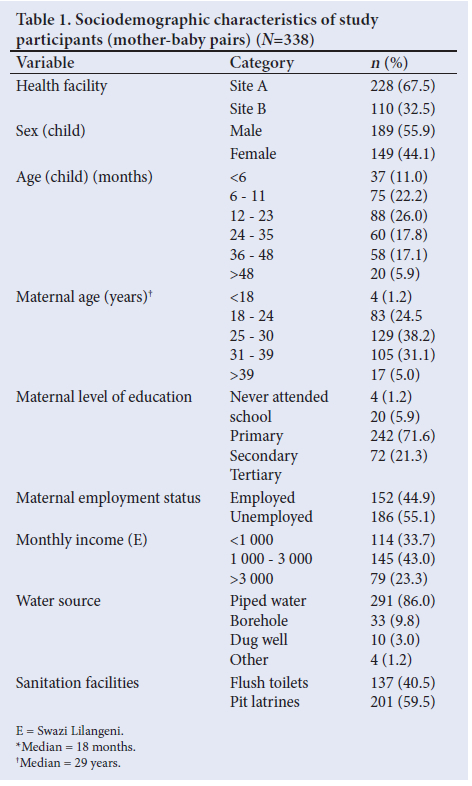
A total of 338 mother-child pair respondents were enrolled. Their sociodemographic characteristics are presented in Table 1. The child population comprised 189 (55.9%) males and 148 (44.1%) females. The median (IQR) age of the mothers was 29 (25 - 34) years, while the median (IQR) age for the child participants was 18 (10 - 34) months. A total of 242 (71.6%) mothers had secondary school level and 72 (21.3%) tertiary level education. A third of the participants had a household income of less than USD55 (ZAR1 000) per month. Most participants (n=291; 86.1%) used piped tap water as the primary source of drinking water, while 33 (9.8%) used borehole water and 10 (3%) dug wells. Pit latrines were used by 201 (59.5%) of the participants.
Prevalence of stunting
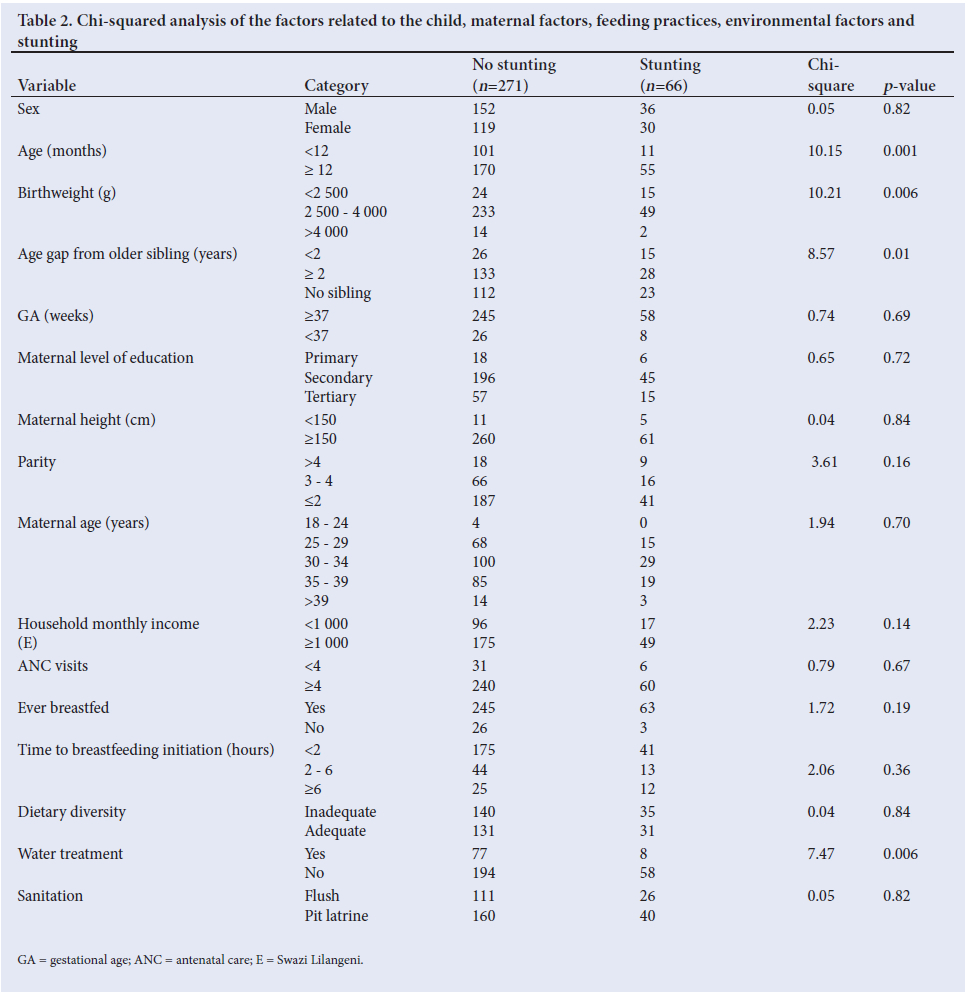
Of 338 children, 66 were stunted, resulting in a prevalence of 19.6%. There was no significant difference in stunting prevalence between the sexes, with a stunting prevalence of 19.1% in males and 20.1% in females (p=0.82). The prevalence was higher in children over 12 months old, at 24.4%, compared with 9.8% in infants under 12 months. In the group with birthweights less than 2 500 g, 15 neonates (37.5%) were stunted compared with 49 (17.3%) in those with birthweights between 2 500 g and 4 000 g.
Factors associated with stunting
As shown in Table 2, increasing age was associated with increased risk of stunting (>12 months v. <12 months) (p=0.001). Children with a birthweight less than 2 500 g were at a much higher risk of stunting compared with those with a birthweight of less than 2 500 g (p=0.006). There was no significant difference in stunting rates between those who were born at term and those delivered prematurely at less than 37 weeks (p=0.69). An age gap of more than 2 years with an older sibling or having no siblings at all was also protective against stunting (p=0.05). Maternal age, education level and parity did not appear to be associated with stunting. Drinking treated water was the only Water, Sanitation and Hygiene (WASH) factor that was significantly protective against stunting (p=0.006).
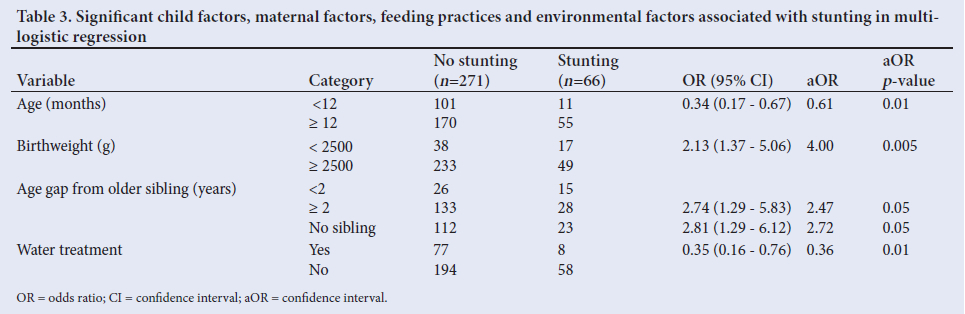
In the adjusted analyses, a birthweight of less than 2 500 g (aOR 4.00 (p=0.005)) was significantly associated with stunting. An age gap of less than 2 years from an older sibling compared with an age gap of more than 2 years from an older sibling (OR 2.47 (p=0.05)) increased the risk of stunting. Additionally, those with no siblings at all (aOR 2.72 (p=0.05)) were significantly protected from stunting. On the other hand, being younger than 12 months of age had a significant protective effect on stunting (aOR 0.61 (p=0.01). Drinking treated water (aOR 0.36 (p=0.01)) also resulted in significantly lower odds of stunting.
Discussion
The present cross-sectional study observed a stunting prevalence of 19.6% in the Manzini region. This was much lower than the 27.6% reported in the 2019 Eswatini Vulnerability assessment report,[15] as well as the 28% reported in the region in 2022.[16] It might therefore not be a true representation of the whole under-five population of Manzini and the prevalence may well be higher than the reported value. This research was mainly conducted in a peri-urban setting, and the exclusion of the rural population may have led to a sampling bias leading to the lower observed rates. Interestingly, Dlamini et al.[17] in 2022 reported a national stunting prevalence of 18.1% and a Manzini regional rate of 17.6%. However, this was a sub-analysis of the 2014 Demographic Health Survey, which is likely to be outdated. The results from the study remain relevant, however, as it is one of very few studies investigating malnutrition that have collected primary data outside of the periodic national surveys. Additionally, the stunting levels noted are still unacceptably high, and factors identified remain applicable in at least the peri-urban population in Manzini. Comparatively, neighbouring South Africa and Lesotho recorded stunting rates of 21.4% and 34.2%, respectively,[8] demonstrating the high burden of stunting in the region.
Factors significantly associated with stunting identified in the study included the child's age, birthweight, age gap with elder siblings, and water treatment.
A higher likelihood of stunting was observed in children older than 12 months of age. The transition from highly nutritive breastfeeding to less nutritious complementary foods, combined with increased exposure to environmental pollutants and repeated infections such as diarrhoea, contributes to stunting as children grow older.[17,18] These findings are supported by findings in sub-Saharan Africa by Aboagye et al.[19] in 2022. Notably, the risk of stunting quadrupled in children with a birthweight of less than 2 500 g (p=0.005). Similar findings have been reported in other studies,[14] emphasising the need for early nutritional support prenatally as prenatal growth restriction has been shown to be associated with poor postnatal growth,[14] hence vulnerability to stunting.
Spacing children less than 2 years apart was found to increase the odds of stunting. Short birth intervals can negatively impact optimal parenting practices, adversely impacting closely spaced siblings' health and nutritional status.[20] WHO guidelines strongly recommend a minimum of 2 years' spacing to prevent adverse maternal and infant outcomes.[21] The statistically significant observation that short spacing between children increases the odds of stunting corroborates research conducted in Ethiopia.[22] Interestingly, compared with mothers with three to four children, mothers with (at most) two children had a 28% protection against stunting, which increased to 66% when compared with mothers with more than four children. Although the association is not statistically significant, the biological gradient phenomenon demonstrated in this study strongly supports this association.
According to previous studies, stunting prevalence tends to be higher in male children.[10,18] However, this study failed to demonstrate any association between gender and stunting. The timing of the study, which was done during the COVID pandemic, may have masked previously reported differences, as vulnerabilities were similar between the sexes at this time. Eswatini is also a strongly patriarchal society,[23] with male children being more valued and potentially receiving better nutritional care. This would potentially counterbalance their biological vulnerability compared with girls leading to similar stunting rates.
Previous studies reported that short maternal stature is linked with up to 4.4 times higher odds of stunting.[24] Contrary to these reports, we did not find any association between any of the maternal anthropometric measurements and stunting in the present study. This impact may have been limited by the small number of mothers with short stature in the study sample («=15; 4.5%). Regarding feeding factors, children who initiated breastfeeding within 2 hours post delivery presented a 49% decreased likelihood of stunting compared with those who initiated breastfeeding after 6 hours. Despite lacking statistical significance, it underscores the importance of maternity healthcare workers supporting mothers in initiating breastfeeding within the golden hour post birth.
While over 95% of the respondents stated that they obtained water from taps and boreholes, most mothers did not treat the water before giving it to their children (Table 1). This research demonstrated a significant protective effect of drinking treated water on stunting (p=0.01). The methods used for treating included boiling and chlorinating. This was similar to what was reported in a Ugandan study,[25] where consumption of contaminated household drinking water was a significant contributing factor to the high burden of stunting and environmental enteric dysfunction (EED), which is a subclinical disorder of the small intestine which occurs in young children exposed to poor hygienic conditions that result in chronic gut inflammation, with pathological changes that lead to reduced absorption of essential nutrients and hence growth retardation.[26] Contaminated drinking water can contribute to the development of EED and our study findings provide further evidence for this phenomenon.
Study limitations
The present study evaluated stunting through an analysis of anthropometric measurements and historical data gathering. The potential for misclassification bias from the employed measurement techniques and recall bias from the study participants were foreseeable disadvantages. However, these were addressed through pilot testing and maintaining participant anonymity to enhance data reliability and minimise bias. Our study was also cross-sectional. Hence, we could not assign a causal direction to the association observed. Another limitation was related to the fact that the study was conducted at two high-volume site clinics in the peri-urban Manzini region. It is possible that children who reside in these areas and have access to healthcare facilities are nutritionally healthier and, hence, a larger, community-based sample including participants from rural Manzini, would have potentially detected more nutritionally challenged children and provided a more representative sample. Despite these limitations, valuable insights have been gained into the factors associated with stunting in the region.
Conclusion and recommendations
In conclusion, this study identified the child's age, birthweight, sibling spacing and water treatment practices as significant determinants influencing stunting in Manzini, Eswatini. Therefore, clinicians and policymakers must intensify their focus on monitoring and support, particularly for children with low birthweight, as well as promoting significant birth spacing through consistent provision of family planning commodities for all women. Interventions should also focus on preventing EED by reducing children's faeco-oral exposure to enteropathogens. This can be done through ensuring that Manzini residents not only have access to a safely managed water supply but also through health promotion measures such that the household water given to children is further treated to improve its safety. Further research is recommended with a broader community-based sample, particularly including children in rural settings in Manzini. Additional longitudinal studies exploring the impact of maternal and feeding factors on stunting would also yield significant insights. Policymakers and health educators should utilise these findings to create robust public health interventions that can prevent any losses to the progress that has been made so far in tackling stunting in the remaining high-risk groups.
Declaration. This study was done in partial fulfilment of the requirements for SK's MPH degree at the University of South Africa.
Acknowledgements. We thank the mothers and children who generously volunteered their time for this study. We wish to acknowledge the contribution of MM, whose MMED thesis provided much of the content of the manuscript.
Author contributions. SK drafted the manuscript, with input from RL. Both authors contributed to its development and reviewed and approvedthe final version.
Funding. None.
Conflicts of interest. None.
References
-
1. Kasajja M, Nabiwemba E, Wamani H. et al. Prevalence and factors associated with stunting among children aged 6-59 months in Kabale district, Uganda. BMC Nutr 2022;8:79. https://doi.org/10.1186/s40795-022-00578-9
» https://doi.org/10.1186/s40795-022-00578-9 -
2. Soliman A, De Sanctis V, Alaaraj N, et al. Early and long-term consequences of nutritional stunting: From childhood to adulthood. Acta Bio Medica: Atenei Parmensis 2021;92(1):1-7 https://doi.org/10.23750/abm.v92i1.11346
» https://doi.org/10.23750/abm.v92i1.11346 -
3. Montenegro CR, Gomez G, Hincapie O, et al. The pediatric global burden of stunting: Focus on Latin America. Lifestyle Med 2022;3(3):e67. https://doi.org/10.1002/lim2.67
» https://doi.org/10.1002/lim2.67 -
4. United Nations Children's Fund / Workd Health Organization / World Bank Multi Agency. Levels and Trends in Childhood malnutrition, 2018. Group Joint Child Malnutrition Estimates Key findings of the 2018 edition. New York: UNICEF, 2020. https://data.unicef.org/resources/levels-and-trends-in-child-malnutrition-2018/ (accessed 3 August 2021).
» https://data.unicef.org/resources/levels-and-trends-in-child-malnutrition-2018/ -
5. Ekholuenetale M, Barrow A, Ekholuenetale CE, et al. Impact of stunting on early childhood cognitive development in Benin: Evidence from demographic and health survey. Egypt Pediatr Assoc Gazette 2020;68:1-11. https://doi.org/10.1186/s43054-020-00043-x
» https://doi.org/10.1186/s43054-020-00043-x - 6. Woldehanna T, Behrman JR, Araya MW. The effect of early childhood stunting on children's cognitive achievements: Evidence from young lives Ethiopia. Ethiopian J Health Dev 2017;31(2):75-84.
-
7. Leroy JL, Frongillo EA. Perspective: What does stunting really mean? A critical review of the evidence. Advances Nutr 2019;10(2):196-204. https://doi.org/10.1093/advances/nmy101
» https://doi.org/10.1093/advances/nmy101 -
8. Mannar V, Micha R, Allemandi L, et al. 2020 Global nutrition report: Action on equity to end malnutrition. https://globalnutritionreport.org/reports/2020-global-nutrition-report/ (accessed 13 July 2022).
» https://globalnutritionreport.org/reports/2020-global-nutrition-report/ -
9. Central Statistical Office, Swaziland. Multiple Indicator Cluster Survey 2014: Key Findings. Mbabane: CSO, 2014. https://mics.unicef.org/sites/mics/files/Swaziland%202014%20MICS%20Final%20Report_English.pdf (accessed 14 August 2021).
» https://mics.unicef.org/sites/mics/files/Swaziland%202014%20MICS%20Final%20Report_English.pdf -
10. Simelane MS, Chemhaka GB, Zwane E. A multilevel analysis of individual, household and community level factors on stunting among children aged 6 - 59 months in Eswatini: A secondary analysis of the Eswatini 2010 and 2014 Multiple Indicator Cluster Surveys. PLoS ONE 2020;15(10):e0241548. https://doi.org/10.1371/journal.pone.0241548
» https://doi.org/10.1371/journal.pone.0241548 -
11. Eswatini Ministry of Economic Planning and Development. Kingdom of Eswatini Voluntary National Review Report for Sustainable Development Goals. Mbabane: Government of the Kingdom of Eswatini, 2019. https://sustainabledevelopment.un.org/content/documents/24651Eswatini_VNR_Final_Report.pdf (accessed on 29 October 2020).
» https://sustainabledevelopment.un.org/content/documents/24651Eswatini_VNR_Final_Report.pdf -
12. United Nations Children's Fund/World Health Organization/World Bank. Global Nutrition Report. Levels and trends in child malnutrition: Key findings of the joint child malnutrition estimates edition. Geneva: WHO, 2021. https://www.who.int/publications/i/item/9789240025257
» https://www.who.int/publications/i/item/9789240025257 -
13. Vaivada T, Akseer N, Akseer S, et al. Stunting in childhood: An overview of global burden, trends, determinants, and drivers of decline. Am J Clin Nutr 2020;112:777S-791S. https://doi.org/10.1093/ajcn/nqaa159
» https://doi.org/10.1093/ajcn/nqaa159 -
14. Danaei G, Andrews KG, Sudfeld CR, et al. Risk factors for childhood stunting in 137 developing countries: A comparative risk assessment analysis at global, regional, and country levels. PLoS Med 2016;13(11):e1002164. https://doi.org/10.1371/journal.pmed.1002164
» https://doi.org/10.1371/journal.pmed.1002164 -
15. United Nations Children's Fund. Child Nutrition in Eswatini. New York: UNICEF, 2020. https://www.unicef.org/eswatini/nutrition (accessed 15 July 2022).
» https://www.unicef.org/eswatini/nutrition -
16. Eswatini Government, Southern African Development Community, World Vision, World Food Program, Food and Agricultural Organization. 2022 Vulnerability Assessment Report Eswatini. Mbabane: Government of the Kingdom of Eswatini. 2023. https://www.gov.sz/images/dpm/Eswatini-VAC-Report-2022-.pdf (accessed 18 August 2022).
» https://www.gov.sz/images/dpm/Eswatini-VAC-Report-2022-.pdf -
17. Dlamini GH, Tlou B. Prevalence and associated risk factors of chronic malnutrition amongst children under five in Eswatini. Afr J Primary Health Care Fam Med 2022;14(1):1-6: https://doi.org/10.4102/phcfm.v14i1.3301
» https://doi.org/10.4102/phcfm.v14i1.3301 -
18. Tafesse T, Yoseph A, Mayiso K, Gari T. Factors associated with stunting among children aged 6 - 59 months in Bensa District, Sidama Region, South Ethiopia: Unmatched case-control study. BMC Pediatr 2021;21:551. https://doi.org/10.1186/s12887-021-03029-9
» https://doi.org/10.1186/s12887-021-03029-9 -
19. Aboagye RG, Ahinkorah BO, Seidu AA, et al. Birth weight and nutritional status of children under five in sub-Saharan Africa. PLoS ONE 2022;17(6):e0269279. https://doi.org/10.1371/journal.pone.0269279
» https://doi.org/10.1371/journal.pone.0269279 -
20. Prendergast AJ, Humphrey JH. The stunting syndrome in developing countries. Paediatr Int Child Health 2014;34(4):250-265. https://doi.org/10.1179/2046905514Y.0000000158
» https://doi.org/10.1179/2046905514Y.0000000158 -
21. World Health Organization. Report of a WHO Technical Consultation on Birth Spacing: Geneva, Switzerland, 13 - 15 June 2005. Geneva: WHO, 2007. URL: https://www.who.int/publications/i/item/WHO-RHR-07.1 (accessed 18 August 2028).
» https://www.who.int/publications/i/item/WHO-RHR-07.1 -
22. Endris N, Asefa H, Dube L. Prevalence of malnutrition and associated factors among children in rural Ethiopia. BioMed Res Int 2017;2017:6587853. https://doi.org/10.1155/2017/6587853
» https://doi.org/10.1155/2017/6587853 -
23. Nyawo S. Deprivation of land tenure to daughters of mother earth: The case of Eswatini. AJGR 2023;29(1):127-147. https://doi.org/10.36615/ajgr.v29i1.1499
» https://doi.org/10.36615/ajgr.v29i1.1499 -
24. Karlsson O, Kim R, Bogin B, SV S. Maternal height-standardized prevalence of stunting in 67 low-and middle-income countries. J Epidemiol 2022;32(7):337-344. https://doi.org/10.2188/jea.JE20200537
» https://doi.org/10.2188/jea.JE20200537 -
25. Lauer JM, Duggan CP, Ausman LM, et al. Unsafe drinking water is associated with environmental enteric dysfunction and poor growth outcomes in young children in rural Southwestern Uganda. Am J Trop Med Hygiene 2018;99(6):1606-1612. https://doi.org/10.4269/ajtmh.18-0143
» https://doi.org/10.4269/ajtmh.18-0143 -
26. Tickell KD, Atlas HE, Walson JL. Environmental enteric dysfunction: A review of potential mechanisms, consequences and management strategies. BMC Med 2019;17:181. https://doi.org/10.1186/s12916-019-1417-3
» https://doi.org/10.1186/s12916-019-1417-3

Accepted 7 May 2025