Audiological findings in a group of neurologically compromised children: A retrospective study
Abstract
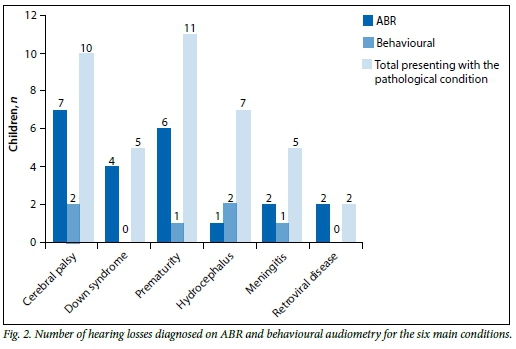
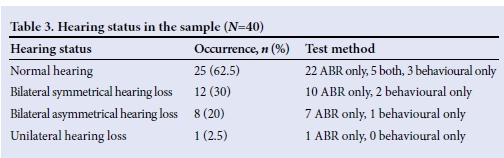
BACKGROUND: Hearing loss is more prevalent in developing countries. Later diagnosis ofhearing loss will result in delayed access to rehabilitation. It is typically more difficult to obtain subjective information required in a hearing test from neurocompromised children, causing audiologists to frequently turn to objective measures such as the auditory brainstem response (ABR) measure to obtain this information. OBJECTIVE: To describe the ABR results in a group of neurologically compromised children and to establish a relationship between ABR findings and behavioural audiometry results, where these existed. METHODS: A retrospective review was conducted on 40 ABR patient records of neurologically compromised participants aged 5 months to 10 years. Behavioural audiometry results were sought where these existed. Hearing status was described per ear for objective and behavioural results, and descriptive statistics were conducted. RESULTS: Behavioural audiometry results were obtained in 72.5% of ears. Results correlated between ABR and behavioural audiometry for only 7.5% of ears, which were all diagnosed with normal hearing. About12.5% of ears were misdiagnosed with behavioural audiometry. Premature infants were most likely to cope with behavioural audiometry. Hearing loss was highest in participants with cerebral palsy, Down syndrome, prematurity and retroviral disease. CONCLUSIONS: Behavioural audiometry appears to be a largely unreliable method of testing the hearing of children diagnosed with neurological disorders, as results were obtained in only 27.5% of the study sample; however, it remains the gold standard in paediatric hearing testing to evaluate the entire auditory system and provides information on how a child processes sound. Hearing thresholds should be established via objective testing. Conditioning should continue for a behavioural audiological test battery, with adaptations for the child's developmental ability.
 Thumbnail
 Thumbnail