Risk factors for developing intraventricular haemorrhage in very low-birthweight infants at Kalafong Provincial Tertiary Hospital, South Africa, 2019 - 2020
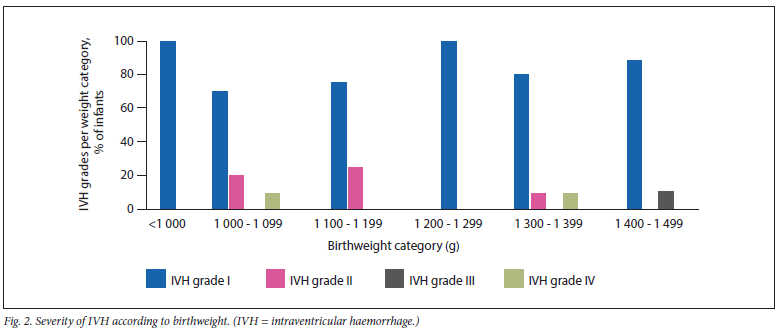
BACKGROUND: Intraventricular haemorrhage (IVH) remains a major concern as a result of the high prevalence of preterm births globally OBJECTIVES: To identify maternal and neonatal risk factors associated with IVH, and to assess its incidence and most frequently occurring grade in a population of very low-birthweight infants (VLBWIs) at Kalafong Provincial Tertiary Hospital, South Africa (SA METHODS: This retrospective cohort study included all infants of birthweight <1 500 g admitted between 1 January 2019 and 31 December 2020. Associations between IVH and maternal and neonatal risk factors were analysed using Pearson's x2 test and Fishers exact test. Risk factors significantly associated with IVH were included in a binary logistic regression model to identify independent predictors. Risk factors significantly associated with IVH (p<0.05) corresponded to a 95% confidence level RESULTS: IVH was diagnosed during the first week of life in 43 out of 127 VLBWIs who met the inclusion criteria. Hypoglycaemia remained the most significant independent risk factor after adjusting for potential confounders in the multivariable logistic regression: adjusted odds ratio 4.02 (95% confidence interval (CI) 1.52 - 10.64). The incidence of IVH was 33.9% (95% CI 25.7 - 42.1). Grade I IVH occurred in 83.7% of infants, grade II in 9.3% and grades III - IV in 7.0% CONCLUSION: This study found an association between hypoglycaemia and IVH, but causality could not be established owing to the nature of the study. In this tertiary hospital in SA, a third of VLBWIs had IVH, mostly graded as mild
intraventricular haemorrhage; risk factors
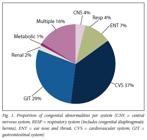 Thumbnail
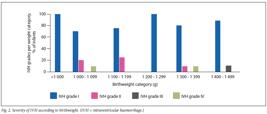 Thumbnail