A survey of the optimal oxygen saturation targets in premature infants in the neonatal intensive care units of three tertiary care hospitals in Tshwane, South Africa
BACKGROUND: An optimal oxygen saturation target for premature infants receiving supplemental oxygen, that aims to decrease morbidity and mortality, has been the aim of many studies worldwide. Recently, a saturation target of 91 - 95% was recommended by the NeOProM collaboration OBJECTIVE: To identify current practice and healthcare-worker knowledge regarding target oxygen saturation in preterm infants METHOD: This cross-sectional descriptive study was conducted at three tertiary hospital neonatal units in Tshwane, South Africa. A web-based survey was administered to staff caring for premature infants. To confirm the reliability of the survey, a snapshot was conducted to assess actual practice in the neonatal units RESULTS: A total of 190 responses from the three neonatal units were analysed for the web-based survey. Overall, 56.3% of respondents indicated that a written standard operating procedure (SOP) for targeting oxygen saturation was in place. However, data analysis revealed that 43 different saturation target ranges were reported, with 90 - 95% being the most common. Approximately three-quarters of respondents indicated that supplemental oxygen may have harmful effects. Knowledge-based questions assessing the benefits and risks of targeting lower saturations (85 - 89%) were answered poorly. Snapshot data analysis revealed that 70.2% of infants were receiving oxygen, of which 81.2% received blended oxygen. The majority (61.2%) of these premature infants had saturations above 95%, with only 27.1% of infants' snapshot saturations falling within the recommended range (91 - 95% CONCLUSION: The large number of saturation target range responses that deviated from the SOP stipulated target, indicates that staff are not following an SOP for targeting oxygen saturation in premature infants. To ensure standardised care, we recommend that all three units ensure the availability of a written SOP and perform ongoing staff training
supplemental oxygen; target saturation; prematurity; survey; neonatal care
A survey of the optimal oxygen saturation targets in premature infants in the neonatal intensive care units of three tertiary care hospitals in Tshwane, South Africa
J G ThomasI; M CoetzeeII
IMMed (Paeds); Department of Paediatrics and Child Health, Steve Biko Academic Hospital and the Faculty of Health Sciences, University of Pretoria, Tshwane, South Africa
IIMMed (Paeds), Cert Neonatol (SA); Department of Paediatrics and Child Health, Steve Biko Academic Hospital and the Faculty of Health Sciences, University of Pretoria, Tshwane, South Africa
BACKGROUND: An optimal oxygen saturation target for premature infants receiving supplemental oxygen, that aims to decrease morbidity and mortality, has been the aim of many studies worldwide. Recently, a saturation target of 91 - 95% was recommended by the NeOProM collaboration
OBJECTIVE: To identify current practice and healthcare-worker knowledge regarding target oxygen saturation in preterm infants
METHOD: This cross-sectional descriptive study was conducted at three tertiary hospital neonatal units in Tshwane, South Africa. A web-based survey was administered to staff caring for premature infants. To confirm the reliability of the survey, a snapshot was conducted to assess actual practice in the neonatal units
RESULTS: A total of 190 responses from the three neonatal units were analysed for the web-based survey. Overall, 56.3% of respondents indicated that a written standard operating procedure (SOP) for targeting oxygen saturation was in place. However, data analysis revealed that 43 different saturation target ranges were reported, with 90 - 95% being the most common. Approximately three-quarters of respondents indicated that supplemental oxygen may have harmful effects. Knowledge-based questions assessing the benefits and risks of targeting lower saturations (85 - 89%) were answered poorly. Snapshot data analysis revealed that 70.2% of infants were receiving oxygen, of which 81.2% received blended oxygen. The majority (61.2%) of these premature infants had saturations above 95%, with only 27.1% of infants' snapshot saturations falling within the recommended range (91 - 95%
CONCLUSION: The large number of saturation target range responses that deviated from the SOP stipulated target, indicates that staff are not following an SOP for targeting oxygen saturation in premature infants. To ensure standardised care, we recommend that all three units ensure the availability of a written SOP and perform ongoing staff training
Keywords: supplemental oxygen; target saturation; prematurity; survey; neonatal care.
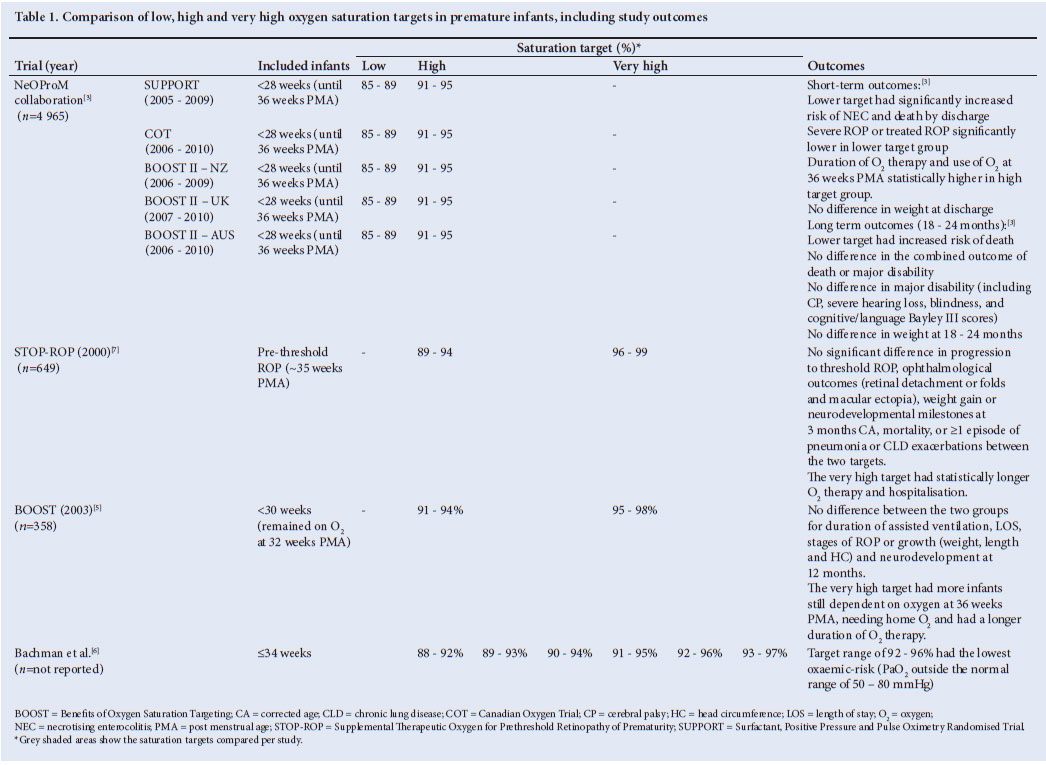
Oxygenation of premature infants has a long-standing history of controversy in neonatal care. Guiding this therapy has been difficult in the past, but with the development of pulse oximetry and advanced forms of regulated oxygen delivery, it has become easier. Complications secondary to hyperoxia include retinopathy of prematurity (ROP) and chronic lung disease (CLD). Similarly, restricting supplemental oxygen therapy also has several adverse short- and long-term consequences, which may include cerebral palsy (CP), necrotising enterocolitis (NEC) and even death.[1] Therefore, an optimal oxygen saturation target needs to be identified and has been the aim of multiple large studies (Table 1).
The 2013 South African (SA) saturation target guideline for the prevention of ROP recommended saturation targets of 88 - 92% in all premature infants <36 weeks' gestation.[2] However, to our knowledge, no survey on target oxygen saturation for premature infants has been done in SA neonatal units, and it is unclear which oxygen saturation is being targeted currently.
The Neonatal Oxygen Prospective Meta-Analysis (NeOProM) collaboration is the largest recent publication describing optimal oxygen saturation targets in premature infants. The NeOProM Collaboration included five randomised controlled trials performed from 2005 to 2010 in five different countries.[3] The trials compared the outcomes of infants targeted to lower (85 - 89%) v. higher (91 - 95%) saturation targets.[3] Additionally, long-term follow-up was performed at 18 - 24 months of age to assess outcomes. A Cochrane meta-analysis of data from the NeOProM collaboration was recently published (2017).[4] The higher saturation target (91 - 95%) was concluded to be safer in this meta-analysis, owing to a significant decrease in important outcomes, including NEC and death.[3] However, this meta-analysis only included trials comparing low saturation targets (85 - 89%) with high saturation targets (91 - 95%), and the question of whether even higher targets of >95% may have an added benefit was not answered. The target oxygen saturations for the two trials (STOP-ROP and BOOST) comparing high targets with very high targets can also be seen in Table 1. Bachman et al.[5] published a paper in 2023 which was performed in a tertiary care hospital in the USA. Six target oxygen saturation ranges were tested for oxaemic-risk (partial pressure of oxygen; PaO2 outside the normal range of 50 - 80 mmHg) at various gestational ages (<34 weeks reported in Table 1) which is unique to this study compared to other studies reported in Table 1. The study found that the saturation target range of 92 - 96% had the lowest oxaemic risk for neonates born <34 weeks.[5] This study did, however, not report on clinical outcomes related to the various saturation target ranges.[5]
Despite the most recent published meta-analysis of five randomised controlled trials favouring a higher saturation target of 91 - 95%,[3] and the study by Bachman et al.[5] reporting the lowest oxaemic risk with a target range of 92 - 96%,[5] the question of which oxygen saturation to target in premature infants receiving supplemental oxygen remains topical, especially in low- and middle-income countries (LMICs) where, for example, infrastructure for ROP screening may not be available in all hospitals. From published data, optimal saturation target recommendations for premature infants are mostly from high-income countries (HIC), including the NeOProM collaboration (91 - 95%),[3] the American Academy of Paediatrics (AAP) (90 - 95%)[8] and the European guidelines (90 - 94%).[9] The SA guideline (2013) of a target oxygen saturation of 88 - 92% for premature infants[2] remains the only locally approved guideline, but should be revised considering the additional evidence available since its first publication.
Ethics
Ethics approval was obtained from the Research Ethics Committee of the Health Sciences Faculty, University of Pretoria, to proceed with the web-based survey and to perform the snapshot assessments (ref. no. 61/2019). Approval was also obtained from the National Health Research Database (NHRD ref. no. GP_201903_026), as well the heads of the respective neonatal units.
Methods
The three tertiary hospitals selected for this study are all part of the public sector and are central to a drainage area within the Gauteng Province (Hospital A, B and C). The present study aimed to identify current practice and knowledge about targeting oxygen saturations in premature infants. We employed a web-based survey (offered to all the medical staff working in the respective neonatal units) to understand the knowledge and intended practice of medical staff caring for premature infants (<37 weeks' gestational age). The results of the Cochrane meta-analysis of data from the NeOProM collaboration[4] were used to identify the correct answers in the survey. To confirm the reliability of the results of the web-based survey, a cross-sectional analysis, referred to as a 'snapshot', was performed in the respective neonatal units to determine whether the information provided by doctors and nurses in the web-based survey correlated with routine practice in the unit. Data collected in the snapshot included birthweight, gestational age, oxygen blender use, method of supplemental oxygen administration, fraction of inspired oxygen (FiO2), current oxygen saturation, oxygen saturation within the past 24 hours, upper and lower alarm limits, as well as primary diagnosis. Infants receiving saturation monitoring at the time of the snapshot were included. Infants diagnosed with cyanotic congenital heart defects were excluded. However, owing to limitations in the number of saturation monitors available in some of the neonatal units, the snapshot was repeated a few times to obtain a sufficient and similar number of patients from each hospital, however, no patient was included twice. The web-based survey and the 'snapshot' were conducted between April and June 2019.
Results
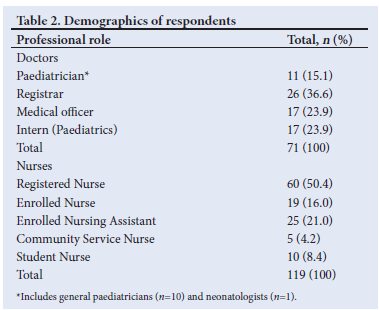
A total of 190 responses were analysed for the web-based survey, of which 71 (37.4%) doctors and 119 (62.6%) nurses participated. Overall, 68.1% of clinical staff working in the respective neonatal units participated (76.3% (n=71/93) doctors and 64.0% (n=119/186) nurses). At the time of the survey, there was a total of five neonatologists between the three hospitals. One neonatologist was excluded from participating in the survey owing to direct involvement in the research. Of the remaining four neonatologists, only one participated in the survey. Although there was overall higher participation from nursing staff (compared with doctors), this was not significant (p=0.098). The demographics of the survey respondents are shown in Table 2.
Saturation target-related questions included the existence of a written standard operating procedure (SOP) for oxygen saturation targets in premature infants, saturation monitoring practices, saturation targets in use, the use of blended oxygen and the presence of screening programmes for complications of prematurity, e.g. ROP. Knowledge-based questions were related to the harmful and beneficial effects of supplemental oxygen therapy and the short-and long-term effects of low (85 - 89%) v. high (91 - 95%) oxygen saturation targets.
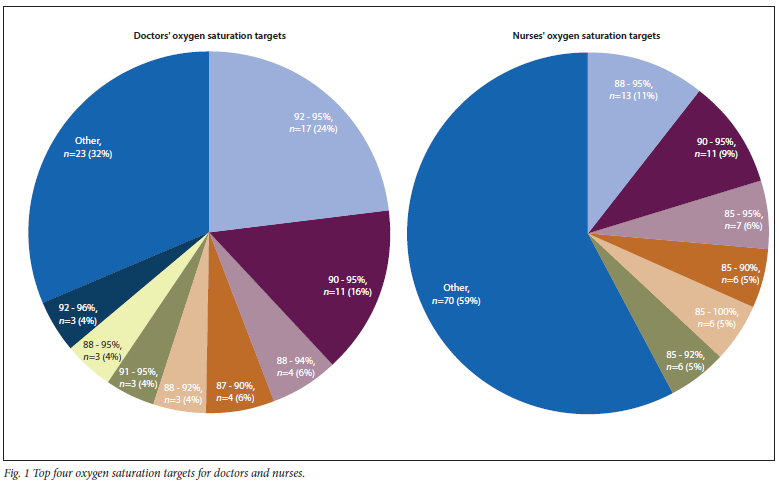
Most respondents (56.3%; n=107) indicated their unit had a written SOP for target saturations in premature infants and 81 respondents (42.6%) indicated that a written SOP for the setting of alarm limits in premature infants receiving supplemental oxygen was in use in their unit. At least 17.4% (n=33) of respondents reported that the SOP for target oxygen saturation for premature infants (in their units) had changed within the last 5 years. Where an SOP for target saturations for premature infants receiving supplemental oxygen was reported to be in place, information regarding the lower and upper targets (range) was requested. If no written SOP for targeting oxygen saturations for premature infants receiving supplemental oxygen was reported or if the respondents were unsure of the existence of a written SOP, they were asked to indicate the lower and upper oxygen saturation targets they used for premature infants receiving supplemental oxygen. The results showed 43 different combinations of target ranges being reported according to an SOP (107 respondents), and 36 combinations without an SOP (83 respondents). Where an SOP existed, the four most common target oxygen ranges were 90 - 95% (n=15; 14.0%), 88 - 95% (n=10; 9.4%), 85 - 90% (n=8; 7.5%) and 92 - 95% (n=7; 6.5%). Without an SOP or if respondents were unsure of a SOP, the three most common target oxygen saturation ranges were 92 - 95% (14.1%; n=12), 90 - 95% (8.2%; n=7) and 88 - 95% (7.1%; n=6). The targets of 85 - 95% (4.8%; n=4), 85 - 100% (4.8%; n=4) and 87 - 90% (4.8%; n=4) had equal responses. The top four oxygen saturation targets for doctors and nurses is shown in Fig. 1. Overall, the two most common oxygen saturation target ranges reported by doctors were 92 - 95% (23.4%; n=17) and 90 - 95% (15.5%;n=11) and by nurses were 88 - 95% (n=13; 10.9%) and 90 - 95% (n=11; 9.2%). Additional responses close to or within the international saturation target range included 90 - 94% (2.1%; n=4), 92 - 94% (1.1%; n=2), 91 - 92% (0.5%; n=1) and 93 - 95% (0.5%; n=1). The lowest lower oxygen saturation target reported by a respondent in the survey was <80% and the highest upper oxygen saturation target was 100%.
Three-quarters (75.8%; n=144) of respondents indicated that oxygen blenders were used to control the fraction of inspired oxygen (FiO2) when supplemental oxygen was administered to premature infants. Thirteen (6.8%) respondents from all three institutions were unaware of what a blender was (hospital A, n=4; B, n=3; C, n=6). Continuous saturation monitoring of premature infants was reported in 42.1% (n=80) of respondents overall. However, most respondents (47.4%; n=90) indicated that the method used for monitoring (continuous v. intermittent) is patient dependent, including considering factors related to gestational age, diagnosis and acuity of illness. Seventeen (8.9%) respondents distributed between the three neonatal units reported that only intermittent monitoring is used in the neonatal unit where they work (hospital A, n=4; B, n=6; C, n=7). The survey also enquired about ROP screening by an ophthalmologist. Overall, 84.2% (n=160) of the respondents reported that an ophthalmologist was available at their hospital, however, significantly fewer respondents reported this for hospital C (72.4% (n=42); p=0.007) and overall, this was reported by a significantly lower proportion of nurses compared with doctors (77.3% (n=92) and 95.8% (n=68); p=0.004). Similarly, a greater proportion of doctors reported that an ROP screening programme was in place at the particular hospital (91.5% (n=65) v. 68.9% (n=82); p=0.002). The reporting of an ROP screening programme was significantly different between the three hospitals (hospital A, 85.3% (n=58); B, 81.3% (n=52); C, 64.0%(n=37); p=0.002).
The remaining questions in the survey were directed towards current knowledge regarding the benefits and harmful effects of supplemental oxygen administration in premature infants. Of 119 nursing respondents, 78.2% (n=93) indicated that supplemental oxygen does have harmful effects. Overall, 58.3%, 32.3% and 37.5% of respondents answered correctly that ROP, days on oxygen and CLD, respectively, were significantly decreased when targeting lower oxygen saturations of 85 - 89%. Furthermore, 22.9%, 14.1% and 0% of the overall respondents answered correctly that targeting lower oxygen saturations significantly increases NEC, death before discharge, and death at 2 years of age, respectively.
A total of 121 snapshots (infants) were captured in the three tertiary hospitals. In total, the snapshot was performed on 21 occasions at the three different hospitals. The number of snapshots per hospital was not significantly different (hospital A, n=44; B, n=38; C, n=39; p=0.682). Gestational ages and birthweights were categorised and there was no significant difference in the number of premature infants per GA group or birthweight when comparing the three hospitals (p=0.365 and p=0.682, respectively). Overall, the majority of infants were between 28 and 36 weeks' GA (n=80; 66.1%) and had a birth weight in the 1 000 - 1 499g category (36.4%; n=44). The mean (standard deviation (SD)) age of the infants at the time of the snapshot was 8.8 days (range 0-110 days; 12.6). Prematurity was a prerequisite for inclusion and was therefore a common diagnosis to all included infants (n=121; 100%). Overall, respiratory distress syndrome was the predominant concomitant diagnosis (86.8%; n=105). There was no statistical difference between the primary diagnoses when comparing the three hospitals (p=0.097).
A total of 85 premature infants were receiving supplemental oxygen. Eleven (9.1%) were receiving invasive positive-pressure ventilation, 34 (28.1%) were receiving nasal continuous positive-airway pressure and 40 (33.1%) were receiving nasal-prong oxygen (NPO2). Of the infants receiving supplemental oxygen, 69 (81.2%) received blended oxygen and 17 (20.0%) received unblended oxygen. For those receiving blended oxygen, the mean (range; SD) FiO2 was 0.41 (0.23 - 1.0; 0.21). For the infants receiving unblended oxygen, the only method of controlling supplemental oxygen administration was to adjust the flow rate (L/min) and was either 1 or 2 L/min (mean (SD) 1.24 (0.44) L/min).
The premature infants' saturations were also recorded and grouped as <91%, 91 - 95%, and >95% for those infants receiving supplemental oxygen (n=85). Overall, the majority of these premature infants had saturations above 95% (n=52; 61.2%), with only 27.1% (n=23) being within the recommended range of 91 - 95%. This finding was consistent across all three hospitals. Overall, the mean (SD) saturation was 96% (3) (range 85 - 100%).
Data on alarm limits were collected for all infants - those receiving oxygen and not receiving oxygen - by documenting the limits set on the monitor attached to the patient. Lower alarm limits were set between 80% and 90% and upper alarm limits were set between 95% and 100%. Overall, the mean (SD) lower and upper alarm limit was 87% (3) and 98% (3), respectively. For infants on supplemental oxygen, the mean (SD) upper alarm limit was also set at 98% (3). The snapshot saturation was then compared with the set limits to assess how many infants had a saturation within the set alarm limit. Overall, most infants (71.1%; n=86) had a saturation within the set alarm limits.
Discussion
The survey results reflect intended practice of individual respondents in the three neonatal units but not necessarily the intended practice set by the management of the unit. The snapshot of actual practice would be an indication of correct application of the knowledge-based intended practice.
Therapy is best guided by the presence of a written SOP, which allows standardisation of care guided by best practice principles and evidence. Communication with the heads of neonatology confirmed that none of the hospitals in the study had a written SOP congruent with the current Cochrane recommendations at the time of the study. However, verbal instructions (communicated to staff on ward rounds) for target oxygen saturations were in place in all three hospitals with target oxygen saturations of 91 - 95% in hospitals A and B and 90 - 94% in hospital C. If a written SOP was in place, a maximum of three target saturation ranges are expected to be reported if each hospital targets a different range. The variation in target saturation ranges reported to be used according to a written SOP (n=107/190), demonstrated by 43 different saturation target combinations, suggests that these units were not following the same SOP. Similarly, if respondents were unsure or if no SOP existed, 36 different combinations of target ranges were reported. Overall, the target ranges closest to the international recommendation were 90 - 95% (11.6%; n=22) and 92 - 95% (10.0%; n=19), with only three respondents (1.6%) indicating a target range similar to the international recommendation (91 - 95%). Additional responses close to or within the international target range included 90 - 94% (2.1%; n=4), 92 - 94% (1.1%; n=2), 91 - 92% (0.5%; n=1) and 93 - 95% (0.5%; n=1). These responses constitute just over a quarter (n=52; 26.3%) of respondents' practices; implying that the lower target, upper target, or both were not within the recommended range for approximately three-quarters of premature infants receiving supplemental oxygen in these units. These results further emphasise the need for a written SOP to guide oxygen therapy in premature infants. Two studies were identified from other LMlCs reporting a target oxygen saturation for infants on supplemental oxygen of 90 - 95% in a hospital in Nigeria (2012) and 93 - 95% in a hospital in South India (2013 - 2015)[10,11] These targets are similar to those recommended by HlC, including the NeOProM collaboration (91 - 95%),[4] the AAP (90 - 95%)[8] and the European guidelines (90 - 94%).[9]
The responses to the survey about target oxygen saturation in premature infants receiving supplemental oxygen were inconsistent with the findings of the single saturation snapshot taken within the three neonatal units. Although only 3 (1.6%) respondents reported targeting 91 - 95%, just over a quarter (27.1%) of infants were within the internationally recommended target range of 91 - 95%. Most infants' (61.2%) snapshot saturation was above 95%.
The upper and lower alarm limits set on the monitors were also diverse and no trend was identified. When comparing the snapshot saturation to the set alarm limits, 27.1% had their snapshot saturation outside the set alarm limit. One explanation for this finding could be that, as saturation monitors are shared between infants in the neonatal wards, the alarm limits were not adjusted when monitors were placed on another infant.
Supplying the appropriate FiO2 is an essential part of supplemental oxygen therapy for preterm infants and it involves the use of an oxygen blender. However, owing to challenges within the public healthcare sector, not all hospitals have sufficient, if any, oxygen blenders available when using NPO2. Prevention of oxygen toxicity and the resultant morbidity remain a challenge in resource-limited units. Of the 85 infants receiving supplemental oxygen, 20.0% (n=17) were receiving unblended oxygen. However, oxygen delivery without a blender is potentially dangerous as the the exact FiO2 being delivered via a flowmeter is unknown.[11] Therefore, oxygen blenders should be used whenever possible to decrease the risks associated with oxygen toxicity.
Maintaining continual target oxygen saturations within a particular range is easier when patients are receiving continuous saturation monitoring. Additionally, continuous saturation monitoring, combined with other vital signs, provides immediate information about the state of an infant and will alert staff in cases of acute decompensation. Almost half (47.4%) of the respondents of the survey indicated that the method used for saturation monitoring (continuous v. intermittent) was patient-dependent. Unfortunately, the survey did not enquire whether the respondent deemed this secondary to limited resources (equipment), acceptable practice guidelines or whether there was a unit specific recommendation for the method of monitoring. Studies from other LMIC have reported that saturation monitors are available in that setting, however intermittent saturation monitoring is sometimes required for infants on supplemental oxygen secondary to a shortage of monitors.[13] Some studies reported no monitors available to monitor infants on supplemental oxygen, stating that the saturation monitors were only available in theatre.[12] Another problem reported in some LMlC studies is that neonatal probes are not available for the saturation monitors.[12]
Access to an ROP screening programme is vital for all neonatal units caring for premature infants receiving supplemental oxygen therapy. There was an ophthalmologist and an ROP screening programme at all three tertiary hospitals included in this study at the time of publication and it is not clear why 22.6% of respondents were not aware of the ROP screening service. Significantly more doctors than nurses were aware of the ROP screening programme (91.5% v. 68.9%). Additionally, only 58.3% of nurses answered correctly that targeting a lower saturation decreases the risk of ROP. There is therefore an opportunity to provide education to the nursing staff about the risk of supplemental oxygen and ROP in premature infants. The present study was not designed to determine whether all eligible infants were screened for ROP, but the lack of information about this service may result in incomplete screening in some eligible infants. Eleven publications from other LMIC regarding ROP have been identified. The incidence of ROP in these studies ranged between 11.9% and 47.2%.[12] However, only two of these studies reported the target oxygen saturation of the neonatal unit,[9,11] with a ROP (stage 1 - 3) incidence of 47.2% in the Nigerian study[9] and 203 cases of ROP reported in the South Indian study[10] (no incidence reported). All included infants were <32 weeks' gestational age and had birthweights <1 500 g.[9,10] However, in this study's context, the incidence of ROP is only known in one of the three hospitals. Hospital A has an ROP (stage 1-3) incidence in infants < 1 500g of 4% (n=4/100) of those screened in 2022 and 0% (n=0/67) of those screened in 2023,[13] where the oxygen saturation target is 91 - 95%. Such a wide range of ROP incidence in different LMIC settings indicates that targeting a particular oxygen saturation to prevent ROP may be site-specific, especially in resource-limited hospitals.
Theoretical knowledge about the harmful and beneficial effects of oxygen therapy is essential in neonatal care. Disease-specific questions in the survey revealed overall poor knowledge of the harmful effects of supplemental oxygen. These results imply that the majority of respondents' knowledge about targeting a specific saturation range is poor and training to improve knowledge will be recommended to all three neonatal units.
Study limitations
Owing to heavy workloads with limited staff and units filled to or beyond capacity, we were unable to achieve a 100% participation rate in the web-based survey. Unfortunately, according to the responses received, only one of the four eligible neonatologists completed the survey. However, whether the three remaining neonatologists selected "paediatrician" to remain anonymous to the investigators when completing the survey cannot be determined. The duration of employment was not requested in the web-based survey. This information could have been used to investigate whether practice (snapshot) and knowledge (survey) was superior in those staff that had been employed longer. Unfortunately, a separate question on outcomes with no statistical difference was not included in the web-based survey and whether clinical staff had this knowledge can therefore not be determined. Lastly, a design flaw occurred in the web-based survey, where only nurses were asked whether supplemental oxygen had harmful effects to premature infants. This question was meant to be asked to all participants of the survey. This result is therefore not representative of the knowledge of all clinical staff per hospital, which would have been invaluable.
Conclusion
Oxygen saturation targeting is an essential component of the management of premature infants receiving supplemental oxygen. The morbidity and mortality associated with lower or higher saturation targets can be prevented by enforcing the use of the recommended oxygen saturation target range for premature infants (91 - 95%) in facilities with adequate resources and access to ROP screening facilities. For facilities without access to screening services for ROP, a lower target saturation range may be more appropriate (to prevent blindness related to ROP). However, this may be at the expense of increased mortality and NEC and would require further investigation before any site-specific recommendations can be made.
The survey performed in the present study indicate that practices differ between the three tertiary hospitals and within the individual neonatal units. To ensure standardised care and optimal neonatal outcomes, we recommend implementing a written evidence-based SOP for targeting oxygen saturations and setting alarm limits in all three units. Thereafter, further research to evaluate compliance with the SOP, and to assess short- and long-term outcomes in premature neonates receiving supplemental oxygen can be performed.
We also recommended that the neonatal units procure additional equipment for monitoring saturations and for controlling oxygen delivery (blenders). Ongoing education of the harmful effects of low and high oxygen saturations should be offered to clinical personnel who care for premature infants in the neonatal units, especially where there is a high turnover of junior clinical personnel. While practices may differ in neonatal units across SA and the world, the common aim remains to ensure good outcomes in all premature infants admitted to a neonatal unit.
Declaration. This manuscript was submitted in partial fulfilment of the requirements for JGT's MMed (Paeds) degree at the University of Pretoria.
Acknowledgements. None.
Author contributions. JGT and MC designed the research project. JGT and MC designed the web-based survey. JGT designed and collected data for the 'snapshot'.
Funding. None.
Conflicts of interest. None.
Data availability. The datasets generated and analysed during the current study are available from the corresponding author on reasonable request. Any restrictions or additional information regarding data access can be discussed with the corresponding author.
References
-
1. Patz A. Oxygen Administration to the premature infant. Am J Ophthalmol 1967;63(2):351-353. https://doi.org/10.1016/0002-9394(67)91567-x
» https://doi.org/10.1016/0002-9394(67)91567-x -
2. Visser L, Singh R, Young M, Lewis H, McKerrow N. Guideline for the prevention, screening and treatment of retinopathy of prematurity (ROP). S Afr Med J 2013;103(2):116-125. https://doi.org/10.7196/SAMJ.6305
» https://doi.org/10.7196/SAMJ.6305 -
3. Stenson BJ. Oxygen Saturation Targets for Extremely Preterm Infants after the NeOProM Trials. Neonatology 2016;109(4):352-358. https://doi.org/10.1159/000444913
» https://doi.org/10.1159/000444913 -
4. Askie LM, Darlow BA, Davis PG, et al. Effects of targeting lower versus higher arterial oxygen saturations on death or disability in preterm infants. Cochrane Database Syst Rev 2017;4(4). https://doi.org/10.1002/14651858.CD011190.pub2
» https://doi.org/10.1002/14651858.CD011190.pub2 -
5. Bachman TE, Iyer NP, Newth CJL, LeMoyne R. Determining an optimal oxygen saturation target range based on neonatal maturity: Demonstration of a decision tree analytic. Diagnostics 2023;13:3312. https://doi.org/10.3390/diagnostics13213312
» https://doi.org/10.3390/diagnostics13213312 -
6. Phelps DL, Lindblad A, Bradford D, et al., STOP-ROP Multicentre Study Group. Supplemental Therapeutic Oxygen for Prethreshold Retinopathy of Prematurity (STOP-ROP), a randomised, controlled trial. I: Primary outcomes. Pediatrics 2000;105(2):295-310. https://doi.org/10.1542/peds.105.2.295
» https://doi.org/10.1542/peds.105.2.295 -
7. Askie LM, Henderson-Smart DJ, Irwig L, Simpson JM. Oxygen-saturation targets and outcomes in extremely preterm infants. N Engl J Med 2003;349(10):959-967. https://doi.org/10.1056/NEJMoa023080
» https://doi.org/10.1056/NEJMoa023080 - 8. Cummings JJ, Polin RA, AAP Committee on Fetus and Newborn. Oxygen targeting in extremely low birth weight infants. Pediatrics 2016;138(2):e20161576.
-
9. Sweet DG, Carnielli VP, Greisen G, et al. European Consensus Guidelines on the management of respiratory distress syndrome: 2022 Update. Neonatology 2023;120:3-23. https://doi.org/10.1159/000528914
» https://doi.org/10.1159/000528914 -
10. Adio AO, Ugwu RO, Nwokocha CG, Eneh AU. Retinopathy of prematurity in Port Harcourt, Nigeria. Ophthalmology 2014:481527. https://doi.org/10.1155/2014/481527
» https://doi.org/10.1155/2014/481527 -
11. Sathar A, Shanavas A, Girijadevi PS, et al. Risk factors of retinopathy of prematurity in a tertiary care hospital in South India. Clin Epidemiol Global Health 2018;6(1):44-49. https://doi.org/10.1016/j.cegh.2017.02.002
» https://doi.org/10.1016/j.cegh.2017.02.002 -
12. McDonald CF. Low-flow oxygen: How much is your patient really getting? Respirology 2014;19(4):469-470. https://doi.org/10.1111/resp.12290
» https://doi.org/10.1111/resp.12290 -
13. Zelasko J, Omotayo MO, Berkelhamer SK, et al. Neonatal oxygen therapy in low- and middle-income countries: A pragmatic review. J Glob Health Rep 2020;4:e2020020. https://doi.org/10.29392/001c.12346
» https://doi.org/10.29392/001c.12346 -
14. Vermont Oxford Network, 2014 - 2024. https://public.vtoxford.org/. Accessed on 16 April 2024.
» https://public.vtoxford.org/

Accepted 5 June 2024