Landau-Kleffner syndrome: A case of a rare epileptic syndrome
We report a case of a 5-year-old boy with seizures and regression of speech. He had a normal and uneventful birth history and a normal developmental course before the age of 5 years. He presented for admission to the hospital at the age of 5 years, with unprovoked tonic-clonic convulsions, which were followed by marked regression in speech. An electroencephalogram (EEG) showed brain electrical patterns of abnormal electrical discharges in the temporoparietal area of language control, in keeping with Landau-Kleffner syndrome (LKS). Cerebrospinal fluid analysis and brain magnetic resonance imaging (MRI) were normal. He was diagnosed with LKS and treatment with sodium valproate, risperidone and prednisone was initiated. Convulsions were controlled and he was discharged for follow-up as an outpatient. Children with LKS may present with uncommon electroclinical presentation, hence more awareness and consideration of the disease is needed in the evaluation of children with language abnormalities and/or convulsive disorders in the 3- to 9-years age group. Further research is required to clearly describe its prevalence, clinical heterogenicity and more successful treatment modalities.
Landau-Kleffner syndrome; epilepsy; speech regression; epileptic encephalopathy
CASE REPORT
Landau-Kleffner syndrome: A case of a rare epileptic syndrome
M J NchabelengI; H P BuasiII
IFC Paed; Department of Paediatrics and Child Health, Job Shimankana Tabane Hospital, Rustenburg, South Africa
IIMB ChB; L J Mahlakeng, MB ChB; Department of Paediatrics and Child Health, Job Shimankana Tabane Hospital, Rustenburg, South Africa
We report a case of a 5-year-old boy with seizures and regression of speech. He had a normal and uneventful birth history and a normal developmental course before the age of 5 years. He presented for admission to the hospital at the age of 5 years, with unprovoked tonic-clonic convulsions, which were followed by marked regression in speech. An electroencephalogram (EEG) showed brain electrical patterns of abnormal electrical discharges in the temporoparietal area of language control, in keeping with Landau-Kleffner syndrome (LKS). Cerebrospinal fluid analysis and brain magnetic resonance imaging (MRI) were normal. He was diagnosed with LKS and treatment with sodium valproate, risperidone and prednisone was initiated. Convulsions were controlled and he was discharged for follow-up as an outpatient.
Children with LKS may present with uncommon electroclinical presentation, hence more awareness and consideration of the disease is needed in the evaluation of children with language abnormalities and/or convulsive disorders in the 3- to 9-years age group. Further research is required to clearly describe its prevalence, clinical heterogenicity and more successful treatment modalities.
Keywords: Landau-Kleffner syndrome; epilepsy; speech regression; epileptic encephalopathy.
A rare case of Landau-Kleffner syndrome can be described in any setting where a thorough clinical consideration of history, symptoms and signs is made in a patient. Landau-Kleffner syndrome, also referred to as acquired epileptic aphasia (AEA), is a rare condition of childhood characterised by epileptic encephalopathy and acute-onset deterioration in language skills in children with previously normal expression and receptive language development associated with epileptiform abnormalities.[3,5] Characteristic epileptiform changes described in electroencephalogram (EEG) of patients with LKS are mainly located around the temporoparietal areas and present with seizures of absence or tonic-clonic type often during sleep.[1]
The exact cause of this disorder is not known. There have been aetiological associations with neurological illnesses such as neurocysticercosis, haemophilus influenzae type B meningitis, temporal lobe tumours, demyelinating disorders and cerebral arteritis.[12] However, autoimmune aetiology seems more likely as there have been autoantibodies to myelin found in some LKS -affected patients with high serum immunoglobulin G index. This is also attested by the good clinical response of some LKS patients following intravenous administration of immunoglobulins and improved language skills following steroids use.
Genetic factors have likely also played a role. The disease may be correlated with GRIN2A (16p13.2) mutations. This gene encodes GluN2A protein, a subunit of the glutamate ion channel receptor N-methyl-D-aspartate (NMDA), which is more concentrated in areas of brain responsible for speech and language.[1,6] LKS is described as a sporadic condition since there have not been more than a few hundred cases in the literature since its initial description in 1957.[1,6]
Males are more affected than females, with a 2:1 male predominance and the disease occurs mostly in the age group 3 - 8 years.[7] Up to two-thirds of patients present with behavioural changes and clinical seizures; the latter are controllable with antiepileptic drugs. Our patient demonstrated characteristic features of LKS. We present the case to increase awareness of this rare disorder and place it within the diagnostic considerations of various epileptic conditions in childhood.
Case
A 5-year-old male was admitted with convulsions. He presented from a local clinic with generalised tonic-clonic seizures which lasted for about 25 minutes. He had normal blood glucose levels. No fever or any other associated symptoms were reported. Following his seizures, he remained in a post-ictal state for ~1 hour. The child had no history of seizures and there was no family history of seizures. His birth history was unremarkable, and he had normal developmental milestones. His mother described an unusually irritable child who seemed to not understand her commands.
The child was also noticed to be unable to pronounce words during the admission. His seizures were aborted with anti-convulsant treatment and he had no further seizures during the admission. Nonetheless, his inability to pronounce words became clear and worse during the admission. Based on his clinical examination and investigations carried out, he was therefore diagnosed with LKS and managed accordingly. He had no further seizures in the ward and was maintained on anti-convulsant therapy. His vital observations were normal during the admission, and he had a normal anthropometric profile. His neurological examination was normal, with no dysmorphic features, except an inability to understand speech and pronounce words.
Investigations
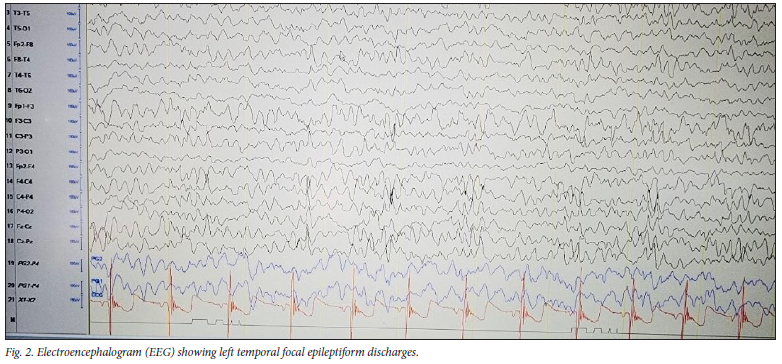
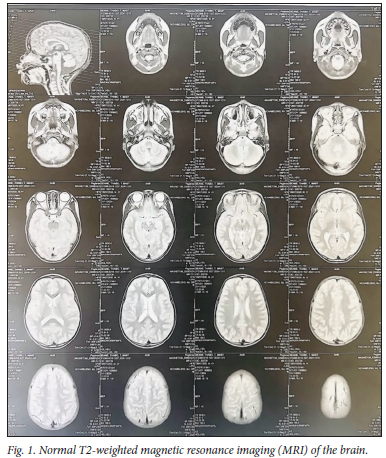
His basic workup, which included glucose levels, a full blood count, electrolytes, calcium and magnesium levels, were normal. His cerebrospinal fluid analysis was normal. Magnetic resonance imaging (MRI) of the brain (Fig. 1) revealed no abnormality and EEG (Fig. 2) showed high-voltage generalised paroxysms of frontally dominant 1.5 - 2 HZ sharp-wave and slow-wave complexes with left temporal focal epileptiform discharges. The sleep pattern was recorded and showed faster background activity and focal epileptiform discharges occurring independently.
Discussion
In this report, we presented a case of a 5-year-old with LKS accompanied by progressive aphasia and characteristic EEG abnormalities. LKS is described well as a rare age-based epileptic encephalopathy that occurs in previously well children with normal language skills and behavioural development.[2,5,7,8] It is characterised by progressive aphasia that develops in association with electroencephalographic abnormalities located in the temporoparietal areas, which indicate the main features of the disease.[1] It is also referred to as epileptic aphasia and children with LKS present with various types of seizures, which may be tonic-clonic seizures, simple or complex partial seizures.[7]
Many patients may present with verbal agnosia and may be suspected to have hearing loss or autism spectrum disorder, but in most patients with LKS, this occurs in association with seizures. EEG examination aids diagnosis, as in the case of our patient, who presented with seizures accompanied by progressive aphasia. Our patient's language skills regression did not recover despite seizure control and initiation of treatment. In other reports, Shah and Balasubramaniam[8] (2021) reported a 5-year-old who presented to their outpatient with progressive speech regression over a month.
Atypical presentations have also been reported, as in the case of an 8-year-old Nigerian boy who presented with recurrent vomiting, delayed gross motor development and acquired aphasia. EEG examination revealed bilateral continuous polyspike waves of slow sleep.[9] Our patient had normal birth and developmental history with normal anthropometry. But upon EEG examination, there was intermittent sharp spikes and waves from the left hemisphere with secondary generalisation, and later (with sedation) the repeat EEG showed bilateral (left > right) parieto-temporal, left central and generalised epileptiform abnormalities.
The exact aetiology of LKS remains unknown since its initial description in 1957 although there have been suggestions for possible genetic associations, such as correlations with GRIN2A (16p13.2) mutations, which involve the protein called GluN2A, found in high concentrations in areas of brain that are important for speech and language development.[1,4]
Pathological variants in GRIN2A, an autosomal dominant gene, have been identified in up to 33% of patients with LKS, mostly those who presented with a non-convulsive EEG abnormality.[11] LKS prevalence is unclear, though it is mainly regarded as a rare epileptic syndrome of childhood. There is a male predominance with a ratio of ~2:1 and it commonly affects children who have achieved their early milestones, with presentation between the ages of 3 and 9 years.[12]
Our patient was a 5-year-old boy at the time of presentation. LKS has also been reported to have onset age at 2 years, with a peak age of occurrence at 5 - 7 years, characterised by progressive regression in language development.[13] In a 2014 Argentinian review of 29 patients with LKS, Caraballo et al.[15] reported a median (range) age of onset of 5 (2 - 8) years.[15] They also cited cases with overlapping differentials such as autistic regression, Rolandic epilepsy with speech dyspraxia and cognitive regression with epileptiform discharges.
LKS is mainly diagnosed in patients with characteristic EEG findings associated with progressive aphasia and childhood history of normal language and developmental milestones. More than two-third of cases of LKS have abnormal EEG. These electroencephalographic changes include bilateral independent temporal or parietal activity, 1 - 3 Hz slow-wave maximally temporal activity or generalised sharp-wave or slow-spike discharges, which are usually activated by sleep.[7] Our patient had 1.5-2 Hz sharp-wave and slow-wave complexes, as well as sleep-pattern focal epileptiform discharges occurring independently.
Computed tomography (CT) and MRI imaging of the brain are usually normal, which was the case in the MRI scan of our patient. Treatment of seizures in patients with LKS has shown good response to sodium valproate - these patients also have improvements in language skills after a course of steroids and cognitive linguistic therapy.[13,16] Our patient's seizures were controlled successfully with sodium valproate and he was discharged on prednisone and cognitive linguistic therapy, with an out-patient follow-up plan.
Conclusions
Many patients with LKS initially show verbal agnosia and expressive aphasia, then followed by seizures. Our patient presented first with generalised tonic-clonic seizures, which were accompanied by expressive aphasia. He is scheduled for out-patients review and assessment of cognitive and language skills treatment outcome and continues to take anti-convulsant therapy.
Careful evaluation is needed in children presenting with seizures and/or language skills abnormalities, especially those aged 3 - 9 years and early and aggressive initiation of therapy. Although case studies provide limited evidence of LKS prevalence and treatment outcome, we hope that our report creates awareness and adds insight into the disease, the need to consider its diagnosis, as well as further successful treatment modalities.
Declaration. None.
Acknowledgements. The authors are grateful to T. Tshabalala for carrying out EEG recordings in our patient.
Author contributions. MN conceptualised the manuscript. HB and LM collected and summarised data. MN drafted the initial manuscript. MN, HB and LM revised the manuscript. All authors read and approved the final manuscript.
Funding. None.
Conflicts of interest. None.
References
- 1. Nadir AA, Zafar NA. Diagnosis and therapeutic tactics of Landau-Kleffner syndrome in adults. Age Sci Mental Stud 2021;5(2):1-3.
-
2. Chowdhury N, Bansal AR, Goyal R, Nikhila G. Cerebral dominance in an unusual case of Landau Kleffner syndrome. BMJ 2021;14(12):e246696. https://doi.org/10.1136/bcr-2021-246696
» https://doi.org/10.1136/bcr-2021-246696 - 3. Al-Qudah AA. Landau-Kleffner syndrome. Neurosciences 2024;9(2):80-83.
-
4. Specchio N, Wirrell EC, Scheffer IE, et al. International League Against Epilepsy classification and definition of epilepsy syndromes with onset in childhood: Position paper by the ILAE Task force on Nosology and definitions. Epilepsia J 2022;63(6):1398-1442. https://doi.org/10.1111/epi.17241
» https://doi.org/10.1111/epi.17241 -
5. Stefanatos GA, Kinbourne M, Wasserstein J. Acquired epileptiform aphasia: A dimensional view of Landau-Kleffner syndrome and the relation to regressive autistic spectrum disorders. Child Neuropsychol 2002;8(3):195-228. https://doi.org/10.1076/chin.8.3.195.13498
» https://doi.org/10.1076/chin.8.3.195.13498 -
6. Strehlow V, Heyne HO, Vlaskamp DRM, et al., GRIN2A study group. GRIN2A related disorders: Genotype and functional consequence predict phenotype. Brain 2019;142(1):80-92. https://doi.org/10.1093/brain/awy304
» https://doi.org/10.1093/brain/awy304 -
7. Motwani N, Afsar S, Dixit NS, Sharma N. Landau-Kleffner syndrome: An uncommon dealt with case in Southeast Asia. BMJ 2015. https://doi.org/10.1136/bcr-2015-212333
» https://doi.org/10.1136/bcr-2015-212333 -
8. Shah R, Balasubramaniam S. Landau Kleffner syndrome: A case report. Bharati Vidyapeeth Med J 2021;1(3):http://www.doi.org/10.56136/BVMJ/2021_00036.
» http://www.doi.org/10.56136/BVMJ/2021_00036 -
9. Nwala CG, Ejemierele OM. Atypical electroclinical presentation of Landau Kleffner syndrome: A case report of an 8-year-old Nigerian child. Int J Sci Rep 2024;10(4):135-138. https://doi.org/10.18203/issn.2454-2156.IntJSciRep20240717
» https://doi.org/10.18203/issn.2454-2156.IntJSciRep20240717 -
10. Benitez-Buraraco A, Hoshi K, Murphy E. Language defects in GRIN2A mutations and Landau-Kleffner syndrome as neural dysrhythmias. J Neurolinguistics 2023;67:101139. https://doi.org/10.1016/j.jneuroling.2023.101139
» https://doi.org/10.1016/j.jneuroling.2023.101139 -
11. Freibauer AE, RamachandranNair R, Jain P, Jones KC, Whitney R. The genetic landscape of developmental and encephalopathy with spike-and-wave activation in sleep. Eur J Epilepsy 2023;110:119-125. https://doi.org/10.1016/j.seizure.2023.06.017
» https://doi.org/10.1016/j.seizure.2023.06.017 -
12. Pearl PL, Carrazana EJ, Holmes GL. The Landau-Kleffner syndrome. Epilepsy Curr 2001;1(2):39-45. https://doi.org/10.1111/j.1469-5812.2005.00134.x-i1
» https://doi.org/10.1111/j.1469-5812.2005.00134.x-i1 -
13. Gong P, Jiao X, Yang Z. A case of Landau-Kleffner syndrome with SLC26A4-related hearing impairment. BMJ 2022;4(1):1-5. https://doi.org/10.1186/s42494-021-00067-9
» https://doi.org/10.1186/s42494-021-00067-9 -
14. Dos Santos LHC, Antoniuk SA, Rodrigues M, Bruno S, Bruck I. Landau Kleffner syndrome: Study of four cases. Arq Neuropsiquiatr 2002;60(2-A):239-241. https://doi.org/10.1590/S0004-282X2002000200010
» https://doi.org/10.1590/S0004-282X2002000200010 -
15. Caraballo RH, Cejas N, Chamorro N, Kaltenmeier MC, Fortini S, Soprano AM. Landau-Kleffner syndrome: A study of 29 patients. Seizure 2014;23:98-104. https://doi.org/10.1016/j.seizure.2013.09.016
» https://doi.org/10.1016/j.seizure.2013.09.016 -
16. Van der Meulen I, Pangalila RF, Van der Sandt-Koenderman WME. Cognitive linguistic treatment in Landau Kleffner syndrome: Improvement in daily life communication. Child Neurol Open 2021;8:2329048X211022196. https://doi.org/10.1177/2329048x211022196
» https://doi.org/10.1177/2329048x211022196

Accepted 25 November 2025