Incidence, associations and outcomes of patent ductus arteriosus among neonates in a South African academic hospital, 2013 - 2020: A retrospective study
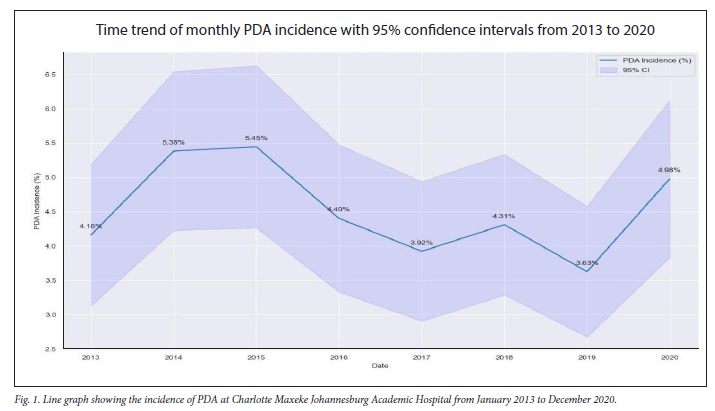
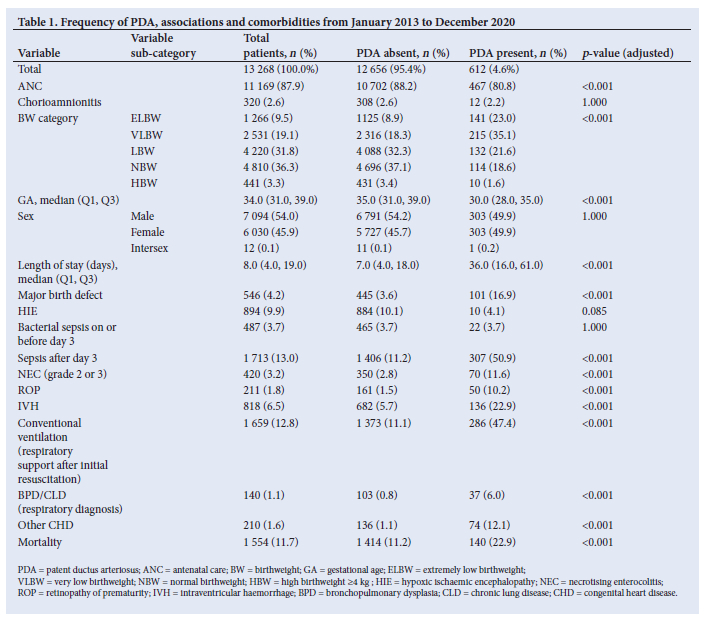
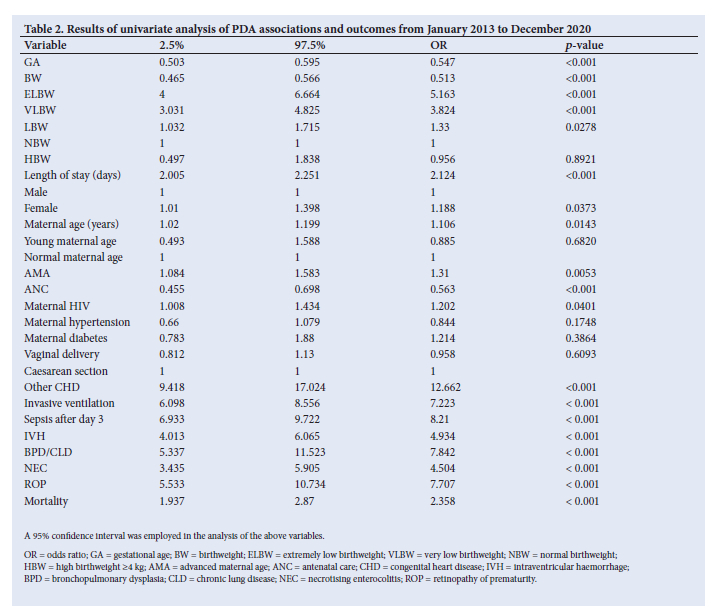
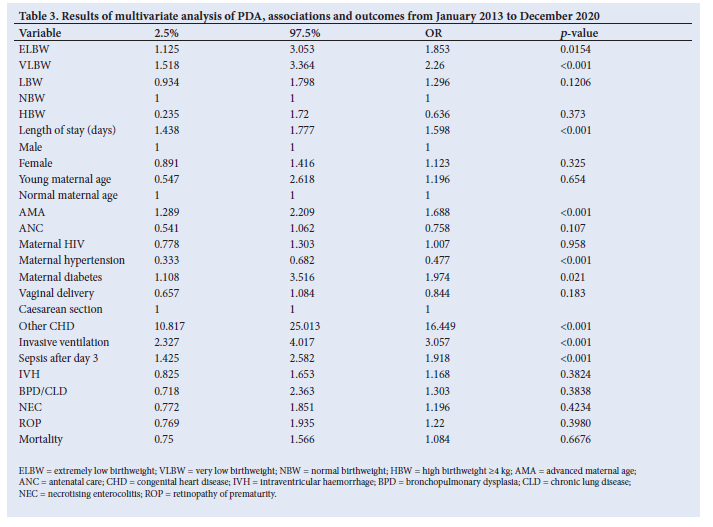
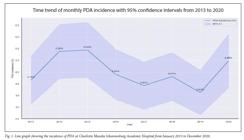
BACKGROUND. Patent ductus arteriosus (PDA) is a congenital heart disease (CHD) whereby the ductus arteriosus fails to close within 72 hours after birth. The aetiology of a PDA is multifactorial. Well-described neonatal associations include prematurity, low birthweight, hypoxic states, infectious states and other co-existing congenital heart defects. Maternal associations include diabetes, hypertension, lack of antenatal care (ANC), advanced maternal age (AMA) and HIV. However, such data are limited to two studies in sub-Saharan Africa. OBJECTIVE. The primary outcome was determining the incidence and trend of PDA at Charlotte Maxeke Johannesburg Academic Hospital (CMJAH) from January 2013 to December 2020. The secondary outcomes were to determine the association between neonatal and maternal variables, and the development of a PDA from January 2013 to December 2020 at CMJAH. METHODS. A retrospective record analysis involving 13 265 neonates admitted to CMJAH, a tertiary hospital in South Africa, from January 2013 to December 2020 was done. Inclusion criteria included confirmed or absent PDA on echocardiography. Exclusion criteria included missing more than 15% of the neonatal and maternal variables. RESULTS. PDA occurred in 4.6% of the population. On multivariate analysis extremely low birthweight (ELBW) and very low birthweight (VLBW) were significant associations (ELBW odds ratio (OR)=1.884, p=0.0134; VLBW OR=2.291, p<0.001). Other significant associations were CHD (OR=16.485, p<0.001), invasive ventilation (OR=3.062, p<0.001) and AMA (OR=1.692, p=<0.001). Maternal hypertension emerged as a protective factor (OR=0.474, p<0.001). Both sex (OR=1.125, p=0.3188) and ANC (OR=0.755, p=0.1027), as protective factors, were not significant. Various complications and associations such as sepsis after day 3 (OR=8.21, p<0.001) and necrotising enterocolitis (NEC) (OR=4.504, p<0.001) were strongly associated with PDA on univariate analysis. PDA was also associated with a greater length of hospital stay (OR=1.6, p<0.001). CONCLUSIONS. PDA is a multifactorial disease with incidence in this study remaining relatively low. Co-existing CHD appears to be the most associated variable with PDA. Other significant variables include lower birthweight, invasive ventilation, advanced maternal age, late-onset sepsis (after day 3 of life) and maternal hypertension. It was also found that the presence of a PDA significantly prolonged hospital stay. The study provides insight into PDA in the South African setting; it also highlights that early PDA screening and appropriate intervention may improve mortality and morbidity.
PDA; neonatology; congenital heart disease
 Thumbnail