Incidence, associations and outcomes of patent ductus arteriosus among neonates in a South African academic hospital, 2013 - 2020: A retrospective study
BACKGROUND. Patent ductus arteriosus (PDA) is a congenital heart disease (CHD) whereby the ductus arteriosus fails to close within 72 hours after birth. The aetiology of a PDA is multifactorial. Well-described neonatal associations include prematurity, low birthweight, hypoxic states, infectious states and other co-existing congenital heart defects. Maternal associations include diabetes, hypertension, lack of antenatal care (ANC), advanced maternal age (AMA) and HIV. However, such data are limited to two studies in sub-Saharan Africa. OBJECTIVE. The primary outcome was determining the incidence and trend of PDA at Charlotte Maxeke Johannesburg Academic Hospital (CMJAH) from January 2013 to December 2020. The secondary outcomes were to determine the association between neonatal and maternal variables, and the development of a PDA from January 2013 to December 2020 at CMJAH. METHODS. A retrospective record analysis involving 13 265 neonates admitted to CMJAH, a tertiary hospital in South Africa, from January 2013 to December 2020 was done. Inclusion criteria included confirmed or absent PDA on echocardiography. Exclusion criteria included missing more than 15% of the neonatal and maternal variables. RESULTS. PDA occurred in 4.6% of the population. On multivariate analysis extremely low birthweight (ELBW) and very low birthweight (VLBW) were significant associations (ELBW odds ratio (OR)=1.884, p=0.0134; VLBW OR=2.291, p<0.001). Other significant associations were CHD (OR=16.485, p<0.001), invasive ventilation (OR=3.062, p<0.001) and AMA (OR=1.692, p=<0.001). Maternal hypertension emerged as a protective factor (OR=0.474, p<0.001). Both sex (OR=1.125, p=0.3188) and ANC (OR=0.755, p=0.1027), as protective factors, were not significant. Various complications and associations such as sepsis after day 3 (OR=8.21, p<0.001) and necrotising enterocolitis (NEC) (OR=4.504, p<0.001) were strongly associated with PDA on univariate analysis. PDA was also associated with a greater length of hospital stay (OR=1.6, p<0.001). CONCLUSIONS. PDA is a multifactorial disease with incidence in this study remaining relatively low. Co-existing CHD appears to be the most associated variable with PDA. Other significant variables include lower birthweight, invasive ventilation, advanced maternal age, late-onset sepsis (after day 3 of life) and maternal hypertension. It was also found that the presence of a PDA significantly prolonged hospital stay. The study provides insight into PDA in the South African setting; it also highlights that early PDA screening and appropriate intervention may improve mortality and morbidity.
PDA; neonatology; congenital heart disease
Incidence, associations and outcomes of patent ductus arteriosus among neonates in a South African academic hospital, 2013 - 2020: A retrospective study
A H ShulmanI; A GordonII; J JudinIII; C FosterIV; M KaziV; M MasemolaV; Y NaidooV; B M SegalVI; R SelepeVII; O AjayiVIII; R BandiniIX; T RamdinX
IMB BCh, BSc Physio (Hons); School of Clinical Medicine, Unit for Undergraduate Medical Education, University of the Witwatersrand, Johannesburg, South Africa
IIMB BCh, BHSc; School of Clinical Medicine, Unit for Undergraduate Medical Education, University of the Witwatersrand, Johannesburg, South Africa
IIIBHSc Hons, MB BCh; School of Clinical Medicine, Unit for Undergraduate Medical Education, University of the Witwatersrand, Johannesburg, South Africa
IVBHSc, MB BCh; School of Clinical Medicine, Unit for Undergraduate Medical Education, University of the Witwatersrand, Johannesburg, South Africa
VBSc, MB BCh; School of Clinical Medicine, Unit for Undergraduate Medical Education, University of the Witwatersrand, Johannesburg, South Africa
VIMB BCh, MSc Eng; School of Clinical Medicine, Unit for Undergraduate Medical Education, University of the Witwatersrand, Johannesburg, South Africa
VIIMB BCh; School of Clinical Medicine, Unit for Undergraduate Medical Education, University of the Witwatersrand, Johannesburg, South Africa
VIIIMB ChB, MSc Epidemiology; Department of Family Medicine, Unit for Undergraduate Medical Education, University of the Witwatersrand, Johannesburg, South Africa
IXMSc Clinical Medicine; PRINCE (Project to Improve Neonatal Care), School of Clinical Medicine, University of the Witwatersrand, Johannesburg, South Africa; Department of Paediatrics and Child Health, Charlotte Maxeke Johannesburg Academic Hospital, University of the Witwatersrand, Johannesburg, South Africa
XMB BCh, MMed Paediatrics; PRINCE (Project to Improve Neonatal Care), School of Clinical Medicine, University of the Witwatersrand, Johannesburg, South Africa; Department of Paediatrics and Child Health, Charlotte Maxeke Johannesburg Academic Hospital, University of the Witwatersrand, Johannesburg, South Africa
BACKGROUND. Patent ductus arteriosus (PDA) is a congenital heart disease (CHD) whereby the ductus arteriosus fails to close within 72 hours after birth. The aetiology of a PDA is multifactorial. Well-described neonatal associations include prematurity, low birthweight, hypoxic states, infectious states and other co-existing congenital heart defects. Maternal associations include diabetes, hypertension, lack of antenatal care (ANC), advanced maternal age (AMA) and HIV. However, such data are limited to two studies in sub-Saharan Africa.
OBJECTIVE. The primary outcome was determining the incidence and trend of PDA at Charlotte Maxeke Johannesburg Academic Hospital (CMJAH) from January 2013 to December 2020. The secondary outcomes were to determine the association between neonatal and maternal variables, and the development of a PDA from January 2013 to December 2020 at CMJAH.
METHODS. A retrospective record analysis involving 13 265 neonates admitted to CMJAH, a tertiary hospital in South Africa, from January 2013 to December 2020 was done. Inclusion criteria included confirmed or absent PDA on echocardiography. Exclusion criteria included missing more than 15% of the neonatal and maternal variables.
RESULTS. PDA occurred in 4.6% of the population. On multivariate analysis extremely low birthweight (ELBW) and very low birthweight (VLBW) were significant associations (ELBW odds ratio (OR)=1.884, p=0.0134; VLBW OR=2.291, p<0.001). Other significant associations were CHD (OR=16.485, p<0.001), invasive ventilation (OR=3.062, p<0.001) and AMA (OR=1.692, p=<0.001). Maternal hypertension emerged as a protective factor (OR=0.474, p<0.001). Both sex (OR=1.125, p=0.3188) and ANC (OR=0.755, p=0.1027), as protective factors, were not significant. Various complications and associations such as sepsis after day 3 (OR=8.21, p<0.001) and necrotising enterocolitis (NEC) (OR=4.504, p<0.001) were strongly associated with PDA on univariate analysis. PDA was also associated with a greater length of hospital stay (OR=1.6, p<0.001).
CONCLUSIONS. PDA is a multifactorial disease with incidence in this study remaining relatively low. Co-existing CHD appears to be the most associated variable with PDA. Other significant variables include lower birthweight, invasive ventilation, advanced maternal age, late-onset sepsis (after day 3 of life) and maternal hypertension. It was also found that the presence of a PDA significantly prolonged hospital stay. The study provides insight into PDA in the South African setting; it also highlights that early PDA screening and appropriate intervention may improve mortality and morbidity.
Keywords: PDA, neonatology, congenital heart disease.
A patent ductus arteriosus (PDA) is a congenital heart disease (CHD) whereby the ductus arteriosus fails to close within 72 hours after birth.[1] This patency is largely maintained by high concentrations of prostaglandin E2 and I2, as well as low oxygen levels in the fetus.[2]
The aetiology of PDA is multifactorial. Well-described neonatal associations include prematurity, low birthweight (LBW) and very low birthweight (VLBW), hypoxic states, infectious states, and other coexisting congenital heart defects.[2-4] There is much controversy around many of the suggested maternal risk factors; nonetheless, those mentioned frequently in the literature include maternal diabetes, hypertension and advanced maternal age.[3,5-7] Maternal HIV, although being a prevalent African concern, lacks sufficient research on its linkage to PDA development; however, studies have reported a connection with cardiac malformations.[8]
Globally, PDA accounts for almost 10% of CHDs or 9 per 1 000 live births globally, and approximately 1.9 per 1 000 live births in Africa.[9,10] The current South African data on PDA prevalence are limited to two groups, the first being a niche population of VLBW neonates in a single centre, in which PDA occurred in 11.9% of their population, and the second being 5 hospitals in the Western Cape, where the PDA prevalence was 11%.[11,12] The vast heterogeneity in the prevalence of PDAs is likely the result of not only population-specific characteristics, but also healthcare inequity and diagnostic access. In addition, these rates continue to rise, and it is uncertain whether this is due to environmental or genetic factors, as opposed to improved diagnostic detection methods.[9]
PDA is one of the most prevalent CHDs globally but often has minimal to no health consequences on the neonate, with many of them remaining asymptomatic and closing spontaneously with time. Despite this, some cases may lead to devastating multi-organ complications and prolonged hospital stays if left unchecked, and therefore its treatment remains significantly controversial and is often centre based.[13] Therefore, it is imperative to determine the associations, especially those that are of consequence, predict the development of pathological PDAs and thus employ effective preventive, health-promotive and curative measures to prevent the severe consequences associated with them. This in turn may reduce mortality, morbidity, as well as the associated healthcare expenditure incurred in the South African context.
Methods
Study design and population
The present study is a retrospective record analysis involving 13 268 neonates admitted to Charlotte Maxeke Johannesburg Academic Hospital (CMJAH), a tertiary hospital in South Africa, from January 2013 to December 2020. Inclusion criteria for the study included confirmed presence or absence of a PDA on echocardiography, and only patients who were admitted to the neonatal unit at CMJAH during the study period.
Our study centre had a low threshold for echocardiography, whereby it was conducted on any neonate with:
1. newly diagnosed murmur
2. presence of central cyanosis
3. low oxygen saturation despite high supplemental oxygen
4. need for high supplemental oxygen on the ventilator or nasal continuous positive airway pressure (NCPAP)
5. persistent positive blood culture to exclude an infective endocarditis.
Exclusion criteria included the non-recording of more than 15% of the following variables:
Neonatal: sex, gestational age, birthweight, presence of other CHD, usage of oxygen/NCPAP/conventional ventilation, bronchopulmonary dysplasia (BPD)/chronic lung disease (CLD).
Medical comorbidities: sepsis on or before day 3 of life, sepsis after day 3 of life, necrotising enterocolitis (NEC), hypoxic ischaemic encephalopathy (HIE), and retinopathy of prematurity (ROP). Neonatal clinical outcomes also included length of stay, major birth defects and mortality. Neonatal haematological and metabolic outcomes: anaemia and hyperkalaemia.
Additionally, where 15% or more of maternal variables were not recorded, these infants were excluded. These variables included: maternal age, antenatal care attendance, maternal HIV status, maternal hypertension, maternal diabetes and chorioamnionitis.
A detailed explanation of the above terms used in the study can be found in the definitions sheet appendix.
Primary and secondary outcome
The primary outcome was determining the incidence and trend of PDA at CMJAH from January 2013 to December 2020. The secondary outcomes were to determine the association between neonatal and maternal variables, and the development of a PDA from January 2013 to December 2020 at CMJAH.
Data collection, preparation and pre-processing
The data set was compiled from a pre-existing REDCap database at CMJAH, hosted by the University of the Witwatersrand.[14] The data were cleaned and harmonised. The final dataset was subjected to sanity checks to remove records with implausible or inconsistent values.
The dataset comprised information on neonatal outcomes for PDA extracted from two distinct tables, one focusing on VLBW and those neonates weighing less than VLBW infants, and the other table on LBW infants and those infants weighing more than LBW. A sample of 3 795 VLBW or weighing less than VLBW neonates were filtered for valid records and logistical limit testing, resulting in 3 789 results, and 11 372 LBW or weighing more than LBW neonates results were filtered for valid records and logistical limit testing, resulting in 9 521 results. Thus, there was a total number of 13 310 results. The remaining results were then filtered for a valid time range, leaving a net total sample of 13 268 neonates which were then analysed in the study. A total of 1 899 samples were excluded as they were invalid or did not meet logistical limits testing (12.52%).
Descriptive statistics
Descriptive statistics were generated using the 'TableOne' package for R (3.3.0+). The analysis was grouped by the outcome variable, PDA. The chi-square test or Fisher's exact test for categorical variables as appropriate, and the Mann-Whitney U test for non-parametric continuous variables, were used. Additionally, Kruskal Wallis tests were used for 3-way non-parametric data and a i-test for parametric data, as appropriate.
Univariate and multivariable logistic regression analysis
Univariate logistic regression was performed on each characteristic to assess its individual effect on the probability of PDA. Variables with a p-value <0.05 were considered significant. These variables were then used in a multivariable logistic regression model to control confounding factors. Both univariate and multivariable analyses were adjusted for covariates such as maternal age and sex of the infant. The results are presented as odds ratios (ORs) with 95% confidence intervals.
Temporal trend analysis
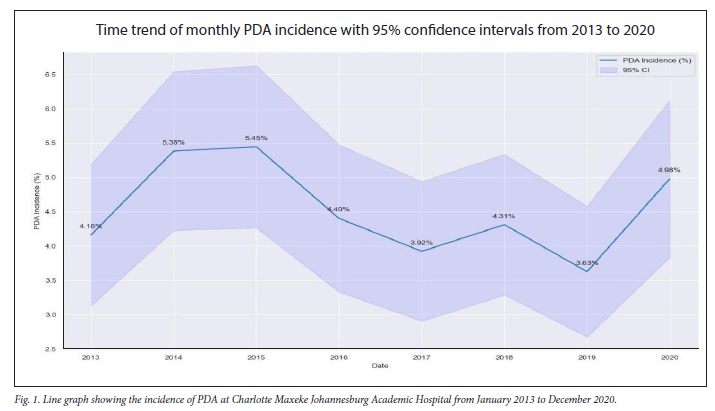
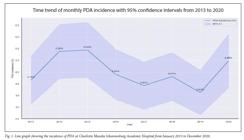
The incidence of PDA was calculated on a monthly and yearly basis using the date of birth as the temporal variable. Incidence was plotted along with 95% confidence intervals to visualise any temporal trends.
Statistical methods
All statistical analyses were performed using Python's 'scikit-learn' and 'statsmodels' libraries (13.2.0). The level of significance was set at α=0.05. Bonferroni correction was applied for multiple comparisons.
Results
The study analysed a total of 13 268 newborns. Among these, 612 neonates (4.6%) were diagnosed with PDA, with temporal trends visualised in Fig. 1.
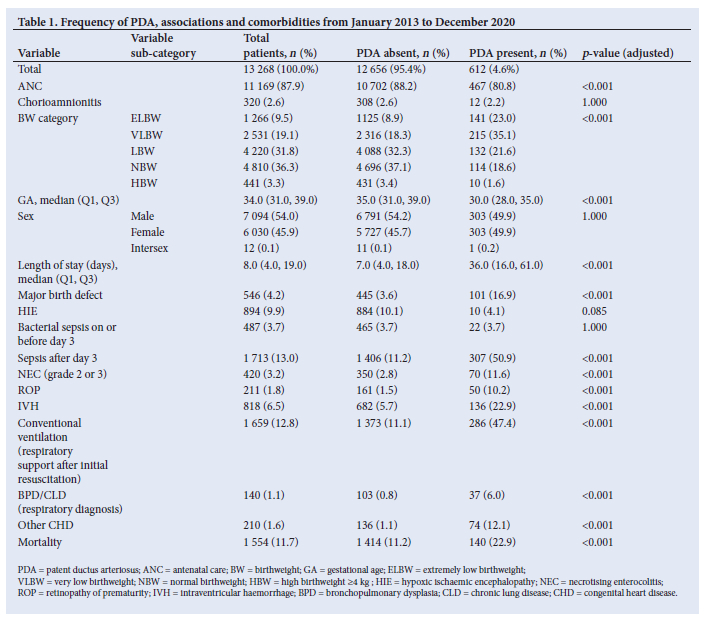
An extensive list of neonatal demographic variables was focused on and are further outlined in Table 1.
Furthermore, several maternal-specific variables were also investigated but showed no clinical significance in terms of incidence of PDA in the studied population and therefore are not included in the table. These variables were: maternal age (specifically segregating the category into advanced, normal and teenage pregnancies); the presence of maternal comorbidities such as HIV, diabetes and hypertension; and lastly the type of delivery (normal vaginal delivery v. caesarean section).
A substantial 50.9% of the PDA group developed sepsis after day 3, compared with 11.2% in the non-PDA group (p<0.001, chi-squared test). The incidence of NEC was significantly higher in the PDA group (11.6%) compared with the non-PDA group (2.8%) (p<0.001, chi-squared test). A higher proportion of the PDA group (63.3%) received surfactant therapy compared with the non-PDA group (30.2%) (p<0.001, chi-squared test).
Anaemia was significantly more common in the PDA group (26.1%) compared with the non-PDA group (4.0%) (p<0.001).
Hyperkalaemia, a potassium >5.2 mmol/L, was also more prevalent in the PDA group (17.5%) compared with the non-PDA group (6.1%) (p<0.001).
The median stay was 8 days (IQR 4 - 19 days) for the entire cohort. However, the PDA group had a significantly longer median stay of 36 days (Q1=16, Q3=61) compared with 7 days (Q1=4, Q3=18) in the non-PDA group (p<0.001). Major birth defects were higher in the PDA group (16.9%) compared with the non-PDA group (3.6%) (p<0.001). Mortality was significantly higher in the PDA group (22.9%) compared with the non-PDA group (11.2%) (p<0.001).
The above variable subsets can be found in Table 1.
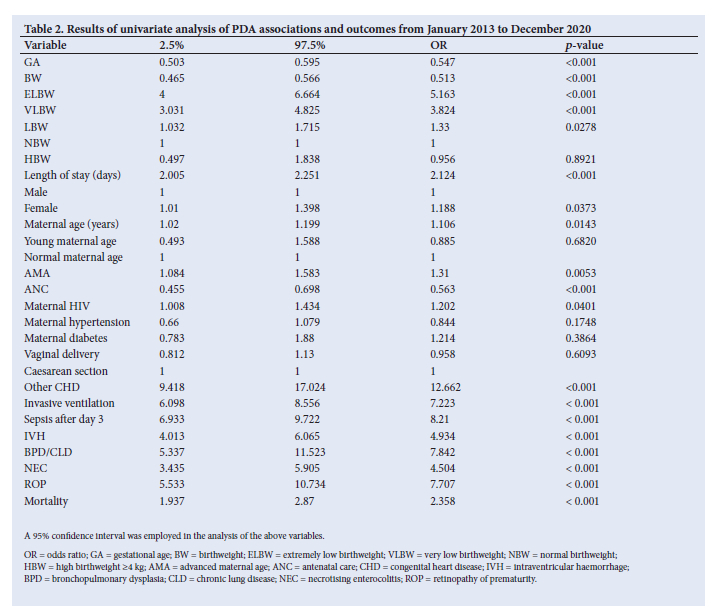
Univariate logistic regression analysis
Significant associations were:
1. Birthweight categories: ELBW and VLBW were found to be significant.
2. Clinical variables: Length of stay, the presence of any additional CHD detected on echocardiography, and invasive ventilation were significant variables.
3. Maternal variables: Advanced maternal age was a significant risk factor, while ANC attendance was found to be protective.
4. Sex: Female sex was associated with a slightly higher risk compared with males.
5. Comorbidities: Various complications such as sepsis after day 3, and NEC were strongly associated with PDA.
The full results of the univariate analysis are presented in Table 2.
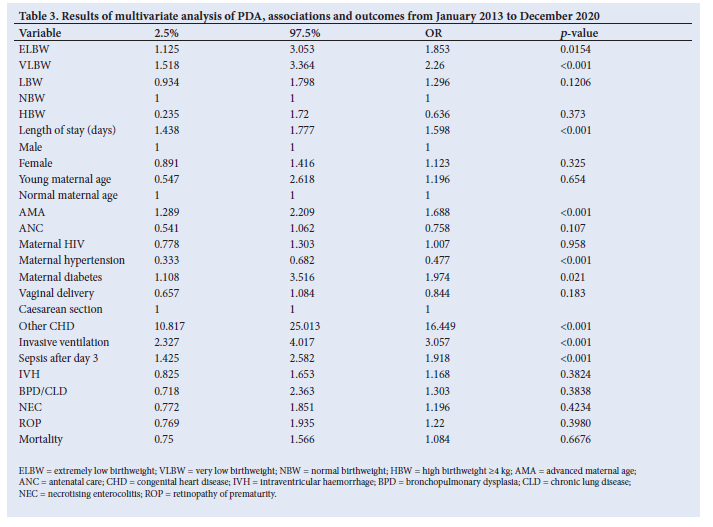
Multivariable logistic regression analysis
Persistent significant associations
Birthweight categories: ELBW and VLBW remained significant associations.
Clinical variables: Length of stay, other CHD, and invasive ventilation continued to show strong associations.
Maternal variables: AMA remained significant while maternal hypertension emerged as a protective factor.
Variables losing significance
Sex: The risk associated with female sex did not show continued significance.
ANC: Lost its significance as a protective factor.
The full results of the multivariable analysis are shown in Table 3.
Discussion
PDA is reported to occur at a rate of 9 per 1 000 live births globally, and 1.9 per 1 000 live births in Africa.[9] The South African PDA population studies are limited to 2 studies, the former being a niche VLBW population in a single centre, in which PDA occurred at a rate of 11.9%, and the latter being 7 clinics and hospitals in the Western Cape, where the PDA prevalence was 11%.[11,12] Our study found that 4.52% of neonates at CMJAH presented with a PDA, with a fairly constant annual trend being seen over the total study period, whereby rates varied by 1% at most.
Our observation is important and goes contrary to the findings reported in other studies. We suspect that this heterogeneity of data is likely the result of the first South African study only focusing on VLBW, where PDA is at a much higher risk to occur in this population.[11,12] We also suspect that the second study taking place in the Western Cape has a far more established referral system with greater healthcare access and thus a greater pick-up rate in keeping with first-world countries.[11,12] This local difference can be further compounded by the fact that many local studies have far fewer total study participants, and the present study having the most recorded patients being involved in a PDA study in South Africa. CMJAH is one of the few tertiary academic hospitals in Johannesburg, and therefore receives a greater but delayed number of referrals, as well as more complicated pregnancies and births possibly resulting in a higher PDA prevalence in comparison with the rest of the African region, which also likely have less established referral and diagnostic services available. Nonetheless, the PDA prevalence is lower than that reported globally, likely due to the opposite, whereby many global communities have improved and timely access to diagnostic services compared with that of South Africa.[9]
In terms of prematurity, our study focused on gestational weight groups rather than gestational ages, and it was found that VLBW and ELBW were statistically significant for the development of a PDA. However, LBW was not a significant association. This is supported in the literature,[2] which reports a significant risk of PDA in VLBW and ELBW neonates, quantifying it to an increased risk of 29% for every 100 g less of gestational weight.
In terms of PDA and the association with any other coexisting CHDs, our study is in concordance with previous findings[15,16] in which PDA was associated with multiple other cardiac lesions, particularly those with cyanotic ductal-dependent states, as a compensatory mechanism. Some studies have quantified this coexistence in up to 10% of cases.[16] Although our study did not further break down cardiac lesions into acyanotic and cyanotic lesions but rather denoted as isolated PDA or those with a coexisting cardiac lesion, the further exploration of these can be expanded on in a further study. The variation in the degree of coexistence could be due to variation in population dynamics, as their studies focused on Romanian and North American populations, whereas our study was conducted in a single site and focused on African patients.
In keeping with previous reports,[2] our study found that invasive ventilation had a higher association with a PDA, which is possibly the result of the severe degree of hypoxia. The varying degree of association may likely be the result of their smaller sample size (n=318) and their sample being predominantly VLBW neonates.
Likewise, a previous study[17] supports our study finding that sex was not statistically significantly associated with PDA development.
Our study found that sepsis after day 3 of life is associated with a PDA. This is in concordance with a previous study[11] that found that late-onset sepsis was associated with the presence of a PDA, owing to the shunting of blood, which can lead to poor blood flow regulation and a compromised immune response. Any degree of variation is likely the result of their study focusing on VLBW neonates exclusively.
Likewise, this shunting can also increase the risk of BPD, as it contributes to lung inflammation and injury.[18] The risk of IVH is increased owing to the potential for blood shunting to affect cerebral blood flow regulation, likewise hypo-perfusion to organs, resulting in NEC and ROP.[18] However, the association between PDA with mortality and other important morbidity associations, namely ROP, BPD/CLD, NEC and IVH, were only found to be statistically significant on univariate analysis but, however, not on multivariate analysis. This difference, we suspect, is likely due to confounding variables in this study[18] focusing on the Italian population of solely VLBW or those neonates born before 32 weeks, which are likely confounding, as previously mentioned.[2]
The present study revealed that the length of stay of children with PDAs, as compared to those without, was significantly longer, with PDA patients having a 150 to 200% longer hospital duration of stay. This association was confirmed through both univariate and multivariate analysis. This association carries important personal and national economic burdens. This finding is comparable to the results of the literature which also concluded that the mean duration of hospital stay was significantly prolonged for neonates with PDAs.[18]
The present study demonstrated a statistically significant association between maternal age, specifically AMA, with a PDA presence. Similar findings have been reported in another study;[6] however, the degree of association differs, because that study had a smaller sample of neonates with a PDA (n=11) and was conducted in Saudi Arabia.
Our study data revealed a significant link between maternal hypertension and the presence of PDA on multivariate analysis, with infants born to mothers' with maternal hypertension having a reduced incidence of PDA to a similar degree of association to a Korean study.[7] Both our study and the Korean study[7] found that PDA presence occurred in greater numbers in both infants who received surfactant, which reflected the severity of disease or may be a surrogate marker for respiratory distress syndrome, a complication of prematurity.[17] Likewise, hyperkalaemia was more prevalent in our study and another study,[19] which was more indicative severe prematurity/sepsis/acute kidney injury or treatment with indomethacin. Similarly, anaemia, also noted to be a complication of prematurity, was associated with persistence of PDA as this resulted in lower oxygen-carrying capacity and delivery,[20] which is in concordance with our study.
Study limitations
The limitations of the study are twofold. The study sampled neonates from a single academic hospital. This may not be reflective of the true incidence and associations of PDA in the South African population. Additionally, the retrospective nature of the study is subject to human collection and storage error and cannot accurately predict a temporal and dosage cause-effect relationship. Our centre employed a low threshold of performing echocardiography on any child with an audible murmur; nevertheless, owing to many PDAs being asymptomatic, many may have still been missed, thus affecting the accuracy of our incidence levels. However, given that this is the largest study of PDA data in South Africa to date, this study holds strength.
Conclusion
PDA is a multifactorial disease, with the incidence in this study remaining relatively stable at 4.52% (3.36 - 5.45%). Co-existing CHD appears to be the most associated variable with PDA. Other significant variables include LBW, invasive ventilation, AMA, late-onset sepsis (after day 3 of life) and maternal hypertension. It was also found that the presence of a PDA significantly prolonged the hospital stay. The study provides insight into PDA in the South African setting; it also highlights that early PDA screening and appropriate intervention may improve mortality and morbidity.
Recommendations
The above findings are intended to inform clinicians, so that liberal screening of all VLBW neonates, as well as neonates with the above risk factors for PDA, may be routinely conducted. This should be coupled with clinical discretion to improve the identification of pathological PDAs which may then be treated accordingly with paracetamol or ibuprofen, while separating those PDAs that are likely to hold no health consequences and therefore require no active intervention. This will in turn help reduce the overall incidence and burden of PDA, as well as the associated prolonged hospital stays of such neonates in the South African population. The study recommends further research on the incidence of PDA on a national basis, to better reflect the true burden of PDA in South Africa, as well as further prospective research focusing on the possible role of the coronavirus and other teratogens that were not included in the study.
Declaration. The investigators have no competing interests to declare. Given the retrospective nature of the study, both the need for informed consent and consent to participate were waived by the University of the Witwatersrand Human Research Ethical Committee (case number MED21-09-011) and Charlotte Maxeke Johannesburg Academic Hospital.
Acknowledgements. The authors would like to thank Dr Zvifadzo Zingoni for her assistance and helpful input in the protocol generation process.
Author contributions. As primary author, AHS together with all other authors conceptualised the study. The data set was provided by RB and TR. BMS, JJ and MAK cleaned and analysed the data. AHS and AG prepared, reviewed and edited the manuscript, with supervision and edits by RB, OA and TR.
Funding. None.
Conflicts of interest. None.
References
-
1. Dice JE, Bhatia J. Patent ductus arteriosus: An overview. J Pediatr Pharmacol Ther 2007;12(3):138-146. https://doi.org/10.5863/1551-6776-12.3.138
» https://doi.org/10.5863/1551-6776-12.3.138 -
2. Nizarali Z, Marques T, Costa C, Barroso R, Cunha M. Patent ductus arteriosus: Perinatal risk factors. J Neonatal Biol 2012;1(3):1-4. https://doi.org/0.4172/2167-0897.1000109
» https://doi.org/0.4172/2167-0897.1000109 -
3. Fung A, Manlhiot C, Naik S, et al. Impact of prenatal risk factors on congenital heart disease in the current era. J Am Heart Assoc 2013;2(3):e000064. https://doi.org/10.1161/JAHA.113.000064
» https://doi.org/10.1161/JAHA.113.000064 -
4. Pistulli E, Hamiti A, Buba S, et al. The association between patent ductus arteriosus and perinatal infection in a group of low birth weight preterm infants. Iran J Pediatr 2014;24(1):42-48. https://pmc.ncbi.nlm.nih.gov/articles/PMC4359603/
» https://pmc.ncbi.nlm.nih.gov/articles/PMC4359603/ -
5. Abu-Sulaiman R, Subaih B. Congenital heart disease in infants of diabetic mothers: Echocardiographic study. Pediatr Cardiol 2004;25(2):137-140. https://doi.org/10.1007/s00246-003-0538-8
» https://doi.org/10.1007/s00246-003-0538-8 -
6. Hashim ST Jr, Alamri RA, Bakraa R, et al. The association between maternal age and the prevalence of congenital heart disease in newborns from 2016 to 2018 in a single cardiac center in Jeddah, Saudi Arabia. Cureus 2020;12(3):e7463. https://doi.org/10.7759/cureus.7463
» https://doi.org/10.7759/cureus.7463 -
7. Lee JA, Sohn JA, Oh S, Choi BM. Perinatal risk factors of symptomatic preterm patent ductus arteriosus and secondary ligation. Pediatr Neonatol 2020;61(4):439-446. https://doi.org/10.1016/j.pedneo.2020.03.016
» https://doi.org/10.1016/j.pedneo.2020.03.016 -
8. Hornberger LK, Lipshultz SE, Easley KA, et al. Cardiac structure and function in fetuses of mothers infected with HIV: The prospective PCHIV multicenter study. Am Heart J 2000;140(4):575-584. https://doi.org/10.1067/mhj.2000.109645
» https://doi.org/10.1067/mhj.2000.109645 -
9. Liu Y, Chen S, Zühlke L, et al. Global birth prevalence of congenital heart defects 1970-2017: Updated systematic review and meta-analysis of 260 studies. Int J Epidemiol 2019;48(2):455-463. https://doi.org/10.1093/ije/dyz009
» https://doi.org/10.1093/ije/dyz009 -
10. van der Linde D, Konings EE, Slager MA, et al. Birth prevalence of congenital heart disease worldwide: A systematic review and meta-analysis. J Am Coll Cardiol 2011;58(21):2241-2247. https://doi.org/10.1016/j.jacc.2011.08.025
» https://doi.org/10.1016/j.jacc.2011.08.025 -
11. Ngubane-Mwandla NAN, Motara F, Ballot DE. A cross-sectional descriptive study of symptomatic patent ductus arteriosus in very low birth weight neonates. Wits J Clin Med 2019;1(2):69-74. https://doi.org/10.18772/26180197.2019.v1n2a3
» https://doi.org/10.18772/26180197.2019.v1n2a3 -
12. Aldersley T, Lawrenson J, Human P, et al. PROTEA, a Southern African multicenter congenital heart disease registry and biorepository: Rationale, design, and initial results. Front Pediatr 2021;9:763060. https://doi.org/10.3389/fped.2021.763060
» https://doi.org/10.3389/fped.2021.763060 -
13. Semberova J, Sirc J, Miletin J, et al. Spontaneous closure of patent ductus arteriosus in infants <1500 g. Pediatrics 2017;140(2):e20164258. https://doi.org/10.1542/peds.2016-4258
» https://doi.org/10.1542/peds.2016-4258 -
14. Harris PA, Taylor R, Thielke R, et al. Research electronic data capture (REDCap) - a metadata-driven methodology and workflow process for providing translational research informatics support. J Biomed Inform 2009;42(2):377-381. https://doi.org/10.1016/j.jbi.2008.08.010
» https://doi.org/10.1016/j.jbi.2008.08.010 - 15. Hruþca A, Cãinap S, Rachiþan AL, et al. Congenital heart defects and associated comorbidities - 5 years of experience. Hum Vet Med 2013;5(2):62-65.
-
16. Gillam-Krakauer M, Mahajan K. Patent ductus arteriosus. In: StatPearls. Treasure Island (FL): StatPearls Publishing; 2022. https://pubmed.ncbi.nlm.nih.gov/28613509/
» https://pubmed.ncbi.nlm.nih.gov/28613509/ -
17. Kusuma A, Gunawijaya E, Putra I, et al. Risk factors of patent ductus arteriosus in preterm. Am J Pediatr 2020;6(2):168-172. https://doi.org/10.11648/j.ajp.20200602.29
» https://doi.org/10.11648/j.ajp.20200602.29 -
18. Terrin G, Di Chiara M, Boscarino G, et al. Morbidity associated with patent ductus arteriosus in preterm newborns: A retrospective case-control study. Ital J Pediatr 2021;47(9). https://doi.org/10.1186/s13052-021-00956-2
» https://doi.org/10.1186/s13052-021-00956-2 -
19. Seyberth HW, Rascher W, Hackenthal R, Wille L. Effect of prolonged indomethacin therapy on renal function and selected vasoactive hormones in very-low-birth-weight infants with symptomatic patent ductus arteriosus. J Pediatr 1983;103(6):979-984. https://doi.org/10.1016/s0022-3476(83)80736-7
» https://doi.org/10.1016/s0022-3476(83)80736-7 -
20. Chen YY, Wang HP, Chang JT, et al. Perinatal factors in patent ductus arteriosus in very low-birthweight infants. Pediatr Int 2014;56(1):72-76. https://doi.org/10.1111/ped.12199
» https://doi.org/10.1111/ped.12199

Accepted 18 June 2025