The long-term concerns post cochlear implantation as experienced by parents/caregivers of prelingually deaf children between the ages of 3 and 5 years in Gauteng Province, South Africa
Abstract
BACKGROUND: Cochlear implantation aims to provide an effective means of spoken communication for prelingually deaf children. However, studies in this field are mostly clinically orientated, with little focus on the experiences and long-term concerns of families post cochlear implantation (CI). OBJECTIVE: To describe the long-term concerns post CI as experienced by parents/caregivers of prelingually deaf children between the ages of 3 and 5 years, and to determine the role of support groups with regard to effective intervention and coping post CI. METHODS: A phenomenological, non-experimental research design was conducted through semi-structured, indepth, one-on-one interviews with five parents/caregivers. RESULTS: Caregivers reported concerns with changes in family support, financial difficulties, poor communication, and schooling and vocational prospects for their children. CONCLUSION: The findings of this study highlight a need for continued support for parents and families with children who have been fitted with cochlear implants. This should be through the use of a family systems perspective model that takes into account the impact on the quality of life of families with children who have a hearing loss or who are fitted with cochlear implants. There is a need for a contextualised longitudinal study where, based on previous observations and experiences, parents/caregivers are reminded about the continual long-term expenses associated with CI. This includes maintenance costs, hospital visits and school placement when the children reach school-going age.
Background
Globally, 6 in 1 000 babies are born with a hearing impairment.89955101112et al.1013
Methods
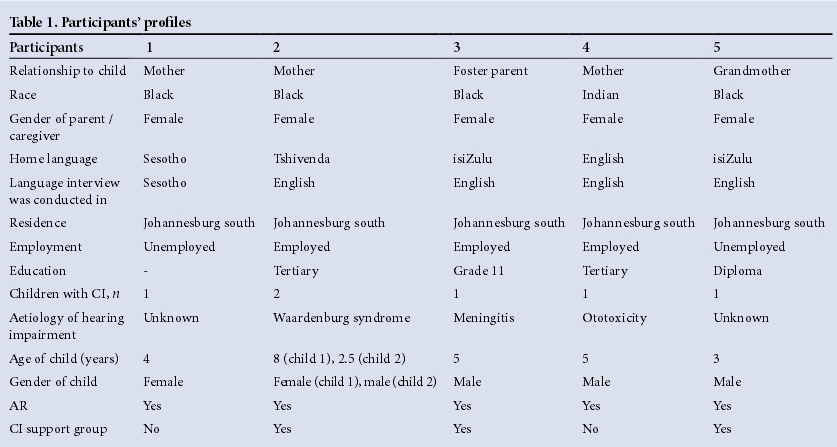
A purposive sampling strategy was used to recruit three biological mothers and two caregivers. Parents/caregivers of children who were prelingually deafened between the ages of 3 and 5 years, fitted with cochlear implants and currently attending paediatric aural rehabilitation (AR), were recruited (Table 1).
The study received ethical clearance from the University of the Witwatersrand Human Research Ethics Committee (non-medical) (clearance certificate number: H14/03/16). Once clearance had been attained, a Speech Therapy and Audiology Department of a local hospital in Johannesburg, which offers paediatric AR, was approached for possible participants. A proposal of the study was submitted to the hospital's ethics committee for approval and permission to conduct the study was granted. The participants were approached through the audiologist responsible for the paediatric AR clinic. The audiologist identified possible participants, informed them about the study and requested their permission to forward their contact details to the researcher. The participants were contacted telephonically to request their permission to participate in the study. Initially, eight participants were contacted; two participants declined and another participant did not meet the inclusion criteria. The remaining five participants were invited to participate in an interview.
One-on-one, open-ended interviews were conducted to collect data. The participants were interviewed at the hospital when they were attending their paediatric AR appointment. On the day of the interview, participants were given the information letter and a consent letter to sign. Permission to use a tape-recorder was also requested. The interviews were approximately 60 minutes long and were conducted in English for four participants and SeSotho for the fifth. The interview conducted in SeSotho was translated into English for transcription.
Informed consent, autonomy and confidentiality were discussed with the participants. Anonymity was maintained by assigning a code system instead of participant names. Participants were made aware that they were free to choose not to participate or withdraw from the study at any time without any negative consequences. There were no identified or assumed risks associated with this study nor were there any immediate benefits related.
Thematic analysis as outlined by Altschuld and White14
Results
All the participants expressed that they were informed that AR is a long process. Despite this, they still had unrealistic expectation with regards to cochlear implants.
'I thought in 6 months or something everything will be fine and she will speak, but they (the therapists) explained to me again.' - P1
'I thought after few days he would say I'm hungry or I love you but I understand it's a process now.' - P3
However, with support and debriefing with the audiologists, the process was explained again and the participants were able to reconstruct realistic expectations.
'Now I feel like I am able to deal and accept the challenges, it is just one obstacle that I can overcome.' - P4
All participants agreed that family support was even more crucial post CI, but there were mixed feelings from their families. Two participants stated that initially they sought advice from the elders in the family. However, when they did not receive support, they made their own decisions.
'They didn't want to accept the hearing loss or the cochlear implants. They gave support after a long long time. We first went to traditional methods to ease the family but the father and I chose cochlears. For my son it was easier because I knew what to do.' - P2
One participant stated that cultural differences affected decision making.
'They are very Zulu. Very cultural and they were in denial. They said that there is no one in their family who is disabled. And so they blamed my daughter. But we had hope and we could see changes after cochlears. So their denial was their own.' - P5
Another participant revealed that her disagreements with her partner delayed intervention and eventually this led to a permanent separation.
'We are not together anymore. It was too much fighting and no support.' - P2
All participants expressed difficulty in finding a crêche or schools as many schools rejected their children due to the school's lack of understanding of cochlear implants.
'No crêche wanted to take him. They just hear 'hearing loss' and they say no.' - P2
Three participants visited schools for learners with special educational needs were unhappy with the quality of education and the availability of resources.
'Remedial schools close to our home seemed to cater for many children with disabilities but nothing seemed to be done to actually assist their needs. Also, I didn't think putting him in a special needs school was best. He is okay academically, he just has a language delay'. - P4
Participant 3 revealed that despite the school claiming to accept her child, she noticed various inconsistencies in the school.
'I don't know if what they say is what they do. Last time I forgot to pack his battery, the cochlear battery for two or three days because I was working overtime and came home very late. My sister used to pack my son's lunch and all that. But anyways I realised there was no questions about the battery from the school and that simply means they are not putting his cochlears on or checking.' - P3
All the participants also expressed private schools were well equipped to cater for their children; however, they were unaffordable.
'There are schools in the North, remedial schools. But economically there is no way a normal man can afford those schools. It was R5 000 a month when we asked, that does not include spending or travelling costs.' - P1
Participants felt the government should play a role in ensuring fair and equal education for children with cochlear implants.
'The government should include courses, not special ones, but for all teachers so that they know how to help children with disability or needs.' - P5
All participants highlighted that they are concerned with the mode of communication used at home.
'Language is a major problem. His vocabulary is extremely limited. We always try to correct his speech and language. Up to now he always forgets to say the last part of a word.' - P2
'People don't know about sign language and everything. There are no opportunities for us. Even I can see that I am failing my son. There is no communication for him until the next morning at school. I really am failing my son.' - P3
Participants indicated that owing to poor communication at home, some children present with challenging behaviours.
'I am worried about his behaviour. He gets angry quickly because we don't understand him most of the time. The message isn't put across.' - P4
'He throws a lot of tantrums, he is always frustrated with the long journey, the communication and also with learning in therapy.' - P2
All participants commented that poor communication has negatively affected their children's social wellbeing.
'He doesn't have a friend, especially one who is deaf or uses Sign Language. He only communicates at school.' - P1
Participants with other hearing children also stated that one of the challenges they face is ensuring equality in the family. It is easy for their implanted child to be left out of conversations and have limited participation in the family. All the participants agreed that they were informed of the ongoing therapy sessions and device maintenance post CI; however, four participants stated that their financial circumstances have since changed.
'I couldn't work because no one would give me off every week to come for therapy. But now I am going to try and look for a job. I've been out of work because we have to come to therapy but my husband can't work alone now. We don't have a grant.' - P1
'The therapists really like me to come every week but I don't have means. I don't have financial ...uh... to come every week cause if I come here I have to be out of work.' - P3
All participants also commented on the maintenance of the cochlear implant device.
'It is not a cheap thing to maintain, but then we obviously went into it knowing this. But you don't realise it until you are placed into the situation and then you're like woah this is an expensive device.' - P4
'And life is very expensive. Transport is like R700 a month. He have to eat. He have to be warm. He have to have medication for flu whatever, you see. And school is R7 500. We do save and tell him to be careful, but he is a child, a boy, he has to play.' - P3
Two participants are currently receiving the state's social grant, while two participants are not eligible for a grant and one has not applied for a grant. The participants who receive the social grant indicated that even though the grant helps, it is not enough as life is very expensive.
Participants expressed concerns regarding vocational prospects and the future for their children.
'I have many concerns for the future. It worries me every day. My most important concern is his education. I think I may have to take him out of school at the first point of exit which is grade nine. Don't you think he'll need to go into a career in which he has to do something hands on instead of education?' - P1
'I want him to grow up and do things for himself. I don't want to close the doors for him.' - P3
'Right now we are there to assist him with finances, in the long term going into the work force with a severe disability will he be able to maintain those cochlears? The parts are ridiculously priced. It's thousands for repairs uh. parts and batteries and a hearing disability means a lower income.' - P4
Discussion
The findings suggest that parents/caregivers had unrealistic expectations regarding CI, as some parents expected their children to talk instantly post CI. When these expectations were not met, the parents/caregivers experienced disappointment. Parents are active participants in the CI process, but because the process is lengthy, they may start having unrealistic expectations and may forget the discussions they had with the audiologists regarding realistic expectations. Therefore parents and audiologists need to remind each other about the benefits, limitations and the process of CI. Cohen1516
Participants had mixed feelings regarding the availability of support from family members and audiologists. Throughout this journey, it is crucial for parents/caregivers to have a support base as they are faced with making informed choices regarding intervention, mode of communication and educational choices for the child.17
From the outset, despite the fact that participants were aware of the financial burden associated with cochlear implants, they were not fully prepared to meet the ongoing financial demands post CI. Kerr et al.1018
Participants felt that the schools were either not well equipped or were inconsistent around how they provided access to children with cochlear implants. Furthermore, schools that adequately cater for children with cochlear implants were expensive. De Villiers1920
The findings of this study also highlighted the parents/caregivers' plight with regard to communication at home. This is largely due to the different modes of communication used in the home. The parents/caregivers were more concerned that their children developed behavioural problems and were socially isolated by their peers due to restricted communication between them and their peers. This difficulty in communication may be expected as an ineffective mode of communication between caregiver and child can lead to parental stress, which consequently may lead to negative developmental outcomes as well as behavioural problems in the child with hearing impairments.1318
Conclusion
There is a need to adopt a holistic model that takes into account the wellbeing of family with a child fitted with cochlear implants. Jackson and Turnbull18
References
-
1. Anagnostou F, Graham J, Crocker S. A preliminary study looking at parental emotions following cochlear implantation. Cochlear Implants Int 2007;8(2):68-86. DOI:10.1002/cii.331
» https://doi.org/10.1002/cii.331 - 2. Bouvard M. Mothers in All but Name: Grandmothers, Aunts, Sisters, Friends, Strangers, Nannies. Nicholasville, Kentucky: Wind Publications, 2009.
- 3. Park H. Grandmothers raising grandchildren: Family well-being and economic assistance. Focus 2005;24(1):19-27.
- 4. Turner J. Grandparents Raising Grandchildren. Washington DC: American Association of Retired Persons, 2005.
- 5. Störbeck C, Moodley, S Cochlear Implantation in an Early Intervention Programme in South Africa. Conference Proceedings: 10th European Symposium on Paediatric Cochlear Implantation, 12-14 May 2001, Athens.
- 6. Barrow M. Aging, the Individual and Society. 6th ed. London: West Publishing Company, 1999.
-
7. Hunt CK. Concepts in caregiver research. J Nurs Sch 2003;35(1):27-32. DOI:10.1111/j.1547-5069.2003.00027.x
» https://doi.org/10.1111/j.1547-5069.2003.00027.x -
8. Swanepoel D, Störbeck C, Friedland P. Early hearing detection and intervention in South Africa. Int J Pediatr Otorhinolaryngol 2009;73(6):783-786. DOI:10.1016/j.ijporl.2009.01.007
» https://doi.org/10.1016/j.ijporl.2009.01.007 - 9. Clark EV. First Language Acquisition. 2nd ed. Cambridge: Cambridge University Press, 2009.
-
10. Kerr G, Tuomi S, Müller A. Costs involved in using a cochlear implant in South Africa. S Afr J Commun Disord 2012;59(1):16-26. DOI:10.7196/SAJCD.117
» https://doi.org/10.7196/SAJCD.117 - 11. Le Roux T, Laurent C. Open access guide to audiology and hearing aids for otolaryngologists. Cape Town: University of Cape Town, 2013.
-
12. Gray RF, Jones F, Shipgood L, Court I. Paediatric cochlear implantation: The balance between professional caution and urgency of treatment. Cochlear Implants Int 2003;4(1):45-51. DOI:10.1179/cim.2003.4.1.45
» https://doi.org/10.1179/cim.2003.4.1.45 - 13. Luterman D. Counselling parents about cochlear implants. The American Speech-Language-Hearing Association Leader 2003;8(10)6-21.
- 14. Altschuld JW, White JL. Needs Analysis: Analysis and Prioritization. 4th ed. Thousand Oaks, California: SAGE Publications Inc., 2010.
- 15. Cohen LJ. The Handy Psychology Answer Book. Canton: Visible Ink Press, 2011.
- 16. Tye-Murray N. Foundations of Aural Rehabilitation: Children, Adults and Their Family Members. New York: Delmar, 2009.
- 17. Most T, Zaidman-Zait A. The needs of parents of children with cochlear implants. Volta Rev 2007;103:99-113.
-
18. Jackson CW, Turnbull AP. Impact of deafness on family life: A review of the literature. Topics Early Child Spec Educ 2004;24(1):15-29. DOI:10.1177/02711214040240010201
» https://doi.org/10.1177/02711214040240010201 - 19. De Villiers D. Vocational training in school programs and occupational training at colleges in South Africa. American Annals of the Deaf 2010;155(4):504-506.
-
20. Hintermair M. Parental resources, parental stress, and socio-emotional development of deaf and hard of hearing children. J Deaf Stud Deaf Educ 2006;11(4):493-513. DOI:10.1093/deafed/enl005
» https://doi.org/10.1093/deafed/enl005