Morbidity profile and survival times among children diagnosed with acute leukaemia at the Cancer Diseases Hospital in Lusaka, Zambia from 2017 to 2023: A retrospective cohort study
BACKGROUND. Acute leukaemia remains one of the most commonly diagnosed childhood cancers and a leading cause of cancer-related morbidity and mortality among children globally. However, disease patterns remain heterogeneous, with a high burden observed in resource-constrained countries. OBJECTIVES. To investigate the morbidity profile and survival times of children diagnosed with acute leukaemia at Cancer Diseases Hospital in Zambia. METHOD. A retrospective cohort study of children with acute leukaemia was conducted at Cancer Diseases Hospital, a national cancer referral centre in Zambia. Medical records of children diagnosed with acute leukaemia between 2017 and 2023 were reviewed, yielding a sample of 150 children. A chart review form was used to collect data from the patients' medical records. Data were analysed using Stata version 17. Factors associated with mortality were analysed using Poisson regression. Descriptive statistics were summarised using counts and frequencies. Survival was analysed using Kaplan-Meier curves. RESULTS. During the study period (2017 - 2023), a total of 150 children with acute leukaemia were included. Of these, 51.3% (77/150) were male and 48.7% (73/150) were female. More children had acute lymphoblastic leukaemia (ALL) (68%; 102/150) than acute myeloid leukaemia (AML) (32%; 48/150). Most children were aged >5 years (68.7%; 103/150), while 31.3% (47/150) were aged <5 years. Overall mortality was 83.3% (125/150); 8.7%, (13/150) were lost to follow-up, and only 8% (12/150) survived during the study period. The median (interquartile range (IQR)) survival time was 19 (3 - 78) days. Factors significantly associated with weekly deaths included age >5 years, leukaemia type, province of residence and year when diagnosed. CONCLUSION. ALL remained the most commonly diagnosed acute leukaemia among children at the referral hospital in Zambia during the study period. Most deaths occurred within the first three months after admission, particularly within the first few days. Factors such as age >5 years, leukaemia type, province of residence and year when diagnosed were significantly associated with weekly deaths.
acute leukaemia; children; survival analysis; morbidity; mortality; Zambia
Morbidity profile and survival times among children diagnosed with acute leukaemia at the Cancer Diseases Hospital in Lusaka, Zambia from 2017 to 2023: A retrospective cohort study
M L SimpasaI, II; M NawaIII, IV; D MulengaV; C ManyandoIII
IBSc, MPH; School of Postgraduate Studies, Doctoral Programs Unit, University of Lusaka, Zambia
IIBSc, MPH; Medical Imaging Department, Levy Mwanawasa University Teaching Hospital, Lusaka, Zambia
IIIMB ChB, PhD; School of Postgraduate Studies, Doctoral Programs Unit, University of Lusaka, Zambia
IVMB ChB, PhD; Department of Biostatistics and Epidemiology, School of Public Health and Environmental Studies, Levy Mwanawasa Medical Universit, Lusaka, Zambia
VDSc, MPH; School of Postgraduate Studies, Doctoral Programs Unit, University of Lusaka, Zambia
BACKGROUND. Acute leukaemia remains one of the most commonly diagnosed childhood cancers and a leading cause of cancer-related morbidity and mortality among children globally. However, disease patterns remain heterogeneous, with a high burden observed in resource-constrained countries.
OBJECTIVES. To investigate the morbidity profile and survival times of children diagnosed with acute leukaemia at Cancer Diseases Hospital in Zambia.
METHOD. A retrospective cohort study of children with acute leukaemia was conducted at Cancer Diseases Hospital, a national cancer referral centre in Zambia. Medical records of children diagnosed with acute leukaemia between 2017 and 2023 were reviewed, yielding a sample of 150 children. A chart review form was used to collect data from the patients' medical records. Data were analysed using Stata version 17. Factors associated with mortality were analysed using Poisson regression. Descriptive statistics were summarised using counts and frequencies. Survival was analysed using Kaplan-Meier curves.
RESULTS. During the study period (2017 - 2023), a total of 150 children with acute leukaemia were included. Of these, 51.3% (77/150) were male and 48.7% (73/150) were female. More children had acute lymphoblastic leukaemia (ALL) (68%; 102/150) than acute myeloid leukaemia (AML) (32%; 48/150). Most children were aged >5 years (68.7%; 103/150), while 31.3% (47/150) were aged <5 years. Overall mortality was 83.3% (125/150); 8.7%, (13/150) were lost to follow-up, and only 8% (12/150) survived during the study period. The median (interquartile range (IQR)) survival time was 19 (3 - 78) days. Factors significantly associated with weekly deaths included age >5 years, leukaemia type, province of residence and year when diagnosed.
CONCLUSION. ALL remained the most commonly diagnosed acute leukaemia among children at the referral hospital in Zambia during the study period. Most deaths occurred within the first three months after admission, particularly within the first few days. Factors such as age >5 years, leukaemia type, province of residence and year when diagnosed were significantly associated with weekly deaths.
Keywords: acute leukaemia, children, survival analysis, morbidity, mortality, Zambia
Acute leukaemia is the most commonly diagnosed childhood cancer and the leading cause of cancer-related death among children, although the distribution of disease morbidity and mortality differs, especially between high-income countries (HICs) and low- and middle-income countries (LMICs).[1,2] In 2021, 58 785 new cases of childhood leukaemia were reported globally.[3] However, owing to the lack of a national cancer registry in Zambia, data on the epidemiology and mortality of childhood acute leukaemia are not readily available.[4
HICs continue to report better health outcomes among children diagnosed with leukaemia than most sub-Saharan African countries.[5] Although >85% of childhood acute leukaemia cases occur in resource-constrained countries, mortality in Africa is as high as 80%, compared with <20% in HICs such as the USA and Canada.[3] In LMICs, where the prevalence of childhood acute leukaemia is highest, survival estimates range from 10% to 50%.[6] However, reliable estimates of the incidence and prevalence of childhood acute leukaemia remain unknown.[6] Available data, which are mostly hospital based, indicate that, out of the 70 to 100 cases reported annually per million children, 50 to 70 patients die.[7]
Technological advances have improved the diagnosis and management of acute leukaemia.[8] In addition, the development of novel therapeutic agents, increased access to cellular therapies and the implementation of high-precision diagnostic and prognostic tests have significantly improved survival, with cure rates approaching 90%.[8] In the USA, ~6 000 new cases are diagnosed each year, with males more commonly affected than females.[9] Targeted therapies and immunological methods, such as chimeric antigen receptor T-cells (CAR-T) or bispecific T-cell engager (BiTE), have represented significant advances toward achieving improved overall survival (OS), with event-free survival (EFS) exceeding 92%.[10] These approaches have reduced treatment-related toxicities in selected patients and may offer a viable alternative to chemotherapy.[11]
Despite advances in the management of acute leukaemia among children, resource-constrained countries continue to experience high leukaemia-related morbidity and mortality.[12] Owing to the limited number of studies from resource-constrained countries such as Zambia, the factors contributing to poor outcomes are not well documented.[13] This study therefore aimed to investigate the morbidity profile and outcomes of children diagnosed with acute leukaemia at Cancer Diseases Hospital (CDH), the only specialised cancer referral hospital in Zambia.
Methods
Study design
This retrospective cohort study included children diagnosed with acute leukaemia at a national referral hospital in Zambia between January 2017 and December 2023.
Study setting
The study was conducted at CDH in Lusaka, Zambia, the country's only specialised referral centre for paediatric and adult oncology. Cancer services at CDH are primarily government funded and supplemented by support from co-operating partners, out-of-pocket payments and the National Health Insurance (NHI) scheme.[14] As a low-income country, Zambia faces a critical shortage of paediatric oncology specialists.[15] This shortage is particularly concerning given Zambia's population of 19 million, of whom 39.5% are aged <15 years. The majority of the population (>11 million) reside in rural areas, while approximately 7 million reside in urban centres.[16]
Sample size
To minimise sampling error, total population enumeration was performed using all available medical records of children diagnosed with acute leukaemia between January 2017 and December 2023, yielding a final sample of 150. During data cleaning, provinces were assigned based on recorded district names where province data were missing. Data for all key variables (age, sex, diagnosis, province and year of diagnosis) were complete.
Sampling procedure
All available medical records of children diagnosed with acute leukaemia between January 2017 and December 2023 at CDH were retrieved.
Data collection method
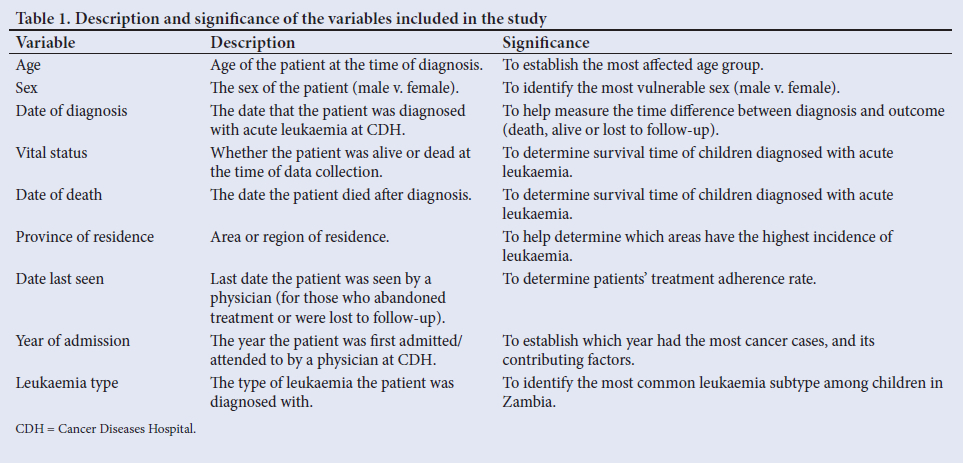
Data were extracted from medical records and electronic databases using a structured chart review form. Data collection was performed by the lead researcher and two hospital data entry clerks, and all entries were systematically cross-checked against the primary patient records to ensure consistency. Missing information was verified using physical records, and the final data set was cleaned and coded in Excel (Microsoft Corp., USA). Variables collected included age at diagnosis, sex, date of diagnosis, vital status at the time of data collection, date of death, province of residence, date last seen (for patients lost to follow-up), year of admission and leukaemia type (Table 1).
Data analysis plan and ethical considerations
Data were analysed using Stata version 17 (StataCorp., USA). A multivariable Poisson regression model was used to identify factors associated with weekly attrition, adjusting for age, sex, type of acute leukaemia, year of admission and province of residence. Time-to-event analysis was also performed using Kaplan-Meier curves for factors that were significantly associated with weekly attrition in the multivariable model. Descriptive statistics were summarised using counts and frequencies. Ethical clearance was obtained from the University of Lusaka Research Ethics Committee (ref. no. FWA00033228-0108/23), the National Health Research Authority (ref. no. NHRA 1015/01/03/2024), and permission to access patient files was obtained from CDH. Informed consent was not required, as the study used only retrospectively collected patient records.
Results
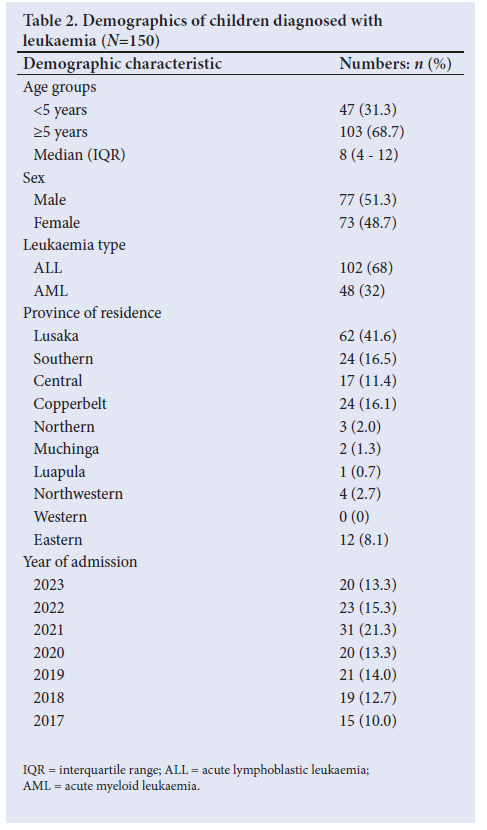
A total of 150 children aged <15 years were included in the study. Of these, 68.7% were aged >5 years, while 31.3% were aged <5 years. The median (interquartile range (IQR)) age was 8 (4 - 12) years. Slightly more patients were male (51.3%) than female (48.7%). Furthermore, 68% of the children had acute lymphoblastic leukaemia (ALL), while 32% had acute myeloid leukaemia (AML). Overall, 8% of the children were alive at the time of data collection, 8.7% were lost to follow-up (unsuccessful contact for >30 days) and 83.3% had died. Mortality was primarily attributed to clinical comorbidities and complications, including anaemia, malnutrition and malaria, together with systemic and socioeconomic barriers to specialised care. These barriers included financial, geographic, institutional and sociocultural constraints. Table 2 provides the demographic characteristics of children diagnosed with acute leukaemia at CDH between 2017 and 2023.
Time from admission to CDH to attrition
The time from admission to CDH to attrition (defined as death or lost to follow-up) varied considerably. Overall, 76% (114/150) of the children experienced attrition within the first three months after admission to CDH, and nearly nine in ten did not continue treatment or follow-up beyond 12 months after admission (Supplementary Fig. 1). The median (IQR) time to attrition was 19 (3 - 78) days, indicating that approximately three-quarters of the children experienced attrition within the first three months after admission to CDH.
Factors associated with weekly attrition of children with acute leukaemia
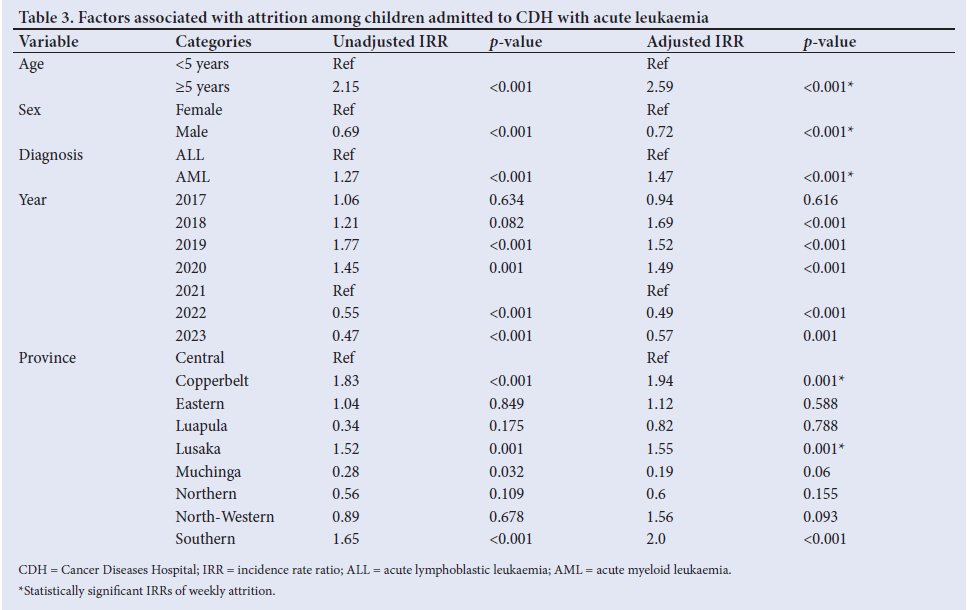
Weekly attrition among children with acute leukaemia was associated with age, sex, type of acute leukaemia, year of admission and province of residence after adjustment for the variables included in the multivariate Poisson regresson model (Table 3). Children aged >5 years had a higher incidence rate ratio (IRR) for attrition (IRR 2.59; JK0.001). Males had a lower IRR for attrition than females (p<0.001). Children with AML had a higher IRR for attrition (IRR 1.47) than those with ALL (p<0.001).
Year of first admission was also significantly associated with weekly attrition. Compared with children first admitted in 2021, those first admitted in 2018 had the highest IRR (IRR 1.69; p<0.001), followed by those first admitted in 2019 (IRR 1.52; p<0.001) and 2020 (IRR 1.49; p<0.001). By contrast, children first admitted in 2022 (IRR 0.49; p<0.001) and 2023 (IRR 0.57) had lower IRRs than those first admitted in 2021. Province of residence was also significantly associated with weekly attrition. Children from Southern, Lusaka and Copperbelt provinces had significantly higher IRRs than those from the Central Province, whereas the remaining provinces did not differ significantly from the reference province.
Time to attrition among children admitted to CDH with acute leukaemia
Time to attrition varied among children with acute leukaemia. Most children experienced attrition within the first 12 weeks after admission, with the steepest decline occurring during the first five weeks. Time to attrition did not differ significantly between children aged >5 years and those aged <5 years (hazard ratio (HR) 0.68, £=0.058) (Supplementary Fig. 2).
Time to attrition was also compared according to leukaemia type (ALL v. AML). The survival curves overlapped, and the difference was not statistically significant (HR 0.87; p=0.525) (Supplementary Fig. 3). Similarly, time to attrition did not differ significantly by year of first admission (HR 1.20; p=0.118) (Supplementary Fig. 4) or province of residence (HR 1.03; p=0.408) (Supplementary Fig. 5).
Discussion
From 2017 to 2023, the number of children admitted with acute leukaemia increased substantially, accompanied by an increase in weekly attrition (defined as mortality and loss to follow-up). While global disparities in childhood cancer outcomes persist, these findings are consistent with broader reports from sub-Saharan Africa, where increasing patient numbers continue to challenge healthcare systems in resource-constrained settings.[5-7] Similarly, the limited available data from Zambia indicate high childhood cancer morbidity and mortality, primarily attributable to treatment abandonment, which is driven by multiple socioeconomic and systemic barriers.[4,8] Although the IRR for attrition in 2017 was not statistically significant, it increased significantly between 2018 and 2022 before declining to its lowest point in 2023, illustrating the temporal volatility of disease management.
Although acute leukaemia is rare, it is associated with high mortality in low-income countries such as Zambia.[17] Standard chemotherapy remains the primary treatment modality in these settings; however, its effectiveness may be limited by severe toxicity and poor outcomes, particularly among patients with comorbidities.[18,19] Across Africa, reported rates of adverse drug reactions vary considerably. A systematic review reported rates as high as 93% in Kenya and 89.8% in Morocco, compared with 5.5% in Ethiopia.[20] By contrast, HICs have transitioned to personalised molecular and immunotherapies, achieving survival rates exceeding 90% through standardised treatment protocols.[21] Zambia, like many other low-income countries, has adapted international treatment guidelines to more cost-effective chemotherapy protocols.[22,23] However, inconsistent access to cytotoxic agents may influence patient regimens, potentially compromising care and contributing to poorer outcomes.[4,24] The early attrition observed in this study may therefore reflect a combination of chemotherapy-related toxicity, inconsistent access to cytotoxic agents and concurrent comorbidities.
While antineoplastic drugs in Zambia are primarily government funded and supplemented by co-operating partners, out-of-pocket payments and the NHI scheme to promote universal health coverage, as in Kenya, Uganda and Rwanda, access to treatment remains a barrier.[14,24] In Zambia, the centralisation of oncology services at a single centre, together with limited specialist staff, compromises outcomes for children with acute leukaemia, as most children with leukaemia are managed by general practitioners.[25] This finding is supported by a study in Limpopo, South Africa (SA), which reported that limited access to treatment centres due to the centralisation of services contributes to delayed diagnosis and poorer survival outcomes.[26] Systemic and socioeconomic barriers, particularly for rural populations, further worsen leukaemia outcomes and increase mortality.[25,27] Long travel distances exacerbate these challenges, often leading parents to seek more accessible alternative therapies rather than conventional treatments.[28] Furthermore, lengthy referral processes may result in high-risk patients presenting with more advanced disease, thereby reducing their chances of survival.[29] Beyond the availability of healthcare facilities, access to care has also been driven by the public's willingness to use available services when needed.[30] The poor outcomes observed among children diagnosed with acute leukaemia in Zambia during the study period are therefore likely to reflect a combination of systemic, socioeconomic and healthcare access-related factors.
Although time to attrition did not differ significantly according to leukaemia type, the overall attrition rate was significantly higher among children with ALL. Although the incidence of ALL is high globally, particularly in East Asia and Andean Latin America, studies from these regions report lower mortality and improved outcomes.[3,31] By contrast, sub-Saharan African countries, including Rwanda, Uganda, Malawi and Tanzania, experience both a high incidence of paediatric leukaemia and increased mortality rates.[3,4,32] Although ALL subtype (e.g. T-cell v. B-cell) is an important determinant of prognosis, immunophenotyping data were unavailable in this study, revealing an important diagnostic limitation.[33] Despite World Health Organization (WHO) recommendations for molecular risk stratification, the diagnosis of acute leukaemia in Zambia continues to rely on cytomorphology and limited flow cytometry, which are insufficient for comprehensive blast characterisation required to optimise treatment.[32-35] Prioritising modern diagnostic and risk-stratification techniques may therefore improve outcomes for children diagnosed with acute leukaemia in Zambia.
In this study, most children experienced attrition within days of admission, resulting in an overall mortality of 83.3%, while only 8% were alive at the time of data collection. This overall survival rate (OSR) is significantly lower than those reported in Uganda (42.1%), SA (52.0%) and HICs such as the United Kingdom (>90%).[32,36] Although intensive care units (ICUs) have been shown to reduce mortality by up to 61%,[37] the absence of a dedicated paediatric ICU and limited supportive care, particularly access to blood products and infection management, remain critical barriers at CDH. These healthcare system limitations may contribute to poor outcomes, particularly among children with high-risk features such as low white blood cell counts (<50,000/μL).[38]·
The increase in leukaemia mortality observed in 2020 and 2022 coincided with peaks in the COVID-19 pandemic and is consistent with global reports of disruption to specialised healthcare services.[39] During the pandemic, redirected resources and patient anxiety were associated with reductions in paediatric admissions of 49.3% in the USA and 63.8% in Germany.[40] Meanwhile, healthcare services across sub-Saharan Africa experienced disruptions affecting >90% of facilities.[41] These findings emphasise the importance of strengthening multilevel emergency preparedness to ensure continuity of care for children with cancer during future public health emergencies, particularly in low-income settings such as Zambia.
Conclusion
This study found an overall mortality of 83.3%, while 8% of children were alive at the time of data collection. Attrition, defined as death or loss to follow-up (8.7%), was included as the study outcome in the survival analysis. These results are consistent with regional trends reported from other countries in sub-Saharan Africa. As the largest reported series of childhood acute leukaemia in Zambia, this study identified ALL as the most common leukaemia subtype. Most deaths occurred within three months of admission. Older age (>5 years), leukaemia type, province of residence and year of admission were significantly associated with weekly attrition.
Study strength and limitations
This retrospective, hospital-based study used routinely collected data from a single national referral centre, which limits the generalisability of the findings to all children with acute leukaemia in Zambia, particularly those who did not reach tertiary care. However, as the largest reported series of childhood acute leukaemia in Zambia, the study included all documented paediatric cases managed at the country's only specialised cancer referral hospital over a seven-year period (2017 - 2023), providing a comprehensive overview of the national referral experience.
Clinical information was limited, with incomplete data on diagnostic methods, disease severity, treatment protocols, supportive care, comorbidities and causes of death, restricting exploration of factors underlying poor outcomes. Death and loss to follow-up were combined into a composite outcome (attrition) because of the small sample size, limiting the distinction between mortality and treatment abandonment. The modest sample size and the high proportion of early attrition reduced the statistical power for time-to-event analyses and constrained the choice of analytical methods. Provincial comparisons were based on case counts rather than population denominators and should not be interpreted as incidence estimates. Finally, important health system factors, including treatment availability, workforce capacity and supportive care, could not be evaluated but may have influenced patient outcomes.
Recommendations
Future studies on acute leukaemia should incorporate detailed clinical data, including treatment regimens, causes of deaths and cost-effectiveness analyses, to improve understanding of factors influencing outcomes among children diagnosed with acute leukaemia in Zambia.
Strengthening medical records for patients with cancer, including the implementation and maintenance of comprehensive electronic medical records, is recommended to improve data quality, facilitate patient follow-up and support future clinical research.
Data availability statement. All relevant data in the article are available from the corresponding author on request.
Declaration. None.
Acknowledgements. The authors would like to acknowledge the hospital administration at CDH in Lusaka, as well as the patients and their families.
Author contributions. MLS designed the study and developed the first and final manuscripts. MN, DM and CM reviewed and substantially contributed to the manuscript. MN and MLS performed data analysis. All authors read and approved the final manuscript for publication.
Funding. None.
Conflicts of interest. None.
References
-
1. Liu W, Fang J, Zhu M, Zhou J, Yuan C. Global, regional, and national burden of childhood leukemia from 1990 to 2021. BMC Pediatr 2025;25(1):571. https://doi.org/10.1186/s12887-025-05847-7
» https://doi.org/10.1186/s12887-025-05847-7 -
2. Sung H, Ferlay J, Siegel RL, et al. Global cancer statistics 2020: GLOBOCAN estimates of incidence and mortality worldwide for 36 cancers in 185 countries. CA Cancer J Clin 2021;71(3):209-249. https://doi.org/10.3322/caac.21660
» https://doi.org/10.3322/caac.21660 -
3. Wang P, Cui J, Ni Z, et al. A cross-sectional analysis of the global burdenof childhood leukemia from 1990 to 2021. J Cancer Res Clin Oncol 2025;151(11):295. https://doi.org/10.1007/s00432-025-06247-1
» https://doi.org/10.1007/s00432-025-06247-1 -
4. Slone JS, Chunda-Liyoka C, Perez M, et al. Pediatric malignancies, treatment outcomes and abandonment of pediatric cancer treatment in Zambia. PLoS ONE 2014;9(2):e89102. https://doi.org/10.1371/journal.pone.0089102
» https://doi.org/10.1371/journal.pone.0089102 -
5. Zapata-Tarrés M, Balandrán JC, Rivera-Luna R, Pelayo R. Childhood acute leukemias in developing nations: Successes and challenges. Curr Oncol Rep 2021;23(5):56. https://doi.org/10.1007/s11912-021-01043-9
» https://doi.org/10.1007/s11912-021-01043-9 -
6. Fuentes-Alabi S, Bhakta N, Vasquez RF, Gupta S, Horton SE. The cost and cost- effectiveness of childhood cancer treatment in El Salvador, Central America: A report from the Childhood Cancer 2030 Network. Cancer 2018;124(2):391-397. https://doi.org/10.1002/cncr.31022
» https://doi.org/10.1002/cncr.31022 -
7. van Heerden J, Zaghloul M, Neven A, et al. Pediatric oncology clinical trials and collaborative research in Africa: Current landscape and future perspectives. JCO Glob Oncol 2020;6:1264-1275. https://doi.org/10.1200/go.20.00159
» https://doi.org/10.1200/go.20.00159 -
8. Hayashi H, Makimoto A, Yuza Y. Treatment of pediatric acute lymphoblastic leukemia: A historical perspective. Cancers 2024;16(4):723. https://doi.org/10.3390/cancers16040723
» https://doi.org/10.3390/cancers16040723 -
9. Inaba H, Pui CH. Advances in the diagnosis and treatment of pediatric acute lymphoblastic leukemia. J Clin Med 2021;10(9):1926. https://doi.org/10.3390/jcm10091926
» https://doi.org/10.3390/jcm10091926 -
10. Malard F, Mohty M. Acute lymphoblastic leukaemia. Lancet 2020;395(10230):1146-1162. https://doi.org/10.1016/s0140-6736(19)33018-1
» https://doi.org/10.1016/s0140-6736(19)33018-1 -
11. Malczewska M, Kosmider K, Bednarz K, Ostapinska K, Lejman M, Zawitkowska J. Recent advances in treatment options for childhood acute lymphoblastic leukemia. Cancers 2022;14(8):2021. https://doi.org/10.3390/cancers14082021
» https://doi.org/10.3390/cancers14082021 -
12. Garniasih D, Susanah S, Sribudiani Y, Hilmanto D. The incidence and mortality of childhood acute lymphoblastic leukemia in Indonesia: A systematic review and meta-analysis. PLoS ONE 2022;17(6):e0269706. https://doi.org/10.1371/journal.pone.0269706
» https://doi.org/10.1371/journal.pone.0269706 -
13. Nyeko R, Kruger M, Niyonzima N, Stijn V, van Heerden J. Paediatric acute myeloid leukaemia epidemiology, treatment approaches, and outcomes in Africa: A review of the literature. BMC Cancer 2025;25(1):1140. https://doi.org/10.1186/s12885-025-14552-8
» https://doi.org/10.1186/s12885-025-14552-8 -
14. Ministry of Health, Zambia. National Cancer Control Strategic Plan: 2022 - 2026. Zambia, Lusaka: MoH, 2022. https://www.iccp-portal.org/sites/default/files/plans/NATIONAL-CANCER-CONTROL-STRATEGIC-PLAN-2022-to-2026.pdf (accessed 11 January 2026).
» https://www.iccp-portal.org/sites/default/files/plans/NATIONAL-CANCER-CONTROL-STRATEGIC-PLAN-2022-to-2026.pdf -
15. Chirande L, Namazzi R, Hockenberry M, et al. Building capacity for pediatric hematological diseases in sub-Saharan Africa. Blood Adv 2025;9(4):939-947. https://doi.org/10.1182/bloodadvances.2024012983
» https://doi.org/10.1182/bloodadvances.2024012983 -
16. Zambia Statistics Agency. 2022 Census of population and housing. Lusaka, Zambia: Zambia Statistics Agency, 2022. https://www.zamstats.gov.zm/wp-content/uploads/2023/12/2022-Census-of-Population-and-Housing-Preliminary.pdf (accessed 11 January 2026).
» https://www.zamstats.gov.zm/wp-content/uploads/2023/12/2022-Census-of-Population-and-Housing-Preliminary.pdf -
17. Sifer SD, Solomon M. Survival status and predictors of mortality among children admitted with acute lymphocytic leukemia at cancer treatment hospitals in Addis Ababa, Ethiopia. Cancer Control 2024;31:10732748241266508. https://doi.org/10.1177/10732748241266508
» https://doi.org/10.1177/10732748241266508 -
18. Walubita M, Sikateyo B, Zulu JM. Challenges for health care providers, parents and patients who face a childhood cancer diagnosis in Zambia. BMC Health Serv Res 2018;18(1):314. https://doi.org/10.1186/s12913-018-3127-5
» https://doi.org/10.1186/s12913-018-3127-5 -
19. Han X, Yun Z, Liu Z, et al. Global, regional, and national burden of acute leukemia and its risk factors from 1990 to 2021 and predictions to 2040: Findings from the global burden of disease study 2021. Biomed Eng Online 2025;24(1):72. https://doi.org/10.1186/s12938-025-01403-7
» https://doi.org/10.1186/s12938-025-01403-7 -
20. Senbeta BS, Liche TN, Ararame GG, Sime LU, Guji AA. Systematic review and meta-analysis of chemotherapy-induced adverse drug reactions among children with cancer in Africa. Infect Agent Cancer 2025;21(10):10. https://doi.org/10.1186/s13027-025-00723-6
» https://doi.org/10.1186/s13027-025-00723-6 -
21. Correa-Carranza V, Rosario-Méndez G, Castillejos-López M, Chávez-Pacheco JL, Galván-Díaz C, Torres-Espíndola LM. Targeted therapies in pediatric B-Cell acute lymphoblastic leukemia: Mechanisms, efficacy, and future directions. Front Pharmacol 2026;17:1654783. https://doi.org/10.3389/fphar.2026.1654783
» https://doi.org/10.3389/fphar.2026.1654783 -
22. Bansal D, Davidson A, Supriyadi E, Njuguna F, Ribeiro RC, Kaspers GJL. SIOP PODC adapted risk stratification and treatment guidelines: Recommendations for acute myeloid leukemia in resource-limited settings. Pediatr Blood Cancer 2023;70(11):e28087. https://doi.org/10.1002/pbc.28087
» https://doi.org/10.1002/pbc.28087 - 23. Ministry of Health, Zambia. Zambia National Formulary. 6th ed. Lusaka, Zambia: MoH, Republic of Zambia.
-
24. Kizub DA, Naik S, Abogan AA, et al. Access to and affordability of World Health Organization essential medicines for cancer in sub-Saharan Africa: Examples from Kenya, Rwanda, and Uganda. Oncologist 2022;27(11):958-970. https://doi.org/10.1093/oncolo/oyac143
» https://doi.org/10.1093/oncolo/oyac143 -
25. Mwamba M, Lombe DC, Msadabwe S, et al. A narrative synthesis of literature on the barriers to timely diagnosis and treatment of cancer in sub-Saharan Africa. Clin Oncol 2023;35(9):e537-e548. https://doi.org/10.1016/j.clon.2023.05.011
» https://doi.org/10.1016/j.clon.2023.05.011 -
26. Ramutumbu NJ, Ramathuba DU, Maputle MS. Barriers to accessing oncology services for effective cancer care in the public health institutions in Limpopo Province, South Africa: A qualitative study. Nurs Rep 2023;13(3):956-968. https://doi.org/10.3390/nursrep13030084
» https://doi.org/10.3390/nursrep13030084 -
27. Gizaw AT, Woldie I, Yilma AN, et al. (2025). Barriers to timely diagnosis and treatment of childhood cancer in sub-Sahara Africa: A qualitative systematic review. BMC Cancer 2025;25:1600. https://doi.org/10.1186/s12885-025-15092-x
» https://doi.org/10.1186/s12885-025-15092-x -
28. Mulrooney DA, Hyun G, Ness KK, et al. The changing burden of long-term health outcomes in survivors of childhood acute lymphoblastic leukaemia: A retrospective analysis of the St Jude Lifetime Cohort Study. Lancet Haematol 2019;6(6):e306-e316. https://doi.org/10.1016/s2352-3026(19)30050-x
» https://doi.org/10.1016/s2352-3026(19)30050-x -
29. Abid N, Bohamad AH, Aljohar HI, et al. Knowledge and awareness of leukemia among the population of Eastern Province, Saudi Arabia. Cureus 2023;15(10):e46382. https://doi.org/10.7759/cureus.46382
» https://doi.org/10.7759/cureus.46382 -
30. Dawkins B, Renwick C, Ensor T, Shinkins B, Jayne D, Meads D. What factors affect patients' ability to access healthcare? An overview of systematic reviews. Trop Med Int Health 2021;26(10):1177-1188. https://doi.org/10.1111/tmi.13651
» https://doi.org/10.1111/tmi.13651 -
31. Yuan C, Zhu M, Shi Y, et al. The global, regional, and national burden of acute lymphoblastic leukemia, 1990 to 2021: A cross-sectional analysis from the 2021 global burden of disease study. Discover Oncol 2025;16:1831. https://doi.org/10.1007/s12672-025-03683-w
» https://doi.org/10.1007/s12672-025-03683-w -
32. Zalwango S, Kalubi P, Ankunda S, Atwiine B. Clinical profiles and survival of children with acute lymphoblastic leukemia in South West Uganda. Qual Prim Care 2024;32(1):003. https://doi.org/10.36648/1479-1064.32.1.03
» https://doi.org/10.36648/1479-1064.32.1.03 -
33. Yi M, Zhou L, Li A, Luo S, Wu K. Global burden and trend of acute lymphoblastic leukemia from 1990 to 2017. Aging 2020;12(22):22869-22891. https://doi.org/10.18632/aging.103982
» https://doi.org/10.18632/aging.103982 -
34. Vardiman JW, Thiele J, Arber DA, et al. The 2008 revision of the World Health Organization (WHO) classification of myeloid neoplasms and acute leukemia: Rationale and important changes. Blood 2009;114(5):937-951. https://doi.org/10.1182/blood-2009-03-209262
» https://doi.org/10.1182/blood-2009-03-209262 -
35. Kachinda W, Trevor K, Peter J, Chirwa E, Chifumbe C, Sumbukeni K. Characterization of chromosomal abnormalities in acute myeloid leukaemia patients at the University Teaching Hospital, Lusaka, Zambia. Int J Res Appl Sci Biotechnol 2020;7(5):234-243. https://doi.org/10.31033/ijrasb.7.5.30
» https://doi.org/10.31033/ijrasb.7.5.30 -
36. Stones DK, De Bruin GP, Esterhuizen TM, Stefan DC. Childhood cancer survival rates in two South African units. S Afr Med J 2014;104(7):501-504. https://doi.org/10.7196/samj.7882
» https://doi.org/10.7196/samj.7882 -
37. Lu L, Liang Q, Yan Y, et al. Dynamic changes in mortality risk factors for acute leukemia patients in the ICU and Post-ICU periods. Ann Hematol 2026;105(3):76. https://doi.org/10.1007/s00277-026-06744-4
» https://doi.org/10.1007/s00277-026-06744-4 -
38. Kachuri L, Jeon S, DeWan AT, et al. Genetic determinants of blood-cell traits influence susceptibility to childhood acute lymphoblastic leukemia. Am J Hum Genet 2021;108(10):1823-1835. https://doi.org/10.1016/j.ajhg.2021.08.004
» https://doi.org/10.1016/j.ajhg.2021.08.004 -
39. Atout M, Tarawneh FS, Al-Kharabsheh A. Challenges faced by mothers caring for children with leukaemia during COVID-19 pandemic: A qualitative study. J Pediatr Nurs 2021;58:e74-e80. https://doi.org/10.1016/j.pedn.2021.01.009
» https://doi.org/10.1016/j.pedn.2021.01.009 -
40. Chou YC, Yen YF, Chu D, Hu HY. Impact of the COVID-19 pandemic on healthcare-seeking behaviors among frequent emergency department users: A cohort study. Int J Environ Res Public Health 2021;18(12):6351. https://doi.org/10.3390/ijerph18126351
» https://doi.org/10.3390/ijerph18126351 -
41. Rine S, Lara ST, Bikomeye JC, et al. The impact of the COVID-19 pandemic on cancer care including innovations implemented in sub-Saharan Africa:A systematic review. J Glob Health 2023;13:06048. https://doi.org/10.7189/jogh.13.06048
» https://doi.org/10.7189/jogh.13.06048

Accepted 25 May 2026