Precision prevention interventions for non-communicable diseases among youth in sub-Saharan Africa: A scoping review
BACKGROUND: Hypertension significantly contributes to the global burden of cardiovascular disease, especially in low- and middle- income countries, including sub-Saharan Africa. OBJECTIVE: To identify existing interventions targeting hypertension prevention among youth aged 13 - 25 years and evaluate the incorporation of precision prevention strategies. In doing so, this review seeks to guide future efforts in reducing hypertension among young populations in SSA. METHODS: We conducted a scoping review aimed to identify interventions for hypertension risk reduction in SSA and map research in this area. Searches across academic databases and grey literature identified 3 301 articles. After removing duplicates, 3 089 articles were screened, with data extracted using a custom template on Covidence and analysed descriptively using narrative synthesis. RESULTS: The review identified 6 interventions targeting hypertension prevention among youth in SSA. While some interventions reported efficacy in improving adherence to dietary guidelines and physical activity, others showed mixed results, particularly regarding substance use. Interventions varied in design, setting, and duration, with a focus on internal (psychological/knowledge-based) and external (health behaviour) conditions. None of the interventions utilised precision prevention methodologies. CONCLUSION: This review identified limited but diverse youth-focused interventions for NCD prevention in SSA, none specifically targeting hypertension or using precision prevention (PP). Despite structural and sociocultural barriers, tailored PP strategies, youth involvement, and theory-based frameworks show promise for enhancing engagement, sustainability, and impact in hypertension prevention for high-risk youth in SSA.
youth; paediatric; hypertension; sub-Saharan Africa; lifestyle; diet; healthy living medicine; precision medicine; precision prevention; precision intervention
Precision prevention interventions for non-communicable diseases among youth in sub-Saharan Africa: A scoping review
M J SamakoskyI; S A NorrisII, III; S S SamakoskyIV
IBA (Hons); SAMRC Developmental Pathways for Health Research Unit, Department of Paediatrics, Faculty of Health Sciences; University of the Witwatersrand, Johannesburg, South Africa
IIPhD; SAMRC Developmental Pathways for Health Research Unit, Department of Paediatrics, Faculty of Health Sciences; University of the Witwatersrand, Johannesburg, South Africa
IIIPhD; University of Southampton, School of Health and Human Development, Faculty of Medicine; Southampton, England
IVBSocSci; Faculty of Health Sciences, University of Cape Town, South Africa
BACKGROUND: Hypertension significantly contributes to the global burden of cardiovascular disease, especially in low- and middle- income countries, including sub-Saharan Africa.
OBJECTIVE: To identify existing interventions targeting hypertension prevention among youth aged 13 - 25 years and evaluate the incorporation of precision prevention strategies. In doing so, this review seeks to guide future efforts in reducing hypertension among young populations in SSA.
METHODS: We conducted a scoping review aimed to identify interventions for hypertension risk reduction in SSA and map research in this area. Searches across academic databases and grey literature identified 3 301 articles. After removing duplicates, 3 089 articles were screened, with data extracted using a custom template on Covidence and analysed descriptively using narrative synthesis.
RESULTS: The review identified 6 interventions targeting hypertension prevention among youth in SSA. While some interventions reported efficacy in improving adherence to dietary guidelines and physical activity, others showed mixed results, particularly regarding substance use. Interventions varied in design, setting, and duration, with a focus on internal (psychological/knowledge-based) and external (health behaviour) conditions. None of the interventions utilised precision prevention methodologies.
CONCLUSION: This review identified limited but diverse youth-focused interventions for NCD prevention in SSA, none specifically targeting hypertension or using precision prevention (PP). Despite structural and sociocultural barriers, tailored PP strategies, youth involvement, and theory-based frameworks show promise for enhancing engagement, sustainability, and impact in hypertension prevention for high-risk youth in SSA.
Keywords: youth; paediatric; hypertension; sub-Saharan Africa; lifestyle; diet; healthy living medicine; precision medicine; precision prevention; precision intervention.
Hypertension, a leading risk factor for cardiovascular disease (CVD), contributes significantly to the growing burden of non-communicable diseases (NCDs) worldwide, accounting for 74.36% of global mortality.[1] This issue is especially pronounced in low- and middle-income countries (LMICs), including those in sub-Saharan Africa (SSA), where limited healthcare resources exacerbate the impact of hypertension and related conditions.[2] Approximately 75% of total deaths secondary to CVDs occur in LMICs.[3] While global health responses have largely focused on treating and detecting hypertension in adults, there is an urgent need to address the rising risk of hypertension among adolescents and young adults, where early-life risk factors contribute to CVD and other NCDs.
The foundations of adult hypertension begin in youth.[4] Findings from the Lifepath research consortium demonstrate that health inequalities start early, with risk factors like poor diet and physical inactivity being more prevalent in lower socioeconomic groups.[4] These early exposures translate to adverse biological markers such as elevated cholesterol and blood pressure that accumulate over time, leading to higher rates of hypertension and CVD in adulthood.[5] This cumulative risk underscores youth as a critical period for targeted interventions to establish healthy habits and prevent the onset of such diseases.[6]
Prevalence of CVD risk factors among youth in SSA has increased. As an example, a recent study of youth in Mozambique found high rates of smoking (10.8% among rural men), alcohol use (38.6% among urban men), limited physical activity (particularly among women in urban areas) and obesity (21.6% among urban women and 25.2% among urban men).[7] Despite some progress in implementing interventions targeting existing cases of NCDs, there is a gap in the literature regarding preventive strategies specifically designed to target CVD risk factors in younger populations.
Precision prevention (PP) is an emerging approach in public healthcare that seeks to tailor interventions based on distinct risk profiles of individuals or specific subpopulations. This approach builds on the foundations of precision medicine, which began gaining traction in the early 2000s with advancements in genomic sequencing technologies. Defined as 'an approach for disease treatment and prevention that takes into account individual variability in genes, environment and lifestyle',[8] PP aims to manage health risks to offset the onset of disease.[9] PP entails personalising interventions based on individual risk profiles by integrating multi-dimensional data from genomic, environmental, behavioural and social sources. Although it is unclear whether PP frameworks have been studied or implemented for youth in SSA, high-income countries have illustrated the potential of PP through targeted lifestyle interventions and genetic risk profiling.[10,11]
The CARDIOPLUS study[12] employed personalised primary care behavioural counselling tailored to individual patients' needs to mitigate CVD risk factors. The study focused on improving diet, increasing physical activity, reducing alcohol consumption and promoting smoking cessation among adults, with personalised advice provided by general practitioners.[12] The intervention was effective in achieving significant reductions in body weight, blood pressure, cholesterol levels, and triglycerides, alongside improved patient compliance and satisfaction with treatment.[12] By customising lifestyle modifications based on individual health profiles and monitoring progress over time, the study demonstrated the potential of PP to reduce CVD risk and enhance treatment outcomes in a high-income setting like Poland.[12] This personalised approach, grounded in the specific needs and behaviours of patients, highlights the effectiveness of targeted interventions in preventing the onset of NCDs.
The present paper has two primary aims: (i) to identify existing interventions in SSA designed to prevent hypertension among youth; and (ii) to evaluate whether any of these interventions incorporate PP strategies. By synthesising the scientific literature on interventions for hypertension among youth in SSA, the present study seeks to bridge the knowledge gap and guide future efforts in reducing the burden of hypertension. This research will build on existing reviews, including those by Adom et al.,[13] Sampson et al.,[14] and Daniels et al.[15] which explored lifestyle-based interventions in SSA targeting youth health, focusing on obesity prevention, cardiovascular health promotion and reducing risky behaviours, with varying emphasis on theory-based approaches, environmental factors and community involvement for sustainability. Unlike these reviews, which did not specifically investigate principles of PP or target youth aged 13 - 25 years, our review aims to expand the scope, aiming to explore PP strategies tailored to an older youth demographic in SSA.
Ethics
This paper is part of a larger research project which received ethical approval from the Human Ethics Research Committee University of the Witwatersrand, Johannesburg, South Africa (SA) (ref. no. M220818).
Methods
This scoping review is developed in accordance with the Preferred Reporting Items for Systematic Reviews and Meta-Analyses-Scoping Review Extension (PRISMA).[16] It is also informed by the Joanna Briggs Institute framework for scoping reviews.[17]
Information sources
Searches were undertaken in 8 electronic bibliographic databases including PubMed, Scopus, PsycINFO, ScienceDirect, DOAJ, Web of Science, Cochrane Libraries and JSTOR, and grey literature databases including Google Scholar. Manual screening of the reference lists of reviews or discussion papers was also undertaken.
Search strategy and eligibility criteria
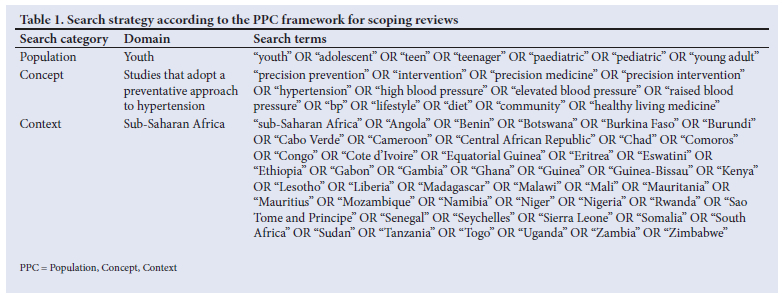
Preliminary searches and extensive prior reading established the final search terms and eligibility criteria. The search strategy was developed and implemented according to the Population, Concept and Context (PCC) format (Table 1).[16]
We first searched for peer-reviewed original studies on interventions for hypertension in youth (between the ages of 13 and 25 years) in SSA which focused on mitigating the prevalence of associated risk factors of hypertension. Thereafter, to understand the extent to which interventions utilised PP frameworks or concepts, we applied the following criteria: (i) inclusion of individual risk assessment using genetic and biometric data; (ii) involvement of continuous health monitoring; (iii) inclusion of tailored dietary and lifestyle recommendations; and (iv) inclusion of the integration of big-data analytics. Additionally, we searched directly for interventions labelled 'precision medicine' or its derivatives (e.g. 'personalised medicine').
Our search strategy for grey literature was guided by the specific database, i.e. Google search operators or website search fillers. Eligible articles included those published between September 2012 and September 2024. Articles were required to refer to 'hypertension' or its derivatives in the title and/or abstract and the introduction, methods and/or results.
We excluded reviews, case reports and case studies with a mean participant age >25 years or if <50% of participants were 13 - 25 years old. Articles were excluded if they were not relevant to the early prevention of hypertension, or if they focused on young participants who had already been diagnosed with hypertension. Only articles whose study context and setting were based within sub-Saharan Africa were included.
Screening
Search results were imported into EndNote (version 20). All stages of the screening process were conducted on Covidence (Veritas Health Innovation, Australia). Duplicates were removed automatically by Covidence, and we manually checked to ensure no duplicates remained. Title, abstract, and full-text screening against inclusion and exclusion criteria were performed independently in correspondence. Discrepancies at each screening stage were discussed until consensus was reached and disagreements were resolved between the three reviewers.
Data extraction, synthesis and analysis
The Covidence extraction document was modified using an iterative process. To structure how we reported preventative interventions, we created a data extraction form modelled after the template for Intervention Description and Replication (TIDieR) checklist.[16] Data extraction was conducted independently in duplicate. Data were analysed and summarised narratively in text and presented in tables and graphs where appropriate.
Results
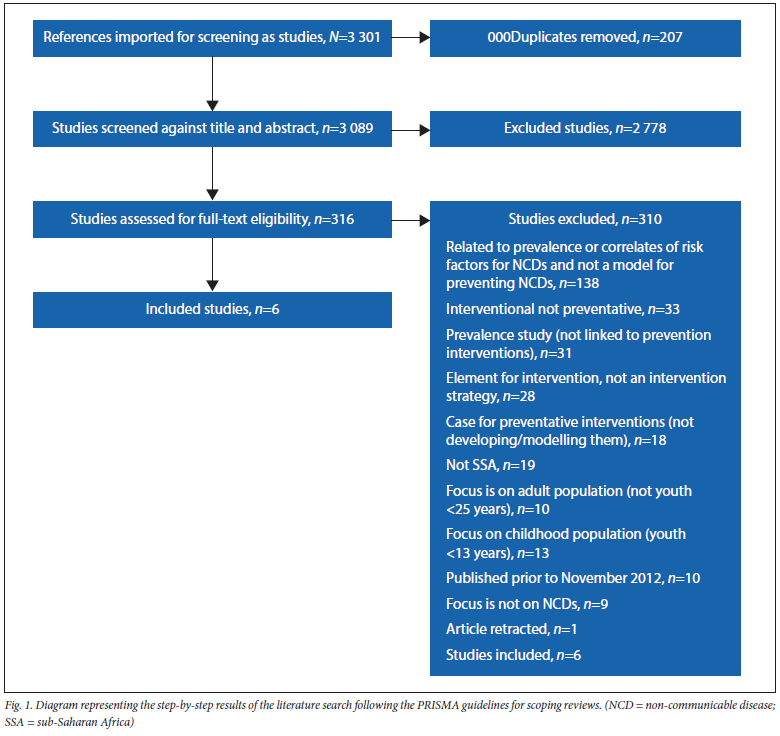
A flow diagram of the article selection process is shown in Fig. 1. Searches retrieved 3 301 articles, of which a total of 6 articles corresponding to 6 unique intervention projects were included in this review.
Context and characteristics of included papers
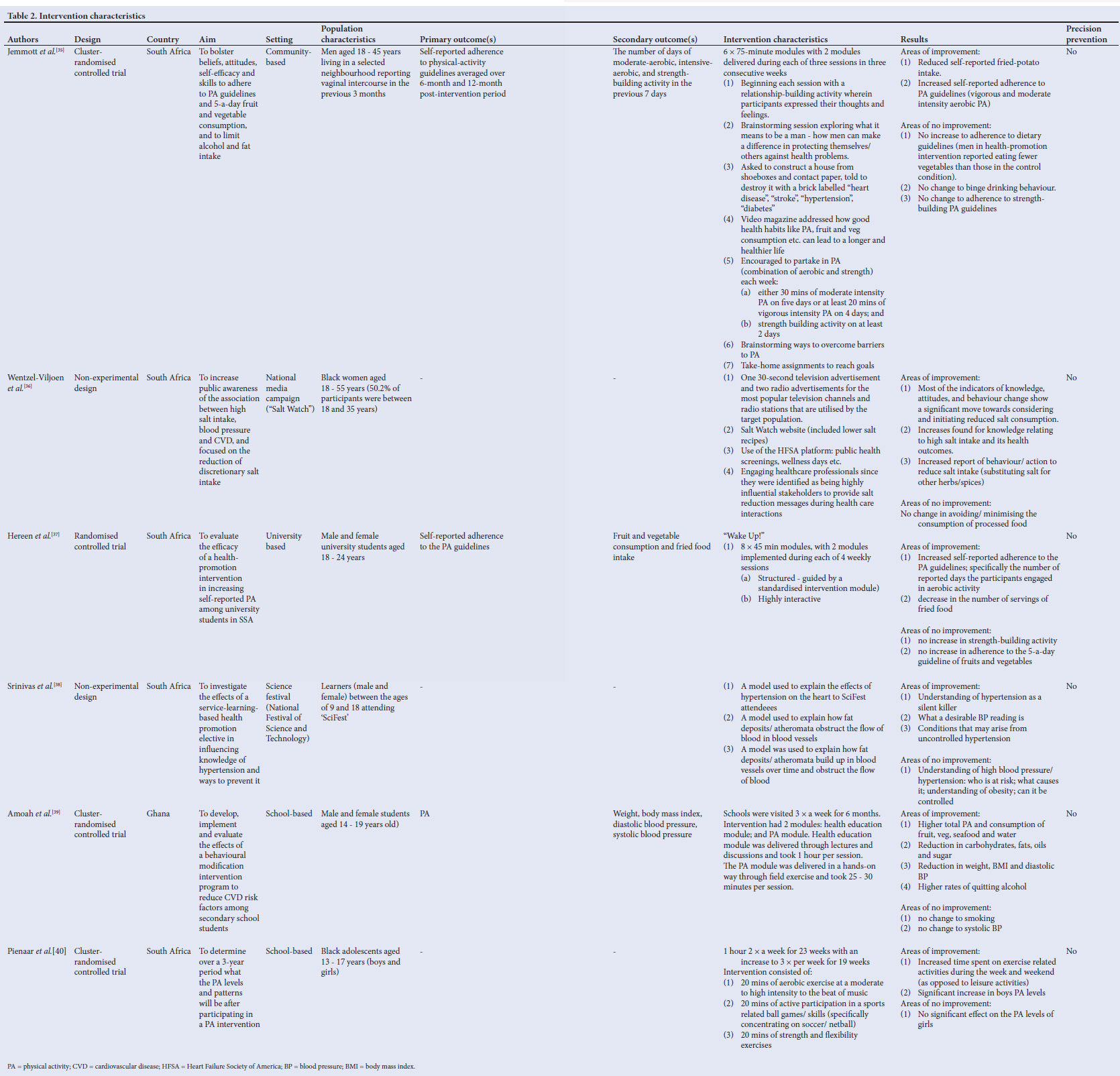
The included studies, detailed in Table 2, primarily focused on SA, with one conducted in Ghana. Among them, three were cluster randomised controlled trials, one was a randomised controlled trial, one was a public awareness media campaign and one was a demonstration at a science festival. Three interventions were conducted in educational settings (two in schools and one in a university), one at a science festival, one as a public media campaign, and one as a community-based intervention. The duration of interventions varied from 1 - 2 hours up to 6 months.
Conditions targeted or addressed
The interventions targeted two main types of conditions, i.e. internal (psychological/knowledge-based) and external (health behaviour-related). Internal conditions focused on aspects like health beliefs, attitudes, awareness, knowledge, and self-efficacy. External factors addressed included adherence to physical activity guidelines, fruit and vegetable consumption, alcohol intake, salt intake, smoking (tobacco and marijuana), and fat intake.
Theoretical bases
Of the 6 interventions included, 3 had no theoretical basis. 2 of the 6 interventions were based on a combination of both Social Cognitive Theory and the Theory of Planned Behaviour, and 1 of the interventions was based on the Theory of Reasoned Action.
Precision prevention
The interventions reviewed incorporated elements such as physical activity guidelines, dietary recommendations, and health education modules, focusing largely on lifestyle modifications. However, none of the interventions fully utilised PP frameworks based on the established criteria. Specifically, there was no evidence of conducting individual risk assessments that leverage genetic or biometric data, which are essential components of PP. Furthermore, the reviewed interventions lacked continuous health monitoring beyond periodic check-ins to evaluate the success of the programmes. Additionally, the reviewed interventions did not integrate big-data analytics for tailoring the recommendations.
Efficacy
The efficacy of the interventions varied across different areas of focus. While some interventions showed limited efficacy in improving adherence to dietary guidelines, others reported reduced consumption of fried foods. Only one intervention showed improvement in adherence to dietary guidelines along with a reduction in fats, oils and sugar. Regarding PA, some interventions increased adherence to aerobic PA but not strength-building guidelines. Substance use findings were also mixed, with some interventions reporting changes in binge-drinking behaviour while others reported higher rates of quitting alcohol. None of the interventions showed a reduction in smoking.
Facilitators of intervention success
Incorporating aerobic exercise into physical activity interventions was shown to boost adherence to guidelines, promoting more active lifestyles among youth. Utilising popular media platforms effectively disseminated hypertension prevention information. Involving influential figures like community leaders enhance intervention impact. Peer-led interventions garner higher acceptability and engagement from adolescents, emphasising community involvement in health promotion. Embedding interventions in existing structures like schools reduces attrition rates and ensures sustained commitment to the programme.
Barriers to intervention success
Barriers to intervention success include household members' exclusion from interventions, which affects behaviour change, particularly in diet control influenced by meal preparers. Urbanisation saturates health messages, impeding behavioural change, while rural areas need structural interventions for increased vegetable consumption. Sustained lifestyle changes require continuous access to information, beyond one-time interventions for awareness. Gender, socioeconomic and cultural factors impact physical activity, while neighbourhood safety influences activity levels. Tailoring interventions to specific contexts and demographics is vital for overcoming these barriers and enhancing hypertension prevention efficacy.
Discussion
Only six studies met all inclusion criteria - although they addressed some general NCD preventative behaviours, none specifically targeted hypertension in youth. None of the interventions incorporated elements of PP. The reviewed studies were implemented in diverse settings, including schools, universities, community venues, and science festivals, each presenting unique benefits and limitations for intervention reach and sustainability. Schools and universities provided structured environments that facilitated engagement and follow-up, though they relied on sustained staff involvement for continuity.[18,19] Less structured settings, such as community venues and festivals, enabled broader demographic reach but struggled with long-term impact owing to short-term engagement.[20] Notably, online and mobile health interventions, which show promise in enhancing youth health outcomes through caregiver involvement,[21] were not utilised in these studies.
The use of theory-based frameworks, including Social Cognitive Theory and the Theory of Planned Behaviour, strengthened intervention strategies by addressing both personal motivators, like self-efficacy, and environmental supports, such as family and school.[22] These frameworks are particularly relevant in SSA, where cultural adaptation is key to sustainability and impact.[23] Findings highlighted variable effectiveness across interventions targeting diet, physical activity and substance use, reflecting the need for context-specific adaptations in SSA. Socioeconomic and cultural barriers - such as addiction, neighbourhood safety and family support - impact feasibility, while facilitators like peer-led initiatives and community leader involvement were shown to improve engagement and support.[18] Including youth in the design of interventions proved beneficial, enhancing alignment with autonomy needs and addressing barriers like limited voice in decision-making and power dynamics with providers.[24-26]
Previous reviews have assessed lifestyle-based interventions for youth in SSA with a general focus on NCD prevention but few have specifically addressed hypertension in this demographic. For instance, Adom et al.[13] evaluated school-based interventions for childhood obesity in children aged 6 - 15 years, showing mixed effectiveness and noting that most lacked essential environmental supports, such as family involvement, and often relied on short-term implementation. Sampson et al.[14] examined cardiovascular health interventions in SSA, emphasising health promotion principles and the potential of WHO's 'best buy' strategies, particularly when combined with community and economic partnerships to enhance sustainability. Daniels et al.[15] explored interventions for health-risk behaviours among SA youth aged 9 - 19 years, suggesting that locally tailored, theory-based and culturally relevant approaches could significantly improve engagement and outcomes. However, none of these studies explicitly targeted hypertension. Collectively, these findings indicate a gap in SSA youth health interventions addressing hypertension specifically and suggest that future initiatives should leverage theory-based frameworks and incorporate local cultural and socioeconomic factors to enhance their relevance and long-term impact.
None of the reviewed interventions in this review incorporated PP strategies, such as individualised genetic or biometric risk assessments, continuous health monitoring or the integration of big-data analytics to tailor interventions.[27-30] Instead, the existing interventions relied on traditional public health models, providing broad recommendations for physical activity, diet and health education. Additionally, none of the previous reviews by Adom et al.,[13] Sampson et al.[14] or Daniels et al.[15] spoke to interventions that incorporated PP strategies. The absence of PP in SSA interventions can be attributed to several challenges that inhibit its adoption in LMICs, including limited healthcare infrastructure,[31] resource constraints for large-scale data collection, and the significant costs associated with advanced technologies like genomic sequencing and real-time monitoring. These barriers are particularly pronounced in SSA, where healthcare systems often lack the resources to support PP's data-driven approach.[31]
In high-income settings, PP has been applied with positive results, particularly for managing cardiovascular health and preventing hypertension. Trials in these regions have utilised data-driven approaches to identify high-risk individuals, enabling more effective and timely interventions.[32,33] The success of PP trials in high-income settings highlights the potential for PP in SSA to efficiently reduce costs by targeting high-risk youth populations, enabling early identification of risk factors and timely interventions to prevent disease onset while optimising resource use. PP also offers a scalable solution that could bridge the gap between traditional public health models and emerging technologies, ensuring more sustainable and impactful NCD prevention efforts across diverse populations in SSA.[8]
Conclusion and recommendations
This review highlights a gap in PP applications for hypertension prevention in SSA youth, emphasising the need for research to integrate PP into targeted interventions. Future studies should assess the feasibility of using biometric data to develop personalised prevention strategies. Collaborative efforts among governments, healthcare organisations, and academic institutions are essential to address infrastructure challenges and ensure PP approaches are culturally relevant. Direct engagement with youth can enhance the design and implementation of interventions by aligning with social and cultural factors that influence health behaviours. Understanding youth perspectives will improve intervention relevance, acceptability, and sustainability, potentially mitigating unique environmental challenges and fostering program buy-in.[34]
While the infrastructural and economic challenges in SSA pose obstacles to adopting PP, evidence from high-income countries suggests that data-driven, targeted approaches could enable cost-effective, timely interventions for high-risk youth. Addressing these gaps with culturally adapted youth-inclusive PP strategies could support sustainable, impactful hypertension prevention across SSA.
Declaration. None.
Acknowledgements. We would like to express our sincere gratitude to the people that have contributed to the completion of this research and the preparation of this article.
Author contributions. MJS conceived and designed the research, conducted the literature search and analysed data, drafted and revised the manuscript, prepared figures and tables and co-ordinated the submission process. SSS assisted with data collection, reviewed and edited the manuscript for grammar, style and formatting. SAN conceived and designed the research, and supervised the research including providing critical input and guidance in the formulation of this research and throughout the research process.
Funding. None.
Conflicts of interest. None.
References
-
1. Bai J, Cui J, Shi F, Yu C. Global epidemiological patterns in the burden of main non-communicable diseases, 1990 - 2019: Relationships with socio-demographic index. Int J Public Health 2023;68:1605502. https://doi.org/10.3389/ijph.2023.1605502
» https://doi.org/10.3389/ijph.2023.1605502 -
2. Kane J, Landes M, Carroll C, Nolen A, Sodhi S. A systematic review of primary care models for non-communicable disease interventions in Sub-Saharan Africa. BMC Family Practice 2017;18(1):46. https://doi.org/10.1186/s12875-017-0613-5
» https://doi.org/10.1186/s12875-017-0613-5 -
3. Pandey A, Dhimal M, Shrestha N, et al. Burden of cardiovascular diseases in Nepal from 1990 to 2019: The Global Burden of Dis Study, 2019. Glob Health Epidemiol Genom 2023:2023:3700094. https://doi.org/10.1155/2023/3700094
» https://doi.org/10.1155/2023/3700094 -
4. Vineis P, Avendano-Pabon M, Barros H, et al. Special report. The biology of inequalities in health: The Lifepath Consortium. Front Public Health 2020;8:118. https://doi.org/10.3389/fpubh.2020.00118
» https://doi.org/10.3389/fpubh.2020.00118 -
5. Mikkelsen B, Williams J, Rakovac I, et al. Life course approach to prevention and control of non-communicable diseases. BMJ 2019;364:l257. https://doi.org/10.1136/bmj.l257
» https://doi.org/10.1136/bmj.l257 -
6. Singh RK, Chang HW, Yan D, et al. Influence of diet on the gut microbiome and implications for human health. J Transl Med 2017;15(1):73. https://doi.org/10.1186/s12967-017-1175-y
» https://doi.org/10.1186/s12967-017-1175-y -
7. Silva I, Damasceno A, Fontes F, et al. Prevalence of cardiovascular risk factors among young adults (18 - 25 years) in Mozambique. J Cardiovasc Dev Dis 2023;10(7):298. https://doi.org/10.3390/jcdd10070298
» https://doi.org/10.3390/jcdd10070298 -
8. Prasad RB, Groop L. Precision medicine in type 2 diabetes. J Intern Med 2019;285(1):40-48. https://doi.org/10.1111/joim.12859
» https://doi.org/10.1111/joim.12859 -
9. Kagura J, Adair LS, Munthall RJ, Pettifor JM, Norris SA. Association between early life and growth and blood pressure trajectories in black South African children. Hypertension 2016;68(5):1123-1131. https://doi.org/10.1161/HYPERTENSIONAHA.116.08046
» https://doi.org/10.1161/HYPERTENSIONAHA.116.08046 -
10. Leopold JA, Loscalzo J. Emerging role of precision medicine in cardiovascular disease. Circ Res 2018;122(9):1302-1315. https://doi.org/10.1161/CIRCRESAHA.117.31078
» https://doi.org/10.1161/CIRCRESAHA.117.31078 -
11. Naithani N, Sinha S, Misra P, Vasudevan B, Sahu, R. Precision medicine: Concept and tools. Med J Armed Forces India 2021;77(3):249-257. https://doi.org/10.1016/j.mjafi.2021.06.021
» https://doi.org/10.1016/j.mjafi.2021.06.021 -
12. Bielecka-Dabrowa A, Lewek J, Sakowicz A, et al.; Cardioplus Investigators. Effects of implementing personalised health education in ambulatory care on cardiovascular risk factors, compliance and satisfaction with treatment. J Pers Med 2022;12(10):1583. https://doi.org/10.3390/jpm12101583
» https://doi.org/10.3390/jpm12101583 -
13. Adom T, De Villiers A, Puoane T, Kengne AP. School-based interventions targeting nutrition and physical activity, and body weight status of African children: A systematic review. Nutrients 2019;12(1):95. https://doi.org/10.3390/nu12010095
» https://doi.org/10.3390/nu12010095 -
14. Sampson UK, Amuyunzu-Nyamongo M, Mensah GA. Health promotion and cardiovascular disease prevention in sub-Saharan Africa. Prog Cardiovasc Dis 2013;56(3):344-355. https://doi.org/10.1016/j.pcad.2013.10.007
» https://doi.org/10.1016/j.pcad.2013.10.007 -
15. Daniels KJ, Hoosen I, Pharaoh H. Health risk behaviour prevention/intervention programmes targeted at youth/adolescents engaging in risky behaviour-a scoping review. J Public Health 2024;1(1):1-10. https://doi.org/10.1007/s10389-024-02329-5
» https://doi.org/10.1007/s10389-024-02329-5 -
16. Tricco AC, Lillie E, Zarin W, et al. PRISMA extension for scoping reviews (PRISMA-ScR): Checklist and explanation. Ann Intern Med 2018;169(7):467-473. https://doi.org/10.7326/M18-0850
» https://doi.org/10.7326/M18-0850 -
17. Peters MD, Godfrey CM, Khalil H, et al. Guidance for conducting systematic scoping reviews. Int J Evid Based Healthc 2015;13(3):141-146. https://doi.org/10.1097/XEB.0000000000000050
» https://doi.org/10.1097/XEB.0000000000000050 -
18. Breet E, Matooane M, Tomlinson M, Bantjes J. Systematic review and narrative synthesis of suicide prevention in high-schools and universities: A research agenda for evidence-based practice. BMC Pub Health 2021;21(1):1116. https://doi.org/10.1186/s12889-021-11124-w
» https://doi.org/10.1186/s12889-021-11124-w -
19. Herlitz L, Macintyre H, Osborn T, Bonell C. The sustainability of public health interventions in schools: A systematic review. Implement Sci, 2020;15. https://doi.org/10.1186/s13012-019-0961-8
» https://doi.org/10.1186/s13012-019-0961-8 -
20. Nickel S, Knesebeck O. Do multiple community-based interventions on health promotion tackle health inequalities? Int J Equity Health 2020;19(1):157. https://doi.org/10.1186/s12939-020-01271-8
» https://doi.org/10.1186/s12939-020-01271-8 -
21. Fedele D, Cushing C, Fritz A, Amaro C, Ortega A. Mobile health interventions for improving health outcomes in youth: A meta-analysis. JAMA Pediatrics 2017; 171(5):461-469. https://doi.org/10.1001/jamapediatrics.2017.0042
» https://doi.org/10.1001/jamapediatrics.2017.0042 -
22. Davis R, Campbell R, Hildon Z, Hobbs L, Michie S. Theories of behaviour and behaviour change across the social and behavioural sciences: A scoping review. Health Psychol Rev 2015;9(3):323-344. https://doi.org/10.1080/17437199.2014.941722
» https://doi.org/10.1080/17437199.2014.941722 -
23. Michie S, Jochelson K, Markham WA, Bridle C. Low-income groups and behaviour change interventions: A review of intervention content, effectiveness and theoretical frameworks. J Epidemiol Community Health 2009;63(8):610-622. https://doi.org/10.1136/jech.2008.078725
» https://doi.org/10.1136/jech.2008.078725 -
24. Nagpaul T, Chen J. Self-determination theory as a framework for understanding needs of youth at-risk: Perspectives of social service professionals and the youth themselves. Child Youth Serv Rev 2019;99:328-342. https://doi.org/10.1016/J.CHILDYOUTH.2019.02.015
» https://doi.org/10.1016/J.CHILDYOUTH.2019.02.015 -
25. Curran T, Wexler L. School-based positive youth development: A systematic review of the literature. Sch Health 2017;87(1):71-80. https://doi.org/10.1111/josh.12467
» https://doi.org/10.1111/josh.12467 -
26. Barnett E, Concepcion-Zayas M, Zisman-Ilani Y, Bellonci C. Patient-centered psychiatric care for youth in foster care: A systematic and critical review. J Public Child Welf 2018;13(1)462-489. https://doi.org/10.1080/15548732.2018.1512933
» https://doi.org/10.1080/15548732.2018.1512933 -
27. Dzau VJ, Hodgkinson CP. Precision hypertension. Hypertension 2023;81(4)702-708. https://doi.org/10.1161/hypertensionaha.123.21710
» https://doi.org/10.1161/hypertensionaha.123.21710 -
28. Kronish IM, Cheung YK, Shimbo D, et al. Increasing the precision of hypertension treatment through personalised trials: A pilot study. J Gen Int Med 2019;34:839-845. https://doi.org/10.1007/s11606-019-04831-z
» https://doi.org/10.1007/s11606-019-04831-z -
29. Herman WH, Ye W. Precision prevention of diabetes. Diabetes Care 2023;46(11):1894-1896. https://doi.org/10.2337/dci23-0052
» https://doi.org/10.2337/dci23-0052 -
30. Weeramanthri TS, Dawkins HJS, Baynam G, Bellgard M, Gudes O, Semmens JB. Editorial: Precision Public Health. Front Public Health 2018;6:121. https://doi.org/10.3389/fpubh.2018.00121
» https://doi.org/10.3389/fpubh.2018.00121 -
31. Ataguba JE, Akazili J, McIntyre D. Socioeconomic-related health inequality in South Africa: Evidence from general household surveys. Int J Equity Health 2011;10:48. https://doi.org/10.1186/1475-9276-10-48
» https://doi.org/10.1186/1475-9276-10-48 -
32. Cicolini G, Simonetti V, Comparcini D, et al. Efficacy of a nurse-led email reminder program for cardiovascular prevention risk reduction in hypertensive patients: A randomised controlled trial. Int J Nurs Stud 2014;51(6):833-843. https://doi.org/10.1016/j.ijnurstu.2013.10.0010
» https://doi.org/10.1016/j.ijnurstu.2013.10.0010 -
33. Soltani S, Saraf-Bank S, Basirat R, et al. Community-based cardiovascular disease prevention programmes and cardiovascular risk factors: A systematic review and meta-analysis. Pub Health 2021;200:59-70. https://doi.org/10.1016/j.puhe.2021.09.006
» https://doi.org/10.1016/j.puhe.2021.09.006 - 34. Pharaoh H, Frantz J, Smith M. Concept mapping: Stakeholders' perceptions of what should be included in intervention programmes aimed at reducing engagement in health risk behaviour amongst youth. African J Phys Health Educ Recreat Dance 2014;2(1):44-58
-
35. Jemmott JB, Jemmott LS, Ngwane Z, et al. Theory-based behavioral intervention increases self-reported physical activity in South African men: A cluster-randomised controlled trial. Prev Med 2014;64, 114-120. https://doi.org/10.1016/j.ypmed.2014.04.012
» https://doi.org/10.1016/j.ypmed.2014.04.012 -
36. Wentzel-Viljoen E, Steyn K, Lombard C, et al. Evaluation of a mass-media campaign to increase the awareness of the need to reduce discretionary salt use in the South African population. Nutrients 2017;9(11):1238. https://doi.org/10.3390/nu9111238
» https://doi.org/10.3390/nu9111238 -
37. Heeren GA, Jemmott JB, Marange CS, et al. Health-promotion intervention increases self-reported physical activity in sub-Saharan African university students: A randomised controlled pilot study. Behav Med 2018;44(4):297-305. https://doi.org/10.1080/08964289.2017.1350134
» https://doi.org/10.1080/08964289.2017.1350134 -
38. Srinivas S, Wrench W, Bradshaw K, Dukhi N. Hypertension: Preliminary health promotion activity based on service-learning principles at a South African national science festival. J Community Health 2012;41(8):1-11. https://doi.org/10.1007/s10900-015-0130-1
» https://doi.org/10.1007/s10900-015-0130-1 -
39. Amoah J, Said S, Rampal L, et al. Effects of a school-based intervention to reduce cardiovascular disease risk factors among secondary school students: A cluster-randomised, controlled trial. PLoS ONE 2021;16(11):e0259581. https://doi.org/10.1371/journal.pone.0259581
» https://doi.org/10.1371/journal.pone.0259581 -
40. Pienaar AE, Salome Kruger H, Steyn HS, Naudé D. Change over three years in adolescents' physical activity levels and patterns after a physical activity intervention: play study. J Sports Med Phys Fitness 2012;52(3),300-310. https://pubmed.ncbi.nlm.nih.gov/22648469/
» https://pubmed.ncbi.nlm.nih.gov/22648469/

Accepted 11 November 2025