Developing simulation-based training for paediatric registrars using best evidence: Sepsis and the Phoenix Sepsis Criteria
BACKGROUND: Sepsis is a leading cause of morbidity and mortality in children, particularly in resource-restricted settings. Early recognition and management are crucial to improving patient outcomes. Despite fairly extensive clinical exposure, paediatric registrars often manage these cases without direct supervision or time for critical reflection. Simulation-based learning experiences (SBLEs) offer a platform for mastering emergency care without risking patient safety. OBJECTIVE: To develop, implement and evaluate an SBLE for paediatric registrars to enhance their confidence and learning in managing paediatric sepsis, incorporating the recently published Phoenix Sepsis Criteria and current evidence-based guidelines. METHODS: An SBLE was developed according to the ADDIE instructional model. The learning experience included a prebriefing phase, a scenario execution using a SimBaby® manikin and a structured debriefing. Paediatric registrars evaluated the SBLE using the modified Simulation Effectiveness Tool (SET-M), which assessed self-reported learning and confidence across the prebriefing, simulated scenario and debriefing phases. RESULTS: Seven registrars participated in the SBLE. The SET-M demonstrated high scores across all domains, with high median scores obtained for prebriefing (6/6), learning (17/18), confidence (16/18) and debriefing (15/15). CONCLUSION: This SBLE enhanced both confidence and learning related to managing paediatric sepsis as reported by participants. The simulation also provided a structured platform to introduce the Phoenix Sepsis Criteria and discuss context-appropriate care in resource-limited settings. The value of simulation in paediatric emergency training is demonstrated.
Simulation-based learning experience; paediatrics; sepsis; ADDIE; Phoenix Sepsis Criteria
Developing simulation-based training for paediatric registrars using best evidence: Sepsis and the Phoenix Sepsis Criteria
M C MyburghI, II; S C BrownIII; M J LabuschagneIV
IMB ChB, MSc, PEM, Dip PEC, PhD (HPE); Department of Paediatrics and Child Health, Faculty of Health Sciences, University of the Free State, Bloemfontein, South Africa
IIMB ChB, MSc, PEM, Dip PEC, PhD (HPE); Department of Internal Medicine, 3 Military Hospital, Tempe Military Base, Bloemfontein, South Africa
IIIDMed, FC Paed, DCH; Department of Paediatrics and Child Health, Faculty of Health Sciences, University of the Free State, Bloemfontein, South Africa
IVMB ChB, MMed (Ophth), PhD (HPE); Clinical Simulation and Skills Unit, Faculty of Health Sciences, University of the Free State, Bloemfontein, South Africa
BACKGROUND: Sepsis is a leading cause of morbidity and mortality in children, particularly in resource-restricted settings. Early recognition and management are crucial to improving patient outcomes. Despite fairly extensive clinical exposure, paediatric registrars often manage these cases without direct supervision or time for critical reflection. Simulation-based learning experiences (SBLEs) offer a platform for mastering emergency care without risking patient safety.
OBJECTIVE: To develop, implement and evaluate an SBLE for paediatric registrars to enhance their confidence and learning in managing paediatric sepsis, incorporating the recently published Phoenix Sepsis Criteria and current evidence-based guidelines.
METHODS: An SBLE was developed according to the ADDIE instructional model. The learning experience included a prebriefing phase, a scenario execution using a SimBaby® manikin and a structured debriefing. Paediatric registrars evaluated the SBLE using the modified Simulation Effectiveness Tool (SET-M), which assessed self-reported learning and confidence across the prebriefing, simulated scenario and debriefing phases.
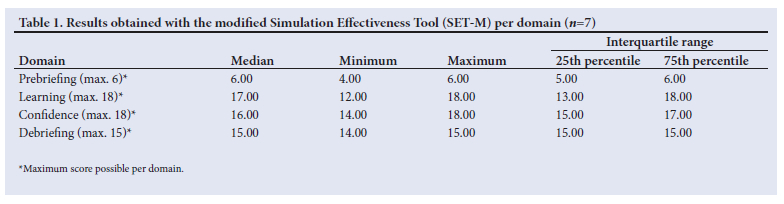
RESULTS: Seven registrars participated in the SBLE. The SET-M demonstrated high scores across all domains, with high median scores obtained for prebriefing (6/6), learning (17/18), confidence (16/18) and debriefing (15/15).
CONCLUSION: This SBLE enhanced both confidence and learning related to managing paediatric sepsis as reported by participants. The simulation also provided a structured platform to introduce the Phoenix Sepsis Criteria and discuss context-appropriate care in resource-limited settings. The value of simulation in paediatric emergency training is demonstrated.
Keywords: Simulation-based learning experience; paediatrics; sepsis; ADDIE; Phoenix Sepsis Criteria
Sepsis is a significant cause of morbidity and mortality in children globally, with up to 85% of cases and deaths affecting children living in low- and middle-income countries.[1,2] Outcomes in children with sepsis are strongly associated with early recognition and appropriate management.[3] Treatment includes rapid yet cautious fluid resuscitation, appropriate (empiric) antibiotic administration and early vasoactive support.[3] The recognition of sepsis has proven to be a challenging area in both adults and children. The introduction of the Phoenix Sepsis Criteria in 2024 is an attempt to identify children with infection who have the highest risk of adverse outcomes and death.[1] Children have a strong potential for recovery from sepsis when timely recognised and properly managed. Recognising this, the 2017 World Health Assembly resolution on sepsis emphasised the importance of training healthcare workers at all levels to improve early detection and effective treatment.[4]
There has been mounting evidence that clinical exposure to patients, combined with ad hoc educational sessions, is not adequate to ensure healthcare practitioners' competence in this regard and that more deliberate educational interventions are needed.[5]
Simulation-based learning experience (SBLE) is a valuable strategy for training fellows and registrars in an environment that allows for learning without jeopardising the care of patients.[6] SBLEs allow for deliberate practice and enhancement of clinical competencies by providing learners with the opportunity to engage in repeated, goal-directed performance in a safe and structured environment. Rooted in Ericsson's theory of deliberate practice, SBLEs allow learners to focus on specific learning objectives, receive immediate feedback and correct errors through iterative practice, all of which are essential for developing expert performance.[7] Furthermore, SBLEs align with Kolb's experiential learning theory, which proposes that learning is most effective when it cycles through concrete experience, reflective observation, abstract conceptualisation and active experimentation.[8] In simulation, learners experience realistic clinical scenarios, reflect during structured debriefing, conceptualise principles from their performance, and apply insights in future simulations or clinical encounters. Simulation can also be an effective tool for developing specific skills and promoting evidence-based medicine, often leading to better retention than didactic lectures alone.[9] For simulation experiences to be effective, they need to be planned, implemented, evaluated and then revised following these educational encounters.[5]
The aim of the study was to design, implement and evaluate an SBLE presented to a group of paediatric registrars (postgraduate paediatric specialist trainees registered with the Health Professions Council of South Africa) on the diagnosis and management of sepsis in paediatric patients.
Methods
The SBLE was developed using the ADDIE model (an acronym for analyse, design, develop, implement and evaluate).[10] The model is used for the systematic design of instruction where an identified performance gap is identified due to a knowledge and skills gap. The ADDIE process ensures the validation of procedures and products in designing guided learning experiences. By systematically analysing and evaluating individual procedures and their interconnections, the use of the ADDIE approach enhances credibility and effectiveness in instructional development. The model maintains that learning objectives should be as close as possible to the environment in which students are expected to perform, and should consider the emotional and instinctive feelings of the student.[10]
Simulation as an educational strategy fits well within this model, with specific scenarios and the discussion of student performance, emotions and reasoning behind decisions being expressed and reflected on in the debriefing sessions following an SBLE.[5]
A summary of each component of ADDIE, along with common procedures, is available in Appendix A.
Analysis phase
This phase included identifying the need for developing an SBLE for clinical management of sepsis in paediatric patients. The learning experience was warranted owing to a lack of such training in the current postgraduate curriculum and the significant morbidity and mortality associated with sepsis in children.[3] The Phoenix Sepsis Criteria[1] needed to be introduced to learners as these have not been presented in their didactic lectures.
Design phase
The design phase included formulating the learning outcomes for the scenario in order to align all aspects of the SBLE. These outcomes were based on specific categories identified in the guidelines of the Surviving Sepsis campaign (2020)[11] as related to the management of sepsis.[3] Content resources comprised two recent publications related to sepsis and its management, namely a review (from 2023) on the summary of current definitions and management recommendations for paediatric sepsis;[3] and another (from 2024) on the International Consensus Criteria for Pediatric Sepsis and Septic Shock.[1]
Outcomes
The outcomes formulated for the SBLE stated that registrars should be able to:
• recognise septic shock using the Phoenix Sepsis Criteria
• direct the appropriate fluid management of septic shock in the context of available resources
• consider the required management for a child when paediatric intensive care services are not readily available
• recognise fluid overload and fluid refractory shock with appropriate next management, including positive-pressure ventilation and initiation of inotropic support
• recognise hypoglycaemia and its correct management in the context of fluids available
• initiate timeous and correct antimicrobial management.
The SBLE was structured to include three sections: prebriefing, during which learners received context to set the scene for the simulation; the simulation activity, during which the 'patient' (a SimBaby® manikin, (Laerdal Medical, Norway)) had to be managed; and debriefing, during which learners engaged in a guided discussion to reflect on the scenario and achieve the intended learning outcomes.
Development phase
Content developed for the SBLE included guidance for both learners and instructors, and provided for the use of a SimBaby manikin and one instructor per simulation. Supporting documentation is provided in Appendix B.
Implementation phase
The instructor delivered the prebriefing session and introduced a verbal 'fiction contract'. This is an agreement between the learner and instructor that they will regard the simulation as real in order to benefit maximally from the learning process.[12] Learners were informed that the instructor would assume the role of a professional nurse during the simulation to assist with a child in the emergency department. This approach allowed for enhanced fidelity of the scenario while allowing the instructor to effectively guide the simulation to align with the intended learning outcomes. The debriefing session was conducted using the PEARLS (Promoting Excellence And Reflective Learning in Simulation) tool to guide discussions of the objectives.[13]
Evaluation phase
At the end of the scenario, the participants completed a modified Simulation Effectiveness Tool (SET-M) questionnaire.[14] This tool includes statements relating to best practices in simulation, such as the prebriefing and debriefing periods. It consists of 19 statements scored on a three-point Likert scale, where 1 = do not agree; 2 = somewhat agree; and 3 = strongly agree. The four domains evaluated by the tool are: prebriefing; learning; confidence; and debriefing. The full questionnaire is available as Appendix C.
The SET-M questionnaire contains two questions relating to the prebriefing domain, six questions relating to the learning and confidence domain and five questions relating to the debriefing domain.
Statistical analysis
Data were analysed by the Department of Biostatistics at the University of the Free State using Statistical Analysis Software (SAS 9.4). Simple descriptive statistics are presented, namely medians, interquartile ranges (IQRs; 25th and 75th percentiles), and the minimum and maximum scores for each of the evaluation domains.
Ethical considerations
Ethical clearance for the study was obtained from the Health Sciences Research Ethics Committee of the University of the Free State. Participation was voluntary, no identifiable information was collected and the responses were kept anonymous. Informed consent was obtained from participants before commencement of the simulated learning.
Results
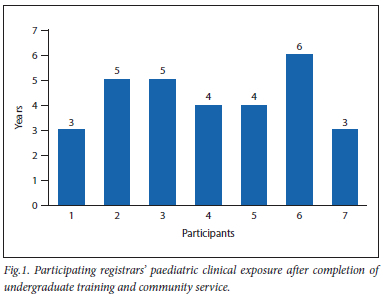
Seven postgraduate paediatric registrars participated in the SBLE (run on two occasions) and consented to complete a SET-M questionnaire (Appendix C). Six of the participants were in the third year of the registrar programme and one in their fourth year. The scores obtained for the different domains of the evaluation tool are summarised in Table 1. Details of participants' general paediatric clinical experience are shown in Fig. 1.
The SET-M questionnaire includes an optional section at the end for participants to provide additional comments, as listed below:
• 'Very informative and really helpful.'
• 'Better understanding of the use of inotropes for sepsis and septic shock.'
• 'It was overall a good experience, and we need to make time in the programme for more sessions.'
• 'I really enjoyed it and filled knowledge gaps.'
• 'Paediatric septic shock was a good scenario to do, as it is something we often encounter. It was a good revision to go through the specific reasoning of some of the decisions we make during emergencies.'
• 'Very well prepared and evidence based.'
Discussion
An SBLE to increase paediatric registrars' self-reported confidence and learning related to recognising and managing paediatric sepsis was developed using the ADDIE process. The registrars who participated in this learning experience had at least three years of paediatric clinical exposure after their community service years. Owing to the high burden of disease in South Africa (SA), they are likely to have been exposed to many children critically ill with sepsis or septic shock. The SET-M results and the individual comments provided by registrars suggested that this SBLE improved both their self-reported learning and their confidence relating to the recognition and management of paediatric sepsis, despite years of paediatric clinical exposure.
Simulation is often cited as being used in programmes in higher resourced settings owing to the concern that residents (paediatric or paediatric emergency trainees) do not have adequate clinical exposure to critically ill children.[15] The opposite is often true in lower-resourced settings with a high burden of disease. If confidence and learning were simply a product of clinical exposure in such a setting, one would have expected the study participants not to have responded positively to these domains in the SET-M. Paediatric registrars generally experience high service demands, which may lead to less time for specific educational interventions. By focusing the limited time available for directed learning on commonly occurring conditions with high morbidity and mortality, such as sepsis, more patients may ultimately benefit from these interventions.
The group of registrars that participated in the SBLE in this study had not been exposed to the Phoenix Sepsis Criteria in formal lectures yet, and these were introduced in the debriefing session following a discussion on what they understood sepsis and septic shock to involve. The debriefing was found to be an effective opportunity to introduce new evidence-based medicine, which was well received by the registrars.
The SBLE was also developed to include discussions and application of knowledge to areas regarded as unique in limited resource settings. Fluid management recommendations in critically ill children are now largely based on the availability of intensive care services, following a study showing a significant increase in the 48-hour mortality rate in febrile children receiving multiple fluid boluses without access to specialised care.[16] This was explored in the SBLE by directing questions to the group during the debriefing session on how their suggested management would differ if they had been advising a doctor treating such a patient in a lower-resource setting where intensive care beds were not readily available. The registrars needed to consider advising against fluid boluses in the absence of hypotension in this patient population. This level of clinical reasoning is a skill needed for every medical professional working in areas with varied resource settings, and the debriefing 'space' allowed for this skill to be applied.
Study limitations
Given the small number of participants in the study, due largely to service delivery demands on registrars, and the activity running at a single site at one university, the results may not be comparable to other training programmes. Implementation in other universities could be explored to allow for standardisation of specific training received in all registrar programmes. The SET-M was developed and validated for nursing personnel and, as such, might not be completely applicable to the registrar population. Some of the questions, particularly those relating to developing a better level of understanding of medication (the learning domain), and questions pertaining to communication and participants' confidence in their ability to teach patients about their condition, might not be applicable to the simulations or to the role of a registrar in managing a scenario.
Conclusion
An SBLE on paediatric sepsis, developed using the ADDIE approach, has proven to be an effective educational tool. Despite their previous clinical experience, paediatric registrars demonstrated increased self-reported confidence and learning. The use of an SBLE in this context also allowed for the application of knowledge specific to lower-resource settings and facilitated the integration of new evidence-based medicine. The debriefing phase in particular served as a crucial opportunity to reinforce key concepts and allow for the learning to be translated into clinical practice.
Declaration. None.
Acknowledgements. The authors thank the registrars who participated in the SBLE, and Dr Daleen Struwig, medical writer/editor, for technical and editorial assistance.
Author contributions. MM conceptualised the study and was responsible for results analysis and drafting the manuscript. SB and ML were involved in supervision and results validation, and contributed to reviewing the manuscript prior to submission.
Funding. None.
Conflicts of interest. None.
References
-
1. Schlapbach LJ, Watson RS, Sorce LR, et al. International consensus criteria for pediatric sepsis and septic shock. JAMA 2024;331(8):665-674. https://doi.org/10.1001/jama.2024.0179
» https://doi.org/10.1001/jama.2024.0179 -
2. Watson RS, Carrol ED, Carter MJ, Kissoon N, Ranjit S, Schlapbach LJ. The burden and contemporary epidemiology of sepsis in children. Lancet Child Adolesc Health 2014;8(9):670-681. https://doi.org/10.1016/s2352-4642(24)00140-8
» https://doi.org/10.1016/s2352-4642(24)00140-8 -
3. Miranda M, Nadel S. Pediatric sepsis: A summary of current definitions and management recommendations. Curr Pediatr Rep 2023;11(2):29-39. https://doi.org/10.1007/s40124-023-00286-3
» https://doi.org/10.1007/s40124-023-00286-3 -
4. Reinhart K, Daniels R, Kissoon N, Machado F, Schachter R, Finfer S. Recognizing sepsis as a global health priority - a WHO resolution. N Engl J Med 2017;377(5):414-417. https://doi.org/10.1056/NEJMp1704633
» https://doi.org/10.1056/NEJMp1704633 -
5. Motola I, Devine L, Chung H, Sullivan J, Issenberg S. Simulation in healthcare education: A best evidence practical guide. Med Teach 2013;35(10):e1511-e1530. https://doi.org/10.3109/0142159X.2013.818632
» https://doi.org/10.3109/0142159X.2013.818632 -
6. Cuesta-Montero P, Navarro-Martínez J, Yedro M, Galiana-Ivars M. Sepsis and clinical simulation: What is new? (and old). J Pers Med 2023;13(10):1475. https://doi.org/10.3390/jpm13101475
» https://doi.org/10.3390/jpm13101475 -
7. Ericsson K, Krampe R, Tesch-Römer C. The role of deliberate practice in the acquisition of expert performance. Psychol Rev 1993;100(3):363-406. https://doi.org/10.1037//0033-295X.100.3.363
» https://doi.org/10.1037//0033-295X.100.3.363 - 8. Kolb D. Experiential learning: experience as the source of learning and development. Englewood Cliffs, NJ: Prentice-Hall, 1984.
-
9. Leiphrakpam PD, Armijo PR, Are C. Incorporation of simulation in graduate medical education: Historical perspectives, current status, and future directions. J Med Educ Curric Dev 2024;11:23821205241257329. https://doi.org/10.1177/23821205241257329
» https://doi.org/10.1177/23821205241257329 -
10. Branch RM. Instructional design: The ADDIE approach. New York, NY: Springer, 2009. https://doi.org/10.1007/978-0-387-09506-6
» https://doi.org/10.1007/978-0-387-09506-6 -
11. Weiss SL, Peters MJ, Alhazzani W, et al. Surviving sepsis campaign international guidelines for the management of septic shock and sepsis-associated organ dysfunction in children. Intensive Care Med 2020;46(Suppl 1):10-67. https://doi.org/10.1007/s00134-019-05878-6
» https://doi.org/10.1007/s00134-019-05878-6 -
12. Stephenson E, Poore J. Tips for conducting the pre-brief for a simulation. J Contin Educ Nurs 2016;47(8):353-355. https://doi.org/10.3928/00220124-20160715-05
» https://doi.org/10.3928/00220124-20160715-05 -
13. Eppich W, Cheng A. Promoting Excellence and Reflective Learning in Simulation (PEARLS): Development and rationale for a blended approach to health care simulation debriefing. Simul Healthc 2015;10(2):106-115. https://doi.org/10.1097/sih.0000000000000072
» https://doi.org/10.1097/sih.0000000000000072 -
14. Leighton K, Ravert P, Mudra V, Macintosh C. Updating the Simulation Effectiveness Tool: Item modifications and reevaluation of psychometric properties. Nurs Educ Perspect 2015;36(5):317-323. https://doi.org/10.5480/15-1671
» https://doi.org/10.5480/15-1671 -
15. Adler MD, Vozenilek JA, Trainor JL, et al. Development and evaluation of a simulation-based pediatric emergency medicine curriculum. Acad Med 2009;84(7):935-941. https://doi.org/10.1097/ACM.0b013e3181a813ca
» https://doi.org/10.1097/ACM.0b013e3181a813ca -
16. Maitland K, Kiguli S, Opoka RO, et al. Mortality after fluid bolus in African children with severe infection. N Engl J Med 2011;364(26):2483-2495. https://doi.org/10.1056/NEJMoa1101549
» https://doi.org/10.1056/NEJMoa1101549

Accepted 11 July 2025