Improving neonatal outcomes through down-referral and integrated health services in Gauteng, South Africa
BACKGROUND. Tembisa Provincial Tertiary Hospital (TPTH) in Gauteng, South Africa, operates one of the busiest neonatal units in the province, routinely exceeding its approved bed capacity. Chronic overcrowding contributes to reduced nurse-to-patient ratios, increased hospital-acquired infections (HAIs), and elevated neonatal mortality. Optimising district-level capacity through kangaroo mother care (KMC) down-referral may reduce congestion and improve neonatal outcomes. OBJECTIVES. To evaluate the effect of a structured KMC down-referral intervention on overcrowding and neonatal outcomes at TPTH. METHODS. A retrospective comparative study analysed routinely collected data for two 6-month periods before (February - July 2024) and during (August 2024 - January 2025) the implementation of a KMC down-referral system. Stable KMC mother-infant pairs were transferred to underutilised KMC units at district hospitals with specialist telephonic support. Indicators measured were inpatient-days, bed utilisation rate, neonatal mortality rate, number of neonatal deaths and HAI rates. Data were summarised descriptively and compared using t-tests. RESULTS. A total of 203 neonates were down-referred between August 2024 and January 2025. During the intervention period, mean bed utilisation was lower compared with the pre-intervention period (145.7% v. 159.8%; p=0.0490). Mean monthly inpatient-days also decreased (3437.5 v. 3707.3; p=0.0916). The mean neonatal mortality rate declined from 21.2 to 16.3 per 1 000 live births (p=0.1534), and the mean number of neonatal deaths decreased from 24.8 to 17.2 per month (p=0.0516). The mean rate of HAIs per 1 000 inpatient-days was 6.1 pre-intervention and 5.5 during the intervention period (p=0.8313). CONCLUSION. The KMC down-referral intervention was associated with reduced bed utilisation and lower mean values in other neonatal indicators. This shows that strengthening district-level KMC capacity and formalising integrated referral pathways may improve neonatal outcomes in resource-constrained settings.
neonatal overcrowding; health systems strengthening; down-referral; kangaroo mother care
Improving neonatal outcomes through down-referral and integrated health services in Gauteng, South Africa
L NaushinI, II; T PhasheIII, IV; D PillayV, VI; KR PhayaneVII, VIII; M Spies HarrisIX, X; S MasekoIX, X; M Chisale MabotjaXI, XII
IMB ChB, Dip HIV Man (SA), MSc (Epidemiology); Department of Public Health Medicine, School of Health Systems and Public Health, Faculty of Health Sciences, University of Pretoria, Pretoria, South Africa
IIMB ChB, Dip HIV Man (SA), MSc (Epidemiology); Steve Biko Academic Hospital, Department of Health, Pretoria, Gauteng, South Africa
IIIBRad, MB ChB, MMed, FCPHM (SA); Department of Public Health Medicine, School of Health Systems and Public Health, Faculty of Health Sciences, University of Pretoria, Pretoria, South Africa
IVBRad, MB ChB, MMed, FCPHM (SA); Steve Biko Academic Hospital, Department of Health, Pretoria, Gauteng, South Africa
VMB ChB, MMed, FCPaeds (SA), Cert Neonatology (SA); Department of Paediatrics and Child Health, School of Medicine, Faculty of Health Sciences, University of Pretoria, Pretoria, South Africa
VIMB ChB, MMed, FCPaeds (SA), Cert Neonatology (SA); Tembisa Provincial Tertiary Hospital, Department of Health, Tembisa, Gauteng, South Africa
VIIMB ChB, FCPaeds (SA); Department of Paediatrics and Child Health, School of Medicine, Faculty of Health Sciences, University of Pretoria, Pretoria, South Africa
VIIIMB ChB, FCPaeds (SA); Tembisa Provincial Tertiary Hospital, Department of Health, Tembisa, Gauteng, South Africa
IXMB ChB, MMed, FCPaeds (SA); Department of Paediatrics and Child Health, School of Medicine, Faculty of Health Sciences, University of Pretoria, Pretoria, South Africa
XMB ChB, MMed, FCPaeds (SA); Tembisa Provincial Tertiary Hospital, Department of Health, Tembisa, Gauteng, South Africa
XIMB ChB, MMed, FCPHM (SA), PGDip Occ Health; Department of Public Health Medicine, School of Health Systems and Public Health, Faculty of Health Sciences, University of Pretoria, Pretoria, South Africa
XIIMB ChB, MMed, FCPHM (SA), PGDip Occ Health; Tembisa Provincial Tertiary Hospital, Department of Health, Tembisa, Gauteng, South Africa
BACKGROUND. Tembisa Provincial Tertiary Hospital (TPTH) in Gauteng, South Africa, operates one of the busiest neonatal units in the province, routinely exceeding its approved bed capacity. Chronic overcrowding contributes to reduced nurse-to-patient ratios, increased hospital-acquired infections (HAIs), and elevated neonatal mortality. Optimising district-level capacity through kangaroo mother care (KMC) down-referral may reduce congestion and improve neonatal outcomes.
OBJECTIVES. To evaluate the effect of a structured KMC down-referral intervention on overcrowding and neonatal outcomes at TPTH.
METHODS. A retrospective comparative study analysed routinely collected data for two 6-month periods before (February - July 2024) and during (August 2024 - January 2025) the implementation of a KMC down-referral system. Stable KMC mother-infant pairs were transferred to underutilised KMC units at district hospitals with specialist telephonic support. Indicators measured were inpatient-days, bed utilisation rate, neonatal mortality rate, number of neonatal deaths and HAI rates. Data were summarised descriptively and compared using t-tests.
RESULTS. A total of 203 neonates were down-referred between August 2024 and January 2025. During the intervention period, mean bed utilisation was lower compared with the pre-intervention period (145.7% v. 159.8%; p=0.0490). Mean monthly inpatient-days also decreased (3437.5 v. 3707.3; p=0.0916). The mean neonatal mortality rate declined from 21.2 to 16.3 per 1 000 live births (p=0.1534), and the mean number of neonatal deaths decreased from 24.8 to 17.2 per month (p=0.0516). The mean rate of HAIs per 1 000 inpatient-days was 6.1 pre-intervention and 5.5 during the intervention period (p=0.8313).
CONCLUSION. The KMC down-referral intervention was associated with reduced bed utilisation and lower mean values in other neonatal indicators. This shows that strengthening district-level KMC capacity and formalising integrated referral pathways may improve neonatal outcomes in resource-constrained settings.
Keywords: neonatal overcrowding, health systems strengthening, down-referral, kangaroo mother care
The neonatal mortality rate (NMR) is a core indicator for Sustainable Development Goal (SDG) 3, which aims to reduce neonatal deaths to fewer than 12 per 1 000 live births by 2030.[1] Globally, an estimated 2.3 million newborns died in 2022, with sub-Saharan Africa experiencing the highest burden.[2] South Africa reported an NMR of 13.4 per 1 000 live births in 2023/24,[3] yet substantial disparities persist across provinces and individual facilities. Tembisa Provincial Tertiary Hospital (TPTH) consistently experiences a higher NMR than national targets, with prematurity and sepsis identified as the leading causes of neonatal mortality.[4] While reducing prematurity requires long-term enhancement of antenatal care, sepsis prevention offers a more immediate opportunity to improve neonatal survival, particularly by addressing modifiable health-system factors such as overcrowding, infection control and staffing capacity.
Overcrowding in neonatal units compromises quality of care by reducing nurse-to-patient ratios, limiting space between incubators, and increasing the risk of hospital-acquired infections (HAIs).[5,6] International evidence demonstrates that high patient census and understaffing are independently associated with neonatal infection outbreaks.[7,8] These risks are amplified in resource-constrained settings where infrastructure and human resources are often limited. Addressing overcrowding is therefore central to improving neonatal outcomes.
System-level strategies to mitigate overcrowding commonly focus on patient-flow optimisation and redistribution of stable patients to appropriate levels of care. A quality improvement initiative in Haiti demonstrated that establishing additional postpartum and step-down neonatal beds significantly reduced overcrowding and improved overall care conditions, eliminating floor-sleeping among postpartum women and reducing inappropriate neonatal care in maternity wards.[9] Broader reviews similarly highlight that enhanced work organisation, strengthened primary care investment, structural adjustments, and the creation of dedicated clinical roles can collectively reduce congestion and improve service delivery.[10] These examples underscore that improving patient flow and rationalising bed utilisation are central strategies for mitigating overcrowding in resource-limited settings.
Kangaroo mother care (KMC) is a well-established, low-cost intervention that plays a critical role in improving outcomes for preterm and low-birthweight infants.[11,12] Extensive evidence shows that KMC significantly reduces neonatal mortality, sepsis and hypothermia. KMC is also associated with shorter hospital stays,[B] improved thermoregulation, reduced heart rate and increased oxygen saturation following skin-to-skin contact.[14] These well-documented advantages highlight the value of KMC.
Despite national progress, TPTH continues to experience an NMR above the national target, largely driven by prematurity and sepsis.[2,4] Overcrowding exacerbates these outcomes by limiting staff capacity and increasing infection risk. In response to these pressures, TPTH implemented a KMC down-referral intervention in August 2024, redirecting clinically stable KMC mother-infant pairs to underutilised district hospital KMC units capable of providing standard neonatal care. This approach sought to alleviate overcrowding, optimise resource utilisation across the district and create a safer care environment for high-acuity neonates at the tertiary facility. The present study assessed the effect of this intervention by examining trends in overcrowding metrics, including inpatient-days and bed utilisation, and key clinical outcomes such as HAIs and mortality. The findings aim to inform health-system strategies for strengthening neonatal care delivery in resource-constrained settings.
Methods
Study setting
TPTH is a high-volume tertiary hospital in the Ekurhuleni District, Gauteng Province, and is the second largest neonatal service in the province. Due to the absence of a district or regional referral hospital in its catchment area, all neonates, including those requiring only standard care, are admitted to the tertiary unit. The hospital is approved for 66 neonatal beds; however, it routinely accommodates an average of 130 patients owing to the high demand for neonatal services.[4] The hospital's physical infrastructure is insufficient to meet the demands of the rapidly growing local population, which is predominantly uninsured and from low socioeconomic backgrounds.[4]
Description of the intervention
A targeted intervention was introduced at TPTH in August 2024 to reduce overcrowding and improve neonatal outcomes. Clinically stable KMC mother-infant pairs were down-referred via emergency medical services (EMS) from the 66-bed neonatal unit to district hospitals with available KMC capacity. All mothers provided consent prior to down-referral.
Clinical stability for down-referral was determined according to a formal standard operating procedure (SOP), with eligibility criteria aligned to the capacity of the receiving facilities. Neonates were required to meet gestational age and weight thresholds appropriate to the level of district care (>34 weeks and >1800 g at some facilities; >32 weeks and >1300 g at others) and be established on appropriate feeding (cup feeding only at selected facilities; tube or cup feeding at others). Across all sites, infants were required to be clinically stable without oxygen therapy, phototherapy or acute complications. Neonates with complex clinical conditions, prolonged or recurrent intensive care admissions, poor weight gain, abnormal laboratory parameters or significant maternal social risk factors were excluded. All transfers were reviewed and approved by a senior clinician. Receiving facilities were equipped to provide emergency stabilisation should clinical deterioration occur.
Structured transfer and return pathways were implemented to ensure continuity of care. After completing district-level care, mother-infant pairs were transported back to TPTH for final discharge and follow-up. As there is no district hospital within the immediate TPTH drainage area, receiving facilities were geographically distant. EMS therefore facilitated return transfer to TPTH once district-level care was complete, allowing discharge to occur closer to the family's residence and ensuring appropriate access to follow-up.
Study design
This retrospective comparative study examined neonatal indicators during two 6-month periods: pre-intervention (February 2024 - July 2024) and during implementation of the down-referral process (August 2024 - January 2025). Routinely collected data from the Perinatal Problem Identification Programme (PIPP) data and TPTH neonatal registers submitted to the Health Information Management Systems (HIMS) department was used to assess trends in key indicators. Data were aggregated by month, anonymised and provided in Microsoft Excel format by HIMS. Variables extracted included the monthly number of KMC down-referrals, rate of HAIs, inpatient-days, bed utilisation rate, NMR, and the number of neonatal deaths. HAIs were defined as laboratory-confirmed bloodstream infections based on positive blood cultures; clinical sepsis without laboratory confirmation was not included. A consistent admission-duration threshold of (>72 hours) was not uniformly applied in this HAI classification.
Variables
The following indicators were defined and measured for analysis:

Data analysis
Descriptive statistics were used to summarise the monthly number of KMC down-referrals following the implementation of the intervention. Comparative analysis assessed changes in key neonatal indicators between the 6 months prior to the intervention (February - July 2024) and the 6 months during the intervention (August 2024 - January 2025). All continuous variables were assessed for normality and met the assumptions required for parametric testing. Accordingly, they were summarised using means and standard deviations. The statistical significance of differences between the two periods was assessed using Student's independent i-tests or Welch's i-tests, depending on variance assumptions. Additionally, trend analysis was conducted using graphical methods to visualise monthly patterns and fluctuations across the full study period. Data were processed and analysed using Microsoft Excel and Stata 18. Notably, only 4 months of pre-intervention data were available for HAIs, therefore 4 months pre-intervention and 4 months of intervention were compared for HAIs only.
Ethical considerations
Approval to conduct this study was obtained from TPTH Research Committee (NHRD reference number: GP_202508_066). Ethical clearance was obtained from the University of Pretoria Human Research Ethics Committee (Ethics reference number: 607/2025).
Results
A total of 203 KMC down-referrals were conducted between August 2024 and January 2025. Referral activity varied from month to month. The intervention began with 38 referrals in August 2024, followed by 26 in September. Activity peaked in October 2024 with 55 referrals, the highest monthly number recorded. This was followed by 42 referrals in November and 25 in December. The lowest number of referrals occurred in January 2025, with 17 down-referrals.
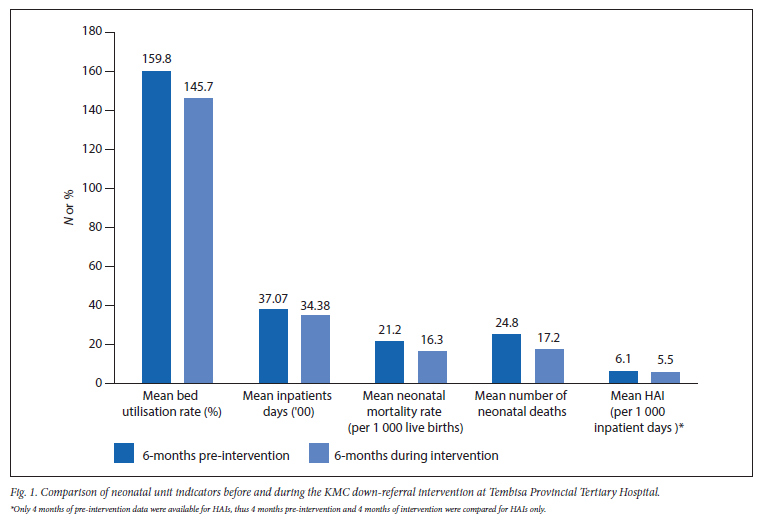
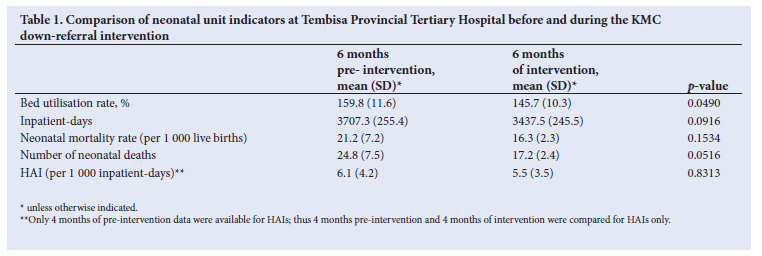
In Table 1, neonatal unit indicators during the 6 months before and during implementation of the KMC down-referral intervention are compared. Mean bed utilisation was significantly lower during the intervention period compared with the pre-intervention period (145.7% v. 159.8%; p=0.0490). Mean monthly inpatient-days also decreased (3437.5 v. 3707.3), although this difference did not reach statistical significance (p=0.0916).
The NMR declined from 21.2 to 16.3 per 1 000 live births (p=0.1534), and the mean monthly number of neonatal deaths decreased from 24.8 to 17.2 (p=0.0516); however, these differences were not statistically significant. The rate of HAIs per 1 000 inpatient-days was 6.1 before the intervention and 5.5 during the intervention period (p=0.8313), with no statistically significant difference observed.
Fig. 1 illustrates differences in neonatal unit indicators before and during the KMC down-referral intervention. Bed utilisation and inpatient-days were lower during the intervention period compared with the pre-intervention period. NMR, number of deaths, and HAI rates also showed lower mean values during the intervention period.
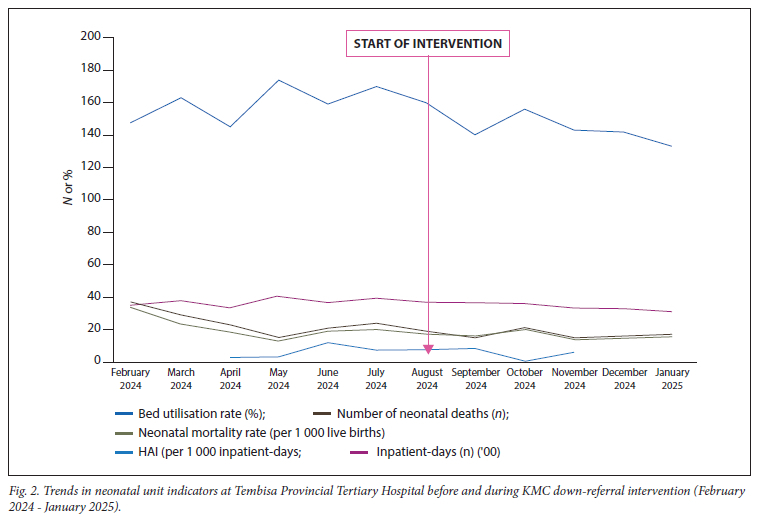
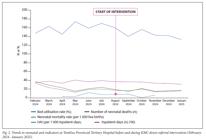
Fig. 2 presents monthly trends in bed utilisation, inpatient-days, NMR, number of deaths, and HAI rates from February 2024 to January 2025, with the intervention starting in August 2024. Bed utilisation and inpatient-days were higher in several pre-intervention months and were generally lower in multiple months during the intervention period, although fluctuations occurred throughout. Neonatal mortality rates and deaths varied month to month, with lower values observed in several intervention months compared with earlier peaks. HAI rates also demonstrated variability across the study period. Overall, the figure illustrates temporal variation in all indicators across the study period.
Discussion
In this study, a structured KMC down-referral intervention aimed at reducing overcrowding in a high-volume tertiary neonatal unit was evaluated. Bed utilisation was significantly lower during the intervention period, and inpatient-days decreased by 7%, suggesting reduced occupancy pressure following implementation. Although reductions in neonatal mortality, total deaths, and HAIs were not statistically significant, the consistent downward trends are clinically relevant.
Overcrowding is a well-established driver of poor neonatal outcomes, contributing to reduced nurse-to-patient ratios, increased infection risk and compromised adherence to care protocols.[5] The present study adds to the growing body of evidence supporting system-level interventions to reduce congestion.[9,10] The observed reduction in bed utilisation aligns with international experiences demonstrating that structured redistribution of stable patients through step-down units or regionalised referral pathways can improve service efficiency and care conditions.[5,9,15,16] However, despite the statistically significant reduction, bed utilisation remained consistently above 100%, indicating persistent overcapacity and ongoing structural pressure within the unit, which may partly explain the absence of statistically significant changes in other neonatal indicators.
Reduced patient density improves infection control compliance and staff workload.[5,6,17] Although reductions in HAI rates and neonatal mortality were not statistically significant, the lower mean values observed during the intervention period may reflect incremental benefits of reduced occupancy pressure in a high-volume setting, and are of clinical significance.
It is important to situate these findings within the evolving global evidence base for KMC. The study does not evaluate the direct biological effectiveness of KMC, nor outcomes among down-referred neonates, and therefore should not be interpreted as new evidence of KMC efficacy. Rather, this intervention represents a systems-level strategy aimed at optimising patient flow and creating capacity within tertiary units. Such optimisation may enable earlier and more continuous provision of KMC for unstable and very-low-birthweight infants who remain at tertiary level, while allowing stable neonates to continue KMC safely within district facilities.
The findings have practical implications for neonatal care in South Africa and similar low- and middle-income country contexts. Improvements in service-level indicators following the implementation of the KMC down-referral model highlight the value of strengthening district-level capacity and creating integrated referral networks to optimise the use of scarce tertiary resources.
This aligns with the principles of triaging patients to the appropriate level of care to ensure efficient resource use and improved outcomes. Furthermore, the intervention demonstrates that even in resource-constrained settings, relatively low-cost organisational changes can have measurable impacts on service delivery.
From a health system-strengthening perspective, the intervention also has implications for human resources for health (HRH). Decompressing the tertiary unit may improve nurse-to-patient ratios and reduce staff strain, which are known determinants of neonatal care quality. This is particularly relevant given the documented shortage of trained neonatal nurses and the negative effect of HRH constraints on quality of care across South Africa.[18]
Study limitations
Several limitations should be considered when interpreting these findings. The study relied on routinely collected hospital data, which may contain inaccuracies, incomplete reporting and limited clinical detail. Only 4 months of pre-intervention HAI data were available, reducing statistical power for that comparison. The observation period was limited to 6 months before and 6 months of the intervention; extending the timeframe would have overlapped with the opening of the lodger-mother unit, introducing additional confounding. Furthermore, all variables were aggregated monthly, which limited statistical power and restricted the ability to perform more detailed analyses.
This analysis did not capture clinical outcomes for mother-infant pairs who were down-referred to district hospitals. Owing to the scope of ethical approval and institutional data access permissions, outcome data from receiving district facilities could not be obtained. As a result, the possibility that adverse outcomes may have occurred at district level following down-referral cannot be excluded. While reductions in neonatal indicators were observed at TPTH, this analysis was limited to facility-level indicators at the tertiary hospital and did not allow assessment of system-wide neonatal outcomes across the referral network. In addition, data on neonates who required referral back to TPTH from district facilities for clinical deterioration or further medical intervention were not captured separately, as outcome data were recorded only at aggregate facility level and were not linked to individual down-referred infants. Consequently, the adequacy of initial stability criteria and reasons for re-referral could not be evaluated in this analysis.
Analytically, the study was restricted to basic pre- and post-comparisons without regression modelling or adjustment for potential confounders. More robust methods were not feasible given the nature of the aggregated monthly observations and lack of individual-level variables. Key unmeasured confounders include seasonal fluctuations in neonatal admissions and mortality, often higher during winter months,[191 and staffing variability, where nurse-to-patient ratios can fluctuate owing to leave cycles or staff shortages. Additional potential confounders include seasonal variation in sepsis patterns, resource availability and possible incident infection outbreaks during the study period. These variables were not available in the dataset and could not be incorporated into the analysis.
Finally, as the study was conducted at a single tertiary hospital, the findings may not be generalisable to settings with different populations, resource constraints or referral pathways.
Recommendations
The findings support scaling up the KMC down-referral model to additional district hospitals to further relieve pressure on TPTH's neonatal unit. Implementation should align with evidence supporting immediate and continuous initiation of KMC, as demonstrated by the iKMC trial, which showed significant mortality reduction when KMC was initiated immediately after birth in infants weighing 1.0 to <1.8 kg.[20] Down-referral should therefore serve as a complementary system-level strategy that promotes continuity of KMC across levels of care rather than a delayed substitute model.
Operational scale-up should include deploying community service nurses to district KMC wards, as KMC care can be safely managed by junior staff with remote specialist oversight. A structured monitoring and evaluation system is needed to track referral timeliness, clinical outcomes, readmission rates and caregiver experience. Strengthening KMC infrastructure through additional beds and lodger-mother facilities, supported by ongoing training in KMC, neonatal resuscitation and infection prevention and control, will help ensure continuity and quality of care. Introducing digital solutions such as electronic referral tracking and telemedicine would further streamline communication and reduce transfer delays.
In the longer term, the model should be incorporated into provincial policy to ensure sustainability and guide scale-up across facilities facing similar overcrowding challenges. Clear referral criteria, routine mapping of neonatal capacity and a centralised system to monitor bed utilisation and outcomes will be essential components of such a policy. Workforce planning should also prioritise maintaining safe nurse-to-patient ratios through strategic staff deployment. Future evaluations should incorporate linked referral-level data across facilities to assess continuity of care, readmissions and mortality and morbidity outcomes, as well as capture caregiver experience and satisfaction, to provide a more comprehensive assessment of system performance.
Conclusion
This study provides evidence that a structured KMC down-referral intervention was associated with reduced bed utilisation and lower mean values in other neonatal indicators. This highlights the potential of such interventions to strengthen neonatal health systems in resource-constrained settings. Scaling up and sustaining this approach, coupled with continued investment in district-level capacity, holds promise for accelerating progress towards South Africa's neonatal mortality reduction targets and achieving SDG 3.
Declaration. None.
Acknowledgements. The authors would like to acknowledge the healthcare workers, management and administrative staff at TPTH, Tshwane District Hospital, Pretoria West Hospital, South Rand Hospital and Bertha Gxowa Hospital for their support and dedication to neonatal care. We also acknowledge the TPTH HIMS department for their assistance with data provision.
Author contributions. MCM conceptualised the study. LN conducted the data analysis and drafted the manuscript. All authors contributed to critical revision of the manuscript, approved the final version and accept responsibility for all aspects of the work.
Funding. None.
Conflict of interest. None.
References
-
1. United Nations. Sustainable Development Goals. New York: United Nations; https://sdgs.un.org/ (accessed 1 November 2025).
» https://sdgs.un.org/ -
2. World Health Organization. Newborn Mortality. Geneva: WHO; 2024. https://www.who.int/news-room/fact-sheets/detail/newborn-mortality (accessed 1 November 2025).
» https://www.who.int/news-room/fact-sheets/detail/newborn-mortality - 3. Ndlovu N, Mokganya M, Blose N, Padarath A, editors. District Health Barometer 2023/24. Durban: Health Systems Trust; 2025.
- 4. Tembisa Provincial Tertiary Hospital. Tembisa Provincial Tertiary Hospital Operation Plan 2025/26. Gauteng: Tembisa Provincial Tertiary Hospital; 2025.
-
5. Fischer D, Schlößer RL, Kempf VAJ, et al. Overcrowding in a neonatal intermediate care unit: impact on the incidence of multidrug-resistant gram-negative organisms. BMC Infect Dis 2019;19(1):357. https://doi.org/10.1186/s12879-019-3981-8
» https://doi.org/10.1186/s12879-019-3981-8 -
6. Dramowski A, Aucamp M, Bekker A, Mehtar S. Infectious disease exposures and outbreaks at a South African neonatal unit with review of neonatal outbreak epidemiology in Africa. Int J Infect Dis 2017;57:79-85. https://doi.org/10.1016/j.ijid.2017.01.026
» https://doi.org/10.1016/j.ijid.2017.01.026 -
7. Dahl TM, Solevåg AL. A cross-sectional study of neonatal intensive care unit overcrowding and understaffing associated with bacterial outbreaks. Acta Paediatr 2022;111(11):2090-2097. https://doi.org/10.1111/apa.16494
» https://doi.org/10.1111/apa.16494 -
8. Haley RW, Bregman DA. The role of understaffing and overcrowding in recurrent outbreaks of staphylococcal infection in a neonatal special-care unit. J Infect Dis 1982;145(6):875-885. https://doi.org/10.1093/infdis/145.6.875
» https://doi.org/10.1093/infdis/145.6.875 -
9. Casella Jean-Baptiste M, Millien C, Sainterant O, et al. Quality improvement initiative reduces overcrowding on labour and delivery unit in a university hospital in Haiti. BMJ Open Qual 2023;12(1). https://doi.org/10.1136/bmjoq-2022-001879
» https://doi.org/10.1136/bmjoq-2022-001879 -
10. Maninchedda M, Proia AS, Bianco L, Aromatario M, Orsi GB, Napoli C. Main features and control strategies to reduce overcrowding in emergency departments: A systematic review of the literature. Risk Manag Healthc Policy 2023;16:255-266. https://doi.org/10.2147/rmhp.S399045
» https://doi.org/10.2147/rmhp.S399045 -
11. Shukla VV, Carlo WA. Review of the evidence for interventions to reduce perinatal mortality in low- and middle-income countries. Int J Pediatr Adolesc Med 2020;7(1):2-8. https://doi.org/10.1016/j.ijpam.2020.02.004
» https://doi.org/10.1016/j.ijpam.2020.02.004 -
12. Chan GJ, Valsangkar B, Kajeepeta S, Boundy EO, Wall S. What is kangaroo mother care? Systematic review of the literature. J Glob Health 2016;6(1):010701. https://doi.org/10.7189/jogh.06.010701
» https://doi.org/10.7189/jogh.06.010701 -
13. Narciso LM, Beleza LO, Imoto AM. The effectiveness of Kangaroo Mother Care in hospitalisation period of preterm and low birth weight infants: Systematic review and meta-analysis. J Pediatr (Rio J) 2022;98(2):117-125. https://doi.org/10.1016/j.jped.2021.06.004
» https://doi.org/10.1016/j.jped.2021.06.004 -
14. Durmaz A, Sezici E, Akkaya DD. The effect of kangaroo mother care or skin-to-skin contact on infant vital signs: A systematic review and meta-analysis. Midwifery 2023;125:103771. https://doi.org/10.1016/j.midw.2023.103771
» https://doi.org/10.1016/j.midw.2023.103771 -
15. Handley SC, Lorch SA. Regionalisation of neonatal care: Benefits, barriers, and beyond. J Perinatol 2022;42(6):835-838. https://doi.org/10.1038/s41372-022-01404-7
» https://doi.org/10.1038/s41372-022-01404-7 -
16. Heidarzadeh M, Rahimi R, Mahmoudi M, et al. Impact of managerial and clinical interventions on trend of neonatal care and mortality in a regional hospital in Iran: A retrospective study. Egyptian Pediatric Association Gazette 2025;73(1):79. https://doi.org/10.1186/s43054-025-00423-1
» https://doi.org/10.1186/s43054-025-00423-1 -
17. Küng E, Waldhör T, Rittenschober-Böhm J, Berger A, Wisgrill L. Increased nurse workload is associated with bloodstream infections in very low birth weight infants. Sci Rep 2019;9. https://doi.org/10.1038/s41598-019-42685-x
» https://doi.org/10.1038/s41598-019-42685-x -
18. Nefale F, Sepeng NV, Ngunyulu R. Work-related support needs of registered nurses in a neonatal intensive care unit in the Tshwane District. Health SA 2023;28:1764. https://doi.org/10.4102/hsag.v28i0.1764
» https://doi.org/10.4102/hsag.v28i0.1764 -
19. Dalili H, Shariat M, Sahebi L. Time series analysis for forecasting neonatal intensive care unit census and neonatal mortality. BMC Pediatr 2025;25(1):339. https://doi.org/10.1186/s12887-025-05685-7
» https://doi.org/10.1186/s12887-025-05685-7 -
20. Arya S, Naburi H, Kawaza K, et al. Immediate "kangaroo mother care" and survival of infants with low birth weight. N Engl J Med 2021;384(21):2028-2038. https://doi.org/10.1056/NEJMoa2026486
» https://doi.org/10.1056/NEJMoa2026486
Accepted 25 February 2026