The challenge of incorporating new methods: The case of group guided reading in South Africa
Abstract
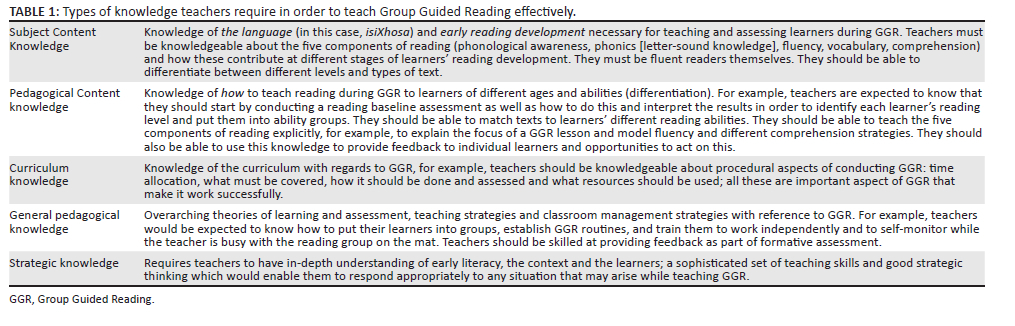
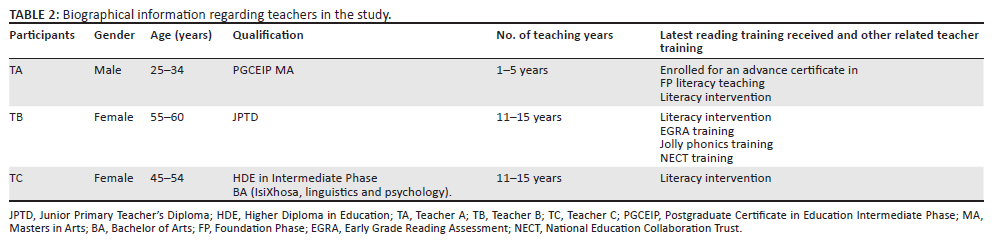
BACKGROUND: South Africa is a country with a reading crisis: 81% of Grade 4 learners are unable to read for meaning in Grade 4. Teaching methods and practices have been identified as a primary cause; there is an over-reliance on choral methods, very little focus on meaning, weak feedback and assessment, and little interaction with books. AIM: This article reports on the kinds of knowledge required to teach Group Guided Reading (GGR) and the extent to which teachers enacted this knowledge in their practice, using Shulman's (1987) knowledge categories. SETTING: The research was carried out in three no-fee, township primary schools where isiXhosa was the language of learning and teaching (LoLT), in the Eastern Cape, South Africa. METHODS: The research took the form of a case study of three teachers, who were given support, including coaching, to implement GGR. Data were generated through classroom observation and stimulated recall interviews using videos; the data were analysed using Shulman's knowledge categories (1986, 1987). RESULTS: Teachers demonstrated sufficient pedagogical content knowledge (PCK) to put GGR into practice. However, no assessment was observed, and two of the teachers chose not to put the learners into reading ability groups, both of which are core elements of GGR CONCLUSION: New methods of teaching do not always take account of local circumstances. CONTRIBUTION: Group Guided Reading was developed in countries where classes are small, and classrooms are spacious and well-equipped.
teacher knowledge; teacher practices; early grade reading; group guided reading; Foundation phase; reading baseline assessment