Prevalence of possible developmental coordination disorder among Grade 1 learners in low socio-economic environments in Mangaung, South Africa
Abstract
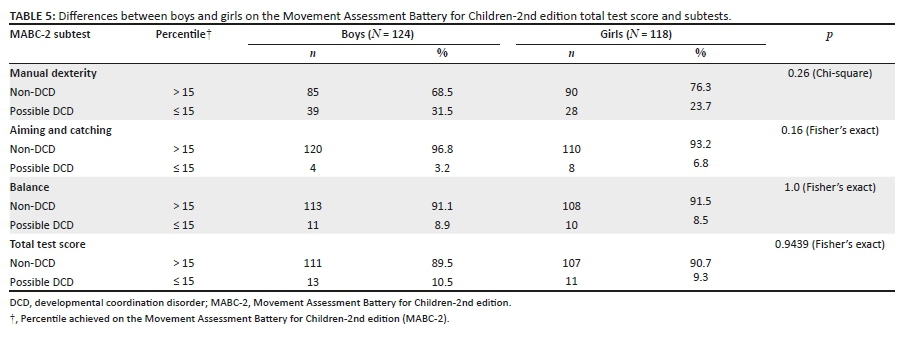
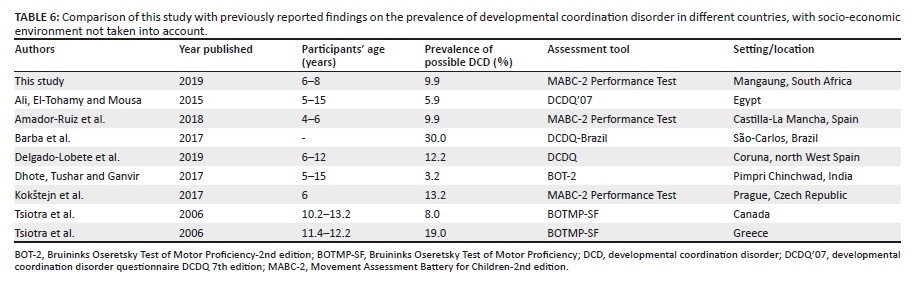
BACKGROUND: Developmental coordination disorder (DCD) affects motor skills and consequently has an impact on the performance in daily living activities of learners with this impairment. AIM: The aim of this study was to determine the prevalence of possible DCD in Grade 1 (Gr. 1) learners in a low socio-economic environment in Mangaung, South Africa. SETTING: The study was conducted in the Mangaung Metro, Motheo District, Free State Province. Gr. 1 learners, 6-8 years old (n = 242), from a low socio-economic environment attending Quintile 1-3 schools were randomly selected for assessment. METHODS: The Movement Assessment Battery for Children-2nd edition (MABC-2) was used to identify learners with possible DCD. Furthermore, results were compared with regard to gender. RESULTS: Of the 242 learners, 9.9% were identified with possible DCD. With regard to gender, 10.5% of boys and 9.3% of girls showed signs of possible DCD. No significant difference (p = 0.9439) has been found between boys and girls. CONCLUSION: The prevalence of possible DCD among Gr. 1 learners in this setting was higher than that in previously reported studies in other low and high socio-economic environments of South Africa. Further research is required to establish the full extent of possible DCD within learners living in low socio-economic environments.
developmental coordination disorder (DCD); Movement Assessment Battery for Children-2nd edition (MABC-2); motor skills; children; learners; socio-economic environment; prevalence