South African teachers work with division actions in Grade 3
Abstract
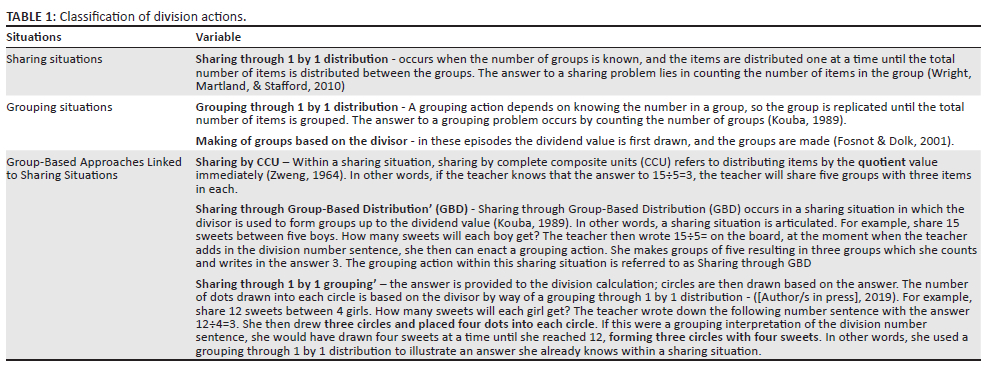
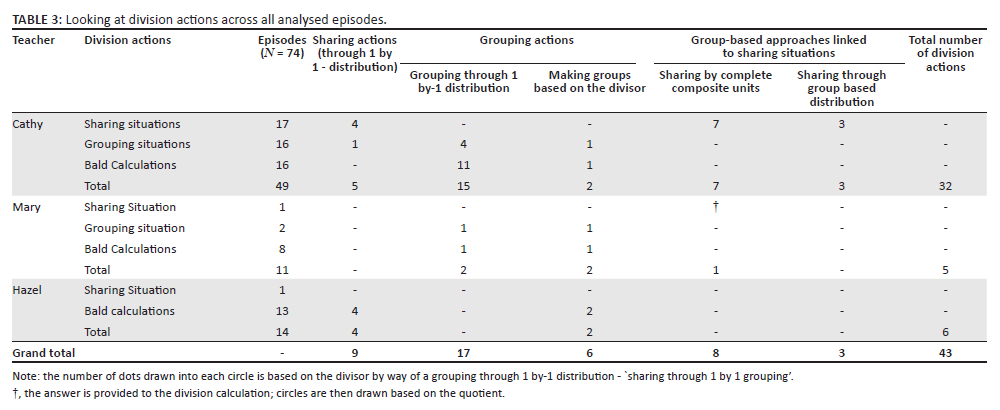
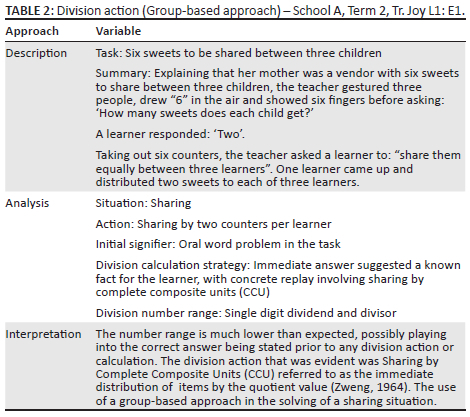
BACKGROUND: Internationally, the teaching of division has noted that the use of sharing situations with sharing actions (one-by-one distribution) is the predominant division model at the beginning of schooling. In South Africa, research suggests a sharing situation with sharing actions is also preferred in the early grades. AIM: This paper aims to look at the predominant approaches to the use of division actions that teachers offer in teaching division tasks. SETTING: The study is set in three government schools in Gauteng, South Africa. METHODS: In this qualitative study, the teachers were observed through video recording, and then the video recording was transcribed, and semiotics was used to make sense of their teaching. RESULTS: The findings of this article suggest that grouping actions and group-based approaches to teaching division tasks are more prevalent than sharing through one-by-one distribution actions, even when sharing situations are used. CONCLUSION: This study concludes that grouping actions and group-based approaches are part of how teachers solve sharing situations. CONTRIBUTION: This study concludes that in a South African context, identifying the grouping actions and group-based approaches linked to sharing situations is a more efficient way of solving sharing situations and will assist teachers in explaining division tasks more coherently.
grouping; sharing; foundation phase; Grade 3; group-based approaches; division model