Disorder of attention, motor control and perception in Grade 1 boys and girls
Abstract
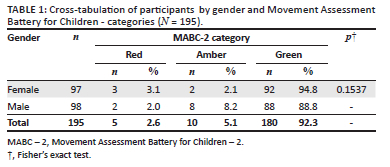
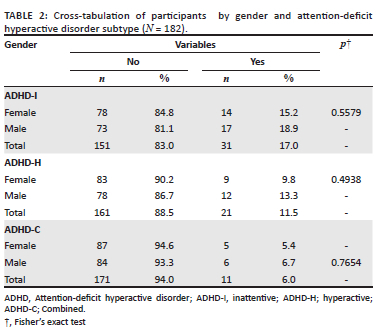
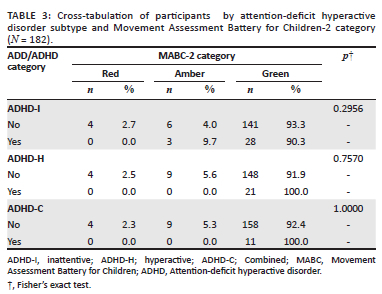
BACKGROUND: Researchers continue to investigate the predictive validity of motor assessment in learners with disorder of attention, motor control and perception (DAMP AIM: Determine the prevalence of attention-deficit hyperactive disorder (ADHD) and developmental coordination disorder (DCD); assess their association in Grade 1 children SETTING: Two primary schools located within 30 km of the University of the Free State, Bloemfontein METHODS: Attention deficit disorder or attention deficit hyperactive disorder (ADD/ ADHD) was assessed using the strength and weaknesses of ADD/ADHD symptoms normal behaviour rating scale (SWAN) and DCD using the Movement Assessment Battery for Children - 2 (MABC-2 RESULTS: One-hundred-and-ninety-five children (97 girls; 98 boys) aged 6 years to 8 years participated. MABC-2 and SWAN data were available for 195 and 182 children, respectively. Across both genders, 180 participants (92.3%) had no, 10 (5.1%) had moderate and 5 (2.6%) had severe motor difficulties. No statistically significant association (p = 0.1537) between gender and DCD was found. Similarly, 31 (17.0%) participants had ADHD subtype ADHD-I, 21 (11.5%) ADHD-H and 11 (6.0%) ADHD-C; no significant associations between gender and ADHD-I (p = 0.5579), ADHD-H (p = 0.4938) or ADHD-C (p = 0.7654) were found. There were no significant associations between DCD and the ADHD subtypes ADHD-I (p = 0.2956), ADHD-H (p = 0.7570) and ADHD-C (p = 1.000 CONCLUSION: Prevalence of DCD in the current study is higher than elsewhere in the world. No significant association between DCD and ADHD was found CONTRIBUTION: The relatively high prevalence of DCD in this South African population and its significance in the motor development of young children
Movement Assessment Battery for Children - 2; Strength and Weaknesses of ADD/ADHD Symptoms Normal Behaviour rating scale; disorder of attention; Motor Control and Perception; Developmental Coordination Disorder; Attention-deficit hyperactive disorder