Detecting change in a caregiver-mediated autism intervention using the Joint Engagement Rating Inventory
Abstract
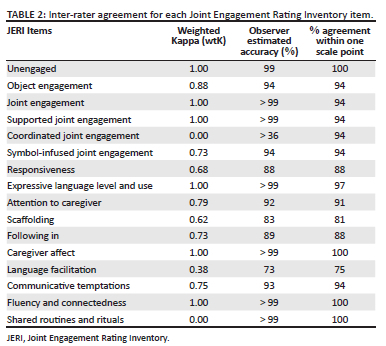
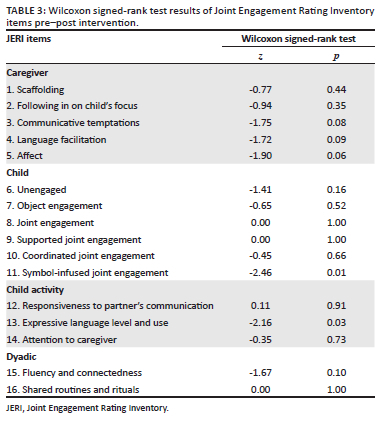
BACKGROUND: The Joint Engagement Rating Inventory (JERI) can be used to measure response to early autism intervention. However, little is known about the utility of the JERI outside the United States, where it was developed. A South African study found the JERI to be a reliable and accurate measure of joint engagement and communication between young autistic children and their caregivers. The next step was to determine if the JERI could be used to detect changes in the behaviours of child and caregiver in response to intervention OBJECTIVES: This proof-of-principle study aimed to evaluate whether the JERI could detect signals of change in the behaviours of child and caregiver in response to 12, 1-h naturalistic developmental behavioural intervention-informed caregiver coaching sessions METHOD: A single-arm pre-post design was utilised. Standardised video-recorded caregiver-child interactions were completed before and after intervention. Two raters, blinded to intervention time-point, coded the JERI. Ten dyads completed coaching and video-recorded assessments. Data analysis included inter-rater reliability, Wilcoxon signed-rank test for paired samples and visual summaries RESULTS: Weighted Kappa values for 13 of the 16 JERI items indicated moderate to strong inter-rater agreement. Significant changes in symbol-infused joint engagement (z = −2.46, p = 0.01) and expressive language (z = −2.156, p = 0.03) were detected. Visual summaries showed change signals in 15 JERI ratings CONCLUSION: Findings suggest that the JERI has the potential to detect change in the context of a caregiver-mediated intervention CONTRIBUTION: The JERI was shown here, for the first time in an African context, to be a potential outcome measure for early autism intervention research
Joint Engagement Rating Inventory (JERI); naturalistic developmental behavioural interventions (NDBI); caregiver coaching; signals of change; intervention response
 Thumbnail