Validating the Measure of Processes of Care for Service Providers (MPOC-SP(A)) tool in adult intensive care units
BACKGROUND: The Measures of Process of Care for Service Providers (MPOC-SP(A)) tool, developed by the CanChild Centre for Childhood Disability Research in Canada, assesses service providers' perceptions of family-centred care (FCC) in adult rehabilitation. It consists of 27 items categorised into four domains: 'showing interpersonal sensitivity', 'providing general information', 'communicating specific information, and 'treating people respectfully'. Each domain encompasses a distinct aspect of family-centred care applicable in the intensive care unit (ICU). An earlier version of the tool was previously validated for use in neonatal ICUs. However, this tool has not been validated for use in adult ICUs OBJECTIVE: To validate the content validity index of the MPOC-SP(A) tool for healthcare professionals working in adult ICUs in South Africa METHOD: Following approval from the Human Research Ethics Committee, a multidisciplinary group of experienced ICU healthcare professionals was invited to review the MPOC-SP(A) tool, rating each item's relevance on a four-point scale to avoid neutrality. The content validity index (CVI) was calculated for each item (I-CVI) and domain (S-CVI/Ave) using Microsoft Excel. An I-CVI of 0.83 and S-CVI/Ave of 0.9 were deemed acceptable. Items with a CVI below 0.83 were discarded RESULTS: The scale-level CVI (S-CVI/Ave) for every domain was 0.9 and above, which is acceptable. Two items in domain A and one item in domain B were deleted owing to low I-CVI values. Two items were revised to improve the item's clarity. Thus, a 24-item MPOC-SP(A) tool applicable to adult ICUs was generated following the content validity analysis CONCLUSION: The content experts' assessment of the instrument's items is essential to ensure its validity. This study has finalised the content validation process of the MPOC-SP(A) tool for use in the adult ICU. The refined tool is now ready for the next phase of validation focusing on construct and internal consistency
MPOC-SP(A) tool; content validity
Validating the Measure of Processes of Care for Service Providers (MPOC-SP(A)) tool in adult intensive care units
C O N OghenetegaI; S ChettyII
IB Pharm, MSc, PhD; Department of Anaesthesiology and Critical Care, Faculty of Medicine and Health Sciences, Stellenbosch University, Tygerberg, Cape Town, South Africa
IIMB ChB, DCH (SA), DA (SA), FCA (SA), Cert Crit Care, PhD; Department of Anaesthesiology and Critical Care, Faculty of Medicine and Health Sciences, Stellenbosch University, Tygerberg, Cape Town, South Africa
BACKGROUND: The Measures of Process of Care for Service Providers (MPOC-SP(A)) tool, developed by the CanChild Centre for Childhood Disability Research in Canada, assesses service providers' perceptions of family-centred care (FCC) in adult rehabilitation. It consists of 27 items categorised into four domains: 'showing interpersonal sensitivity', 'providing general information', 'communicating specific information, and 'treating people respectfully'. Each domain encompasses a distinct aspect of family-centred care applicable in the intensive care unit (ICU). An earlier version of the tool was previously validated for use in neonatal ICUs. However, this tool has not been validated for use in adult ICUs
OBJECTIVE: To validate the content validity index of the MPOC-SP(A) tool for healthcare professionals working in adult ICUs in South Africa
METHOD: Following approval from the Human Research Ethics Committee, a multidisciplinary group of experienced ICU healthcare professionals was invited to review the MPOC-SP(A) tool, rating each item's relevance on a four-point scale to avoid neutrality. The content validity index (CVI) was calculated for each item (I-CVI) and domain (S-CVI/Ave) using Microsoft Excel. An I-CVI of 0.83 and S-CVI/Ave of 0.9 were deemed acceptable. Items with a CVI below 0.83 were discarded
RESULTS: The scale-level CVI (S-CVI/Ave) for every domain was 0.9 and above, which is acceptable. Two items in domain A and one item in domain B were deleted owing to low I-CVI values. Two items were revised to improve the item's clarity. Thus, a 24-item MPOC-SP(A) tool applicable to adult ICUs was generated following the content validity analysis
CONCLUSION: The content experts' assessment of the instrument's items is essential to ensure its validity. This study has finalised the content validation process of the MPOC-SP(A) tool for use in the adult ICU. The refined tool is now ready for the next phase of validation focusing on construct and internal consistency
Keywords: MPOC-SP(A) tool, content validity.
Family-centred care (FCC) represents a paradigm shift in healthcare, emphasising partnership among healthcare providers, patients and their families in the planning, delivery and evaluation of healthcare services.[1] In intensive care units (ICUs), FCC aims to strengthen the connection between patients and their families while mitigating the negative effects of hospitalisation.[2] The effectiveness of FCC relies on four core concepts: respect and dignity, information sharing, participation, and collaboration.[1] These core concepts have also formed the basis for the development of guidelines for the practice of FCC in ICUs and have led to the development of several tools which assess the adherence, acceptance and perception of the three groups of partners in FCC. Examples of such tools include the family-centred care assessment tool, a 21-item 5-point Likert-type scale;[2] NICU Family Needs Inventory, a 56-item self-report scale for parents of children in the neonatal ICU (NICU); the 55-item Family-Centred Care Questionnaire; the EMpowerment of PArents in The Intensive Care-30 (EMPATHIC-30) questionnaire and the EMpowerment of PAtients in The Intensive Care-Family (EMPATHIC-F) questionnaire; and various variants of the Measure of Processes of Care (MPOC) a 56-item questionnaire, among others.
The MPOC tool is a widely used and well-validated self-reporting tool developed by the CanChild Centre for Childhood Disability Research in Canada. Originally developed as a 56-item questionnaire to assess the family-centred care of service providers through the self-reported experiences of parents of children with disabilities who received care at rehabilitation centres, the MPOC tool has demonstrated its utility in sensitive environments in various countries.[3] The MPOC tool has undergone various modifications and has been validated to be used not only in paediatric rehabilitation centres but also in adult rehabilitation centres and in NICUs. It was modified from a 56-item tool to a 20-item tool to improve its utility and its ability to differentiate between different service delivery models.[4] The 20-item tool still covered rehabilitation settings and was administered to parents of children who were cared for in these settings.[4] The developers of the tool thereafter validated the tool for use among service providers in paediatric rehabilitation centres. This led to the development of the 27-item MPOC-SP tool. The MPOC-SP was designed to evaluate service providers' perceptions of FCC, providing insights into the quality and effectiveness of care from the provider's perspective.[5] Himuro et al. also validated the Japanese version of the MPOC-SP, intended for use in NICUs.[6] The MPOC-SP(A) tool was then validated by the developers to be used in adult rehabilitation centres to assess service providers' perceptions of FCC.[7] The MPOC-SP(A) tool has not yet been administered in adult ICUs nor a low- and middle-income country (LMIC) setting. The extension of its use to the adult ICU environment necessitates rigorous validation to ensure its relevance and accuracy in a different clinical setting.
The process of validating a reflective psychometric tool analyses the survey questions for their dependability in measuring what is intended.[8] It begins with measuring the degree to which the content of the questionnaire reflects the intended behaviour to be measured. This is called content validation. It can be assessed by asking a sample of the target population about the relevance, comprehensiveness and comprehensibility of the questions, response options and instructions.[9] This type of validity can also be conducted using face validity, which is a process which measures the degree to which the individual items of the psychometric tool look as though they are an adequate reflection of the intended behaviour to be measured.[10] This is followed by validating the internal structure of the psychometric tool. This refers to the quality of questions in the tool, and how the different questions relate to each other within a subscale or scale. The second step, generally known as construct validation, evaluates the structure, internal consistency and cross-cultural validity of the tool.[10]
Content validation is a fundamental first step in the validation process of any psychometric instrument, as it ensures that the tool accurately reflects the specific context in which it will be used. The present article discusses this fundamental step in the comprehensive validation process of an adapted version of the MPOC-SP(A) tool, for use in adult ICUs.
Methods
Scale
The MPOC-SP(A) questionnaire consists of items categorised into four scales: 'showing interpersonal sensitivity, 'providing general information', 'communicating specific information^ and 'treating people respectfully'. Each scale encompasses a distinct aspect of family-centred care in the ICU setting. Ten items are included under 'showing interpersonal sensitivity,' which describes care that actively involves family members in patient care; five items are included under 'providing general information,' which describes care that meets the general information needs of family members; three items are included under 'communicating specific information,' which reflects behaviours through which family members obtain information about their loved one; and nine items are included under 'treating people respectfully,' which reflects the proper provision of care by which all family members are treated with respect.
Ethics
This study was conducted in Cape Town, South Africa, following approval from the Human Research Ethics Committee of Stellenbosch University (HREC approval number: N24/03/032). Written informed consent was obtained from every participant after a brief explanation. Confidentiality was ensured.
Participants and sample size
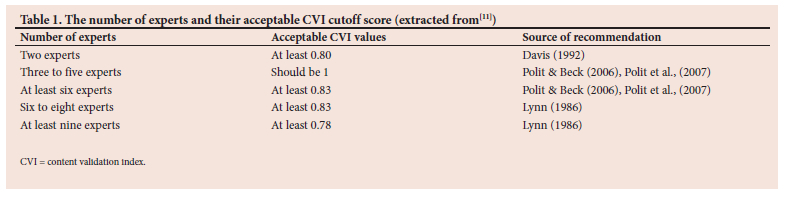
Six experienced ICU healthcare professionals participated in the content validation process. The experts represented the different healthcare professions working in the ICU. The study population included two medical doctors (intensivists), two critical care nurses, and two allied health professionals (one dietician and one physiotherapist) with a range of 6 to 31 years of ICU experience between them. The participants were included based on convenience sampling. This composition ensured representation across key disciplines involved in ICU care. The recommended number of participants for content validation studies ranges from a minimum of 2 to not more than 10 experts (Table 1).[11-14]
Procedure
A validation tool was given to participants with definitions of the various constructs of the MPOC-SP(A) tool. Participants were tasked with evaluating the relevance of each item in the MPOC-SP(A) tool on a four-point scale, thereby preventing neutral responses and ensuring a clear assessment of each item's importance. The participants were also asked to assess the tool's comprehensibility. Suggestions for revision of items were accepted when two or more experts agreed on the change.
The content validation index (CVI) was used to evaluate the validity of items, representing the proportion of items judged as valid by the experts. The number of participants affected the cutoff value of the content validation index (CVI) (Table 1). A CVI value of 0.83 and above was considered acceptable for each item.[14] Items failing to meet this threshold were excluded from the questionnaire. The feedback provided by experts was used to inform necessary adjustments to the tool to enhance its relevance and applicability in the context of adult ICUs in South Africa.
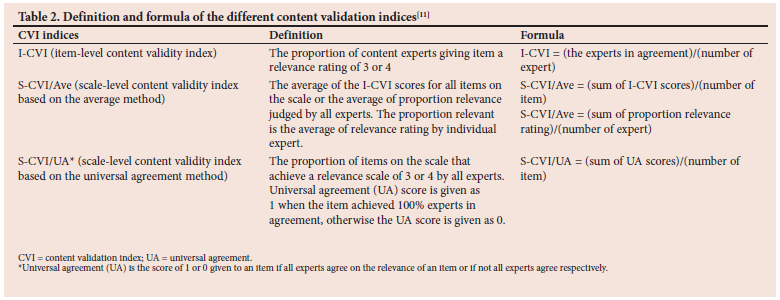
The two forms of CVI, CVI for item (I-CVI) and CVI for scale (S-CVI), were calculated in this study. The I-CVI was calculated by dividing the number of experts in agreement by the total number of experts. The S-CVI was calculated in two ways, by calculating the average of the I-CVI scores for all items on the scale (S-CVI/Ave) and by calculating the proportion of items on the scale that achieve a relevance scale of 3 or 4 by all experts (S-CVI/UA(universal agreement).[14] The definition and formula of the CVI indices are summarised in Table 2.
The CVI was calculated for each item (I-CVI) and domain (S-CVI/Ave) using Microsoft Excel, with the thresholds for acceptability set at 0.83 for I-CVI and 0.9 for S-CVI/Ave.
Results
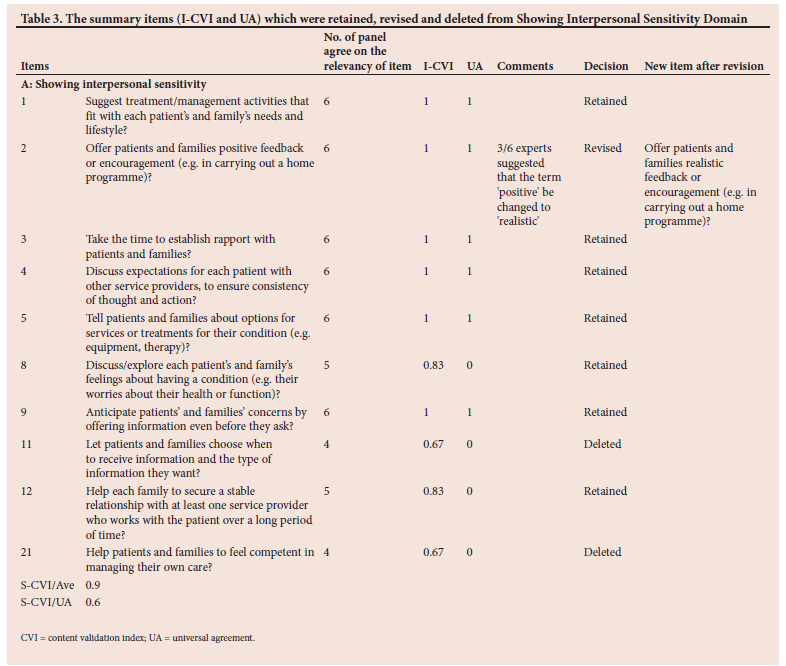
Six health professionals experienced in intensive care assessed the relevance of the MPOC-SP(A) tool to the adult ICU setting. The content validation process addressed all four of the domains of the MPOC-SP(A) tool: 1. Showing interpersonal sensitivity (Table 3):
• This domain evaluates the empathetic interactions between service providers and patients/families.
• Items 11(Let patients and families choose when to receive information and the type of information they wanted?) and 21 (Help patients and families to feel competent in managing their own care?) were deleted because they both had a low I-CVI of 0.67.
• Item 2 (Offer patients and families positive feedback or encouragement (e.g., in carrying out a home programme?) was revised to be 'Offer patients and families realistic feedback or encouragement (e.g., in carrying out a home programme?' as the wording 'positive feedback' was deemed not to fit into the adult ICU setting but rather realistic feedback.
• This domain achieved an S-CVI/Ave of 0.9, indicating strong content validity.
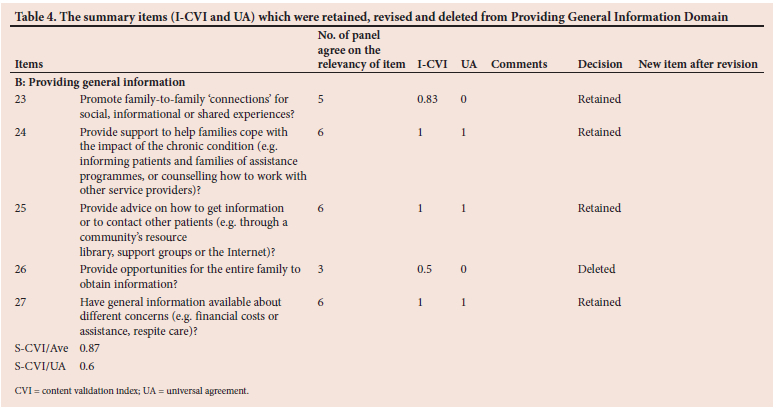
2. Providing general information (Table 4):
• This domain assesses the availability and clarity of general information provided to patients and families.
• Item 26 (Provide opportunities for the entire family to obtain information?) was deleted as it had a low I-CVI of 0.5.
• The S-CVI/Ave for this domain was 0.87.
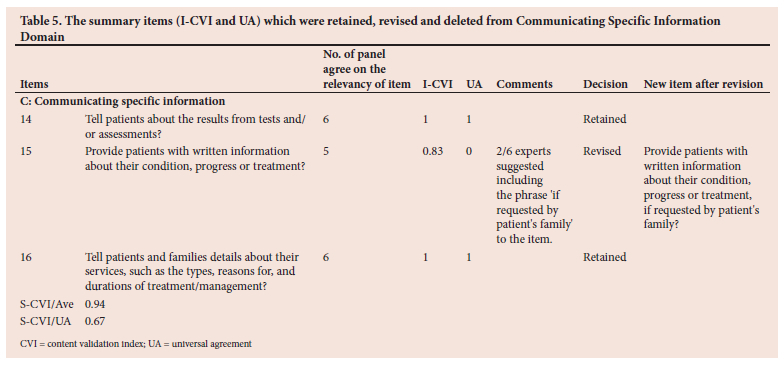
3. Communicating specific information (Table 5):
• This domain evaluates the accuracy and relevance of specific medical information communicated to patients and families.
• Item 15 (Provide patients with written information about their condition, progress or treatment.) was revised to be 'Provide patients with written information about their condition, progress, or treatment, if requested by patient's family?'
• No items were removed; all items met the validity threshold with an I-CVI of 0.83.
• This domain achieved an S-CVI/Ave above 0.9.
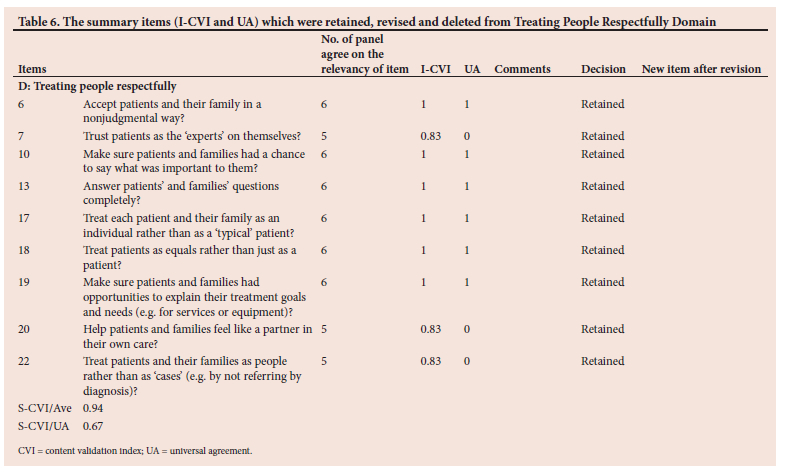
4. Treating people respectfully (Table 6):
• This domain focuses on respect and dignity in patient-provider interactions.
• All items in this domain had an I-CVI of 0.83 and above.
• This domain had an S-CVI/Ave above 0.9, confirming strong validity.
The final MPOC-SP(A) tool was refined to 24 items from the original 27, ensuring it was both focused and relevant for adult ICUs in South Africa.
Discussion
The content validation of the MPOC-SP(A) tool for use in adult ICUs in the South African context resulted in a 24-item version. The removal of items 11, 21 and 26 reflects the distinct dynamics of FCC in adult ICUs compared with rehabilitation settings, where the original tool was developed. From these deletions, one can infer that in the adult ICU there are differing levels of family involvement and information needs which necessitate adjustment on the tool. In addition to these deletions, two items were revised for clarity and to improve on their comprehensibility in the adult ICU setting.
Except for the validation study on the Dutch translation of the MPOC-SP tool, previous validation studies in either paediatric or adult settings did not report on content validation of the tool explicitly. Pretesting of the tool to address the content, readability, comprehensiveness and comprehensibility of the tool were carried out but the focus was more on the construct and reliability of the tool.[5-71516] The decision to include items in the tool was made at the development stage of the tool.[5] In the validation study of the Dutch translation of the MPOC-SP tool, content validation was carried out using a 5-point scale of importance ranging from 0 (not important) to 4 (very important). The outcome of this study did not lead to the deletion or modification of any item, but only highlighted items that were considered highly important to family-centred care and those that were deemed less important to family-centred care.[15] Previous validation studies on the variants of the MPOC tool, also did not report on content validation using the content validity index, which makes this study unique and so there is no reference study with which to compare the results of the present study.[3-7,17-22]
The importance of rigorous content validation when adapting assessment tools for a new clinical setting cannot be overstated. Content validation is an important foundation in any psychometric study as it determines each item's relevance, clarity and comprehensiveness in measuring the intended construct.[9] The absence of content validity can negatively impact all other measurement properties. Including irrelevant items may reduce internal consistency, structural validity, and the interpretability of the tool.[9] Therefore content validation should be evaluated before the evaluation of the internal structure of a psychometric tool.[9] In the case of the MPOC-SP (A) tool, which was originally validated for rehabilitation settings, it was important to ensure that the items were relevant to the adult ICU settings. This involved rephrasing or eliminating items that did not translate well to the new setting. The items also needed to be easily understood by the target population, in this case, healthcare providers working in adult ICUs. Any ambiguities or complex terminologies needed to be clarified to avoid misinterpretation and ensure accurate responses. In addition to the relevance of the tool to the adult ICU setting, it also needed to be culturally and contextually relevant to the South African healthcare environment as there could be differences in the healthcare environments of the developers of the tool. The inclusion of a diverse group of ICU professionals ensured that the tool was comprehensive and applicable to various aspects of ICU care. This multidisciplinary approach helped to capture a wide range of perspectives, enhancing the tool's relevance and utility. One of the limitations of this study which is quite common with content validation studies is the subjectivity of the experts' feedback which makes the outcome subject to bias that may exist among experts.[23] To compensate for this limitation, recommendations made by experts were only accepted when two or more of the experts suggested the change independently. Also, although the study looked at the relevance of each item and the comprehensibility of the tool, it failed to assess the comprehensiveness of the tool which is also a part of content validation.
The next phase of validation will focus on construct validity and reliability assessments of the refined tool so as to ensure the tool's overall psychometric robustness.
Conclusion
The rigorous content validation process underscores the importance of expert review in adapting assessment tools for new clinical environments. The high S-CVI/Ave values across all domains in this study reflect a consensus among experts on the tool's relevance and clarity. The modifications made to the MPOC-SP(A) tool enhance its applicability and potential effectiveness in assessing FCC practices in adult ICUs in South Africa. The study successfully completed the content validation of the MPOC-SP(A) tool for use in adult ICUs, resulting in a refined 24-item instrument. The next phase of validation will focus on construct validity and reliability to further establish the tool's reliability and applicability. By integrating feedback from experienced ICU professionals, the MPOC-SP(A) tool is poised to contribute significantly to improving FCC practices in adult intensive care settings.
Declaration. None.
Acknowledgements. We gratefully acknowledge Prof. Peter Rosenbaum and his colleagues at the Can-Child Centre for Childhood Disability Research for making the MPOC-SP(A) tool available to us. We thank too the healthcare professionals who willingly participated in the study. We also acknowledge using ChatGPT (https://chat.openai.com/) to generate content from the results and improve the flow and wording of the discussion section (more information in Supplementary document).
Author contributions. CONO contributed to the conception and design of the research, conducting the collection and analysis of data, and drafting the manuscript. SC contributed to the conception and design of the research, and revision of the manuscript. Both authors read and approved the final manuscript.
Funding. None.
Conflict of interest. None.
References
-
1. What is PFCC? https://ipfcc.org/about/pfcc.html (accessed 22 June 2023).
» https://ipfcc.org/about/pfcc.html -
2. Arslan FT, Geckil E, Aldem M, Celen R. The Family-Centered Care Assessment Scale: Development and psychometric evaluation in a Turkish sample. J Pediatric Nurs 2019;48:e35-e41. https://doi.org/10.1016/j.pedn.2019.06.001
» https://doi.org/10.1016/j.pedn.2019.06.001 -
3. King GA, Rosenbaum PL, King SM. Evaluating family-centred service using a measure of parents' perceptions. Child Care Health and Development 1997;23(1):47-62. https://doi.org/10.1046/j.1365-2214.1997.840840.x
» https://doi.org/10.1046/j.1365-2214.1997.840840.x -
4. King S, King G, Rosenbaum P. Evaluating health service delivery to children with chronic conditions and their families: Development of a refined Measure of Processes of Care (MPOC-20). Child Health Care 2004;33(1):35-57. https://doi.org/10.1207/s15326888chc3301_3
» https://doi.org/10.1207/s15326888chc3301_3 -
5. Woodside JM, Rosenbaum PL, King SM, King GA. Family-centered service: Developing and validating a self-assessment tool for pediatric service providers. Children's Health Care 2001;30(3):237-252. https://doi.org/10.1207/S15326888CHC3003_5
» https://doi.org/10.1207/S15326888CHC3003_5 -
6. Himuro N, Miyagishima S, Kozuka N, Tsutsumi H, Mori M. Measurement of family-centered care in the neonatal intensive care unit and professional background. J Perinatol 2015;35(4):284-289. https://doi.org/10.1038/jp.2014.204
» https://doi.org/10.1038/jp.2014.204 -
7. Bamm EL, Rosenbaum P, Wilkins S, Stratford P. Performance of the measures of processes of care for adults and service providers in rehabilitation settings. Patient Related Outcome Measures 2015;6:157-165. https://doi.org/10.2147/PROM.S81361
» https://doi.org/10.2147/PROM.S81361 -
8. Aithal A, Aithal PS. Development and validation of survey questionnaire & experimental data - A systematical review-based statistical approach. Int J Management Technol Social Sciences 2020;5(2), 233-251. http://doi.org/10.5281/2enodo.4179499
» http://doi.org/10.5281/2enodo.4179499 -
9. Terwee CB, Prinsen C, Chiarotto A, et al. COSMIN methodology for evaluating the content validity of patient-reported outcome measures: A Delphi study. Qual Life Res 2018;27(5):1159-1170. https://doi.org/10.1007/s11136-018-1829-0
» https://doi.org/10.1007/s11136-018-1829-0 -
10. Prinsen C, Mokkink LB, Bouter LM, et al. COSMIN guideline for systematic reviews of patient-reported outcome measures. Qual Life Res 2018;27(5):1147-1157. https://doi.org/10.1007/s11136-018-1798-3
» https://doi.org/10.1007/s11136-018-1798-3 -
11. Yusoff MSB. ABC of content validation and content validity index calculation. Educ Med J 2019;11:49-54. https://doi.org/10.21315/eimj2019.11.2.6
» https://doi.org/10.21315/eimj2019.11.2.6 -
12. Davis LL. Instrument review: Getting the most from a panel of experts. Applied Nurs Res 1992;5(4):194-197. https://doi.org/10.1016/S0897-1897(05)80008-4
» https://doi.org/10.1016/S0897-1897(05)80008-4 -
13. Polit DF, Beck CT, Owen SV. Is the CVI an acceptable indicator of content validity? Appraisal and recommendations. Res Nurs Health 2007;30(4):459-467. https://doi.org/10.1002/nur.20199
» https://doi.org/10.1002/nur.20199 -
14. Polit DF, Beck CT. The content validity index: Are you sure you know what's being reported? Critique and recommendations. Res Nurs Health 2006;29(5):489-497. https://doi.org/10.1002/nur.20147
» https://doi.org/10.1002/nur.20147 -
15. Siebes RC, Ketelaar M, Wijnroks L, et al. Family-centred services in The Netherlands: Validating a self-report measure for paediatric service providers. Clin Rehabil 2006;20(6):502-512. https://doi.org/10.1191/0269215506cr979oa
» https://doi.org/10.1191/0269215506cr979oa -
16. Siebes RC, Nijhuis BJG, Boonstra AM, et al. A family-specific use of the Measure of Processes of Care for Service Providers (MPOC-SP). Clin Rehabil 2008;22(3):242-251. https://doi.org/10.1177/0269215507081568
» https://doi.org/10.1177/0269215507081568 -
17. Saloojee GM, Rosenbaum PR, Westaway MS, Stewart AV. Development of a measure of family-centred care for resource-poor South African settings: The experience of using a modified version of the MPOC-20. Child: Care, Health and Dev 2009;35(1):23-32. https://doi.org/10.1111/j.1365-2214.2008.00914.x
» https://doi.org/10.1111/j.1365-2214.2008.00914.x -
18. McConachie H, Logan S. Validation of the measure of processes of care for use when there is no child development centre. Child: Care, Health and Dev 2003;29(1):35-45. https://doi.org/10.1046/j.1365-2214.2003.00314.x
» https://doi.org/10.1046/j.1365-2214.2003.00314.x -
19. Groleger Srsen K, Vidmar G, Zupan A. Validity, internal consistency reliability and one-year stability of the Slovene translation of the Measure of Processes of Care (20-item version). Child: Care, Health and Dev 2015;41(4):569-580. https://doi.org/10.1111/cch.12198
» https://doi.org/10.1111/cch.12198 -
20. Saleh M, Almasri NA. Use of the Measure of Processes of Care (MPOC-20) to evaluate health service delivery for children with cerebral palsy and their families in Jordan: Validation of Arabic-translated version (AR-MPOC-20). Child: Care, Health and Dev 2014;40(5):680-688. https://doi.org/10.1111/cch.12116
» https://doi.org/10.1111/cch.12116 -
21. Tang HN, Chong WH, Goh W, Chan WP, Choo S. Evaluation of family-centred practices in the early intervention programmes for infants and young children in Singapore with Measure of Processes of Care for Service Providers and Measure of Beliefs about Participation in Family-Centred Service. Child: Care, Health and Dev 2012;38(1):54-60. https://doi.org/10.1111/j.1365-2214.2011.01259.x
» https://doi.org/10.1111/j.1365-2214.2011.01259.x -
22. Bamm EL, Rosenbaum P, Stratford P. Validation of the measure of processes of care for adults: A measure of client-centred care. Int J Qual Health Care 2010;22(4):302-309. https://doi.org/10.1093/intqhc/m2q031
» https://doi.org/10.1093/intqhc/m2q031 -
23. Rubio DM, Berg-Weger M, Tebb SS, Lee ES, Rauch S. Objectifying content validity: Conducting a content validity study in social work research. Social Work Res 2003;27(2):94-104. https://doi.org/10.1093/swr/27.2.94
» https://doi.org/10.1093/swr/27.2.94

Accepted 25 February 2025
Contribution of the study
This study contributes to the field of research by providing robust evidence for the content validity of the MPOC-SP(A) tool in adult ICU settings, supporting its relevance, clarity, and comprehensiveness for measuring family-centred care practices. It also offers a framework for future validation studies in similar resource-limited healthcare contexts.