Shock epidemiology and outcomes among internal medicine patients
BACKGROUND: Shock, characterised by circulatory hypoperfusion and cellular hypoxia, represents a critical medical condition requiring immediate attention. Despite its significance, there are limited data on shock incidence and outcomes, particularly within the context of Thailand OBJECTIVES: This retrospective observational study aimed to investigate the incidence, management and outcomes of shock patients admitted to the internal medicine department of Siriraj Hospital, a referral university hospital in Bangkok, Thailand. Additionally, the study sought to identify factors associated with mortality among these patients METHODS: Medical records of patients admitted were reviewed. Shock cases were identified based on specific diagnostic criteria, and demographic and clinical data were extracted for analysis RESULTS: A total of 125 patients were included in the study, with septic shock being the most prevalent condition (40.0%), followed by cardiogenic shock (39.2%), hypovolaemic shock (18.4%) and obstructive shock (2.4%). The overall intensive care unit (ICU) admission rate was 46.7%, varying among shock types, with cardiogenic shock patients exhibiting the highest rate. The overall 28-day mortality rate was 23.7%, with septic shock patients admitted to the ICU demonstrating the highest mortality rate (50.0%). The multivariate analysis identified factors associated with mortality, including colloid resuscitation (adjusted odds ratio (aOR) 3.10 (1.08 - 8.9), p=0.036); vasopressor dose of more than 0.2 μg/kg/min (aOR 4.38 (1.39 - 13.74), p=0.011); and renal replacement therapy (aOR 3.43 (1.04 - 11.28), p=0.043 CONCLUSIONS: This study provides significant insights into shock incidence, management and outcomes in a tertiary referral hospital in Thailand. It also highlights challenges related to ICU bed availability and identifies predictors of mortality. Early recognition and tailored interventions are crucial for improving outcomes in shock patients
cardiogenic shock; hypovolaemic shock; septic shock
Shock epidemiology and outcomes among internal medicine patients
C Maluangnon; B Joyjumroon; C Phawanawichian; S Tongyoo
MD; Department of Medicine, Faculty of Medicine Siriraj Hospital, Mahidol University, Bangkok, Thailand
ABSTRACTBACKGROUND: Shock, characterised by circulatory hypoperfusion and cellular hypoxia, represents a critical medical condition requiring immediate attention. Despite its significance, there are limited data on shock incidence and outcomes, particularly within the context of Thailand
OBJECTIVES: This retrospective observational study aimed to investigate the incidence, management and outcomes of shock patients admitted to the internal medicine department of Siriraj Hospital, a referral university hospital in Bangkok, Thailand. Additionally, the study sought to identify factors associated with mortality among these patients
METHODS: Medical records of patients admitted were reviewed. Shock cases were identified based on specific diagnostic criteria, and demographic and clinical data were extracted for analysis
RESULTS: A total of 125 patients were included in the study, with septic shock being the most prevalent condition (40.0%), followed by cardiogenic shock (39.2%), hypovolaemic shock (18.4%) and obstructive shock (2.4%). The overall intensive care unit (ICU) admission rate was 46.7%, varying among shock types, with cardiogenic shock patients exhibiting the highest rate. The overall 28-day mortality rate was 23.7%, with septic shock patients admitted to the ICU demonstrating the highest mortality rate (50.0%). The multivariate analysis identified factors associated with mortality, including colloid resuscitation (adjusted odds ratio (aOR) 3.10 (1.08 - 8.9), p=0.036); vasopressor dose of more than 0.2 μg/kg/min (aOR 4.38 (1.39 - 13.74), p=0.011); and renal replacement therapy (aOR 3.43 (1.04 - 11.28), p=0.043
CONCLUSIONS: This study provides significant insights into shock incidence, management and outcomes in a tertiary referral hospital in Thailand. It also highlights challenges related to ICU bed availability and identifies predictors of mortality. Early recognition and tailored interventions are crucial for improving outcomes in shock patients
Keywords: cardiogenic shock; hypovolaemic shock; septic shock.
Shock is a life-threatening condition characterised by circulatory hypoperfusion and cellular hypoxia. Since it can lead to multi-organ failure and death, this condition requires special consideration and urgent care. The epidemiology of shock varies, based on population, definition and data acquisition period. Data from multi-European intensive care units (ICUs) show that septic shock has the highest incidence (63.2%), followed by hypovolaemic shock (16.1%), cardiogenic shock (14.3%) and obstructive shock (1.40%).[1] A nationwide cross-sectional study from China showed that hypovolaemic and septic shock were equally predominant, followed by cardiogenic and obstructive shock.[2]
Mortality rates differ by shock type. Septic shock has a mortality rate of approximately 30 - 40%,[3,4] while cardiogenic shock has a mortality rate of about 50%.[5] Non-traumatic hypovolaemic shock results in a 30% mortality rate.[6] Data on mortality for obstructive shock are limited.
Most available data on the incidence and outcomes of patients with shock focus on patients in the emergency department or ICU, with limited information from internal medicine departments. The present study aimed to investigate the incidence, management and outcomes of shock patients who received optimal treatment, whether admitted to an ICU or treated in a general ward of the internal medicine department. Additionally, we aimed to identify clinical parameters associated with mortality among these patients.
Methods
Study setting and population
This retrospective observational study enrolled patients admitted to Siriraj Hospital, a tertiary referral university hospital located in Bangkok, Thailand, who met the inclusion criteria between July 2018 and September 2019. The internal medicine department has approximately 30 ICU beds, representing about 5% of the ICU-to-general bed ratio.
The inclusion criteria were as follows:
• age >18 years
• admitted to internal medicine department (both general ward and ICU)
• shock was a principal diagnosis of admission
• hypotension (any of the following)
• systolic blood pressure (SBP) <90 mmHg
• diastolic blood pressure (DBP) <60 mmHg
• mean arterial pressure (MAP) <65 mmHg
• need of vasopressor or inotropic agent to maintain adequate blood pressure
• reduced tissue perfusion (any of the following)
• altered mental status
• poor peripheral perfusion (capillary refill time >3 seconds or mottled skin)
• acute kidney injury
• elevated serum lactate >2 mmol/L
Patients who were terminally ill, declined invasive procedures, or had do-not-resuscitate orders were excluded.
Ethics approval and informed consent
Prior to commencing this research, the Institutional Review Board of the Faculty of Medicine Siriraj Hospital, Mahidol University, approved the study protocol (Si264/2019). Informed consent was waived owing to the retrospective study design. The study was carried out according to the Ethics Code of the World Medical Association (Declaration of Helsinki).
Data collection
The authors screened the eligibility of every patient admitted to the internal medicine department during the study period using electronic medical records, and extracted demographic- and management-related data from eligible patients.
Shock classification
Shock types were classified into five categories: septic shock, cardiogenic shock, hypovolaemic shock, obstructive shock, and other types of shock based on the following definitions.
Septic shock is a vasodilatory shock resulting from a systemic inflammatory response to infections. The diagnosis of septic shock is guided by The Third International Consensus Definitions for Sepsis and Septic Shock (Sepsis-3) criteria, which include an increase in the sequential organ failure assessment (SOFA) score by >2 points, a vasopressor requirement to maintain a MAP >65 mmHg, and a serum lactate level >2 mmol/l.[7]
Cardiogenic shock is diagnosed when myocardial or valvular performance is severely impaired, resulting in diminished cardiac output, systemic hypotension, clinical signs of pulmonary congestion, and end-organ hypoperfusion.[8] If invasive haemodynamic parameters are available, a cardiac index <2.2 L/min/m2[9]
Hypovolaemic shock is recognised by evidence of either internal or external fluid or blood loss leading to hypotension and reduced tissue perfusion.[10]
Obstructive shock is characterised by the identification of obstruction in a central vessel of the systemic or pulmonary circulation, resulting in low cardiac output, hypotension and shock.[10]
Other types of shock include those that do not fit into any of the groups mentioned above, such as anaphylactic shock, neurogenic shock, or adrenal shock.
Measurement of outcomes
The primary outcome of this study was the assessment of 28-day mortality rates for each type of shock. Secondary outcomes included evaluating the incidence of shock, management strategies, and identifying predictive factors associated with 28-day mortality among shock patients.
Statistical analysis
A sample size calculation was not performed owing to the epidemiological nature of the study.
Variables among different shock types were compared using ch-square tests for categorical data and one-way ANOVA for continuous data. Probability values (p) <0.05 were considered statistically significant. All otential clinical parameters were analysed in a univariate analysis to determine the predictive factors of the primary outcome. Types of shock and clinical parameters that showed an association with the primary outcome, indicated by a p-value <0.1 in the univariate analysis, were entered into a multivariate logistic regression model. All analyses were performed using PASW Statistics for Windows, version 18.0 (SPSS, Chicago, USA).
Results
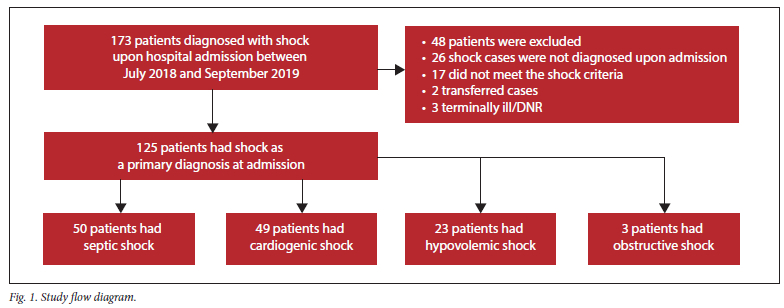
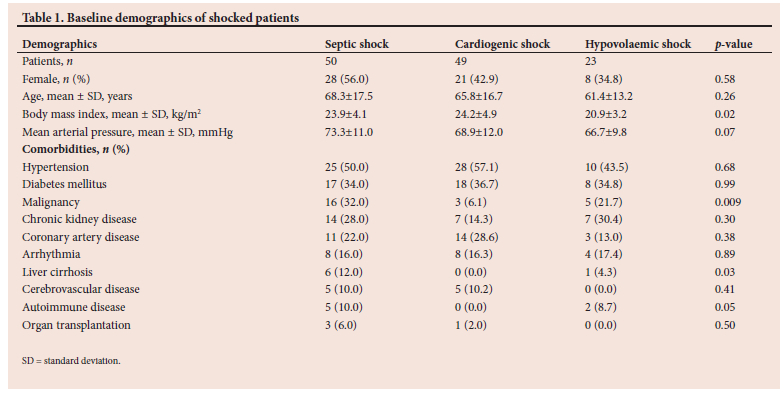
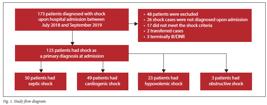
A total of 125 patients were enrolled after exclusions, comprising 50 patients (40.0%) with septic shock, 49 patients (39.2%) with cardiogenic shock, 23 patients (18.4%) with hypovolaemic shock, and 3 patients (2.4%) with obstructive shock (Fig. 1). Owing to the small number of patients in the obstructive shock group, comparisons were made among the remaining three groups. Age and sex were comparable across all groups. Septic shock patients tended to display more liver cirrhosis, while cardiogenic shock patients had the lowest malignancy rate. Additionally, the hypovolaemic shock group exhibited the lowest body mass index (BMI) (Table 1).
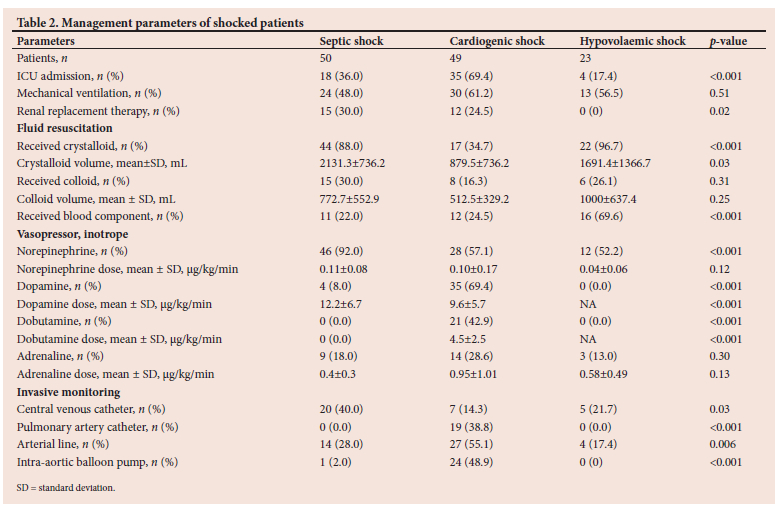
Significantly more individuals with cardiogenic shock (69.4%) were admitted to the ICU, compared with 36.0% in the septic shock group and 17.4% in the hypovolaemic shock group, respectively. Mechanical ventilation was required in 24 patients (48.0%) in the septic shock group, 30 patients (61.2%) in the cardiogenic shock group, and 13 patients (56.5%) in the hypovolaemic shock group. Renal replacement therapy was performed on 15 patients (30.0%) in the septic shock group and 12 patients (24.5%) in the cardiogenic shock group, but in none in the hypovolaemic shock group. In terms of management, crystalloids were used more frequently in septic and hypovolaemic shock than in cardiogenic shock, with usage rates of 88.0% (mean volume of 2 131.3±736.2 mL), 96.7% (1 691.4±1366.7 mL) and 34.7% (879.5±736.2 mL), respectively. Blood component usage was significantly higher in hypovolaemic shock patients (69.6%). Norepinephrine was the most commonly used vasopressor, with the highest usage in septic shock (92.0%) compared with cardiogenic (57.1%) and hypovolaemic (52.2%) shock. The mean dose of norepinephrine did not significantly differ between groups but tended to be lower in hypovolaemic shock compared with the others (0.04±0.06 v. 0.11±0.08 and 0.10±0.17 μg/kg/min). Dopamine and dobutamine were used significantly more in cardiogenic shock, at 69.4% (9.6±5.7 μg/kg/min) and 42.9% (4.5±2.5 μg/kg/min), respectively. Adrenaline use and dose did not significantly differ, but both were slightly higher in cardiogenic shock (28.6%, 0.95±1.01 μg/kg/min). Central venous catheter insertion was performed on 40.0% of septic shock patients, significantly more than in the remaining two groups. Only cardiogenic shock patients had pulmonary artery catheters (38.8%), and this group also had the highest use of arterial lines (55.1%) and intra-aortic balloon pumps (48.9%) (Table 2).
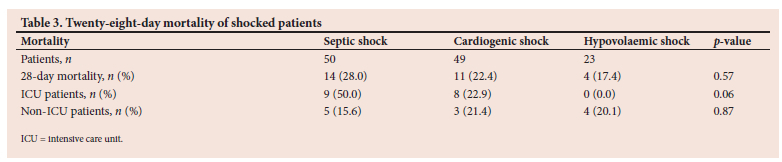
Regarding the primary outcome, 28-day mortality did not differ significantly between groups: septic shock (28.0%), cardiogenic shock (22.4%) and hypovolaemic shock (17.4%). A subgroup analysis of ICU patients showed that septic shock led to the highest 28-day mortality (50.0%), but this was not statistically significant compared with cardiogenic shock (22.9%). There was zero mortality in the hypovolaemic shock group within the ICU. For patients outside the ICU, the 28-day mortality rate was comparable and did not reach statistical significance (Table 3).
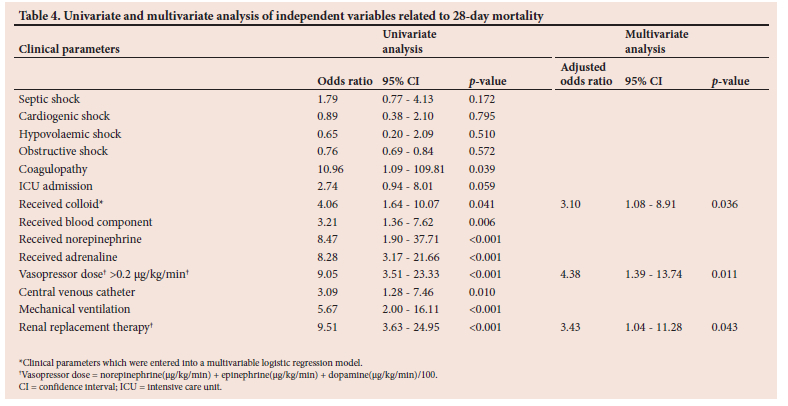
In the univariate analysis, factors associated with primary outcome included coagulopathy, resuscitation with colloid, blood component transfusion, norepinephrine infusion, adrenaline infusion, vasopressor dose of more than 0.2 μg/kg/min, central venous catheterisation, mechanical ventilation, and renal replacement therapy. However, in the multivariate analysis model, only colloid resuscitation (adjusted odds ratio (aOR) 3.10, 95% confidence interval (CI) 1.08 - 8.91, p=0.036), vasopressor dose >0.2 μg/kg/min (aOR 4.38, 95% CI 1.39 - 13.74, p=0.011), and renal replacement therapy (aOR 3.43, 95% CI 1.04 - 11.28, p=0.043) remained significant (Table 4).
Discussion
To our knowledge, this study is the first to illustrate the incidence of shock in the internal medicine department of Siriraj Hospital, a tertiary referral university hospital in Bangkok, Thailand.
The incidence of septic shock in our cohort was the highest among shock patients, which is consistent with previous studies. The percentage was comparable to that reported in a study from China[2] but relatively low when compared to the 63.2% reported in a previous international study[1] and the 67.8% observed in the emergency department (ED) of Srinagarind Hospital in Khon Kaen, Thailand.[11] A previous sepsis study published by our institute indicated a sepsis or septic shock prevalence of 34.9% among patients who had blood cultures performed.[12] Two-thirds of these cases were hospital-acquired sepsis, which was not included in our study. This could explain the relatively low incidence of septic shock in our cohort, as we included septic shock only if it was the primary diagnosis upon admission. Cardiogenic shock was surprisingly disproportionate, and our study demonstrated the highest incidence at 39.2%, compared with around 15%[1,2] and 2.9%[11] in other studies. This could be explained by differences in inclusion criteria in the Chinese study which was based on the International Classification of Diseases (ICD), which may raise questions about the accuracy of diagnosis[2] while the ED study relied on ED discharge diagnoses, which may be considered provisional.[11] Our study's diagnosis of shock was based on a thorough review and distinct diagnostic criteria, providing confidence in the diagnostic accuracy. Another explanation for this finding could be that our hospital is a tertiary university referral hospital and therefore sophisticated cardiac cases requiring special interventions or support were more likely to be accepted, unlike septic cases, which could be managed peripherally.
Notably, in our cohort, not every shock patient was admitted to and managed in the ICU. The overall ICU admission rate was 46.7%, with the highest rate in the cardiogenic shock group, while the admission rates for septic shock and hypovolaemic shock were significantly lower. This finding demonstrates that even in a university hospital, ICU bed shortages persist which prevents optimal care for all patients. This finding is consistent with our previous study, which demonstrated that only 40% of ICU requests were accepted.[13]
In Thailand, owing to ICU bed limitations, managing shock in a resource-limited setting often requires alternative approaches. At our institution, norepinephrine is commonly administered initially through a peripheral vein.[14] If patients achieve haemodynamic stability with a low dose and show no complications from peripheral vasopressor administration, central venous catheter and arterial line insertion may be omitted. Additionally, a high-dependency sector within the general ward is utilised to manage more severe cases when ICU beds are unavailable. While this sector does not provide the same level of care as the ICU-particularly regarding nurse-to-patient ratio, advanced organ support, or continuous monitoring-it allows for the management of patients on low-dose vasopressors and non-complicated ventilator care. Furthermore, with limited availability of vasopressin in Thailand, adrenaline remains the primary second-line agent for refractory septic shock based on available evidence.[15]
The mean resuscitation volume varied according to shock type. Septic shock patients received the highest crystalloid volume, around 30 mL/kg, in line with sepsis guidelines.[15] Hypovolaemic shock patients received the highest amount of blood components as most patients in our cohort had gastrointestinal haemorrhage, while cardiogenic shock patients received limited volume to avoid harm.[5] Norepinephrine remained the vasopressor of choice for all shock individuals.[16] It counteracted the underlying pathophysiology of vasodilatation in septic shock[15] and provided additional inotropic and chronotropic benefits in cardiogenic shock.[17] In hypovolaemic shock, although norepinephrine did not correct volume depletion, it helped to maintain perfusion pressure and reduced the amount of fluid needed by shifting unstressed to stressed blood volume.[18]
The overall mortality rate in this cohort was 23.7%, but it rose dramatically to 50% in septic shock patients who were admitted to the ICU. These percentages are consistent with previous studies.[1,2,13] Although ICU admission is considered a positive factor for improving outcomes, our study found a much higher mortality rate in septic shock patients treated in the ICU. This higher mortality rate in ICU septic shock patients can be explained by the fact that severe cases are more likely to be admitted into the ICU.[13]
The factors related to 28-day mortality in shock patients in our study included receiving colloid, a vasopressor dose >0.2 μg/kg/min, and a requirement for renal replacement therapy. These factors indicate a more severe condition. Colloid is usually reserved as a second-line fluid therapy for patients who do not adequately respond to crystalloid or who are at risk of its complications, as it provides no clear clinical benefits at a higher cost.[19] Multi-organ failure is an undesirable outcome for shock patients, requiring interventions such as vasopressors for haemodynamic support and renal replacement therapy for renal support. A higher dose of vasopressors administered at any point during the ICU stay indicates a more critical condition and serves as a robust indicator of mortality. [20,21] Previous research consistently links acute kidney injury (AKI) severity and the need for renal replacement therapy (RRT) to heightened mortality rates among critically ill patients.[22,23] Additionally, RRT has been identified as an independent factor linked to increased mortality in ICU patients compared with conservative treatment approaches, even after adjusting for disease severity.[24]
The strength of the present study lies in its comprehensive review of medical records and the robust diagnostic criteria used for identifying shock cases. By employing clear definitions and criteria, we were able to accurately determine the true incidence of shock among patients admitted to the internal medicine department. This meticulous approach ensured the reliability of our findings and provided valuable insights into the distribution and management of shock cases within our hospital setting.
However, it is important to acknowledge the inherent limitations associated with our single-centre design. Our study was conducted exclusively at a tertiary referral university hospital in Thailand, so our findings may not fully reflect the diversity of patient populations and healthcare practices observed in other settings. This restricts the generalisability of our results and underscores the need for caution when extrapolating findings to broader populations or healthcare contexts. Additionally, the study's retrospective nature and relatively small sample size may have compromised the statistical power and precision of our analyses. Future studies with larger and more diverse cohorts are needed to validate our findings and provide a more comprehensive understanding of shock management and outcomes across different healthcare settings.
Conclusion
Our study provides comprehensive insight into the incidence, management and outcomes of shock patients, particularly within the unique context of a tertiary referral hospital in Thailand. Furthermore, the study sheds light on structural issues regarding the availability of ICU beds. Despite the urgent need for specialised care in shock cases, our findings reveal that not all patients can be accommodated in the ICU owing to capacity constraints. This highlights a systemic challenge that healthcare institutions face in delivering optimal care to critically ill patients. Moreover, our analysis underscores the significant impact of disease severity on outcomes of shock patients, emphasising its role in determining patient prognosis and treatment outcomes.
Declaration. None.
Acknowledgements. None.
Author contributions. CM: conceptualisation, methodology, investigation, formal analysis, supervision, review and editing of the manuscript. BJ and CP: conceptualisation, methodology, data curation, investigation, writing of the original draft of the manuscript. ST: conceptualisation, methodology, investigation, formal analysis, supervision, validation, visualisation, review and editing of the manuscript. All authors read and approved the final version of the manuscript.
Funding. None.
Conflict of interest. None.
References
- 1. De Backer D, Biston P, Devriendt J, et al. Comparison of dopamine and norepinephrine in the treatment of shock. N Engl J Med 2010;362:779-789.
- 2. Su L, Ma X, Rui X, et al. Shock in China 2018 (SIC-study): A cross-sectional survey, Ann Transl Med 2021;9:1219.
- 3. Permpikul C, Sivakorn C, Tongyoo S. In-hospital death after septic shock reversal: A retrospective analysis of in-hospital death among septic shock survivors at Thailand's largest national tertiary referral center. Am J Trop Med Hyg 2021;104:395-402.
- 4. Bauer M, Gerlach H, Vogelmann T, Preissing F, Stiefel J, Adam D. Mortality in sepsis and septic shock in Europe, North America and Australia between 2009 and 2019 - results from a systematic review and meta-analysis. Crit Care 2020;24:239.
- 5. Vahdatpour C, Collins D, Goldberg S. Cardiogenic shock. J Am Heart Assoc 2019;8:e011991.
- 6. Bloom JE, Andrew E, Dawson LP, et al. Incidence and outcomes of nontraumatic shock in adults using emergency medical services in Victoria, Australia. JAMA Netw Open 2022;5:e2145179.
- 7. Singer M, Deutschman CS, Seymour CW, et al. The Third International Consensus Definitions for Sepsis and Septic Shock (Sepsis-3). JAMA 2016;315:801-810.
- 8. Lee JM, Rhee TM, Hahn JY, et al. Multivessel percutaneous coronary intervention in patients with ST-segment elevation myocardial infarction with cardiogenic shock. J Am Coll Cardiol 2018;71:844-856.
- 9. Hochman JS, Sleeper LA, Webb JG, et al. Early revascularisation in acute myocardial infarction complicated by cardiogenic shock. Shock investigators. Should we emergently revascularise occluded coronaries for cardiogenic shock? N Engl J Med 1999;341:625-634.
- 10. Vincent JL, De Backer D. Circulatory shock. N Engl J Med 2013;369:1726-1734.
- 11. Phungoen P, Piyapaisarn S, lenghong K, Kotruchin P, Mitsungnern T, Apiratwarakul K. Shock in the emergency department: Incidence, etiology, and mortality. J Med Assoc Thailand 2020;103.
- 12. Tancharoen L, Pairattanakorn P, Thamlikitkul V, Angkasekwinai N. Epidemiology and burden of sepsis at Thailand's largest university-based national tertiary referral center during 2019. Antibiotics (Basel) 2022;11.
- 13. Maluangnon C, Kanogpotjananont P, Tongyoo S. Comparing outcomes of critically ill patients in intensive care units and general wards: A comprehensive analysis. Int J Gen Med 2023;16:3779-3787.
- 14. Permpikul C, Tongyoo S, Viarasilpa T, Trainarongsakul T, Chakorn T, Udompanturak S. Early use of norepinephrine in septic shock resuscitation (CENSER). A randomised trial. Am J Respir Crit Care Med 2019;199:1097-1105.
- 15. Evans L, Rhodes A, Alhazzani W, et al. Surviving sepsis campaign: International guidelines for management of sepsis and septic shock 2021. Intensive Care Med 2021;47:1181-1247.
- 16. Russell JA. Vasopressor therapy in critically ill patients with shock. Intensive Care Med 2019;45:1503-1517.
- 17. Bloom JE, Chan W, Kaye DM, Stub D. State of shock: Contemporary vasopressor and inotrope use in cardiogenic shock. J Am Heart Assoc 2023;12:e029787.
- 18. Gupta B, Garg N, Ramachandran R. Vasopressors: Do they have any role in hemorrhagic shock? J Anaesthesiol Clin Pharmacol 2017;33:3-8.
- 19. Finfer S, Bellomo R, Boyce N, French J, Myburgh J, Norton R. A comparison of albumin and saline for fluid resuscitation in the intensive care unit. N Engl J Med 2004;350:2247-2256.
- 20. Sviri S, Hashoul J, Stav I, van Heerden PV. Does high-dose vasopressor therapy in medical intensive care patients indicate what we already suspect?, J Crit Care 2014;29:157-160.
- 21. Tongyoo S, Tanyalakmara T, Naorungroj T, Promsin P, Permpikul C. The association of high dose vasopressor and delayed vasopressor titration with 28-day mortality in adult patients with septic shock. J Health Sci Med Res 2022;41:2022886.
- 22. Hoste EA, Bagshaw SM, Bellomo R, et al. Epidemiology of acute kidney injury in critically ill patients: The multinational AKI-EPI study. Intensive Care Med 2015;41:1411-1423.
- 23. Nisula S, Kaukonen KM, Vaara ST, et al. Incidence, risk factors and 90-day mortality of patients with acute kidney injury in Finnish intensive care units: The FINNAKI study. Intensive Care Med 2013;39:420-428.
- 24. Elseviers MM, Lins RL, Van der Niepen P, et al. Renal replacement therapy is an independent risk factor for mortality in critically ill patients with acute kidney injury, Crit Care 2010;14:R221.

Accepted 25 February 2025
Contribution of the study
This study provides the comprehensive evaluation of shock incidence, management and outcomes among internal medicine patients. By identifying critical care resource limitations and key predictors of mortality, the findings offer valuable insights for improving early recognition and tailored interventions in resource-constrained settings.