Transfusion-associated necrotising enterocolitis in very low birth weight babies: transfusion and feeding practices in two neonatal units in Bloemfontein, Free State
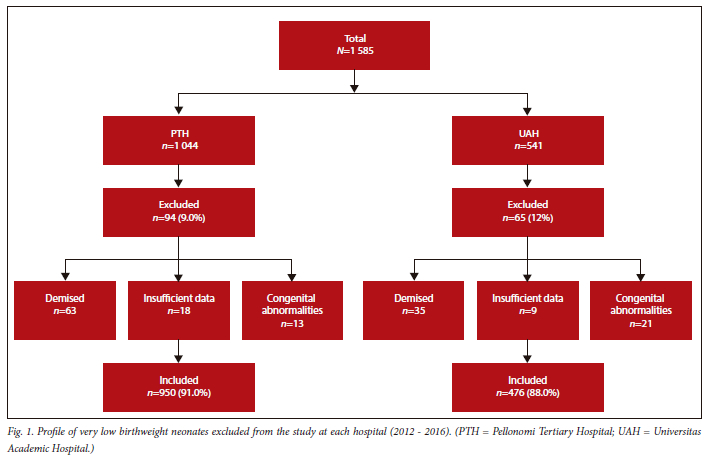
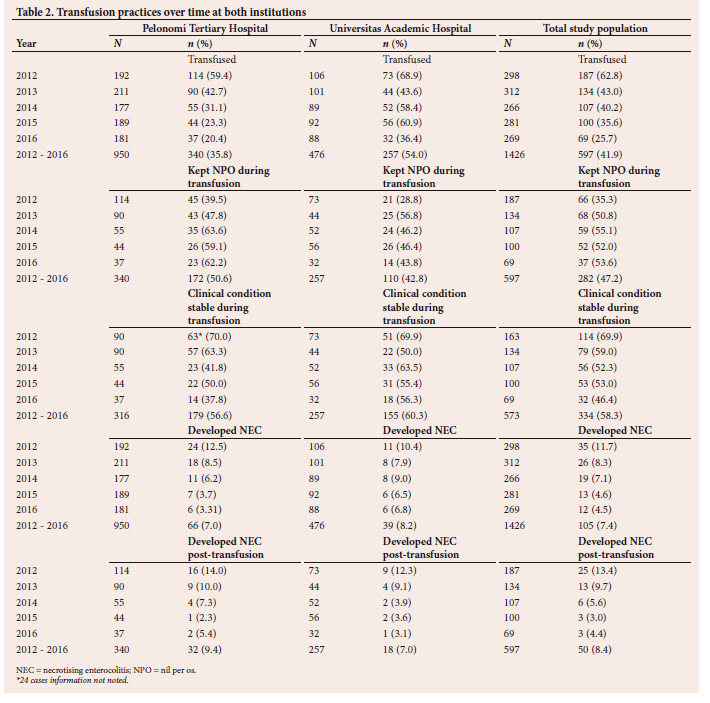
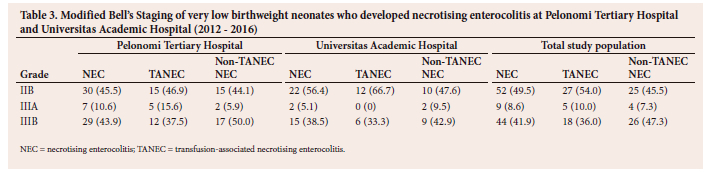
BACKGROUND. Necrotising enterocolitis (NEC) is life-threatening with a rising incidence due to improved neonatal care. While researchers' focus has shifted to causes, risk factors and preventative clinical strategies, little is known about the exact aetiology of NEC. Risk factors include the relationship between red blood cell transfusions (RBCTs) and the development of transfusion-associated NEC (TANEC) and peri-transfusion feeding, increasing the risk of TANEC. OBJECTIVES. Evaluate the relationship between RBCT and peri-transfusion feeding practices and the development of TANEC in very low birthweight (VLBW) neonates over 5 years. METHODS. This was a retrospective analytical record review of all VLBW neonates admitted to two tertiary hospitals' neonatal units in Bloemfontein, South Africa (SA), from 1 January 2012 - 31 December 2016. RESULTS. The study population (n=1 426) had a median birthweight of 1 260 g and a median gestation age of 30 weeks. RBCTs were given to 41.9%, and NEC developed in 7.4%, of whom 47.6% had an RBCT (TANEC). Half (47.2%) were kept nil per os (NPO) around the transfusion. No association was found between NPO status and TANEC development (8.9% NPO patients, 7.9% non-NPO patients, p=0.6826). No significant differences regarding Modified Bell's Staging were found between neonates who developed TANEC v. NEC. CONCLUSION. Optimising the administration of RBCTs and evidence-based feeding protocols is crucial in reducing TANEC's impact on premature neonates.
Red blood cell transfusions; transfusion-associated necrotising enterocolitis; transfusion protocol
 Thumbnail