Use of intravenous immunoglobulin for the treatment of severe COVID-19 in the Chris Hani Baragwanath Academic Hospital intensive care unit, Johannesburg, South Africa
BACKGROUND: COVID-19 infection has a variable clinical presentation, with a small subgroup of patients developing severe disease, requiring intensive care with mechanical ventilation, with an increased mortality rate. South Africa (SA) has experienced multiple waves of this pandemic, spanning the pre-vaccine and vaccine periods. The method and initiation of treatment is a debated topic, changing according to evolving research and the literature. The present study investigated the use of high-dose intravenous immunoglobulin (IVIg) as a salvage therapy after initial medical treatment failure OBJECTIVES: To compare disease progression among critically ill COVID-19 pneumonia patients receiving IVIg therapy with that in patients receiving standard of care (SoC), in respect of inflammation, organ dysfunction and oxygenation METHODS: This was a single-centre, retrospective study of patients admitted to the intensive care unit (ICU) at Chris Hani Baragwanath Academic Hospital, Johannesburg, SA, during the pre-vaccine COVID-19 pandemic. Demographics, inflammatory markers (C-reactive protein (CRP)), organ function (Sequential Organ Failure Assessment (SOFA) score), oxygenation (ratio of partial pressure of oxygen in arterial blood to fraction of inspiratory oxygen (P/F ratio)), overall mortality and complications (nosocomial infections and thromboembolism) were recorded and compared RESULTS: We included 113 eligible patients in the study. The IVIg cohort had a significantly lower initial P/F ratio than the SoC cohort (p=0.01), but the change in P/F ratio was similar (p=0.54). Initial CRP and changes in CRP were similar in the two groups (p=0.38 and p=0.75, respectively), as were initial SOFA score and changes in SOFA score (p=0.18 and p=0.08, respectively) and vasopressor dose on day 0 and day 5 (p=0.97 and p=0.93, respectively). Duration of mechanical ventilation did not differ significantly between the IVIg group and the SoC group (p=0.13). There were no significant differences in measured complications between the two groups. On univariate analysis, the relative risk of death was 1.6 times higher (95% confidence interval (CI) 1.1 - 2.3) in the IVIg group; however, a logistical regression model demonstrated that only a higher P/F ratio (odds ratio (OR) 0.991; 95% CI 0.983 - 0.997) and higher mean airway pressure (OR 1.283; 95% CI 1.026 - 1.604) were significantly associated with ICU mortality CONCLUSION: Use of IVIg in our study was directed at an older population, with significantly worse oxygenation. We found no evidence of adverse effects of immunoglobulin therapy; however, we found no benefit either. Only the P/F ratio and mean airway pressure independently predicted ICU mortality
COVID-19; intravenous immunoglobulin; intensive care unit; Sequential Organ Failure Assessment score; C-reactive protein; P/F ratio; pneumonia; inflammation
Use of intravenous immunoglobulin for the treatment of severe COVID-19 in the Chris Hani Baragwanath Academic Hospital intensive care unit, Johannesburg, South Africa
G MenskyI; A van BlydensteinII, III; J DamelinIV; S OmarV, VI
IMB BCh, BEngSc, Dip HIV Man (SA); Department of Internal Medicine, Faculty of Health Sciences, University of the Witwatersrand, Johannesburg, South Africa
IIMB BCh, DCH, FCP (SA), Cert Pulm (SA), MMed (Int Med); Department of Internal Medicine, Faculty of Health Sciences, University of the Witwatersrand, Johannesburg, South Africa
IIIMB BCh, DCH, FCP (SA), Cert Pulm (SA), MMed (Int Med); Department of Pulmonology, Chris Hani Baragwanath Academic Hospital and Faculty of Health Sciences, University of the Witwatersrand, Johannesburg, South Africa
IVMB BCh; Critical Care, Chris Hani Baragwanath Academic Hospital and Faculty of Health Sciences, University of the Witwatersrand, Johannesburg, South Africa
VMB ChB, PC Path (Chem) SA, DA (SA), Critical Care (SA); Department of Internal Medicine, Faculty of Health Sciences, University of the Witwatersrand, Johannesburg, South Africa
VIMB ChB, PC Path (Chem) SA, DA (SA), Critical Care (SA); Critical Care, Chris Hani Baragwanath Academic Hospital and Faculty of Health Sciences, University of the Witwatersrand, Johannesburg, South Africa
BACKGROUND: COVID-19 infection has a variable clinical presentation, with a small subgroup of patients developing severe disease, requiring intensive care with mechanical ventilation, with an increased mortality rate. South Africa (SA) has experienced multiple waves of this pandemic, spanning the pre-vaccine and vaccine periods. The method and initiation of treatment is a debated topic, changing according to evolving research and the literature. The present study investigated the use of high-dose intravenous immunoglobulin (IVIg) as a salvage therapy after initial medical treatment failure
OBJECTIVES: To compare disease progression among critically ill COVID-19 pneumonia patients receiving IVIg therapy with that in patients receiving standard of care (SoC), in respect of inflammation, organ dysfunction and oxygenation
METHODS: This was a single-centre, retrospective study of patients admitted to the intensive care unit (ICU) at Chris Hani Baragwanath Academic Hospital, Johannesburg, SA, during the pre-vaccine COVID-19 pandemic. Demographics, inflammatory markers (C-reactive protein (CRP)), organ function (Sequential Organ Failure Assessment (SOFA) score), oxygenation (ratio of partial pressure of oxygen in arterial blood to fraction of inspiratory oxygen (P/F ratio)), overall mortality and complications (nosocomial infections and thromboembolism) were recorded and compared
RESULTS: We included 113 eligible patients in the study. The IVIg cohort had a significantly lower initial P/F ratio than the SoC cohort (p=0.01), but the change in P/F ratio was similar (p=0.54). Initial CRP and changes in CRP were similar in the two groups (p=0.38 and p=0.75, respectively), as were initial SOFA score and changes in SOFA score (p=0.18 and p=0.08, respectively) and vasopressor dose on day 0 and day 5 (p=0.97 and p=0.93, respectively). Duration of mechanical ventilation did not differ significantly between the IVIg group and the SoC group (p=0.13). There were no significant differences in measured complications between the two groups. On univariate analysis, the relative risk of death was 1.6 times higher (95% confidence interval (CI) 1.1 - 2.3) in the IVIg group; however, a logistical regression model demonstrated that only a higher P/F ratio (odds ratio (OR) 0.991; 95% CI 0.983 - 0.997) and higher mean airway pressure (OR 1.283; 95% CI 1.026 - 1.604) were significantly associated with ICU mortality
CONCLUSION: Use of IVIg in our study was directed at an older population, with significantly worse oxygenation. We found no evidence of adverse effects of immunoglobulin therapy; however, we found no benefit either. Only the P/F ratio and mean airway pressure independently predicted ICU mortality
Keywords: COVID-19, intravenous immunoglobulin, intensive care unit, Sequential Organ Failure Assessment score, C-reactive protein, P/F ratio, pneumonia, inflammation.
COVID-19 is a disease caused by the novel SARS-CoV-2 virus.[1] By June 2023 there had been a reported 4 055 656 cases of COVID-19 in South Africa (SA), with 102 595 deaths and over 21 million tests performed.[2] SA has experienced multiple waves of this pandemic, spanning the pre-vaccine and vaccine periods.
COVID-19 has a variable clinical presentation, with a small subgroup of patients developing severe disease, requiring intensive care with mechanical ventilation, with an increased mortality rate.[3] The method and initiation of treatment is a debated topic, changing according to evolving research and the literature. The present study investigated the use of high-dose intravenous immunoglobulin (IVIg) as a salvage therapy after initial medical treatment failure.
The SA National Department of Health (NDoH) has stated that there is insufficient evidence to support inclusion of IVIg in the treatment guidelines for COVID-19 in SA, and recommends further clinical trials and research.[4] However, Chris Hani Baragwanath Academic Hospital (CHBAH) in Johannesburg, as well as many other hospitals in SA, used IVIg as a treatment modality for COVID-19 in the pre-vaccine era. The findings reported below offer an opportunity to retrospectively analyse the use of IVIg therapy and create a more robust understanding of its safety and efficacy as a treatment option for SA patients in the future.
Methods
Study design and setting
This was a single-centre, retrospective, descriptive cohort study of patients admitted to the intensive care unit (ICU) at CHBAH during the pre-vaccine COVID-19 pandemic. Based on the local ICU admission rate, we selected peak periods correlating with the second wave, between 2 December 2020 and 3 February 2021, and the third wave, between 9 June 2021 and 11 August 2021 (both 9 weeks). These peaks correlated with the NDoH definition of the second and third waves for the City of Johannesburg Metropolitan Municipality.[5] The study compared data points on day 0 and day 5 of ICU admission.
Participant eligibility criteria
One hundred and thirteen patients were included in the study. Inclusion criteria were all adults aged >18 years admitted to the CHBAH ICU with a definitive diagnosis of COVID-19 based on a real-time polymerase chain reaction test. Patients known to suffer from an immune deficiency requiring IVIg treatment were excluded.
Study definitions
Severe inflammation was defined as a C-reactive protein (CRP) level >100 mg/L, as per the hospital COVID-19 management protocol. Severe acute respiratory distress syndrome was defined as a ratio of partial pressure of oxygen in arterial blood (PaO2) to fraction of inspiratory oxygen (FiO2) (P/F ratio) >100 as per the new global definition of acute respiratory distress syndrome.[6]
For convenience, we defined hospital-acquired infections as positive blood cultures after 48 hours in the hospital and excluded contaminant organisms, as per the US Centers for Disease Control and Prevention.[7]
The ROX index was defined as the ratio of oxygen saturation (as measured by pulse oximetry/FiO2) to respiratory rate.[8] The ROX index was recorded for patients receiving non-invasive ventilation and/or high-flow nasal cannula therapy only.
Data collection
Demographic data and other data relating to inflammation, organ dysfunction, oxygenation and organ support, including but not limited to CRP, Sequential Organ Failure Assessment (SOFA) score and P/F ratio, were collected. In addition, complications such as nosocomial infections and thromboembolism, need for renal replacement therapy and overall mortality were reviewed. Data extraction from the ICU chart was performed for the peaks of the second and third waves at CHBAH. These patients were divided into two cohorts, namely patients receiving standard of care (SoC) and those receiving IVIg in addition to SoC. IVIg was administered at the discretion of the managing physician in the ICU. All patients were treated according to the standard operating protocol established by the CHBAH COVID-19 committee (supplementary file available online at https://www.samedical.org/file/2288).
Sample size
We chose a sample that included the second and third waves of COVID-19 infections before the national vaccination programme commenced. The study included a total of 113 patients, who were subsequently divided into two cohorts, SoC and IVIg.
Statistical analysis
Raw data were captured on an Excel spreadsheet, Office 365, 2021 (Microsoft Corp., USA). Statistica version 13.3 (TIBCO Software Inc., USA) was used to analyse the data. Descriptive analysis was done for the demographics and clinical profiles of the patients. For dependent variables that were normally distributed, means and standard deviations were used. Student's t-test was used for normally distributed variables to compare the means between two groups. If data were not normally distributed, the Mann-Whitney test was used. Percentages and proportions were compared using the x2
Ethical considerations
Permission to perform the study was granted before data collection commenced by the head of the Department of Internal Medicine, the Medical Advisory Committee and hospital management at CHBAH, as well as by the Human Research Ethics Committee (Medical) at the University of the Witwatersrand (ref. no. HREC M230305, National Research Database ref. no. GP 202302 024).
Outcomes
The primary objective was to describe and compare disease progression among critically ill patients receiving IVIg therapy with that in patients receiving SoC during the pre-vaccine phase of the COVID-19 pandemic in respect of inflammation, organ dysfunction and oxygenation. Secondary objectives included comparison of organ support requirements, clinical outcomes, complications and mortality in the ICU. We evaluated the use of renal replacement therapy as a component of the complications of IVIg therapy and not in the usual role of organ support.
Results
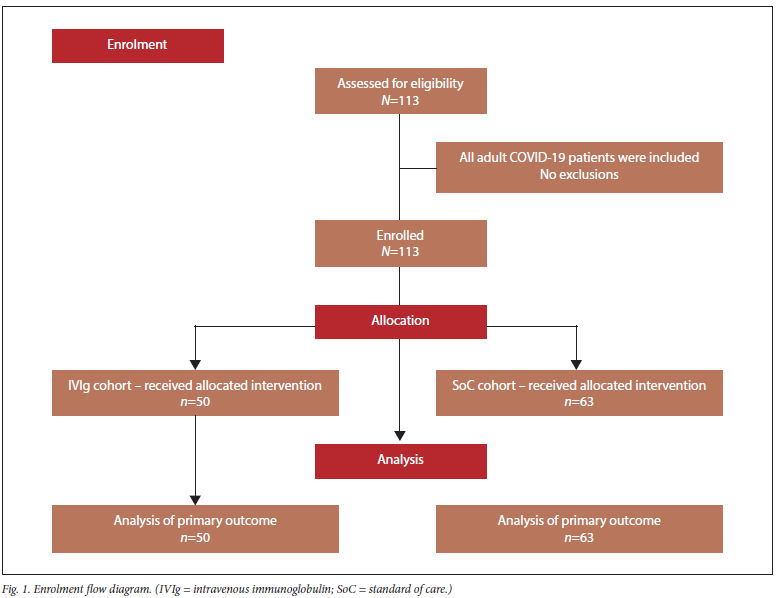
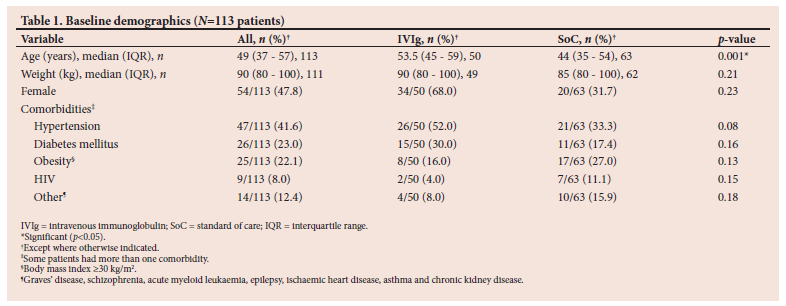
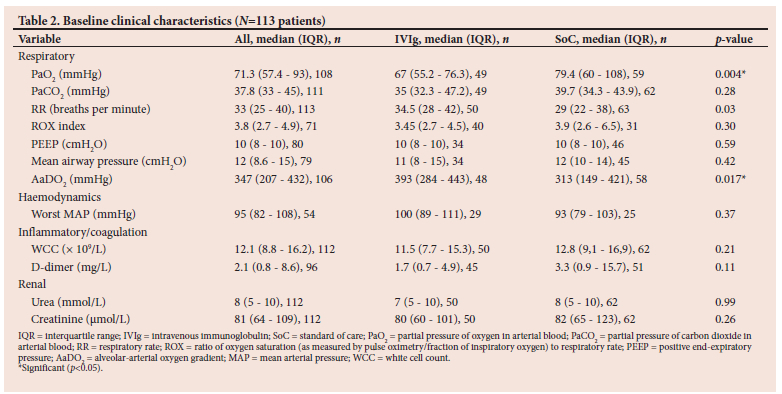
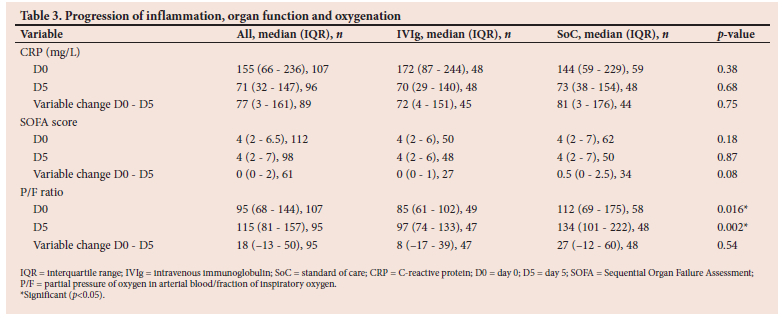
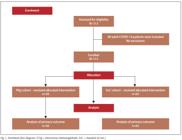
We included 113 eligible patients in the study (study flow is shown in Fig. 1). Baseline demographics are set out in Table 1. At baseline, the IVIg cohort had a significantly lower PaO2 and P/F ratio, and a higher alveolar-arterial oxygen gradient and respiratory rate, than the SoC cohort (Tables 2 and 3). Both cohorts had elevated D-dimer levels. We did not find a significant difference in D-dimer levels between the two cohorts (Table 2).
Primary objective: Disease progression
Although higher, the initial median CRP level was not significantly higher in the IVIg cohort compared with the SoC cohort. The decline in CRP between days 0 and 5 was significant for the SoC cohort (p=0.01) and the IVIg cohort (p=0.000); however, there was no significant difference between the two groups (Table 3). The median P/F ratio was significantly lower in the IVIg cohort compared with the SoC cohort on days 0 and 5 (Table 3). Additionally, P/F ratios in the IVIg and SoC cohorts increased significantly between day 0 and day 5 (p=0.038 and p=0.035, respectively), but there was no significant difference between the two groups in the variable change (p=0.54) (Table 3). The median SOFA score was not significantly different between the groups at baseline or on day 5, and we found no difference in the variable change (Table 3).
Secondary objectives
Organ support requirements and clinical outcomes
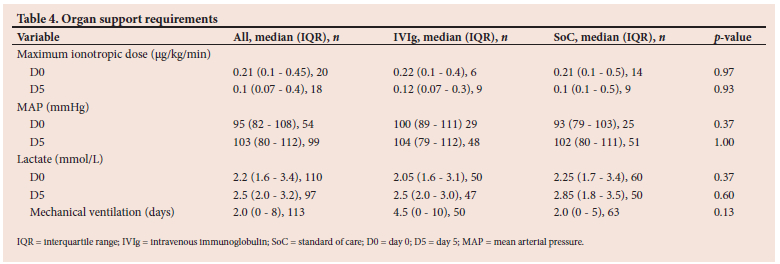
The median vasopressor dose, lactate level and mean arterial pressure on admission and on day 5 were similar between the two groups (Table 4).
Clinical complications and mortality
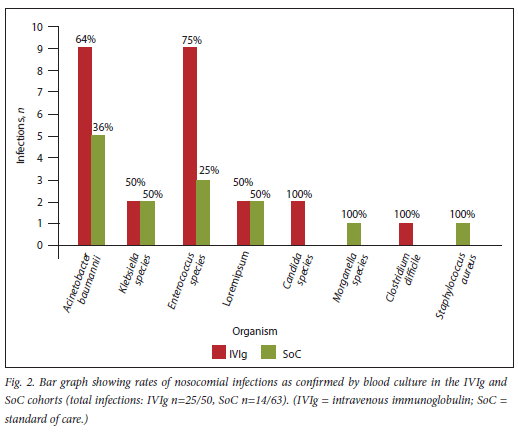
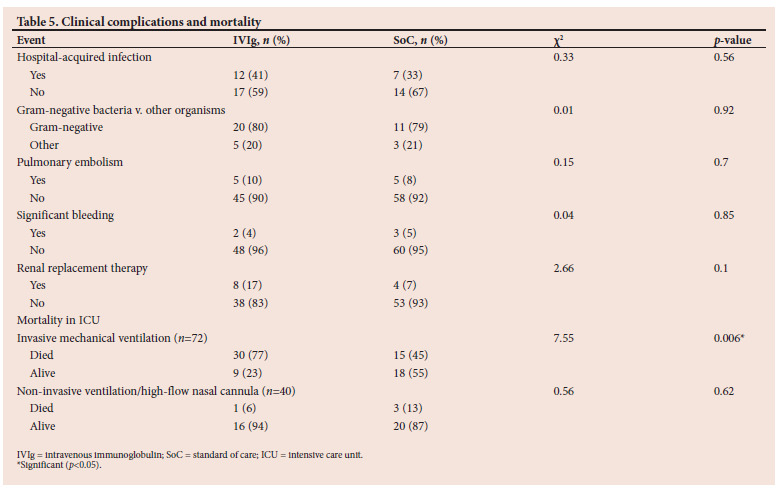
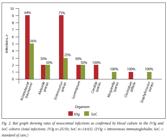
No significant differences in renal, thrombotic/embolic or bleeding complications were noted between the two groups (Table 5). In addition, there were no significant differences in hospital-acquired infections between the groups, and the distribution of Gram-negative pathogens v. all other pathogens in the IVIg group was similar to that in the SoC group (Fig. 2 and Table 5).
Length of ICU stay and mortality
The median length of ICU stay in the IVIg group was significantly longer at 10 (interquartile range (IQR) 6 - 13) days compared with 6 (6 - 10) days for the SoC group (p=0.000).
On univariate analysis, the relative risk of death was 1.6 times higher (95% CI 1.1 - 2.3) in the IVIg group compared with the SoC group. This increased risk was driven by the group requiring invasive mechanical ventilation (Table 5).
We built a regression model assessing demographic factors, oxygenation and ventilation, inflammatory markers, renal and metabolic parameters, and immunoglobulin and pulse-dose steroid therapy. All patients received standard-dose dexamethasone treatment. Eight factors with p<0.2 were entered into the final prediction model.
The final logistical regression model identified two independent predictors of ICU mortality. A higher P/F ratio was associated with decreased mortality (odds ratio (OR) 0.991; 95% CI 0.983 - 0.997), while higher mean airway pressure was associated with increased mortality (OR 1.283; 95% CI 1.026 - 1.604).
Discussion
The main finding was that despite a significantly lower P/F ratio in the IVIg cohort, the increase in the P/F ratio over time was similar in both cohorts. The lower baseline P/F ratio may be due to greater severity of disease and older age in the IVIg group compared with the SoC group. Our data demonstrate older age and possibly a higher prevalence of hypertension in the IVIg group. The median (IQR) P/F ratio for the IVIg group was 85 (61 - 102) at admission. Our patients were more hypoxaemic at baseline compared with those in other studies. Esen et al.[9] reported a higher P/F ratio of 110 (83 - 151), Shao et al.[10] a P/F ratio of 215 (153 - 277), and Mazeraud et al.[11] a P/F ratio of 125 (96 - 155). Sakoulas et al.[12] also found an increase in P/F ratio over time (admission to day 7), and although they did not provide the exact P/F ratios, 7/10 values were >100, with a range of 80 - 200. It is very possible that IVIg use in the abovementioned studies was based on the severity of hypoxaemia and an apparent inadequate response to standard care.
Although CRP levels improved significantly between day 0 and day 5 in both our cohorts, the improvements were not statistically significant between the cohorts. CRP levels for other studies in which patients received IVIg for COVID-19 pneumonia ranged from 34 to 164 mg/L.[9,10,13] In keeping with a greater severity of hypoxaemia, our IVIg group also had a greater severity of inflammation using CRP as a surrogate when compared with other studies reported in the literature. We did not demonstrate any significant differences in the inflammatory profiles between the groups. While we have used CRP to describe the inflammatory profile and progression of these patients, we have not used these changes to imply any clinical benefit.
The vasopressor dose, lactate level and mean arterial pressure on admission and on day 5 were similar between the two groups and highlight an equivocal requirement for cardiovascular support. Organ function as assessed by the SOFA score was also similar in both groups. In our study, the median SOFA score was 4. Esen et al.[9] reported a median (IQR) SOFA score of 5.0 (2.5 - 7.5), Liu et al.[14] a score of 3 (2 - 4), Shao et al.[10] a score of 2 (2 - 4), Mazeraud et al.[11] a score of 6 (4 - 8), and Ali et al[13] a score of 2 (1 - 4). The large variation in SOFA scores highlights the heterogeneity in the use of IVIg.
Although D-dimer levels were elevated in both our groups, we did not demonstrate a significant difference between the two. According to a recent meta-analysis, Varikasuvu et al.[15] found that an elevated baseline D-dimer level was associated with disease progression and mortality. It is possible that our small sample size may be a limiting factor.
Regarding mechanical ventilation and length of ICU stay, we were only able to find comparative data on the length of stay. The IVIg group had a significantly longer length of stay than the SoC group, in keeping with greater severity of disease. Shao et al.[10] also demonstrated longer length of stay in their group receiving IVIg in comparison with the SoC group. It is noteworthy that their group receiving IVIg was also more hypoxaemic than the SoC group, not dissimilar to our data. In contrast to our findings, Sakoulas et al.[12] found a shorter length of stay in their IVIg group compared with the SoC group. Differences in patient characteristics and disease severity may explain these variations.
We found higher mortality in the IVIg group among patients who required invasive mechanical ventilation. There was also a trend to a longer duration of mechanical ventilation in the IVIg group (4.5 v. 2 days). The greater level of hypoxaemia and higher respiratory rate are reflective of more severe pulmonary pathology in keeping with these findings.
Given the known side-effects of IVIg, we compared renal, thromboembolic and infectious complications between the IVIg and SoC groups. We found no significant difference in complications between the groups. This is in keeping with other studies.[9-14]
Our study showed higher ICU mortality in the IVIg group compared with the SoC group (56% v. 32%); however, only a lower P/F ratio and higher mean airway pressure were independent predictors of mortality. This finding emphasises severity of pulmonary disease as the possible trigger for IVIg initiation. In contrast to our findings, Shao et al.[10] found an overall mortality rate of 36% in their IVIg group compared with 15% in the group receiving routine care. After correcting for confounders, they were able to demonstrate an improvement in mortality in the IVIg group. A meta-analysis of 2 3'3 patients failed to show a mortality benefit with the use of IVIg.[16]
Study limitations
This was a small, retrospective single-centre study with implicit limitations including the ability to control for biases; however, a main objective was to describe changes in disease progression. The study did not document the time from symptom onset to admission, resulting in uncertainty with regard to the stage of disease progression at admission. The use of IVIg was not standardised to a specific protocol, and the decision to use IVIg was therefore individualised to the patient and the treating physician. It was largely determined by disease progression, and the most severely affected patients were most likely to receive IVIg. CRP was the only marker used for inflammation, and other markers such as interleukin 6, tumour necrosis factor alpha and procalcitonin were not used owing to budget constraints. Furthermore, immunoglobulin levels were not measured. This measurement has been shown to benefit certain population subsets.
Conclusion
Use of IVIg in our study was directed at an older population, with significantly worse oxygenation. We found no evidence of adverse effects of immunoglobulin therapy; however, we found no benefit either. Only P/F ratio and mean airway pressure independently predicted ICU mortality.
Declaration. The research for this study was done in partial fulfilment of the requirements for GM's MMed (Int Med) degree at the University of the Witwatersrand.
Acknowledgements. None.
Author contributions. GM conceived the idea, developed the protocol, interpreted the work and created the first draft, and is accountable for all aspects of the work. AvB assisted with guidance on the protocol development and reviewed the final draft, and agreed to be accountable for all aspects of the work. JD collected the data, analysed the integrity of the data, reviewed the final manuscript and agreed to be accountable for all aspects of the work. SO assisted with the design of the protocol, analysed the data and reviewed the final manuscript, and agreed to be accountable for all aspects of the work.
Data availability. The datasets generated and analysed during the present study are available from the corresponding author (GM) on reasonable request. There is no restriction on the anonymised data set.
Funding. None.
Conflicts of interest. None.
References
-
1. World Health Organization. Coronavirus disease (COVID-19). https://www.who.int/health-topics/coronavirus (accessed 26 November 2023).
» https://www.who.int/health-topics/coronavirus -
2. National Department of Health, South Africa. COVID-19 online resource and news portal. https://sacoronavirus.co.za/ (accessed 7 June 2023).
» https://sacoronavirus.co.za/ -
3. Roedl K, Jarczak D, Thasler L, et al. Mechanical ventilation and mortality among 223 critically ill patients with coronavirus disease 2019: A multicentric study in Germany. Aust Crit Care 2021;34(2):167-175. https://doi.org/10.1016/j.aucc.2020.10.009
» https://doi.org/10.1016/j.aucc.2020.10.009 -
4. National Department of Health, South Africa. Intravenous immunoglobulin for COVID-19: Evidence review of potential benefit and harm. 8 April 2020. https://www.health.gov.za/wp-content/uploads/2020/12/Rapid-review-of-IV-Immunoglobulin-for-COVID-19_8April2020.pdf (accessed 6 September 2023).
» https://www.health.gov.za/wp-content/uploads/2020/12/Rapid-review-of-IV-Immunoglobulin-for-COVID-19_8April2020.pdf -
5. National Institute for Communicable Diseases, South Africa. COVID-19 hospital surveillance update: Week 48, 2021. https://www.nicd.ac.za/wp-content/uploads/2021/12/COVID-19-HOSPITAL-SURVEILLANCE-UPDATE_WEEK-48-2021_rev.pdf (accessed 28 January 2024).
» https://www.nicd.ac.za/wp-content/uploads/2021/12/COVID-19-HOSPITAL-SURVEILLANCE-UPDATE_WEEK-48-2021_rev.pdf -
6. Matthay MA, Arabi Y, Arroliga AC, et al. A new global definition of acute respiratory distress syndrome. Am J Respir Crit Care Med 2024;209(1):37-47. https://doi.org/10.1164/rccm.202303-0558WS
» https://doi.org/10.1164/rccm.202303-0558WS -
7. National Healthcare Safety Network, Centers for Disease Control and Prevention. Bloodstream infection event (central line-associated bloodstream infection and noncentral line associated bloodstream infection). January 2024. www.cdc.gov/nhsn/pdfs/pscmanual/4psc_clabscurrent.pdf (accessed 22 October 2024).
» www.cdc.gov/nhsn/pdfs/pscmanual/4psc_clabscurrent.pdf -
8. Hanci P, Uysal A, Yüksel B, Inal V. ROX index dynamics according to high flow nasal cannula success in intensive care unit patients with COVID-19-related acute respiratory failure. Balkan Med J 2023;40(2):111-116. https://doi.org/10.4274/balkanmedj.galenos.2022.2022-6-31
» https://doi.org/10.4274/balkanmedj.galenos.2022.2022-6-31 -
9. Esen F, Özcan PE, Orhun G, et al. Effects of adjunct treatment with intravenous immunoglobulins on the course of severe COVID-19: Results from a retrospective cohort study. Curr Med Res Opin 2021;37(4):543-548. https://doi.org/10.1080/03007995.2020.1856058
» https://doi.org/10.1080/03007995.2020.1856058 -
10. Shao Z, Feng Y, Zhong L, et al. Clinical efficacy of intravenous immunoglobulin therapy in critical ill patients with COVID-19: A multicenter retrospective cohort study. Clin Transl Immunol 2020;9(10):e1192. https://doi.org/10.1002/cti2.1192
» https://doi.org/10.1002/cti2.1192 -
11. Mazeraud A, Jamme M, Mancusi RL, et al. Intravenous immunoglobulins in patients with COVID-19-associated moderate-to-severe acute respiratory distress syndrome (ICAR): Multicentre, double-blind, placebo-controlled, phase 3 trial. Lancet Respir Med 2022;10(2):158-166. https://doi.org/10.1016/S2213-2600(21)00440-9
» https://doi.org/10.1016/S2213-2600(21)00440-9 -
12. Sakoulas G, Geriak M, Kullar R, et al. Intravenous immunoglobulin plus methylprednisolone mitigate respiratory morbidity in Coronavirus Disease 2019. Crit Care Explor 2020;2(11):e0280. https://doi.org/10.1097/CCE.0000000000000280
» https://doi.org/10.1097/CCE.0000000000000280 -
13. Ali HS, Elshafei MS, Saad MO, et al. Clinical outcomes of intravenous immunoglobulin therapy in COVID-19 related acute respiratory distress syndrome: A retrospective cohort study. BMC Pulm Med 2021;21(1):354. https://doi.org/10.1186/s12890-021-01717-x
» https://doi.org/10.1186/s12890-021-01717-x -
14. Liu J, Chen Y, Li R, et al. Intravenous immunoglobulin treatment for patients with severe COVID-19: A retrospective multicentre study. Clin Microbiol Infect 2021;27(10):1488-1493. https://doi.org/10.1016/j.cmi.2021.05.012
» https://doi.org/10.1016/j.cmi.2021.05.012 -
15. Varikasuvu SR, Varshney S, Dutt N, et al. D-dimer, disease severity, and deaths (3D-study) in patients with COVID-19: A systematic review and meta-analysis of 100 studies. Sci Rep 2021;11(1):21888. https://doi.org/10.1038/s41598-021-01462-5
» https://doi.org/10.1038/s41598-021-01462-5 -
16. Marcec R, Dodig VM, Radanovic I, Likic R. Intravenous immunoglobulin (IVIg) therapy in hospitalised adult COVID-19 patients: A systematic review and meta-analysis. Rev Med Virol 2022;32(6):e2397. https://doi.org/10.1002/rmv.2397
» https://doi.org/10.1002/rmv.2397

Accepted 3 October 2024
Contribution of the study
During the COVID-19 pandemic, treatment protocols changed in response to the evolving literature. Hospitals were faced with choosing a treatment modality that they believed at the time had benefit. Chris Hani Baragwanath Hospital in Johannesburg, South Africa (SA), incorporated IVIg into its treatment protocols for patients with severe COVID pneumonia requiring ICU admission. This study retrospectively analysed the use of IVIg therapy in the hope of creating a more robust understanding of its safety and efficacy as a treatment option for SA patients in the future.