Implementation strategies to overcome barriers to early mobilisation practices in Zimbabwean and South African public sector ICUs: A Delphi study
BACKGROUND: Barriers to early mobilisation in healthcare settings encompass various factors, including practical challenges, accountability and the crucial role of leadership OBJECTIVE: To gain consensus from multidisciplinary team members in South African (SA) and Zimbabwean public sector hospitals to formulate implementation strategies addressing identified barriers for early mobilisation METHODS: An online two-round modified Delphi study including 23 experts from SA and Zimbabwe was undertaken. The implementation strategies were aligned with the Consolidated Framework for Implementation Research that outlines five areas impacting implementation RESULTS: The expert panel included intensive care unit (ICU) clinicians, academics and managers, who participated in both Delphi rounds. The median years of ICU experience was 8.5 (range 5 - 17) years, with 16 (80.0%) having a general ICU background. The panel reached consensus on several strategies to standardise early mobilisation practices in ICUs, including defining specific early mobilisation activities, appointing champion leaders, ensuring timely management of fractures, promoting patient admission to specialised units, creating dedicated physiotherapy positions, and providing skills training for staff responsible for implementing early mobilisation activities in ICUs CONCLUSION: The strategies developed represent an important step toward implementation of early mobilisation in routine ICU patient care
Barriers; intensive care unit; expert consensus; early mobilisation; framework for implementation research
Implementation strategies to overcome barriers to early mobilisation practices in Zimbabwean and South African public sector ICUs: A Delphi study
C Tadyanemhandu; V Ntsiea; H van Aswegen
PhD; Department of Physiotherapy, School of Therapeutic Sciences, Faculty of Health Sciences, University of the Witwatersrand, Johannesburg, South Africa
ABSTRACTBACKGROUND: Barriers to early mobilisation in healthcare settings encompass various factors, including practical challenges, accountability and the crucial role of leadership
OBJECTIVE: To gain consensus from multidisciplinary team members in South African (SA) and Zimbabwean public sector hospitals to formulate implementation strategies addressing identified barriers for early mobilisation
METHODS: An online two-round modified Delphi study including 23 experts from SA and Zimbabwe was undertaken. The implementation strategies were aligned with the Consolidated Framework for Implementation Research that outlines five areas impacting implementation
RESULTS: The expert panel included intensive care unit (ICU) clinicians, academics and managers, who participated in both Delphi rounds. The median years of ICU experience was 8.5 (range 5 - 17) years, with 16 (80.0%) having a general ICU background. The panel reached consensus on several strategies to standardise early mobilisation practices in ICUs, including defining specific early mobilisation activities, appointing champion leaders, ensuring timely management of fractures, promoting patient admission to specialised units, creating dedicated physiotherapy positions, and providing skills training for staff responsible for implementing early mobilisation activities in ICUs
CONCLUSION: The strategies developed represent an important step toward implementation of early mobilisation in routine ICU patient care
Keywords: Barriers, intensive care unit, expert consensus, early mobilisation, framework for implementation research.
Early mobilisation of patients is more than just an exercise but a complex intervention that demands interdisciplinary co-ordination and communication.[1,2] When planning early mobilisation, two considerations are sustainability and reach,[3] as both affect implementation of the intervention.[4]
Considering the complexity of implementing early mobilisation, individual, group and organisational readiness is particularly relevant in intensive care unit (ICU) settings as interdisciplinary teams work together to provide patient care, with some individuals working across the organisation.[3] Detailed initial planning by the team is essential for successful implementation of an early mobilisation programme.[2,5] Heterogeneous ICU patient populations demand considered clinical reasoning when deciding on early patient mobilisation guidelines.[6]
Translation of research findings into clinical practice is impacted by vague descriptions of interventions used,[7,8] particularly those describing early mobilisation in ICU.[8] The available evidence on early mobilisation activities in ICU does not consistently provide sufficient details on the variables used for exercise prescription.[8] It becomes difficult for clinicians to replicate and implement exercise interventions that are associated with improved patient mobilisation.[7]
The sustainability of early mobilisation programmes may be enhanced by focusing on overcoming perceived barriers to such programmes through knowledge translation strategies involving interdepartmental collaboration, communication, education and training.[2,5,9] Translational researchers acknowledge increasingly that an accumulation of positive research evidence is not sufficient to achieve widespread implementation of interventions in clinical practice.[10] This finding justifies using a practice-based approach together with an evidence-based approach for implementation of effective and sustainable interventions in clinical settings. The purpose of the present study was to reach consensus on recommended implementation strategies to overcome barriers to early patient mobilisation in South African (SA) and Zimbabwean public sector hospital ICUs.[11-13]
Methods
Study design
An online, two-round, modified Delphi survey was conducted using the REDCap online managing system hosted at the University of the Witwatersrand from October to November 2018. The Consolidated Framework for Implementation Research (CFIR), a well-established framework for assessing implementation barriers, was used.[14] Barriers to early patient mobilisation identified in SA and Zimbabwean public sector ICUs, previously described,[11-13] were categorised according to the five CFIR categories, namely intervention characteristics, ICU contextual factors, hospital context (encompassing patient needs and resources), characteristics of individuals responsible for implementation, and process (including active changes to promote intervention implementation). Strategies to overcome the identified barriers were generated through an appropriate literature review and presented to the Delphi panel to initiate the consensus-seeking process.[15,16] A modified Delphi process employs multiple iterations designed to develop consensus regarding a specific topic, and the feedback process allows the participants to reassess their initial judgement about the information provided in previous iterations.[15,16]
Sampling and study participants
The number of participants anticipated was between 20 and 50 people. This assumption was based on the literature, which states that as long as the background of the participants is homogeneous, then 10 - 15 people should participate.[17] However, if various reference groups are involved, more participants should be included.[17] As the definition of an expert depends on the setting and objectives of the proposed modified Delphi study,[16] the panel of experts for this study were chosen from the clinicians, academics and managers who had experience in working in public sector hospital ICUs in SA and Zimbabwe and in the practice of early mobilisation. The clinicians, managers and academic experts were invited, with the object being to provide practical, research-based and theoretical perspectives on clinical practice.[18]
The expert panel was purposively selected through shortlisting of eligible candidates and invited to participate in this study. The expert panel comprised clinicians (intensivists, consultant anaesthetists, ICU specialists in training, medical officers rotating through ICU, physiotherapists and nurses), academics (ICU nurses involved in training of nurses) and managers (ICU directors of services, ICU nursing services directors, and physiotherapy heads of department) with three or more years of clinical ICU experience including early patient mobilisation in SA and Zimbabwean public sector hospital settings.
Instruments
Separate Delphi questionnaires for clinicians and academics, and managers, were created, comprising four sections:
• Demographic information (profession, current position, ICU type, years of ICU experience). For managers, information was gathered on their clinical and managerial experience.
• CFIR information, encompassing statements related to the five categories mentioned.
• Equipment required for facilitating early patient mobilisation in ICU.
• The implementation of early mobilisation, activity definitions, variables and outcome considerations for tracking exercise therapy progress during patient mobilisation.
Data collection procedure
Upon consent, participants were asked to confirm their electronic availability for six weeks from the beginning of October to the end of November 2018.
Round 1
Participants received a REDCap link to the respective Delphi questionnaire, allowing them three weeks for completion. This round involved lengthy statements that required dedicated time from participants (Supplementary file 1; https://www.samedical.org/file/2306). Participants ranked the statements using a five-point Likert scale, assessing agreement (ranging from strongly disagree to strongly agree), importance (from not important at all to absolutely essential), and likelihood (from extremely unlikely to extremely likely). The listed statements had either been implemented in different ICU contexts or were recommended in published research to address barriers to early patient mobilisation. Participants had the opportunity to provide comments in open text boxes within the questionnaire and suggest additional items.
After three weeks, the submitted responses were analysed. Statements that did not meet 70% agreement among participants and a median score >4 and semi-interquartile range (SIQR) <0.5 were modified in accordance with the feedback provided by the panel and redistributed to the panelists for round 2. New statements emerging from participants' responses in round 1, were included in round 2.
Round 2
Two weeks after the completion of round 1, participants received links to round 2 questionnaires and had three weeks to submit their responses. The round 2 questionnaires were shorter in length (Supplementary file 2; https://www.samedical.org/file/2306). Median and SIQR scores from round 1 were presented for each item in round 2 to help participants reconsider their responses in light of these results and to foster consensus.
Consensus was achieved (>70% agreement) after only two rounds of the Delphi study, with areas of agreement and disagreement identified.
Data analysis
Data were checked for completeness and accuracy and data cleaning was done. Information obtained through open-ended questions was encoded for ease of analysis. Data analysis was performed using SPSS version 25 (IBM, USA). Descriptive statistics summarised the data as means and standard deviations (normally distributed data), medians and IQRs, or numbers and percentages. The median and SIQR were calculated for each statement. Consensus for a statement was defined as a priori if the median score >4, SIQR <0.5 and >70%[16] of the participants either 'agreed and/or strongly agreed' with the statement or rated the statement as 'either likely and/or extremely likely' or 'important and/or very important'. For the calculation of consensus on the percentage of agreement, importance and likelihood, the five-point scale was re-categorised, with scores of 1 or 2 defined as disagreement; 3 as having reservations or neutral; and 4 or 5 as agreement.
All qualitative data obtained from the open-ended questions were read, encoded and summarised into themes, and a deductive approach was used to analyse the responses within the framework of the CFIR domains. A summary of quotes was assigned to each domain and presented alongside the quantitative results.
Ethical clearance
Ethical clearance for this study was obtained from the Joint Research Ethics Committee for the University of Zimbabwe College of Health Sciences and Parirenyatwa Group of Hospitals (ref. no. 377/15), Medical Research Council of Zimbabwe (ref. no. MRCZ/A/2040) and the University of the Witwatersrand Human Research Ethics Committee (Medical) (ref. no. M150927) in SA.
Results
General characteristics of the panel
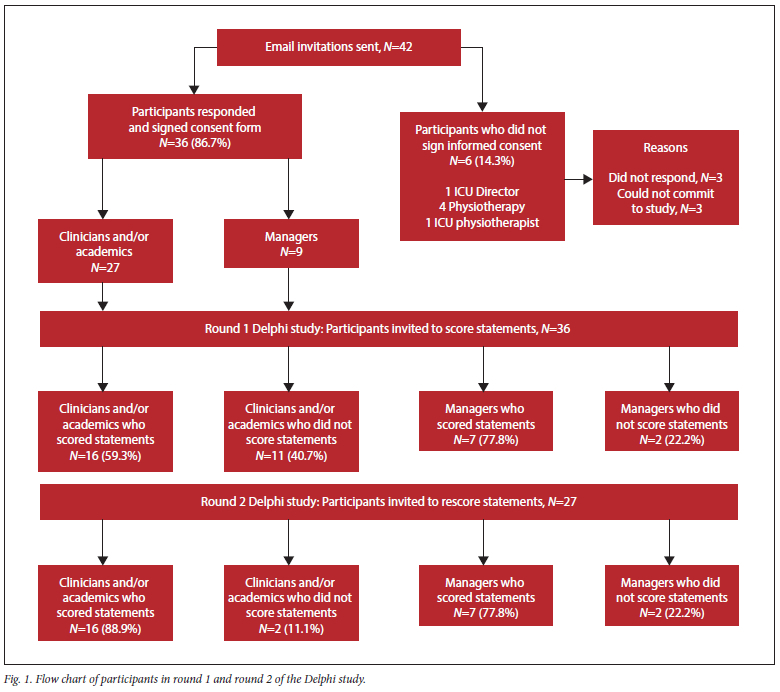
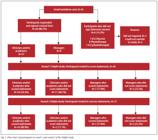
Forty-two potential participants were identified. Of these, 36 (86.7%) provided consent and included nine managers, six academic staff and 21 clinicians. For round 1, responses were received from 23 expert participants (63.8% response rate). For round 2, 27 participants from round 1 were invited to participate and 23 responded (85.2% response rate) (Fig. 1).
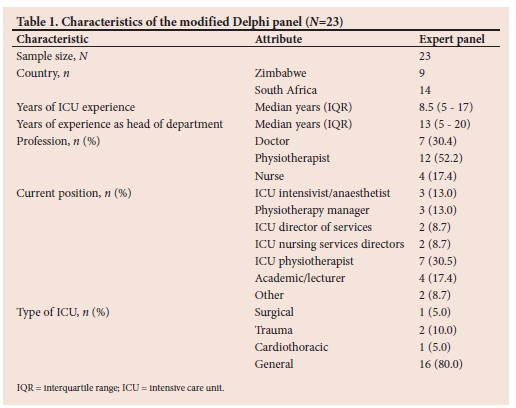
Clinician and academic participants had a median of 8.5 (5 - 17) years of ICU experience (Table 1). Most participants were from a general ICU clinical background (80%). One participant was a senior medical officer and one an anaesthetist registrar. For the managers, the median years of experience as heads of department was 13 (5 - 20) years.
CFIR category 1: Characteristics of early mobilisation interventions
Consensus was reached for 23 of 26 statements (88.5%) after round 2 (Supplementary file 3; https://www.samedical.org/file/2307). Experts agreed that the following were active mobilisation activities: rolling (SIQR: 0), bridging (SIQR: 0.25), upper and lower limb flexion and extension exercises, sitting on the edge of the bed, standing next to the bed, stand transfer to a chair, marching on the spot, and walking away from the bedside (SIQR: 0.5 overall). They concurred that changes in vital signs during early activity or mobilisation should be considered in conjunction with clinician clinical judgement (SIQR: 0.5) and not be deemed as contraindications to movement.
Three statements (11.5%) did not reach consensus after round 2. These related to whether early mobilisation should be redefined to encompass intended physiological effects (SIQR: 0.875), exclusion of passive joint movements from early mobilisation activities (SIQR: 1), and inclusion of neuromuscular electrical stimulation as part of passive mobilisation (SIQR: 0.5).
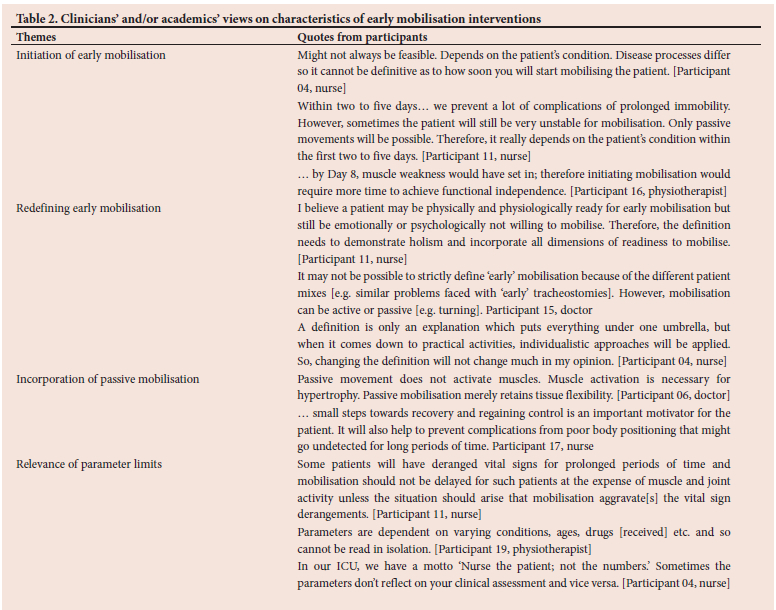
The themes and quotes highlighted by participants on characteristics of early mobilisation interventions are presented in Table 2. Participants noted that while early mobilisation ideally begins within the first five days of critical illness, it may not always be feasible due to disease processes and recovery trajectory.
CFIR category 2: ICU contextual factors
In round 1, experts reached consensus on 13 of 18 statements (72.2%) (Supplementary file 4; https://www.samedical.org/file/2307). They concurred that having a stationary discipline-specific leader in ICU, who takes responsibility for educating new staff, would promote the culture of early patient mobilisation (SIQR: 0.5). After some modification of the remaining five statements, consensus was reached for all statements in round 2. Supplementary file 5 (https://www.samedical.org/file/2307) presents the themes and quotes which were derived from the comments by clinicians under the ICU contextual factors category. These statements supported the need for champion leaders who promote early mobilisation and maintain consistency of patient care in the unit. Participants highlighted the role of multidisciplinary team engagement and the dynamics which exist if professions are not given autonomous status in the team.
CFIR category 3: Patient needs, resources and hospital administrative support
Consensus was reached for 15 of 32 statements (46.9%) pertaining to patient needs, resources and hospital administrative support to promote early mobilisation interventions after round 1 (Supplementary file 6; https://www.samedical.org/file/2307). Several statements had to be modified or deleted for round 2 based on participants' comments under safety measures. By the end of round 2, consensus was reached for 19 of the 20 statements (95%) in this category. Agreement was reached on specific safety measures prior to early mobilisation: interpretation of a patient's resting heart rate should be executed in conjunction with other safety parameters (SIQR: 0.5), respiratory rate below 30 beats per minute (BPM) is safe for in-bed and out-of-bed early mobilisation activities (SIQR: 0.5), and intracranial pressure >15 mmHg is unsafe for progression with early mobilisation (SIQR: 0.5).
No consensus was reached on the progression of early mobilisation in a patient with controlled intracranial pressure as indicated by no mannitol or hypertonic saline administration in the past 24 hours (SIQR: 0.5). Experts reported as follows: 'For me, this would be moving into dangerous ground. Intracranial pressure can increase dramatically by even a light flicker of change.' (Participant 17, nurse) and 'The settling of raised intracranial pressure cannot be assumed simply because no mannitol has been given; premature mobilisation may be a major risk in traumatic brain injury patients.' (Participant 06, doctor).
CFIR category 4: Characteristics of the individuals responsible for implementation of early mobilisation
Consensus was reached on all 13 statements (100%) (Supplementary file 7; https://www.samedical.org/file/2307). Experts agreed on the need to define roles for all clinicians responsible for early mobilisation to ensure smooth execution of the intervention (SIQR: 0.5), the need for skills training of all staff members (SIQR: 0.5) and acknowledged that all disciplines working in ICU are responsible for early patient mobilisation.
CFIR category 5: Process (including active changes to promote intervention implementation)
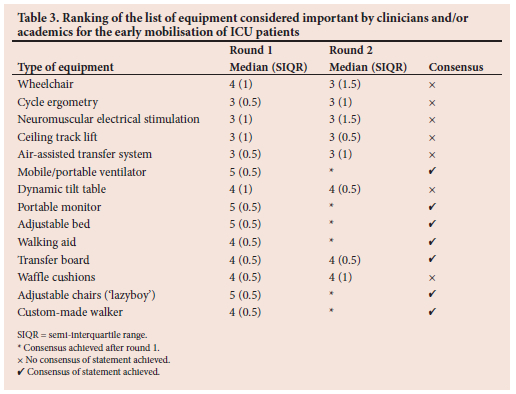
Under this section, there were two parts. The first part included two statements on implementation. Consensus was reached on both statements in round 1. Experts agreed that physiotherapists should assess all patients and screen those eligible for early mobilisation for successful implementation of early mobilisation to be achieved (SIQR: 0.5). There was agreement among experts to have prompts for physiotherapy referrals for early mobilisation on physician order forms. This should be standard practice to increase the rate of early mobilisation in these ICUs (SIQR: 0.5). Secondly, participants rated important equipment needed to facilitate early mobilisation in ICU. Experts agreed that equipment such as portable ventilators (SIQR: 0.5) and monitors (SIQR: 0.5), adjustable chairs (SIQR: 0.5), and walking aids (e.g. custom-made walkers (SIQR: 0.5)) may assist with early patient mobilisation. No consensus was reached on the use of wheelchairs (SIQR: 1.5), cycle ergometers (SIQR: 1), neuromuscular electrical stimulation (SIQR: 1.5) and waffle cushions (SIQR: 1) (Table 3). Supplementary file 8 (https://www.samedical.org/file/2307) presents statements reported by participants regarding the equipment that can facilitate early mobilisation.
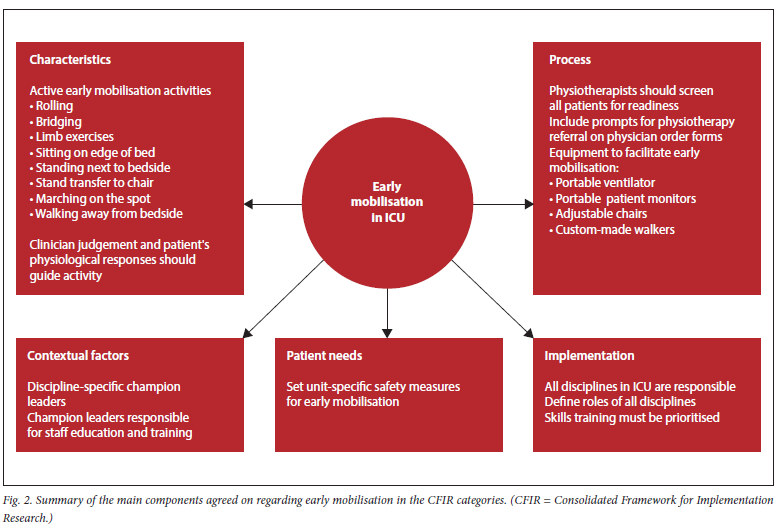
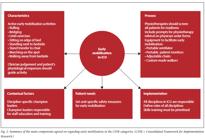
Fig. 2 summarises the components of early mobilisation in ICU that Delphi members agreed on within the Consolidated Framework for Implementation Research.
Priority focus areas for the successful implementation of early mobilisation
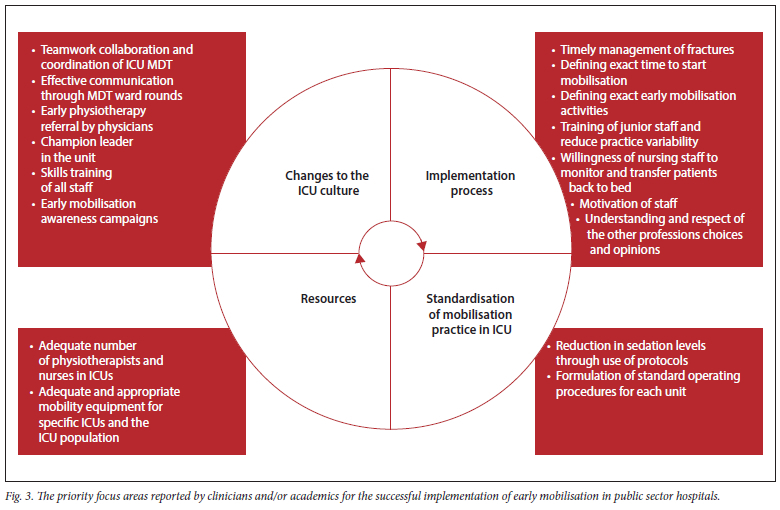
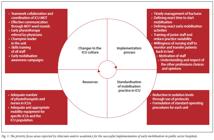
The participants listed priority focus areas based on the identified barriers for the successful implementation of early mobilisation in round 1. The broad areas identified included the ICU culture, the standardisation of practice in the ICU, resources and the implementation process. The most frequently cited focus areas by the clinicians included: skills training for staff, multidisciplinary teamwork and collaboration, the formulation of standard operating procedures and the availability of appropriate mobility equipment.
Fig. 3 summarises the main priority focus areas suggested for successful implementation of early mobilisation in public sector hospitals ICUs.
Discussion
This modified Delphi study aimed to reach consensus on recommended implementation strategies to overcome barriers to early patient mobilisation in SA and Zimbabwean public sector hospital ICUs. These strategies considered practicality (resources, time, commitment) and implementation (extent, likelihood, manner of full execution), drawing on the experts' experiences and contexts.
Panellists reached consensus with respect to patient physical and physiological parameters for successful implementation of early mobilisation. They agreed that specific vital signs and clinical signs should be checked before early mobilisation is initiated. These parameters include heart rate, low dosage of vasoactive drugs, oxygen saturation levels, respiratory rate, intracranial pressure <15 mmHg and platelet count. Additionally, the patient should be psychologically ready for early mobilisation, besides being physically or physiologically stable. The overall concern by the expert panel was that clinicians should not read these parameters in isolation to make decisions about early mobilisation as ICU patients present with deranged vital signs most of the time, hence the need for clinical reasoning. Others sharing this view point that fluctuations in vital signs are a normal part of caring for the critically ill and occur with any nursing procedures.[19, 20] The consensus among the expert panel was that early mobilisation guidelines should not include rigid vital sign parameters as criteria for exclusion from early mobilisation. Instead, clinicians are encouraged to rely on their clinical judgement and reasoning, which is supported by Brissie et al.[21]
Cultural changes that were recommended by the experts for public sector ICUs in SA and Zimbabwe included a strong multidisciplinary team agreement regarding the importance of protocols on sedation practices and early mobilisation; flow diagrams detailing patient assessments for readiness for early mobilisation; and the role of leadership in the implementation of early mobilisation. The panel agreed that there was a need to develop protocols and guidelines which consider the local resources and environment, with the parameters included in the protocols not being read in isolation in order to assist with clinical decision-making. Similarly, others report that the availability of protocols and/or guidelines for early mobilisation result in standardisation of practice, more consistent delivery of the intervention, and higher levels of achievement in activity.[22-25]
Panellists agreed on the importance of multidisciplinary teamwork and communication, clarification of roles among members of the multidisciplinary team, development of expertise and skills training, and agreed that early mobilisation was a collaborative effort rather than the responsibility of physiotherapists or nurses alone. Similarly, others recommend skills training for ICU staff to educate clinicians and train junior staff to empower them with knowledge and confidence to safely and effectively implement early patient mobilisation.[4,26,27] A team-centred collaborative approach guarantees successful implementation of early mobilisation strategies for ICU patients[2,4,22,25,28] and minimises overlapping of responsibilities. Although consensus was reached on the statement that the ICU doctor should be consulted before a final decision for early mobilisation is made, there were controversial views among the panellists as to who was responsible to give the instruction for early mobilisation, as they felt that physiotherapists and nurses should be consulted. Conversely, it was proposed that there should be an ICU doctor's order on why a patient should not be mobilised, with a justified medical reason.
The panel agreed that using specific mobilisation equipment may encourage a higher level of early patient mobilisation and minimise strain on clinicians. Other authors have made similar suggestions.[29,30] The cost implications of equipment acquisition in public sector settings need consideration. The use of some of equipment such as wheelchairs, electrical stimulators and cycle ergometers prompted divergent opinions within the panel. Some of these opinions resonated with the lack of concrete evidence available on the clinical benefits of cycle ergometry and electrical stimulators, respectively, on patient-important outcomes in ICU.[25,31,32]
Location of patients was highlighted as one of the environmental influences.[4] The importance of admitting patients to specialised units rather than general units to mitigate delays in specialist consultations for individual ICU patients was emphasised. The incidence of road traffic accidents and injuries in low- and middle-income countries such as SA and Zimbabwe, is exceptionally high.[33] The panel agreed that timely fracture management is crucial to support the implementation of early patient mobilisation in ICUs.
Early mobilisation is influenced by factors related to the individual healthcare providers. High staff turnover rates lead to unsustainable patient care interventions[30] and failure to maintain consistency and expert clinical skills. Evidence supports the link between the appointment of fulltime physiotherapists in ICU and timely delivery of early mobilisation when patients are awake and medically stable.[22,34] This observation was echoed by the panelists. The feasibility of creating full-time positions for senior ICU physiotherapists within SA and Zimbabwean public sector ICUs needs further exploration. An adequate number of human resources to promote early mobilisation and overall motivation of the staff were also some of the factors highlighted.
Study strengths and limitations
A strength of the study is the diversity and consistency of participation of the panel members. The panel included a heterogeneous group of academics, clinicians and managers. The questionnaire included structured, closed-ended questions which were generated through a review of the available literature, and open-ended comment boxes. The statements which participants rated were supported by evidence from randomised controlled trials and systematic reviews.[8,9,35]
The study had some limitations. The first limitation is related to the study design. There was criticism due to lack of clarity on what was meant by consensus and also the quality of evidence generated due to relying on expert opinions to generate findings. The questionnaire used in round 1 of the study was long and could have resulted in response fatigue. There was also a high attrition rate of participants, considering the number of participants who were sent an invitation and agreed to participate, to the number of participants who finally scored the statements in both rounds. Another limitation was the selection bias of participants as there was non-proportional representation of different disciplines. The number of nurses were fewer compared with the other disciplines. The first stage involved developing strategies through review of the literature, and the phrasing of these statements might have been ambiguous.
Conclusion
Several factors need consideration in the development, acceptance and implementation of early patient mobilisation guidelines for SA and Zimbabwean public sector ICUs as standard patient care. An ICU culture of teamwork and co-ordination, patient readiness for mobilisation and adequate staffing of units with motivated and skilled personnel could facilitate effective and safe implementation of early patient mobilisation in these units.
Declaration. Each questionnaire contained information on the study and participation was anonymous and voluntary. Informed consent was obtained from each participant.
Acknowledgements. The authors would like to thank the panel of experts, which included the clinicians working in ICUs, managers of the relevant departments and also the academics who participated in the study.
Author contributions. CT, HvA and VN participated in the design of the study. CT was responsible for the data collection. CT, HvA and VN participated in the data management, analysis and interpretation. All the authors participated in the write-up and final editing of the manuscript. All authors read and approved the final manuscript.
Data availability. The datasets generated and analysed during the current study are available from the corresponding author on reasonable request. Any restrictions or additional information regarding data access can be discussed with the corresponding author.
Funding. Research reported in this article was supported by the Fogarty International Center (Office Of The Director, National Institutes Of Health (OD), National Institute Of Nursing Research (NINR), National Institute Of Mental Health (NIMH), National Institute Of Dental & Craniofacial Research (NIDCR), National Institute OfNeurological Disorders And Stroke (NINDS), National Heart, Lung, And Blood Institute (NHLBI), Fogarty International Center (FIC)) of the National Institutes of Health under Award Number D43 TW010137; Fogarty International Center of the National Institutes of Health under Award Number D43 TW009539 and D43 TW009343, and the University of California Global Health Institute (UCGHI; San Francisco, CA, USA). The content is solely the responsibility of the authors and does not necessarily represent the official views of the NIH or UCGHI.
Conflicts of interest. None.
References
-
1. Hodgson CL, Berney S, Harrold M, Saxena M, Bellomo R. Clinical review: Early patient mobilisation in the ICU. Critical Care 2013;17(1):1-7. https://doi.org/10.1186/cc11820
» https://doi.org/10.1186/cc11820 -
2. Parry SM, Remedios L, Denehy L, et al. What factors affect implementation of early rehabilitation into intensive care unit practice? A qualitative study with clinicians. J Crit Care 2017;38:137-143. https://doi.org/10.1016/j.jcrc.2016.11.005
» https://doi.org/10.1016/j.jcrc.2016.11.005 -
3. Phelan S, Lin F, Mitchell M, Chaboyer W. Implementing early mobilisation in the intensive care unit: An integrative review. Int J Nurs Stud 2018;77:91-105. https://doi.org/10.1016/j.ijnurstu.2017.09.019
» https://doi.org/10.1016/j.ijnurstu.2017.09.019 -
4. Parry SM, Knight LD, Connolly B, et al. Factors influencing physical activity and rehabilitation in survivors of critical illness: A systematic review of quantitative and qualitative studies. Intensive Care Med 2017;43(4):531-542. https://doi.org/10.1007/s00134-017-4685-4
» https://doi.org/10.1007/s00134-017-4685-4 -
5. Eakin MN, Ugbah L, Arnautovic T, Parker AM, Needham DM. Implementing and sustaining an early rehabilitation program in a medical intensive care unit: A qualitative analysis. J Crit Care 2015;30(4):698-704. https://doi.org/10.1016/j.jcrc.2015.03.019
» https://doi.org/10.1016/j.jcrc.2015.03.019 -
6. Sibilla A, Nydahl P, Greco N, et al. Mobilisation of mechanically ventilated patients in Switzerland. J Intensive Care Med 2020;35(1):55-62. https://doi.org/10.1177/0885066617728486
» https://doi.org/10.1177/0885066617728486 -
7. Hariohm K, Jeyanthi S, Kumar JS, Prakash V. Description of interventions is under-reported in physical therapy clinical trials. Brazil J Physical Ther 2017;21(4):281-286. https://doi.org/10.1016/j.bjpt.2017.05.006
» https://doi.org/10.1016/j.bjpt.2017.05.006 - 8. De Queiroz RS, Saquetto MB, Martinez BP, Andrade EA, da Silva PAMP, Gomes-Neto M. Evaluation of the description of active mobilisation protocols for mechanically ventilated patients in the intensive care unit: A systematic review of randomised controlled trials. Heart Lung 2018;47(3):253-260.
-
9. Cameron S, Ball I, Cepinskas G, et al. Early mobilisation in the critical care unit: A review of adult and pediatric literature. J Critical Care 2015;30(4):664-672. https://doi.org/10.1016/j.jcrc.2015.03.032
» https://doi.org/10.1016/j.jcrc.2015.03.032 -
10. Lean MEJ, Mann JI, Hoek JA, Elliot RM, Schofield G. Translational research. BMJ 2008;337:a863. https://doi.org/10.1136/bmj.a863
» https://doi.org/10.1136/bmj.a863 -
11. Tadyanemhandu C, Aswegen HV, Ntsiea V. Early mobilisation practices of patients in intensive care units in Zimbabwean government hospitals - a cross-sectional study. South Afr J Crit Care 2018;34(1):16-21. https://pmc.ncbi.nlm.nih.gov/articles/PMC9256537/
» https://pmc.ncbi.nlm.nih.gov/articles/PMC9256537/ -
12. Tadyanemhandu C, van Aswegen H, Ntsiea V. Organisational structures and early mobilisation practices in South African public sector intensive care units-a cross-sectional study. J Eval Clin Pract 2021;27(1):42-52. https://doi.org/10.1111/jep.13378
» https://doi.org/10.1111/jep.13378 -
13. Tadyanemhandu C, van Aswegen H, Ntsiea V. Barriers and facilitators to implementation of early mobilisation of critically ill patients in Zimbabwean and South African public sector hospitals: A qualitative study. Disabil Rehab 2021;44(22):6699-6709. https://doi.org/10.1080/09638288.2021.1970827
» https://doi.org/10.1080/09638288.2021.1970827 -
14. Costa DK, White MR, Ginier E, et al. Identifying barriers to delivering the awakening and breathing coordination, delirium, and early exercise/mobility bundle to minimise adverse outcomes for mechanically ventilated patients: A systematic review. Chest 2017;152(2):304-311. https://doi.org/10.1016/j.chest.2017.03.054
» https://doi.org/10.1016/j.chest.2017.03.054 - 15. Barrett D, Heale R. What are Delphi studies? Evidence Based Nursing 2020;23(3):68-69.
-
16. Nasa P, Jain R, Juneja D. Delphi methodology in healthcare research: How to decide its appropriateness. World J Method 2021;11(4):116-129. https://doi.org/10.5662/wjm.v11.i4.116
» https://doi.org/10.5662/wjm.v11.i4.116 -
17. Hsu C-C, Sandford BA. The Delphi technique: Making sense of consensus. Pract Assess Res Eval 2007;12(10). https://doi.org/10.7275
» https://doi.org/10.7275 -
18. Van der Lee L, Hill AM, Patman S. Expert consensus for respiratory physiotherapy management of mechanically ventilated adults with community-acquired pneumonia: A Delphi study. J Eval Clin Pract 2019;25(2):230-243. https://doi.org/10.1111/jep.13077
» https://doi.org/10.1111/jep.13077 -
19. Shahiri S, Gélinas C. The validity ofvital signs for pain assessment in critically ill adults: A narrative review. Pain Manage Nurs 2023;24(3):318-328. https://doi.org/10.1016/j.pmn.2023.01.004
» https://doi.org/10.1016/j.pmn.2023.01.004 -
20. Boitor M, Richard-Lalonde M, Bérubé M, Émilie G, Gélinas C. Vital signs fluctuations and their relationship with pain in the brain-injured adult critically ill - A repeated-measures descriptive-correlational study. Intensive Crit Care Nurs 2019;55:102743. https://doi.org/10.1016/j.iccn.2019.07.002
» https://doi.org/10.1016/j.iccn.2019.07.002 -
21. Brissie MA, Zomorodi M, Soares-Sardinha S, Jordan JD. Development of a neuro early mobilisation protocol for use in a neuroscience intensive care unit. Intensive Crit Care Nurs 2017;42:30-35. https://doi.org/10.1016/j.iccn.2017.03.007
» https://doi.org/10.1016/j.iccn.2017.03.007 - 22. Barber EA, Everard T, Holland AE, Tipping C, Bradley SJ, Hodgson CL. Barriers and facilitators to early mobilisation in intensive care: A qualitative study. Austral Crit Care 2015;28(4):177-182.
-
23. Hanekom SD, Louw Q, Coetzee A. The way in which a physiotherapy service is structured can improve patient outcome from a surgical intensive care: a controlled clinical trial. Crit Care 2012;16(6):1-11. https://doi.org/10.1186/cc11894
» https://doi.org/10.1186/cc11894 -
24. Harrold ME, Salisbury LG, Webb SA, Allison GT. Early mobilisation in intensive care units in Australia and Scotland: A prospective, observational cohort study examining mobilisation practises and barriers. Crit Care 2015;19(1):1-9. https://doi.org/10.1186/s13054-015-1033-3
» https://doi.org/10.1186/s13054-015-1033-3 - 25. Hodgson CL, Schaller SJ, Nydahl P, Timenetsky KT, Needham DM. Ten strategies to optimise early mobilisation and rehabilitation in intensive care. Crit Care 2021;25(1-4).
-
26. Zhang L, Hu W, Cai Z, et al. Early mobilisation of critically ill patients in the intensive care unit: A systematic review and meta-analysis.PLoS 2019;14(10):e0223185. https://doi.org/10.1371/journal.pone.0223185
» https://doi.org/10.1371/journal.pone.0223185 -
27. Nydahl P, Jeitziner M-M, Vater V, et al. Early mobilisation for prevention and treatment of delirium in critically ill patients: Systematic review and meta-analysis. Intensive Crit Care Nurse 2023;74:103334. https://doi.org/10.1016/j.iccn.2022.103334
» https://doi.org/10.1016/j.iccn.2022.103334 -
28. Hodgson CL, Capell E, Tipping CJ. Early mobilisation of patients in intensive care: Organisation, communication and safety factors that influence translation into clinical practice. Crit Care 2018;22(1-7). https://doi.org/10.1186/s13054-018-1998-9
» https://doi.org/10.1186/s13054-018-1998-9 -
29. Toccolini BF, Osaku EF, de Macedo Costa CRL, et al. Passive orthostatism (tilt table) in critical patients: Clinicophysiologic evaluation. J Crit Care 2015;30(3):655.e1-e6. https://doi.org/10.1016/j.jcrc.2014.12.018
» https://doi.org/10.1016/j.jcrc.2014.12.018 -
30. Van Willigen Z, Collings N, Richardson D, Cusack R. Quality improvement: The delivery of true early mobilisation in an intensive care unit. BMJ Quality Improvement Reports 2016;5(1):u211734.w4726. https://doi.org/10.1136/bmjquality.u211734.w4726
» https://doi.org/10.1136/bmjquality.u211734.w4726 -
31. Zayed Y, Kheiri B, Barbarawi M, et al. Effects of neuromuscular electrical stimulation in critically ill patients: A systematic review and meta-analysis of randomised controlled trials. Aust Crit Care 2020;33(2):203-210. https://doi.org/10.1097/ccm.0000000000005941
» https://doi.org/10.1097/ccm.0000000000005941 -
32. Takaoka A, Utgikar R, Rochwerg B, Cook DJ, Kho ME. The efficacy and safety of in-intensive care unit leg-cycle ergometry in critically ill adults. A systematic review and meta-analysis. Ann Am Thorac Soc 2020;17(10):1289-1307. https://doi.org/10.1513/annalsats.202001-059oc
» https://doi.org/10.1513/annalsats.202001-059oc -
33. Wyatt GE, Thames A, Simbayi L, Stein DJ, Burns J, Maselesele M. Trauma and mental health in South Africa: Overview. Psychological Trauma: Theory, Research, Practice, and Policy 2017;9(3):249-251. https://doi.org/10.1037/tra0000144
» https://doi.org/10.1037/tra0000144 -
34. Engel HJ, Tatebe S, Alonzo PB, Mustille RL, Rivera MJ. Physical therapist-established intensive care unit early mobilisation program: Quality improvement project for critical care at the University of California San Francisco Medical Center. Phys Ther 2013;93(7):975-985. https://doi.org/10.2522/ptj.20110420
» https://doi.org/10.2522/ptj.20110420 -
35. McWilliams D, Jones C, Atkins G, et al. Earlier and enhanced rehabilitation of mechanically ventilated patients in critical care: A feasibility randomised controlled trial. J Crit Care 2018;44:407-412. https://doi.org/10.1016/j.jcrc.2018.01.001
» https://doi.org/10.1016/j.jcrc.2018.01.001

Accepted 23 July 2024
Contribution of the study
This study provides implementation strategies, aligned with the Consolidated Framework for Implementation Research, to overcome barriers to early patient mobilisation in public sector ICUs. These strategies emanate from consensus reached by a panel of experts and serve as the first step in guiding clinicians towards developing and implementing early mobilisation protocols for their units to promote better-quality patient care in daily clinical practice.