Physical function measures in ICU survivors, where to now? A scoping review
BACKGROUND. Growing evidence is describing the long-term morbidity experienced by critical illness survivors, a major contributing factor being impaired physical function. Consensus is yet to be reached on which physical function measures should be included in this population. This review aimed to describe physical functioning measurement instruments used in longitudinal studies of critical illness survivors, based on the International Classification of Function (ICF). METHODS. An electronic database search of EbscoHost, Web of Science and Scopus was conducted from inception to November 2023. Two reviewers independently applied the inclusion and exclusion criteria to titles, abstracts and full text-studies. Extracted data included year of publication; country; participant age; follow-up timeframes and physical measurement instruments used. Instruments were classified according to ICF domains. RESULTS. Eighty studies published between 1995 and November 2023 were included. Forty-four different outcome measures were identified. Most studies (68) included multiple followed-up points and were completed within a year, and few studies (12) follow-up beyond a year. Based on the ICF, 11 (25%) instruments measured impairments and 33 (75%) activity limitations. Muscle power functions were the most frequently measured impairment (65%), utilising manual muscle testing (37.3%). The six-minute walk test (6MWT) was the most frequently used instrument in the activity/participation domain (31.6%). Only one instrument addressed all five the physical activity/participation domains, while the majority focused on mobility domain. CONCLUSIONS. Multiple tools are used to report on physical deficits experienced by ICU survivors, either measuring impairments or activity/ participation limitations. Most studies report on physical function within the first year of survival. The heterogeneity and inconsistency over time of instruments used prevents synthesis of data to determine intervention efficacy. The validity, predictive value and sensitivity of the reported measures within ICU survivors needs to be established, only then can intervention studies be designed to measure effectiveness.
Critical care; critical illness; outcome assessment; rehabilitation; post-intensive care syndrome
Physical function measures in ICU survivors, where to now? A scoping review
I du PlessisI; S D HanekomII; A R Lupton-SmithII
IMS; Division of Physiotherapy, Faculty of Medicine and Health Sciences, Stellenbosch University, Cape Town, South Africa
IIPhD; Division of Physiotherapy, Faculty of Medicine and Health Sciences, Stellenbosch University, Cape Town, South Africa
BACKGROUND. Growing evidence is describing the long-term morbidity experienced by critical illness survivors, a major contributing factor being impaired physical function. Consensus is yet to be reached on which physical function measures should be included in this population. This review aimed to describe physical functioning measurement instruments used in longitudinal studies of critical illness survivors, based on the International Classification of Function (ICF).
METHODS. An electronic database search of EbscoHost, Web of Science and Scopus was conducted from inception to November 2023. Two reviewers independently applied the inclusion and exclusion criteria to titles, abstracts and full text-studies. Extracted data included year of publication; country; participant age; follow-up timeframes and physical measurement instruments used. Instruments were classified according to ICF domains.
RESULTS. Eighty studies published between 1995 and November 2023 were included. Forty-four different outcome measures were identified. Most studies (68) included multiple followed-up points and were completed within a year, and few studies (12) follow-up beyond a year. Based on the ICF, 11 (25%) instruments measured impairments and 33 (75%) activity limitations. Muscle power functions were the most frequently measured impairment (65%), utilising manual muscle testing (37.3%). The six-minute walk test (6MWT) was the most frequently used instrument in the activity/participation domain (31.6%). Only one instrument addressed all five the physical activity/participation domains, while the majority focused on mobility domain.
CONCLUSIONS. Multiple tools are used to report on physical deficits experienced by ICU survivors, either measuring impairments or activity/ participation limitations. Most studies report on physical function within the first year of survival. The heterogeneity and inconsistency over time of instruments used prevents synthesis of data to determine intervention efficacy. The validity, predictive value and sensitivity of the reported measures within ICU survivors needs to be established, only then can intervention studies be designed to measure effectiveness.
Keywords: Critical care, critical illness, outcome assessment, rehabilitation, post-intensive care syndrome.
Improvements in medical care have not only led to increased survival rates following critical illness but also recognised the presence of new or worsening long-term impairments in these survivors.[1] Over the last decade, the focus of critical illness research has shown that physical function and quality of life in critical care survivors are reduced in the long term and many survivors do not recover to their baseline level of function.[2-5] Their long-term impairments are not limited to physical function only but include cognitive and psychological impairments following critical illness.[6,7] These consequences of critical illness in survivors are referred to as post-intensive care syndrome (PICS), which is defined as 'new or worsening co-occurrence of physical dysfunctions, psychological disorders, cognitive impairments or failed social reconstruction with these impairments persisting beyond ICU and hospital discharge'.[8] The newly acquired disability has been shown to significantly impact the health of both patients and their families and is associated with significant direct and indirect costs.[9-11]
While the cause of the disability is multifactorial, physical dysfunction is one of the primary contributing factors and is considered one of the four domains identified in PICS.[1,8] The measurements of physical function as well as muscle and/or nerve function are recommended as core domains in critical illness research.[12]
Published core outcome measure sets (COMS) address quality of life, mental health and cognitive function; however, despite Delphi processes, no consensus has been reached on measures of physical function.[13] The inclusion of activities of daily living measures has, however, been deemed essential in critical care research and recommendations for the inclusion of physical function measures were made as part of a Delphi consensus study on clinical effectiveness trials in nutritional/metabolic interventions in critical care research.[14] Agreement on COMS is essential to ensure standardisation across research, as well as to improve the outcome of survivors of critical illness.[12,15] Many critical care COMS studies are, however, ongoing and results still need to be published.[16]
The importance of patient-centred outcomes has been highlighted as a necessary aspect in advancing critical care research and care for survivors,[17] even though they are rarely used as primary outcomes in critical care research.[18,19] Physical functioning measurement instruments, especially performance-based instruments focusing on impairments like muscle strength testing (manual and dynamometry), respiratory muscle testing and pulmonary function testing, showed a poor association with patient-centred outcomes in long-term follow-up after critical illness.[20] However, patient-reported participation measurement instruments like the Incremental Activities of Daily Living (IADL) as well as the Functional Performance Inventory have shown a good association with patient-centred outcomes and have been recommended for inclusion in long-term follow-up studies.[20]
The heterogeneity of physical outcome measures being used in critical care research has been highlighted by systematic reviews. Parry et al.[21] identified 33 physical outcome measures being used and Romero et al.[22] identified 19 physical outcome measures being used in critical care research. However, the measurement instruments identified were mostly used in acute care, with only one post-hospital discharge study included in the review by Romero et al.[22] and seven in the review by Parry et al.[21] The inconsistent and variable use of outcome measures as well as methodological inconsistencies pose a challenge in determining the effectiveness of interventions and conducting meta-analyses of literature in this field.[19,23] A systematic review of measurement properties of outcome measures used in critical care research reported a poor to fair methodological quality of studies included in the review.[24] This reported quality was affected by inadequate sample size and failure to report on details of the outcome measures tested. Standardised objective measurement and reporting in critical illness research is paramount to identify deficits in the physical function domain of PICS. Instruments should have good validity, sensitivity to pick up a change in physical function longitudinally and precision to measure the success of interventions.
The International Classification of Function, Disability and Health (ICF) is a conceptual framework developed by The World Health Organization (WHO). The ICF classification aims to provide a standardised way of reporting and coding health.[25] The ICF framework contains three levels of functioning describing 'disability': body structure and function impairments, activity limitations and participation restrictions^25,2^ Critical illness significantly affects various aspects of functioning, and impairments have been reported on all three levels of the ICF following critical illness.[27] The ICF has been proposed as a suitable framework to guide the standardisation of outcome measures at different levels and stages following critical illness.[21]
Given the importance of measuring outcomes of critical illness and the reported heterogeneity of outcome measures used in the literature, this scoping review aimed to plot the available literature on clinical assessment measurement instruments used to report on the physical function of survivors of critical illness after hospital discharge. Measurement instruments were plotted against ICF domains and sub-domains to determine which aspects of physical functioning an instrument assesses. The longitudinal timeframes at which these instruments were used following hospital discharge were also identified. This information will assist in identifying potential gaps in the body of knowledge and can inform the development of consensus on the most suitable physical function measuring tools to be used in longitudinal research of survivors of critical illness.
Methods
Study design
The scoping review was conducted using the methodology detailed by JBI.[28] Protocol was registered on Open Science Framework, registration number doi.org/10.17605/OSEIO/8KYAR. PRISMA Extension for Scoping Reviews was used in the reporting of results.
Research question
Which clinical assessment measurement instruments have been used in longitudinal studies of survivors of critical illness after hospital discharge to determine impairments, activity limitations and participation restrictions related to physical functioning?
Identification of eligible studies
An electronic database search of EBSCOhost, Web of Science and Scopus platforms was conducted from inception to November 2023. Included in the EBSCOhost platform were Academic Search Premier, Africa Wide Information, CINAHL, Medline and Health Source Nursing/Academic Edition databases.
The search strategy used was specific for each database and the following keywords and MeSH terms used were: (critical illness OR ARDS OR sepsis OR ICU survivors OR chronic critical illness OR post-intensive care syndrome OR PICS) AND (physical activity OR functional ability OR functional capacity OR muscle strength OR muscle power OR cardiovascular fitness OR physical endurance OR endurance OR fitness OR exercise tolerance OR articular range of motion OR joint range of motion OR joint flexibility OR contractures OR muscle weakness OR muscle power OR diaphragm weakness OR inspiratory muscle weakness) AND (Adult) NOT (paediatric OR pediatric).
Study selection
Two reviewers (IdP and ALS) independently applied the inclusion and exclusion criteria to all the citations and abstracts, which were refined as researchers became more familiar with the selection process. The inclusion criteria were: original studies (not an editorial, abstract, review or consensus statements) involving critically ill adults (above 18 years), clinical assessment measures of physical functioning and follow-up assessment after hospital discharge. Non-English studies, studies only investigating quality of life and neurological conditions as well as studies evaluating the psychometric properties of instruments and systematic reviews were excluded. Disagreements were resolved through consensus and/or consultation with a third reviewer (SH).
A standardised data collection form was developed, and data were extracted accordingly. Data included: year of publication, country, age of participants, type of ICU, follow-up timeframes and physical measurement instruments used at each follow-up timeframe. Participants' age was categorised into four categories based on the mean/median age of participants in the included studies: 18 - 45, 46 - 55, 56 - 65 and 66 - 85 years. If participants were followed up and assessed longitudinally at multiple periods in a study, each follow-up timeframe with its measurement instrument was included in the analysis.
Measurement instruments were further classified and coded according to the levels of functioning and physical domains of the ICF as follows:
• Body structure and function: Domains include - Muscle functions, Functions of the respiratory system and Structures related to movement.
• Activity and participation: Domains include - Mobility, General tasks and demands, Self-Care, Domestic Life, Community and Social and Civic Life.
Summary and reporting of results
A descriptive analysis of the included studies was performed. Categorical data were summarised as percentages. Charts and tables were produced to summarise the geographical distribution of studies; number of participants; age group of participants; post-discharge follow-up timeframe; type of ICUs and measurement instruments that were used at each follow-up timeframe.
Results
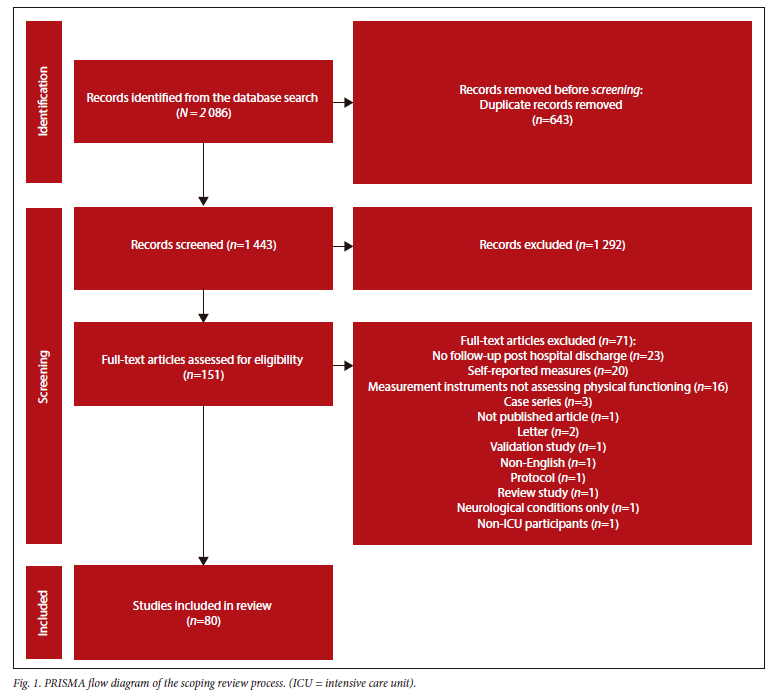
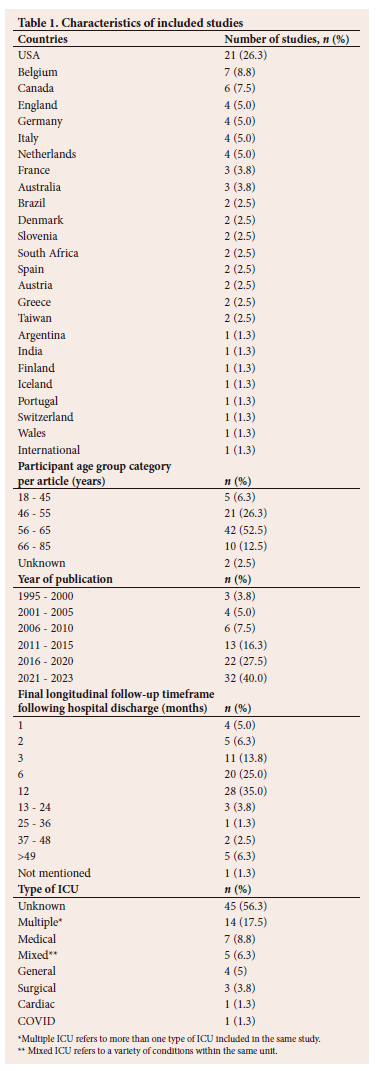
The study selection process is summarised in Fig. 1. An initial 2 086 studies were screened and 80 were included in the analysis (Fig. 1). Most studies included multiple follow-up points and were completed within a year (68 - 85%). A few studies (12 - 15%) were followed up beyond a year. Article characteristics are summarised in Table 1.
Physical function measurement instruments
Forty-four different measurement instruments were identified in this review and used at variable follow-up intervals. Based on the ICF framework (Supplemental Table 1; https://www.samedical.org/file/2240), 11 (25%) instruments mainly measured body structure and function impairments and 33 (75%) measured activity/participation limitations and restrictions.
Measurement instruments results are explained in relation to the number of times used (n) across all included studies as well as the percentage (%) in relation to the total impairment or activity/participation measurement instruments. Most studies used more than one measurement instrument with a total of 120 impairment and 117 activity/ participation instruments used across the 80 studies.
Body structure and function measurement instruments
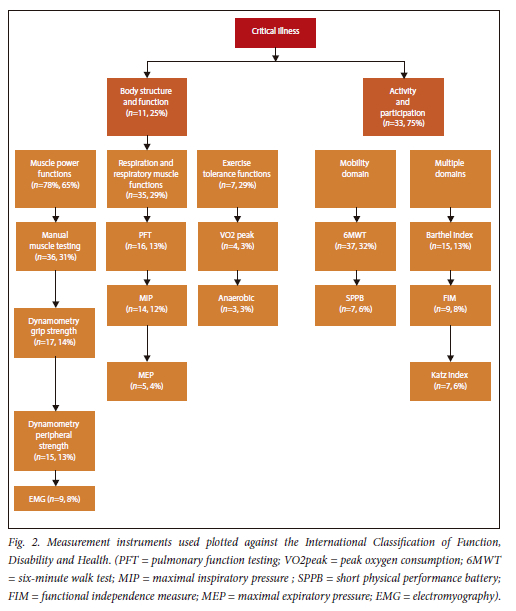
All the physical impairment level instruments assessed the ICF body structure and function domain. In this domain, muscle power functions were most frequently measured (Fig. 2).
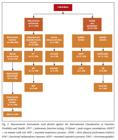
Manual muscle testing was used to assess muscle power functions in 36 studies. The Medical Research Council Sum Score (MRC-SS) was used in 27 studies (22.5%), while the Medical Research Council Scale (MRC) was used in nine studies (7.5%). Dynamometry was used in 32 studies: 17 (14.2%) measured grip strength and 15 (12.5%) assessed peripheral muscle strength. Respiratory muscle functioning was tested using Maximal Inspiratory Pressure (MIP) in 14 (11.7%) studies and Maximal Expiratory Pressure (MEP) in five (4.2%) studies. Pulmonary function testing (PFT) was used to assess respiration functions in 16 (13.3%) studies. The only measurement instrument used to assess the body structure domain was electromyography (EMG) in nine (7.5%) studies. Fig. 2 illustrates the main instruments used, plotted against the ICF.
Activity and participation domain measurement instruments
Various tests were used to assess physical function across multiple domains, including general tasks and demands, mobility, self-care, domestic life and community, and social and civic life domains (Supplementary Table 2; https://www.samedical.org/file/2240). The most frequently used activity/ participation instruments (utilised in more than 5% of studies) are summarised in Fig. 2.
The majority (n=22, 66.6%) of the identified 33 activity/participation instruments assessed only the mobility domain while the other 11 measurement instruments assessed across two or more domains. Two instruments were measured across two domains (6.1%), three across three domains (9.1%) and five across four domains (15.2%). Only one instrument, the Clinical Frailty Scale, assessed physical functioning across all five domains of activity and participation relating to physical functioning.
The Six Minute Walk Test (6MWT) was the main activity/participation domain measurement used and was reported on in 37 (31.6%) studies. Other measurement instruments related to mainly the walking subdomain included the 4 Meter Walk Test (4MWT), Timed 10 Feet Walk Test, 10 Meter Walk Test (10MWT), 2 Minute Step Test and the Chair sit-stand and walk 50 m unaided test. Accelerometry and a step counter were used to report on moving around in different locations.
The second most common activity/participation measurement instrument, used in 15 (12.8%) studies, was the Barthel Index, followed by the Functional Independence Measure (FIM) in nine (7.7%) and the Short Physical Performance Battery (SPPB) and Katz Index of Independence in Activities of Daily Living in seven studies each (6.0%). These instruments assess multiple ICF domains, except for SPPB, which assesses only the mobility domain.
Six (18.2%) instruments (6MWT, 2MST, Chelsea Critical Care Physical Assessment Tool (CPAx), Physical Function in Intensive Care Test (PFIT), Takahashi and Physical Activity Scale for the Elderly (PASE) related to activity/participation also measured components of the body structure and function domains.
Within the mobility domain, the Rivermead Mobility Index assessed the highest number of mobility subdomains (n=11), followed by the Berg Balance Scale (n=9) and the CPAx (n=8). These instruments were however only used in single studies. Fig. 2 illustrates the activity/ participation measurements used in 5% or more of the included studies.
Discussion
In this scoping review of 80 studies from database inception, we mapped and analysed the available literature on measurement instruments used to describe physical functioning domains related to the ICF. A large variety of measurement instruments were identified and used at variable follow-up intervals. Most papers present data on the first 12 months after discharge. The longer-term outcome data remains limited.
Most measurement instruments assess muscle functions on body structure and function level, whereas activity/participation level instruments mostly assess the mobility domain. The MRC-SS and 6MWT were the most frequently used body function and activity/participation instruments of the ICF, respectively.
Muscle power functions were measured by a wide range of measures, including MRC, MRC-SS, peripheral and grip strength dynamometry. These measurement instruments are all used for limb muscle power assessment and no studies assessed trunk muscle power, even though all skeletal muscles are affected by critical illness myopathy.[29,30] The importance of standardised testing procedures and positions in voluntary muscle power assessment has also been highlighted.[31]
The wide use of the MRC-SS for manual muscle testing supports findings by Parry,[21] who also reported its common usage in post-critical illness muscle testing; despite the ceiling effect, it has been proven sensitive in diagnosing ICU-acquired weakness.[31] This measure reports good inter-rater reliability in the overall score but varies in reliability for individual muscle testing.[21,31]
Consensus, however, has not been reached in a Delphi study on the importance of using the MRC-SS post-hospital discharge.[32] Dynamometry has proven to be an effective strength measurement tool that can be used to assess muscle power over time with good sensitivity,[33] and is recommended as a physical measure for long-term follow-up studies.[14,32,34] The heterogeneity of measures used prevents the synthesis of data to determine intervention efficacy and conduct meta-analyses.
The use of any body structure and function measurement instruments in long-term follow-up studies remains debatable as poor associations have been found with patient-centred outcomes.[20]
Most studies used the 6MWT as activity level and mobility domain measurement. Chan et al.,[35] demonstrated that the 6MWT had good psychometric properties was validated for use in the ICU and can be recommended as a physical activity measurement.[14,20,32,36] Even though the 4MWT has been recommended as a valid, responsive measure of physical function in ARDS survivors,[37] it was only used in one study. The wide range of other walking domain tests used again highlights the challenge of consistency and variations in the reporting of findings.
The Barthel Index, SPPB, FIM and Katz Index were the activity/participation measurement instruments reporting mostly on function in multiple ICF domains. Two recent Delphi studies recommended the use of these measurement instruments.[14,32] Participation measurement instruments have also been found to be better associated with health-related quality of life, which is an important patient-centred outcome and is recommended in long-term follow-up studies. [20] A limited number of studies in this scoping review utilised these measures to indicate the participation restrictions of survivors of critical illness, which emphasises the gap in this area of the literature. Some studies also utilised measurement instruments like the PFIT and CPAx, though their utility beyond ICU discharge is unclear, given the ceiling effects of these tools.
From the ICF coding of measurement tools used in the included studies, it was highlighted that only the Clinical Frailty Scale assessed all five activity/participation domains relating to physical functioning. The assessment of activity limitations and participation restrictions across multiple domains is important in longterm follow-up studies to determine multi-dimensional long-term complications and community reintegration.
Even though this scoping review focussed on the long-term physical measurement instruments following critical illness, most of the studies were conducted up to 12 months post-hospital discharge (medium term), with a rapid decrease in measurements used at follow-up timeframes of more than 12 months following hospital discharge. There were no published studies with follow-up timeframes of more than 60 months (five years) post-discharge even though persistent physical problems and associated reduced quality of life have been reported up to five years following critical illness.[38-42] To understand the true long-term physical effects of critical illness and to guide effective management, more objective outcomes-based studies are needed extending beyond one-year post-critical illness.
Our results indicated that most of the studies conducted were from high-income developed countries like the USA, with limited literature from middle to low-income countries. This could be a result of the search strategy using specific databases and excluding non-English studies. The results could, however, also highlight an important gap in the available evidence that future research is needed globally to address this limitation.
Most earlier studies focused on body structure and function measurement instruments, with more recent studies focusing on a combination of body structure/function and activity/participation. This could have been influenced by the recognition of the long-term complications of severe acute respiratory syndrome (SARS), which originated in 2002,[43] and the more recent acknowledgement and creation of the concept of PICS in 2010.[1] The number of studies has increased significantly over the last five years, highlighting the expansion of critical care literature to acknowledge and include the long-term effects, complications and management of critical care survivors.
Further research is, however, needed to determine the psychometric properties of physical measurement instruments in an ICU environment to assist in the development of a COMS[12,15,44] to improve comparison of findings and effectiveness of interventions.
This scoping review might be limited in the fact that it only included English studies. Self-reported, quality of life, qualitative measurement instruments and telephonic self-reported measurement instruments, though very valuable to the body of critical illness literature, were not included in this scoping review.
Conclusion
Multiple tools are used to report on physical functional deficits experienced by survivors of critical illness. The tools measure either body structure and function impairments or activity/participation limitations. Current data suggest that most studies only report on physical function within the first year of survival. Clinicians and researchers can use the instruments reported in this manuscript to inform their use of physical function measures across multiple physical functioning domains. Moving forward the validity, predictive value and sensitivity of the reported measures within ICU survivors need to be established. Only then can intervention studies be designed to measure effectiveness.
Declaration. None.
Acknowledgements. None.
Author contributions. All authors were involved in designing the analysis, collecting and/or checking the data, performing the analysis and writing the manuscript.
Funding. None.
Data availability statement. The datasets generated and analysed during the current study are available from the corresponding author upon reasonable request.
Conflicts of interest. None.
References
-
1. Needham DM, Davidson J, Cohen H, et al. Improving long-term outcomes after discharge from intensive care unit: Report from a stakeholders' conference. Crit Care Med 2012;40(2):502-509. https://doi.org/10.1097/CCM.0b013e318232da75
» https://doi.org/10.1097/CCM.0b013e318232da75 -
2. Desai SV, Law TJ, Needham DM. Long-term complications of critical care. Crit Care Med 2011;39(2):371-379. https://doi.org/10.1097/ccm.0b013e3181fd66e5
» https://doi.org/10.1097/ccm.0b013e3181fd66e5 -
3. Fan E, Dowdy DW, Colantuoni E, et al. Physical complications in acute lung injury survivors: A two-year longitudinal prospective study. Crit Care Med 2014;42(4):849-859. https://doi.org/10.1097/CCM.0000000000000040
» https://doi.org/10.1097/CCM.0000000000000040 -
4. Herridge MS. Recovery and long-term outcome in acute respiratory distress syndrome. Crit Care Clin 2011;27(3):685-704. https://doi.org/10.1016/j.ccc.2011.04.003
» https://doi.org/10.1016/j.ccc.2011.04.003 -
5. Dowdy DW, Eid MP, Dennison CR, et al. Quality of life after acute respiratory distress syndrome: A meta-analysis. Intensive Care Med 2006(32):1115-1124. https://doi.org/10.1007/s00134-006-0217-3
» https://doi.org/10.1007/s00134-006-0217-3 -
6. Davydow DS, Gifford JM, Desai S V, Needham DM, Bienvenu OJ. Posttraumatic stress disorder in general intensive care unit survivors: A systematic review. Gen Hosp Psychiatry 2008;30(5):421-434. https://doi.org/10.1016/j.genhosppsych.2008.05.006
» https://doi.org/10.1016/j.genhosppsych.2008.05.006 -
7. Chung CR, Yoo HJ, Park J, Ryu S. Cognitive impairment and psychological distress at discharge from intensive care unit. Psychiatry Investig 2017;14(3):376-379. https://doi.org/10.4306/pi.2017.14.3.376
» https://doi.org/10.4306/pi.2017.14.3.376 -
8. Yuan C, Timmins F, Thompson DR. Post-intensive care syndrome: A concept analysis. Int J Nurs Stud 2021;114. https://doi.org/10.1016/j.ijnurstu.2020.103814
» https://doi.org/10.1016/j.ijnurstu.2020.103814 -
9. Kamdar BB, Huang M, Dinglas VD, et al. Joblessness and lost earnings after acute respiratory distress syndrome in a 1-year national multicenter study. Am J Respir Crit Care Med 2017;196(8):1012-1020. https://doi.org/10.1164/rccm.201611-2327OC
» https://doi.org/10.1164/rccm.201611-2327OC -
10. Unroe M, Kahn JM, Carson SS, et al. One-year trajectories of care and resource utilisation for recipients of prolonged mechanical ventilation: A cohort study. Ann Intern Med 2010;153(3):167-175. https://doi.org/10.1059/0003-4819-153-3-201008030-00007
» https://doi.org/10.1059/0003-4819-153-3-201008030-00007 -
11. Donaghy E, Salisbury L, Lone NI, et al. Unplanned early hospital readmission among critical care survivors: A mixed methods study of patients and carers. BMJ Qual Saf 2018;27(11):915-927. https://doi.org/10.1136/bmjqs-2017-007513
» https://doi.org/10.1136/bmjqs-2017-007513 -
12. Turnbull AE, Sepulveda KA, Dinglas VD, Chessare CM, Bingham CO, Needham DM. Core domains for clinical research in acute respiratory failure survivors: An international modified Delphi consensus study. Crit Care Med 2017;45(6):1001-1010. https://doi.org/10.1097/CCM.0000000000002435
» https://doi.org/10.1097/CCM.0000000000002435 -
13. Needham DM, Sepulveda KA, Dinglas VD, et al. Core outcome measures for clinical research in acute respiratory failure survivors an international modified Delphi consensus study. Am J Respir Crit Care Med 2017;196(9):1122-1130. https://doi.org/10.1164/rccm.201702-0372OC
» https://doi.org/10.1164/rccm.201702-0372OC -
14. Davies TW, van Gassel RJJ, van de Poll M, et al. Core outcome measures for clinical effectiveness trials of nutritional and metabolic interventions in critical illness: An international modified Delphi consensus study evaluation (CONCISE). Crit Care 2022;26(1). https://doi.org/10.1186/s13054-022-04113-x
» https://doi.org/10.1186/s13054-022-04113-x -
15. Semler MW, Bernard GR, Aaron SD, et al. Identifying clinical research priorities in adult pulmonary and critical care: NHLBI working group report. In: Am J Respir Crit Care Med. Am Thoracic Soc 2020; 511-523. https://doi.org/10.1164/rccm.201908-1595WS
» https://doi.org/10.1164/rccm.201908-1595WS -
16. Dinglas VD, Cherukuri SPS, Needham DM. Core outcomes sets for studies evaluating critical illness and patient recovery. Curr Opin Crit Care 2020;26(5):489-499. https://doi.org/10.1097/MCC.0000000000000750
» https://doi.org/10.1097/MCC.0000000000000750 -
17. Dinglas VD, Faraone LN, Needham DM. Understanding patient-important outcomes after critical illness: A synthesis of recent qualitative, empirical, and consensus-related studies. Curr Opin Crit Care 2018;24(5):401-409. https://doi.org/10.1097/MCC.0000000000000533
» https://doi.org/10.1097/MCC.0000000000000533 -
18. Gaudry S, Messika J, Ricard JD, et al. Patient-important outcomes in randomised controlled trials in critically ill patients: A systematic review. Ann Intensive Care 2017;7(1):28. https://doi.org/10.1186/s13613-017-0243-z
» https://doi.org/10.1186/s13613-017-0243-z -
19. Granholm A, Anthon CT, Kjœr MBN, et al. Patient-important outcomes other than mortality in contemporary ICU trials: A scoping review. Crit Care Med 2022;50(10):e759-e771. https://doi.org/10.1097/CCM.0000000000005637
» https://doi.org/10.1097/CCM.0000000000005637 -
20. Chan KS, Aronson Friedman L, Dinglas VD, et al. Are physical measures related to patient-centred outcomes in ARDS survivors? Thorax 2017;72(10):884-892. https://doi.org/10.1136/thoraxjnl-2016-209400
» https://doi.org/10.1136/thoraxjnl-2016-209400 -
21. Parry SM, Granger CL, Berney S, Jones J, Beach L, El-Ansary D. Assessment of impairment and activity limitations in the critically ill: A systematic review of measurement instruments and their clinimetric properties. Intensive Care Med 2015;41(5):744-762. https://doi.org/10.1007/s00134-015-3672-x
» https://doi.org/10.1007/s00134-015-3672-x -
22. Tipping CJ, Young PJ, Romero L, Saxena MK, Dulhunty J, Hodgson CL. A systematic review of measurements of physical function in critically ill adults. Crit Care Resusc 2012 Dec;14(4):302-311. https://www.researchgate.net/publication/233899430
» https://www.researchgate.net/publication/233899430 -
23. Bach C, Hetland B. A step forward for intensive care unit patients: Early mobility interventions and associated outcome measures. Crit Care Nurse 2022 Dec 1;42(6):13-24. https://doi.org/10.4037/ccn2022459
» https://doi.org/10.4037/ccn2022459 -
24. Robinson KA, Davis WE, Dinglas VD, et al. A systematic review finds limited data on measurement properties of instruments measuring outcomes in adult intensive care unit survivors. J Clin Epidemiol 2017 Feb;82:37-46. https://doi.org/10.1016/j.jclinepi.2016.08.014
» https://doi.org/10.1016/j.jclinepi.2016.08.014 - 25. WHO. International Classification of Functioning, Disability and Health. In: International Classification of Functioning, Disability and Health 2001;1-3,16: 123-124, 168-170.
-
26. Iwashyna T. Trajectories of recovery and dysfunction after acute illness, with implications for clinical trial design. Am J Respir Crit Care Med 2012;186(4):302-304. https://doi.org/10.1164/rccm.201206-1138ED
» https://doi.org/10.1164/rccm.201206-1138ED -
27. Ohtake PJ, Lee AC, Scott JC, et al. physical impairments associated with post-intensive care syndrome: Systematic review based on the World Health Organization's International Classification of Functioning, Disability and Health Framework Phys Ther 2018;98(8):631-645. https://doi.org/10.1093/ptj/pzy059
» https://doi.org/10.1093/ptj/pzy059 - 28. Peters M, Godfrey C, Mcinerney P, Soares C, Khalil H, Parker D. Methodology for JBI Scoping Reviews. 2015: 1-24.
-
29. Friedrich O, Reid MB, Van Den Berghe G, et al. The sick and the weak: Neuropathies/myopathies in the critically ill. Physiol Rev 2015;95(3):1025-1109. https://doi.org/10.1152/physrev.00028.2014
» https://doi.org/10.1152/physrev.00028.2014 -
30. Latronico N, Bolton CF. Critical illness polyneuropathy and myopathy: A major cause of muscle weakness and paralysis. Lancet Neurol 2011;10(10):931-941. https://doi.org/10.1016/S1474-4422(11)70178-8
» https://doi.org/10.1016/S1474-4422(11)70178-8 -
31. Hermans G, Clerckx B, Vanhullebusch T, et al. Interobserver agreement of medical research council sum score and handgrip strength in the intensive care unit. Muscle Nerve 2012;45(1):18-25. https://doi.org/10.1002/mus.22219
» https://doi.org/10.1002/mus.22219 -
32. Major ME, Kwakman R, Kho ME, et al. Surviving critical illness: What is next? An expert consensus statement on physical rehabilitation after hospital discharge. Crit Care 2016;20(1). https://doi.org/10.1186/s13054-016-1508-x
» https://doi.org/10.1186/s13054-016-1508-x -
33. Baldwin CE, Paratz JD, Bersten AD. Muscle strength assessment in critically ill patients with handheld dynamometry: An investigation of reliability, minimal detectable change and time to peak force generation. J Crit Care 2013;28(1):77-86. https://doi.org/https://doi.org/10.1016/j.jcrc.2012.03.001
» https://doi.org/https://doi.org/10.1016/j.jcrc.2012.03.001 -
34. Spies CD, Krampe H, Paul N, et al. Instruments to measure outcomes of post-intensive care syndrome in outpatient care settings - Results of an expert consensus and feasibility field test. J Intensive Care Soc 2021;22(2):159-174. https://doi.org/10.1177/1751143720923597
» https://doi.org/10.1177/1751143720923597 -
35. Chan KS, Pfoh ER, Denehy L, et al. Construct validity and minimal important difference of 6-minute walk distance in survivors of acute respiratory failure. Chest 2015;147(5):1316-1326. https://doi.org/10.1378/chest.14-1808
» https://doi.org/10.1378/chest.14-1808 -
36. Mikkelsen ME, Still M, Anderson BJ, et al. Society of Critical Care Medicine's International Consensus Conference on Prediction and Identification of Long-Term Impairments After Critical Illness. Crit Care Med 2020;48(11):1670-1679. https://doi.org/10.1097/CCM.0000000000004586
» https://doi.org/10.1097/CCM.0000000000004586 -
37. Chan KS, Aronson Friedman L, Dinglas VD, et al. Evaluating physical outcomes in acute respiratory distress syndrome survivors: Validity, responsiveness, and minimal important difference of 4-meter gait speed test. Crit Care Med 2016;44(5):859-868. https://doi.org/10.1097/CCM.0000000000001760
» https://doi.org/10.1097/CCM.0000000000001760 -
38. Herridge M, Tansey CM, Matté A, Tomlinson G, Diaz-Granados N, Guest CB. Functional disability 5 years after acute respiratory distress syndrome. N Engl J Med 2011;364:1293-1304. https://doi.org/10.1056/NEJMoa1011802
» https://doi.org/10.1056/NEJMoa1011802 -
39. Pfoh ER, Wozniak AW, Colantuoni, et al. Physical declines occurring after hospital discharge in ARDS survivors: A 5-year longitudinal study. Intensive Care Med 2016;42(10):1557-1566. https://doi.org/10.1007/s00134-016-4530-1
» https://doi.org/10.1007/s00134-016-4530-1 -
40. Van Aerde N, Meersseman P, Debaveye Y, et al. Five-year impact of ICU-acquired neuromuscular complications: A prospective, observational study. Intensive Care Med 2020;46(6):1184-1193. https://doi.org/10.1007/s00134-020-05927-5
» https://doi.org/10.1007/s00134-020-05927-5 -
41. Van Aerde N, Meersseman P, Debaveye Y, et al. Five-year outcome of respiratory muscle weakness at intensive care unit discharge: Secondary analysis of a prospective cohort study. Thorax 2021;76(6):561-567. https://doi.org/10.1136/thoraxjnl-2020-216720
» https://doi.org/10.1136/thoraxjnl-2020-216720 -
42. Van Aerde N, Meersseman P, Debaveye Y, et al. Aerobic exercise capacity in long-term survivors of critical illness: Secondary analysis of the post-EPaNIC follow-up study. Intensive Care Med 2021;47(12):1462-1471. https://doi.org/10.1007/s00134-021-06541-9
» https://doi.org/10.1007/s00134-021-06541-9 -
43. Ahmed H, Patel K, Greenwood DC, et al. Long-term clinical outcomes in survivors of severe acute respiratory syndrome (SARS) and Middle East respiratory syndrome (MERS) coronavirus outbreaks after hospitalisation or ICU admission: A systematic review and meta-analysis. J Rehabil Med 2020;52(5). https://doi.org/10.2340/16501977-2694
» https://doi.org/10.2340/16501977-2694 -
44. Robinson KA, Davis WE, Dinglas VD, et al. A systematic review finds limited data on measurement properties of instruments measuring outcomes in adult intensive care unit survivors. J Clin Epidemiol 2017;82:37. https://doi.org/10.1016/j.jclinepi.2016.08.014
» https://doi.org/10.1016/j.jclinepi.2016.08.014

Accepted 5 June 2024
Contribution of the study
This scoping review contributes to the existing literature and development of standardised core outcome measure sets (COMS) for critical illness research by providing a comprehensive and systematic mapping of physical function measurement instruments utilised in longitudinal studies of critical illness survivors. By categorising these instruments according to the International Classification of Functioning, Disability and Health (ICF) framework, the review offers a novel perspective on the current state of outcome measurement in this field.