Chemical and nutritional compositions of flame of forest (Delonix regia) seeds and seed oil
Abstract
The seeds of Delonix regia were investigated for proximate, antinutrient, mineral, amino acid and vitamins compositions while the physicochemical properties, fatty acids and acylglycerols of its oil were also determined. Moisture, crude fibre, ash, crude fat, crude protein, carbohydrate, tannin, oxalate and saponin were 10.12 ± 0.59 %, 14.6 ± 0.44 %, 1.03 ± 0.02 %, 17.16 ± 0.15 %, 8.75 ± 0.04 %, 48.34 %, 1.28 ± 0.02 mg g-1,2.57 ± 0.02 mg g-1, and 2.89 ± 0.02 mg g-1, respectively. The seed contained 1604.0 ± 0.1 mg 100 g-1 Na, 1144.0 ± 0.2 mg 100 g-1 Fe, 920.0 ± 0.6 mg 100 g-1 Zn, 284.0 ± 0.1 mg 100 g-1 Mn, 114.0 ± 0.1 mg 100 g-1 Cu, 9.1 ± 0.1 mg 100 g-1 K, 4.1 ± 0.1 mg 100 g-1 P, 4.0 ± 0.1 mg 100 g-1 Mg, and 1.5 ± 0.1 mg 100 g-1 Ca. The ratios of Na/K and Ca/P were 176.26 and 0.37, respectively. Glutamic acid (147.95 mg g-1 protein) and methionine (10.87 mg g-1 protein) were the most and least abundant amino acids, respectively. The oil was liquid at room temperature, sweet-smelling, amber and had high saponification (203.40 ± 6.72 mg KOH g-1) and iodine (121.03 ± 3.02 g 100 g-1) values. The most abundant fatty acids in the oil followed the order; linoleic acid (C18:2, 37.1 %) > palmitic acid (C16:0,23.90 %) > stearic acid (C18:0,8.20 %) > linolenic (C18:3, 7.6 %) > oleic (C18:1A„ 4.91 %) > ricinoleic acid (C18:1,4.50 %). The ratio of saturated to unsaturated fatty acids was 0.83. Vitamin E (33.68 mg 100 g-1) and triacylglycerols (96.62 %) accounted for the highest contributions to vitamins and acylglycerols, respectively, in the oil. These results showed that the seeds were nutritive and good for both nutrition and industrial uses.
Delonix regia seed; chemical composition; nutritional composition; seed oil
1. Introduction
Oils from vegetable sources especially their seeds have recently gained prominence and attention because of their wide range of uses. They are good sources of food and raw materials for industries for the production of lubricants, fuel for paraffin lamps, additives for paint formulation and soap production.1,2 Due to continuous demands for edible and industrial oils, various sources of oil, especially from seeds of relatively neglected plants that are in abundance in our locality, are continuously being investigated to supplement the existing ones. One of such plants is Delonix regia.
Delonix regia is a legume and belongs to the family Caesalpiniaceae. It is a beautiful, semi-deciduous tree known as flame of forest in Nigeria and grows to heights of about 18 metres. It can be easily propagated from seeds but take a long time to germinate. Leaflets are less than 12 mm long with very numerous flowers with long stalks. Leaflets are opposite and flowers are conspicuous and scarlet. The fruits are long pods, which dangle from the branches and are green and flaccid when young and later turn dark brown and hard when matured. On ripening, the mature fruit splits open into two halves revealing the elongated hard seeds.3-8D. regia leaves and seeds have been reported to possess anti-inflammatory, anti-microbial, anti-ulcer and antioxidant properties.5,6 Pharmacological, phytochemical and proximate investigation of D. regia showed that it contains bioactive compounds and essential minerals such as tannin, saponin, phenolics, flavonoids, reducing sugars, triterpenoids, anthraquinones, amino acids, alkaloids, sodium, potassium, calcium, phosphorus and iron.9,10
Delonix regia leaves, roots, and seeds have been extensively used in the treatment of many diseases and ailments but only the immature seeds have been found edible because the mature seeds are reportedly toxic due to their antinutrient contents.6
2. Materials and Methods
2.1.
Seed SamplesMature pods of D. regia were collected from a tree within the premises of the Federal Polytechnic, Ilaro (6.89°N, 3.02°E) between February and March, 2013. The seeds were removed from the pods, washed with distilled-deionized water and then oven-dried at 60 °C. The dried seeds were pulverized using a blender, sieved and kept in an airtight container for further analysis.
2.2.
Proximate and Antinutrient CompositionStandard methods of Association of Analytical Chemists11
2.3.
Macro and Micro Mineral ElementsThe micro and macro mineral contents such as potassium (K), magnesium (Mg), calcium (Ca), sodium (Na), manganese (Mn), iron (Fe), copper (Cu) and zinc (Zn) were determined in triplicate using Atomic Absorption Spectrophotometer (Buck 210 VGP).
2.4.
Amino Acid CompositionAmino acid composition of the seeds was determined using modified method of Association of Analytical Chemists.12-1 for 6 min was constant for 2 min.
2.5.
Extraction of Seed OilThe method of Nehdi et al? was used for extraction. The powdered seeds of D. regia were extracted with 400 mL hexane using a soxhlet extraction apparatus for 8 h. The hexane was recovered using a rotary vacuum evaporator at 40-50 °C.
2.5.1. Physicochemical Parameters
Iodine value was determined using ISO 3961314
2.5.2. Pally Acid Composition
The fatty acid composition was determined using the method of Nehdi et al? with modification. 1 μL of oil converted to methyl ester was injected into GC coupled with MS (Shimadzu gcms-QP2010) with a column HP (30 m x 0.25 μm x 0.255 mm id) to obtain individual peaks of the fatty acid methyl esters. The carrier gas was helium and the injector temperature was 250 °C with splitless modes. The column temperature was initially at 80 °C held for 1 min and increased at the rate of 10 °C min-1 to 200 °C held for 2 min and held at the rate of 20 °C min-1 to 300 °C for 8 min.
2.5.3. Acylglycerol Composition
The method of ASTM D6584153 in methanol was added and the mixture was heated for 5 min at 90 °C to achieve complete methylation. The fatty acid methyl esters were extracted three times from mixture with redistilled n-hexane. The content was concentrated to 1 mL for gas chromatography coupled with flame ionization detector analysis. 1 μL was injected into the injection port of GC (HP 6890 powered with HP ChemStation) equipped with flame ionization detector (FID). The carrier gas was helium in a column Elite-BiodieselM with dimension 14 m x 530 μm x 0.16 μm. The injector temperature was 60 °C while the detector temperature was 380 °C. The column temperature was initially at 60 °C held for 2 min and increased at the rate of 10 °C min-1 to 200 °C held for 2 min and held at the rate of 8 °C min-1 to 300 °C for 5 min.
2.5.4. Vitamin Composition
Vitamins (A, D, E, K, B1,B2,B3,B5,B6,B9 and C) in the seeds were determined using Association of Analytical Chemists122SO4 (15 min, 120-123 °C). The resulting slurry was treated with 8 mL of 2M-CH3COONa buffer and thereafter digested with 10 % amylase. The digest obtained was centrifuged in methanol and concentrated to 1 mL for the chromatographic analysis using gas chromatography (HP 6890) coupled with pulse flame photometric detector (GC-PFPD). 1 μL of the extract was injected into the injection port with a column HP (30m x 0.25 μm x 0.255 mmid) to obtain individual peaks of each vitamin. The carrier gas was nitrogen and the inlet temperature was 250 °C while the detector temperature was 320 °C. The column temperature was initiallyat 50 °C held for 2 min and increased at the rate of 10 °C min-1 for 20 min, maintained for 4 min and held at the rate of 20 °C min-1 to 320 °C for 2 min.
3. Results and Discussion
3.1. Proximate Composition
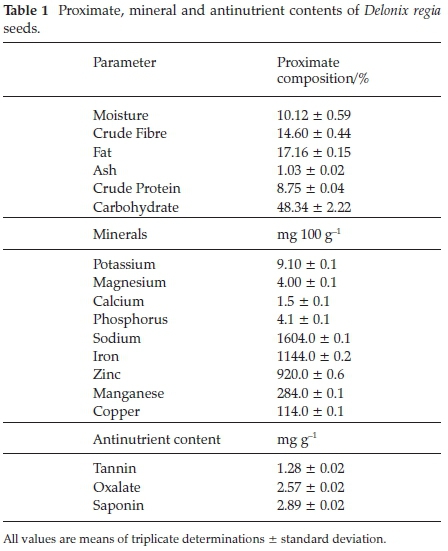
Proximate composition of D. regia is presented in Table 1. Moisture, crude fibre, ash, crude fat, crude protein and carbohydrate are 10.12 ± 0.59 %, 14.6 ± 0.44 %, 1.03 ± 0.02 %, 17.16 ± 0.15 %, 8.75 ± 0.04 % and 48.34 %, respectively. The results obtained in this study for moisture, crude fibre, crude fat and carbohydrate are higher than values obtained for D. regia by Bake et al.861617,18 The fat content of the seed indicates that it could be a potential source of biodiesel feedstock.19Xylocarpus moluccensis seeds.19D. regia seed is comparable with the results obtained by Coimbra and Jorge19Syagrus oleracea, Syagrus romanzoffiana and Acrocomia aculeate. This indicates that the seeds are rich in carbohydrate because it meets recommended dietary values of 40 % for children and adults.18-20
3.2.
Antinutrient ContentsResults of antinutrient contents of D. regia seed (Table 1) are tannin 1.28 ± 0.02 mg g-1, oxalate 2.57 ± 0.02 mg g-1, and saponin 2.89 ± 0.02mgg-1.Thevalueswerelower compared to the values reported for tannin and phytate in Colocasia esculenta according to Lewu et al.21Colocasia esculenta L. and saponin reported by Jukanti et al.22Cicer arietinum L. but have higher oxalate content than values obtained by Amata and Nwagu6D. regia. Oxalate has been implicated in the formation of kidney stones and a decrease in calcium absorption but consumption of seeds of low oxalate content such as D. regia may not induce any of these. Tannin content of this seed is also lower than the critical value of 9.0 mg g-1 that could induce tannin toxicity.2321D. regia shows that it could provide a chemo-preventive measure as it has been reported that saponin lowers blood cholesterol, inhibits the growth of cancerous cells and enhances immune system however the low content in this seed shows that it may not pose any danger when the seed is consumed.21,22
3.3.
Mineral CompositionThe trend of the abundance of mineral concentration in the seeds of D. regia (Table 1) in decreasing order is as follows Na>Fe>Zn>Mn>Cu>K>M>P>Ca. Results obtained in the current study showed lower concentrations of Mn, Cu, K, Mg and Ca but higher values of Na, Fe and Zn than results of mineral contents obtained by Amata and Nwagu6D. regia seeds while it is higher than the results obtained for fruits of Antheraea pernyi and leaves of Cnidoscolus aconitifolius. Macro and micro elements are necessary for normal physiological function, the deficiency of which causes serious metabolic abnormalities and the increase of which leads to toxicity, so their presence in D. regia shows it is a good source for essential minerals.2520,26
Na/Kratio for D. regia seed in this study is 176.26 and when this ratio is higher than 1 in diet, such diets have been linked with increased risk of hypertension and cardiovascular disease (CVD)-related mortality.26D. regia analyzed for minerals have Ca/P ratio of 0.37, this shows that the seeds are not a good source of minerals for bone formation. A diet with Ca/P ratio higher than one is considered a good source of minerals for bone formation but with a ratio less than 0.5 is considered a poor source.27
3.4.
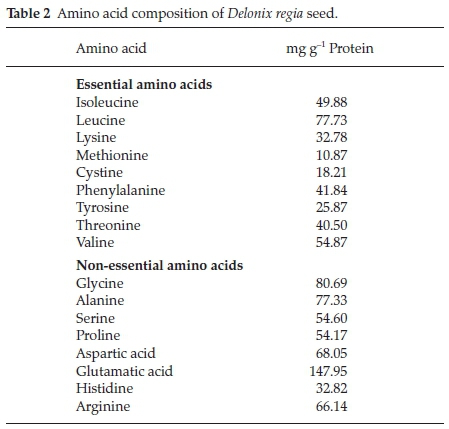
Amino Acid CompositionThe results of amino acid composition of D. regia seed are presented in Table 2. D. regia contained seventeen known amino acids including all essential amino acids (EAAs) and sulphur-containing amino acids. Glutamic acid was the most abundant while methionine was the least abundant. The percentage of EAAs in the total amino acids is 35.48 % and the ratio of EAAs to non-EAAs is 0.55 which is close to 0.6 recommended by FAO/ WHO.29,30 The percentages of savoury amino acids (glutamic acid) and sweet amino acids (glycine and alanine) to the total amino acids were 16.82 % and 17.97 %, respectively. The high content of glutamic acid suggests that D. regia has a very good flavouring agent used in food preparation. This is also beneficial because glutamic acid is involved in the synthesis and metabolism of nucleotides and amino acids.31D. regia (312.05 mg g-1 protein) is lower than EAAs of A. pernyi (406.2 mg g-1 protein) reported by Zhou and Han.26D. regia is comparable with FAO/WHO reference pattern established for humans: 40, 70, 55, 35, 60, 40, 10 and 50 for Isoleucine, Leucine, Lysine, (Methionine + Cysteine), (Phenylalanine + Tyrosine), Threonine, Tryptophan and Valine, respectively, but for Trypto-phan which was deficient. Also, the EAAs are comparable with the reference (FAO/WHO/UNU)32-1 protein for Threonine, Valine, (Methionine + Cysteine), Isoleucine, Leucine, (Phenyl-alanine + Tyrosine) and Lysine.
The results of amino acid composition in D. regia seed shows that it could be used as a supplement for protein and amino acid deficiency as well as in compounding animal feeds.16,26
3.5. Physicochemical Properties
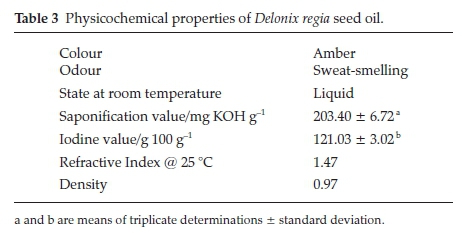
Physicochemical properties of D. regia seed oil are presented in Table 3. The seeds contained 17.16 % of oil. They have higher oil content than Albizia julibrissin (10.50 %) reported by Nehdi et al.2 33D. regia reported by Arora et al.4D. regia oil was a liquid, amber in colour and sweet-smelling. Iodine value was 121.03 ± 3.02 g 100 g-1, saponification value was 203.40 ± 6.72 mg KOH g-1, refractive index (25 °C) was 1.47 and density was 0.97 g cm-3.
These results are comparable with the results of A. julibrissin reported by Nehdi et al.233D. regia reported by Arora et al.4D. regia indicate that the oil contains normal glycerides, low unsaturation and will be very good for the production of soaps and shampoos.2A. julibrissin reported by Nehdi et al.,234
3.6.
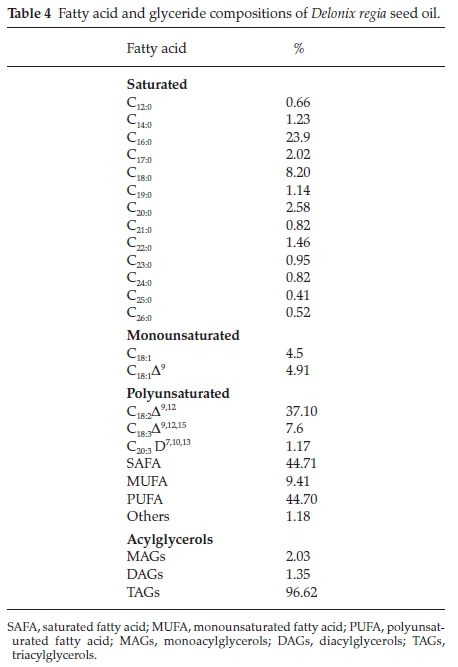
Fatty Acid Composition of the Seed OilThe results of fatty acid in D. regia seeds are presented in Table 4. The oil contained high level of linoleic acid (C182,37.1 %) followed by palmitic acid (C160, 23.90 %), stearic acid (C180, 8.20 %), linolenic (C18:3,7.6 %), oleic (C18:1∆918:1, 4.50 %). The total saturated fatty acid (SAFA) was 44.71 % and total unsaturated fatty acid was 54.11 % (Mono-unsaturated 9.41 % and Polyunsaturated 44.70 %). Polyunsatu-rated/saturated fatty acid of ratio 0.999 makes it inferior to A. julibrissin (2.96). This confirms that the degree of unsaturation in D. regia is lower than in A. julibrissin as also revealed by refractive index. This equally shows that it is favourable for consumption to reduce serum cholesterol, atherosclerosis and prevention of heart diseases.35et al. for the seed.4
Nutritional and industrial characteristics of oils are enhanced by the amount of fatty acid components. The linoleic acid which is the most abundant in D. regia is indispensable for the healthy growth of human skin and it makes the oil a valuable component for the production of food and in cosmetic applications.4,36 Oleic acid is very important in nervous cell construction but its percentage is low in this oil, thus, D. regia oil may not be much desirable in terms of nutrition.35D. regia oil will provide good resistance to oxidative rancidity due to its high SAFA content.33
3.7.
Acylglycerol CompositionThe percentages of monoacylglycerols (MAGs), diacyl-glycerols (DAGs) and triacylglycerols (TAGs) are presented in Table 4. Triacylglycerols are the most abundant with 96.62 %. The results were similar to those reported for chickpea by Jukanti et al.222
3.8.
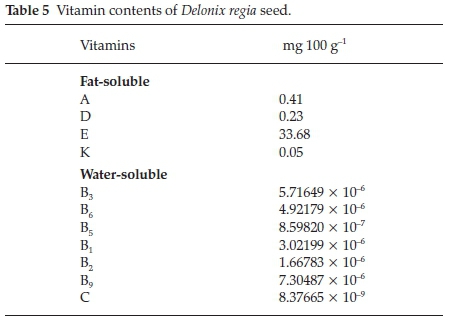
Vitamin ProfileVitamin contents of D. regia are presented in Table 5. Fat-soluble vitamins contents were higher than water soluble vitamins. In all, vitamin E was the most abundant. Vitamin E content in D. regia is higher than vitamin E contents in Tamarindus indica and Citrullus vulgaris. Vitamin E is a fat-soluble vitamin which is known to have several biological functions of which the most important are its antioxidant function and prevention of lipid peroxidation.37,38
4. Conclusion
This study has investigated D. regia seeds for proximate composition, antinutrient contents and mineral composition while the seed oil was investigated for vitamins, fatty acid, acyl-glycerol, amino acid composition and physicochemical properties. It was concluded that the seeds are a good source of oil, energy-rich, good for consumption and can be used as protein supplement but may pose cardiovascular risk due to its high sodium-to-potassium ratio. The seed oil contains essential fatty acids, acylglycerols and vitamins needed for nutrition and production of soaps, shampoos and as a biodiesel feedstock.
References
- 1 E.O. Aluyor, C.E. Ozigagu, O.I. Oboh and P. Aluyor, Chromatographic analysis of vegetable oils: a review, Sci. Res. Essay, 2009, 4, 191-197.
- 2 I. Nehdi, S. Omri, M.I. Khalil and S.I. Al-Resayes, Characteristics and chemical composition of date palm (Phoenix canariensis) seeds and seed oil, Ind. Crops Prod., 2010, 32, 360-365.
- 3 F. Adje, Y.F. Lozano, E. Meudec, P. Lozano, A. Adima, G.A. N'zi and E.M. Gaydou, Anthocyanin characterization of pilot plant water extracts of Delonix regia flowers, Molecules, 2008,13, 1238-1245.
- 4 A. Arora, R. Sen and J. Singh, Fatty acid composition of Delonix regia (Gulmohar) seed oil from arid zone of Rajasthan, J. Indian Coun. Chem., 2010, 27, 150-152.
- 5 P.M.J. Rani, P.S.M. Kannan and S. Kumaravel, Screening of antioxi- dant activity, total phenolics and gas chromatograph and mass spectrometer (GC-MS) study of Delonix regia, Afr. J. Biochem. Res., 2011, 5, 341-347.
- 6 I.A. Amata and K.M. Nwagu, Comparative evaluation of the nutrient profile of the seeds of four selected tropical plants and maize, Int. J. Appl. Biol. Pharm. Tech, 2013, 4, 200-204.
- 7 I.B. Kaga, Biological and carcass characteristics of rabbits fed Delonix regia meal diets, Biol. Sys, 2013, 2, 120.
- 8 G.G. Bake, E.L. Martins and S.O.E. Sadiku, Nutritional evaluation of varying levels of cooked flamboyant seed meal (Delonix regia)onthe growth performance and body composition of Nile tilapia (Oreo- chromis niloticus) fingerlings, Agric., Forest. Fish., 2014, 3, 233-239.
- 9 A.R. Kumar, R. Shaikand D. Yeshwanth, Phytochemical evaluation of Delonix regia, Samanea saman and Bauhinia variegata, Int. J. Res. Pharm. Chem., 2013, 3, 768-772.
- 10 S.P. Roy, K. Prajapati, R. Gupta, D. Bhadra, N. Patel, A. Batiwala, G. Sonara, N. Gheewala and T. Kannadasan, Evaluation of anti-ulcer effects of ethanolic extract of Delonix regia flower, Indian J. Res. Pharm. Biotech., 2013,1,440-45.
- 11 AOAC, 1990, Official Methods of Analysis, 15th edn., The Association of Official Analytical Chemists, Arlington, USA.
- 12 AOAC, 2006, Official Methods of Analysis, 18th edn., The Association of Official Analytical Chemists, Arlington, USA.
- 13 ISO, 1996, Animal and vegetable fats and oils, in ISO 3961, Determination ofIodine Value, International Organization for Standardization.
- 14 ISO, 2002, Animal and vegetable fats and oils, in ISO3657, Determination of Saponification Value, International Organisation for Standardisation.
- 15 D6584,2003, Test Method for Determination of Free and Total Glycerides in B-100 Biodiesel Methyl Esters by Gas Chromatography, ASTM International, West Conshohocken, PA, USA.
- 16 R. Horax, N. Hettiarachchy, A. Kannanand A.P. Chen, Proximate composition and amino acid and mineral contents of Mormordica charantia L. pericarp and seeds at different maturity stages, Food Chem., 2010,122, 1111-1115.
- 17 L. Azeez, M.D. Adeoye, O.T. Ganiyu, I.O. Abdulsalami, T.A. Majolagbe and A.T. Lawal, Influence of microbial contamination on the antioxidant composition and freeradical scavenging effects of fresh and decaying spices, Fountain J. Nat. App. Sci., 2012,1, 55-64.
- 18 E.D. Fagbohun, A.O. Egbebi and O.U. Lawal, Phytochemical screening, proximate analysis and in-vitro antimicrobial activities of methanolic extract of Cnidoscolus aconitifolius leaves, Int. J. Pharm. Sci. Rev. Res., 2012,13, 28-33
- 19 S. Gunawan, R. Darmawan, M. Nanda, A.M. Setiawan and H. Fansuri, Proximate composition of Xylocarpus moluccensis seeds and their oils, Ind. Crops Prod., 2013,41, 107-112.
- 20 M.C. Coimbra and N. Jorge, Proximate composition of guariroba (Syagrus oleracea), jerivá (Syagrus romanzoffiana) and macaúba (Acrocomia aculeata) palm fruits, Food Res. Int., 2011, 44, 2139-2142.
- 21 M.N. Lewu, P.O. Adebola and A.J. Afolayan, Effect of cooking on the mineral contents and anti-nutritional factors in seven accessions of Colocasia esculenta (L.) Schott growing in South Africa, J. Food Comp. Anal., 2010, 23, 389-393.
- 22 A.K. Jukanti, P.M. Gaur, C.L.L Gowda and R.N. Chibbar, Nutritional quality and health benefits of chickpea (Cicer arietinum L.): a review, Brit. J. Nutr., 2012,108, 11-26.
- 23 G. Oboh and A.A. Akindahunsi, Biochemical changes in cassava products (flour & gari) subjected to Saccharomyces cerevisae solid media fermentation, Food Chem.,2003, 8,599-602.
- 24 U.O. Pius, E.A.C. Cemaluk, O.L. Nnamdi and E.P. Madus, Tannins and other phytochemicals of the Samanaea saman pods and their antimicrobial activities. The 34th Annual International Conference of the Chemical Society of Nigeria (CSN), 2011, 155-162.
- 25 A. Ozkaya, H. Ciftci, O. Yilmaz, A. Zafer Tel, E. Cil and B.S Cevrimli, Vitamin, trace element, and fatty acid levels of Vitex agnus-castus L., Juniperus oxycedrus L., and Papaver somniferum L. plant seeds, J. Chem., 2013, 845743,1-4.
- 26 J. Zhou and D. Han, Proximate, amino acid and mineral composition of pupae of the silkworm Antheraea pernyi in China, J. Food Comp. Anal., 2006, 19, 850-853.
- 27 K.A. Cockell, M.R. L'Abbe and B. Belonje, The concentrations and ratio of dietary calcium and phosphorus influence development of nephrocalcinosis in female rats, J. Nutr., 2002, 132, 252-256.
- 28 J.Z. Schneider, The calcium to phosphorus ratio as related to mineral metabolism, Int. J. Orthodon., Oral Surg. Radiogr., 1930,16, 277-285
- 29 FAO/WHO, 1973, Energy and Protein Requirements, FAO/WHO, Rome, Italy.
- 30 FAO/WHO, 1973, Energy and Protein Requirements, FAO/WHO, Rome, Italy.
- 31 F. Musieba, S. Okoth, R.K. Mibey, S. Wanjiku and K. Moraa, Proximate composition, amino acids and vitamins profile of Pleurotus citrino- pileatus Singer: an indigenous mushroom in Kenya, Amer. J. Food Tech., 2013, 8, 200-206.
- 32 FAO/WHO/UNU, 1985, Energy and Protein Requirements, Report of a joint FAO/WHO/UNU, Expert consultation, World Health Organisation Technical Rep. Ser. 724, WHO, Geneva.
- 33 I. Nehdi, Characteristics, chemical composition and utilisation of Albizia julibrissin seed oil, Ind. Crops Prod., 2011, 33, 30-34
- 34 J-R. Riba, B. Esteban, G. Baquero, R. Puig and A. Rius, Temperature dependence of density and viscosity of vegetable oil, Biomass Bioenergy, 2012,42, 164-171
- 35 S. Fatnassi, I. E. Nehdi and H. Zarrouk, Chemical composition and profile characteristics of Osage orange Maclura pomifera (Rafin.) Schneider seed and seed oil, Ind. Crops Prod., 2009, 29, 1-8.33.
- 36 C.S. Ku and S.P. Mun, Characterization of seed oils from fresh Bokbunja (Rubus coreanus Miq.) and wine processing waste, Bior. Tech., 2008, 99, 2852-2856.
- 37 S.J. Shin, Vitamin E modulates radiation-induced oxidative damage in mice fed a high-lipid diet, J. Biochem. Mol. Biol., 2003, 36, 190-195.
- 38 N. Habila, H.M. Inuwa, I.A. Aimola, A.S. Agbaji, Z. Ladan, R. Shangodare, I.S. Williams, O.B. Odjobo and E. Ogabiela, Variationof fatty acids and vitamin E composition in seed oils of some plant species, J. Plant Studies, 2012, 1, 55-60.
Revised 5 December 2016
Accepted 14 December 2016