Trends in NMR Structural Elucidation Of Polycyclic Cages, Namely: Adamantane, Pentacycloundecane and Trishomocubane
Abstract
Advances in Nuclear Magnetic Resonance (NMR) spectroscopy is a cornerstone in structure elucidation of polycyclic 'cage' scaffolds. Due to the compactness of these compounds, much overlap, as well as unique through-space and bond NMR interactions are frequently observed. This review serves as a guide for the NMR elucidation of future derivatives by providing some of the typical and relevant aspects of the characteristic trends, substituent patterns and chemical shift behaviour for the identification of the polycyclic structures, namely adamantane, pentacycloundecane and trishomocubane derivatives.
adamantane; NMR elucidation; pentacycloundecane; polycyclic compounds; trishomocubane
1. Introduction
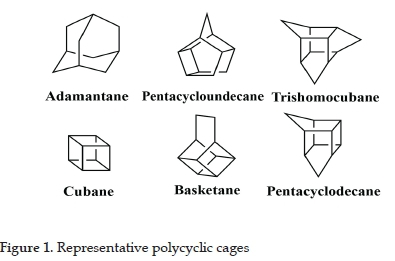
The chemistry of polycyclic 'cage' scaffolds has fascinated organic chemists for over six decades.1-8 These compounds include adamantane, pentacycloundecane, trishomocubane, pentacyclodecane, cubane, basketane (Figure 1).
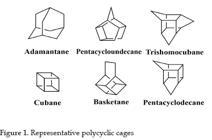
These molecules have played a significant role in synthetic, theoretical and medicinal chemistry. The effect of the unusual cage geometries on chemical reactivity,9108,11-16 Furthermore, polycyclic cage based compounds have been reported to possess antifungal/antibacterial,17-18 anti-tuberculosis19-23 and anti-viral properties.24-28 Research on the chemistry and medicinal applications of this class of polycyclic cage derivatives is ongoing.9,29-32
In terms of their chemistry, these cage moieties exhibit unique features such as strained bonds/angles due to their rigid nature. The result is broad overlapping of 131,33113
2. Discussion
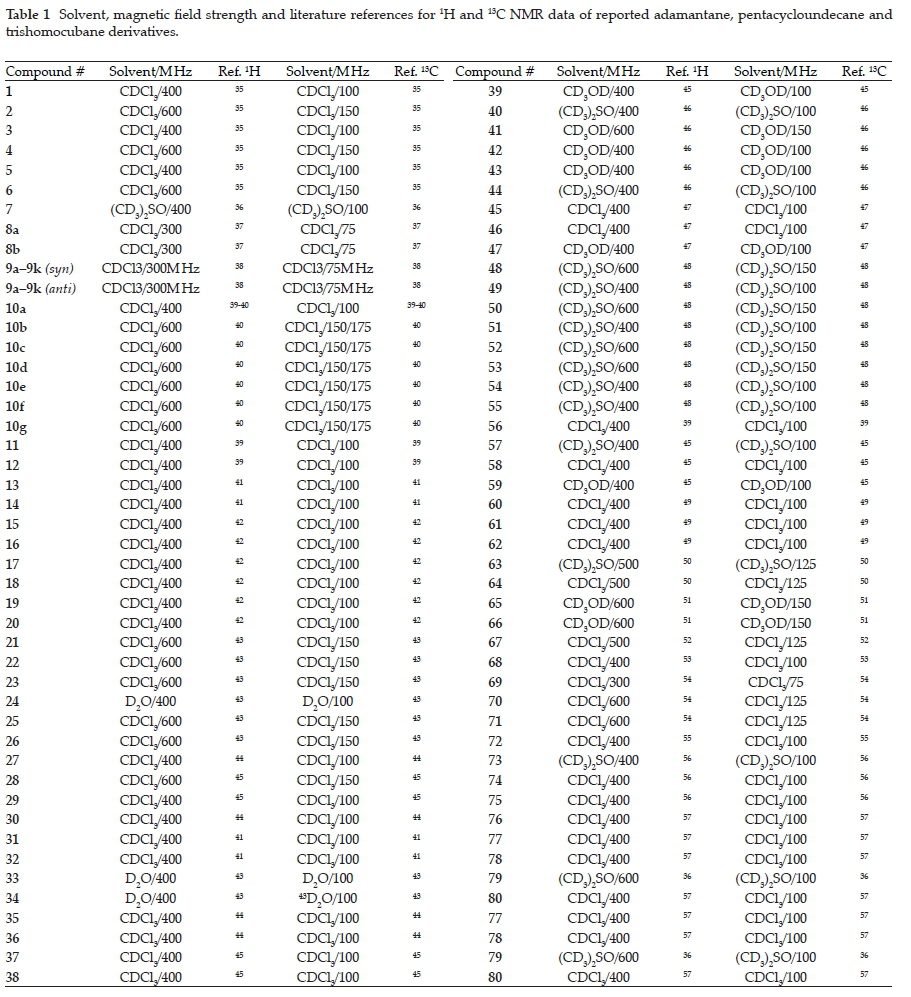
The NMR data are arranged into seven tables and three figures to enable easy interpretation of the collated data and as a guide for the elucidation of newer derivatives. There are a few cases where more than one reference for the NMR data of the same compound are documented. Here we used the data that best described the NMR elucidation or pattern. Information on the references, solvents, and magnetic field strength in which the NMR data were obtained for each compound are provided in Table 1.
2.1. Adamantane
Adamantane, a naturally occurring substance, was first isolated in 1933 from petroleum fractions."' 343066
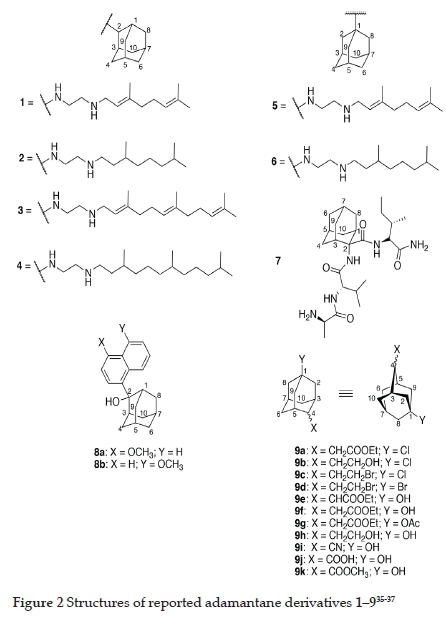
From literature' a general trend was observed in the elucidation of monosubstituted (positions 1 or 2) adamantane compounds (1-6) (Figure 2). Free rotation along the C-1 or C-2 (of the adamantane scaffold) with the substituent (X = N, O etc.) amplifies the plane of symmetry of the adamantyl moiety
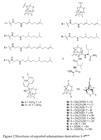
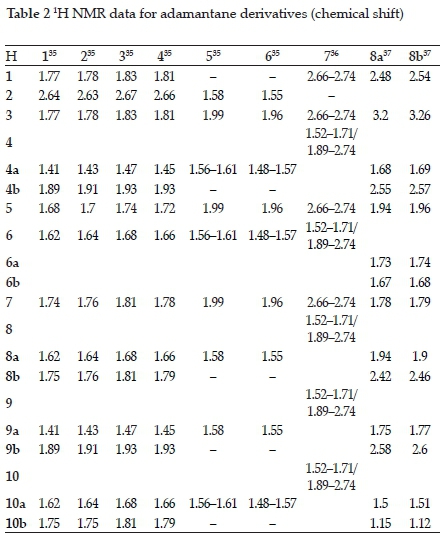
For instance, for substituents at position 1 of the adamantane group (compounds 5 and 6), the following carbon groups are equivalent: C-2/C-8/C-9 (CH2), CH-4/C-6/C-10 (CH2) and C-3/ C-5/C-7 (CH). Signals C-1/C-3 (CH), C-8/C-10 (CH2), C-4/C-9 (CH2), C-5 (CH), C-6 (CH2) and C-7 (CH) are equivalent for substituents at position 2 (compounds 1-4) (see Table 2). The presence of a plane of symmetry on the adamantane moiety further simplifies the structural elucidation of these compounds. However, overlapping in the proton spectrum due to the symmetry and subtle differences of the often diastereotopic carbon skeleton of these derivatives still appears to sometimes obscure some assignments.
Compounds 1-4,reported by Onajole et al.35
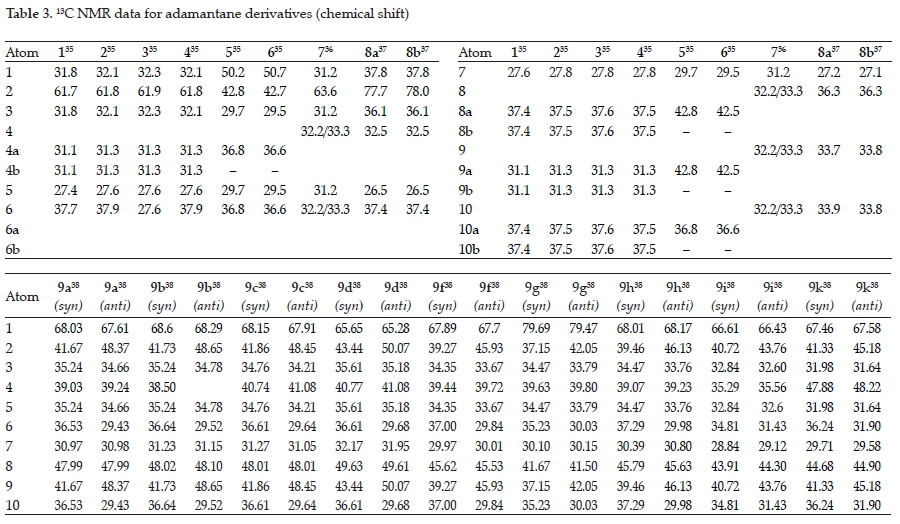
Makatini et al.,367 on C-2 with peptide linkages de-shielding the resonances of the neighbouring protons (Table 2), e.g. H-1/3 have chemical shifts around 2.66-2.74 ppm as compared to 1-6. Another di-substituted adamantane derivatives, 8a and 8b,37378a, were used by Jelena et al.378a and of 8b. Low-temperature NMR spectra (CDCl3; 1138a and 8b at 223 K showed well-resolved proton and carbon signals for both compounds accounting for fourteen chemically inequivalent aliphatic proton atoms and ten inequivalent carbon atoms, all belonging to the adamantane moiety. It is noteworthy, that low temperatures reduced the interconversion of 8a and 8b between their non-symmetrical conformations. However, this is not observed in the fast exchange (i.e. at room temperature) as only six different 13Table 3).
The methylene protons in the adamantane moiety are diastereotopic as a result of rigidity in the molecule, making these protons nonequivalent, therefore, exhibiting spin-spin interactions. The protons (Ha) axial to each of the cyclohexyl rings show signals appearing at a lower frequency than the equatorial protons (Hb) due to the through-space effect. This effect is observed for compounds 1-4 as well as 8a and 8b. NOESY/ ROESY interactions of Ha/Hb with neighbouring protons were used to distinguish between these two protons resulting from their orientation in space. Studies have shown that a class of 1,4-disubstituted adamantane derivatives (9a-9k) (Figure 2) containing electron-withdrawing groups at both positions C-1 and C-4 resulted in increased chemical shifts of adjacent protons.389a-9k, show large discrepancies in both proton and carbon resonance signals from the other classes stated above. In the carbon-13 spectra, compounds 1-4 with substituent attached to C-2 recorded the most de-shielded signal for C-2, followed by either C-6 or C-8/10, C-1/3, C-4/9, C-7, and C-5 consecutively, in decreasing order of chemical shift with C-5 being the most shielded (Table 3). The following class of compounds, 5, 6, 7, including 8a and 8b isomers, displayed a definite pattern of chemical shifts of carbon-13 signals for each class as observed in their carbon spectra. The syn-isomers of compounds 9 registered C-1, C-8, C-2/9, C-4, C-6/10, in order of decreasing frequency except for 9f and 9g (9k), where the order of C-2/9 and C-4 (C-8 and C-2/9) are reversed, while the antf-isomers recorded C-1, through C-2/9, C-8, C-4, C-3/5, C-7, to C-6/10 in a definite order of decreasing chemical shift except for 9i and 9k with each displaying a different pattern. The combined effect of the 1,4-disubstitutents on the adamantane skeleton causes the signals of C-2, 9 and C-6, 10 to be fairly close together in the syn-isomers while they are further apart in the antf-isomers.
The signals for the proton and carbon resonances fall within a similar region for equivalent positions for this class compounds with the same substituent pattern as displayed in Tables 2 and 3. The electron-withdrawing groups on either C-1, C-2 or C-4 have the effect of shifting the resonance signals of the adjacent protons towards the higher frequency region. So far, aromatic rings attached to an adamantane cage is expected to cause a large de-shielding effect of the adjacent proton resonances as compared to carbonyl, amino, hydroxyl, and other electron-withdrawing groups. The 13
2.2. Pentacycloundecane
The synthesis of the Cookson's dione, which is the starting material for all pentacyclo[5.4.0.02,6.03,10.05,9]undecane (PCU) derivatives, was first reported in 1964.433113148,5848
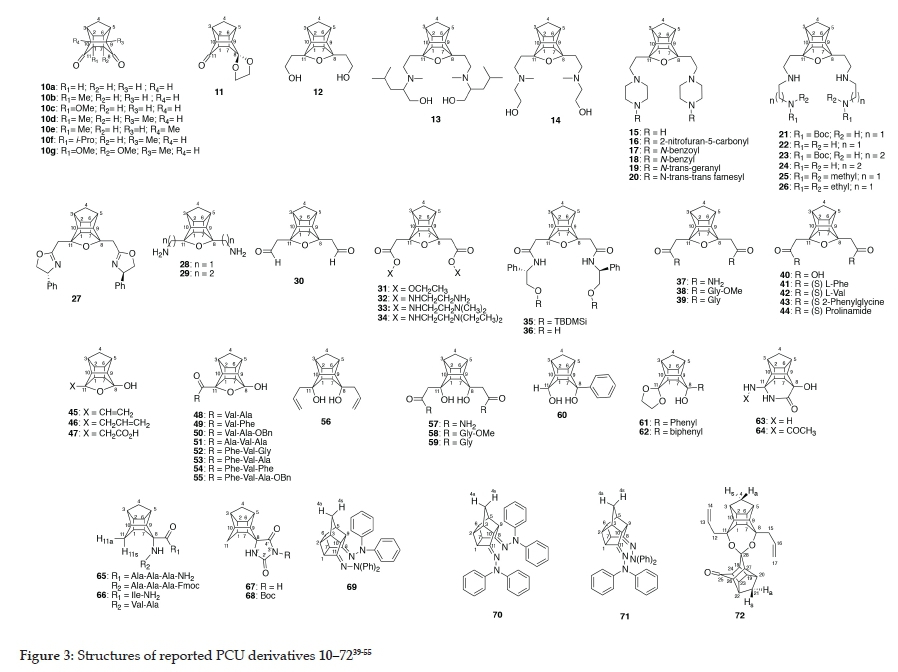
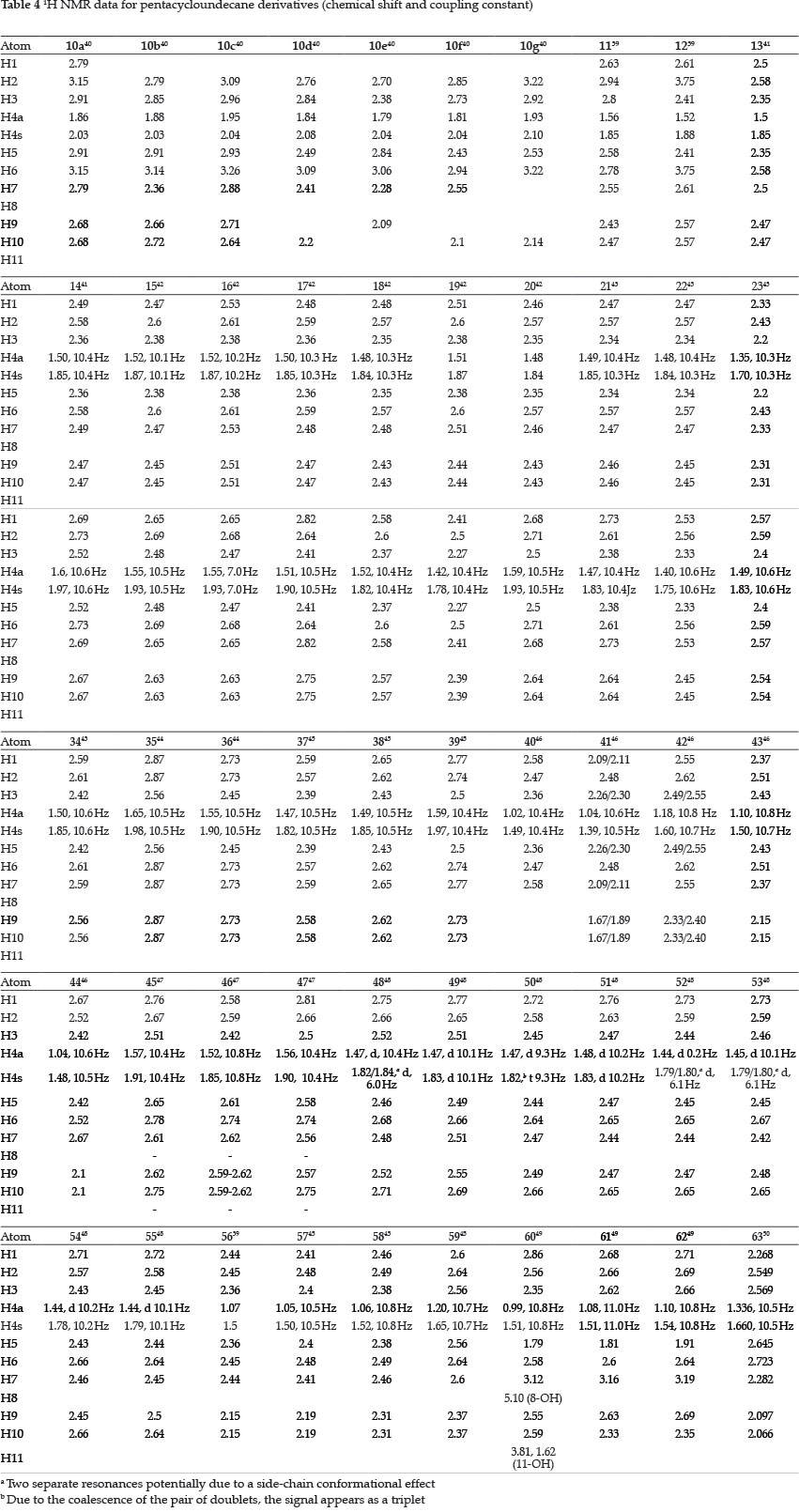
Kenwright et al.,4010a-10g (Figure 3), where the protons in the 2 and 6 positions of the four-membered ring have the highest shift in frequency of all the methine protons in unsubstituted PCU derivatives. However, the chemical shift of position 2 appears de-shielded when position 1 is substituted by an alkyl or methoxy group. At least in most cases, it reduces to a frequency lower than any one of the bridgehead protons at position 3 or 5. H-6 is always the most de-shielded proton (Table 4) when there is no substituent attached to position 7, while H-2, H-3, or H-5 follow at the next highest frequency, but the order depends on the position and type of substituent at H-9 or H-10. A significant shift in the proton signal of H-9/H-10 is found in the derivatives where alkyl substituent is attached to either C-9 or C-10 than when alkyl substituent is attached to other positions and in unsubstituted PCU derivatives.
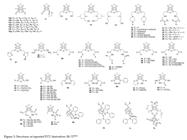
Generally, electron-withdrawing groups such as methoxy at C-1 and/or C-2 cause adjacent proton signals to be de-shielded but has no marked effect on protons farther away from the substituent. Furthermore, it is generally observed that the relative shifts in the signals of the methine protons are opposite to the trend for the carbon signals. Hence, the proton with the highest chemical shift value has its corresponding carbon appearing at the lowest frequency.
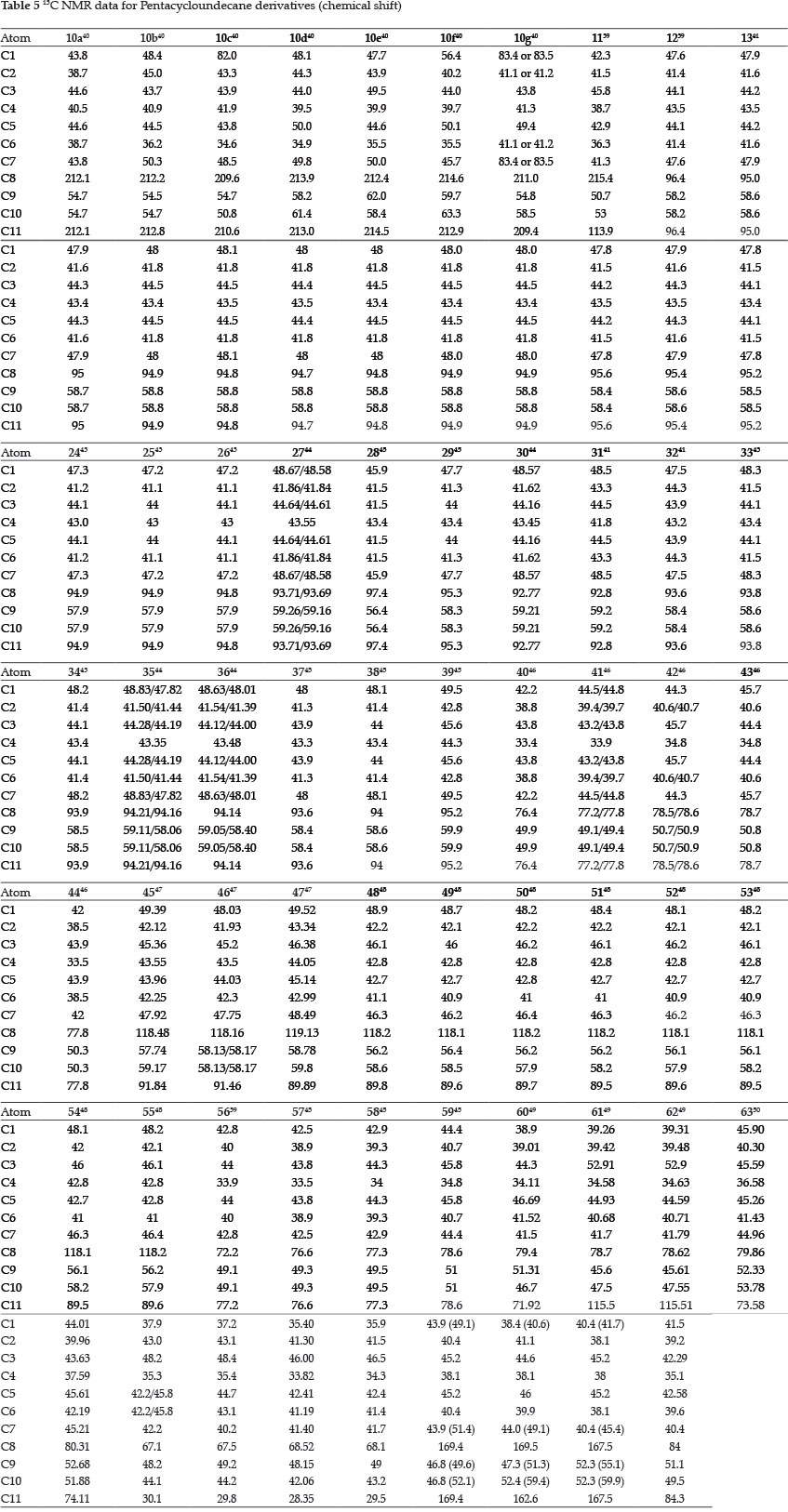
An asymmetric keto-ketal, 11, reported by Kruger et al.,39 12-44 (Table 4). The next set of de-shielded signals is recorded for H-1/7 and H-9/10 consecutively, while the reverse is true for only 13, but H-3/5 immediately follows H-1/7 in decreasing order of chemical shift for 41-44. However, 27 and 31 are the only compounds where H-1/7 was recorded as the most de-shielded proton and followed next by H-9/10 and H-2/6 accordingly. The chiral side arm substituent of compound 27 induced diastereomeric character to the cage moiety. As a result of this effect, the cage protons are nonequivalent, thus making its elucidation challenging. Also, in compound 35, the diastereomeric effect (induced by the chirality on the side arms) causes all the cage carbon signals to display a split pattern. High-temperature NMR experiments of 35 (333, 393 and 423 K) revealed that the C-1/7, C-9/10, and C-8/11 signals remained split even at the highest tested temperature (423 K) with the exception of C-4, an achiral methylene carbon, thus further confirming the diastereomeric effect experienced by these carbon atoms. This observed interaction illustrated a conformation of 35, where one of the "arms" is positioned in front of the cage moiety while the other is at the back. As previously reported for related chiral PCU ligands,41-44,48,555913
H-3/5 was registered as the most shielded proton of all the methine protons for the symmetrically substituted PCU ether at positions 8 and 11, except for 41-44, where H-9/10 was recorded as the lowest frequency. The chemical shift of the carbon signals of compounds 12-44 follows a definite trend by decreasing from C-8/11 through C-9/10, C-1/7, C-3/5, C-4 to C-2/6. However, 31, 32 and 40-44 show deviation from this regular pattern, where C-4 was registered as the lowest carbon frequency while C-2/6 takes the position of C-4, and that observed for 32 is given as follows, C-8/11, through C-9/10, C-1/7, C-2/6, C-3/5, to C-4. It is noteworthy that equivalent carbons resonate within a similar range of frequency. The electron-withdrawing effect induced by the oxo bridge of the ether functional group holding C-8 and C-11 together has an intense effect on these carbons; hence, they were recorded as the most de-shielded. Since C-1/7 and C-9/10 are both adjacent to the ether group, C-1/7 is expected to be the next de-shielded because it is enclosed in a four-membered ring inducing strain effect. However, C-9/10 was recorded as the second most de-shielded carbon due to the high stretching strain exerted by the oxo bridge of the ether. This evidence is supported by single X-ray diffraction of certain PCU derivatives indicating shorter bond length for C9-C10 than normal value expected due to the stretching strain induced by the oxo bridge holding the cage "mouth" together by C8 and C11.60
For the ether monosubstituted hydroxyl group at position 8, with position 11 substituted by an alkene functionality (45 and 46), methylene carboxylic acid (47) and the carbonyl group of peptide linkage (48-55), H-1 signal was attributed to the highest frequency, followed by H-10 and/or H-6. However, 45 and 46 registered the highest chemical shift value for H-6, followed by H-1 and H-10, and H-10 and H-1, respectively. The highest ppm was attributed to H-1 due to the electron-withdrawing effect induced by the carbonyl group attached to position 11. At the same time, there is little effect due to the alkene functionality compared to the carbonyl. H-3, H-5, and H-7 were recorded as the lowest frequency for 45-47, 48-50/54-55 and 51-53. H-3 and H-5 are farther away from the electron-withdrawing groups, hence experience little or no effect from these groups. This class of compounds exhibited a general pattern of carbon chemical shift decreasing from C-8, C-11, C-10, C-9, C-1, C-7 to C-3. The lowest frequency was registered for C-6 except for 45 and 46, which recorded the lowest chemical shift for C-2. Simultaneously, the remaining two carbons, C-4 and C-5, show a very slight difference in ppm with C-4 slightly higher than C-5 or vice versa (see Table 5). C-8 was recorded as the most de-shielded carbon due to the hydroxyl group directly attached to this position. The decreasing order of chemical shift ranging from C-10, through C-9, C-1, to C-7 is also supported by the evidence given above for 12-44, except that there is no plane of symmetry; therefore, each carbon resonates at a different frequency. The unsymmetrical and non-separable diastereomeric nature of compounds 48-55 resulted in complicated 11348
Compounds 56-59 are symmetrically di-substituted at positions 8 and 11 with hydroxyl groups at these positions. These compounds all show similar patterns in chemical shifts, where H-2/6 was registered as the most de-shielded signal, followed by H-1/7 and H-3/5 consecutively, with H-9/10 being the least de-shielded of all the methine protons. The carbon-13 signals here show the following trend of chemical shift in decreasing order, from C-8/11, through C-9/10, C-3/5, C-1/7, C-2/6, to C-4. The hydroxyl groups attached to C-8 and C-11 cause a large de-shielding effect of these carbon signals.
The remaining compounds, 60-72, lack a plane of symmetry except for compounds 69 and 71 with symmetrical di-substituents at positions 8 and 11. Compounds 69-71 are conformational isomers, while 70 proved to be the most stable isomer in solution. The observed 1369-71 were also calculated using DFT54135470 was energetically more stable, which agrees with the experimentally observed isomeric ratios. Here the shifts in the signals do not follow a regular pattern, while the through-space de-shielding effect plays a significant role in determining the shifts of signals. The carbon signals exhibited a definite pattern for the following pairs of compounds with similar functional groups, 63 and 64, 65 and 66, 67 and 68.
In contrast, the remaining compounds do not follow a specified order of chemical shifts. Conclusively, in most cases, it can be proposed that H-2/6 seems to be the most de-shielded of the methine protons, followed by either H-1/7 or H-9/10 and H-3/5 being the most shielded proton for symmetrically substituted PCU ethers at positions 8 and 11 for 12-44. The PCU ethers, 45-55, with mono-substituent at position 11 and a hydroxyl group at position 8, lacking plane of symmetry, have H-1 and C-8 recorded at the highest ppm (for 1131
In summary, the PCU family of compounds is quite intriguing, as it can exist in one of three forms (asymmetric, diastereomeric or mesomeric), which then dictate the protocol to be followed on its NMR elucidation. The mesomeric PCU cage becomes chiral upon attachment of a group that breaks the symmetry. In such cases, COSY and NOESY interactions, in particular, are required to supplement the 1D spectra in order to aid the elucidation. Next, the PCU cage can exist as diastereoisomers, i.e. when the side arm substituents are the same yet possess chirality. Here the carbon signals appear as pairs due to diastereomeric splitting. In both cases, the asymmetric and diastereomeric PCU derivatives experience conformational effects induced by the side arms (one arm pointing to the back whilst one arm points to the front of the cage) that influence the NMR spectra (NOESY interactions, splitting of carbons). When the side arms prove to be stable in a specific orientation relative to the cage, these isomers are referred to as configurational isomers. Finally, the PCU cage may have identical achiral side arms resulting in a mesomeric structure. In this instance, all the atoms on the PCU molecule, except for the methylene at the C-4 position, become equivalent resulting in much overlap in both the proton and carbon spectra. The carbon spectra, in particular, are somewhat simplified in these cases as an overlap of the equivalent signals occur. Generally, a convenient starting point in the elucidation of any of the above three forms of PCU is with the geminal bridge methylene protons (H-4) that register as an AB spin system around 1.1 and 1.5 ppm displaying a coupling constant of approximately 10 Hz. Essentially thereafter, the core PCU protons (i.e. H-1 through to H-11) are assigned using mainly COSY and NOESY spectra; the NOESY interactions are particularly important to confirm the cage methine protons with the substituents on the side arms due to the induction of different chemical environments. Typically, the COSY interaction of H-4a/s with H-3/5 is followed by the interaction of H2/6 and its connection with H-1/7. Thereafter, the H-2/6 interaction with H-9/10 confirms the core handle to further the elucidation. The route to be followed is dependent on whether the arms make the cage asymmetric, diastereomeric (noting that configurational isomers can exist in these cases) or mesomeric.
2.3. Trishomocubane
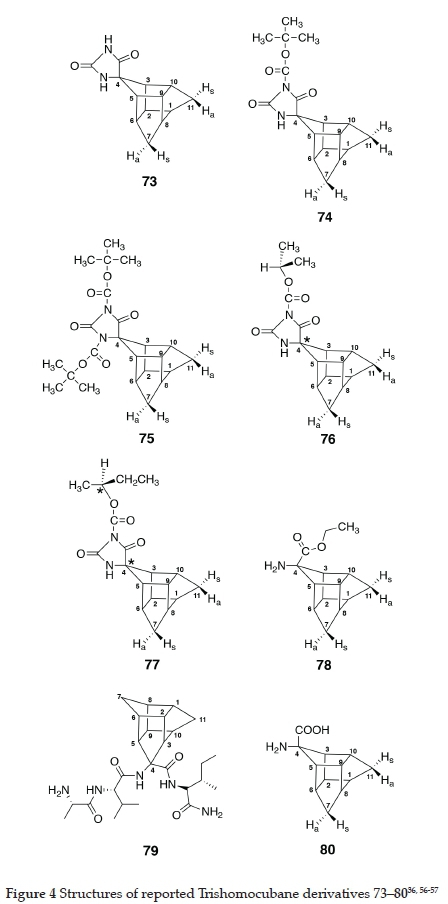
The most stable of all the pentacycloundecane based cages, namely, the D3-symmetrical trishomocubane, was first reported in 1970.6162-63 There are many publications on the synthesis and reactivity of these derivatives.1,62Figure 4). In earlier reports, simple chemical shift values, intensity ratios or only the 13161,63-64 The NMR data was assigned using chemical shift values, double resonance 113165
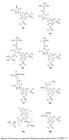
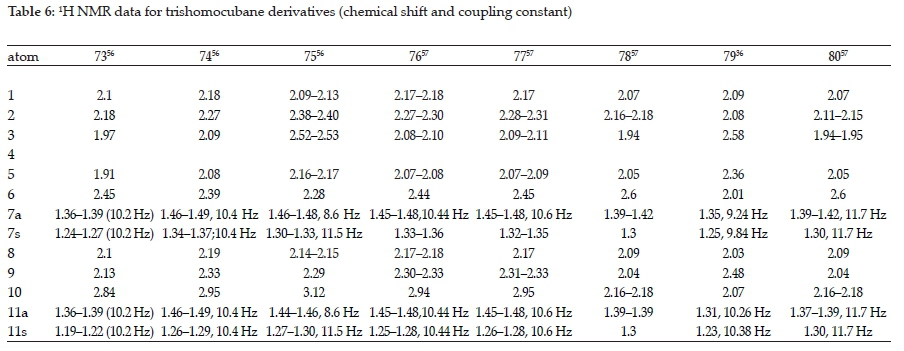
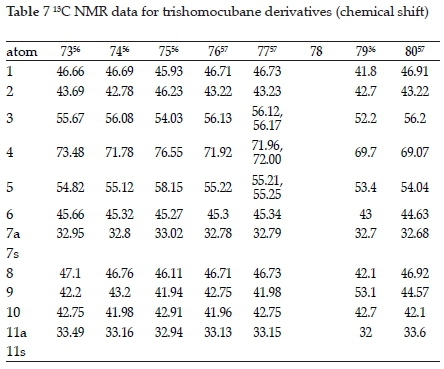
The trishomocubane hydantoin derivatives, 73-77,56-57 reveal H-10 as the most de-shielded signal of all the methine protons followed by H-6 and H-9 or H-2 in most cases (Table 6) as evident from the DFT calculations565675, where H-1 and H-8 are recorded in the lower frequency region with H-1 being more shielded. COSY and NOESY correlations are used to establish the assignments of the methylene protons H-7a (s) and H-11a (s). These geminal protons (H-7a (s) and H-11a (s)) exhibit an AB spin-spin splitting pattern and resonates as a pair of doublets with a coupling constant of approximately 10 Hz.56 5675 where C-5 is more de-shielded than C-3 (Table 7). The next increased de-shielded signals are attributed to either C-8 or C-1, while the most shielded signals are assigned to C-7 except 75, which recorded C-11 as the most shielded carbon.56
Compounds 78 and 80, reported by Govender et. al.,57 Table 6), while the most shielded signal was assigned to both H-7s and H-11s having the same chemical shift. Here, H-10 appears shielded due to the free rotation of the carbonyl functionality obtained upon hydrolysis of the rigid hydantoin ring. The proton chemical shifts of both compounds follow essentially the same order.5779 recorded the most de-shielded and shielded signals for H-3 and H-11s, respectively.3679 (AVPI).36363679 and 80 recorded C-4 as the most de-shielded carbon due to direct attachment to carbonyl functionality and amino group. The next de-shielded carbon was attributed to either C-3 or C-5 due to being directly attached to the most de-shielded carbon, namely, C-4, as given above, similarly for 73-77. Simultaneously, the most shielded signal could either be assigned to C-7 or C-11 (Table 7).
3. Conclusion
The use of NMR spectroscopy for elucidating large compounds has revolutionised the traditional analytical methods used in many research fields. The data provided by 1D NMR spectroscopy is much simpler to analyse; however, it typically does not provide enough information to fully elucidate these compounds. 2D NMR spectroscopy allows for structure elucidation by determining the proximity and effects of protons on carbons or other protons via bond/space interactions. 2D NMR spectroscopy is especially useful for structural elucidation of similar compounds, as there are typical patterns that can be identified. After analysing a variety of literature, it can be concluded that adamantane, pentacycloundecane, and trishomocubane have unique NMR patterns. For unsubstituted adamantane, the general pattern in 13111
ORCID iDs:
Monsuru Kelani: https://orcid.org/0000-0001-6873-5415
Darcelle Dieudonne: https://orcid.org/0000-0003-4963-8622
Clayton Pedigo: https://orcid.org/0000-0002-1504-6648
Thavi Govender: https://orcid.org/0000-0003-2511-2503
Gert Kruger: https://orcid.org/0000-0003-0606-2053
Tricia Naicker: https://orcid.org/0000-0002-7134-6258
Oluseye Onajole: https://orcid.org/0000-0002-4485-9648
Acknowledgements
O.K. thanks and acknowledges Roosevelt University for the generous financial support. G.K., TN., and T.G. thank and acknowledge the Medical Research Council, National Research Foundation (South Africa) and UKZN for the generous final support.
References
- 1 A.P Marchand, Synthesis and chemistry of homocubanes, bishomocubanes, and trishomocubanes. Chem. Rev., 1989, 89(5), 1011-1033.
- 2 G.W. Griffin and A.P Marchand, Synthesis and chemistry of cubanes. Chem. Rev., 1989, 89(5), 997-1010.
- 3 A.P Marchand, Advances in Theoretically Interesting Molecules. Thummel, R. P, Ed. JAI: 1989; Vol. 1, pp 357-399.
- 4 R.C. Cookson, E. Crundwell, R.R. Hill and J. Hudec, Photochemical cyclisation of Diels-Alder adducts. J. Chem. Soc., 1964, 3062-3075.
- 5 S. Landa and V Machacek, Sur l'adamantane, nouvel hydrocarbure extrait du naphte. Collect Czech. Chem. Commun., 1933, 5 (1-5).
- 6 R.C. Fort and P. Schleyer, Adamantane: Consequences of the Diamondoid Structure. Chem. Rev., 1964, 63(3), 277-300.
- 7 W.J. Geldenhuys, S.F. Malan, J.R. Bloomquist, A.P Marchand and C.J. Van der Schyf, Pharmacology and structure-activity relationships of bioactive polycyclic cage compounds: A focus on pentacycloundecane derivatives. Med. Res. Rev., 2005, 25(1), 21-48.
- 8 J. Joubert, W.J. Geldenhuys, C.J. Van der Schyf, D.W. Oliver, H.G. Kruger, T. Govender and S.F. Malan, Polycyclic Cage Structures as Lipophilic Scaffolds for Neuroactive Drugs. Chem.Med. Chem., 2012, 7(3), 375-384.
- 9 J.L. Neumeyer, Principles of Medicinal Chemistry. Lea and Febiger: London, 1989.
- 10 K.B. Brookes, PW. Hickmott, K.K. Jutle and C.A. Schreyer, Introduction of pharmacophoric groups into polycyclic systems .4. Aziridine, oxirane, and tertiary beta-hydroxyethylamine derivatives of adamantane. S. Afr. J. Chem, 1992, 45(1), 8-11.
- 11 A. Mdzinarishvili, W.J. Geldenhuys, T.J. Abbruscato, U. Bickel, J. Klein and C.J. Van der Schyf, NGP1-01, a lipophilic polycyclic cage amine, is neuroprotective in focal ischemia. Neuosci. Lett., 2005, 383, 49-53.
- 12 W.J. Geldenhuys, S.F. Malan, T. Murugesan, C.J. Van der Schyf and J. R. Bloomquist, Synthesis and biological evaluation of pentacyclo 5.4.0.0(2,6).0(3,10).0(5,9) undecane derivatives as potential therapeutic agents in' Parkinson's disease. Biorg. Med. Chem., 2004, 12(7), 1799-1806.
- 13 S.F. Malan, K. Dyason, B. Wagenaar, J.J. van der Walt and C.J. Van der Schyf, The structure and ion channel activity of 6-benzylamino-3-hydroxyhexa-cyclo 6.5.0.0(3,7).0(4,12).0(5,10).0(9,13) tridecane. Arch. Pharm. (Weinheim), 2003, 336(2), 127-134.
- 14 N. Tsuzuki, T. Hama, T. Hibi, R. Konishi, S. Futaki and K. Kitagawa, Adamantane as a brain-directed drug carrier for poorly absorbed drug - antinociceptive effects of D-Ala2 Leu-enkephalin derivatives conjugated with the 1-adamantane moiety. Biochem. Pharmacol., 1991, 41(4), R5-R8.
- 15 N. Tsuzuki, T. Hama, M. Kawada, A. Hasui, R. Konishi, S. Shiwa, Y Ochi, S. Futaki and K. Kitagawa, Adamantane as a brain-directed drug carrier for poorly absorbed drug .2. Azt derivatives conjugated with the 1-adamantane moiety. J. Pharm. Sci.,1994, 83(4), 481-484.
- 16 R.S. Schwab, A.C. England, P Dc and R.R. Young, Amantadine in the Treatment of Parkinson's Disease. JAMA, 1969, 208, 1168-1170.
- 17 O.K. Onajole, Y. Coovadia, T. Govender, H.G. Kruger, G.E.M. Maguire, D. Naidu, N. Singh and P. Govender, In Vitro Antifungal and Antibacterial Activities of Pentacycloundecane Tetra-Amines. Chem. Biol. Drug Des., 2011, 77(4), 295-299.
- 18 O.K. Onajole, X. V Belewa, Y. Coovadia, T. Govender, H.G. Kruger, G.E.M. Maguire, D. Naidu, B. Somai, N. Singh and P. Govender, SQ109 analogues as potential antimicrobial candidates. Med. Chem. Res, 2011, 20(8), 1394-1401.
- 19 O.K. Onajole, P. Govender, P.D. van Heiden, H.G. Kruger, G.E. M. Maguire, I. Wiid and T. Govender, Synthesis and evaluation of SQ109 analogues as potential anti-tuberculosis candidates. Eur. J. Med. Chem, 2010, 45(5), 2075-2079.
- 20 M. Protopopova, C. Hanrahan, B. Nikonenko, R. Samala, P. Chen, J. Gearhart, L. Einck and C.A. Nacy, Identification of a new antitubercular drug candidate, SQ109, from a combinatorial library of 1,2-ethylenediamines. J. Antimicrob. Chemother., 2005, 56(5), 968-974.
- 21 O.K. Onajole, Y. Coovadia, H.G. Kruger, G.E.M. Maguire, M. Pillay and T. Govender, Novel polycyclic ''cage'-1,2-diamines as potential anti-tuberculosis agents. Eur. J. Med. Chem., 2012, 54, 1-9.
- 22 O.K. Onajole, M. Pieroni, S.K. Tipparaju, S. Lun, J. Stec, G. Chen, H. Gunosewoyo, H.D. Guo, N.C. Ammerman, W.R. Bishai and A.P. Kozikowski, Preliminary Structure-Activity Relationships and Biological Evaluation of Novel Antitubercular Indolecarboxamide Derivatives Against Drug-Susceptible and Drug-Resistant Mycobacterium tuberculosis Strains. J. Med. Chem., 2013, 56(10), 4093-4103.
- 23 O.K. Onajole, S. Sosibo, P. Govender, T. Govender, P.D. van Helden, G. E. M. Maguire, K. Mlinaric-Majerski, I. Wiid and H. G. Kruger, Novel Linear Diamine Disubstituted Polycyclic ''Cage' Derivatives as Potential Antimycobacterial Candidates. Chem. Biol. Drug Des., 2011, 78(6), 1022-1030.
- 24 B. Honarparvar, M.M. Makatini, S.A. Pawar, K. Petzold, M.E.S. Soliman, P.I. Arvidsson, Y. Sayed, T. Govender, G.E.M. Maguire and H.G. Kruger, Pentacycloundecane-diol-Based HIV-1 Protease Inhibitors: Biological Screening, 2D NMR, and Molecular Simulation Studies. ChemMedChem., 2012, 7(6), 1009-1019.
- 25 M.M. Makatini, K. Petzold, C.N. Alves, PI. Arvidsson, B. Honarparvar, P. Govender, T. Govender, H.G. Kruger, Y. Sayed, J. Lameira, G.E.M. Maguire and M.E.S. Soliman, Synthesis, 2D-NMR and molecular modelling studies of pentacycloundecane lactam-peptides and peptoids as potential HIV-1 wild type C-SA protease inhibitors. J.Enzyme Inhib. Med. Chem., 2013, 28(1), 78-88.
- 26 M.M. Makatini, K. Petzold, PI. Arvidsson, B. Honarparvar, T. Govender, G.E.M. Maguire, R. Parboosing, Y. Sayed, M.E.S. Soliman and H.G. Kruger, Synthesis, screening and computational investigation of pentacycloundecane-peptoids as potent CSA-HIV PR inhibitors. Eur. J. .Med. Chem., 2012, 57, 459-467.
- 27 M.M. Makatini, K. Petzold, S.N. Sriharsha, N. Ndlovu, M.E.S. Soliman, B. Honarparvar, R. Parboosing, A. Naidoo, P.I. Arvidsson, Y. Sayed, P. Govender, G.E.M. Maguire, H.G. Kruger and T. Govender, Synthesis and structural studies of pentacycloundecane-based HIV-1 PR inhibitors: A hybrid 2D NMR and docking/QM/MM/MD approach. Eur. J. .Med. Chem., 2011, 46(9), 3976-3985.
- 28 M.M. Makatini, K. Petzold, S.N. Sriharsha, M.E.S. Soliman, B. Honarparvar, PI. Arvidsson, Y. Sayed, P Govender, G.E M. Maguire, H.G. Kruger and T. Govender, Pentacycloundecane-based inhibitors of wild-type C-South African HIV-protease. Biorg. Med. Chem. Lett., 2011, 21(8), 2274-2277.
- 29 T. G. Dekker and D. W. Oliver, Synthesis of (D3)-trishomocuban-4-ol via carbenium ion rearrangement of pentacyclo[5.4.0.0.2,6.03,10.05,9] undecan-8-ol. S. Afr. J. Chem., 1979, 32(2), 45-48.
- 30 V. Prelog and R. Seiwerth, Uber die Synthese des Adamantans. Eur. J. Inorg. Chem., 1941, 74(10), 1644-1648.
- 31 F.J.C. Martins, G.H. Coetzee, L. Fourie, H.J. Venter, A.M. Viljoen and PL. Wessels, Complete H-1 and C-13 NMR spectral assignment of pentacyclo [6.4.0.0(2,6).0(5,9).0(4,12)]dodecane derivatives and structure elucidation of pentacyclo [6.4.0.0(2,6).0(3,11).0(5,9)] dodecane. Magn. Reson. Chem., 1993, 31(6), 578-584.
- 32 J. Joubert, H. Samsodien, Q.R. Baber, D.L. Cruickshank, M.R. Caira and S.F. Malan, Synthesis and Structural Analysis of Novel Neuroprotective Pentacyclo 5.4.1.0(2,6).0(3,10).0(5,9) undecane- and Adamantane-Derived Propargylamines. J. Chem. Crystallogr., 2014, 44(4), 194-204.
- 33 D.H. Cadd, W.J. Feast, A.M. Kenwright and J.M. Say, Complete assignment of the H-1 and C-13 NMR-spectra of a pentacyclo 5.4.0.0(2,6).0(3,10).0(5,9) undecane derivative. Magn. Reson. Chem., 1993, 31(9), 801-807.
- 34 M.A. McKervey, Synthetic approaches to large diamondoid hydrocarbons. Tetrahedron, 1980, 36(8), 971-992.
- 35 O.K. Onajole, P. Govender, T. Govender, G.E.M. Maguire and H. G. Kruger, NMR elucidation of novel SQ109 derivatives. Struct. Chem., 2010, 21(6), 1203-1209.
- 36 M. Makatini, T. Chetty, O. K. Onajole, T. Govender, P. Govender, G. E.M. Maguire and H.G. Kruger, Synthesis and NMR elucidation of novel tetrapeptides. J. Pept. Sci., 2012, 18(2), 114-121.
- 37 J. Veljkovic, I. Antol, N. Basaric, V. Smrecki, K. Molcanov, N. Muller and K. Mlinaric-Majerski, Atropisomerism in 1-(2-adamantyl) naphthalene Derivatives. J. Mol. Struct., 2013, 1046, 101-109.
- 38 D.A. Cvitas, B. Savin and K. Mlinaric-Majerski, Novel 1,4-disubstituted adamantane stereoisomers: Synthesis and spectroscopic characterization. Croat. Chem. Acta, 2004, 77(4), 619-625.
- 39 H.G. Kruger and R. Ramdhani, NMR analysis of some pentacycloundecanedione derivatives. S. Afr. J. Chem., 2006, 59, 71-U28.
- 40 A.M. Kenwright and J.D. Sellars, Preparation and complete 1H and 13C assignment of some pentacyclo 5.4.0.02,6.03,10.05,9 undecane-8,11- dione (PCUD) derivatives. Magn. Reson. Chem., 2012, 50(12), 803-808.
- 41 G. A. Boyle, H. G. Kruger, G. E. M. Maguire and A. Singh, NMR elucidation of some pentacycloundecane derived ligands. Struct. Chem., 2007, 18(5), 633-639.
- 42 T. Govender, H. G. Kruger, M. Makatini and O. K. Onajole, Synthesis and NMR elucidation of pentacyclo-undecane diamine derivatives as potential anti-tuberculosis drugs. Struct. Chem., 2008, 19(5), 719-726.
- 43 O. K. Onajole, P Govender, T. Govender, G. E. M. Maguire and H. G. Kruger, Synthesis and NMR elucidation of novel pentacyclo-undecane diamine ligands. Struct. Chem., 2009, 20(6), 1067-1076.
- 44 G. A. Boyle, T. Govender, H. G. Kruger, G. E. M. Maguire and T. Naicker, NMR elucidation of a novel (S)-pentacyclo-undecane bis-(4-phenyloxazoline) ligand and related derivatives. Magn. Reson. Chem, 2008, 46(12), 1089-1095.
- 45 O. K. Onajole, M. M. Makatini, P. Govender, T. Govender, G. E. M. Maguire and H. G. Kruger, Synthesis and NMR assignment of pentacycloundecane precursors of potential pharmaceutical agents. Magn. Reson. Chem, 2010, 48(3), 249-255.
- 46 R. Karpoormath, O. K. Onajole, T. Naicker, T. Govender, G. E. M. Maguire and H. G. Kruger, Synthesis and NMR Elucidation of Novel Pentacycloundecane-Derived Peptides. S. Afr. J. Chem. 2012, 65, 108-114.
- 47 M. T. Kelani, H. G. Kruger, T. Govender, G. E. Maguire, T. Naicker and O. K. Onajole, Serendipitous discovery of new pentacycloundecane molecules. J. Mol. Struct, 2020, 1204, 127497.
- 48 R. Karpoormath, F. Albericio, T. Govender, G. E. M. Maguire and H. G. Kruger, Synthesis and NMR elucidation of pentacycloundecane-derived hydroxy acid peptides as potential anti-HIV-1 agents. Struct. Chem, 2013, 24(5), 1461-1471.
- 49 G.A. Boyle, T. Govender, H.G. Kruger, G.E.M. Maguire and T Naicker, NMR elucidation of some ligands derived from the pentacycloundecane skeleton. Struct. Chem., 2008, 19(3), 429-434.
- 50 F. J. C. Martins, A. M. Viljoen, H. G. Kruger and P L. Wessels, Structure elucidation of 11-amino-8-hydroxypentacyclo 5.4.0.0(2,6).0(3,10).0(5,9) undecane-8,11-l lactam through selective acetylation and complete H-1 and C-13 NMR spectral assignment of the mono-, di- and triacetates. Magn. Reson. Chem., 2004, 42(4), 402-408.
- 51 M.S. Altaib, PI. Arvidsson, T.Govender, G.E.M. Maguire, M. Makatini, O.K. Onajole and H.G. Kruger, Synthesis and NMR elucidation of novel pentacycloundecane-based peptides. Magn. Reson. Chem. 2010, 48(6), 435-442.
- 52 F.J.C. Martins, A.M. Viljoen, H.G. Kruger, L. Fourie, J. Roscher, A.J. Joubert and P.L. Wessels, Enantioselective synthesis of amino acids from pentacyclo 5.4.0.0(2,6).0(3,10).0(5,9) undecane-8,11-dione. Tetrahedron, 2001, 57(8), 1601-1607.
- 53 H.G. Kruger and PS. Mdluli, Regioselective protection of hydantoins - essential for hydantoin based anti-epileptic drugs. Struct. Chem., 2006, 17(1), 121-125.
- 54 J. Veljkovic, M. Sekutor, K. Molcanov, R. Lo, B. Ganguly and K. Mlinaric-Majerski, Structural studies of PCU-hydrazones: NMR spectroscopy, X-ray diffractions, and DFT calculations. J. Mol.Struct., 2011, 997(1-3), 46-52.
- 55 H.G. Kruger and R. Ramdhani, NMR assignments of a di-pentacyclo-undecane cyclic ether. Magn. Reson. Chem., 2006, 44(11), 1058-1062.
- 56 L. Fourie, T. Govender, H.K. Hariprakasha, H.G. Kruger and T. Raasch, Complete NMR elucidation of a novel trishomocubane hydantoin and its mono- and bis-t-Boc protected derivatives. Magn. Reson. Chem., 2004, 42(7), 617-623.
- 57 T. Govender, H.G. Kruger and T. Raasch, Complete NMR elucidation of two N-protected trishomocubane hydantoins and the ethyl ester of the corresponding amino acid. Struct. Chem., 2005, 16(2), 129-134.
- 58 R.C. Salles, V Lacerda Jr, A. Beatriz, F.M. Ito, R.B. dos Santos, Greco, Sandro J., E.V.R. de Castro and D.P. de Lima, 1H and 13C NMR spectral data of bioactive cage-like polycyclic compounds. Magn. Reson. Chem, 2010, 48(5), 409-415.
- 59 P W. Hickmott and S. Wood, Introduction of pharmacophoric groups into polycyclic systems .2. Adamantane derivatives of 3-methylene-2-oxofurans. S. Afr. J. Chem, 1985, 38(2), 61-64.
- 60 A. Linden, J. Romanski, G. Mloston and H. Heimgartner, Trifluoromethyl derivatives of pentacyclo [5.4. 0.02, 6.03, 10.05, 9] undecane. Acta Crystalogr. C, 2005, 61(4), o221-o226.
- 61 G.R. Underwood and B. Ramamoorthy, Chemical studies of caged compounds .2. The synthesis of pentacyclo [6,3,0,02,6,03,10,05,9] ńundecane: Trishomocubane. Tetrahedron Lett., 1970, (47), 4125-4127.
- 62 I.A. Levandovsky, D.I. Sharapa, O.A. Cherenkova, A.V Gaidai and T.E. Shubina, The chemistry of D-3-trishomocubane. Russ. Chem. Rev., 2010, 79 (11), 1005-1026.
- 63 T.G. Dekker, K.G.R. Pachler, P.L. Wessels, J. Dekker, J.J. Dekker and L. Fourie, Cage compounds .4. H-1 and c-13 NMR-study of 3,6-epoxypentacyclo-[6.2.2.02,7.04,10.05,9]dodecane and 3,6-epoxypentacyclo-[6.2.1.02,7.04,10.05,9]undecane. Org. Magn. Reson., 1978, 11(10), 520-523.
- 64 P.E. Eaton, R.A. Hudson and C. Giordano, Trishomocubanone (pentacyclo[6,3,0,0,2,6,03,10,05,9]undecan-4-one). J. Chem. Soc. Chem. Commun, 1974, (23), 978-978.
- 65 T.G. Dekker, D.W. Oliver, K.G. Pachler, P.L. Wessels and M. Woudenberg, 1H and 13C nuclear magnetic resonance study of (D3)-trishomocuban-4-ol and (D3)-trishomocubanone. Org. Magn. Reson., 1981, 15(2), 188-192.
Revised 07 January 2021
Accepted 20 January 2021
* To whom correspondence should be addressed Email: