The coordination behaviour of 2-((E)-(ferf-butylimino)methyl) phenol towards lanthanide nitrate and chloride salts
Abstract
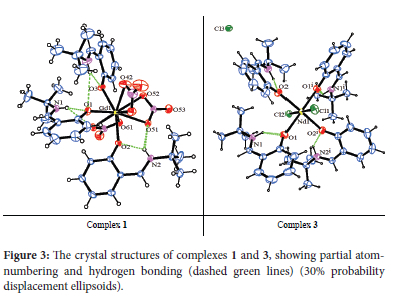
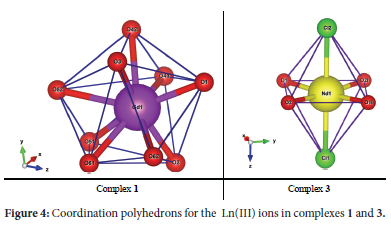
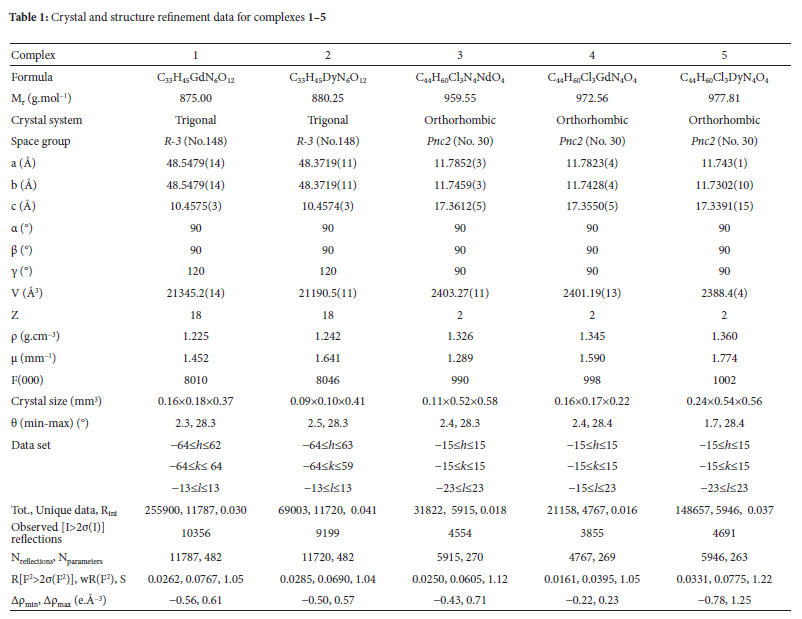
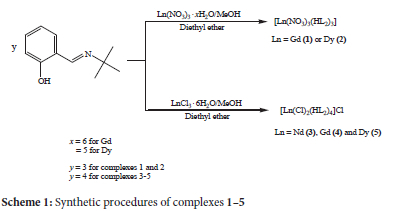
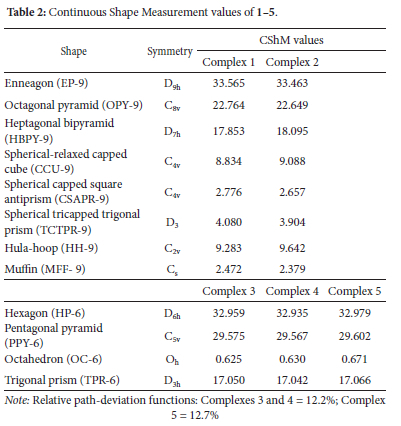
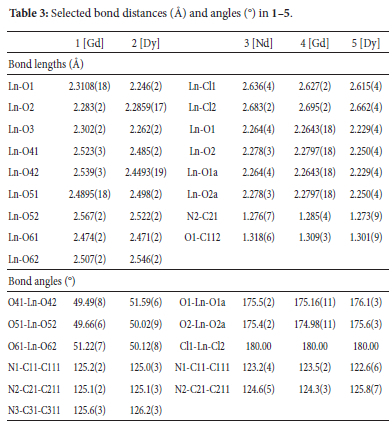
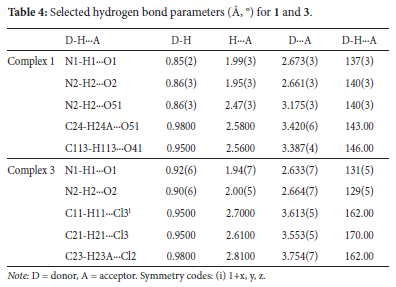
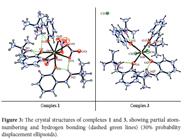
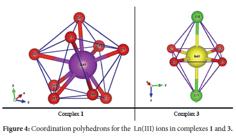
Five novel complexes were prepared by reacting 2-((E)-(tert-butylimino)methyl)phenol (HL2) with Ln(NO3)3xH2O (Ln = Gd and Dy ; x = 6 and 5, respectively) and LnCl3-6H2O (Ln = Nd, Gd and Dy). The crystal structures of the former two Ln(III) nitrate complexes are isostructural and the coordination sphere is composed of three monodentate HL2 ligands bonded to the metal centre through the phenolic oxygen atom and three nitrate ions coordinated in a bidentate fashion. Both complexes are nine-coordinate and SHAPE analysis reveals that they adopted a muffin polyhedra geometric type. The average Ln-Onitrate and Ln-Ophenolate bond lengths are 2.5059 and 2.2816 A, respectively. The complexes derived from the chloride salts exhibited an octahedral geometry with four monodentate Schiff base ligands [Ln-Ophenolate distances range from 2.229(4) to 2.2797(18) A] coordinating in the equatorial positions and two chloride ions [average Ln-Cl bond length is 2.6530 A, and average Cl-Ln-Cl angles is 180o] in axial positions. The ligand coordinated through the phenolate oxygen with the phenolic proton migrating to the imino nitrogen to give a zwitterionic form of the ligand. There are weak C-H-Cl interactions present and O-H-N hydrogen bonds are also observed in the crystal packing.
bidentate; lanthanide; monodentate; Schiff base; zwitterion
 Thumbnail
 Thumbnail
 Thumbnail
 Thumbnail