Potentiometrie and spectroscopic study of isoniazid - an anti-tubercular drug
Abstract
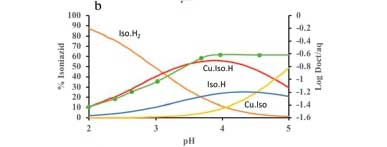
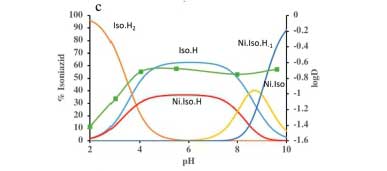
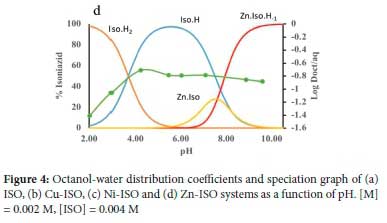
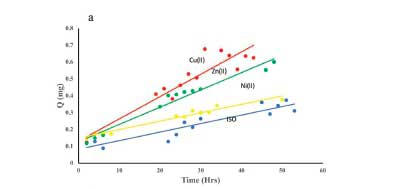
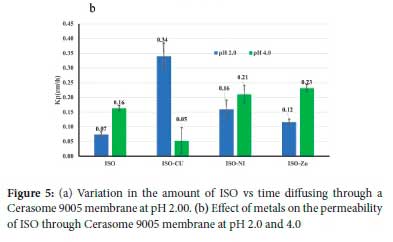
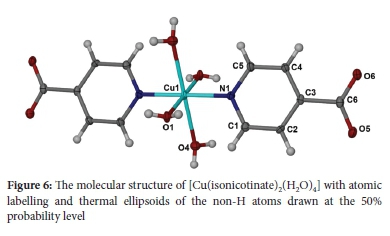
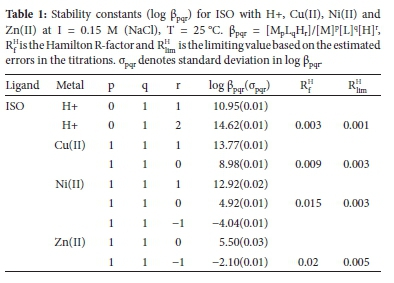
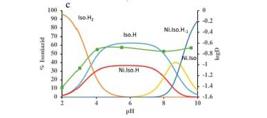
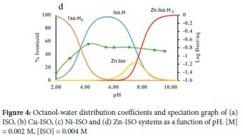
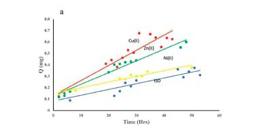
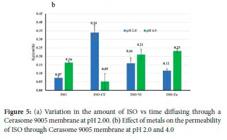
The copper, nickel and zinc complexes of isoniazid (ISO, isonicotinic acid hydrazide), an anti-tubercular drug, have been investigated to determine whether these metal-ions improve the permeability and bioavailability of the drug. Since such properties of isonazid depend on its solution speciation, the latter was investigated by determining the equilibrium constants for the reaction of H+, Cu(II), Ni(II) and Zn(II) with isonazid in aqueous solution at 25.00 ± 0.01 °C and 0.15 M (NaCl), using glass electrode potentiometry. The structure of the copper complex of isoniazid was investigated using ultraviolet-visible spectroscopy. The results support the structures postulated from the potentiometric data. This study also considered membrane permeability using a Franz cell and octanol/water distribution coefficients. Distribution coefficient studies showed that ISO and its metal complexes are hydrophilic. The incorporation of a metal-ion improves the hydrophilicity of the ligand. The presence of a metal ion greatly enhanced the permeation of ISO through an artificial membrane in the order Cu(II) > Ni(II) > Zn(II) > ISO at pH 2 and Zn(II) > Ni(II) > ISO > Cu(II) at pH 4.
permeability; potentiometric; speciation; spectroscopy; tuberculosis
 Thumbnail
 Thumbnail
 Thumbnail
 Thumbnail
 Thumbnail
 Thumbnail
 Thumbnail
 Thumbnail
 Thumbnail
 Thumbnail