Degradation of o-Chloranil Using Nanocrystalline-Cellulose/TiO2 Composites via a Solar Photocatalytic Route
Abstract
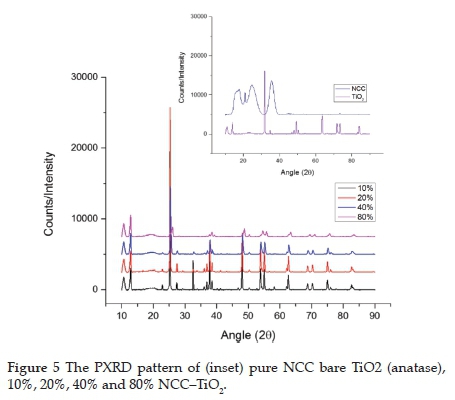
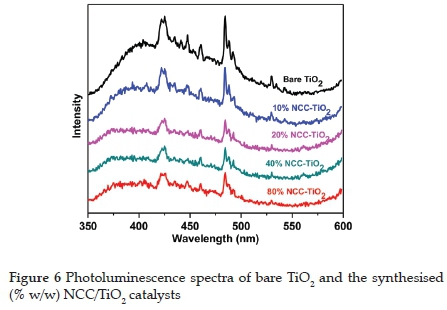
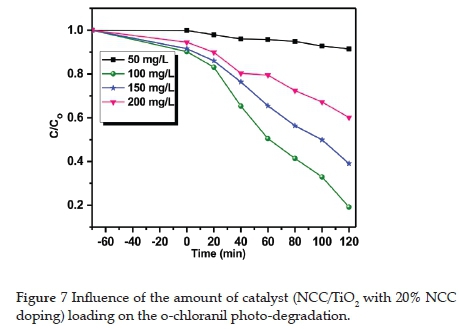
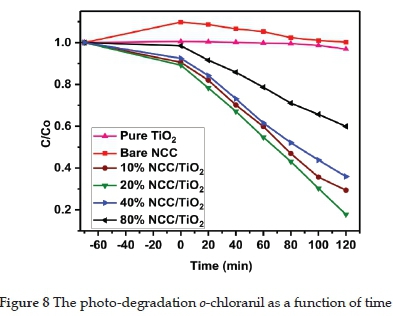
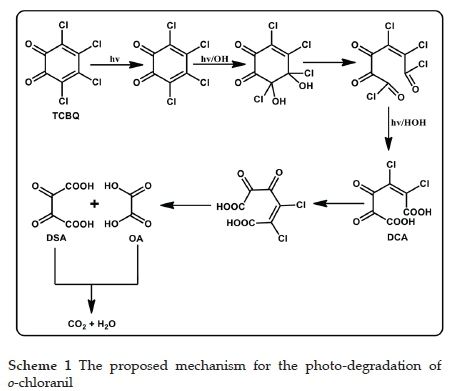
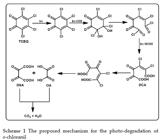
Water pollution by organic pollutants is a continuous and increasing problem of global concern. In this paper, we developed a nanocrystalline cellulose (NCC) and titania (TiO2) based nanocomposite for the photocatalytic degradation of o-chloranil via aqueous wet impregnation. Different NCC loadings (10, 20, 40, and 80%) were used, and several analytical and microscopy techniques characterised the NCC/TiO2 catalyst. The efficiency of TiO2 as a photo-catalyst was enhanced through the chiral nematic nature and potential charge carrier capacity of NCC, which lowered the rate of electron recombination. The NCC/TiO2 material was used in the solar-driven photo-degradation of o-chloranil (3,4,5,6-tetrachloro-1,2-benzoquinone), a by-product of a commonly used pesticide. The successful decomposition of o-chloranil led to the successful identification of three breakdown products, namely 2,3-dichloro-4,5-dioxohex-2-enedoic acid (DCA), 2,3-dioxosuccinic acid (DSA) and oxalic acid (OA). The 20% NCC/TiO2 catalyst was found to be optimum and showed excellent degradation and mineralisation of o-chloranil within 2 hours (~90% degradation after 2 hours or 0.00920 mols of the total 0.0102 mols). The degradation products were analysed and identified using GC-MS. The photo-catalyst offers many benefits, including ease of preparation, a low cost-factor, and high stability with no loss of activity.
nanocrystalline cellulose; o-chloroanil; photocatalyst; photo-degradation
 Thumbnail
 Thumbnail
 Thumbnail
 Thumbnail
 Thumbnail
 Thumbnail
 Thumbnail
 Thumbnail
 Thumbnail