Green synthesis of chromeno[2,3-c]pyrazoles and 4,4'-(arylmethylene)bis(1H-pyrazole-5-ols) via catalyst-free multicomponent reaction in magnetized distilled water
Abstract
An eco-friendly benign catalyst-free synthesis of chromeno[2,3-c]pyrazoles and bis-pyrazolone derivatives has been reported using magnetized distilled water (MDW). Under the optimal condition, most chromeno[2,3-c]pyrazoles (5a-f) and bis-pyrazolone (7a-k) were obtained in 85-93% and 85-95% yields respectively. This process offers several advantages, including its environmentally friendly and cost-effective nature, along with a simplified workup procedure and a high yield of desired products. Additionally, the absence of catalysts minimizes the potential for undesirable side reactions and contamination, resulting in a cleaner and more efficient synthesis process.
Chromeno[2,3-c]pyrazole; Bis-pyrazolone; Catalyst-free; Magnetized distilled water
INTRODUCTION
The multi-component reaction (MCR) is a chemical process where three or more reactants combine in a single step to form a product. This efficient method is widely used in organic synthesis for creating complex molecules. Multi-component reactions (MCRs) have recently attained significant importance because this address several constituent principles of green chemistry, such as reaction design and synthetic efficiency. Multi-component reactions have several advantages like operational atom economy, simplicity, and a decrease in the number of synthetic steps, thereby saving time and chemicals in the form of separations and purifications of intermediate compounds.1,2
In recent years, chromens had a broad range of applications. They have shown different biological and pharmacological activities such as antitumor,345-7 antifungal,8910 111213
Bis-pyrazolone derivatives are very important compounds, for example, they exhibit gastric secretion stimulatory,1415161718192021,22 These protocols, however, suffer from some disadvantages such as hard reaction conditions, and a tedious workup process.
With the general increment concern on environmental degradation, eco-friendly safe solvent-like water displays robust green chemical technology methods from the economic viewpoint. Water has many benefits, including the cleanest, cheapest, eco-friendly, nonflammable, easy work-up, and high specific heat capacity.23
Since the mid-20th century, much researches about the magnetized treatment theory have been carried out, and applied in many fields.24-26
The magnetized treatment can originate the change in pH value, density, refractive index, specific heat, vaporization enthalpy, electric dipole-moment, hydrogen bond distribution, surface zeta potential, and viscosity in water.27-33 Water magnetization is an easy method without excessive energy consumption when a constant foreign magnet is used. Such a magnet can be installed on a previously established water tube system, resulting in no additional energy required for water magnetization. Magnetized water plays an important role in the synthesis of one-pot organic compounds. In the multi-component reactions it acts as a solvent and produces tetrahydro-benzo[b] pyrans,343536373839,40 we wish to report a simple procedure for the preparation of chromeno[2,3-c]pyrazoles and bis-pyrazolones in MDW (Scheme 1).
EXPERIMENTALGeneral
The materials used in the experiment were obtained from reputable sources. The chemicals and solvents were purchased from Fluka and Merck, which are two well-known companies that produce high-quality products for scientific research. The melting point of all reported compounds was determined using a digital device that can measure the temperature at which a solid substance changes into a liquid. The device was an Electrothermal model, which is a brand of digital melting point apparatus that uses a capillary tube and a heating block. The synthesized compounds' 113
Preparation of chromeno[2,3-c]pyrazoles (5)
Hydrazine hydrate (1 mmol), ethyl acetoacetate (1 mmol), an aldehyde (1.0 mmol), and dimedone/cyclohexanedione (1.0 mmol) were stirred at 80 °C in 3 mL of MDW. After completion of the reaction, the resulting crude product was separated and recrystallized from ethanol. The crystals were collected by filtration and dried to obtain the final pro duct.
4-(2-Hydroxyphenyl)-3,7,7-trimethyl-7,8-dihydrochromeno[2,3-c]pyrazol-5(1H,4H,6H)-one (5a)
White powder solid (93% yield): mp, 194-196 °C; IR (v) (KBr) cm-1: 3300 (NH), 3075 (C-H Aromatic), 2800,3000 (C-H aliphatic), 1641 (CO). 16) δ 0.9 (s, 3H, CH3), 1.06 (s, 3H, CH3), 2.07 (s, 3H, CH3), 2.28 (s, 3H, CH2), 2.38 (s, 2H, CH2), 3.35 (s, 1H, OH), 5.07 (s, 1H, CH), 6.97-7.00 (m, 2H ArH), 7.09-7.10 (d, J = 3, 1H, ArH), 7.14-7.149 (d, J = 2.7 Hz,1H, ArH), 10.42 (br, 1H, NH). 136, 75 MHz) δ 26.6, 27.5, 28.1, 29.6, 32.0, 50.9, 111.2,115.7, 124.6, 126.0, 127.3, 129.6, 139.4, 150.1, 161.2, 165.2, 196.2; C19H20N2O3, (ESI) m/z; 324.00.
4-(3-Hydroxyphenyl)-3,7,7-trimethyl-7,8-dihydrochromeno[2,3-c]pyrazol-5(1H,4H,6H)-one (5b)
White powder solid (91% yield): mp, 110-112 °C; 13), 2.32 (s, 4H, 2CH2), 2.52 (s, 3H, CH3), 4.18 (s, 1H, OH), 5.78 (s, 1H, CH), 6.47-6.49 (m, 1H, ArH), 6.64-6.65 (d, J = 2.1 Hz, 1H, ArH), 6.76 (s, 1H, ArH), 6.85-6.86 (d, J = 1.5 Hz, 1H, ArH), 8.682 (br, 1H, NH) ppm. 1319H20N2O3, (ESI) m/z; 324.00.
4-(3-Hydroxy-4-methoxyphenyl)-3,7,7-trimethyl-7,8-dihydrochromeno[2,3-c]pyrazol-5(1H,4H,6H)-one (5c)
White powder solid (87% yield): mp, 120-122 °C; 13), δ 1.07 (s, 3H, CH3), 2.27 (s, 2H, CH2), 2.33 (s, 2H, CH2), 2.53 (s, 3H CH3), 3.73 (s, 3H, OCH3), 4.20 (s, 1H, OH), 5.8 (s, 1H, CH), 6.38-6.45 (m, 1H, ArH), 6.70 (s, 1H, ArH), 6.756.77 (d, 1H, J = 2.1 Hz, ArH), 8.68 (br, 1H, NH) ; C20H22N2O4, (ESI) m/z; 354.14.
3,7,7-Trimethyl-4-(3,4,5-trimethoxyphenyl)-7,8-dihydrochromeno[2,3-c]pyrazol-5(1H,4H,6H)-one (5d)
White powder solid (90% yield): mp, 116-118 °C; IR (v) (KBr) cm-1: 3300 (NH), 3050, 3057 (C-H Aromatic), 2800,3000 (C-H aliphatic), 1595 (CO). 1DMSO-d6) δ 1.05 (s, 6H, CH3), 2.15 (s, 4H, 2CH2), 2.25 (s, 1H, CH3), 3.63 (s, 9H, CH3), δ 5.49 (s, 1H, CH), 6.36 (s, 2H, ArH), 11.92 (br, 1H, NH). 1322H26N2O5, (ESI) m/z; 398.18.
4-(2-Hydroxyphenyl)-3-methyl-7,8-dihydrochromeno[2,3-c] pyrazol-5(1H,4H,6H)-one (5e)
White powder solid (85% yield): mp, 238-240 °C; IR (v) (KBr) cm-1: 3300 (NH), 3050, 3075 (C-H Aromatic), 2800, 3000 (C-H aliphatic), 1645 (CO). 12), 1.81-1.85 (t, J = 6.9 Hz, 2H, CH2), 1.93-1.95 (t, J = 5.4 Hz, 2H, CH2), 2.37 (s, 3H, CH3), 3.37 (s, 1H, OH), 5.09 (s, 1H, CH), 6.94-6.97 (d, J = 7.8 Hz, 2H, ArH), 6.99-7.00 (d, J = 3.9 Hz, 1H, ArH), 7.08-7.10 (m, 1H, ArH), 7.12-7.14 (m, 1H, ArH), 10.48 (s, 1H, NH). 1317H16N2O3, (ESI) m/z; 296.12.
3-Methyl-4-p-tolyl-7,8-dihydrochromeno[2,3-c]pyrazol-5(1H,4H,6H)-one (5f)
White powder solid (80% yield): mp, 192-194 °C; 12), 2.36-2.40 (t, J = 6.6 Hz, 2H, CH2), 2.42-2.45 (t, J = 6.6 Hz, 2H, CH2), 2.98 (s, 3H, CH3), 4.28 (s, 1H, CH), 5.72 (s, 1H, CH), 6.86-6.86 (d, J = 1.5 Hz, 2H, ArH), 6.93-6.96 (d, J = 8.9 Hz, 1H, ArH), 7.01-7.03 (d, J = 6 Hz, 1H, ArH), 7.07.7.09 (d, J = 6 Hz, 1H, ArH), 9.97 (s, 1H, NH) ppm. 13
Preparation of bis-pyrazolones (7)
A mixture of 5- methyl-2-phenyl-2,4-dihydro-3H-pyrazol-3-one (2.0 mmol), and an aldehyde (1.0 mmol), were stirred at 80 °C in 3 mL of MDW. At the end of the reaction, the resulting solid was separated by simple filtration and recrystallized from ethanol.
4-(2,4-dichlorophenyl)(5-hydroxy-3-methyl-1-phenyl-1H-pyrazol-4-yl)methyl)-3-methyl-1-phenyl-1H-pyrazol-5-ol (7c)
White powder solid (85% yield): mp, 227-229 °C; 13), 5.11 (s, 1H, CH), 7.24-7.29 (t, 3H, J = 6, ArH), 7.41-7.48 (m, 5H, ArH), 7.570-7.577 (t, 1H, J = 1 Hz, ArH), 7.70 (s, 1H, CH, ArH), 7.72-7.73 (d, 2H, J = 4.5, ArH), 7.75-7.78 (d, 1H, J = 3, ArH), 12.61 (s, 1H, OH), 13.83 (s, 1H, OH).
4-((5-hydroxy-3-methyl-1-phenyl-1H-pyrazol-4-yl) (2-methoxyphenyl)methyl)-3-methyl-1-phenyl-1 H-pyrazol-5-ol (7i)
White powder solid (85% yield): mp, 209-211 °C; 13), 3.38 (s, 3H, OCH3), 5.20 (s, 1H, CH, 6.86-6.91 (m, 1H, ArH), 6.94-6.97 (m, 1H, ArH), 7.26-7.28 (t, 1H, J = 2Hz, ArH), 7.42-7.48 (t, 5H, J = 4.5, ArH), 7.61-7.63 (d, 2H, J = 3, ArH), 7.70-7.73 (d, 4H, J = 3, ArH), 12.64 (s, 1H, OH), 14.39 (s, 1H, OH).
RESULTS AND DISCUSSION
MDW was prepared similarly to a previous method reported in a scientific paper.36
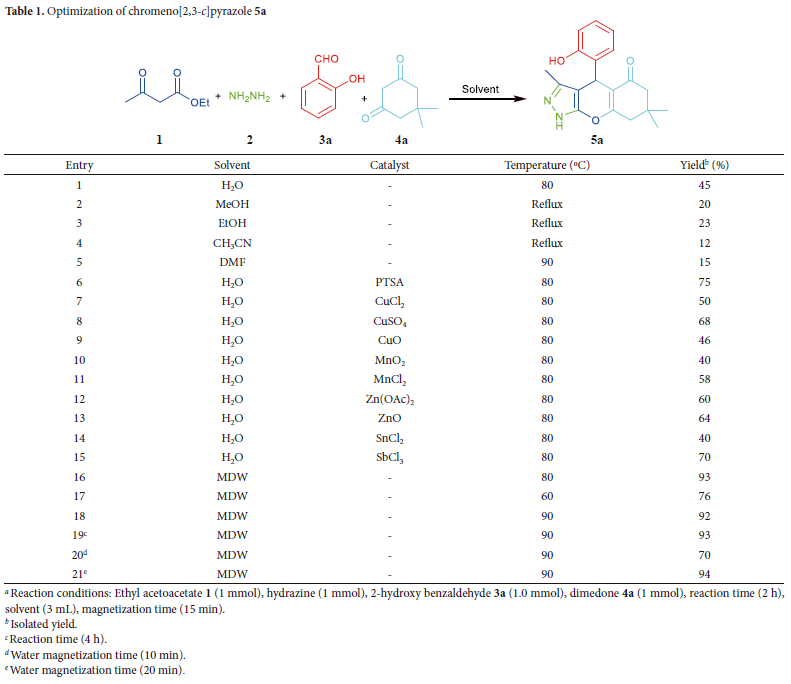
The evaluation of various solvents and catalysts for the preparation of chromeno[2,3-c]pyrazole 5a is described in Table 1. First, the reaction was carried out without a catalyst in the solvents such as H2O, MeOH, EtOH, CH3CN, and DMF (Table 1). We observed the superior solvent was H2O (Table 1, entry 1). Then, different catalysts such as £-toluenesulfonic acid (PTSA), CuCl2, CuSO4, CuO, MnO2, MnCl2, Zn (OAc)2, ZnO, SnCl2, and SbCl3 in water were used to increase the reaction yield. According to Table 1, a higher reaction yield was obtained with the PTSA catalyst (Table 1, entry 6). Interestingly, when the multi-component reaction was carried out in the absence of a catalyst in MDW, an excellent yield (93%) was obtained (Table 1, entry 16). When the reaction was performed at various temperatures ranging from 60 °C to 90 °C; an excellent reaction yield (93%) was obtained at 80 °C. Increasing the reaction temperature, and the reaction time did not affect the reaction yield (Table 1, entries 18, and 19 respectively). According to Table 1, decreasing the water magnetization time resulted in the low formation of chromeno[2,3-c]pyrazole 5a (Table 1, entry 20). However, high product formation was not observed with increasing the water magnetization time (Table 1, entry 21).
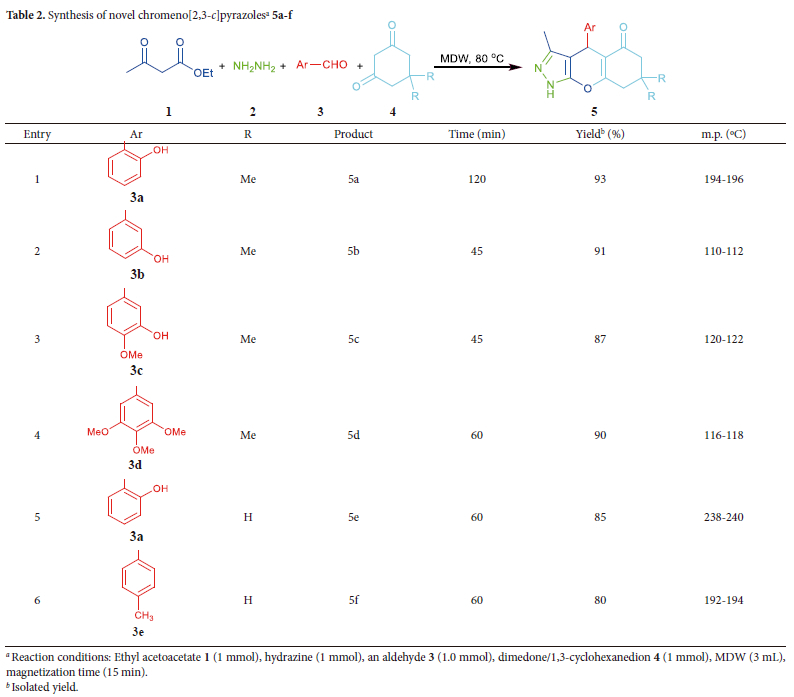
Upon establishing the optimized reaction conditions, the methodology was extended by utilizing different substrates to access desired novel chromeno[2,3-c]pyrazoles (Table 2). According to Table 2, the reactions of various aldehydes, led to chromeno[2,3-c]pyrazoles 5 in high-to-excellent yields (80-93%). Moreover, a bulky aldehyde 3,4,5-trimethoxybenzaldehyde afforded the chromeno[2,3-c]pyrazole 5d an excellent yield (Table 2, entry 4).
Toledo et al.41via a theoretical and experimental method. They have explained that the being of competition among the intra- and inter-molecular hydrogen bond lattices in water, diminish the powerful intra-cluster hydrogen bonds, breaks the big clusters, and forms the smaller ones with stronger inter-cluster hydrogen bonds. Thus, the numeral of hydrogen bonds between the MDW molecules and the reacting molecules enhanced. In addition, recently, we described the synthesis of 9-substituted-9H-diuracilopyrans from the reaction of barbituric acids with aldehydes in MDW as a solvent.35 5 from ethyl acetoacetate, hydrazine, an aldehyde, and 1,3-diketone 4 in MDW is shown in Scheme 2.
The synthesis of chromeno[2,3-c]pyrazole 5 was successfully achieved through a well-defined five-step reaction sequence. The initial step involved the condensation of ethyl acetoacetate I and hydrazine II, resulting in the formation of pyrazolone III. Subsequently, the pyrazolone III ring system was converted to its corresponding enolate IV in the presence of magnetized distilled water (MDW), which played a crucial role in promoting enolate formation. Also, MDW plays a major role in its promoting activity for the formation of intermediate V, which is readily prepared in situ by the Knoevenagel condensation of aldehyde 3 with the highly active CH acidic diketone 4. Finally, the Michael-type addition of 3-methyl-1H-pyrazol-5(4H)-one IV to intermediate V followed by cyclization and tautomerization yielded chromeno[2,3-c]pyrazoles 5.
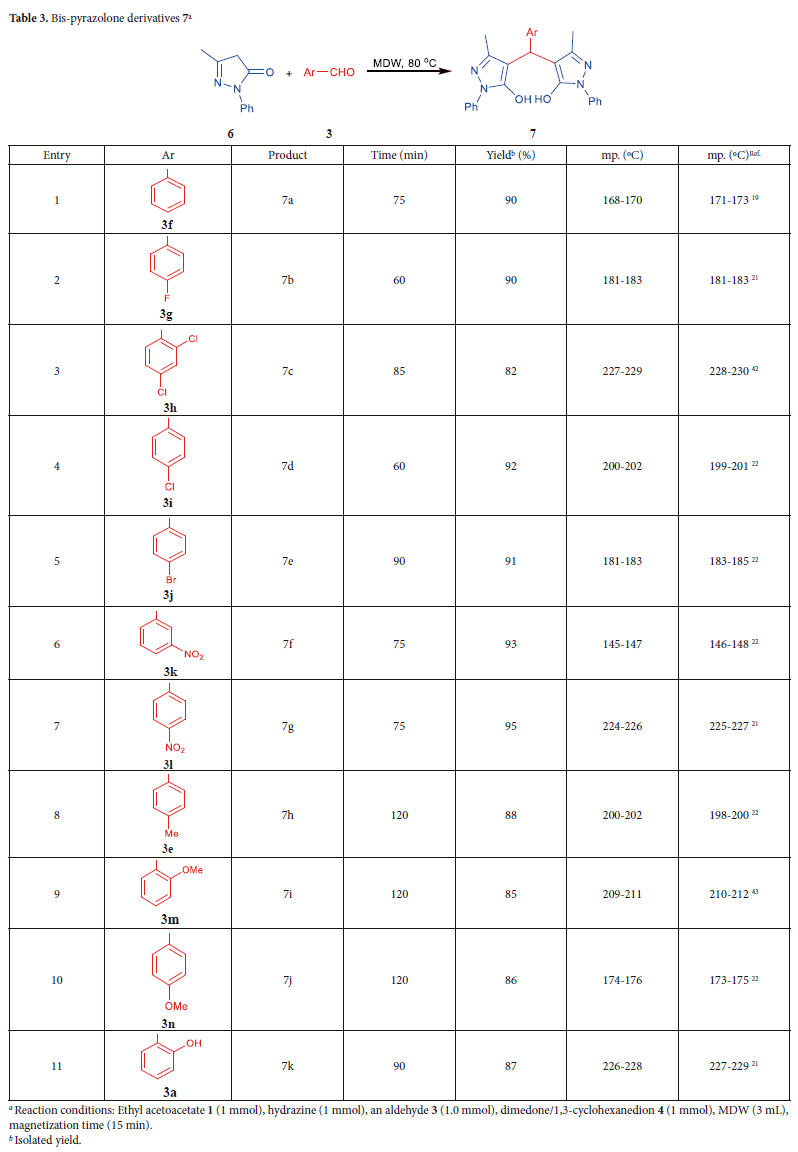
The results have shown the use of MDW as a suitable solvent for the preparation of chromeno[2,3-c]pyrazole derivatives. Therefore, we investigated the synthesis of bis-pyrazolone derivatives from the reaction of an aldehyde 3 with 3-methyl-1-phenyl-1H-pyrazole-5(4H)-one 6 in MDW (Table 3). As shown in Table 3, different aldehydes underwent the reaction to give the corresponding 4,4'- (aryl methylene)bis(1H-pyrazole-5-ols) in high to excellent yields. Aldehydes with electron receptor groups including NO2, F, and Cl provided the corresponding bis-pyrazolones in excellent yields (Table 3, entries 2-7). However, the yield of the product was slightly decreased with 4-methyl benzaldehyde, 2-methoxy benzaldehyde, 4-methoxy benzaldehyde, and 2-hydroxy benzaldehyde (Table 3, entries 8-11). In this reaction, the Knoevenagel condensation takes place between pyrazole (nucleophile) and aldehyde (electrophile). Therefore, electron donating groups on aldehyde reduce the electrophilic property of aldehyde and as a result, the reaction yield decreases.
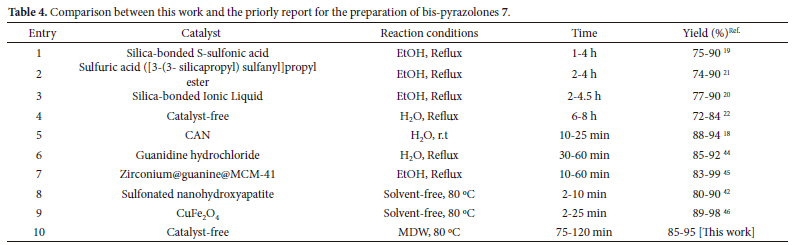
Table 4 compares the efficiency of MDW as a green solvent with some reported methods in the bis-pyrazolones 7 syntheses. As the table shows, this method has high efficiency in the synthesis of products 7.
CONCLUSIONS
In conclusion, this study demonstrates a successful catalyst-free, green synthesis of chromeno[2,3-c]pyrazoles and bis-pyrazolone derivatives using magnetized distilled water as a solvent. The newly developed method utilizing MDW as the solvent, without the need for a catalyst, demonstrated remarkable results. At a temperature of 80 °C, the reaction yielded 85-95% of the desired products within a time frame of 75-120 minutes. This approach exhibits favorable results in terms of both yield and reaction time compared to alternative methods. The information presented in the Table 4, suggests that the employment of MDW as a solvent offers an efficient and environmentally friendly approach for synthesizing bis-pyrazolone compounds. This method proves to be competitive, if not superior, in terms of yield and reaction time when compared to most other reported methods. Furthermore, it provides a greener alternative to methods involving the use of catalysts or less environmentally friendly solvents like ethanol. Moreover, the high reaction yields and reduced energy consumption further highlight the potential of this technique for widespread adoption in the field.
SUPPLEMENTARY MATERIAL
Supplementary information for this article is provided in the online supplement.
ORCID IDSMohammad Bakherad: https://orcid.org/0000-0003-3139-2249
Ali Keivanloo: https://orcid.org/0000-0003-1430-7399
Mahsa Abedi Bajestani: https://orcid.org/0009-0004-7115-9948
Amin Rezaeifard: https://orcid.org/0000-0003-2323-9498
ACKNOWLEDGMENTS
We wish to express our thanks to the research council of the Shahrood University of Technology for the financial support of this work.
REFERENCES
-
1. Li CJ. Organic reactions in aqueous media with a focus on carbon-carbon bond formations: A decade update. Chem. Rev. 2005;105(8):3095-3166. https://doi.org/10.1021/cr030009u.
» https://doi.org/10.1021/cr030009u -
2. Narayan S, Muldoon J, Finn MG, Fokin VV, Kolb HC, Sharpless KB. "On water": unique reactivity of organic compounds in aqueous suspension. Angew. Chem. Int. Ed. 2005;44(21):3275-3279. https://doi.org/10.1002/anie.200462883.
» https://doi.org/10.1002/anie.200462883 -
3. Kidwai M, Saxena S, Rahman Khan MK, Thukral SS. Aqua mediated synthesis of substituted 2-amino-4H-chromenes and in vitro study as antibacterial agents. Bioorg. Med. Chem. Lett. 2005;15(19):4295-4298. https://doi.org/10.1016/j.bmcl.2005.06.041.
» https://doi.org/10.1016/j.bmcl.2005.06.041 -
4. Rueping M, Sugiono E, Merino E. Asymmetric organocatalysis: an efficient enantioselective access to benzopyranes and chromenes. Chem. Eur. J. 2008;14(21):6329-6332. https://doi.org/10.1002/chem.200800836.
» https://doi.org/10.1002/chem.200800836 -
5. Wang JL, Liu D, Zhang ZJ, Shan S, Han X, Srinivasula SM, Croce CM, Alnemri ES, Huang Z. Structure-based discovery of an organic compound that binds Bcl-2 protein and induces apoptosis of tumor Cells. Acad. Sci. U. S. A. 2000;97(13):7124-7129. https://doi.org/10.1073/pnas.97.13.7124.
» https://doi.org/10.1073/pnas.97.13.7124 - 6. El-Saghier AM, Naili MB, Rammash BK, Saleh NA, Kreddan KM. Synthesis and antibacterial activity of some new fused chromenes. Arkivoc, xvi. 2007;16:83-91.
-
7. Kumar RR, Perumal S, Senthilkumar P, Yogeeswari P, Sriram D. An atom efficient, solvent-free, green synthesis and antimycobacterial evaluation of 2-amino-6-methyl-4-aryl-8-[(E)-arylmethylidene]-5,6,7,8-tetrahydro-4H-pyrano[3,2-c]pyridine-3-carbonitriles. Bioorg. Med. Chem. Lett. 2007;17(23):6459-6462. https://doi.org/10.1016/j.bmcl.2007.09.095.
» https://doi.org/10.1016/j.bmcl.2007.09.095 -
8. Bhatia Raj T, Bhatia RK, Sharma M, Saxena AK, Ishar MP. Cytotoxic activity of 3-(5-phenyl-3H-[1,2,4]dithiazol-3-yl)chromen-4-ones and 4-oxo-4if-chromene-3-carbothioic acid N-phenylamides. Eur. J. Med. Chem. 2010;45(2):790-794. https://doi.org/10.1016/j.ejmech.2009.11.001.
» https://doi.org/10.1016/j.ejmech.2009.11.001 -
9. Moon DO, Kim KC, Jin CY, Han MH, Park C, Lee KJ, Park YM, Choi YH, Kim GY. Inhibitory effects of eicosapentaenoic acid on lipopolysaccharide-induced activation in BV2 microglia. Int. Immunopharmacol. 2007;7(2):222-229. https://doi.org/10.1016/j.intimp.2006.10.001.
» https://doi.org/10.1016/j.intimp.2006.10.001 -
10. Rashad AE, Hegab MI, Abdel-Megeid RE, Micky JA, Abdel-Megeid FME. Synthesis and antiviral evaluation of some new pyrazole and fused pyrazolopyrimidine derivatives. Bioorg. Med. Chem. 2008;16(15):7102-7106. https://doi.org/10.1016/j.bmc.2008.06.054.
» https://doi.org/10.1016/j.bmc.2008.06.054 -
11. Alegaon SG, Alagawadi KR, Garg MK, Dushyant K, Vinod D. 1,3,4-Trisubstituted pyrazole analogues as promising anti-inflammatory agents. Bioorg. Chem. 2014;54:51-59. https://doi.org/10.1016/j.bioorg.2014.04.001.
» https://doi.org/10.1016/j.bioorg.2014.04.001 -
12. Bailey DM, Hansen PE, Hlavac AG, Baizman ER, Pearl J, DeFelice AF, Feigenson ME. 3,4-Diphenyl-1H-pyrazole-1-propanamine antidepressants. I. Med. Chem. 1985;28(2):256-260. https://doi.org/10.1021/jm00380a020.
» https://doi.org/10.1021/jm00380a020 -
13. Kamal A, Shaik AB, Jain N, Kishor C, Nagabhushana A, Supriya B, Bharath Kumar G, Chourasiya SS, Suresh Y, Mishra RK, Addlagatta A. Design and synthesis of pyrazole-oxindole conjugates targeting tubulin polymerization as new anticancer agents. Eur. J. Med. Chem. 2015;92:501-513. https://doi.org/10.1016/j.ejmech.2013.10.077.
» https://doi.org/10.1016/j.ejmech.2013.10.077 -
14. Rosiere CE, Grossman MI. An analog of histamine that stimulates gastric acid secretion without other actions of histamine. Science. 1951;113(2945):651. https://doi.org/10.1126/science.113.2945.65La.
» https://doi.org/10.1126/science.113.2945.65La -
15. Sugiura S, Ohno S, Ohtani O, Izumi K, Kitamikado T, Asai H, Kato K, Hori M, Fujimura H. Syntheses and antiinflammatory and hypnotic activity of 5-alkoxy-3-(N-substituted carbamoyl)-1-phenylpyrazoles. J. Med. Chem. 1977; 20(1):80-85. https://doi.org/10.1021/jm00211a016.
» https://doi.org/10.1021/jm00211a016 -
16. Acharya BN, Saraswat D, Tiwari M, Shrivastava AK, Ghorpade R, Apna S, Kaushik MP. Synthesis and antimalarial evaluation of 1, 3, 5-trisubstituted pyrazolines. Eur. J. Med. Chem. 2010;45(2):430-438. https://doi.org/10.1016/j.ejmech.2009.10.023.
» https://doi.org/10.1016/j.ejmech.2009.10.023 -
17. McDonald E, Jones K, Brough PA, Drysdale MJ, Workman P. Discovery and development of pyrazole-scaffold hsp 90 inhibitors. Curr. Top. Med. Chem. 2006;6(11):1193-1203. https://doi.org/10.2174/156802606777812086.
» https://doi.org/10.2174/156802606777812086 -
18. Sujatha K, Shanthi G, Selvam NP, Manoharan S, Perumal PT, Rajendran M. Synthesis and antiviral activity of 4,4'-(arylmethylene)bis(1H-pyrazol-5-ols) against peste des petits ruminant virus (PPRV). Bioorg. Med. Chem. Lett. 2009;19(15):4501-4503. https://doi.org/10.1016/j.bmcl.2009.02.113.
» https://doi.org/10.1016/j.bmcl.2009.02.113 -
19. Niknam K, Saberi D, Sadegheyan M, Deris A. Silica-bonded S-sulfonic acid: an efficient and recyclable solid acid catalyst for the synthesis of 4,4'-(arylmethylene)bis(1H-pyrazol-5-ols). Tetrahedron Lett. 2010;51(4):692-694. https://doi.org/10.1016/j.tetlet.2009.11.114.
» https://doi.org/10.1016/j.tetlet.2009.11.114 -
20. Baghernejad M, Niknam K. Synthesis of 4,4'-(arylmethylene)bis(1H-pyrazol-5-ols) using silica-bonded ionic liquid as recyclable catalyst. Int. J. Chem. 2012;4(3):52-60. http://dx.doi.org/10.5539/ijc.v4n3p52
» http://dx.doi.org/10.5539/ijc.v4n3p52 -
21. Tayebi S, Baghernejad M, Saberi D, Niknam K. Sulfuric acid ([3-(3-silicapropyl)sulfanyl]propyl)ester as a recyclable catalyst for the synthesis of 4,4'-(arylmethylene)bis(1H-pyrazol-5-ols). Chin. J. Catal. 2011;32(9-10):1477-1483. https://doi.org/10.1016/S1872-2067(10)60260-4.
» https://doi.org/10.1016/S1872-2067(10)60260-4 -
22. Tale NP, Tiwari GB, Karade NN. Un-catalyzed tandem Knoevenagel-Michael reaction for the synthesis of 4,4'-(arylmethylene)bis(1H-pyrazol-5-ols) in aqueous medium. Chin. Chem. Lett. 2011;22(12):1415-1418. https://doi.org/10.1016/j.cclet.2011.09.004.
» https://doi.org/10.1016/j.cclet.2011.09.004 -
23. Sheldon RA. Selective catalytic synthesis offine chemicals: opportunities and trends. J. Mol. Catal. 1996;107(1-3):75-83. https://doi.org/10.1016/1381-1169(95)00229-4.
» https://doi.org/10.1016/1381-1169(95)00229-4 - 24. Ding Zhen-Rui, Zhao Ya-Jun, Chen Feng-Ling, Chen Jin-Zhong, Duan Shu-Xing. Magnetization mechanism of magnetized water. Acta Phys. Sin. 2011;60(6):064701.
-
25. Zhou Q, Qin B, Wang F, Wang H. Experimental investigation on the performance of a novel magnetized apparatus used to improve the dust suppression ability of surfactant-magnetized water. Powder Technol., 2019;354:149-157. https://doi.org/10.1016/j.powtec.2019.05.081.
» https://doi.org/10.1016/j.powtec.2019.05.081 -
26. Deng B, Pang XF. Variations of optic properties of water under action of static magnetic field. Chin. Sci. Bull. 2007;52(23):3179-3182. https://doi.org/10.1007/s11434-007-0430-7.
» https://doi.org/10.1007/s11434-007-0430-7 - 27. Baran B, Berezyuk O, Golonzhka V. Water systems after magnetic field action. Env. Res. Eng. Manag. 2006;38(4):19-23.
-
28. Gang N, St-Pierre LS, Persinger M. Water dynamics following treatment by one hour 0.16 tesla static magnetic fields depend on exposure volume, Water 2012;3:122-131. https://doi.org/10.14294/WATER.2011.10.
» https://doi.org/10.14294/WATER.2011.10 -
29. Higashitani K, Oshitani J, Ohmura N. Effects of Magnetic field on water investigated with fluorescent probes. Coll. Surf. A: Phys. Engin. Asp. 1996;109(2-3):167-173. https://doi.org/10.1016/0927-7757(95)03483-8.
» https://doi.org/10.1016/0927-7757(95)03483-8 -
30. Chang KT, Weng CI. The effect of an external magnetic field on the structure of liquid water using molecular dynamics simulation. J. Appl. Phys. 2006;100(4):043917-043923. https://doi.org/10.1063/L2335971
» https://doi.org/10.1063/L2335971 -
31. Guo YZ, Yin DC, Cao HL, Shi JY, Zhang CY, Liu YM, Huang HH, Liu Y, Wang Y, Guo WH, Qian AR, Evaporation rate of water as a function of a magnetic field and field gradient. Inter. J. Mol. Sci. 2012;13(12):16916-16928. https://doi.org/10.3390/ijms131216916.
» https://doi.org/10.3390/ijms131216916 -
32. Wang Q, Li L, Chen G, Yang Y. Effects of magnetic field on the sol-gel transition of methylcellulose in water. Carbohydr. Polym. 2007;70(3):345-349. https://doi.org/10.1016/jxarbpol.2007.04.006.
» https://doi.org/10.1016/jxarbpol.2007.04.006 -
33. Esmaeilnezhad E, Choi HJ, Schaffie M, Gholizadeh M, Ranjbar M. Characteristics and applications of magnetized water as a green technology. J. Clean. Prod. 2017;161:908-921. https://doi.org/10.1016/j.jclepro.2017.05.166.
» https://doi.org/10.1016/j.jclepro.2017.05.166 -
34. Bakherad M, Moosavi F, Keivanloo A, Doosti R, Moradian E, Armaghan M. Catalyst-free green synthesis of tetrahydro-benzo[b]pyrans in magnetized water: experimental aspects and molecular dynamics simulation. Res. Chem. Intermed. 2019;45(5):2981-2897. https://doi.org/10.1007/s11164-019-03774-8.
» https://doi.org/10.1007/s11164-019-03774-8 -
35. Bakherad M, Moosavi-Tekyeh Z, Keivanloo A, Gholizadeh M, Toozandejani Z. A catalyst-free and green method for synthesis of 9-substituted-9H-diuracilopyrans in magnetized water: experimental aspects and molecular dynamics simulation. Res. Chem. Intermed. 2018;44(1):373-387. https://doi.org/10.1007/s11164-017-3109-y.
» https://doi.org/10.1007/s11164-017-3109-y -
36. Bakherad M, Keivanloo A, Gholizadeh M, Doosti R, Javanmardi M. Using magnetized water as a solvent for a green, catalyst-free, and efficient protocol for the synthesis of pyrano[2,3-c]pyrazoles and pyrano[4',3':5,6] pyrazolo [2,3-d]pyrimidines. Res. Chem. Intermed. 2017;43(2):1013-1029. https://doi.org/10.1007/s11164-016-2680-y.
» https://doi.org/10.1007/s11164-016-2680-y -
37. Bakherad M, Doosti R, Keivanloo A. Gholizadeh M, Jadidi K. Rapid, green, and catalyst-free one-pot three-component syntheses of 5-substituted 1h-tetrazoles in magnetized water. J. Iran. Chem. Soc. 2017;14(12):2591-2597. https://doi.org/10.1007/s13738-017-1193-y.
» https://doi.org/10.1007/s13738-017-1193-y -
38. Emamdadi N, Gholizadeh M, Housaindokht MR. The effect of magnetized water on the oxidation reaction of phenol derivatives and aromatic amines by horseradish peroxidase enzyme. Biotech. Prog. 2020;36(6):e3035-e3049. https://doi.org/10.1002/btpr.3035.
» https://doi.org/10.1002/btpr.3035 -
39. Bakherad M, Doosti R, Keivanloo A, Gholizadeh M, Amin A.H. A new, simple, catalyst-free method for the synthesis of pyrazolopyrano-pyrimidines in magnetized water. Lett. Org. Chem. 2017;14(7):510-516. https://doi.org/10.2174/1570178614666170511170329.
» https://doi.org/10.2174/1570178614666170511170329 -
40. Bakherad M, Bagherian GA, Rezaeifard A, Mosayebi F, Shokoohi B, Keivanloo A. Synthesis of pyrano[2,3-d]pyrimidines and pyrido[2,3-d] pyrimidines in the magnetized deionized water based on UV-visible study. I. Iran. Chem. Soc. 2021;18(4):839-852. https://doi.org/10.1007/s13738-020-02073-z.
» https://doi.org/10.1007/s13738-020-02073-z -
41. Toledo EJ, Ramalho TC, Magriotis ZM. Influence of magnetic field on physical-chemical properties of the liquid water: Insights from experimental and theoretical models. J. Mol. Struct. 2008;888(1-3):409-415. https://doi.org/10.1016/j.molstruc.2008.01.010.
» https://doi.org/10.1016/j.molstruc.2008.01.010 -
42. Zarghani M, Akhlaghinia B. Sulfonated nanohydroxyapatite functionalized with 2-aminoethyl dihydrogen phosphate (HAP@AEPH2-SO3H) as a new recyclable and eco-friendly catalyst for rapid one-pot synthesis of 4,4'-(aryl methylene)bis(3-methyl-1H-pyrazol-5-ol)s. RSC Adv. 2015;5(107):87769-87780. https://doi.org/10.1039/C5RA16236J.
» https://doi.org/10.1039/C5RA16236J -
43. Phatangare K.R, Padalkar VS, Gupta VD, Patil VS, Umape PG, Sekar N. Phosphomolybdic acid: an efficient and recyclable solid acid catalyst for the synthesis of 4,4'-(arylmethylene)bis(1H-pyrazol-5-ols). Synth. Commun. 2012;42(9):1349-1358. https://doi.org/10.1080/00397911.2010.539759.
» https://doi.org/10.1080/00397911.2010.539759 -
44. Noruzian F, Olyaei A, Hajinasiri R, Sadeghpour M. Guanidine hydrochloride catalyzed efficient one-pot pseudo five-component synthesis of 4,4'-(arylmethylene)bis(1H-pyrazol-5-ols) in water. Synth. Commun. 2019;49(20):2717-2724. https://doi.org/10.1080/00397911.2019.1643483.
» https://doi.org/10.1080/00397911.2019.1643483 -
45. Nikoorazm M, Mohammadi M, Khanmoradi M. Zirconium@guanine@ MCM-41 nanoparticles: An efficient heterogeneous mesoporous nanocatalyst for one-pot, multi-component tandem Knoevenagel condensation-Michael addition-cyclization Reactions. Appl. Organomet. Chem. 2020;34(8):e5704. https://doi.org/10.1002/aoc.5704.
» https://doi.org/10.1002/aoc.5704 -
46. Khalifeh R, Shahimoridi R, Rajabzadeh M. Design and synthesis of novel cage like CuFe2O4 hollow nanostructure as an efcient catalyst for synthesis of 4,4'-(aryl methylene)bis(3-methyl-1H-pyrazol-5-ol)s. Cat. Lett. 2019;149(10):2864-2872. https://doi.org/10.1007/s10562-019-02818-3.
» https://doi.org/10.1007/s10562-019-02818-3
Revised 19 June 2023
Accepted 13 October 2023