Occurrence and Fate of Amoxicillin and Penicillin G Antibiotics in Hospital Wastewater Treatment Plants: A Case Study - Gonbad Kavous, Iran
Abstract
Release of antibiotics to the environment as a result of wastewater effluent discharge is a cause for concern worldwide, as they pose a potential threat to human health and the earth ecosystem. Penicillin and amoxicillin are widely used antibiotics. Despite their rapid hydrolysis in aqueous matrices, their presence in the environment is widely investigated. The current study reported and analysed the current state of four hospital wastewater treatment plants (WWTPs) in Gonbad Kavous, Iran, during 2019, from the perspective of amoxicillin and penicillin G removals. WWTPs were sampled at various stages of the treatment process to determine at which stage the antibiotics are being removed. Concentrations of amoxicillin and penicillin G in raw wastewater, analysed by HPLC, varied from 0.35 to 1.02 and 0.02-0.31 /AgL-1, respectively. These values reduced in the final effluent, corresponding to overall efficiency in removing the studied antibiotics of 20-60.5%. Anaerobic processes (i.e. septic tank) slightly outperformed aerobic biological processes for both antibiotics' removal, and penicillin G was removed more efficiently than amoxicillin. Effects of wastewater physicochemical properties, including chemical oxygen demand (COD), biochemical oxygen demand (BOD), and total suspended solids (TSS) on antibiotics removal, were also studied. Whereas statistically significant correlations were noticed between COD, amoxicillin and penicillin G removals, their decline showed no correlation with TSS removal. Our study shows that despite the deployment of treatment plants, a considerable amount of antibiotics is released into receiving water bodies, resulting in significant amounts of these pharmaceuticals entering the environment. There is abundant room for further progress in the detection and quantification of pharmaceuticals and other emerging contaminants in hospital wastewaters and their metabolites and biodegradation products.
amoxicillin; penicillin G; high-performance liquid chromatography; hospital wastewater treatment plants; removal
1. Introduction
In recent years special attention has been paid to the existence of refractory emerging contaminants (RECs) in wastewaters, groundwater and surface waters. Emerging contaminants refer to unregulated pollutants which are scrutinised for future regulation. These chemicals are persistent in the environment and have detrimental effects on the aquatic ecosystem.1234 5-7 Statistically, global consumption of antibiotics has increased up to >30%.8,9 Previous studies have shown that the rate of antibiotics consumption in Iran is three times more than their global average.10,11 Based on different studies, amoxicillin (AMX), ampicillin, metronidazole, erythromycin, and tetracycline are the most common antibiotics used in Iran's hospitals.12,13 The serum penicillin G (PEN G) and AMX have half-lives of 4.1 days and 61.3 minutes, respectively.14
A high proportion of prescribed antibiotics are excreted in the urine (55-80%) and faeces (4-30%) in the form of un-metabolised substances, metabolites, or conjugated with inactivating substances.4967-3-10-6 mgL-1), which is considerably smaller than macro pollutants, such as 5-day BOD (BOD5), COD and nitrogen, among others, which the conventional WWTPs plants are designed for and operation is based on.615
At present, several physicochemical and biological methods, such as conventional activated sludge (CAS),161718195, COD and TSS were also analysed in the influent and effluent to determine their possible effects on antibiotics removal.
2. Experimental
2.1. Sampling sites and wastewater treatment plants properties
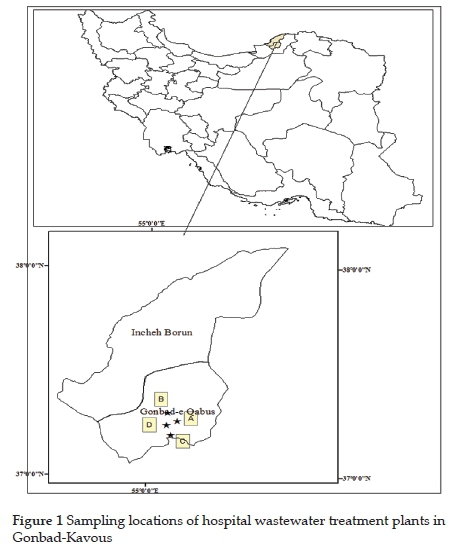
Gonbad Kavous is located in Golestan Province, northeast of Iran, near the Caspian sea, with an approximate area of 2059 ha and an estimated population of 151910 in 2017. The county consists of two districts and has two cities: Incheh Borun and Gonbad-e Qabus (Fig. 1).
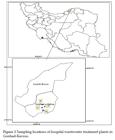
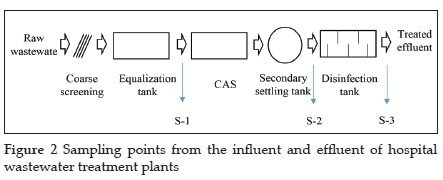
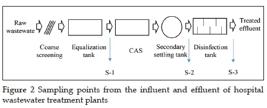
Samples were taken at different stages of the treatment process in four selected hospitals. Three hospitals are general teaching hospitals under the auspices of Gorgan University of Medical Sciences, and one is private. The university hospitals are medium-sized, with 96-140 beds. The private hospital is also small-sized with 50 beds. Three stages of the treatment process were considered for sampling: Influent following coarse screening and equalisation tank (S1), secondary biological treatment effluent (S2), and the final effluent after disinfection process (S3) (Fig. 2). Samples were collected during autumn 2019 (twice each month; n = 76). In the university/ governmental hospitals (A, B and C), conventional activated sludge (CAS) processes are applied with respective treatment capacities of 1.7, 1.7, and 2 m3-1. However, a septic tank with a treatment capacity of 1.5 m3-1 is used to treat wastewater in the private hospital (D). In all hospitals, treated effluents are finally discharged into rivers through collective run-off systems.
2.2. Sample analysis
Glass bottles (1 L) attached to steel wire were used to collect samples from turbulent wastewater stream by an on-site technician. The sample was then passed through a 0.45μ glass fibre filter to eliminate suspended solids. The filtered samples were subsequently subjected to pH adjustment (pH = 4) by adding formic acid and were kept in a refrigerator until analysis.
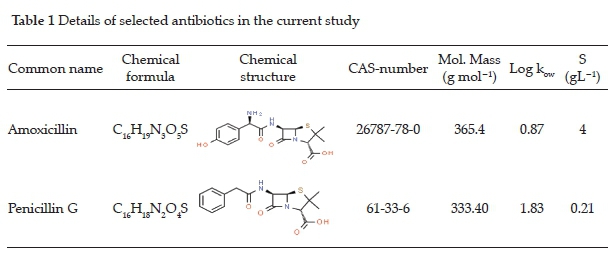
All chemicals used in the current study were of analytical reagent grade. AMX, PEN G, buffer phosphate and acetonitrile were purchased from Merk Co. Antibiotics were dissolved in a buffer phosphate/acetonitrile (70/30 v/v) solution. All solvents were of HPLC grade. Properties of selected antibiotics are presented in Table 1.
The concentrations of selected antibiotics were determined using a Knauer HPLC (C18 ODS column; 250 mm x 4.6 mm χ 5 mm) with a UV detector at a wavelength of 158 nm for AMX and 220 nm for PEN G with 20 injection volumes. The mobile phase also included buffer phosphate with pH = 4.5 and acetonitrile (a volumetric ratio of 70:30) and 40:60 volumetric ratio of methanol/water for both antibiotics. The injection flow rate was fixed at 1 mL min-1. Each stage of the experiment was repeated twice, and the mean is reported here.
The HPLC results obtained from 5 standard concentrations of AMX and PEN G showed a wide linear dynamic range with the equations: Y = 159199x - 25508y (in which, Y is peak area and x is the concentration of the AMX, R22
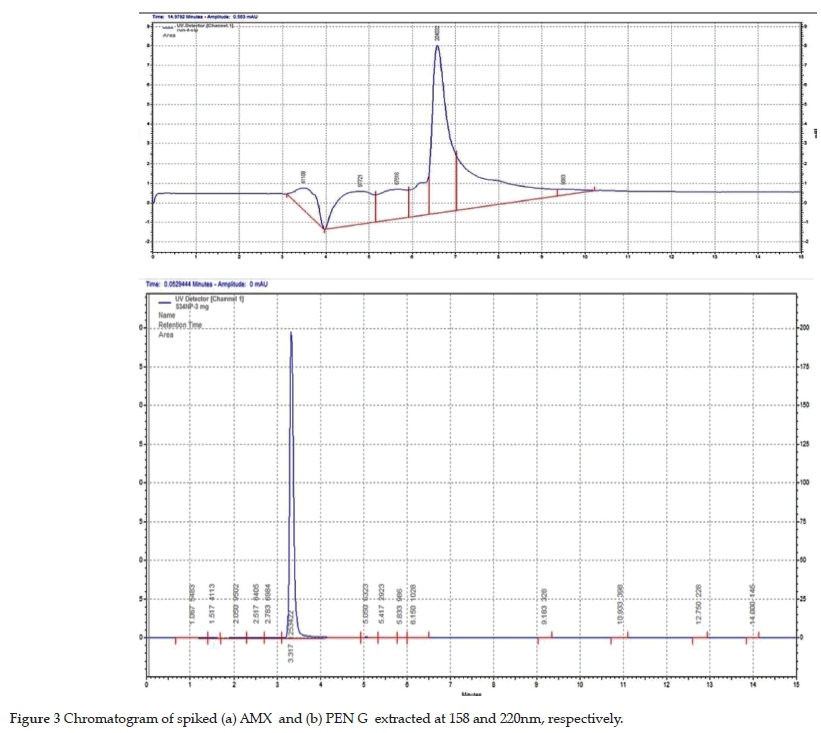
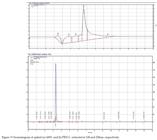
The chromatogram obtained from (a) PEN G and (b) AMX injections are shown in Figure 3; n = 4.
Physicochemical parameters, including TSS, COD and 5-day BOD, were measured according to standard methods.20
2.3. Data analysis
Mass balance analyses were applied to assess how effective aerobics conditions of hospital WWTP removal of antibiotics from the wastewater flow is. Based on the following equation, the removal efficiencies were calculated assuming the influent and effluent of AMX and PEN G from the aerobic systems;

where Ci, Cee are mean concentrations of antibiotics in the influent and effluent (ugL-1), respectively. V denotes the quantity of wastewater (L day-1) entering hospital WWTPs. The Friedman test was conducted using SPSS 22 to test the impact of monthly variations for antibiotics removal. The Spearman correlation analysis was also used to evaluate the correlation between antibiotics removal and studied operational physiochemical parameters.
Since the on-site three-chamber septic tank with a volume of 75 m3

3. Results and Discussion
3.1. Concentration of selected antibiotics in influent and effluent of WWTPs
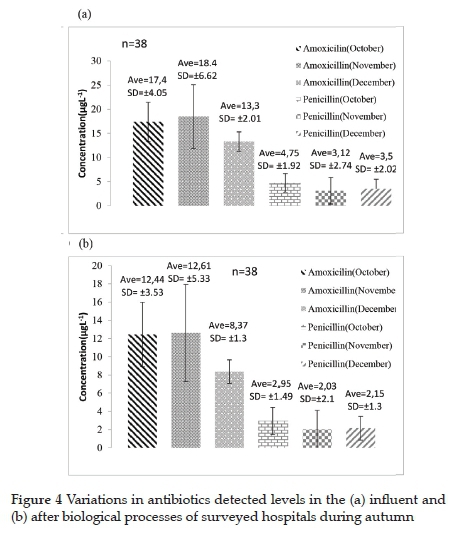
The concentrations of AMX and PEN G in influents (after equalisation tank) and following biological treatment of four hospitals are shown in Fig. 4 a and b, respectively. The respective mean concentrations of AMX and PEN G in the influent ranged from 13.3-18.47 μgL-1 and 3.12-4.75 μgL-1. They were observed in influent samples of the studied hospitals with the maximum concentrations of 25 and 6.6 /xgL-1, respectively.
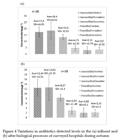
In all the experiments, AMX presented approximately 4 folds higher concentrations compared to PEN G. Specifically, the higher concentration of AMX with 25 and 21.95 μgL-1 were detected in influents of hospitals B and C, respectively. Appreciable values of antibiotics in raw wastewater corresponds with their elevated levels of consumption in these hospitals.21Streptococcus, Gonococcus and Staphylococcus.221,23 However, minimum amounts of them were found in the urban wastewater treatment plant effluents. The β-lactam ring in PEN G and AMX structures are known to be transience, which leads to their further degradation by chemical hydrolysis and/ or β-lactamase-producing bacteria over time.24-1in raw samples of Tanzanian wastewater treatment plants.2425
The highest mean residue concentrations in the effluent were 12.44, and 2.95 μgL-1 for AMX and PEN G. Heidler and Halden26 27,28 Extensive studies have been conducted on the occurrence of antibiotics in raw and treated wastewater of WWTPs, including urban and hospitals.26,29-31 Our results imply that the concentrations of selected antibiotics in HWWTPs are higher than most reported values. These values could be mainly attributed to the fact that Iran's antibiotics consumption is three times higher than the global average.323324
hospitals. Likewise, in a study conducted by Li et al.33-1 of penilloic acid, a degradation product of PEN G, was detected in hospital WWTP effluent with 153 μgL-1 of the parent compound that remained intact.3334
3.2. Antibiotics removal and loading estimations of WWTPs
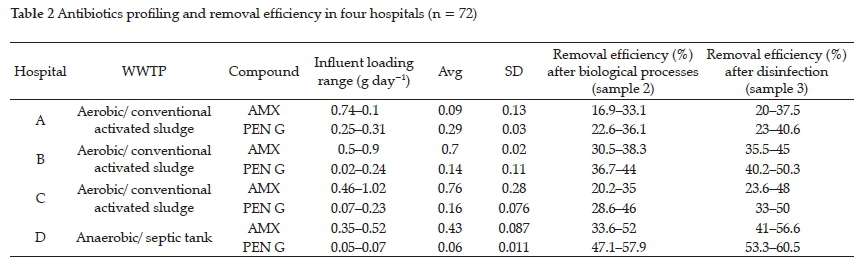
Table 2 shows the influent loading and removal of each antibiotic in the studied hospitals. The influent loading varied from 0.25 to 1.02 g d-1 and 0.02 to 0.31-1 for AMX and PEN G in the aerobic processes. Approximately the same influent loadings of AMX and PEN G were observed in septic tank operating in hospital D. Hospitals operated with conventional activated sludge showed almost similar loads. The highest influent mean load was observed for AMX in hospital A. Removal efficiency of each antibiotic was calculated by comparing its mass load in HWWTP influent and effluent.
The removal efficiencies altered from 16.9 to 38.3% and 22.6 to 46% for AMX and PEN G in the aerobic processes, respectively. However, higher removal rates were observed for both antibiotics in anaerobic conditions with the maximum removal of 52 and 57.9% of AMX and PEN G. Li et al.33 L-1 for AMX and 0.35-4 μgL-1 for PEN G).
Carballa and colleagues.35 have reported a 20-50% removal efficiency for some antibiotics during the initial treatment. Even though the reported performance was increased up to 70% after the activated sludge process. During wastewater treatment processes, antibiotics undergo a battery of processes, including adsorption on suspended solids, degradation by microbial communities, or destruction through the disinfection processes that produce CO2 and water due to ultimate oxidation363738Table 1, the measured log Kow for PEN G and AMX are 1.83 and 0.87, respectively. These values demonstrate that sorption of these antibiotics onto the solids are insignificant, which corroborate with many other pharmaceuticals studied in the literature.3540-42 Moreover, it has been shown to involve two principles; (1) co-metabolism consisting of degradation of the targeted compounds by microbial communities' enzymes or (2) substrate degradation. In the later process, microbial communities exploit the pollutants as being their sources of carbon and energy.4344,45 On the other hand, the presence of sulphur or halogen elements in the structure of long-chain aliphatic compounds, such as PEN and AMX, has made them more biologically decomposable compared to aromatic substances (Table 1). According to Andreozzi et al.44 4622,47 Degradation of ß-lactam antibiotics may arise from acidic/alkaline conditions or through reactions with weak nucleophiles like water or metal ions.22,48 In such circumstances, some other degrading compounds may be found in water resources. Intermediate compounds, such as penicilloic acid, may become dominant based on the pH of the medium. 49 173548503541
Furthermore, the septic tank's removal performance, with a 2-3 days retention time, was slightly greater than that of activated sludge processes. This finding could also be explained by the presence of nitrogen and sulphur in the molecular structures of AMX and PEN that might escalate anaerobic degradation.51
The results obtained throughout the current study corroborate the findings of many previous works that demonstrate that an exact determination of pharmaceutical removal rate and efficacy is impossible, and only a range can be elucidated.52,53 The results of the current study revealed removal variability in the same season (autumn) for each WWTP. Thus, it seems risky to decide on antibiotics removal efficiencies in a specified season just based on the analysis of only two samples. Our research results are in accordance with a study by Thiebault et al.16
Overall, inconsistent operational conditions, such as insufficient air supply, unsuitable disinfectant dosage, low SRT and HRT, loss of activated sludge and presence of other pharmaceuticals, might lead to low antibiotics removal efficiency.1619
Another factor that should be considered is the chlorine effect on AMX and PEN G degradation. As shown in Table 2, chorine's degree of degradation was not significant since the studied antibiotics' removal efficiency following chlorination in all surveyed hospitals only showed a 5-8% increment. This small increase could be assigned to insufficient chlorine concentration, low chlorine contact time and the presence of other pharmaceuticals.
3.3. Wastewater treatment situation and potential influence of wastewater characteristics on removal efficiencies
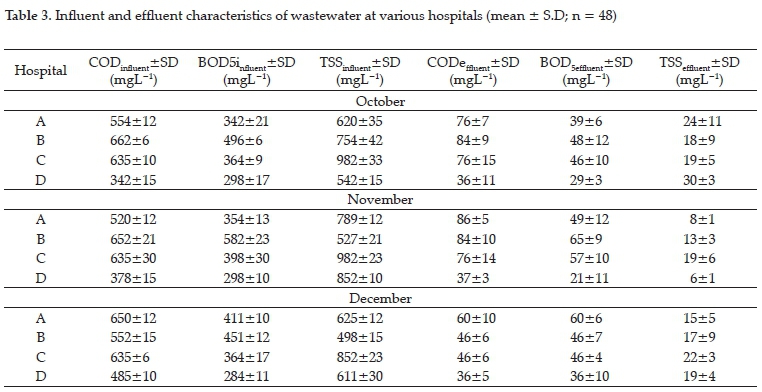
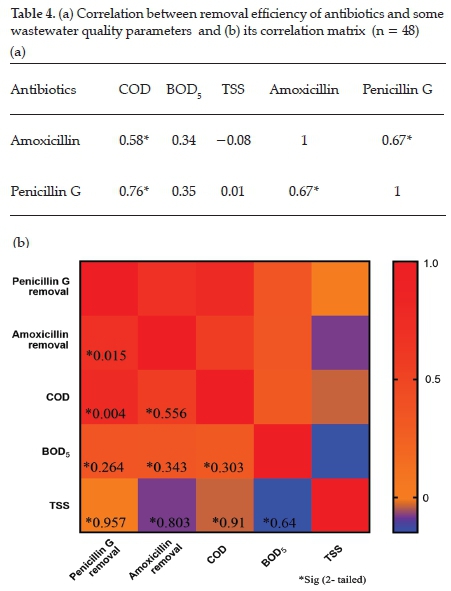
Table 3 represents average COD, BOD5 and TSS concentrations of each hospital's influent and effluent during the monitoring period. The mean removal percentages of TSS, BOD5 and COD were 97.38, 88.34 and 87.37, respectively. As it is clear, these parameters' removal efficacy was high, and WWTPs perform effectively in treating wastewater. However, the effluent quality of three of the studied hospitals operated under aerobic conditions did not meet the national standard limits in terms of COD (< 60 mg L-1) and BOD5 (< 30 mg L-1). In contrast, the COD and BOD5 values of treated wastewater of hospital D met the discharge criteria. The examined effluent concentrations of TSS in all hospital met the promulgated standards (TSS < 30 mgL-1). The statistical correlation between removal efficiencies of antibiotics and wastewater quality parameters is shown in Table 4 (a), and the corresponding correlation graph is depicted in Table 4(b).
Removal of both antibiotics does not exhibit any statistically significant correlation with TSS. Based on their low log K , AMX and PEN G's adsorption on TSS is presumably negligible. However, antibiotics removal showed a significant correlation with COD removal and a fairly strong correlation with BOD5 removal, demonstrating the involved processes. Given the secretion of ß-lactamase enzymes, both antibiotics are known to be susceptible to biodegradation. The correlation with the removal of BOD5 indicates that the performance of some processes (particularly those involved in the degradation of carbonaceous organic matter) affects the removal of AMX and PEN G. In line with these results, a study has recently demonstrated statistically significant correlations with Metoprolol removal, BOD5 and NO2 reduction, pointing out that biodegradation and nitrogen removal is the key factors concerning its removal.155455
A weak but significant correlation was observed between AMX and PEN G removal (r = 0.67). Similar correlations have been reported between several antibiotics; including PEN and AMX in influents and effluents of HWWTP in Qatar.56
4. Conclusions
This survey represents the detection and quantification of two widely used antibiotics, AMX and PEN G, in the raw wastewater entering HWWTPs in autumn and their fate and effect in waste treatment units. The target antibiotics were all detected in the influent and effluent samples. Concentrations of measured AMX and PEN G in the four hospital's wastewater influents ranged from 9.8 to 21.95 μgL-1 and from 0.6 to 6.6 μgL-1, respectively. Although both antibiotics' concentrations in the effluents were lower than their raw wastewater values, their removals were incomplete. Maximum removal efficiencies (48% and 50.3 %, respectively) of AMX and PEN G in aerobic WWTP by conventional physical, biological treatment and disinfection processes were obtained. In contrast, the septic tank (anaerobic process) revealed higher removal efficiencies of both antibiotics with respective values of 56.6 and 60.5%. The removal efficiency of antibiotics showed a strong dependence on COD and, to some extent, with BOD 5,while their removal was not correlated significantly with TSS reduction.
In conclusion, high concentrations of PEN, AMX and their intermediate residues discharged into streams can pose a great threat to aquatic ecosystems and diversely affect human health. There is abundant room for further progress in determining additional pharmaceuticals and other emerging contaminants in the hospital wastewater of Iran and their metabolites and biodegradation products.
ORCID iDs
Maryam Golchin: https://orcid.org/0000-0002-8881-6690
Mohammadreza Khani: https://orcid.org/0000-0002-8853-0158
Mohsen Sadani: https://orcid.org/0000-0002-2321-0866
Mehdi Sadeghi: https://orcid.org/0000-0001-9095-5449
Mahsa Jahangiri-rad: https://orcid.org/0000-0002-1626-4014
Acknowledgement
This research was part of a master's thesis conducted in Tehran Medical Sciences, Islamic Azad University, Tehran, Iran.
References
- 1. S, Jobling, R. Williams, A. Johnson, A. Taylor, M. Gross-Sorokin, M. Nolan, et al. Predicted exposures to steroid estrogens in UK rivers correlate with widespread sexual disruption in wild fish populations. Environ. Health Perspect., 2005, 114(Suppl 1): 32-39.
- 2. A. Watkinson, E. Murby, D. W. Kolpin, S. Costanzo, The occurrence of antibiotics in an urban watershed: from wastewater to drinking water, Sci. Total Environ, 2009, 407, 2711-2723.
- 3. A. Grossberger, Y. Hadar, T. Borch, B. Chefetz, Biodegradability of pharmaceutical compounds in agricultural soils irrigated with treated wastewater, Environ. Pollut., 2014, 185, 168-177.
- 4. S.R. Hughes, P Kay, L.E. Brown, Global synthesis and critical evaluation of pharmaceutical data sets collected from river systems, Environ. Sci. Technol., 2012, 47, 661-677.
- 5. W. Xu, G. Zhang, X. Li, S. Zou, P Li, Z. Hu, J. Li, Occurrence and elimination of antibiotics at four sewage treatment plants in the Pearl River Delta (PRD), South China, Water Res., 2007, 41, 4526-4534
- 6. B.I. Escher, R. Baumgartner, M. Koller, K. Treyer, J. Lienert, C.S. McArdell, Environmental toxicology and risk assessment of pharmaceuticals from hospital wastewater, Water Res., 2011, 45, 75-92.
- 7. L. Gunnarsson, A. Jauhiainen, E. Kristiansson, O. Nerman, D. J. Larsson, Evolutionary conservation of human drug targets in organisms used for environmental risk assessments, Environ. Sci. Technol, 2008, 42, 5807-5813.
-
8. World Health Organization. WHO's first global report on antibiotic resistance reveals serious, worldwide threat to public health 2014. At http://www.who.int/mediacentre/news/releases/2014amr-report/eW
» http://www.who.int/mediacentre/news/releases/2014amr-report/eW - 9. A. Rahbarimanesh, S.Y. Mojtahedi, P Sadeghi, M. Ghodsi, S. Kianfar, L. Khedmat, S.J.M. Siyahkali, M.K. Yazdi, A. Izadi, Antimicrobial stewardship program (ASP): an effective implementing technique for the therapy efficiency of meropenem and vancomycin antibiotics in Iranian pediatric patients, Ann. Clin. Microbiol. Antimicrob., 2019, 18, 6
- 10. A. Fahimzad, Z. Eydian, A. Karimi, F. Shiva, S. Armin, R.M. Ghanaei, F. Fallah, S. R. Tabatabaei, F. Shirvani, M. Rahbar, Antibiotic prescribing pattern in neonates of seventeen Iranian hospitals, Arch. Pediatr. Infect. Dis., 2017, 5(4) e61630
- 11. R. Shokoohi, M. Leili, A. Dargahi, Y. Vaziri, R. Khamutian, Common Antibiotics in Wastewater of Sina and Besat Hospitals, Hamadan, Iran, Arch, Hygiene Sci., 2017, 6, 152-159
- 12. E. Salehifar, M. Nasehi, G. Eslami, S. Sahraei, R.A. Navaei, Determination of antibiotics consumption in buali-sina pediatric hospital, sari 2010-2011, Iran. J Pharm. Res.: IJPR, 2014, 13, 995-1002.
- 13. Y. Zhang, S.-U. Geißen, C. Gal, Carbamazepine and diclofenac: removal in wastewater treatment plants and occurrence in water bodies, Chemosphere, 2008, 73, 1151-1161.
-
14. Antibiotic Chart simple. 2004. http://www.lymepa.org/Antibiotics_spreadsheet_2004-1215.pdf.
» http://www.lymepa.org/Antibiotics_spreadsheet_2004-1215.pdf - 15. M. Patel, R. Kumar, K. Kishor, T. Mlsna, C. U. Pittman, D. Mohan, Pharmaceuticals of emerging concern in aquatic system: chemistry, Occurrence, effects, and removal methods, Chem. Rev, 2019, 119, 3510-3673.
- 16. T. Thiebault, M. Boussafir, C. Le Milbeau, Occurrence and removal efficiency of pharmaceuticals in an urban wastewater treatment plant: mass balance, fate and consumption assessment, J. Environ. Chem. Eng., 2017, 5, 2894-2902.
- 17. M. Kim, P. Guerra, A. Shah, M. Parsa, M. Alaee, S. Smyth, Removal of pharmaceuticals and personal care products in a membrane bioreactor wastewater treatment plant, Water Sci. Technol., 2014, 69, 2221-2229.
- 18. A. Dordio, A.P Carvalho, D.M. Teixeira, C.B. Dias, A.P Pinto, Removal of pharmaceuticals in microcosm constructed wetlands using Typha spp. and LECA, Bioresour. Technol, 2010, 101, 886-892.
- 19. X.-T. Bui, V-P Luu, T.-T. Nguyen, B.-T. Dang, M.-Q. Thai, D.-D. Nguyen, T.-S. Nguyen, Q.-T. Dinh, T.-S. Dao, Investigation of antibiotics in health care wastewater in Ho Chi Minh City, Vietnam, Environ. Monit. Assess. , 2016, 188, 686-700.
- 20. APHA, Standard Methods for Examination of Water and Wastewater, 20th ed, 1998.
- 21. K. Kümmerer, Antibiotics in the aquatic environment-a review-part I, Chemosphere, 2009, 75, 417-434.
- 22. N. Le-Minh, S. Khan, J. Drewes, R. Stuetz, Fate of antibiotics during municipal water recycling treatment processes, Water Res., 2010, 44, 4295-4323.
- 23. Lindberg R. Environmental chemistry, department of chemistry, Umea University, Umea, Sweden. Determination of antibiotics in the Swedish environment with emphasis on Sewage Treatment Plants. 2006.
- 24. C. Kihampa, β-lactams and Fluoroquinolone Antibiotics in influents and effluents of Wastewater treatment plants, Dar es Salaam, Tanzania, Research J. Chem. Sci.,2014, 2231, 606-611.
- 25. J. Radjenovic, M. PetroviC, D. Barceló, Fate and distribution of pharmaceuticals in wastewater and sewage sludge of the conventional activated sludge (CAS) and advanced membrane bioreactor (MBR) treatment, Water Res., 2009, 43, 831-841.
- 26. S. J. Kimosop, Z. Getenga, F. Orata, V. Okello, J. Cheruiyot, Residue levels and discharge loads of antibiotics in wastewater treatment plants (WWTPs), hospital lagoons, and rivers within Lake Victoria Basin, Kenya, Environ. Monit. Assess., 2016, 188, 532-537.
- 27. R. Varela, S. André, O.C. Nunes, C.M. Manaia, Insights into the relationship between antimicrobial residues and bacterial populations in a hospital-urban wastewater treatment plant system, Water Res., 2014, 54, 327-336.
- 28. I.M. Al-Riyami, M. Ahmed, A. Al-Busaidi, B. Choudri, Antibiotics in wastewaters: a review with focus on Oman, Appl. Water Sci., 2018, 8, 199-211.
- 29. J. Heidler, R.U. Halden, Meta-analysis of mass balances examining chemical fate during wastewater treatment, Environ. Sci. Technol., 2008, 42, 6324-6332.
- 30. A. Hartmann, A.C. Alder, T. Koller, R.M. Widmer, Identification of fluoroquinolone antibiotics as the main source of umuC genotoxicity in native hospital wastewater, Environ. Sci. Technol., 1998, 17, 377-382.
- 31. K.D. Brown, J. Kulis, B. Thomson, T.H. Chapman, D.B. Mawhinney, Occurrence of antibiotics in hospital, residential, and dairy effluent, municipal wastewater, and the Rio Grande in New Mexico, Sci. Total Environ. , 2006, 366, 772-783.
- 32. F. Jafari, A. Khatony, E. Rahmani, Prevalence of self-medication among the elderly in Kermanshah-Iran, Glob. J. Health Sci., 2015, 7, 360.
- 33. D. Li, M. Yang, J. Hu, Y. Zhang, H. Chang, F. Jin, Determination of penicillin G and its degradation products in a penicillin production wastewater treatment plant and the receiving river, Water Res., 2008, 42, 307-317.
- 34. M. Bonyadian, H. Moshtaghi, M.A. Taheri, in Veterinary research forum: an international quarterly journal, Vol. 5, Faculty of Veterinary Medicine, Urmia University, Urmia, Iran, 2014, p. 29.
- 35. M. Carballa, F. Omil, J. M. Lema, M. a. Llompart, C. García-Jares, I. Rodriguez, M. Gomez, T. Ternes, Behavior of pharmaceuticals, cosmetics and hormones in a sewage treatment plant, Water Res., 2004, 38, 2918-2926.
- 36. S. Suárez, M. Carballa, F. Omil, J.M. Lema, How are pharmaceutical and personal care products (PPCPs) removed from urban wastewaters ?, Rev. Environ. Sci. Biotechnol., 2008, 7, 125-138.
- 37. H.R. Rogers, Sources, behaviour and fate of organic contaminants during sewage treatment and in sewage sludges, Sci. Total Environ., 1996, 185, 3-26.
- 38. M. Rand-Weaver, L. Margiotta-Casaluci, A. Patel, G.H. Panter, S.F. Owen, J.P. Sumpter, The read-across hypothesis and environmental risk assessment of pharmaceuticals, Environ. Sci. Technol., 2013, 47, 11384-11395.
- 39. J. Sipma, B. Osuna, N. Collado, H. Monclús, G. Ferrero, J. Comas, I. Rodriguez-Roda, Comparison of removal of pharmaceuticals in MBR and activated sludge systems, Desalination, 2010, 250, 653-659.
- 40. B. Blair, A. Nikolaus, C. Hedman, R. Klaper, T. Grundl, Evaluating the degradation, sorption, and negative mass balances of pharmaceuticals and personal care products during wastewater treatment, Chemosphere, 2015, 134, 395-401.
- 41. M. Gross, M. Petrovic, A. Ginebreda, D. Barceló, Removal of pharmaceuticals during wastewater treatment and environmental risk assessment using hazard indexes. Environ. Int., 2010, 36 (1), 15-26.
- 42. L. Feng, M.E. Casas, L.D.M. Ottosen, H.B. Moller, K. Bester, Removal of antibiotics during the anaerobic digestion of pig manure, Sci. Total Environ, 2017, 603, 219-225.
- 43. A. Jelic, M. Gros, A. Ginebreda, R. Cespedes-Sánchez, F. Ventura, M. Petrovic, D. Barcelo, Occurrence, partition and removal of pharmaceuticals in sewage water and sludge during wastewater treatment, Water Res., 2011, 45, 1165-1176.
- 44. A. Joss, H. Andersen, T. Ternes, PR. Richie, H. Siegrist, Removal of estrogens in municipal wastewater treatment under aerobic and anaerobic conditions: consequences for plant optimization, Environ. Sci. Technol., 2004, 38, 3047-3055.
- 45. R. Andreozzi, V Caprio, C. Ciniglia, M. De Champdoré, R. Lo Giudice, R. Marotta, E. Zuccato, Antibiotics in the environment: occurrence in Italian STPs, fate, and preliminary assessment on algal toxicity of amoxicillin, Environ. Sci. Technol., 2004, 38, 6832-6838.
- 46. T. Zhang, B. Li, Occurrence, transformation, and fate of antibiotics in municipal wastewater treatment plants, Crit. Rev. Environ. Sci. Technol, 2011, 41, 951-998.
- 47. A. Watkinson, E. Murby, S. Costanzo, Removal of antibiotics in conventional and advanced wastewater treatment: implications for environmental discharge and wastewater recycling, Water Res., 2007, 41, 4164-4176.
- 48. K. Hirte, B. Seiwert, G. Schüürmann, T. Reemtsma, New hydrolysis products of the beta-lactam antibiotic amoxicillin, their pH-dependent formation and search in municipal wastewater, Water Res., 2016, 88, 880-888.
- 49. I. Gozlan, A. Rotstein, D. Avisar, Amoxicillin-degradation products formed under controlled environmental conditions: identification and determination in the aquatic environment, Chemosphere, 2013, 91, 985-992.
- 50. P Paíga, L. H. Santos, S. Ramos, S. Jorge, J. G. Silva, C. Delerue-Matos, Presence of pharmaceuticals in the Lis river (Portugal): Sources, fate and seasonal variation, Sci. Total Environ., 2016, 573, 164-177.
- 51. M. Carballa, G. Fink, F. Omil, J. M. Lema, T. Ternes, Determination of the solid-water distribution coefficient (Kd) for pharmaceuticals, estrogens and musk fragrances in digested sludge, Water Res., 2008, 42, 287-295.
- 52. K.C. Wijekoon, J.A. McDonald, S.J. Khan, F.I. Hai, W.E. Price, L.D. Nghiem, Development of a predictive framework to assess the removal of trace organic chemicals by anaerobic membrane bioreactor, Bioresour. Technol., 2015, 189, 391-398.
- 53. B. Petrie, R. Barden, B. Kasprzyk-Hordern, A review on emerging contaminants in wastewaters and the environment: current knowledge, understudied areas and recommendations for future monitoring, Water Res., 2015, 72, 3-27.
- 54. S. Sari, G. Özdemir, C. Yangin-Gomec, G.E. Zengin, E. Topuz, E. Aydin, E. Pehlivanoglu-Mantas, D.O. Tas, Seasonal variation of diclofenac concentration and its relation with wastewater characteristics at two municipal wastewater treatment plants in Turkey, J. Hazard. Mater., 2014, 272, 155-164.
- 55. J. Santos, I. Aparicio, M. Callejón, E. Alonso, Occurrence of pharmaceutically active compounds during 1-year period in wastewaters from four wastewater treatment plants in Seville (Spain), J. Hazard. Mater., 2009, 164, 1509-1516.
- 56. S. Al-Maadheed, I. Goktepe, A.B.A. Latiff, B. Shomar, Antibiotics in hospital effluent and domestic wastewater treatment plants in Doha, Qatar, J. Water Process Eng., 2019, 28, 60-68.
Revised 17 October 2020
Accepted 27 October 2020