Removal of uranium from aqueous solutions using ammonium-modified zeolite
Abstract
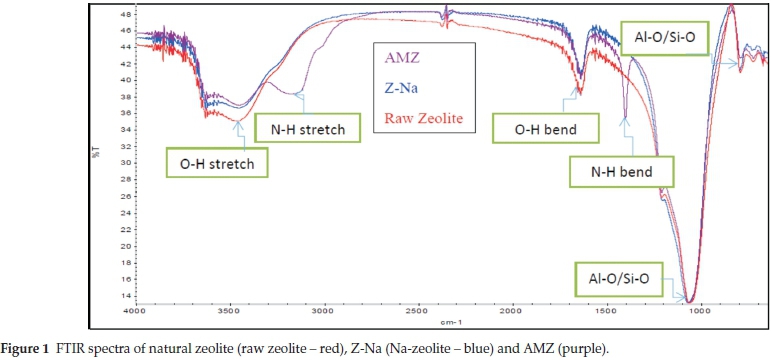
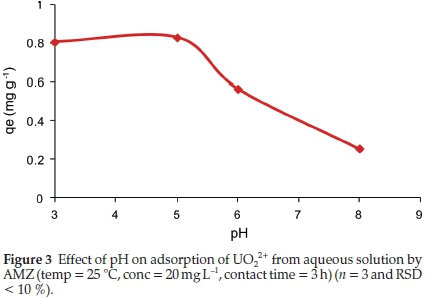
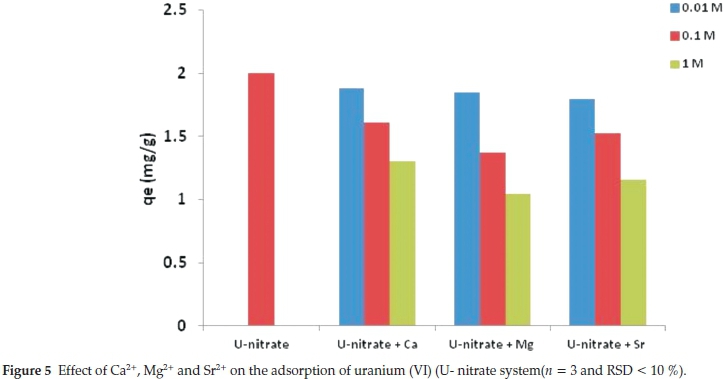
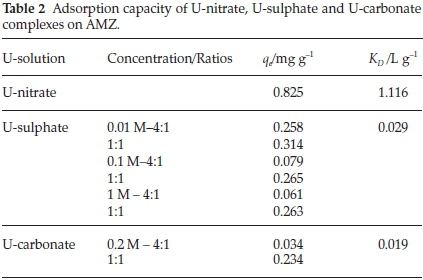
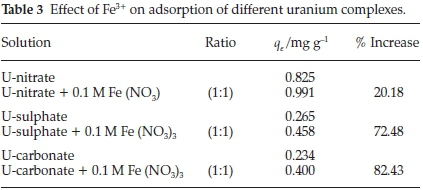
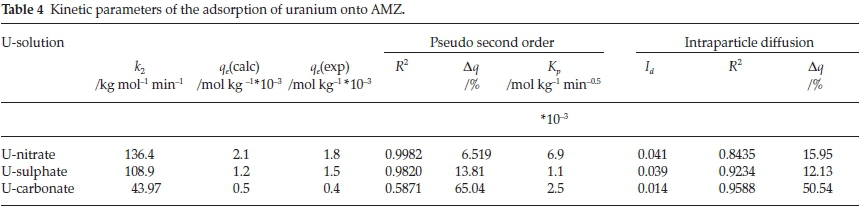
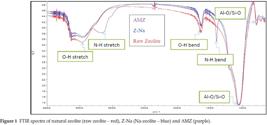
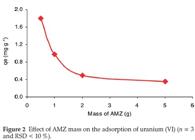
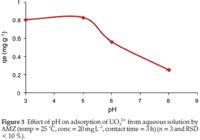
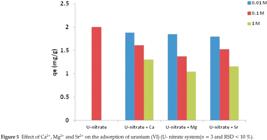
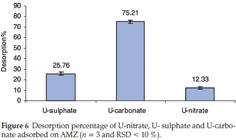
Batch experiments were conducted to study the effects of contact time, pH (3 to 8), initial concentration, presence of carbonate, sulphate, and competing ions (Fe3+,Ca2+,Sr2+,Mg2+) on the adsorption of U(VI) on ammonium-modified zeolite (AMZ). The structural features of the modified zeolite were assessed by Fourier Transform Infra Red Spectroscopy (FTIR) while the metal content was determined by Inductively Coupled Plasma Optical Emission Specroscopy (ICP-OES). The removal of uranium was effective and maximal under acidic conditions (pH 3 to 5). The kinetics of adsorption of U-nitrate and U-sulphate on AMZ were described by the pseudo-second-order model (R2 ≥ 0.9820). In the presence of SO42" and CO32-, a significant reduction of 67.88 % and 71.63 %, respectively, in uranium uptake was observed. The distribution coefficient, KD(L g-1), was in the order of: U-nitrate (1.116) > U-sulphate (0.029) > U-carbonate (0.019), suggesting that AMZ had a high affinity for U-nitrate. The presence of Fe3+ enhanced the removal of U(VI) from U-nitrate, U-sulphate and U-carbonate by 20.18 %, 72.48 % and 82.43 %, respectively, while the presence of Ca2+,Mg2+ and Sr2+ reduced the removal to 19.57 %, 31.60 % and 23.65 %, respectively. AMZ is an effective adsorbent for uranium removal from aqueous solutions dominated by nitrate, carbonate and sulphate.
Adsorption; zeolite-ammonium; uranyl; carbonate; sulphate; nitrate; aqueous solutions
 Thumbnail
 Thumbnail
 Thumbnail
 Thumbnail
 Thumbnail