Future of chemistry in the presence of artificial intelligence
Abstract
Science-related subjects including chemistry, physics, mathematics, engineering, and medicine have all benefited greatly from advanced technology, particularly Artificial Intelligence (AI). Recently, the significance of AI in promoting chemistry research to improve the chemical industry has evolved. The goal of the researchers is to advance drug development by creating novel medications at a minimal cost. AI assists in achieving this goal. Other areas of chemistry that will benefit from AI include compound solubility, optimizing reaction conditions, and providing production methods for challenging target molecules. Researchers from Massachusetts Institute of Technology (MIT) have discovered a potent new antibiotic molecule using a machine-learning system. Typically, AI may produce ten times more antibody sequence clusters than a lab-based approach alone. Systems containing hundreds of interacting ions and electrons can now be modeled using an approximation of the physical laws. This is because modern algorithms and supercomputers make these applications possible.
AI; designing molecules; detection of molecules; drug discovery; molecule; properties of molecules
INTRODUCTION
AI has enabled computers to function and think like human by creating software or machines that are based on human intelligence. Google Maps is among the most useful examples of AI.122 3-10 AI implementations have demonstrated their ability to significantly reduce design and experimental effort.1112,13 Systems with hundreds of interacting ions and electrons can now be represented using approximations to the physical rules that govern the world on the atomic scale, this is due to contemporary algorithms and supercomputers.14-17 The field of computational chemistry has expanded in the 21th century, and its applications include the creation of catalysts for the conversion of greenhouse gases, the identification of materials for energy harvesting and storage, and the development of computer-aided pharmaceuticals.1819-23 Shields et al.'s study demonstrates how Bayesian optimization can be utilized in synthetic chemistry to fine-tune neural networks. In this study, they show how Bayesian optimization can be viewed as a self-sufficient technique for reducing human biases.242526
AI APPLICATIONS IN CHEMISTRYAlthough AI has many applications in the area of technology, it also has many applications in the field of chemical science.2127
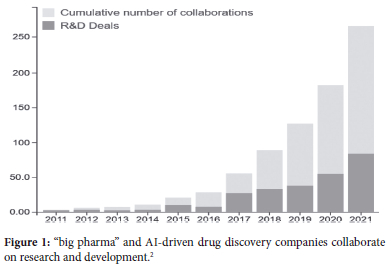
AI AND DRUG DISCOVERYIt is stated that the process of drug discovery is one of the top applications of AI in chemistry.128figure 1.2
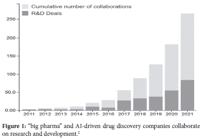
Big data and machine learning-based antibody design has also extensively utilized AI technologies. Additionally, a variety of AI models can assess and optimize the biophysical characteristics of potential antibodies, such as stability, solubility, and chemical properties, to lower costs and boost therapeutic effectiveness. As reported, the number of antibody clusters for HIV GP140 has increased 13-fold thanks to research that uses AI to boost discovery.28
The lack of advanced technologies affects the production of medicines, and this costs pharmaceutical companies large sums of money and a long time, and all of this can be solved to reduce money and time by using artificial intelligence.28-30 Researchers from the University of Toronto and the Hong Kong-based Insilico Medicine reported that AI algorithms had selected roughly 30 000 previously unknown chemical combinations, eventually narrowing that list down to six promising novel pharmaceuticalmolecules.131-33 All these steps to produce new medicine is time consuming too. Accordingly, AI has significantly advanced the R&D process for accelerating drug discovery. However, as stated in a recent study, there are other uses for AI in chemistry besides drug discovery.34
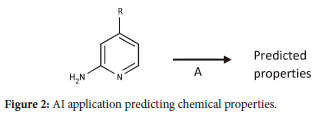
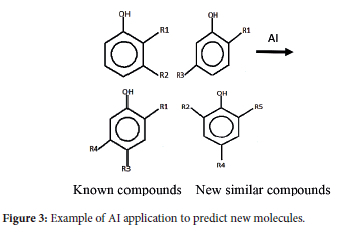
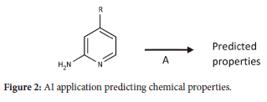
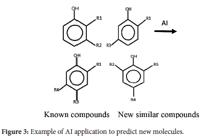
MOLECULAR PROPERTIES AND AIThe first and most important application of AI in chemistry is the discovery of molecular properties. Scientists perform the process of manually revealing the chemical properties of molecules because characterizing a molecule is a lengthy process.1Figure 2. The search for novel medicine options might become easier and more affordable as a result. AI helps researchers to synthesize only the most promising chemicals and avoid synthesizing and testing several molecules that don't have the desired qualities.31Figure 3, the AI predicts new similar molecules. Machine learning methods can also be used to predict chemical properties, as shown in Figure 2. Numerous other types of attributes, including, solubility of compounds, melting point of compounds, bioactivity of compounds, toxicity of compounds, atomization energies, HOMO/LUMO molecular orbital energies, and many others, have also been predicted using these algorithms.
STRUCTURING OF MOLECULES
While the characterization of compounds is extremely useful in the field of chemistry, the discrete use of artificial intelligence in molecular design has led to groundbreaking discoveries. Scientists have been able to gather historical information and establish chemical relationships by building molecules. Researchers have advanced in finding compounds by incorporating AI algorithms, and this has undoubtedly assisted them in making ground-breaking discoveries in AI chemical synthesis.135
An AI programe created by German researchers at the University of Münster, for instance, can plan a multistep synthetic route 30 times faster than a person can by continuously simulating the 12.4 million known single-step chemical processes.35,36 Computer-aided synthesis planning can help chemists find better methods faster. The missing ingredient can also be found in new virtual design and robot systems that perform molecular design, synthesis, and test cycles.37-39 Games or automated theorem proving are examples of sequential choice problems with large branching factors that can be solved using Monte Carlo tree search (MCTS), a universal search approach.40-42 As stated, to create new materials, the sequential steps of molecular design, property prediction, synthesis of chemicals, and experimental assessment are routinely repeated until adequate performance is reached.43
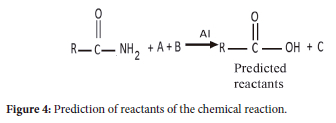
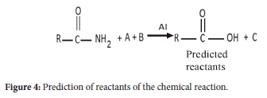
REACTANTS AND PRODUCTS PREDICTIONSynthesis of new chemical compounds by using conventional methods take a lot of time, this is because of experiment trying and errors to find suitable reactants, and to produce the required products, as shown in Figure 4. The researchers stay days and nights in the laboratories for testing and searching to synthesis new molecules. AI has made a significant change in this issue. It shortens the steps to synthesis new molecules. The process of reactants prediction is called retrosynthesis.
FUTURE OF AI AND CHEMISTRY
In fact, the relationship between chemistry and AI still has a long way to go, because AI is still a work in progress, but it can be said that artificial intelligence can contribute to the development of the chemical industry in the future. The world experiences more and more illnesses arising, accordingly, AI in chemistry rashly assists researchers in the production of potentially ground-breaking scientific discoveries. It can be expected that the future use of artificial intelligence is anticipated to greatly expand the field of chemical sciences.133344
SAVING MONEY AND TIMEIt is reported that AI can save money and time, particularly the process of discovery of drug. It is estimated that 85% of drugs projects have been failed within the period 2000 and 2015.4445454546
LABORATORY AUTOMATION BY AISome organizations, such as InSilico organization and Exscientia, are rapidly merging AI methods with laboratory automation.4547, 484545
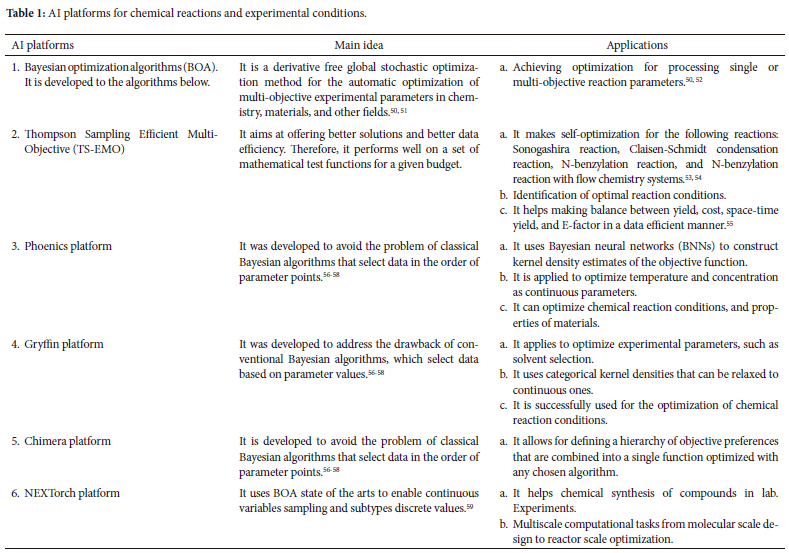
AI PLATFORMS AND CHEMICAL REACTIONSSince the evolution of AI, there have been a number of AI platforms developed to facilitate the process of chemical reactions and their complex conditions.49Table 1 shows a summary of some AI platforms and their useful applications in chemistry.
In reality, there are additional platforms that have already been established and will be produced in the future in addition to those listed in table 1. One such combination involves the platforms TS-EMO, Phoenics, Gryffin, and Chimaera. This combination is to add more advantages and functions for chemical reactions and compound formation. The developing of aforementioned platforms and other platforms have been done by Aspuru-Guzik's group.6061-63
ADVANTAGES AND LIMITATIONS OF AIAI has a number of advantages, such as accelerating data analysis, making accurate predictions of chemical reactions and properties, providing support in adapting the exact period of the research project, minimizing errors in chemical reactions, reducing repetitive experiments of researchers, allowing the automation of synthesis of compounds, and saving money on the production process.49, 64
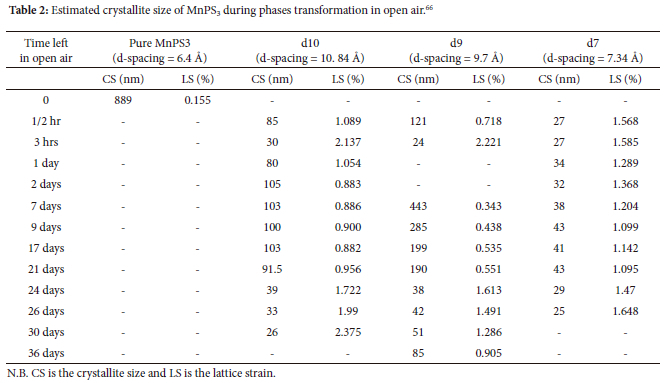
As usual, new applications are applied without paying much attention to drawbacks or limitations. In fact, there are a number of limitations for AI applications. AI cannot replace humans, especially human judgement in chemistry. AI cannot perform critical thinking or contextual comprehension in the same way that humans can. These are thought to be crucial for making complicated judgements in chemistry and drug discovery. The data must be reliable and accurate in order to be used in the AI process for decision making and prediction. Any mistake or inaccuracy in the data can result in erroneous results, limiting the efficiency of AI. It is necessary to mention the complexities of various chemical reactions. This intricacy includes modifications in the experimental circumstances, which must be tried numerous times to achieve the optimal reaction conditions. Also, some conditions such as, toxicity, safety of the materials, environmental impact, need to adapted by human. This intricacy will provide a challenge for AI, but with appropriate algorithmic computations, some of these conditions may be addressed. According to a real example, my research in the synthesis and intercalation of layered materials, MPS3, (where M is a transition element), revealed a number of parameters that must be met in order to achieve the optimum results.65table 2, we discovered that the nanosize of the layered materials might alter during phase transformation in open air for 36 days.66
AI cannot detect nanosize variations unless there is human intervention. Human skills, talent, critical thinking, observation, trial and error, and so on cannot be totally acquired by AI, even if some elements, such as trial and error, can be done by AI while still lacking the human mind and sensibility. As previously stated, AI can recommend certain conditions, but it is only capable of recommending a single reaction class.67,68 The fundamental cause of such constraints is a scarcity of high-quality data. Future challenges face AI applications in the field of chemistry include: (1) there is a need to develop in-line and online analysis, especially in terms of accuracy of measurements, tool response speed, and compatibility with heterogeneous synthesis; (2) the cost of automated equipment is still high where developing countries can't purchase it. As is usual, every new technology is first quite expensive, but the cost will reduce with time. For example, mobile phones and the internet were initially prohibitive in price, but as technology advanced, their costs fell.49
CONCLUSION
In conclusion, reading about how AI found molecules is a groundbreaking subject. Nevertheless, it is not impossible to see chemical sciences working with AI to improve results and data. The R&D method for accelerating drug discovery has greatly improved due to AI. The missing CASP component is absent from modern virtual design and robotic systems that perform molecular design, synthesis, and testing cycles. This might speed up the process of helping chemists discover better techniques. There are a number of AI platforms have been developed to automate and optimize chemical reaction and experimental conditions. AI application in chemistry and drug discovery is a reality, and it will never end, especially, it saves a lot of money, time and jobs. If you can't keep up with 21st century technology, you will be back in the 19th century and beyond. Although we need many years to produce any drugs, AI helps to produces drugs in less than a year. This saves money, and time.
ORCID IDAmin A El-Meligi - https://orcid.org/0000-0002-3628-5867
Acknowledgements
This work was done at National Research Centre, Egypt. It is a part of the author's duties. The author would like to thank all researchers, institutions and organizations cited or not cited in the paper.
REFERENCES
-
1. Rawat S, 5 AI Applications in Chemistry, May 24,2021 https://www.analyticssteps.com/blogs/5-ai-applications-chemistry (accessed 19 August, 2022).
» https://www.analyticssteps.com/blogs/5-ai-applications-chemistry -
2. Sokolova B. Biotech Startups, BiopharmaTrend.com, https://www.biopharmatrend.com/contributor/734. (accessed August 22, 2022).
» https://www.biopharmatrend.com/contributor/734 -
3. Zachary J. Baum, Xiang Yu, Philippe Y. Ayala, Yanan Zhao, Steven P. Watkins, Qiongqiong Zhou. Artificial Intelligence in Chemistry: Current Trends and Future Directions, J. of Chem. Info. and Mod. 2021; 7: 31973212. https://doi.org/10.1021/acs.jcim.1c00619.
» https://doi.org/10.1021/acs.jcim.1c00619 -
4. Mullin R. The Lab of the Future Is Now. Chem. Eng. News. 2021; 28. https://doi.org/10.47287/cen-09911.
» https://doi.org/10.47287/cen-09911 -
5. Elton DC, Boukouvalas Z, Fuge MD, Chung PW. Deep Learning for Molecular Design-a Review of the State of the Art. Molecular Systems Design & Engineering, 2019; 4: 828-849. https://doi.org/10.1039/C9ME00039A.
» https://doi.org/10.1039/C9ME00039A -
6. Bender A, Cortés-Ciriano I. Artificial Intelligence in Drug Discovery: What Is Realistic, What Are Illusions? Part 1: Ways to Make an Impact, and Why We Are Not There Yet. Drug Disc. Today, 2021; 26: 511-524. https://doi.org/10.1016/j.drudis.2020.12.009.
» https://doi.org/10.1016/j.drudis.2020.12.009 -
7. Muratov EN, Bajorath J, Sheridan RP, Tetko IV, Filimonov D, Poroikov V, Oprea TI Baskin II, Varnek A, Roitberg A, Isayev O, Curtalolo S, Fourches A, Cohen Y, Aspuru-Guzik A, Winkler DA, Agrafiotis D, Cherkasov A, Tropsha A. Qsar without Borders. Chem. Soc. Rev., 2020; 49: 3525-3564. https://doi.org/10.1039/D0CS00098A.
» https://doi.org/10.1039/D0CS00098A -
8. Strieth-Kalthoff F, Sandfort F, Segler MHS, Glorius F. Machine Learning the Ropes: Principles, Applications and Directions in Synthetic Chemistry. Chem. Soc. Rev. 2020; 49: 6154-6168. https://doi.org/10.1039/C9CS00786E
» https://doi.org/10.1039/C9CS00786E -
9. Villalba M, Wollenhaupt M, Ravitz O. Predicting New Chemistry: Impact of High-Quality Training Data on Prediction of Reaction Outcomes. CAS Whitepapers. 2022. https://www.cas.org/resources/whitepapers/predicting-new-chemistry.
» https://www.cas.org/resources/whitepapers/predicting-new-chemistry -
10. Mater, AC, Coote, ML. Deep Learning in Chemistry, J. Chem. Inf. Model., 2019; 59: 2545-2559. https://doi.org/10.1021/acs.jcim.9b00266.
» https://doi.org/10.1021/acs.jcim.9b00266 - 11. Wills TJ, Polshakov DA, Robinson MC, Lee AA. Impact of Chemist-in-the-Loop Molecular Representations on Machine Learning Outcomes. J. Chem. Inf. Model. 2020; 60: 4449.
-
12. Struble TJ, Alvarez JC, Brown SP, Chytil M, Cisar J, DesJarlais RL et al. Current and Future Roles of Artificial Intelligence in Medicinal Chemistry Synthesis. J. Med. Chem. 2020; 63: 8667. https://doi.org/10.1021/acs.jmedchem.9b02120
» https://doi.org/10.1021/acs.jmedchem.9b02120 - 13. Smith RG, Farquhar A. The road ahead for knowledge management: an AI perspective. AI Mag. 2000; 21: 17.
-
14. Butler KT, Davies DW, Cartwright H, Isayev O, Walsh A. Machine learning for molecular and materials science. Nat. 2018; 559: 547. doi.org/10.1038/s41586-018-0337-2.
» doi.org/10.1038/s41586-018-0337-2 - 15. Arita M, Bowler DR, Miyazaki T. Stable and efficient linear scaling first-principles molecular dynamics for 10000+ atoms. J. Chem. Theory Comput. 2014; 10: 5419-5425.
- 16. Wilkinson KA, Hine NDM, Skylaris CK. Hybrid mpi-openmp parallelism in the Onetep linear-scaling electronic structure code: application to the delamination of cellulose nanofibrils. J. Chem. Theo. Comput. 2014; 10: 4782-4794.
- 17. Havu V, Blum V, Havu P, Scheffler M. Efficient O(N) integration for all-electron electronic structure calculation using numeric basis functions. J. Comput. Phys. 2009; 228: 8367-8379.
- 18. Catlow CRA, Sokol AA, Walsh A. Computational Approaches to Energy Materials. 2013, Wiley-Blackwell, New York.
- 19. Kang PL, Liu ZP. Reaction prediction via atomistic simulation: from quantum mechanics to machine learning. Iscience. 2020; 24: 102013.
- 20. Kayala M, Baldi PA. machine learning approach to predict chemical reactions. Adv. Neural Inf. Process. Syst. 2011; 24: 747-755.
- 21. Toniato A, Schwaller P, Cardinale A, Geluykens J, Laino T. Unassisted noise reduction of chemical reaction datasets. Nat. Mach. Intell. 2021; 3: 485-494.
- 22. Schwaller P, Petraglia R, Zullo V, Nair VH, Haeuselmann RA, Riccardo Pisoni R, Costas Bekas, Anna Iuliano, Teodoro Laino. Predicting retrosynthetic pathways using transformer-based models and a hyper-graph exploration strategy. Chem. Sci. 2020; 11: 3316-3325.
- 23. Schwaller P, Laino T, Gaudin T, Bolgar P, Hunter CA, Bekas C, Lee AA. Molecular transformer: a model for uncertainty-calibrated chemical reaction prediction., ACS Cent. Sci. 2019; 5: 1572.
- 24. Shields BJ, Stevens J, Li J, Parasram M, Damani F, Alvarado JIM. Janey JM, Adams RP, Doyle AG. Bayesian reaction optimization as a tool for chemical synthesis. Nat. 2021; 590: 89-96.
- 25. Gale EM, Durand DJ. Improving reaction prediction. Nat. Chem. 2020; 12: 509.
- 26. Iovanac NC, Savoie BM. Improved chemical prediction from scarce data sets via latent space enrichment. J. Phys. Chem. 2019; A 123: 4295.
-
27. Bajwa A. Artificial Intelligence vs Robotics vs Machine Learning vs Deep Learning vs Data Science, DataDrivenInvestor, 2021. https://medium.datadriveninvestor.com (accessed July 18, 2023).
» https://medium.datadriveninvestor.com - 28. Lamberti MJ. A study on the application and use of artificial intelligence to support drug development. Clin. Ther. 2019; 41: 1414.
-
29. AI augmented drug discovery,https://ai.creative-biolabs.com/ai-augmented-drug-discovery.htm (accessed August 21, 2022).
» https://ai.creative-biolabs.com/ai-augmented-drug-discovery.htm - 30. Vyas M. Artificial intelligence: the beginning of a new era in pharmacy profession. Asian J. Pharm. 2018; 12: 72.
- 31. DiMasi JA. Grabowski HG, Hansen RW. Innovation in the pharmaceutical industry: New estimates of R&D costs. J. Health. Med. Econ., 2016; 47: 20.
-
32. Paul SM, Mytelka DS, Dunwiddie, CT, Persinger CC, Munos, B H, Lindborg SR, Schacht A. How to improve R&D productivity: the pharmaceutical industry's grand challenge. Nat Rev Drug Discov. 2010; 9(3): 203-14. https://doi.org/10.1038/nrd3078.
» https://doi.org/10.1038/nrd3078 - 33. Homburg Propellants A. Explos., Pyrotech., 2017; 42: 851.
-
34. ChemIntelligence, AI for chemistry: A concise state of the art, https://chemintelligence.com/ai-for-chemistry (accessed August 25, 2022).
» https://chemintelligence.com/ai-for-chemistry -
35. Carbeck J. AI for Molecular Design, September 14, 2018, https://www.scientificamerican.com/article/ai-for-molecular-design/ (accessed September 8, 2022).
» https://www.scientificamerican.com/article/ai-for-molecular-design/ -
36. Segler M, Preuss M, Waller M. Planning chemical syntheses with deep neural networks and symbolic AI. Nature. 2018; 555: 604. https://doi.org/10.1038/nature25978.
» https://doi.org/10.1038/nature25978 - 37. Ley SV, Fitzpatrick DE, Ingham R, Myers RM. Organic synthesis: march of the machines. Angew. Chem. Int. Ed. 2015; 54: 3449.
- 38. Schneider P., Schneider G. De novo design at the edge of chaos: miniperspective. J. Med. Chem. 2016; 59: 4077.
- 39. Segler MH, Kogej T, Tyrchan C, Waller MP. Generating focused molecule libraries for drug discovery with recurrent neural networks. ACS Cent. Sci. 2018; 4: 120-131.
- 40. Coulom R. Efficient selectivity and backup operators in Monte-Carlo tree search. In: Int. Conf. on Computers and Games, 2006, Springer. pp 72-83.
- 41. Kocsis L, Szepesvári C. Bandit based Monte-Carlo planning. In: 17th European Confernce on Machine Learning, 2006, Springer. pp 282-293.
- 42. Browne, CB, Browne CB, Powley E, Whitehouse D, Lucas SM, Cowling PI, Rohlfshagen P, Tavener S, Perez D, Samothrakis S, Colton S. A survey of Monte Carlo tree search methods. IEEE Trans. Comput. Intell. AI Games, 2012;4:1.
-
43. Kim K, Kang S, Yoo J, Kwon Y, Nam Y, Lee D, Kim I, Choi Y-S, Jung Y, Kim S, Son W-J, Son J, Lee HS, Kim S, Shin J, Hwang S. Deep-learning-based inverse design model for intelligent discovery of organic molecules. npj ComputMater. 2018; 4: 67. https://doi.org/10.1038/s41524-018-0128-1.
» https://doi.org/10.1038/s41524-018-0128-1 -
44. Robinson P. How will AI and automation change chemistry? Chemistry World, 2023. https://www.chemistryworld.com/opinion/how-will-ai-and-automation-change-chemistry/4016915.article (accessed on July 20, 2023).
» https://www.chemistryworld.com/opinion/how-will-ai-and-automation-change-chemistry/4016915.article -
45. King A. Encoding creativity in drug discovery, Chemistry World, 2023. https://www.chemistryworld.com/news/encoding-creativity-in-drug-discovery/4016866.article.
» https://www.chemistryworld.com/news/encoding-creativity-in-drug-discovery/4016866.article -
46. Extance A. AI model accurately classifies reaction mechanisms, https://www.chemistryworld.com/news/ai-model-accurately-classifies-reaction-mechanisms/4016870.article (accessed August 27, 2023).
» https://www.chemistryworld.com/news/ai-model-accurately-classifies-reaction-mechanisms/4016870.article -
47. Bures J, Larrosa I. Trained AI model and associated files. Dataset. University of Manchester, 2022. https://doi.org/10.48420/16965271.v2.
» https://doi.org/10.48420/16965271.v2 -
48. Tempke R, Musho T. Autonomous design of new chemical reactions using a variational autoencoder. Commun Chem, 2022; 5: 40. https://doi.org/10.1038/s42004-022-00647-x.
» https://doi.org/10.1038/s42004-022-00647-x -
49. He C, Zhang C, Bian T, Jiao K, Su W, Wu K-J, Su A. A Review on Artificial Intelligence Enabled Design, Synthesis, and Process Optimization of Chemical Products for Industry 4.0, Proc. 2023; 11: 330. https://doi.org/10.3390/pr11020330.
» https://doi.org/10.3390/pr11020330 - 50. Shields BJ, Stevens J, Li J, Parasram M, Damani F, Alvarado JIM, Janey JM, Adams RP, Doyle AG. Bayesian reaction optimization as a tool for chemical synthesis. Nat. 2021; 590: 89-96.
- 51. Shambhawi S, Csányi G, Lapkin AA. Active Learning Training Strategy for Predicting O Adsorption Free Energy on Perovskite Catalysts using Inexpensive Catalyst Features. Chem. Methods 2021; 1: 444-450.
- 52. Nandiwale KY, Hart T, Zahrt AF, Nambiar AMK, Mahesh PT, Mo Y, Nieves-Remacha, MJ, Johnson MD, García-Losada P, Mateos C, Rincón JA, Jensen KF. Continuous stirred-tank reactor cascade platform for self-optimization of reactions involving solids. React. Chem. Eng. 2022; 7: 1315-1327.
- 53. Schweidtmann AM, Clayton AD, Holmes N, Bradford E, Bourne RA, Lapkin AA. Machine learning meets continuous flow chemistry: Automated optimization towards the Pareto front of multiple objectives. Chem. Eng. J. 2018; 352: 277-282.
- 54. Clayton AD, Schweidtmann AM, Clemens G, Manson JA, Taylor C, Nino CG, Chamberlain TW, Kapur N, Blacker AJ, Lapkin AA, Bourne, RA. Automated self-optimisation of multi-step reaction and separation processes using machine learning. Chem. Eng. J. 2019; 384: 123340.
- 55. Jeraal MI, Sung S, Lapkin AA. A Machine Learning- Enabled Autonomous Flow Chemistry Platform for Process Opti-mization of Multiple Reaction Metrics. Chem. Methods 2021; 1: 71-77.
- 56. Hase F, Roch, LM, Aspuru-Guzik A. Chimera: Enabling hierarchy based multi-objective optimization for self-driving laboratories. Chem. Sci. 2018; 9: 7642.
- 57. Hase, F, Aldeghi, M, Hickman, RJ, Roch, LM, Aspuru-Guzik A. Gryffin: An algorithm for Bayesian optimization of categorical variables informed by expert knowledge. Appl. Phys. Rev. 2021; 8: 031406.
- 58. Hase F, Roch LM, Kreisbeck C, Aspuru-Guzik A. Phoenics: A Bayesian Optimizer for Chemistry. ACS Central Sci. 2018; 4: 1134-1145.
- 59. Wang Y, Chen, TY, Vlachos, D. NEXTorch: A Design and Bayesian Optimization Toolkit for Chemical Sciences and Engineering. J. Chem. Inf. Model. 2021; 61: 5312-5319.
- 60. Pollice R., Gomes, GDP, Aldeghi M, Hickman RJ, Krenn M, Lavigne C, Lindner-D'Addario, M., Nigam A, Ser CT, Yao, Z, Aspuru-Guzik A. Data-Driven Strategies for Accelerated Materials Design. Accounts Chem. Res. 2021, 54: 849-860.
- 61. MacLeod BP, Parlane, FGL, Morrissey TD, Hase F, Roch LM, Dettelbach KE, Moreira R, Yunker LPE, Rooney MB, Deeth JR, Lai V, Ng GJ, Situ H, Zhang RH, Elliott MS, Haley TH, Dvorak DJ, Aspuru-Guzik A, Hein JE, Berlinguette CP. Self-driving laboratory for accelerated discovery of thin-film materials. Sci. Adv. 2020; 6: eaaz8867.
-
62. Christensen M, Yunker LPE, Adedeji F, Hase F, Roch LM, Gensch T, Dos Passos Gomes G, Zepel T, Sigman MS, Aspuru-Guzik A, Hein JE. Data-science driven autonomous process optimization. Commun Chem. 2021; 4(1): 112. https://doi.org/10.1038/s42004-021-00550-x.
» https://doi.org/10.1038/s42004-021-00550-x - 63. Langner S, Hase, F, Perea JD, Stubhan T, Hauch J, Roch LM, Heumueller T, Aspuru-Guzik, A, Brabec CJ. Beyond Ternary OPV: High-Throughput Experimentation and Self-Driving Laboratories Optimize Multicomponent Systems. Adv. Mater. 2020; 32: e1907801.
-
64. Chiaramonte F, Artificial Intelligence in Chemistry: Advantages and Limitations, April 1, 2023. https://fchiaramonte.com/artificial-intelligence-in-chemistry/#limitations-of-ai-in-chemistry (accessed July 22, 2023).
» https://fchiaramonte.com/artificial-intelligence-in-chemistry/#limitations-of-ai-in-chemistry - 65. El-Meligi AA. New Conditions for Intercalation of Organic Compounds into Semiconductor Nanomaterial, J. of Mater. Sci. and Tech. 2009; 25(4):1-8.
- 66. El-Meligi AA, Al-Saie AM, Al-Buflasa H, Bououdina M. Formation of Composite Nanomaterial MnPS3 Layered Structure Intercalated with Pyridine. J. Alloys & Comp. 2010; 488: 284-290.
- 67. Nielsen MK, Ahneman DT, Riera O, Doyle AG. Deoxyfluorination with Sulfonyl Fluorides: Navigating Reaction Space with Machine Learning. J. Am. Chem. Soc. 2018; 140: 5004-5008.
- 68. Li J, Eastgate MD. Making Better Decisions during Synthetic Route Design: Leveraging Prediction to Achieve Green-ness-by Design. React. Chem. Eng. 2019; 4: 1595-1607.
Revised 10 August 2023
Accepted 5 September 2023