Poly (Ethylene Glycol)-Bound Sulphonic Acid as a Novel Catalyst for Synthesis of Benzoxazoles
Abstract
A highly efficient, simple and rapid method for the preparation of various 2-aminobenzoxazoles and other benzoxazole derivatives using a catalytic amount of poly (ethylene glycol)-bound sulphonic acid (PEG-SO3H) is described. PEG-SO3H is found to be economical and reusable catalyst with low catalytic loading. The percentage yield was found to be satisfactory, experimental set-up and purification of final products is facile and easy.
Poly (ethylene glycol)-bound sulphonic acid (PEG-SO3H); 2-aminobenzoxazole; benzoxazole derivatives
1. Introduction
Benzazoles like benzoxazole, benzothiazole and benzimidazole derivatives are of immense importance in chemical1234567891011121314151617181920212223242526272829303132
Benzoxazol-2-amine is either obtained via reaction with concen-trated ammonia3334,35. Alternatively, the reaction is carried out in aqueous solution,36,37 refluxing benzene or toluene38,39, 1,1,2,2-tetrachloroethane404142
There has been a rapid and extensive growth in the development of catalysts, novel reagents for synthesis of these compounds for organic, inorganic and pharmaceutical use. Need of new, efficient, reusable, economic and eco-friendly catalyst has led to development of polymer-bound catalyst. They are used in solution phase, solid phase synthesis, microwave-assisted synthesis because these methods offer benefits such as enhanced reaction rate, greater selectivity, ease at experimental work-up and com-paratively higher yields. These are of two types; soluble and insoluble polymer based, depending on the nature of polymer and bound catalyst. The experimental work-up such as washing, filtration, isolation is easier with polymer-bound catalyst of insoluble nature. An ideal one would act as a solvent and cata-lyst; however, such examples are rare like ionic liquids, carbon dioxide, micellar systems, etc. Poly (ethylene glycols)-bound cata-lysts have been reported earlier by Wang et al. and Zare et al. for synthesis of carboxyl pheneoxyacetic acid derivatives under solvent-free conditions and acylals in the presence of solvents, respectively42,43. Recently various new catalyst are reported for the synthesis of benzazoles such as CAN supported PEG444545
Herein we report synthesis of 2-aminobenzoxazoles and their derivatives employing poly (ethylene glycol)-bound sulphonic acid (PEG-SO3H) that acts concurrently as reaction promoter and reaction solvent.
2. Experimental
2.1.
Materials and MethodsThe uncorrected melting and boiling points of compounds were determined by open tube capillary method using Thermonik precision apparatus (model-C-PMP-2, Mumbai, India), in Celsius scale. The purity of the compound was verified by precoated TLC plates (E-Merck Kieselgel 60 F254). IR spectra were recorded using KBr pellets on a Perkin-Elmer 337 Spectrophotometer from Perkin-Elmer International Incorporation, Rorkreuz, Switzerland (νmax in cm-1). 1
2.2.
Preparation of Poly Ethylene Glycol (PEG)-Bound Sulphonic Acid CatalystTo a solution of Poly (ethylene glycol)-6000 (1 mmol) in dichloromethane (15 mL) was added chlorosulphonic acid (10 mmol) at cold temperature (0-8 °C). The resulting solution was stirred mechanically at 20 °C for 16 h, and then concentrated under reduced pressure. Diethyl ether was added and the precipitated product was washed again three times to give PEG-SO3H (Fig. 1). 13H), 4.23 (s, 2H, CH2SO3H), 3.49-3.66 (m, PEG).

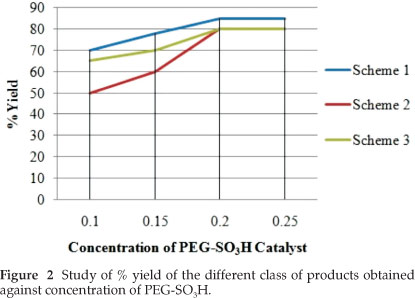
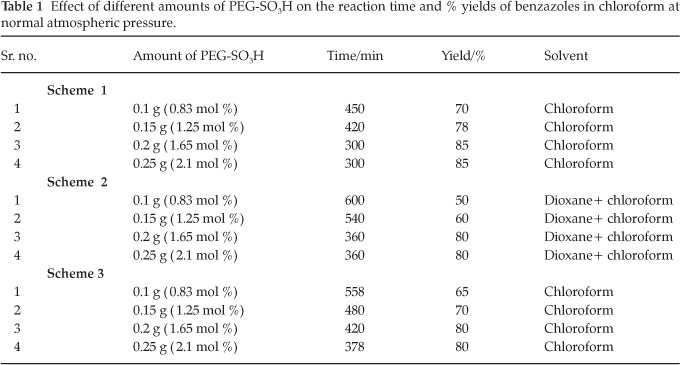
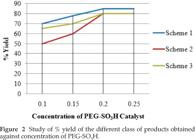
In order to determine the amount of catalyst required for carrying out these reactions, another study was carried out involving different concentrations of catalyst for individual sets of reactions, i.e. for substituted benzoxazole derivatives. The control study was carried out for representative reactions from each series. The first example involved the conversion of phenylurea into 2-aminobenzoxazole derivatives using different concentrations; the study was carried out as given in Table 1. The comparative study of required concentration and time for completion of reaction was studied (Fig. 2)
2.3. General Procedure for Synthesis of Benzoxazole Derivatives
2.3.1. General Procedure for Synthesis of Substituted Benzoxazole Derivatives starting from Substituted O-Nitro Phenols and Substituted Aldehydes (Scheme 1)
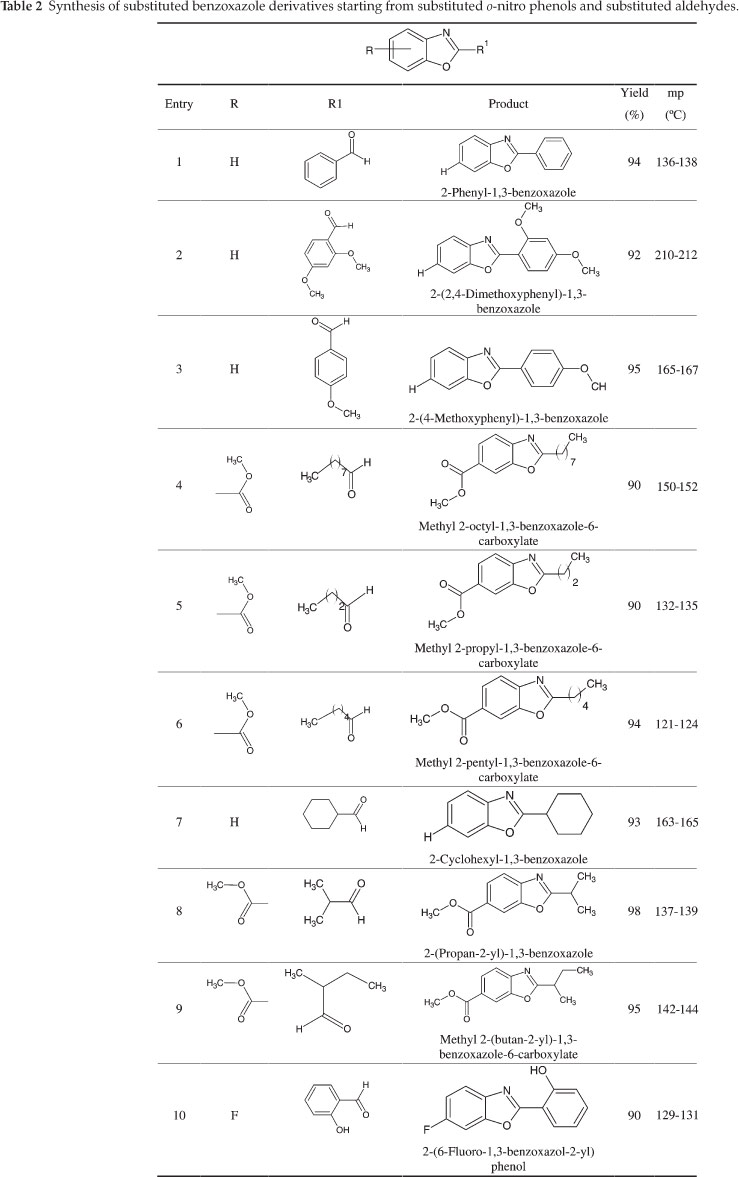
A solution of substituted o-nitro phenols (10 mmol) in a minimal quantity of chloroform was prepared and transferred into a three-neck round bottom flask. A spiral condenser, overhead stirrer and dropping funnel were attached to the reaction flask. PEG-SO3H (2.1 mmol) was added with stirring for 30 min subse-quently; substituted aldehydes (10 mmol) were added via a dropping funnel over a period of 30 min and further heated for 4-6 h at 50-60 °C. The reaction mixture was cooled to room tem-perature and the resulting solid mixture was washed with strong ammonia solution and filtered to remove catalyst. The solution was evaporated under vacuum (Scheme 1). The resulting products were recrystallized from rectified spirit to obtain substituted 2-aminobenzoxazole (Table 2).
2.3.1.1. 2-Phenyl-1,3-benzoxazole
It was synthesized by procedure as given in 2.3.1 from o-nitro phenol and benzaldehyde employing PEG-SO3H. TLC (1:1 CH2Cl2:hexane), Rf = 0.5.1J = 1.2, 7.1 Hz, 1H); 7.8 (d, 8.3 Hz, 1H); 7.5 (m, 3H); 4.0 (s, 3H). 13
2.3.1.2. 2-(2,4-Dimethoxyphenyl)-1,3-benzoxazole
It was synthesized by procedure as given in 2.3.1 from o-nitro phenol and dimethoxy benzaldehyde employing PEG-SO3H. TLC (1:1 CH2Cl2:hexane), Rf= 0.3.1J = 8.8 Hz, 1H); 8.07 (dd, J = 1.3, 7.1 Hz, 1H); 7.8 (d, J = 8.4 Hz, 1H); 6.66 (dd, J = 2.1,6.5 Hz, 1H); 6.63 (d, J = 2.1 Hz, 1H); 4.05 (s, 3H); 4.0 (s, 3H); 3.9 (s, 3H). 132-(4-Methoxyphenyl)-1,3-benzoxazole
It was synthesized by procedure as given in 2.3.1 from o-nitro phenol and para-methoxy benzaldehyde employing PEG-SO3H. TLC (1:1 CH2Cl2:hexane), Rf= 0.3; 1J = 8.4, 1.5 Hz); 7.76(1H, d, J = 8 Hz); 7.07 (2H, m); 3.99 (3H, s); 3.93 (3H, s). 13Methyl 2-octyl-1,3-benzoxazole-6-carboxylate
It was synthesized by procedure as given in 2.3.1 from o-nitro phenol methyl benzoate and Octanal employing PEG-SO3H. TLC (1:1 CH2Cl2:hexane), Rf= 0.4; 1J = 1.2 Hz, 1H); 8.05 (dd, J = 1.4 Hz, 7.0 Hz, 1H); 7.69 (d, J = 8.3 Hz, 1H); 4.0 (s, 3H); 2.95 (t, J = 7.6 Hz, 2H); 1.88 (q, J = 7.4 Hz, 2H), 1.28-1.46 (m, 10H); 0.87 (t, J = 6.7 Hz, 3H). 13Methyl 2-propyl-1,3-benzoxazole-6-carboxylate
It was synthesized by procedure as given in 2.3.1 from o-nitro phenol methyl benzoate and propanal employing PEG-SO3H.TLC (1:1 CH2Cl2:hexane), Rf= 0.4; 1J = 1.3 Hz, 1H), 8.05-8.02 (dd, J = 1.51,6.7 Hz, 1H), 7.69-7.67 (d, J = 8.2 Hz, 1H), 3.95 (s, 3H), 2.96-2.92 (t, J = 7.4 Hz, 2H), 1.96-1.91 (m, 2H), 1.08-1.04 (t, J = 7.42 Hz, 3H). 13
2.3.1.6. Methyl 2-pentyl-1,3-benzoxazole-6-carboxylate
It was synthesized by procedure as given in 2.3.1 from o-nitro phenol methyl benzoate and pentanal employing PEG-SO3H. TLC (1:1 CH2Cl2:hexane), Rf = 0.4; 1J = 0.9 Hz, 1H), 8.04-8.02 (dd, J = 1.5, 6.87 Hz, 1H), 7.69-7.67 (d, J = 8.3 Hz, 1H), 3.94 (s, 3H), 2.97-2.93 (t, J = 7.6 Hz, 2H), 1.94-1.86 (m, 2H), 1.47-1.35 (m, 4H), 0.93-0.89 (t, J = 7 Hz, 3H). 13+) Calculated: 247.2896, Found: 247.2900.
2.3.1.7. 2-Cyclohexyl-1,3-benzoxazole
It was synthesized by procedure as given in 2.3.1 from o-nitro phenol and cyclohexanal employing PEG-SO3H. TLC (1:1 CH2Cl2:hexane), Rf = 0.3.1J = 1 Hz, 1H); 8.04 (dd,J = 1 Hz, 7.1 Hz, 1H); 7.7 (d, J = 8.3 Hz, 1H); 3.96 (s, 3 H); 2.97 (m, 1 H); 2.18 (m, 2 H); 1.88 (m, 2 H); 1.72 (m, 3 H); 1.27 (m, 3H). 13+) Calculated: 201.2643, Found: 201.2710.
2.3.1.8. 2-(Propan-2-yl)-1,3-benzoxazole
It was synthesized by procedure as given in 2.3.1 from o-nitro phenol methyl benzoate and isopropanal employing PEG-SO3H.TLC (1:1 CH2Cl2:hexane), Rf = 0.5; 1J = 8.33 Hz, 1H), 7.71-7.69 (d, J = 8.31 Hz, 1H), 3.95 (s, 3H), 3.31-3.24 (m, 1H), 1.49-1.47 (d, J = 7.6 Hz, 6H). 13
2.3.1.9. Methyl 2-(butan-2-yl)-1,3-benzoxazole-6-carboxylate
It was synthesized by procedure as given in 2.3.1 from o-nitro phenol methyl benzoate and isobutanal employing PEG-SO3H. TLC (1:1 CH2Cl2:hexane), Rf = 0.4; 1J = 8 Hz); 7.69 (1H, d, J = 8 Hz); 3.94 (3H, s); 3.08 (1H, sextuplet, J = 6 Hz); 1.99-1.74 (2H, m); 1.44 (3H, d, J = 7 Hz); 0.96 (3H, t, J =7 Hz). 13+) Calculated: 233.2631, Found: 233.2733.
2.3.1.10. 2-(6-Fluoro-1,3-benzoxazol-2-yl)phenol
It was synthesized by procedure as given in 2.3.1 from meta fluro-3-nitro phenol and 2-hydroxy benzaldehyde employing PEG-SO3H. TLC (1:1 CH2Cl2:hexane), Rf = 0.5; 1J = 2.4 Hz, 5.6 Hz, 1H); 7.13-7.16 (m, 1H). 13
2.3.2.
General Procedure for Synthesis of Substituted Benzoxazole Derivatives starting from Substituted 2-Amino Phenols and Substituted Benzoic Acids (Scheme 2)
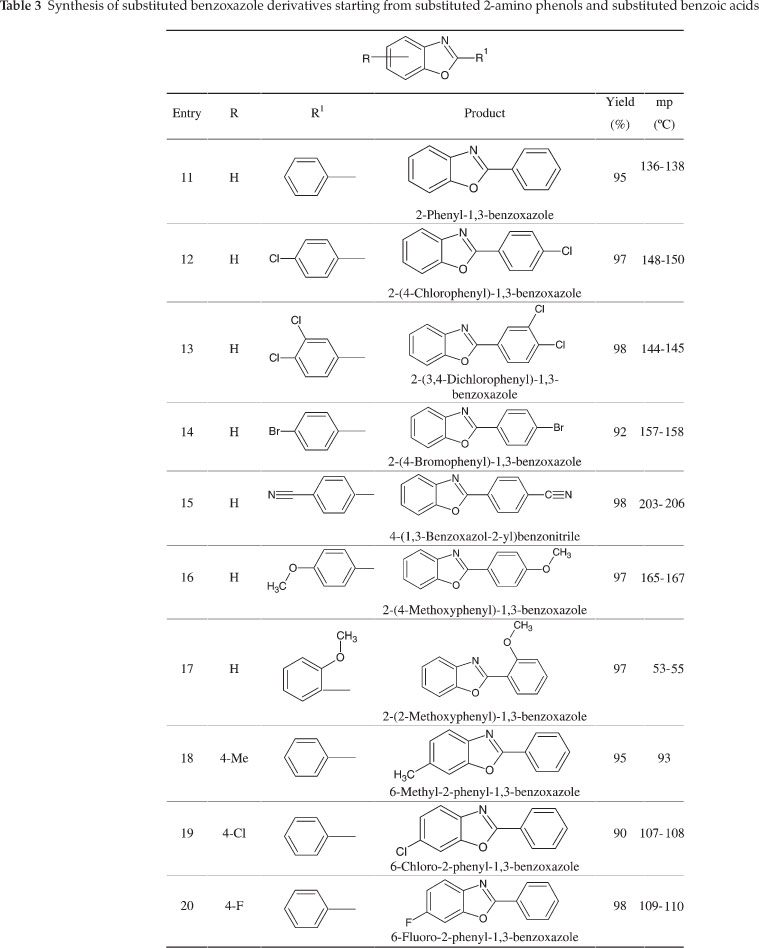
A solution of substituted 2-amino phenols (10 mmol) was prepared in mixture of dioxane:chloroform (1:1) arranged in a three neck flask, to it a solution of substituted benzoic acid (10 mmol) in chloroform was added drop wise over a period of 1 hour with constant stirring. To this mixture PEG-SO3H (2.1 mmol) was added and the reaction was carried out for 5 to 6 hours at 60-65 °C, progress of the reaction was monitored by TLC. After completion of reaction as determined by TLC, the reaction mixture was cooled to room temperature and the resulting solid was washed with strong ammonia solution and filtered to remove catalyst, then dried under vacuum (Scheme 2). The resulting products were recrystallized from rectified spirits to obtain substituted 2-aminobenzoxazole (Table 3).
2.3.2.11. 2-Phenyl-1,3-benzoxazole
It was synthesized by procedure as given in 2.3.2 from 2-amino phenol and benzoic acid employing PEG-SO3H. TLC (1:1 CH2Cl2:hexane), R = 0.5; 1J = 5.6 Hz, J = 2.1 Hz), 7.79-7.86 (m, 1H), 7.53-7.67 (m, 4H), 7.36-7.44 (m, 2H). 13
2.3.2.12. 2-(4-Chlorophenyl)-1,3-benzoxazole
It was synthesized by procedure as given in 2.3.2 from 2-amino phenol and para chloro benzoic acid employing PEG-SO3H. TLC (1:1 CH2Cl2:hexane), R = 0.4; 1J = 7.8 Hz), 7.77-7.84 (m, 1H), 7.57-7.65 (m, 1H), 7.52 (d, 2H, J = 7.8 Hz), 7.36-7.44 (m, 2H). 13+) Calculated: 229.6617, Found: 229.7001.
2.3.2.13. 2-(3,4-Dichlorophenyl)-1,3-benzoxazole
It was synthesized by procedure as given in 2.3.2 from 2-amino phenol and 3, 4-dichloro benzoic acid employing PEG-SO3H. TLC (1:1 CH2Cl2:hexane), Rf = 0.5; 1J = 1.8 Hz), 8.09 (dd, 1H, J = 8.2 Hz, J = 1.8 Hz), 7.77-7.83 (m, 1H), 7.58-7.65 (m, 2H), 7.38-7.45(m, 2H). 132-(4-Bromophenyl)-1,3-benzoxazole
It was synthesized by procedure as given in 2.3.2 from 2-amino phenol and 4-bromo benzoic acid employing PEG-SO3H. TLC (1:1 CH2Cl2:hexane), Rf = 0.5; 113+) Calculated: 274.1127, Found: 274.1221.
2.3.2.15. 4-(1,3-Benzoxazol-2-yl)benzonitrile
It was synthesized by procedure as given in 2.3.2 from 2-amino phenol and 4-cyano benzoic acid employing PEG-SO3H. TLC (1:1 CH2Cl2:hexane), Rf = 0.4; 1J = 8.5 Hz), 7.80-7.87 (m, 3H), 7.60-7.68 (m, 1H), 7.39-7.49 (m, 2H). 13
2.3.2.16. 2-(4-Methoxyphenyl)-1,3-benzoxazole
It was synthesized by procedure as given in 2.3.2 from 2-amino phenol and 4-methoxy benzoic acid employing PEG-SO3H. TLC (1:1 CH2Cl2:hexane), Rf = 0.4; 1J = 8.2 Hz), 7.75-7.80 (m, 1H), 7.56-7.61 (m, 1H), 7.31-7.40 (m, 2H), 7.06 (d, 2H, J = 8.2 Hz), 3.91 (d, 3H, J = 0.9 Hz). 13
2.3.2.17. 2-(2-Methoxyphenyl)-1,3-benzoxazole
It was synthesized by procedure as given in 2.3.2 from 2-amino phenol and 2-methoxy benzoic acid employing PEG-SO3H. TLC (1:1 CH2Cl2:hexane), Rf = 0.3; 1J = 7.7 Hz, J = 1.8 Hz), 7.83-7.90 (m, 1H), 7.60-7.66 (m, 1H), 7.52-7.58 (m, 1H), 7.35-7.42 (m, 2H), 7.11-7.17 (m, 2H), 4.06 (s, 3H). 13
2.3.2.18. 6-Methyl-2-phenyl-1,3-benzoxazole
It was synthesized by procedure as given in 2.3.2 from 4-methyl-2-amino phenol and benzoic acid employing PEG-SO3H. TLC (1:1 CH2Cl2:hexane), Rf = 0.3; 1J = 8.2 Hz), 7.51-7.58 (m, 3H), 7.40 (t, 1H, J = 0.6 Hz,), 7.19 (δ,1H, J = 8.0 Hz, J = 1.5 Hz, J = 0.6 Hz), 2.53 (s, 3H). 13+) Calculated: 209.2432, Found: 209.2400.
2.3.2.19. 6-Chloro-2-phenyl-1,3-benzoxazole
It was synthesized by procedure as given in 2.3.2 from 4-chloro-2-amino phenol and benzoic acid employing PEG-SO3H. TLC (1:1 CH2Cl2:hexane), Rf = 0.3; 1J = 8.5 Hz), 7.55 (d, 1H, J = 1.9 Hz), 7.45-7.57 (m, 3H), 7.30 (dd, 1H, J = 8.5 Hz, J = 1.9 Hz. 13
2.3.2.20. 6-Fluoro-2-phenyl-1,3-benzoxazole
It was synthesized by procedure as given in 2.3.2 from 4-fluro-2-amino phenol and benzoic acid employing PEG-SO3H. TLC (1:1 CH2Cl2:hexane), Rf = 0.3; 1J = 8.8 Hz, J = 4.9 Hz), 7.50-7.59 (m, 3H), 7.33 (dd, 1H, J = 8.0 Hz, J = 2.3 Hz), 7.13 (td, 1H, J = 8.8 Hz, J = 2.3 Hz). 13+) Calculated: 213.2071, Found: 213.2082.
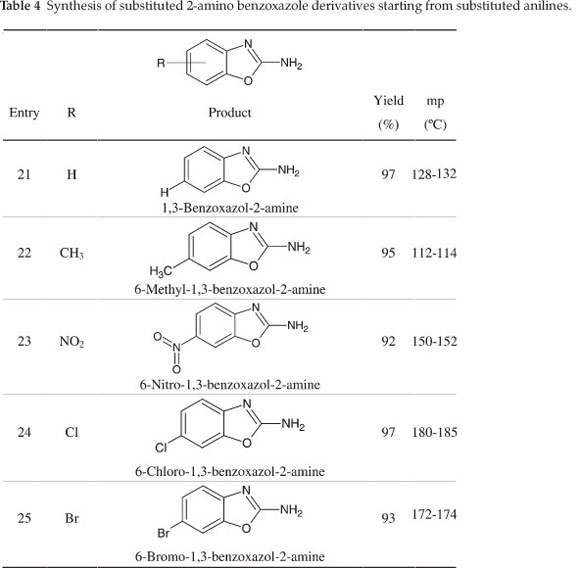
2.3.3. General Procedure for Synthesis of Substituted 2-Amino Benzoxazole Derivatives starting from Substituted Anilines (Scheme 3)

Synthesis of substituted benzoxazol-2-amine or substituted 2-aminobenzoxazoles was carried out in two steps. The first step involves the synthesis of substituted phenylurea from parent anilines followed by PEG-SO3H promoted cyclization. Substi-tuted aniline (10 mmol) was added to round bottom flask con-taining water. To it was added conc. HCl (10 mL), the mixture was warmed for about 10 min followed by addition of potassium cyanate (10 mmol) and was stirred for 1 hour. The solid was allowed to precipitate (at low temperature 0-5 °C) the precipitate so obtained was filtered and dried. A solution of substituted phenylurea (10 mmol) was prepared in chloroform, to it PEG-SO3H (2.1 mmol) was added. The reaction mixture was stirred for about 6 to 7 hours at 80-90 °C; progress and comple-tion of reaction was monitored by TLC method. After comple-tion of the reaction it was allowed to cool to room temperature. The catalyst was filtered out. Filtrate was made basic by addition of ammonia solution leading to precipitation of the product which was collected and further recrystallized from rectified spirits (Scheme 3, Table 4).
2.3.3.21.1,3-Benzoxazol-2-amine
Synthesis of 1,3-benzoxazol-2-amine was carried out in two steps. Aniline (10 mmol) was added to round bottom flask con-taining water. To it was added conc. HCl (10 mL), the mixture was warmed for about 10 min followed by addition of potassium cyanate (10 mmol) and was stirred for 1 hour. The solid was allowed to precipitate (at low temperature 0-5 °C) the precipitate was filtered and dried.
A solution of phenylurea (10 mmol) was prepared in chloro-form, to it PEG-SO3H (2.1 mmol) was added. The reaction mixture was stirred for about 6 to 7 hours at 80-90 °C, progress and completion of reaction was monitored by TLC method. After completion of the reaction it was allowed to cool to room temperature. The catalyst was filtered out. Filtrate was made basic by addition of ammonia solution leading to precipitation of the product which was collected and further recrystallized from rectified spirits. Yield: 97 %, mp: 128-132 °C, TLC (1:1; CH2Cl2:hexane), R = 0.5.
2.3.3.22. 6-Methyl-1,3-benzoxazol-2-amine
Synthesis of 6-methyl-1,3-benzoxazol-2-amine was carried out in two steps, 4-methyl aniline (10 mmol) was added to round bottom flask containing water. To it was added conc. HCl (10 mL), the mixture was warmed for about 10 min followed by addition of potassium cyanate (10 mmol) was stirred for 1 hour. The solid was allowed to precipitate (at low temperature 0-5 °C) the precipitated was filtered and dried.
A solution of tolylurea (10 mmol) was prepared in chloroform, to it PEG-SO3H (2.1 mmol) was added. The reaction mixture was stirred for about 6 to 7 hours at 80-90 °C, progress and comple-tion of reaction was monitored by TLC method. After comple-tion of the reaction it was allowed to cool to room temperature. The catalyst was filtered out. Filtrate was made basic by addition of ammonia solution leading to precipitation of the product which was collected and further recrystallized from rectified spirits. Yield: 95 %, mp: 112-114 °C, TLC (1:1; CH2Cl2:hexane), Rf = 0.5.
2.3.3.23. 6-Nitro-1,3-benzoxazol-2-amine
Synthesis of 6-nitro-1,3-benzoxazol-2-amine was carried out in two steps, para-nitro aniline (10 mmol) was added to round bottom flask containing water. To it was added conc. HCl (10 mL), the mixture was warmed for about 10 min followed by addition of potassium cyanate (10 mmol) was stirred for 1 hour. The solid was allowed to precipitate (at low temperature 0-5 °C) the precipitated was filtered and dried.
A solution of para-nitrophenyl urea (10 mmol) was prepared in chloroform, to it PEG-SO3H (2.1 mmol) was added. The reaction mixture was stirred for about 6 to 7 hours at 80-90 °C, progress and completion of reaction was monitored by TLC method. After completion of the reaction it was allowed to cool to room temperature. The catalyst was filtered out. Filtrate was made basic by addition of ammonia solution leading to precipitation of the product which was collected and further recrystallized from rectified spirits. Yield: 92 %, mp: 150-152 °C, TLC (1:1; CH2Cl2:hexane), Rf = 0.4.
2.3.3.24. 6-Chloro-1,3-benzoxazol-2-amine
Synthesis of 4-chloro-1,3-benzoxazol-2-amine was carried out in two steps, para-chloro aniline (10 mmol) was added to round bottom flask containing water. To it was added conc. HCl (10 mL), the mixture was warmed for about 10 min followed by addition of potassium cyanate (10 mmol) was stirred for 1 hour.
The solid was allowed to precipitate (at low temperature 0-5 °C) the precipitated was filtered and dried.
A solution of para-chlorophenyl urea (10 mmol) was prepared in chloroform, to it PEG-SO3H (2.1 mmol) was added. The reaction mixture was stirred for about 6 to 7 hours at 80-90 °C, progress and completion of reaction was monitored by TLC method. After completion of the reaction it was allowed to cool to room temperature. The catalyst was filtered out. Filtrate was made basic by addition of ammonia solution leading to precipitation of the product which was collected and further recrystallized from rectified spirits. Yield: 97 %, mp: 180-185 °C, TLC (1:1; CH2Cl2:hexane), Rf = 0.4.
2.3.3.25. 6-Bromo-l,3-benzoxazol-2-amine
Synthesis of 4-bromo-1,3-benzoxazol-2-amine was carried out in two steps, para-bromo aniline (10 mmol) was added to round bottom flask containing water. To it was added conc. HCl (10 mL), the mixture was warmed for about 10 min followed by addition of potassium cyanate (10 mmol) was stirred for 1 hour. The solid was allowed to precipitate (at low temperature 0-5 °C) the precipitate was filtered and dried.
A solution of para-bromophenyl urea (10 mmol) was prepared in chloroform, to it PEG-SO3H (2.1 mmol) was added. The reaction mixture was stirred for about 6 to 7 hours at 80-90 °C, progress and completion of reaction was monitored by TLC method. After completion of the reaction it was allowed to cool to room temperature. The catalyst was filtered out. Filtrate was made basic by addition of ammonia solution leading to precipi-tation of the product which was collected and further recrystallized from rectified spirit. Yield: 93 %, mp: 172-174 °C, TLC (1:1; CH2Cl2:hexane), Rf = 0.3.
3. Results and Discussion
The present article describes a highly economical, facile and clean method for synthesis of chemically and pharmaceutically important benzoxazole derivatives by employing poly (ethylene glycol) supported sulphonic acid (PEG-SO3H) as a reusable catalyst. PEG acts as support for sulphonic acid catalyst as well as solvent medium. A study presented by Zare et. al. was taken in consideration to determine and optimize a optimal catalyst system for the synthesis of 2-aminobenzoxazole. Different molar concentrations of catalyst, duration of reaction, and use of sol-vent systems were used as presented in Table 1. It was observed that synthesis of 2-aminobenzoxazole was obtained in highest yield of 97 % at about 80-90 °C in presence of a solvent system consisting of chloroform, instead of 78 % when the reaction was carried out in presence of PEG alone. The concentration of PEG-SO3H needed was studied keeping solvent and tempera-ture constant; it was found that use of ~2.1 mmol of catalyst gave optimum results. As the catalyst was recovered after each reac-tion, the ability to recycle the catalyst was investigated. After 3-4 cycles of use the % yield was hampered also the consistence of PEG-SO3H has changed. However, it was found that up to 3 cycles the catalytic activity provided good yield of reaction product. This encouraged the use of PEG-SO3H in the synthesis of 2-amino derivatives of benzoxazole. A variety of substituent and methods were tested and two of these methods were opti-mized for their synthetic applicability. First, the syntheses use 2-nitro phenols with aldehydes and second the synthesis involv-ing 2-nitro phenols and carboxylic acids.
The first method involves the synthesis of benzoxazoles from substituted 2-nitro phenols and allyl or aryl aldehydes (Scheme 1). This method was optimized by use of chloroform as solvent medium along with PEG-SO3H, 4-6 hours at 50 to 60 °C for the synthesis of 2-aminobenzoxazole derivatives. The prod-ucts were obtained in a range of 90 to 96 % which is satisfactory, also for production on large scale (Table 2). The products like allyl derivatives found application in the coating industry and production of olefins. The second method involved the synthesis of benzoxazoles from 2-nitro phenols and carboxylic acids (Scheme 2). This method was optimized by use of a solvent sys-tem consisting of dioxane: chloroform (1:1) at 60-65 °C for about 5-6 hours. The % yield was found to be satisfactory in the range 90 to 97 % (Table 3).
With reference to Scheme 3, all compounds (Table 4) are known and widely used for scaffold synthesis. These com-pounds were synthesized in excellent yields as compared to other methods; however our method involves two steps. In the first step phenyl urea of respective anilines was synthesized followed by their cyclization employing PEG-SO3H as a mild catalyst. Their physico-chemical properties are similar than that of the standard compounds which are commercially available.
All the synthesized compounds were analyzed by 113Table 2, entry 10), compound 2.3.2.11 (Table 3, entries 1-20) and compound 2.3.3.21 (Table 4, entries 21-25) are compounds prepared by different methods hence their physico-chemical properties were studied and it was found to be identical to authentic samples prepared by different methods. This provided us with a new synthetic route to a variety of com-pounds and with the option of different substituents.
In summary, we have developed an more eco-friendly method to synthesize benzoxazole derivatives in excellent yields with high purity using a reusable PEG-SO3H catalyst very economically.
Acknowledgements
RVC is thankful to the Council of Scientific and industrial Research (CSIR) New Delhi, India, for providing financial support in form of SRF: 09/128/0080/2011/EMR-I. PBK acknowl-edges financial support by the University Grants Commission (UGC) New Delhi, India, in the form of Major Research Project 41-744/2012 (SR).
References
- 1 M. Yoshida, I. Hayakawa and N. Hayashi, Bioorg. Med. Chem., 2005,15, 3328-3332.
- 2 T. Tian and L. Ling, J. Chinese. Chem. Soc, 2007, 54,1369-1373.
- 3 P. Vicini, A. Geronikaki and M. Incerti, Bioorg. Med. Chem., 2008, 16, 3714-3724.
- 4 D. Murugesan, S. Palaniappan and Y. Perumal, Biomed. Pharmacotherp., 2009, 63, 11-18.
- 5 P. Vicini, A. Geronikaki and M. Incerti, Bioorg. Med. Chem., 2003, 11, 4709-4789.
- 6 K.Jain,A.ShahandJ.Bariwal,Bioorg.Med. Chem.,2007,15,1181-1205.
- 7 K. Walczynski, R. Guryn and H. Timmerman, Il Farmaco, 1999, 54, 684-694.
- 8 K. Tsurumi, Y. Hiramatsu, M. Hayashi and A. Yamaguchi, Arznei-mittelforschung., 1973, 70, 261-283.
- 9 N. Siddiqui, A. Rana and S. Khan, Bioorg. Med. Chem. Lett, 2007,17, 4178-4182.
- 10 I. Yildiz-Oren, I. Yalcin and E. Aki-Saner, Eur. J. Med. Chem., 2004, 39, 291-298.
- 11 R. McCracken and W. Stillwell, Int. J. Parasitology, 1991, 21, 99-104.
- 12 X. Wang, Z. Li, Y. Da, J. Chen, and T. Wei, Syn. Comm., 2007, 29, 4153-4161.
- 13 C.J. O'Donnell, B.N. Rogers, B.S. Bronk, D.K. Bryce, J.W. Coe, K. K. Cook, A.J. Duplantier, E. Evrard, M. Hajos, W.E. Hoffmann, R.S. Hurst, N. Maklad, R.J. Mather, S. McLean, F.M. Nedza, B.T. ONeill, L. Peng, W. Qian, M.M. Rottas, S.B. Sands, A.W. Scmidt, A.V. Shrikhande, D.K. Spracklin, D.F. Wong, A. Zhang and L. Zhang, J. Med. Chem., 2010, 53,1222.
- 14 M. Cheung, P. Harris, M. Hasegawa, S. Ida, K. Kano and N. Nishigaki, PCT WO 02/44156A2, 2002.
- 15 D. Clark, P. Eastwood, N. Harris, C. McCarthy, A. Morley and S. Pickett, PCT WO 00/49005, 2000.
- 16 P. Muller, R. Huranus, R. Maier, M. Mark, B. Eisele, R.M. Budzinski, L. Thomas and G. Hallermayer, US Patent US 5919807, 1999.
- 17 Y. Sato, M. Yamada, K. Kobayashi, K. Iwamatsu, F. Konno and K. Shudo, EP 806419 A1, 1997.
- 18 D.L.N.G. Surleraux, S.M.H. Vendeville, W.G. Verschueren, M. P. T. M. G. De Bethune, H.A. De Kock and A. Tahri, WO 02/092595A1, 2002.
- 19 A. Laibekman, H.M. Jantzen, L. Conley, L. Fretto and R. Scarborough, US 6667306B1, 2003.
- 20 C.D.Cox, M.J. Breslin, D.B. Whitman, J.D. Schreier, G.B. McGaughey, M.J. Bogusky, A.J. Roecker, S.P. Mercer, R.A. Bednar, W. Lemaire, J.G. Bruno, D.R. Reiss, C.M. Harrell, K.L. Murphy, S.L. Garson, S.M. Doran, T. Prueksaritanont, W.B. Anderson, C. Tang, S. Roller, T.D. Cabalu, D. Cui, G.D. Hartman, S.D. Young, K.S. Koblan, C.J. Winrow, J.J. Renger and P.J. Coleman, J. Med. Chem. 2010, 53, 5320.
- 21 M. Seefelder and D. Leuchs, GB 913910, 1962.
- 22 L. Katz and M. Cohen, J. Org. Chem. 1954,19, 758.
- 23 M. Yamato, Y. Takeuchi, K. Hattori and K. Hashigaki, Chem. Pharm. Bull. 1984, 32, 3053.
- 24 J. Kroeber, T. Tmar, and J. Tompa, Synthesis 1994, 1124.
- 25 H. Ogura, S. Mineo and K. Nakagawa, Chem. Pharm. Bull. 1981, 29, 1518.
- 26 H.S. Chang, G.H. Yon and Y.H. Kim, Chem. Lett. 1986, 1291.
- 27 N. Wishart, A. Rudolph and K. Ritter, US Patent US2003/0109714 A1.
- 28 Z. Tian, W.S.J. Plata and A. Bhatia, Tetrahedron Lett. 2005, 8341.
- 29 U. Heinelt, D. Shultheis, S. Jeager, M. Lindenmaier, A. Pollex and H. Beckman, Tetrahedron 2004, 60, 9883.
- 30 L.S. Wittenbrook, J. Heterocycl. Chem. 1975,12, 37.
- 31 A. El-Faham, M. Chebbo, M. Abdul-Ghani and G. Younes, J. Hetero-cycl. Chem. 2006, 43,599.
- 32 J. Sam and J.N. Plampin, J. Pharm. Sci., 1964, 53,538.
- 33 W. Doeller Ber. Dtsch. Chem. Ges., 1939, 72,2148.
- 34. T. Takahashi and A. Koshiro, Chem. Pharm. Bull, 1959, 7, 720.
- 35 V.D. Patil and L.B. Townsend, J. Heterocycl. Chem, 1971, 8,503.
- 36 F.E. King and R.M. Acheson, J. Chem. Soc., 1949, 1396.
- 37 H. Wamhoff and C. Materne, Justus Liebigs Ann. Chem., 1973, 573.
- 38 W. Ried and E. Schmidt, Justus Liebigs Ann. Chem., 1964, 676,114.
- 39 J. Sam and S.B. Advani, J. Heterocycl. Chem, 1967, 4,141.
- 40 H. Zinner and K. Niendorf, Chem. Ber, 1956, 89,1012.
- 41 G. Holan, E.L. Samuel, B.C. Ennis and R.W. Hinde, J. Chem. Soc. C, 1967, 20.
- 42 A. Zare, A. Hasaninejad, E. Roastami, A.R. Moosavi-zare and C. Trans, Chem. Chem. Eng., 2010,17, 24-30.
- 43 M. Kidwai, A. Jahan and D. Bhatnagar, J. Chem. Sci., July 2010, 122, 607-612.
- 44 A. Rao, A. Chimirri, S. Ferro, A. Maria Monforte and P. Monforte, ARKIVOC 5, 2004, 147-155.
- 45 I. Mohammadpoor-Baltorka, M. Moghadama, S. Tangestaninejada, V Mirkhania, M.A. Zolfigolb and S. Hojatia, J. Iran. Chem. Soc., October 2008, 5, S65-S70.
 Correspondence:
E-mail:
Revised 31 May 2013
Accepted 19 August 2013