A novel coumarin Schiff-base fluorescent probe for Mg2+
Abstract
A novel fluorescent probe for Mg2+ based on coumarin Schiff-base was synthesized and characterized. The sensor displayed high selectivity toward Mg2+ in acetonitrile, and shows 1:1 complex formation with Mg2+ in acetonitrile.
Coumarin; Schiff-base; fluorescent probe; magnesium ion
1. Introduction
The design and synthesis of fluorescent probes with selectivity and sensitivity is an active field of supramolecular chemistry for biological as well as analytical and environmental problems. Mg2+ is one of the most abundant divalent ions in the cell, and it plays a critical role in many biological activities, such as cell proliferation1,2, cell death3456,7 To date, several fluorescence-based probes for Mg2+ have been developed; however, most of them have shortcomings in practical application, such as difficult synthesis, insufficient selectivity or sensitivity, or interference problems from other metal ions.8,9 Therefore, development of highly sensitive and selective fluorescent probes is necessary.
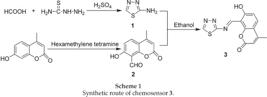
Coumarin and its derivatives have been widely used as desirable fluorophore and binding moiety. However, there are few reports about the derivatives of coumarin as fluorescent sensors for Mg210-12 In this paper, a highly sensitive and selective fluorescent chemosensor 3 for Mg2Scheme 1), which displays remarkable fluorometric enhancement upon the addition of Mg2+.
2. Experimental
All chemicals were purchased from commercial suppliers and used without further purification. The solvents purified with standard methods. 113
Synthesis of 8-((1,3,4-Thiadiazol-2-ylimino)methyl)-7-hydroxy-4- methyl-2H-chromen-2-one (3)
1,3,4-Thiadiazol-2-amine (1) was synthesized according to literature.13(2) was synthesized according to literature.14
Compound 1 (2.45 mmol, 0.500 g) was dissolved in ethanol (20 mL), and compound 2 (2.45 mmol, 0.247 g) was added to the solution. The reaction mixture was refluxed for 8 h under N2 atmosphere, cooled to room temperature. The pale yellow precipitate was filtered and washed with cold ethanol. The crude product was recrystallized from ethanol to give 3 (90 %) as yellow solid; m.p. 226-228 °C; δH (400 MHz, CDCl3): 2.43(3H, s), 6.21(1H, s), 6.91(1H, d, J 9.2 Hz,), 7.73(1H, d, J 8.8 Hz), 10.62(1H, s),12.22(1H, s) ppm; δC (100 MHz, CDCl3): 18.95, 108.66, 111.96, 112.06, 114.27, 132.88, 152.63, 156.14, 159.19, 165.25,193.40 ppm; m/z: 286.1 [M-H]+ (Found: C, 54.40; H, 3.11; N, 14.78; S, 11.10 %. Calc. for C13H9N3O3S(287.29): C, 54.35; H, 3.16; N, 14.63; S 11.16 %).
3. Results and Discussion
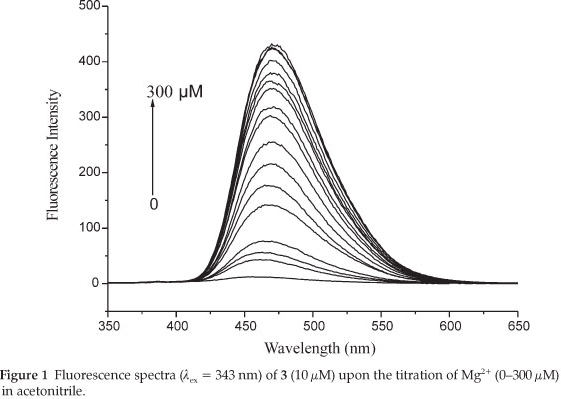
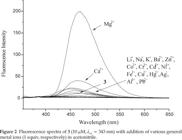
As shown in Fig. 1, the free ligand 3 (10 ^M) alone had a weak fluorescence intensity at 456 nm when it was excited at 343 nm, due to isomerization of the C=N double bond and effect of intramolecular charge transfer (ICT) in Schiff base. Compound with an unbridged C=N structure is often nonfluorescent due to the C=N isomerization, but it may be inhibited by complexation with metal ions.152µM) into the solution of 3 (10µM the fluorescence intensity was increased, and λem red-shifted to 470 nm. At a Mg2µM, the fluorescence intensity reached a maximum and showed a 33.3-fold enhancement, which suggested that 3 may serve as a 'turn-on' sensor for Mg2
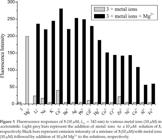
The selectivity of 3 (10 /M) to various complex at 470 nm decreased, but it still had strong fluorescence intensity. The fluorescence intensity increased with the addition of Li+,Na+,K+,Ca22222333 via energy or electron transfer163 showed a high selectivity for Mg2+ in the presence of these coexistent metal ions in acetonitrile.
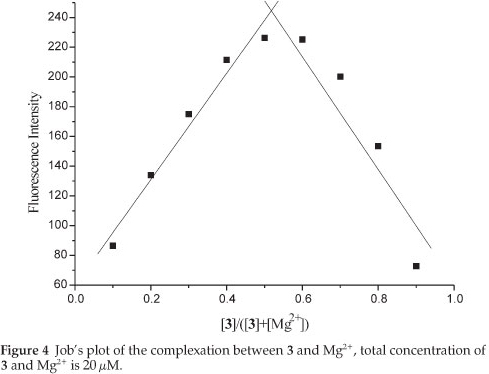
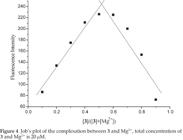
To determine the stoichiometry of the 3/Mg22+ and 3 at 20 and changing the molar ratio of Mg2M; XM=[Mg223 in the absence (F0) and presence (F) of Mg2+ ion was determined, respectively. A plot of (F-F0) versus XM shows that the value goes through a maximum at a molar fraction of about 0.5, indicating a 1:1 stoichiometry complex formation exactly (Fig. 4).
4. Conclusion
A novel coumarin Schiff-base fluorescent probe 3 for Mg2+ has been designed and synthesized. It displayed high selectivity and sensitivity for Mg2+ over the other metal ions. The chemosensor 3 shows 1:1 complex formation with Mg2
References
- 1 F.I. Wolf and A. Cittadini, Front. Biosci., 1999, 4, 607-617.
- 2 H. Rubin, Bioessays, 2005, 27, 311-320.
- 3 R. Eskes, B. Antonsson, A. Osen Sand, R. Montessuit, C. Richter, R. Sadoul, G. Mazzei, A. Nichols and J.C. Martinou, J. Cell Biol., 1998, 143, 217-224.
- 4 H.C. Politi and R.R. Preston, Neuroreport, 2003, 14, 659-668.
- 5 T. Kubota, K. Tokumo, J. Nakagawa, Y. Kitamura, H. Ogawa, Y. Suzuki, K. Suzuki and K. Oka, Biochem. Bioph. Res. Co., 2003, 303, 332-336.
- 6 M.J.S. Nadler, M.C. Hermosura, K. Inabe, A. Perraud, Q.Q. Zhu, A.J. Stokes, T. Kurosaki, J.P. Kinet, R. Penner, A.M. Scharenberg and A. Fleig, Nature, 2001, 411, 590-595.
- 7 C. Schmitz, A.L. Perraud, C.O. Johnson, K. Inabe, M.K. Smith, R. Penner, T. Kurosaki, A. Fleig and A.M. Scharenberg, Cell, 2003, 114, 191-200.
- 8 J. Pesco, J. Salmon, J. Vigo and P. Viallet, Anal. Biochem., 2001, 290, 221-231.
- 9 L. Prodi, F. Bolletta, M. Montalti and N. Zaccheroni, Tetrahedron Lett., 1998, 39, 5451-5454.
- 10 D. Ray and P.K. Bharadwaj, Inorg. Chem., 2008, 47, 2252-2254.
- 11 Y. Suzuki, H. Komatsu, T. Ikeda, N. Saito, S. Araki, D. Citterio, H. Hisamoto, Y. Kitamura, T. Kubota, J. Nakagawa, K. Oka and K. Suzuki, Anal. Chem., 2002, 74, 1423-1428.
- 12 E. Brunet, M.T. Alonso, O. Juanes, R. Sedano and J.C. Rodriguez-Ubis, Tetrahedron Lett., 1997, 38, 4459-4462.
- 13 P. Kaur and D. Sareen, Dyes. Pigments, 2011, 88, 296-300.
- 14 A. Kulkarni, S.A. Patil and P.S. Badami, Eur. J. Med. Chem. , 2009, 44, 2904-2912.
- 15 J.S. Wu, W.M. Liu, X.Q. Zhuang, F. Wang, P.F. Wang, S.L. Tao, X.H. Zhang, S.K. Wu and S.T. Lee, Org. Lett, 2007, 9, 33-36.
- 16 A.P.D. Silva, H.Q.N. Gunaratne, T. Gunnlaugsson, A.J.M. Huxley, C.P. McCoy, J.T. Rademacher and T.E. Rice, Chem. Rev. , 1997, 97, 1515-1566.
Accepted 7 November 2012