Oxyhalogen-Sulfur Chemistry: Kinetics and Mechanism of Oxidation of N-acetylthiourea by Aqueous Bromate and Acidified Bromate
Abstract
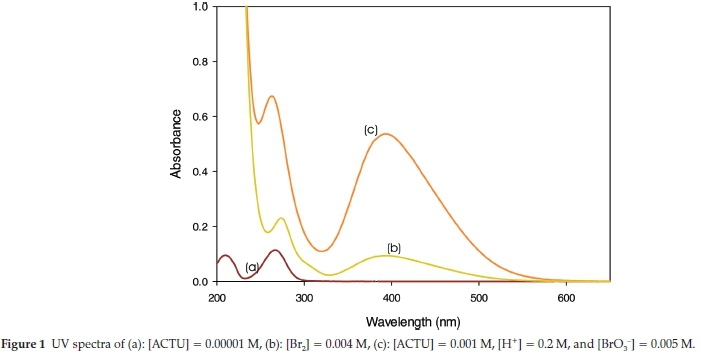
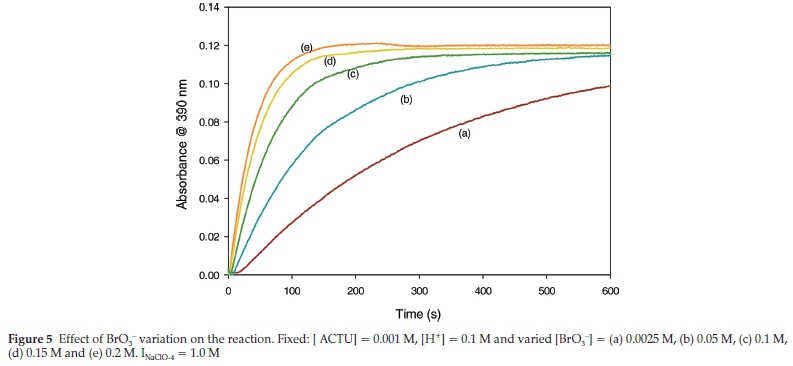
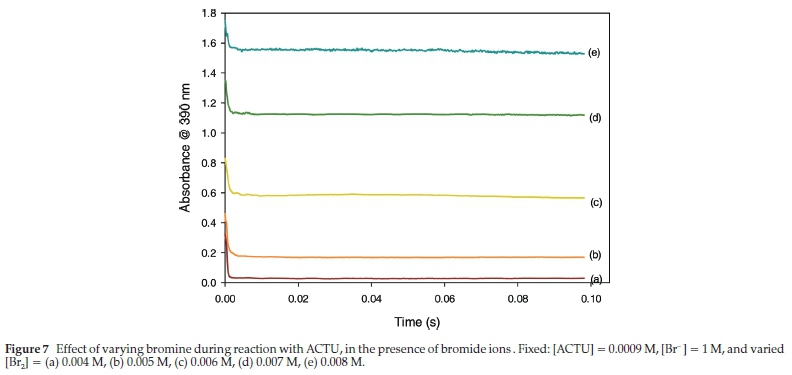
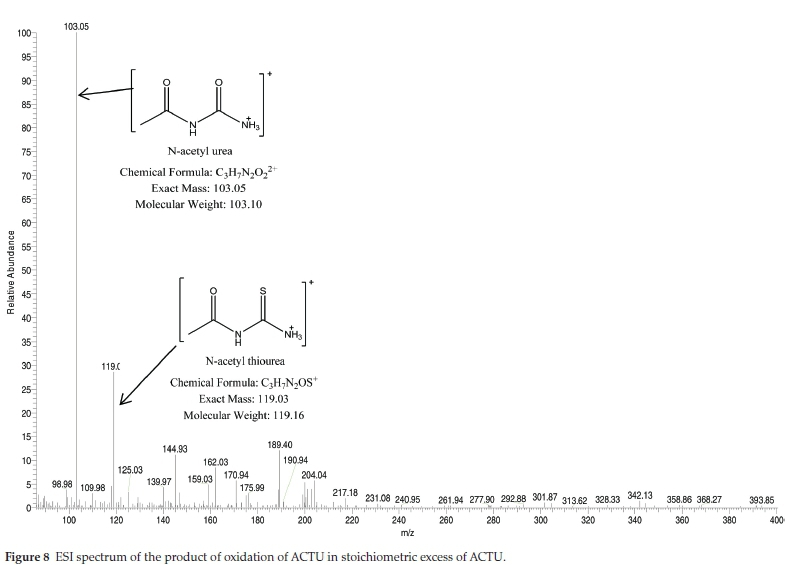
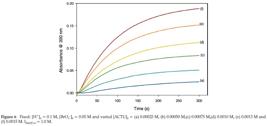
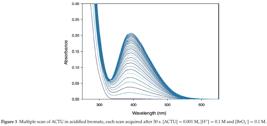
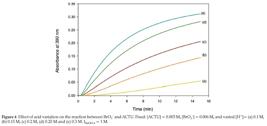
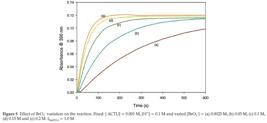
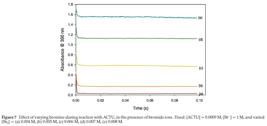
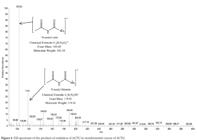
The oxidation of N-acetylthiourea (ACTU) by acidic bromate has been studied by observing formation of bromine in excess bromate conditions. The reaction displays an induction period before formation of bromine. The stoichiometry of the reaction was determined to be 4:3:4BrO3- + 3(CH3CO)NH(NH2)C=S + 3H2O ―> 4Br- + 3(CH3CO)NH(NH2)C=O + 3SO42- + 6H+ (A) witha complete desulfurization of ACTU to its urea analogue. In excess bromate conditions the stoichiometry was 8:5: 8BrO3- + 5(CH3CO)NH(NH2)C=S + H2O ―> 4Br2 + 5(CH3CO)NH(NH2)C=O + 5SO42- + 2H+ (B). Bromine is derived from an extraneous reaction in which bromide from stoichiometry (A) reacts with excess acidic bromate. The oxidation of ACTU by aqueous bromine gave stoichiometry (C):4Br2(aq) + (CH3CO)NH(NH2)C=S + 5H2O ―> 8Br- + (CH3CO)NH(NH2)C=O + SO42- + 10H+. Reaction (C) is much faster than reactions (A) and (B), with a lower limit bimolecular rate constant of 2.1 X10⁵ M-1 s-1 such that appearance of bromine signals complete consumption of ACTU. We were unable to trap any intermediate sulfur oxo-acids of ACTU on its oxidation pathway to N-acetylurea. As opposed to other substituted thioureas, none of its intermediates were stable enough to be isolated and detected.
Kinetics; mechanisms; oxyhalogen chemistry; s-oxygenation; bioactivation
 Thumbnail
 Thumbnail
 Thumbnail
 Thumbnail
 Thumbnail
 Thumbnail
 Thumbnail